How Much to Sell a Business for and How to Price It Right
Learn how much to sell a business for with SDE and EBITDA multiples, adjustments, and deal tips to set a defensible price and maximize proceeds.
September 21, 2026
By Remi Taffin · September 23, 2026
Recurring revenue is predictable income expected from active customer contracts over a future period. In a trades business, that might be the maintenance fee an HVAC customer pays each month or the amount a commercial property pays under an ongoing plumbing agreement.
A Tuesday morning tells you whether this idea is real in your business. Your service manager isn’t spending the whole morning chasing unknown demand. Instead, they’re checking which customers are due for maintenance, filling next week’s route, and estimating whether next month will resemble this month. That visibility gives you something a one-off emergency call can’t: a reasonable view of future work and income.
Recurring revenue starts with a customer relationship that continues under an active agreement. The customer has accepted a defined service, payment schedule, or access arrangement, and the business expects that income to repeat under normal conditions.
An HVAC maintenance plan fits. So does a plumbing service agreement, a landscaping retainer, or a filter replacement program. The trade doesn’t matter as much as the commitment. A signed agreement creates a clearer expectation than a customer who happens to call every spring.
Compare that with a roof replacement. The project may be profitable, but the customer usually pays for a defined job and then leaves. You can build a strong referral relationship afterward, but the original project isn’t recurring revenue just because the customer might hire you again someday.
Practical rule: Count the commitment first, then count the money. A predictable contract matters more than an optimistic guess about future purchases.
The reason owners and buyers care about this isn’t only the size of the revenue. Predictability makes planning easier. You can schedule technicians, purchase materials, plan hiring, and judge whether the company can support debt or an ownership transition with better information.
A useful overview of the mechanics is Suby’s revenue model guide, particularly if you want to compare subscriptions, retainers, and other repeating structures. For an owner preparing for a sale, the distinction between recurring and reoccurring revenue is just as important. Follow-on work may repeat, but it doesn’t necessarily carry the same contractual certainty.
That distinction will matter throughout your records. True contract-based recurring revenue is committed under terms. Repeat revenue is behavior you hope will continue. Both can be valuable, but they shouldn’t be presented as identical when you assess financing, business value, or exit readiness.
An HVAC owner with 200 maintenance customers paying $149 each month has a predictable base to measure. MRR means monthly recurring revenue, the contracted income expressed for one month. ARR means annual recurring revenue, usually calculated by multiplying MRR by 12, as explained in Stripe’s ARR guide for SaaS businesses.
The calculation is:
For a full walkthrough of the annualization math, see this guide to how to calculate annual recurring revenue. Creem’s explanation of annual recurring revenue also explains annual recurring revenue in plain language.
The total moves as the customer base changes. New contracts add recurring revenue. Upgrades, added services, or extra locations create expansion MRR. Downgrades create contraction MRR, while cancellations create churn. Customer count can remain stable while revenue falls if larger accounts leave and smaller ones replace them.
| Metric | What It Measures | Trades Example |
|---|---|---|
| Expansion MRR | New monthly recurring income from existing customers | A maintenance customer adds another property or service tier |
| Contraction MRR | Monthly recurring income lost through downgrades | A commercial client reduces the number of covered sites |
| Contracted recurring revenue | Income committed under active agreement terms | A commercial maintenance contract includes defined renewal and payment terms |
| Contractual minimum | The least amount the customer must pay under the agreement | A client commits to a minimum service level even when usage varies |
An HVAC agreement priced at $1,800 per site per year translates to $150 MRR per site when the annual commitment is divided by 12. The customer may pay once a year. The monthly figure makes contracts with different billing schedules easier to compare.
A spreadsheet can label repeat calls as recurring, but the label does not make them contracted. Track retention, churn, and customer lifetime value alongside MRR and ARR. Those measures show whether the revenue base holds together, rather than only how large it is. MRR and ARR mean something only when the contracts are enforceable and customers renew. This distinction also matters in an exit review, because repeat-revenue companies can mistake familiar customer behavior for durable contracted income and overlook a strategic blind spot that affects how buyers assess future value.
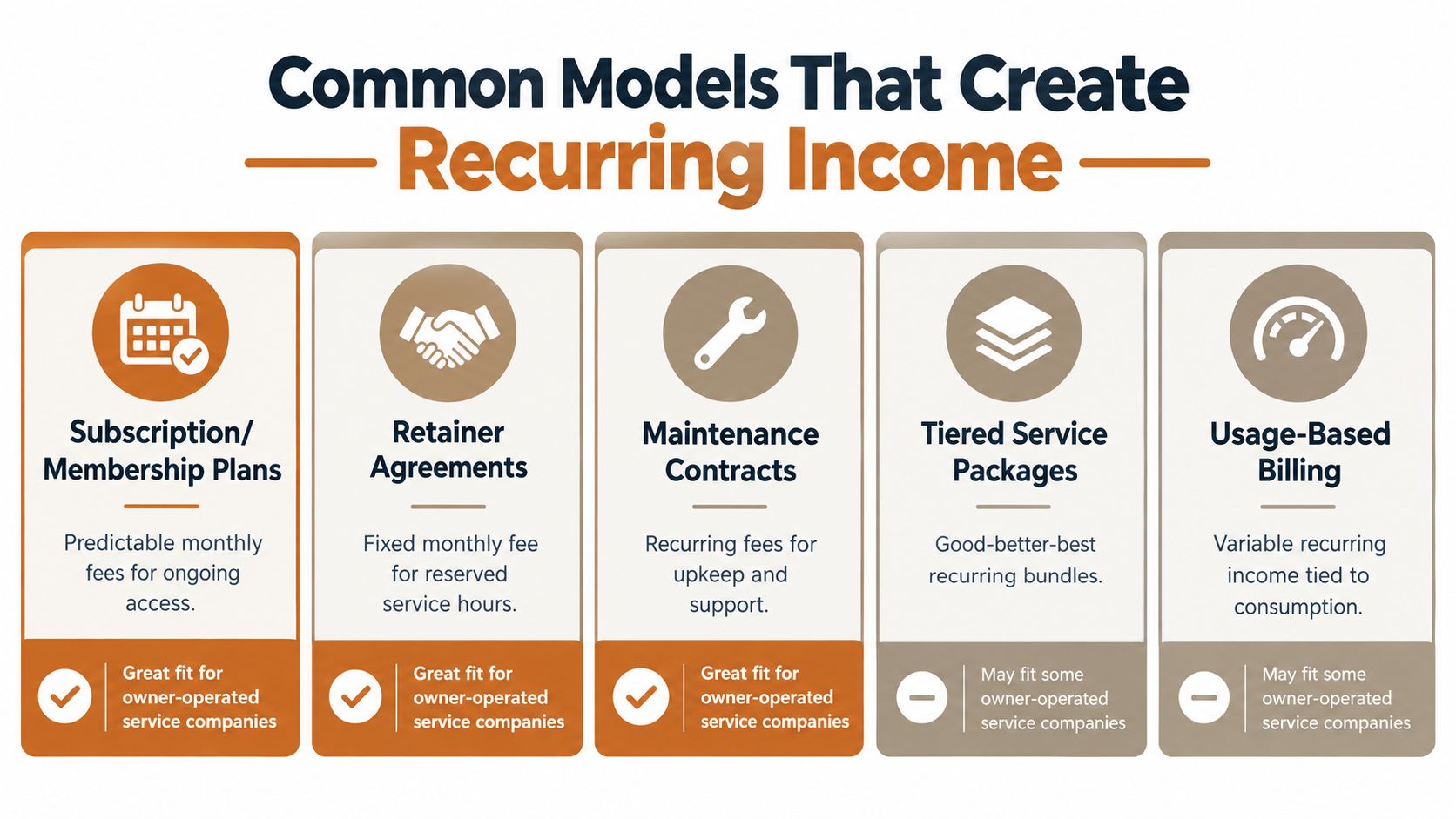
Owner-operated companies use several structures to create repeating income. They differ in what the customer receives, how firmly the work is committed, and how clearly the arrangement appears in a buyer’s diligence file.
A subscription or membership plan is usually the cleanest model. An HVAC or plumbing club might charge a monthly or annual fee for priority response, scheduled inspections, or included maintenance. The customer pays for continued access or service rather than waiting until something breaks.
A service contract works similarly but often centers on a defined asset or site. Commercial clients may sign annual maintenance agreements for rooftop units, drainage systems, irrigation, or facility equipment. A multi-year agreement with a property manager can provide stronger visibility than a series of informal purchase orders, though the exact terms still need review.
Retainers reserve capacity. A commercial lawn-care provider may receive a fixed monthly fee to keep a crew available for agreed services. Facility-service companies can use the same structure when customers value guaranteed response time or a defined amount of ongoing support.
Consumable replenishment combines products with a schedule. Examples include water treatment, filter delivery, chemical dosing, and related service visits. The recurring element is strongest when the customer has agreed to scheduled orders or a continuing program, rather than placing another order whenever supplies run low.
Usage-based billing appears more often in software, equipment leasing, and managed systems. The customer pays repeatedly, but the amount changes with consumption. That can still be recurring income, although it requires more careful forecasting than a fixed fee.
| Model | Customer Pays For | Contract Strength |
|---|---|---|
| Subscription or membership | Ongoing access, priority, or included service | Usually clear when written terms apply |
| Maintenance contract | Planned upkeep for an asset or site | Strong when scope and renewal terms are defined |
| Retainer | Reserved capacity or agreed availability | Strong if hours, response, and cancellation terms are documented |
| Consumable replenishment | Scheduled products and related service | Strong when orders are contractually scheduled |
| Usage-based billing | Ongoing access tied to consumption | Recurring, but less predictable in amount |
A one-time project belongs in a different bucket. So does a customer who has purchased from you several times without signing an agreement. Repeat business can be excellent business, but it isn’t automatically recurring revenue. That difference becomes important when someone evaluates how much of your income is committed.
An HVAC company might sell an annual maintenance plan that includes scheduled visits and defined service benefits. The company can place those customers into the route plan, monitor upcoming renewals, and see which accounts are active. The revenue may arrive in one payment or across several invoices, but the agreement creates the recurring relationship.
A plumbing firm may offer a water-heater replacement and service program to commercial sites. Customers pay quarterly under a multi-year arrangement, and the firm manages inspections, planned replacements, and service obligations. The contract’s value comes from the continuing program, not merely from the next invoice.
Landscaping shows another variation. A commercial customer signs a seasonal agreement that renews each spring, covering mowing, planting, irrigation checks, or site cleanup. The income may be seasonal rather than evenly distributed across every month, so the owner needs to record the renewal pattern accurately instead of forcing it into a flat monthly picture.
Roofing is a useful contrast. A customer may call the same roofer for repairs after several years, but each job is generally a separate purchase unless the customer has signed an ongoing inspection or maintenance agreement. A history of repeat calls demonstrates trust and commercial opportunity. It doesn’t, by itself, create contracted recurring revenue.
| Trade | Typical Recurring Setup | Billing Cadence | Renewal Trigger |
|---|---|---|---|
| HVAC | Maintenance plan covering scheduled inspections and service benefits | Monthly, annual, or per agreement | Plan renewal and continued service need |
| Plumbing | Water-heater service or replacement program | Quarterly or according to contract | Asset condition, service schedule, or contract date |
| Landscaping | Seasonal grounds-care agreement | Seasonal or scheduled throughout the agreement | Spring renewal and ongoing site requirements |
| Roofing | Inspection or maintenance agreement, when formally contracted | Scheduled or annual | Inspection cycle and signed renewal |
| Water treatment | Product replenishment combined with service | Scheduled deliveries or service visits | Consumption pattern and program renewal |
The monthly numbers also look different. A fixed membership produces a relatively steady run rate. A seasonal agreement creates recurring income with predictable timing changes. A usage-linked program may retain customers while the invoice amount moves.
That distinction helps a buyer underwrite the business. Even modest contract coverage can make choppy project revenue easier to understand when the owner can show active agreements, billing history, renewal dates, service obligations, and customer concentration. The work still carries risk, but the risk is visible enough to discuss and manage.
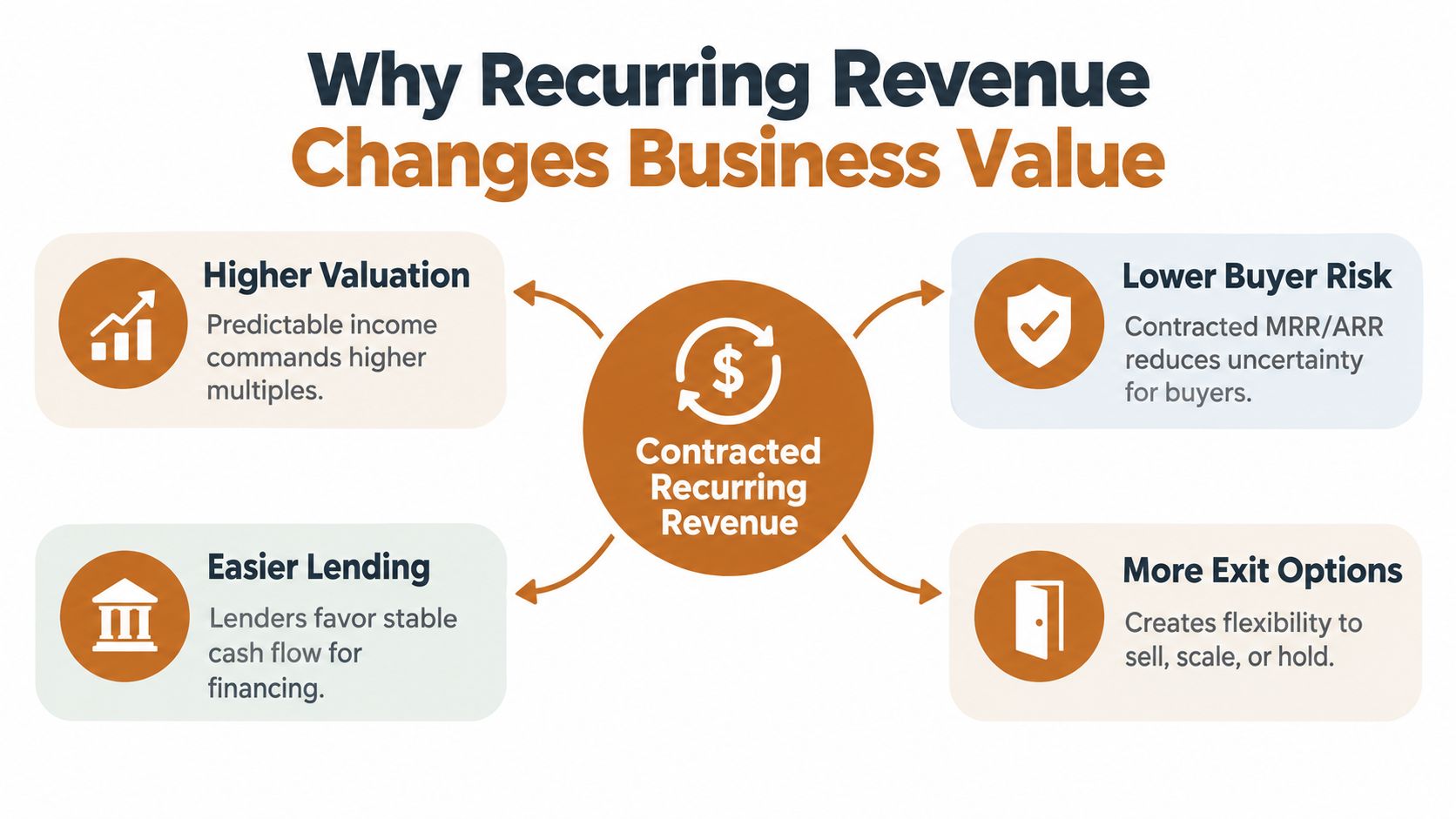
A buyer isn’t purchasing a label called ARR. They’re assessing how much future cash flow the business can produce, how much effort it will take to retain that cash flow, and what could cause it to disappear.
Contracted income can reduce uncertainty because the customer relationship already has defined terms. That may make lenders more comfortable evaluating repayment capacity, and it can give buyers a clearer base from which to model earnings. Mercury’s discussion of recurring-revenue financing describes the practical appeal of contracted future payments, while also emphasizing that financing remains debt and must be repaid. Its eligibility discussion cites a practical benchmark of several months of subscription history and roughly $10K to $15K MRR, or $120K to $180K ARR, although lender requirements vary. Mercury’s recurring-revenue financing overview provides that context.
Recurring revenue can also affect the multiple applied to earnings. Buyers generally accept more uncertainty in a business dependent on the owner’s next sales push than in one with enforceable agreements, documented renewals, and stable service delivery. That doesn’t guarantee a higher price. Weak margins, poor retention, or concentrated accounts can offset the benefit.
The risk is that owners mistake repetition for permanence. BDO’s 2026 analysis warns that repeat-revenue companies can develop strategic myopia by focusing heavily on renewal, expansion, and pricing while underinvesting in new demand, new segments, and product-market expansion. Read BDO’s analysis of the unintended consequences of repeat revenue for the warning in its broader business context.
A renewal is not proof that the relationship is safe. It is evidence that the customer has renewed so far.
A service business can show a steady top line while margins weaken, one large account becomes too important, or customers leave at renewal. Buyers will test those issues during diligence. They’ll examine contract terms, churn, renewal history, gross margin by account, customer concentration, service obligations, and the owner’s role in keeping customers.
Owners who want predictable growth should also protect demand outside the existing base. That may mean moving away from pay-per-lead growth tactics and building a balanced pipeline, rather than treating contracted revenue as permission to stop selling.
Start with the customers you already understand. Review invoices and service records, then mark accounts that buy on a schedule, maintain the same assets, or repeatedly request the same service. You’re looking for a customer problem that naturally continues, not a way to force every job into a membership.
Next, turn that pattern into a written offer. Define what the customer receives, what isn’t included, when service occurs, how emergency work is billed, and what happens when either party wants to cancel. A clear scope protects both sides and gives you something a buyer can evaluate later.
A per-visit plan works when the service event is the main value. A per-asset plan fits equipment, buildings, or sites that need scheduled attention. Tiered memberships can separate basic inspections from priority response or broader coverage.
Price the offer around the work you must deliver, not only around what competitors advertise. Account for travel, technician time, parts, administration, seasonal demand, and the cost of serving customers who use more support than expected. A low monthly fee can create recurring invoices while damaging margin.
A spreadsheet is enough to begin. Keep one row per account and record:
Track contracted monthly revenue, renewal rate, customer churn, and average revenue per account. Add notes explaining changes caused by new customers, upgrades, downgrades, cancellations, or price changes. The point isn’t to create a complicated dashboard. It’s to know whether the base is growing because customers are staying, because prices changed, or because new accounts are replacing lost ones.
Your operating procedures matter too. The business systems and processes guide can help you think about how agreements, scheduling, billing, and customer records function without the owner personally holding every detail.
Protect the stream with suitable auto-renewal language, cancellation procedures, service-level commitments, and documented customer communications. Review the recurring base quarterly, paying particular attention to accounts that represent a large share of income or require disproportionate service effort.
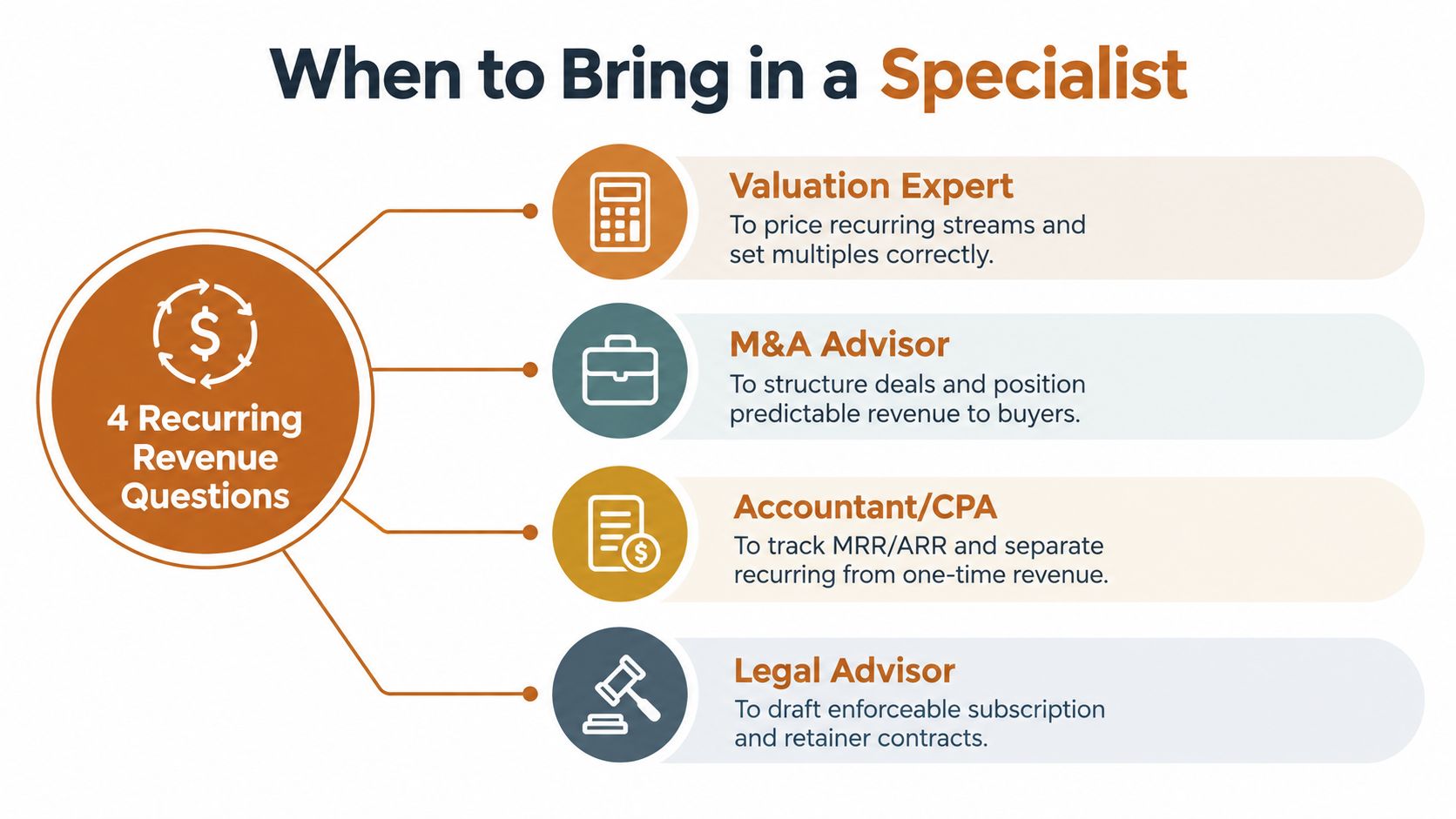
Recurring revenue crosses several professional boundaries. The right time to seek help is usually tied to a specific decision, not to a vague feeling that the business is becoming more advanced.
If you’re preparing for a sale or capital raise, speak with a valuation specialist before presenting MRR or ARR to the market. They can help separate contracted revenue from repeat sales, test the quality of renewals, and explain how customer concentration, margins, and owner dependence affect the analysis.
A tax advisor should be involved before you restructure maintenance plans, subscriptions, or service add-ons. Billing cadence, bundled services, revenue recognition, and sales-tax treatment can create obligations that aren’t obvious from the sales pitch.
A lawyer earns a place in the conversation when you draft or revise auto-renewal, cancellation, service-level, liability, and data-protection terms. The contract should match what your team can deliver. A promise that sounds attractive but creates an unpriced obligation can reduce rather than increase business quality.
A lender or finance broker can assess whether recurring income supports working capital or equipment financing. Don’t borrow against a headline number before checking retention, concentration, contract enforceability, and the effect of a customer loss.
Decision point: Bring in the specialist before signing the agreement that creates the risk, not after the risk appears in diligence.
The roles don’t replace one another. A lawyer may draft enforceable terms, but a valuation advisor can judge whether customers renew. An accountant can classify revenue, but a lender will still examine repayment risk. Early coordination helps you build a stream that works operationally, financially, and legally.
Recurring revenue is predictable income from active customer contracts, measured monthly as MRR or annually as ARR. It differs from repeat or follow-on revenue because a customer’s separate purchase doesn’t create the same contractual commitment.
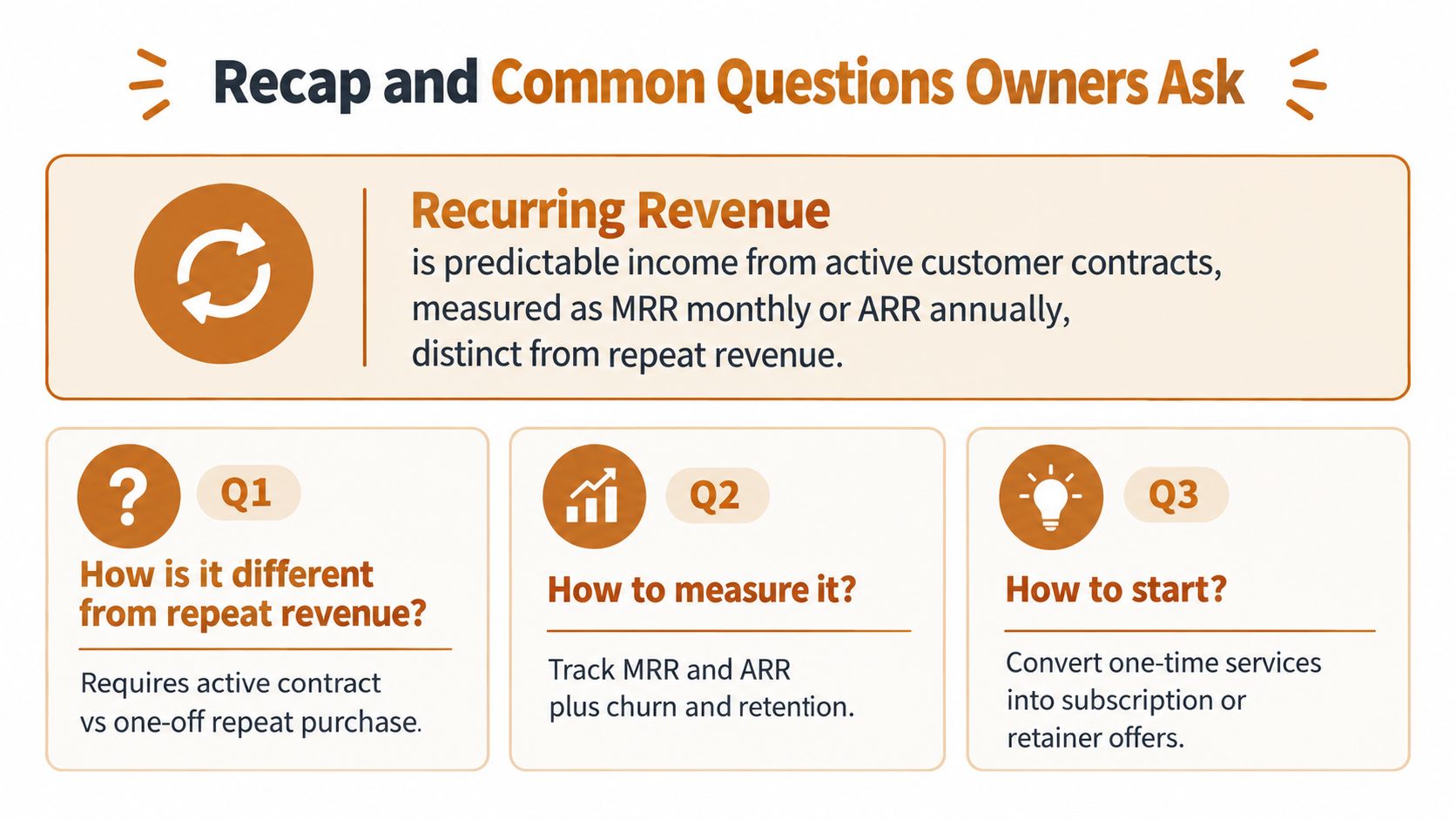
Is a maintenance contract recurring revenue? Yes, when the customer has agreed to renewal and payment terms.
Are scheduled filter deliveries recurring revenue? Yes, when customers agree to scheduled orders or an ongoing program.
Are repeat service calls recurring revenue? Usually not. Each call is generally a separate purchase unless an active agreement covers it.
How long must a contract run? A longer, clearly documented commitment is easier to evaluate. Don’t assume duration alone makes revenue durable. Review cancellation rights, renewal behavior, scope, and payment history.
Does recurring revenue raise a sale price? It can support steadier valuation when the contracts are real, profitable, transferable, and supported by healthy retention. Buyers still test the underlying quality.
Audit your customer agreements now. Mark which accounts have enforceable terms, which merely repeat by habit, and which contracts need clearer scope or renewal language before you speak with an advisor.
The Owner’s Shortlist connects long-tenured business owners with vetted specialists for valuation, taxes, legal matters, financing, succession, and related decisions. Visit The Owner’s Shortlist to review practical guidance and find an appropriate specialist for evaluating your recurring revenue before a sale or financing conversation.
Tell us your situation. We'll connect you with a specialist who works with owners like you. One conversation, no sales pressure.
Found this useful?
Add The Owner's Shortlist as a preferred source and get our articles highlighted in Google Search results.
Add to Preferred SourcesLearn how much to sell a business for with SDE and EBITDA multiples, adjustments, and deal tips to set a defensible price and maximize proceeds.
September 21, 2026
Understand business valuation cost, fee structures, price ranges and what drives fees so you can budget wisely and get accurate quotes.
September 19, 2026
Learn how a sustainable growth model works for owner-operated businesses. Covers core metrics, valuation impact, trade examples, and when
September 13, 2026
What is a quality of earnings report? Learn what a QoE covers, who prepares it, key adjustments, red flags, and how it shapes valuation and deal terms.
September 9, 2026