Sustainable Growth Model for Owner-Operated Businesses
Learn how a sustainable growth model works for owner-operated businesses. Covers core metrics, valuation impact, trade examples, and when
September 13, 2026
By Remi Taffin · September 19, 2026
Most owners will see about $1,500 to $8,000 for a calculation engagement and about $5,000 to $15,000 or more for a full valuation with a conclusion of value. The big driver usually isn’t revenue by itself. It’s whether the report needs to stand up for planning, lending, tax, litigation, or an actual transaction.
That’s the spot many owners are in right now. You ask what a business valuation costs, one firm gives you a quote in the low thousands, another quotes something much higher, and both insist they’re being reasonable. It feels like shopping for the same service and getting prices from two different planets.
Usually, both quotes can be right.
A valuation for internal planning is a different animal from a valuation that a lender, buyer, court, or tax authority may challenge. If you buy the cheaper one when you really needed the sturdier one, you may end up paying twice. If you buy the highest-rigor report for a question that only needed a planning estimate, you may overspend for no practical benefit.
That’s why it helps to stop asking only, “What does a business valuation cost?” and start asking, “What kind of valuation do I need this to do?”
A common first valuation story goes like this. An owner wants to know what the business is worth because retirement is getting real, a partner is asking questions, or a bank wants more support. They request a few quotes and get back very different numbers. One provider talks about a quick calculation. Another talks about a formal report. A third asks whether the result may be used in a dispute, a tax filing, or financing.
At that point, the owner often thinks someone is padding the fee.
Usually, what’s really happening is that each provider is pricing a different level of defensibility.
If you just want a planning estimate, the valuer can work with a lighter scope. If the result will go in front of a lender or be picked apart by the other side in a dispute, the work changes. The analyst has to document assumptions more carefully, support adjustments more thoroughly, and write the report in a way another reviewer can follow and challenge.
Think of it like property work.
A homeowner might pay for a basic walk-through before listing a house. That’s different from hiring a structural engineer when a bank, insurer, or buyer needs a report that can survive scrutiny. Both involve looking at the same property. The second assignment costs more because the risks are higher.
Practical rule: The more people who may question the number later, the more you should expect business valuation cost to rise.
Owners often assume fee quotes should track revenue. Revenue matters some, because larger businesses often create more review work. But it’s not the whole story. A simple owner-operated firm with clean books can take less effort than a smaller company with messy records, multiple entities, and unusual adjustments.
That’s why independent pricing guides often separate valuations by engagement type rather than just size. A widely used market pattern places a calculation engagement at about $1,500 to $8,000, while a full valuation engagement with a conclusion of value is typically $5,000 to $15,000 or more for complex cases according to Real Cost Report’s business valuation pricing overview.
Before you compare fees, get clear on these questions:
Those answers shape the quote more than owners expect.
Two owners can pay very different fees for what sounds like the same job. One needs a quick planning number for internal decisions. The other needs a report a lender or tax advisor can rely on. The difference is not just size. It is how much the number needs to stand up when someone else reviews it.
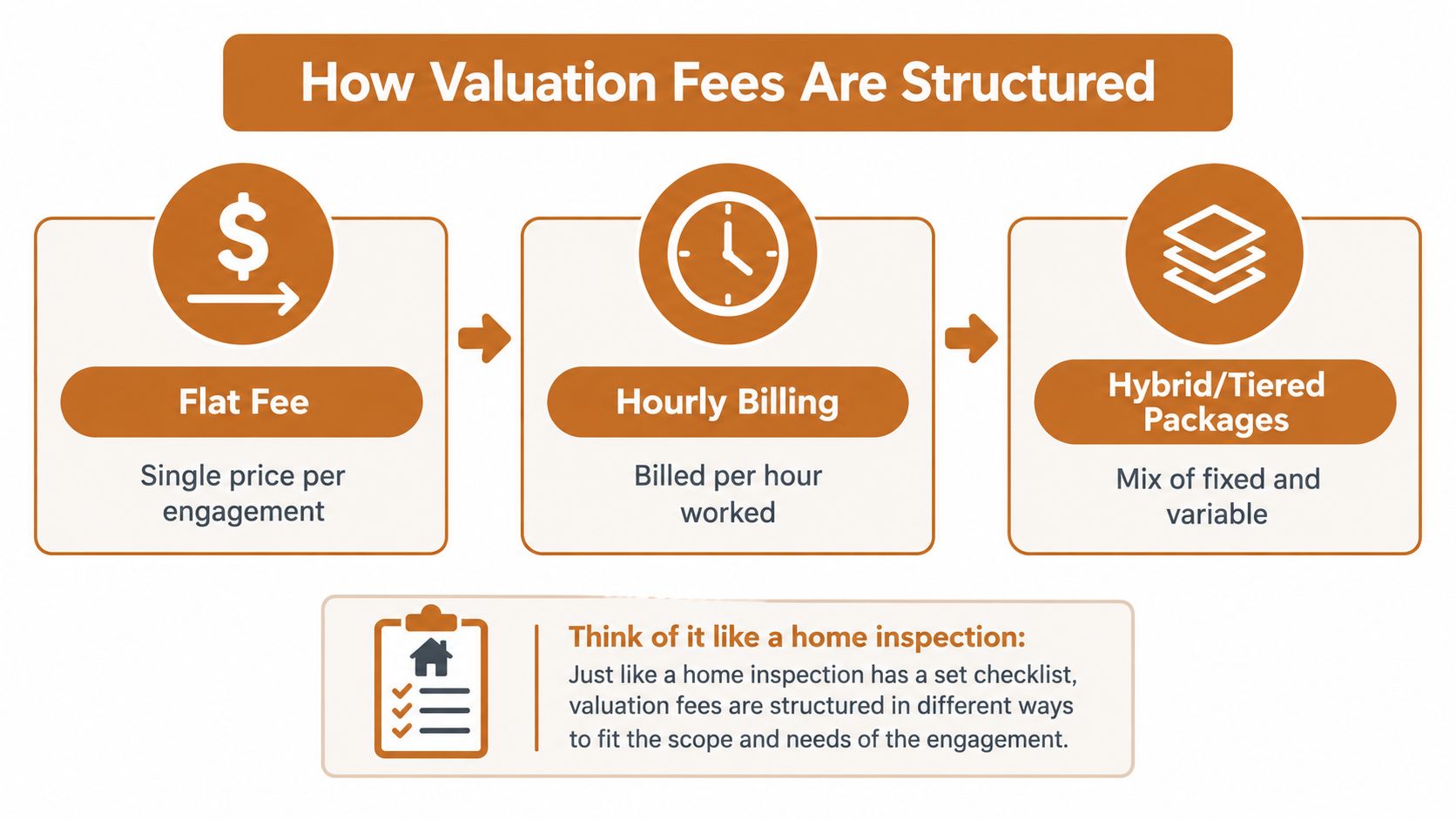
A useful comparison is property work. A seller might pay for a simple pricing opinion before listing. A bank financing a purchase wants a formal appraisal with more support behind it. Business valuation fees work in a similar way. You are paying for a level of defensibility tied to the job the report has to do.
This is the easiest pricing model to understand. The firm quotes one price for a defined assignment, such as a calculation of value for planning or a full valuation report for a transaction, lender file, or tax matter.
Owners often prefer flat fees because the budget is clear up front. The tradeoff is that the scope has to be clear too. If you ask for a planning report now, then later need something formal enough for a buyer or lender, you may need an upgrade or a second engagement. That is where paying twice can happen.
A better question than “How big is my business?” is “Who needs to rely on this number?” If the answer is just you and your partner, a lighter report may fit. If the answer is a bank, the IRS, a buyer, or opposing counsel, the engagement usually needs more support and more documentation.
Hourly billing shows up when the work is harder to predict.
That often means disputes, expert witness support, or situations where the valuator expects rounds of questions, document requests, or testimony. In those cases, fixing one price at the start can be unrealistic because no one knows how much back and forth is coming.
One UK fee guide from Business Valuation Experts shows this pattern clearly, with rates rising based on seniority and dispute complexity. The lesson is simple. Hourly pricing does not automatically mean the firm is expensive. It usually means the scope can expand.
Some firms combine both models. You might get a fixed fee for the report itself, then hourly charges for extras such as meetings, lender follow-up, additional schedules, testimony, or major revisions after new information appears.
This model is common because valuation assignments rarely stay frozen. A lender may ask follow-up questions. A buyer may want extra backup. An attorney may need a revised version that fits a filing requirement. A hybrid quote separates the core work from the optional support.
Tiered packages follow the same logic. Software pricing works this way too. Resolut subscription pricing lays out levels based on what the user needs. Valuation firms often price the same way, with one level for internal planning and a higher level for reports built for outside review.
A low quote can mean a narrower assignment.
Start with what the report is meant to do, not just what it costs. If the wording is vague, ask the valuator to explain it in plain English.
Look for terms like these:
If you are comparing proposals and the labels blur together, this overview of a business appraisal service can help you sort out what each report type is meant for before you compare fees.
A common mistake goes like this: an owner buys a lower-cost valuation for planning, then learns the bank, CPA, or buyer will not rely on it. Now they are paying twice.
That is why price ranges make more sense when you sort by use case and defensibility first, then by business size. Revenue still matters, but it is usually the second question, not the first. A $2 million company getting a number for internal planning may need less work than a smaller company preparing a report for an SBA lender or a tax filing.
One public example shows how wide that gap can be. Experian sells an automated Business Valuation Report for $149, while professional appraisal work for small businesses is often priced in the low thousands to five figures, as shown on Experian’s valuation report purchase page.
Those are different tools for different jobs. A quick estimate works like an online home-value checker. A formal appraisal works more like the report a lender wants before approving a mortgage.
Start by asking, “Who needs to rely on this report?” That question usually puts you in the right lane faster than asking, “How big is my business?”
Here is a practical way to think about typical ranges:
| Report Type | Under $1M Revenue | $1M to $5M Revenue | Best Use Case |
|---|---|---|---|
| Calculation of value | $2,500 to $5,000 | $4,000 to $8,000 | Planning, early sale prep, internal decisions |
| Standard appraisal | Often priced above a calculation and below highly defended legal or tax work | Often priced above a calculation and below highly defended legal or tax work | Buyer discussions, formal planning, some financing situations |
| Full defensible report | Can reach $15,000+ when a third party needs detailed support | Can reach $15,000+ when a third party needs detailed support | Lending, tax filings, legal review, partner disputes, transaction support |
The pattern matters more than the exact number. Fees do not rise in a neat staircase as revenue goes up. They often jump when the report must stand up to outside review.
Take a shop with $1.5 million in revenue.
If the owner wants a reality check for succession planning, a lighter calculation may be enough. If the same owner needs a report a lender can review line by line, the fee can rise sharply because the analyst has to document more assumptions, support more adjustments, and write a fuller report.
That is why broad market summaries often show limited-scope calculations in one price band, standard appraisals in a higher band, and legal or tax work in a much higher one, as outlined in CT Acquisitions’ discussion of valuation costs.
The extra fee is not just “more math.” It is usually more proof.
A more formal assignment may include:
That is the part many first-time owners miss. You are not only buying a number. You are buying a number that is fit for a specific audience.
UK pricing shows the same basic split. Some firms market simple SME valuations at a low fixed fee, while formal written valuations can run much higher depending on scope and purpose, as shown on The Business Valuers pricing page.
Different currency, same lesson. Match the report to the decision-maker who will rely on it. That is often the best way to avoid overbuying, and the best way to avoid paying twice.
A quote goes up or down for reasons that are usually visible before the engagement starts. If you understand those levers, you can have a much better scoping call.
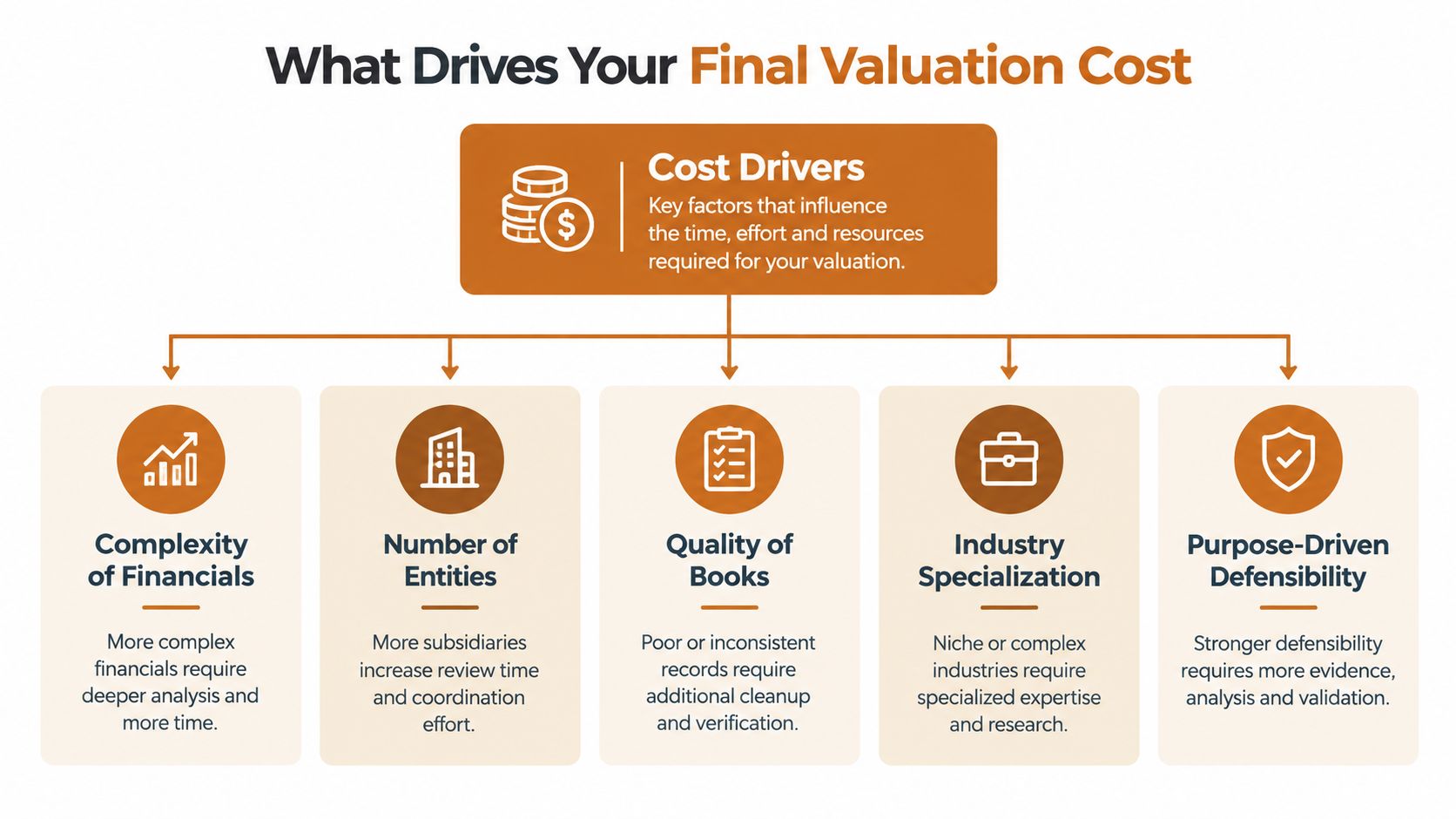
The biggest driver is often purpose-driven defensibility. A report built for internal planning doesn’t need the same paper trail as one built for a lender, tax filing, or dispute.
Then come the mechanics.
The fee often reflects how much explanation the valuer must build into the file, not just how much math they perform.
Preparation saves money.
If you hand over tidy financial statements, a clear list of add-backs, and an explanation of your legal structure, you reduce the cleanup burden. If your records are rough, the valuer or your accountant may need to do extra prep first. For owners trying to estimate that upstream cleanup, this overview of cost of hiring an accountant 2026 can help frame what accounting support may add before the valuation even begins.
A video walkthrough can also help if you’re trying to understand why quality of earnings and valuation prep often overlap:
Trades and service businesses are a good example. An HVAC, plumbing, or similar company may look simple from the outside, but the valuation work can get heavier when the analyst has to separate installation revenue from service revenue, examine maintenance agreements, and understand how recurring work affects future earnings quality.
If you’ve heard someone mention quality of earnings in that context, this primer on what is a quality of earnings report helps explain why buyers and lenders sometimes push for more support than a basic valuation memo provides.
Another hidden driver is add-backs. Owners often know certain expenses are personal or one-time, but unless those adjustments are documented clearly, a valuer has to test and explain them. Every unsupported adjustment creates more work.
A useful way to judge business valuation cost is to ask what deliverable you’re receiving. Owners sometimes compare a short memo to a formal report as if they were the same product. They aren’t.
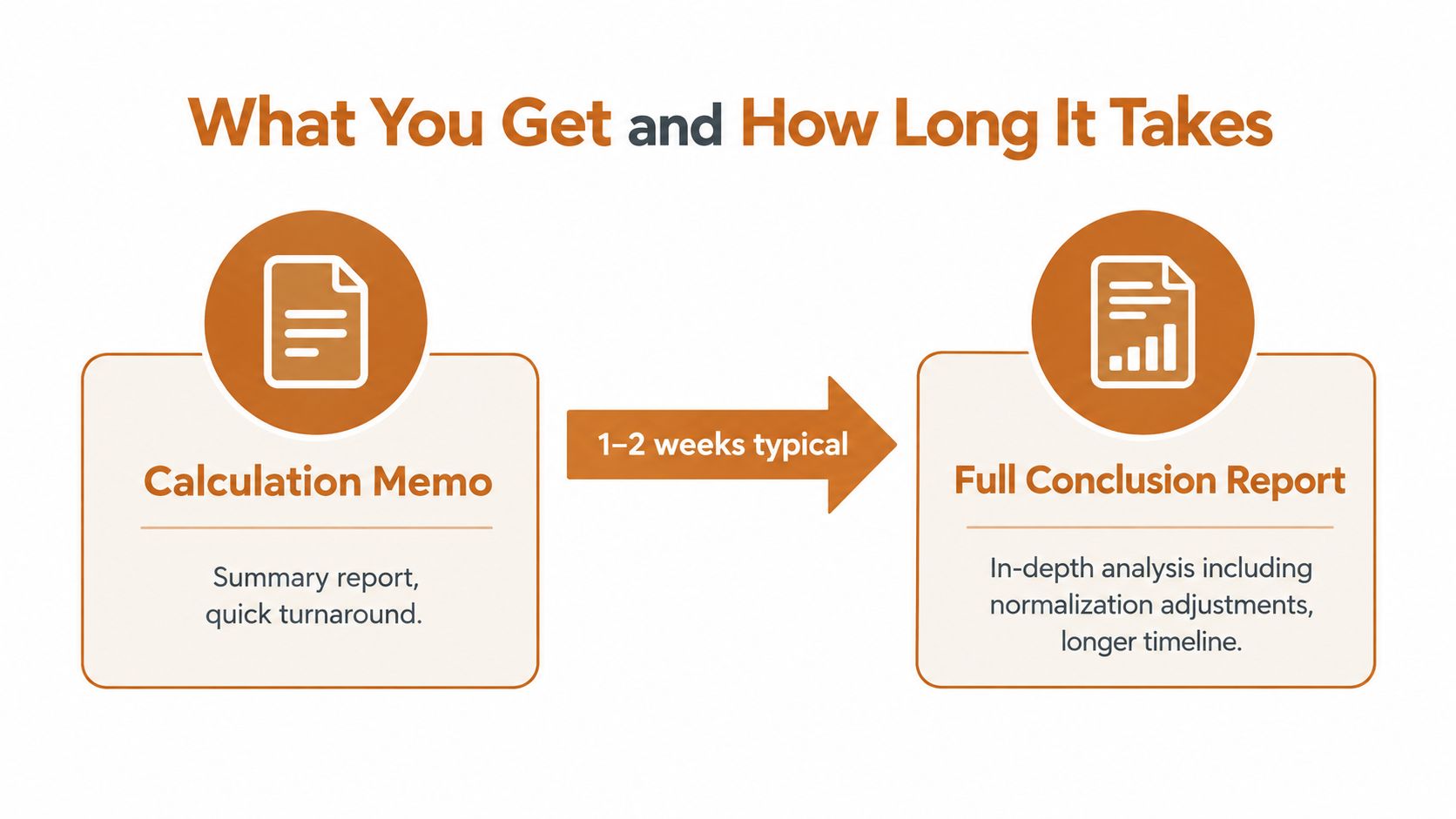
A calculation memo is often built for planning. It may summarize the company, outline the approach used, present key adjustments, and provide an estimate of value with less narrative support.
That can be perfectly appropriate when you’re asking questions like:
It’s usually faster because the report isn’t trying to answer every challenge a third party might raise.
A more formal conclusion-of-value report usually goes further. It may include fuller normalization schedules, more developed comparable support, discussion of assumptions, and clearer documentation designed for outside reliance.
That’s the version owners should think about when the report may be reviewed by:
Ask a simple question before signing: “Will this report be acceptable for the exact use I’m hiring you for?”
That one sentence can save a second engagement.
Turnaround isn’t just about the valuer’s calendar. It depends on how quickly you provide the requested information and how much follow-up the analyst needs.
Delays usually come from:
If timing matters, confirm three things in writing:
Rush work can exist, but it only helps if the inputs are organized.
The easiest way to make valuation fees click is to watch how scope changes the answer.

A solo owner of a local service company is five years from retirement. No lender is involved. No buyer has submitted a letter of intent. There’s no dispute. The owner mainly wants to know whether the business is on track and whether it makes sense to invest more before exiting.
That owner usually doesn’t need the heaviest report on day one.
A lighter calculation engagement may fit because the goal is internal decision-making. The owner needs a grounded estimate, a sensible look at earnings, and enough explanation to understand what’s driving value. Paying for the highest-rigor report too early may not change the next decision.
Buy the report that matches the next real decision, not the most impressive title.
Now take an HVAC company with recurring service agreements, multiple technicians, and an owner beginning active sale preparation. The owner expects buyer diligence, questions about normalization, and close review of recurring versus project revenue.
That situation often needs more than a rough estimate.
The analyst may need to work through owner compensation, fleet and equipment issues, service contract economics, and the consistency of recurring revenue. The report may also need to hold up in negotiations with buyers and lenders. That pushes the engagement toward a more formal valuation.
For owners in service trades, understanding the earnings base matters just as much as understanding the multiple. This explanation of seller discretionary earnings is useful because many owner-operated valuations start by getting that earnings figure right.
The businesses may both be privately held and owner-led, but they are not buying the same thing.
One owner is paying for clarity. The other is paying for clarity plus support that can survive outside review. If the HVAC owner buys only the lighter report, there’s a real chance of rework once a buyer, lender, or adviser asks for something sturdier. If the first owner buys the heavier report too soon, money gets spent before the business needs that level of proof.
That’s the central lesson in business valuation cost. The right fee depends on what the report must do after it lands on someone’s desk.
If you want apples-to-apples proposals, give valuers the same facts and the same intended use. That one step cuts a surprising amount of confusion.
Don’t ask only, “What’s your price?” Ask:
Those questions usually tell you more than the top-line quote.
A low quote isn’t always wrong. Sometimes it reflects a narrow planning engagement, and that may be exactly what you need.
But be careful if the fee sounds low and the provider is vague about acceptance by lenders, buyers, or tax and legal users. That’s when owners end up with a report that answers their own question but not the third party’s question. Then they commission a second report.
If you want a neutral place to compare specialists and read plain-language guidance before hiring anyone, The Owner’s Shortlist can be one practical option in the mix. It organizes valuation and related advisory topics around owner decisions rather than around provider sales pages.
If you’re trying to pin down the right valuation scope before spending money, The Owner’s Shortlist gives you plain-language guides and access to vetted specialists across valuation, tax, legal, financing, and succession topics. It’s a useful next step when you want to avoid buying the wrong report first and would rather match the engagement to the actual decision in front of you.
Tell us your situation. We'll connect you with a specialist who works with owners like you. One conversation, no sales pressure.
Found this useful?
Add The Owner's Shortlist as a preferred source and get our articles highlighted in Google Search results.
Add to Preferred SourcesLearn how a sustainable growth model works for owner-operated businesses. Covers core metrics, valuation impact, trade examples, and when
September 13, 2026
What is a quality of earnings report? Learn what a QoE covers, who prepares it, key adjustments, red flags, and how it shapes valuation and deal terms.
September 9, 2026
Learn the key methods for a plumbing business valuation. This guide covers SDE, multiples, value drivers, and how to prepare for a defensible assessment.
September 7, 2026
Learn how to do business valuation with a clear owner-focused method covering income, market, and asset approaches, multiples, and common pitfalls.
September 4, 2026