How to Sell My Plumbing Business: A Practical Roadmap
Ready to sell my plumbing business? Follow a step-by-step roadmap for valuing, marketing, and closing the sale with confidence and clarity.
October 15, 2026
By Remi Taffin · September 4, 2026 · Updated October 12, 2026

You’re sitting at the kitchen table with several years of profit and loss statements spread out in front of you. A buyer says the business is worth one number, your partner suggests another, and an online calculator produces something that feels disconnected from reality. Before you agree to a sale price, buy out an owner, report a transfer, or approach a lender, you need a valuation you can explain line by line.
How to do business valuation starts with matching the method to the business. A recurring-revenue service company shouldn’t be valued like an equipment-heavy operation. A stable Main Street trades business may not justify a complicated discounted cash flow model. A DIY estimate can help you prepare, but when the number will be challenged, specialist work is worth the cost.
A business valuation is a defensible estimate of economic value at a specific point in time, for a specific purpose. It isn’t the owner’s preferred price, the amount invested over the years, or the revenue multiplied by a convenient figure. A buyer, tax authority, bank, court, or departing partner may all ask a different valuation question because each situation can use a different standard and premise of value.
Owners commonly need valuations for:
The valuation profession generally works through three approaches. The CFA Institute’s overview of market-based valuation describes the role of market multiples, while IRS guidance referenced in the valuation framework says the asset-based, market, and income approaches should all be considered when valuing a business interest.
The income approach converts expected future benefits into present value. A discounted cash flow model projects free cash flow, estimates a terminal value, and discounts those amounts using a rate that reflects risk. It works best when management can defend its forecasts.
The market approach compares the company with relevant public companies or completed private transactions. Multiples can be based on earnings, sales, book value, or cash flow. In a small business, this approach often produces the most useful headline range because buyers frequently think in terms of normalized earnings multiplied by a market-supported multiple.
The asset approach estimates the value of assets minus liabilities, using appropriate economic values rather than blindly accepting accounting book values. It often establishes a floor for an owner-operated company, especially when equipment, property, inventory, or other tangible assets represent a meaningful part of the operation.
Practical rule: Don’t choose the approach that gives you the highest number. Choose the approach that best explains how a buyer would actually earn a return.
A credible valuation triangulates the approaches. The asset result can test downside protection, the market result can anchor buyer expectations, and the income result can test whether projected earnings are sustainable. If the three outputs diverge sharply, the answer isn’t to average them automatically. Recheck the assumptions.
The calculation begins before you apply a multiple. Pull the company’s tax returns and internal profit and loss statements together, then reconcile revenue, owner compensation, unusual expenses, and differences in accounting treatment. You’re looking for the economic earnings a buyer would receive, not merely the net income printed at the bottom of one statement.
For an owner-operated company, the practical starting point is often Seller’s Discretionary Earnings, or SDE. Start with reported net income, then examine legitimate adjustments such as:
Consider a plumbing company with $1.4 million in revenue. Its owner receives a $90,000 salary, runs $22,000 of personal expenses through the company, and has incurred a one-time truck replacement cost and a non-recurring legal settlement. Those figures cannot be added back because the owner wants a larger SDE. Each line needs evidence, an explanation, and a view of whether a replacement owner would face a similar cost.
| Line Item | Reported Amount | Add-Back Category | Adjusted Amount |
|---|---|---|---|
| Reported net income | Company-specific | Starting earnings | Company-specific |
| Owner salary | $90,000 | Owner compensation | Add back if appropriate |
| Personal expenses through business | $22,000 | Discretionary or personal | Add back if documented |
| Truck replacement | Company-specific | Non-recurring capital-related item | Adjust only for the unusual portion |
| Legal settlement | Company-specific | Non-recurring expense | Add back if genuinely isolated |
| Normalized SDE | Recalculated | Adjusted earnings | Final defensible figure |
The worksheet’s structure matters more than its appearance. Keep columns for the raw expense, add-back category, supporting documentation, and adjusted figure. A buyer or appraiser should be able to trace every adjustment to a bank statement, invoice, payroll record, tax return, or written explanation.
Owners usually make one of two mistakes. They under-adjust and leave legitimate value hidden, or they add back every expense that feels inconvenient. The first reduces negotiating power. The second destroys credibility when a buyer replaces the owner, reviews the books, and discovers the expense will continue.
A defensible add-back is not an owner benefit. It’s an expense you can prove is unusual, personal, non-cash, or unnecessary for the buyer’s version of the business.
The final normalized figure should reflect a repeatable earning stream. If revenue depends on the owner answering every call, performing the skilled work, and retaining the top customers personally, the SDE may be accurate but the multiple may need to reflect that transfer risk.
The three approaches aren’t interchangeable. They answer the same broad question, but they rely on different evidence and fit different businesses.
| Business Profile | Primary Approach | Supporting Approach | Typical Weighting |
|---|---|---|---|
| Main Street retail or trades with established earnings | Market | Income and asset | Market-led |
| Service company with contractual or recurring revenue | Income | Market | Income-led |
| Equipment-heavy manufacturing operation | Asset and income | Market | Blended |
| Holding company or real estate-rich operation | Asset | Income | Asset-led |
| Distressed business | Asset | Market or income, if viable | Asset-led |
| High-growth company with reliable forecasts | Income | Market | Income-led |
For most small operating companies with stable financial records, the market approach is the practical anchor. Completed transactions show what buyers have paid for comparable earnings, customer profiles, operational risk, and transferability. The comparison only works when the transactions resemble the subject company. A large, professionally managed company with multiple locations isn’t a useful peer for a business that depends on one owner and a small local customer base.
The income approach earns more weight when future cash flow is predictable. Recurring maintenance contracts, subscription-like service agreements, reliable retention, and documented growth can support a forecast-based analysis. DCF isn’t automatically more advanced. If the owner can’t defend the forecast, the model merely turns optimism into precise-looking arithmetic.
The asset approach fits companies where tangible assets drive the economics. Manufacturing equipment, inventory, property, specialized vehicles, or recoverable assets may matter more than a small earnings stream. It also provides a realistic floor when the business is distressed or a buyer is primarily acquiring assets rather than ongoing operations.
A plumbing company with repeat service agreements may deserve an income-oriented analysis alongside market evidence. A local contractor with strong historical SDE but limited contracts will usually be judged more heavily through comparable transactions. A fabrication shop with valuable equipment and inconsistent earnings may need a blended view.
The right output is a weighted conclusion based on business fit, not a menu of equally attractive answers. The IRS valuation framework emphasizes considering the relevant approaches and selecting assumptions consistent with the benefit stream. That principle should guide owner planning too.
If the methods produce different ranges, investigate why. A gap may reveal weak forecasts, poor comparables, unrecorded assets, excessive owner dependence, or a discount rate that doesn’t match the company’s risk. The reconciliation process often teaches you more about the business than the final number.
Once earnings are normalized, two inputs drive the result: the multiple in a market approach and the discount rate in an income approach. Neither should come from a generic online calculator.
A multiple compares market value with a financial measure such as earnings, sales, book value, or cash flow. The CFA Institute’s discussion of valuation multiples identifies examples such as P/E, P/B, P/S, EV/EBITDA, and enterprise value to free cash flow. For private companies, comparable transactions can be especially useful because completed acquisitions often reflect control value.
Start with private-company transactions in the same industry and region where possible. Then adjust for the factors that make your business more or less transferable:
A DCF discount rate should reflect the risk of the actual business, not the rate used for a diversified public company. A build-up approach can consider a risk-free rate, equity risk, company size, industry risk, and company-specific factors such as key-person exposure or customer concentration. The Accountancy Europe guide for SME business valuation discusses why private-company risk adjustments and correctly matched assumptions matter.
| Factor | Effect on Multiple | Effect on Discount Rate |
|---|---|---|
| Larger, diversified operation | Can support a stronger multiple | May reduce size-related risk |
| Predictable recurring revenue | Can support a stronger multiple | May reduce forecast uncertainty |
| Customer concentration | Usually reduces the multiple | Raises company-specific risk |
| Owner dependence | Usually reduces the multiple | Raises key-person risk |
| Volatile margins | Reduces confidence in earnings | Raises operating risk |
| Strong systems and management depth | Supports transferability | Can reduce company-specific risk |
Don’t force a DCF to produce a favorable result. If honest risk adjustments produce a high discount rate, that may be telling you the business has a transferability problem, not that the model is broken.
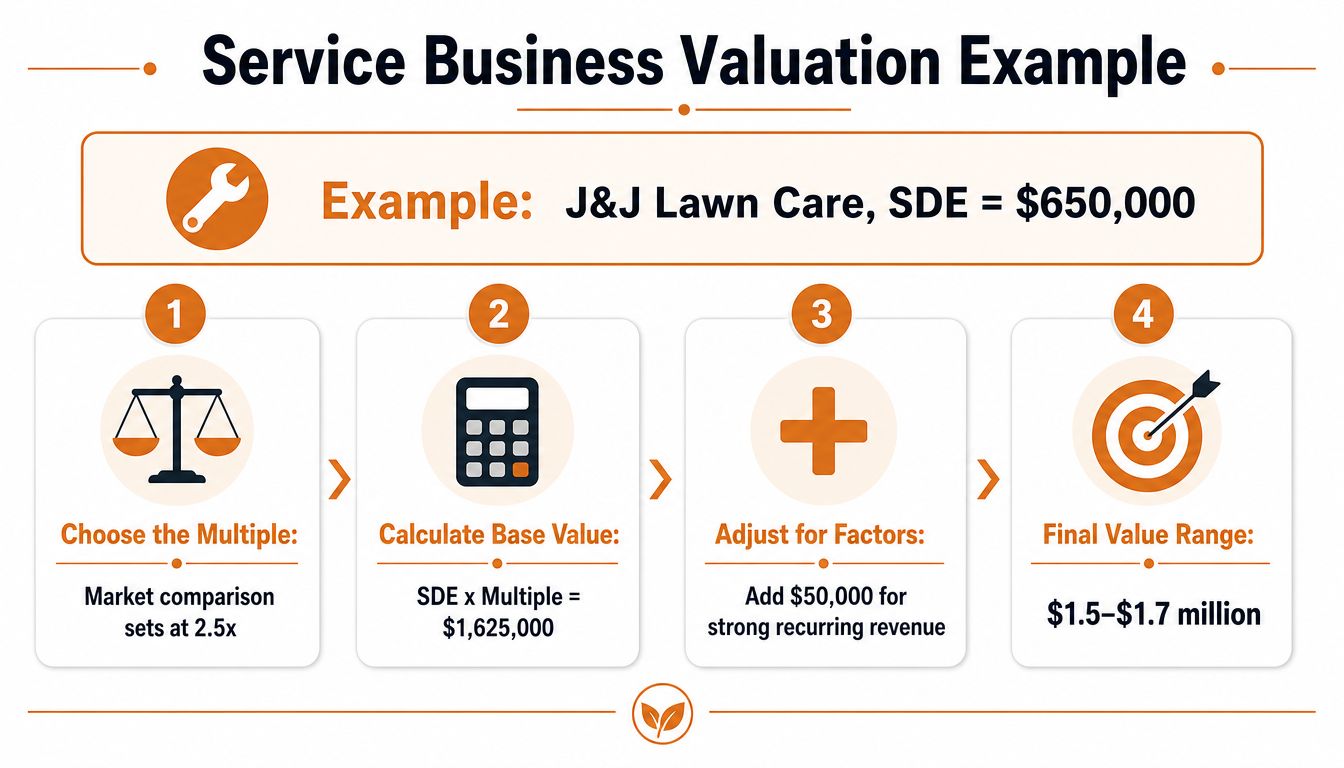
Take a service business with $650,000 of normalized SDE. A market approach begins with the SDE multiple. The verified small-business guidance reports U.S. SDE multiples around 2.0x to 3.3x for small businesses under $500,000 SDE, with an overall midpoint near 2.57x and many deals clustering around 2x to 4x SDE. Those benchmarks come from BridgeBook’s business valuation multiples guide, but they aren’t a substitute for comparable evidence for this specific company.
Using a deliberately illustrative range:
The lower result describes a business with more owner dependence, weaker recurring revenue, or greater customer risk. The higher result requires a buyer to believe the earnings are durable, transferable, and supported by reliable operations. The calculation is simple. Defending the selected multiple is the work.
A DCF would project free cash flow over a forecast period, calculate a terminal value, and discount each amount back to today. The verified framework describes forecast periods of 5 to 10 years, with terminal value based on perpetual growth or an exit multiple. See the practical valuation framework for private businesses.
For a basic owner exercise, don’t pretend a forecast is precise. Build a conservative forecast from documented customer demand, labor capacity, pricing, maintenance obligations, and historical margins. Apply a discount rate that reflects the company’s size, concentration, owner dependence, and operational risk. Then compare the resulting enterprise value with the SDE range.
The two methods shouldn’t be identical. They should land in a sensible band if the forecast, multiple, and risk assumptions describe the same business. A wide gap is a warning. Revisit the cash-flow forecast, terminal multiple, working-capital needs, capital expenditures, or the market comparables before presenting a conclusion.
Treat the answer as a range, not a magical point estimate. A buyer may pay more for a clean transition and recurring contracts, while a lender or tax appraiser may focus on different risk and value assumptions.
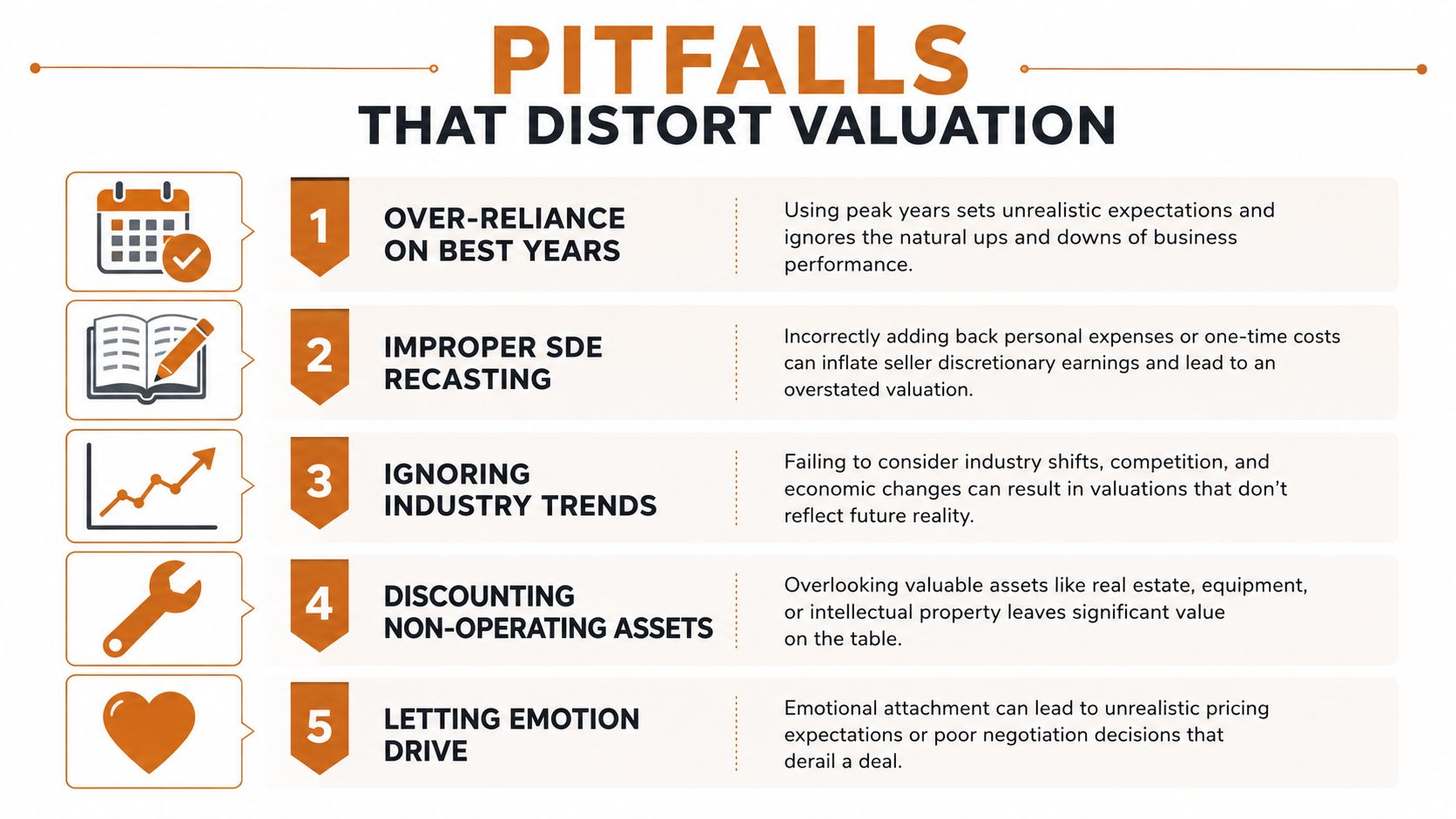
Most valuation failures begin with judgment, not multiplication. Owners select the strongest historical period, apply a large-company comparable, and use a discount rate that makes the forecast look attractive. The spreadsheet balances, but the conclusion doesn’t survive scrutiny.
Choosing the best years from the historical record creates a distorted base. A defensible analysis uses normalized performance and explains unusual volatility rather than excluding weak periods. If a strong year came from a temporary contract, price shock, storm-related demand, or an owner working unsustainable hours, the valuation should show that risk.
SDE recasting creates a similar problem. Personal expenses and one-time costs may be legitimate add-backs, but a replacement owner may still need to pay for a vehicle, office, administrator, or skilled labor. The SME valuation guidance from Accountancy Europe highlights methodological errors involving market values, cash-flow consistency, risk premiums, and unsuitable market evidence.
Public-company multiples often describe businesses with more scale, diversification, liquidity, and management depth. Applying them directly to a small local company can overstate value. The same warning applies to transaction databases that don’t disclose customer concentration, owner involvement, working-capital requirements, or the quality of reported earnings.
Revenue multiples also need context. Nimbo’s overview of valuation methods explains that revenue multiples are more relevant for high-growth or recurring-revenue businesses, while asset-based valuation can fit equipment-heavy or distressed companies. A trades business shouldn’t receive a revenue multiple merely because revenue is easy to find.
A recurring contract is valuable because it improves forecastability, not because the word “recurring” appears in a sales report.
Borrowing a discount rate from a textbook or public-company analysis ignores small-business size and company-specific risk. Understating the rate inflates present value. Overstating it can erase genuine operating strength. The rate has to match the benefit stream, currency, capital structure, and actual risks in the forecast.
Owners also bury non-operating assets, assign unsupported goodwill, or let emotion influence the conclusion. Separate operating value from excess cash, personal assets, and non-operating property, then document how each item enters the final result. Sentimental value belongs in the owner’s decision-making, not in an unsupported appraisal adjustment.
A valuation range only becomes useful when you connect it to the decision in front of you. A sale requires market positioning and buyer diligence. A partner buyout requires careful treatment of ownership rights and the governing agreement. An estate, divorce, tax filing, or court dispute requires a report designed for scrutiny.
Start by comparing the outputs from the asset, market, and income approaches. Don’t average an outlier into the conclusion. If the asset value is far below the market result, confirm that equipment and property were valued properly. If the DCF is far above the market result, challenge the forecast and terminal assumptions. The reconciliation should explain why one approach deserves more weight.
DIY work is appropriate for early planning, a simple internal discussion, or a preliminary conversation with a broker. Stop doing it yourself when the number will be challenged by the IRS, a bank, a court, a partner, or a buyer. Bring in a credentialed specialist for a transaction above $1 million, estate or gift filings, shareholder disputes, buy-sell enforcement, or financing rounds where valuation affects ownership. Those triggers are practical escalation points, not universal legal rules.
Look for credentials such as ASA, ABV, CVA, or NACVA, then read the engagement letter carefully. It should identify:

Use this final checklist:
The Owner’s Shortlist is a free service that helps owners find a business broker or other specialist. You talk to a real person, who introduces you to one specialist whose past work fits your business. When your estimate needs to hold up in front of a buyer, tell us about your business. Owners pay nothing.
Tell us your situation. We'll connect you with a specialist who works with owners like you. One conversation, no sales pressure.
Found this useful?
Add The Owner's Shortlist as a preferred source and get our articles highlighted in Google Search results.
Add to Preferred SourcesReady to sell my plumbing business? Follow a step-by-step roadmap for valuing, marketing, and closing the sale with confidence and clarity.
October 15, 2026
Learn how to sell your service business with a practical, step-by-step roadmap. From readiness and valuation to deal structure and closing, get actionable
October 14, 2026
Learn how business valuation EBITDA works for service companies. Discover adjustments, multiples, and owner-dependency tests before you sell.
October 12, 2026
Thinking 'I want to sell my landscaping business'? Learn how to value your company, prepare financials, handle labor risks, and find the right buyer quietly.
October 11, 2026