Sell My HVAC Business: A Practical Roadmap for Owners
Sell My HVAC Business. Thinking about selling your HVAC business? Learn how owners prepare, value, negotiate, and close a sale
October 9, 2026
By Remi Taffin · August 27, 2026
An owner preparing to sell may hear three different answers to one question: how much revenue is recurring? The buyer examines contracts and renewals, the lender checks customer commitments, and the bookkeeper reports total sales. Your advisor then rebuilds the figure from service agreements, cancellations, and purchase history.
That review can change how the market values your company. A spring HVAC tune-up booked by a loyal homeowner is valuable repeat business, but it is not the same as a maintenance agreement that renews under defined terms. The distinction affects forecasting, ARR and MRR reporting, revenue recognition, lender underwriting, and the price a buyer will pay.
The practical question is whether your revenue can survive your departure and remain visible on a buyer’s forecast. Classify each revenue line, then focus this quarter on converting dependable repeat work into written commitments.
An owner preparing to sell may discover the problem during a buyer review. The customer list shows years of repeat work, yet the buyer separates customers who choose to return from customers tied to written commitments. If every repeat customer has been labeled “recurring,” the reporting can look careless even when the relationships and margins are strong.
That creates valuation pressure at the worst point in the process. A trades or services company may have dependable customers, capable technicians, healthy margins, and a long record of repeat jobs, while still carrying less contracted recurring revenue than the owner expects. Repeat behavior supports the business, but it does not give a buyer the same forecast confidence as a maintenance plan, retainer, or multi-period service contract.
Practical rule: If a customer can stop buying without breaching a written commitment, keep that revenue out of your contractual recurring bucket.
Use the distinction to make five decisions:
The issue reaches well beyond software. HVAC, plumbing, electrical, lawn care, pest control, commercial cleaning, and property services businesses can carry both revenue types. A customer list full of repeat buyers supports a strong operating business, but it does not automatically create the exit profile of a documented contract book.
Sort the revenue early, while you still have time to act. Improve terms, test an agreement offer, reprice services, strengthen records, or prepare evidence showing that customer behavior remains dependable. Waiting until diligence begins leaves fewer facts, fewer choices, and less negotiating time.
For an owner preparing to sell, the dividing line is contractual commitment. Recurring revenue comes from an agreement that requires payment or renewal under defined terms. Reoccurring revenue repeats because customers choose to return, not because they must repurchase.
| Attribute | Recurring Revenue | Reoccurring Revenue |
|---|---|---|
| Definition | Contractually committed income expected at regular intervals | Repeat business that occurs without a repurchase obligation |
| Contract requirement | Requires a subscription, retainer, maintenance agreement, or comparable commitment | No enforceable ongoing commitment is required |
| Renewability | Renewal terms, auto-renewal, or a defined service period can be documented | The customer decides whether and when to buy again |
| Predictability | More suitable for forward forecasting | Forecast depends on historical behavior and current demand |
| Forecast reliability | Higher, because the agreement supports the expected cash flow | Lower, because the customer can stop without breach |
A monthly maintenance plan, annual service agreement, or multi-year property-management contract generally qualifies as recurring revenue when its terms create an enforceable obligation. A homeowner who calls every spring for the same tune-up may show strong loyalty and repeat demand, but that pattern alone is reoccurring revenue.
The distinction determines how you support a forecast. Contract-backed income can be tied to active terms, renewal dates, cancellation clauses, and scheduled billing. Reoccurring income needs a different evidence file: customer history, service frequency, seasonality, margins, and results across changing market conditions.
For reporting, MRR, or monthly recurring revenue, expresses contracted recurring income as a monthly figure. ARR, or annual recurring revenue, is commonly calculated as MRR multiplied by 12. Annual contracts are divided across their service period to calculate the monthly equivalent, as described in Geckoboard’s MRR guidance.
Keep the labels accurate. Buyers and lenders do not pay more because an owner calls repeat work recurring. They pay for evidence that the cash flow can continue after closing. Reoccurring revenue can still support value, especially when customer behavior is consistent, margins hold, and demand has survived different conditions. The owner must prove that durability rather than assign it a stronger label.
If you want buyers to stop discounting the revenue, convert the repeat pattern into a written agreement where the service and customer obligation support it. Until then, report it separately and defend it with operating evidence.
The income statement may show both revenue streams as ordinary sales. That similarity causes many owners to miss the reporting difference until a lender or buyer asks for supporting schedules.
A contract-backed maintenance plan may generate invoices today while the related service obligation extends across the agreement term. Finance teams may therefore track deferred revenue or contract liabilities and recognize revenue over the period in which the service is delivered. By contrast, an on-demand repair or project is generally recognized when the work is delivered under the applicable accounting treatment. The exact treatment depends on the contract and accounting framework, so your accountant should confirm the entries.
Recurring revenue also feeds management metrics. A business can organize active agreements into MRR, ARR, renewal schedules, gross revenue retention, and net revenue retention. ARR and MRR should exclude setup fees, one-time projects, and revenue that isn’t contractually committed, consistent with the distinction described in Software Equity Group’s ARR guide.
Reoccurring sales belong in total revenue, but they should be reported separately from ARR. A repeat plumbing customer, seasonal lawn-care purchaser, or commercial client that orders projects without a term agreement can contribute heavily to the P&L while remaining outside the contractual recurring schedule.
Your P&L won’t tell a buyer whether revenue is durable. The schedules behind it will.
A lender may give greater weight to contracted cash flow when assessing debt-service support, while a strategic buyer can analyze repeat history but still discount it for attrition risk. The P&L records what happened. The schedules explain what may happen next.
Don’t blend repeat purchases into ARR to make the number look larger. A smaller ARR figure with clear definitions is more credible than an inflated number that must be rebuilt during diligence.
A customer can use the same service for years and still produce reoccurring revenue. The classification turns on the agreement, not the quality of the relationship.
A residential HVAC tune-up shows the difference. A homeowner who calls every spring has demonstrated loyalty, but each visit remains reoccurring if the next appointment is optional. If the homeowner signs a maintenance plan covering defined services, billing, renewals, and cancellations, the related future income may qualify as recurring.
The work stays the same. The customer’s obligation changes.
| Scenario | Without Contract, Reoccurring | With Contract, Recurring |
|---|---|---|
| HVAC tune-up | Homeowner books when needed each season | Maintenance agreement schedules and covers defined visits |
| Plumbing inspection | Property owner calls after a problem appears | Service plan requires scheduled inspections |
| Electrical maintenance | Commercial customer requests occasional work | Retainer or service agreement sets ongoing obligations |
| Lawn care | Customer rebooks after a satisfactory season | Agreement defines recurring visits and renewal terms |
| Pest control | Homeowner orders treatment when pests return | Membership or service plan provides scheduled treatment |
| Equipment monitoring | Customer pays for occasional diagnostics | Monitoring subscription covers ongoing oversight |
Repeat commercial accounts still matter. A plumbing company may receive repair calls from the same customers throughout the year, with prompt payment and healthy margins. That history supports the business’s value, but label it as reoccurring unless a contract, retainer, or other enforceable commitment supports recurring classification.
Planned equipment replacement creates a similar trap. A customer that repeatedly buys pumps, boilers, or electrical equipment from your company may represent a strong future opportunity. The expected sale becomes recurring only when an agreement creates a commitment. A written replacement schedule, reserved-capacity agreement, or service contract can make the forecast more defensible, provided the terms are real and commercially enforceable.
Property-management contracts usually offer a clearer recurring structure because the service relationship, scope, billing, and term are documented. Cleaning and pest-control franchise systems also commonly use recurring arrangements, since scheduled service supports route density and customer retention.
The buyer isn’t asking whether customers like you. The buyer is asking what keeps the next invoice from becoming optional.
Start with your service-ticket history. Sort it by customer and service line, then flag annual patterns, booked-ahead work, warranty-related purchases, and customers using several services. Those patterns identify where a contract offer could fit. Until the customer signs terms that create an obligation, keep the revenue classified as reoccurring and expect buyers to treat it accordingly.
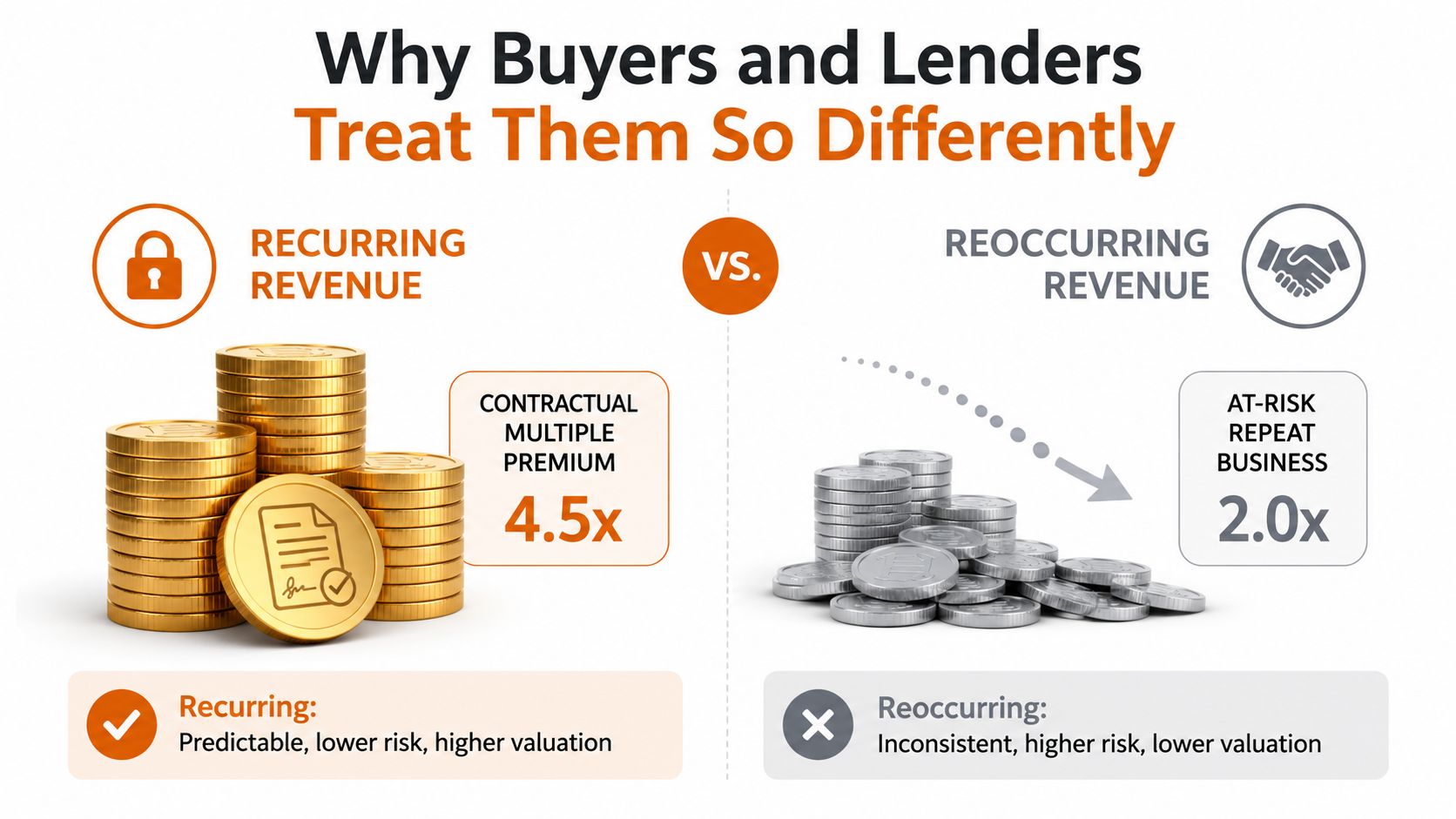
Contractual revenue reduces one important uncertainty: whether the customer has already agreed to continue under stated terms. That doesn’t eliminate churn, service failures, pricing pressure, or cancellation risk. It does give a buyer a documented base from which to evaluate renewals and expansion.
A buyer can calculate retention measures such as NRR, gross revenue retention, and churn more meaningfully when the starting population consists of active contracts. Subscription operators commonly treat 100% NRR as break-even, while top performers often target more than 110%. Monthly churn below 3% is commonly described as excellent, 3% to 5% as healthy, and above 7% as a danger zone, according to subscription churn benchmark guidance from Elena Verna.
Those benchmarks aren’t a valuation formula for every HVAC or plumbing company. They illustrate the buyer’s mindset. Contracted revenue can be measured through renewals, contractions, expansions, and cancellations. Reoccurring revenue requires a different analysis built around repeat-purchase rate, customer tenure, frequency, and margin.
Private-market valuation guidance cited by Levera Partners on recurring versus reoccurring revenue places true recurring-revenue SaaS businesses around 4.8x to 5.3x ARR in private markets, with public SaaS often around 6x to 7x. The source contrasts that with repeat-but-noncontractual revenue, which receives a discount because customer behavior doesn’t guarantee retention.
Those figures describe SaaS markets, not a universal multiple for a trades business. Don’t copy a software multiple onto an HVAC company. Apply the principle instead: buyers usually pay more for a revenue stream they can document, renew, transfer, and forecast.
A lender has a different concern. It needs confidence that cash flow will support repayment. A strategic acquirer may also value the repeat-customer list, but it will test how many customers return without the owner personally selling, scheduling, or rescuing the relationship.
Use separate lines in your confidential information memorandum. Present contracted recurring revenue, reoccurring revenue, one-time project revenue, and usage or overage revenue independently. There isn’t a universal percentage at which every buyer stops discounting the business, but guidance often treats 50% or more of total revenue from recurring sources as a practical sign that predictability materially improves valuation and cash-flow stability, as summarized by Geckoboard’s MRR resource.
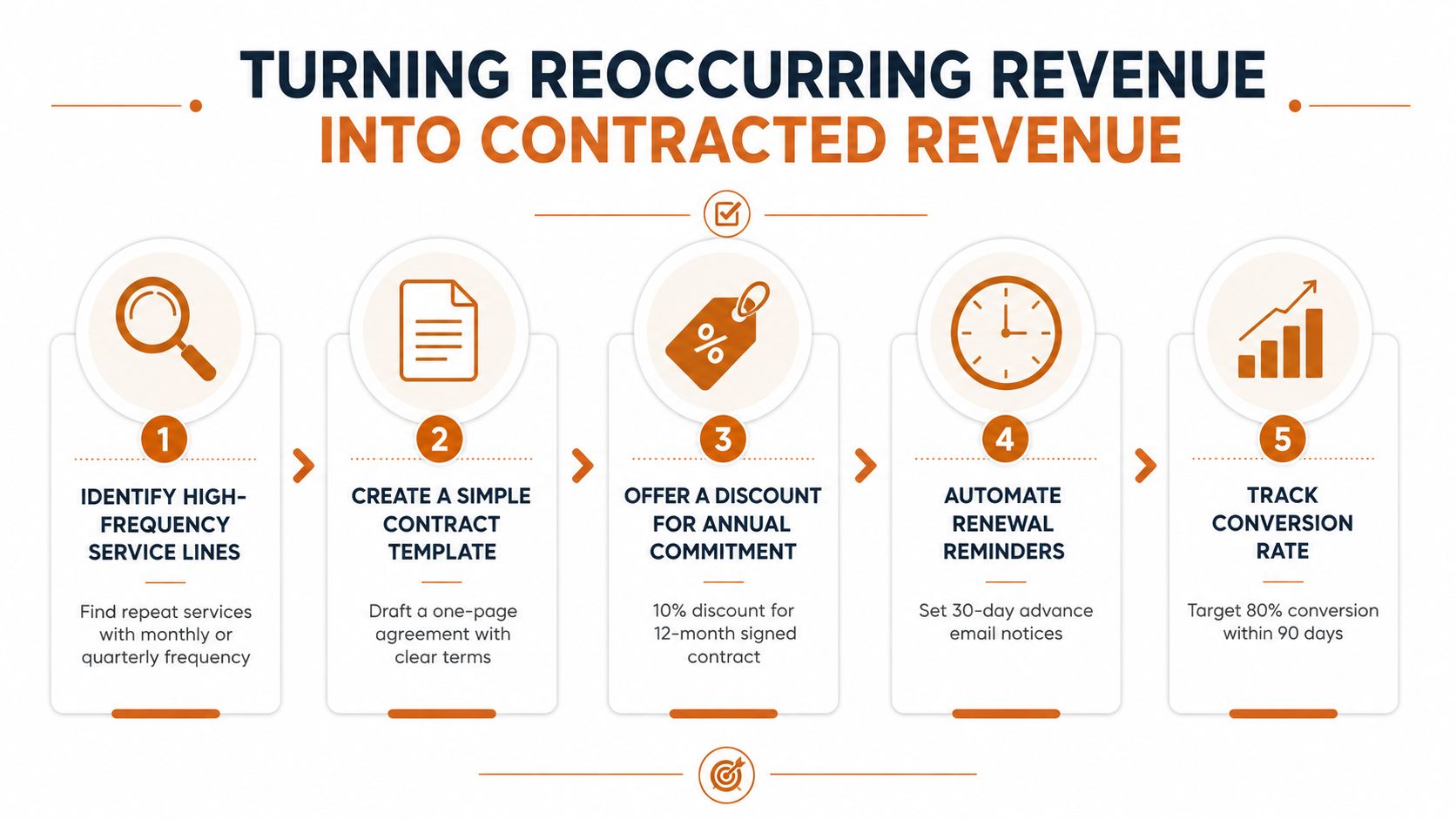
Start with service lines that already repeat, produce acceptable margins, and fit a schedule your team can deliver. Do not offer a contract to every customer at once. Build one focused pilot, document the results, then expand what works.
Review customer and job history. Sort accounts by service frequency, gross margin, average invoice, response burden, and time since the last purchase. Customers who repeatedly buy a service with seasonal or scheduled demand are better pilot candidates than customers whose work is unpredictable or difficult to price.
Choose one narrow offer. An HVAC company might begin with a maintenance agreement. A plumbing company could offer scheduled inspections for commercial properties. A lawn-care operator might package defined visits with seasonal treatments. Keep the scope clear for customers and straightforward for operations staff.
A workable agreement should state:
Have counsel review the document, especially automatic-renewal language and consumer requirements in the jurisdictions where you operate. Legal uncertainty weakens buyer confidence instead of strengthening it.
A discount may help a customer commit, but it can turn uncertain revenue into predictable low-margin revenue. Offer benefits that cost less than a price cut, such as priority scheduling, documented inspections, preferred booking windows, or bundled maintenance.
Separate agreement customers from noncontractual repeat buyers in your CRM. Record renewal dates, service utilization, missed visits, cancellations, and technician notes. Set renewal reminders in ServiceTitan, Housecall Pro, Jobber, or the system your team already uses. The software matters less than consistent tagging and follow-through.
Track contract conversion, renewal behavior, gross margin, utilization, cancellation reasons, and available service capacity. Set response commitments your dispatch board can support. A missed visit or delayed repair can weaken the retention record you will later show a buyer.
Run the pilot long enough to expose delivery problems, then put the results into your sale materials. Show contracted revenue separately from repeat jobs, one-time projects, and usage or overage charges. Buyers need to see which income is supported by an agreement and which depends on customers choosing to return.
Some owners overcorrect after learning the recurring versus reoccurring distinction. They try to force every repeat customer into a contract, even when the contract would lower margin, add administrative work, or make the service less attractive.
That can be a mistake. A reoccurring revenue stream may deserve serious buyer attention when customers return through a clear pattern, the company earns strong contribution margin, the work doesn’t depend on the owner’s personal involvement, and the business can forecast demand from its history. Contractual status is powerful, but paperwork isn’t the only evidence of durability.
A seasonal HVAC tune-up booked reliably by customers who schedule ahead may be more profitable than a heavily discounted maintenance plan. A commercial plumbing account that repeatedly awards work through a formal procurement rhythm may be strategically important even without a blanket service agreement. The owner should present those facts clearly, not rename them.
Build a side-by-side analysis for each major reoccurring line:
Then compare the result with a contract alternative. If the proposed agreement requires a large discount, adds costly included work, or creates scheduling obligations that reduce overall capacity, the contract may be weaker than the existing repeat model.
Subscription Flow’s discussion of recurring versus reoccurring revenue makes the useful broader point that behaviorally sticky, high-margin repeat revenue can hold strategic value even without contractual lock-in.
Decision rule: Defend reoccurring revenue when its historical behavior, margin, and transferability are stronger than the economics of the contract you would create.
Watch for warning signs. Customers may appear loyal because discounts keep them from leaving. Repeat work may depend on one estimator, one technician, or one personal relationship. A seasonal spike may look reliable until weather, construction cycles, or local competition changes. If the pattern collapses when the owner stops making personal calls, it’s not valuation-grade loyalty yet.
A buyer will not pay a premium for revenue you cannot classify, explain, or reproduce. Use the next 90 days to establish a clean baseline, run a focused contract pilot, and leave records another owner can understand.
Audit the trailing twelve months by customer, service line, invoice type, and contract status. Tag every line as contractual recurring, reoccurring, one-time, or usage-based. A customer who has purchased more than once does not automatically belong in the recurring bucket.
Calculate MRR and ARR only from contractual recurring revenue. Build a separate reoccurring report showing purchase frequency, repeat history, gross margin, seasonality, and customer concentration. The report should let a buyer distinguish committed revenue from repeat demand without blending the two.
Set gross-margin baselines by service line. Pull cancellation records, renewal dates, average customer tenure, and customer-level revenue history. If your accounting system cannot produce these reports, create a controlled spreadsheet and have your bookkeeper reconcile it to the general ledger.
Choose the three service lines with the clearest repeat behavior and strongest operational fit. Select high-value customers for a contract pilot, while protecting margin. Use a simple agreement with defined scope, renewal, cancellation, pricing, and service expectations.
Reprice repeat-buyer offers if the current arrangement hides the value you deliver. Add priority scheduling or planned inspections only when they improve retention without overloading dispatch. Train the team to present the offer consistently, then record objections, cancellations, and delivery problems.
Track:
Package the results in a one-page recurring revenue scorecard. Show contractual MRR, ARR, renewals, cancellations, expansion, reoccurring revenue, one-time revenue, gross margin, and customer concentration. Add your classification policy in plain language so a buyer does not have to infer what each category means.
Brief your bookkeeper on contract billing, deferred revenue, and delivered project work. Ask your accountant whether quality-of-earnings preparation makes sense, especially if the records combine service agreements, prepaid work, projects, and usage charges.
Bring in a specialist if a sale is likely within 18 months, a buyer asks for your ARR definition, or NRR remains below 100% for two consecutive quarters, using the retention framework cited earlier. Those are signals that classification, retention, or both need outside scrutiny.
You can use a curated directory such as The Owner’s Shortlist to review specialists for valuation, accounting, legal preparation, financing, and succession decisions before engaging an advisor.
The finished work should answer four buyer questions: which revenue is committed, which repeat customers could sign a contract, which profitable patterns deserve protection, and which risks require a discount. Complete those answers before the sale process begins.
Tell us your situation. We'll connect you with a specialist who works with owners like you. One conversation, no sales pressure.
Found this useful?
Add The Owner's Shortlist as a preferred source and get our articles highlighted in Google Search results.
Add to Preferred SourcesSell My HVAC Business. Thinking about selling your HVAC business? Learn how owners prepare, value, negotiate, and close a sale
October 9, 2026
What Is SDE. Learn what SDE means in business valuation, how to calculate it with common add-backs, how it differs from EBITDA, and why buyers and lenders focus
October 7, 2026
Discover what a business valuation report includes, how to interpret it, and why it matters for your company's financial strategy.
October 6, 2026
Explore the best value drivers that influence exit value, with practical steps owners can take before engaging a valuation specialist.
October 4, 2026