SDE vs EBITDA: Which Metric Fits Your Business Sale
Confused by SDE vs EBITDA? Learn when each metric applies to your owner-operated business, how adjustments change valuations, and which buyers prefer which
October 3, 2026
By Remi Taffin · October 4, 2026

Revenue alone does not set a sale price. Buyers pay more for earnings that are profitable, predictable, and transferable, with evidence they can continue after the owner exits.
This roundup covers eight value drivers, from customer mix and recurring revenue to systems, personnel, and owner dependence. Each section explains why the driver affects buyer confidence, shows how it appears in a trade or home-service business, and gives owners practical steps to strengthen the evidence before commissioning a formal valuation.
Consider an HVAC company with service contracts, clean job costing, documented dispatch procedures, trained technicians, and no customer representing most of its sales. Those facts can support stronger buyer confidence than a larger but less predictable revenue figure. Owners preparing for sale can also review this guide to overcoming buyer objections with data.
Preparation turns operational strengths into defensible valuation evidence.
The Owner’s Shortlist provides plain-language valuation guidance and access to curated specialists. It is not legal, tax, or financial advice.
Before researching the best value drivers, confirm that the phrase refers to business valuation, not golf equipment. For The Owner’s Shortlist audience, the purpose is to help owner-operators prepare for succession, an intergenerational transfer, or a potential sale by improving the factors buyers and valuation specialists examine.

A strong listicle starts with the reader’s decision, not an unverified placeholder.
Before assigning research, confirm four items:
For example, a request for golf equipment on a business-owner directory signals a brief mismatch, much like requesting cooking tips for a legal-advice site. Correcting it early prevents irrelevant research and ensures the final roundup leads readers toward practical business planning. Use a brief template that records the mission, target reader, commercial purpose, and approved visual direction. Choose a grounded business-planning image rather than golf imagery.
A clear client business profile gives valuation, tax, legal, and succession specialists the facts needed to assess risk and identify the best value drivers. It should explain how the company earns money, who controls key relationships, and what might change if the owner steps away.

Prepare a two-page profile covering:
A plumbing company, for example, may discover that 40% of revenue depends on the owner’s personal relationships with property managers. Documenting those accounts, assigning account ownership, and introducing service agreements can reduce transfer risk before a sale.
Buyers pay more readily for documented performance that does not depend on one person.
Use the profile at least 12 to 24 months before a planned transaction. Update it quarterly, then share it with a valuation specialist, tax adviser, succession planner, or M&A lawyer through a vetted directory such as The Owner’s Shortlist.
The original request for “best value golf drivers” does not fit The Owner’s Shortlist audience. Here, best value drivers should refer to the business factors that increase sale value, improve succession readiness, and support a stronger valuation multiple.
Keep golf equipment research in a separate consumer channel. For an owner-operated business publication, replace that topic with practical guidance on the drivers buyers and valuation specialists review:
A clear example is an HVAC company that shifts from one-off repair calls toward maintenance agreements. Recurring contracts make revenue easier to forecast, while documented service procedures reduce dependence on the owner. The same principle applies to customer concentration, margins, management depth, and reliable financial records.
A relevant business guide should help owners improve value, not send them toward unrelated product comparisons.
Owners can learn more about the factors that drive a business multiple before commissioning a formal valuation. Use the topic correction early so research, examples, imagery, and referrals all support the reader’s exit or succession decision.
Before researching the best value drivers, confirm that the brief describes business valuation rather than golf equipment. A placeholder topic can send an otherwise useful roundup toward the wrong audience, examples, and commercial purpose.
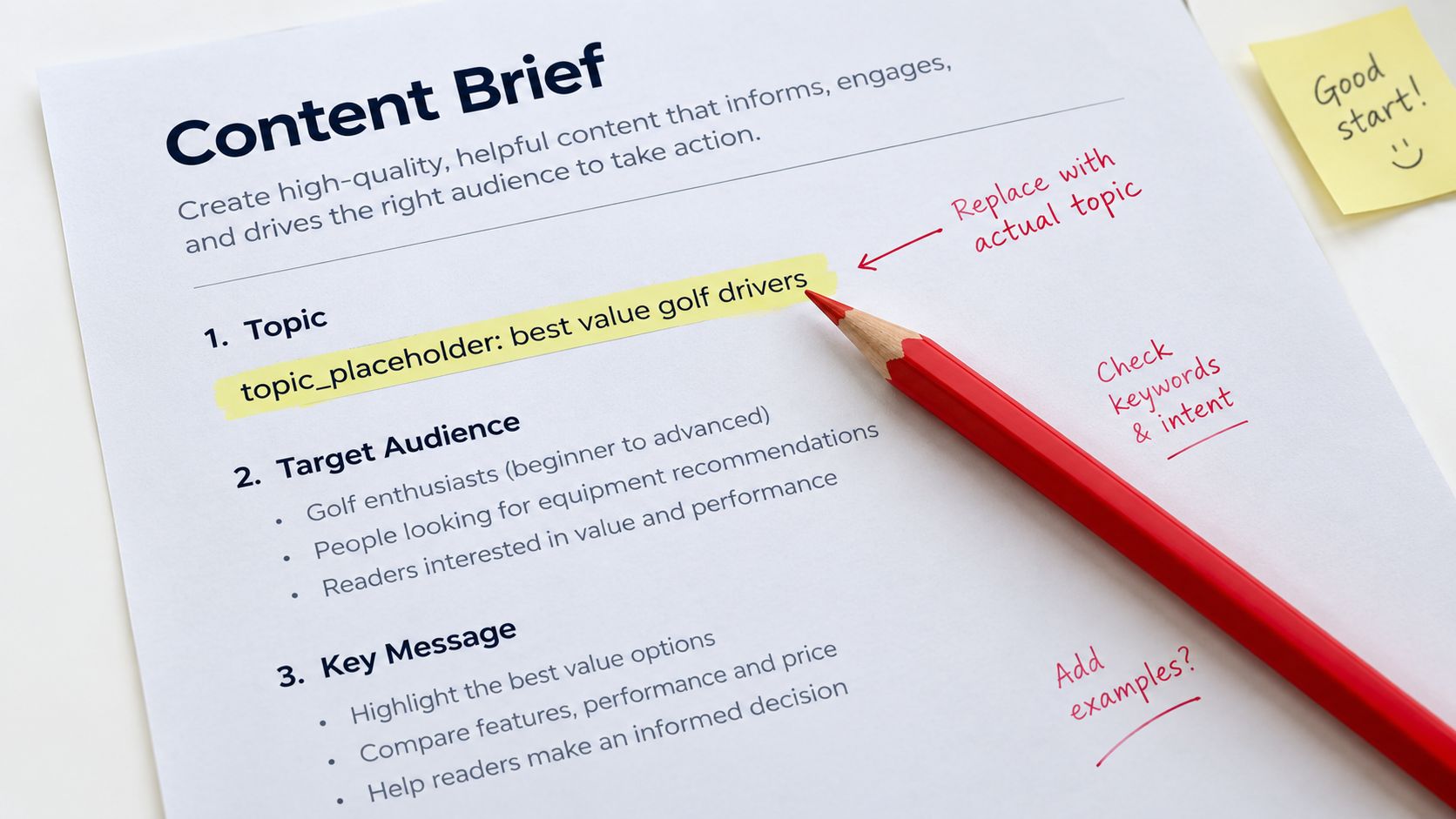
A clear business context protects both research quality and reader trust.
Before sending a request, check:
A common example is a copy-paste brief that still says “best value golf drivers” after the client requested content for HVAC or plumbing owners. The same problem occurs when a generic form lacks a business-context field, leaving writers to guess the intended market.
Audit templates and request forms for default wording, then require a short context statement covering the client, industry, reader, and desired outcome. For instance, “Help HVAC owners improve recurring revenue and sale readiness” immediately supports relevant examples, such as maintenance agreements, customer concentration, and documented service procedures. This checkpoint belongs in the list because accurate research is the first condition for useful valuation guidance.
If “best value drivers” is intended for The Owner’s Shortlist, reframe the assignment around the business owners who need help preparing for succession, an intergenerational transfer, or a sale. Instead of listing unrelated products, create a useful roundup of specialist categories or resources that help owners improve and document enterprise value.

The strongest business-focused roundup connects each recommendation to a decision an owner must make before an exit.
A practical list could cover:
Explain whether the roundup will compare individual firms, specialist categories, or resource types. Before research begins, record the geographic scope, preferred business size, relevant trade sectors, and any fee or budget considerations.
This approach deserves a place among the best value drivers because the right adviser can expose weak margins, customer concentration, undocumented systems, or recurring-revenue opportunities. Owners of HVAC or plumbing businesses can also learn more about recurring revenue before selecting a specialist. Use this format when the audience needs practical referrals rather than a generic list of valuation factors.
If the brief genuinely concerns the best value drivers in golf, reframe the assignment around equipment rather than business valuation. This approach can satisfy a consumer searcher comparing price, forgiveness, adjustability, and performance, but it does not serve owners preparing a company for succession or sale.
A clear audience decision prevents useful research from appearing in the wrong publication.
Before producing the comparison, confirm four items:
A useful review should report current pricing, test conditions, shaft options, and player type rather than simply naming a winner. Publish the piece separately if the main directory serves business owners, then link or tag it clearly so readers understand the change in subject.
I recommend Option 1, reframing the article around business value drivers, because it matches The Owner’s Shortlist mission and gives owner-operators practical guidance for succession, financing, or a potential sale. A roundup of recurring revenue, margins, customer concentration, operating systems, and personnel can help readers identify what buyers and valuation specialists will examine.
Choose the business brief unless the audience specifically requires consumer golf content.
Before approving the assignment, confirm:
For example, an HVAC owner may need practical steps for documenting service agreements and reducing dependence on one large customer, while a family manufacturer may need guidance on management depth and succession planning. Option 2 remains suitable only when the publication specifically wants golf equipment recommendations. Clarifying the brief early keeps the best value drivers article focused, actionable, and relevant to owners preparing for a transition.
The final step is turning the best value drivers into a practical preparation plan. Owners should decide whether they need specialist referrals for valuation and succession, or product research for an unrelated golf-equipment request. The correct choice determines the research, evidence, and output required.
A clear brief turns general advice into a decision-ready deliverable.
For Option 1, specify:
A useful JSON deliverable could contain eight specialist categories, each with a description, ideal use case, selection tips, and questions to ask. Owners preparing an HVAC, plumbing, or family business for sale can then match each value weakness with the right advisor. Learn more about business appraisal services before commissioning a formal valuation.
For Option 2, confirm the golf-driver budget, player level, and required specifications. Use these checks before research begins so the final list supports the reader’s actual decision rather than an unclear interpretation of “best value drivers.”
| Item | Implementation complexity 🔄 | Resource requirements ⚡ | Expected outcomes 📊 | Ideal use cases ⭐ | Key advantages / Tips 💡 |
|---|---|---|---|---|---|
| Context Mismatch Identified | 🔄 Low — simple detection | ⚡ Minimal — brief review | 📊 Prevents off-topic publication | ⭐ Editorial QA / pre-publish checks | 💡 Verify topic vs mission; include audience in briefs |
| Client Business Profile | 🔄 Low — documented profile | ⚡ Moderate — maintain directory data | 📊 Clear audience alignment; consistent messaging | ⭐ Source for content & listings | 💡 Curated specialists in valuation, tax, legal, succession |
| Requested Topic (Best value golf drivers) | 🔄 Low (researchable) | ⚡ Moderate — review aggregation/testing | 📊 Strong consumer SEO but low site relevance | ⭐ Consumer golf sites or separate channel | 💡 If needed, publish on a distinct consumer channel |
| Probable Cause (template error) | 🔄 Low — corrective action | ⚡ Minimal — audit forms/templates | 📊 Fewer repeat mismatches after fix | ⭐ Process improvement / template QA | 💡 Audit templates; require business-context field |
| Option 1 — Reframe to Business (Recommended) | 🔄 Moderate — content reframing & curation | ⚡ Moderate — subject research, formatting (JSON/CSV/MD) | 📊 High relevance and engagement; supports site mission | ⭐ Directory entries, editorial resources for owners | 💡 Specify categories/region/output; typical turnaround 1–2 days |
| Option 2 — Reframe to Golf Drivers | 🔄 Moderate — product research & comparison | ⚡ Moderate–High — testing, market data, specs | 📊 Good consumer value but irrelevant to core audience | ⭐ Consumer/golf audience or separate channel | 💡 Tag clearly or host on separate consumer channel |
| Recommendation | 🔄 Low — decision step | ⚡ Minimal — confirmation needed | 📊 Maintains editorial coherence if Option 1 chosen | ⭐ Editorial strategy decisions | 💡 Confirm desired output (categories vs resources) and constraints |
| Next Steps / Call to Action | 🔄 Low — request for choices | ⚡ Minimal — user supplies inputs | 📊 Ready-to-produce deliverable within 24–48h after confirmation | ⭐ Project kickoff / brief clarification | 💡 Provide chosenOption, region, and outputFormat for delivery |
The best value drivers are not abstract scores on a valuation worksheet. They are operating facts a buyer, lender, or adviser can verify: recurring revenue that renews, margins that hold after owner compensation is normalized, customers who are not overly concentrated, documented systems, capable personnel, clean financial records, manageable risk, and a business that can continue without its founder.
The first step is to keep the analysis focused on the business owner and the company being prepared for succession or sale. A clear profile should identify the trade or service model, revenue mix, customer base, geography, owner responsibilities, growth constraints, and likely transfer timeline.
That corrected brief prevents useful questions from being lost in irrelevant comparisons. The goal is not simply to find a high valuation number. It is to show why the company deserves confidence and what a new owner can realistically maintain.
Owners can assess the eight drivers by pairing every claim with a record, process, or measurable trend:
Before contacting a valuation specialist, owners should:
Strong operations become stronger valuation evidence when they are repeatable, measured, and easy for another person to verify. The Owner’s Shortlist offers plain-language research and curated specialist connections for owners working through the best value drivers and preparing for the next stage of ownership. Explore The Owner’s Shortlist as a practical starting point, not a substitute for individualized valuation, tax, legal, or financial advice.
Tell us your situation. We'll connect you with a specialist who works with owners like you. One conversation, no sales pressure.
Found this useful?
Add The Owner's Shortlist as a preferred source and get our articles highlighted in Google Search results.
Add to Preferred SourcesConfused by SDE vs EBITDA? Learn when each metric applies to your owner-operated business, how adjustments change valuations, and which buyers prefer which
October 3, 2026
This business valuation guide explains how to calculate what your company is worth using proven methods. Get clarity for 2026 sale, funding, or planning.
October 2, 2026
Explore business valuation meaning for owner-operated firms. Learn valuation methods, drivers, misconceptions, and steps to secure a defensible valuation.
September 28, 2026
What Is Recurring Revenue. Learn what recurring revenue is, how ARR and MRR work, real trade examples, and why this revenue model shapes business value and exit
September 23, 2026