What Is SDE and How Does It Shape a Business Sale
What Is SDE. Learn what SDE means in business valuation, how to calculate it with common add-backs, how it differs from EBITDA, and why buyers and lenders focus
October 7, 2026
By Remi Taffin · August 18, 2026
You’re sitting across from a buyer who has asked what your company is worth. You name a figure based on years of work, loyal customers, equipment, and the profit shown on your books. The buyer pauses, asks about owner dependence and working capital, then presents a number that feels far lower than expected.
That moment exposes the problem with casual valuation estimates. A headline figure isn’t the same as a defensible appraisal, and a defensible appraisal isn’t the same as the cash you’ll receive at closing. The right business appraisal service helps you understand all three.
Most owners first hear a valuation number in an informal setting. A broker mentions a rough multiple at a networking event. A buyer calls with an unsolicited offer. A partner forwards a calculator after searching for a business appraisal service online.
The number sounds precise, but the underlying work may be almost nonexistent. Someone may have applied an industry multiple to reported earnings without examining add-backs, customer concentration, debt, working-capital requirements, or the extent to which the company depends on the owner.

Owners usually need clarity on three separate issues:
A valuation is a process, not a price tag. Two qualified professionals can reach different conclusions because they may use different assumptions about risk, cash flow, control, marketability, or the purpose of the engagement. That doesn’t automatically mean one is wrong. It means you need to understand the assignment before comparing the numbers.
Practical rule: Never approve a valuation based only on the final figure. Ask what earnings measure, adjustments, transaction evidence, and assumptions produced it.
A casual estimate can help you form an early expectation. It shouldn’t decide whether you accept an offer, structure a partner buyout, transfer shares to family, or borrow against the company. Those decisions require a number that can withstand questions from buyers, lenders, attorneys, shareholders, and tax professionals.
A business appraisal service estimates a company’s economic value through documented analysis. The provider reviews financial performance, assets, liabilities, future earning capacity, ownership interests, industry conditions, and business risks. The result is a written report that defines the assignment, explains the methods used, states key assumptions, and presents a value conclusion or range.
The report is only one part of the service. A capable appraiser also identifies the operational factors affecting value before a sale, such as owner dependence, earnings quality, customer concentration, management depth, and the reliability of financial records. Improving those areas can increase the proceeds you ultimately keep, even when the headline valuation changes only modestly.
Professional valuation follows recognized standards across jurisdictions. The International Valuation Standards Council sets International Valuation Standards as a principle-based framework for valuing companies, assets, and liabilities. RICS says its valuation standards incorporate IVS, and its Red Book Global was updated in 2026 with reorganized valuation procedure standards. A serious appraisal therefore rests on defined expectations, documented reasoning, and more than a private spreadsheet formula.
Marketing materials often blur these terms, but each describes a different level of work:
Credentials matter, but they do not replace judgment. Owners may encounter ASA, ABV, CVA, and CEIV designations. Ask what each credential requires, how much valuation work the professional performs, and whether the provider regularly handles companies like yours.
The purpose determines the assignment. Divorce, estate transfer, financing, partner buyout, sale preparation, and succession planning can require different standards of value and report depth. Explain why you need the number before discussing the fee.
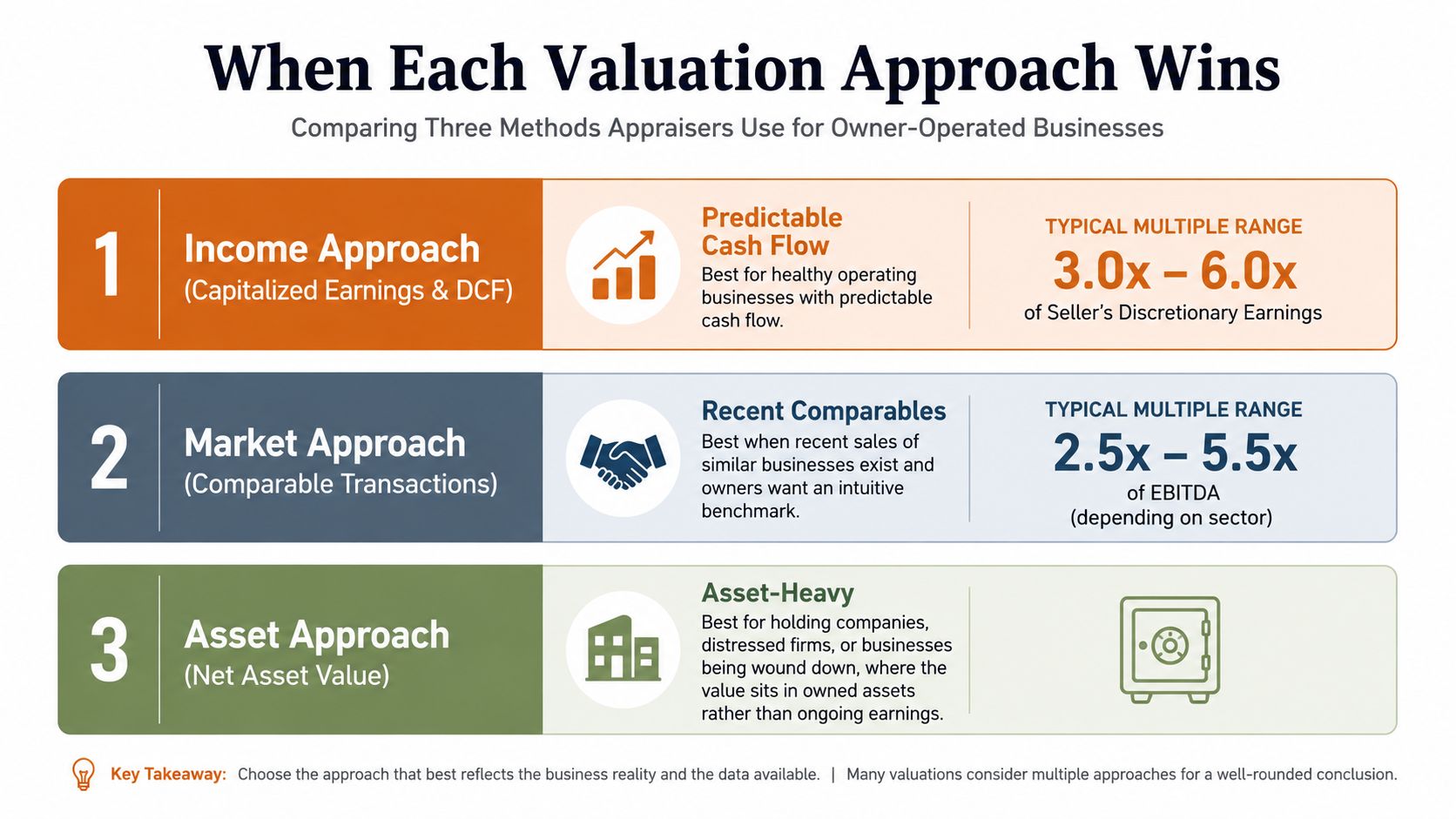
A competent appraiser doesn’t force every company through the same formula. The business’s economics determine which approach carries the most weight.
The income approach converts expected future economic benefits into present value. It fits a healthy operating company whose cash flow provides the main reason a buyer would pay for it.
A capitalized earnings method can work when current operations represent a stable pattern that should continue. A discounted cash flow method is more suitable when management expects changing growth, uneven cash flow, or a meaningful shift in operations. Both methods require judgment about risk and future performance.
Consider an established service company with recurring contracts, consistent margins, and a management team that already handles daily operations. Its value rests primarily in its ability to generate future cash flow, so the income approach deserves serious attention.
The market approach compares the subject company with relevant private transactions or publicly traded companies, then applies an appropriate pricing multiple. It’s intuitive because owners can relate the method to property comparables. The difficulty lies in finding directly comparable transactions.
A neighborhood contractor with project-based revenue shouldn’t automatically be compared with a larger company that has recurring service agreements, stronger management depth, and less customer concentration. The appraiser must adjust the analysis for differences in size, risk, profitability, capital needs, and ownership structure.
The asset approach values the company through its assets and liabilities. It becomes more useful when the company owns substantial equipment, real estate, inventory, or investment assets, or when ongoing earnings don’t explain the company’s worth.
A holding company may be worth more for its owned assets than for operating income. A distressed company may require an asset-based analysis because a buyer is evaluating liquidation value rather than future operations. The method can also help establish a floor, although it may understate intangible value such as customer relationships, brand strength, or proprietary processes.
| Approach | Best fit | Main question |
|---|---|---|
| Income | Predictable operating cash flow | What future benefits can the business produce? |
| Market | Relevant transaction evidence | What have comparable businesses sold for? |
| Asset | Asset-heavy or distressed companies | What do the assets contribute after liabilities? |
The strongest report may reconcile more than one approach. The appraiser’s job isn’t to pick the method that produces the most flattering answer. It’s to explain why the selected approach reflects the company’s actual economics.
Industry multiples provide a starting range, not a promised price. They compress several buyer judgments into one figure, including risk, profitability, transferability, and growth prospects. Owners get hurt when they treat a sector benchmark as an entitlement instead of asking what their business must prove to earn it.
BizBuySell’s sector data uses a trailing five-year aggregation of sales and is updated biannually, with the cited dataset covering businesses sold from Q3 2021 through Q2 2026. It reports an average earnings multiple of 2.58x across all businesses and an average revenue multiple of 0.67x. The business valuation multiples data helps put those figures in context and keeps owners from treating them as automatic pricing rules.
Revenue alone does not determine value. BizBuySell reports food and restaurants at 2.27x earnings and 0.42x revenue, while financial services averages 2.46x earnings and 1.21x revenue in the cited dataset. The gap can reflect margins, recurring revenue, capital intensity, regulation, customer relationships, and buyer demand. Use BizBuySell’s sector valuation table to compare earnings and revenue benchmarks directly.
| Sector | Earnings Multiple | Revenue Multiple |
|---|---|---|
| All businesses average | 2.58x | 0.67x |
| Food and restaurants | 2.27x | 0.42x |
| Financial services | 2.46x | 1.21x |
Revenue multiples require extra discipline. They make more sense when revenue quality is strong, margins are understood, and customers produce repeatable economic value. A high-revenue company with weak margins can be worth less than a smaller, more profitable competitor.
Reject any provider who gives you one multiple without a range or explanation. Ask which metric is being multiplied, whether the benchmark reflects completed transactions, how your company differs from the comparables, and whether the conclusion assumes cash-free, debt-free terms or another deal structure.
A benchmark opens the valuation conversation; it doesn’t resolve it.
Use the chart as a sanity check while the appraiser tests normalized earnings, risk, and transferability. A defensible range gives you a better sale-preparation target than a falsely exact figure. Operational improvements that strengthen margins, reduce owner dependence, or make revenue more repeatable can move that range before a buyer ever submits an offer.
You’re not paying for a number on a phone call. You’re paying for a defined professional process and a report that shows how the conclusion was reached.
A finished report commonly identifies the client, valuation date, purpose, ownership interest, standard of value, scope, information reviewed, assumptions, limitations, methodology, financial analysis, and reconciliation of the approaches. It should explain normalized earnings, relevant market evidence, material risks, and the final conclusion.
A three-page estimate may be useful for preliminary planning. It isn’t equivalent to an appraisal prepared for a dispute or transaction where another professional will challenge the work.
The appraiser will usually need more than tax returns. Gather:
The cleaner the records, the fewer avoidable delays you’ll create. More important, documentation lets the appraiser test whether an adjustment is transferable to a buyer.
A limited valuation for a straightforward operating business can take two to four weeks, while a full appraisal for litigation, a buy-sell dispute, or a complex capital event typically takes six to twelve weeks. Those planning ranges come from the assignment brief, not a promise that every provider will follow them.
Fees rise with the number of entities, ownership interests, valuation dates, reporting requirements, data gaps, required interviews, and disputes over assumptions. Ask whether the provider charges a fixed fee, hourly rates, a retainer, or a combination. The guide to business valuation costs can help you frame questions before requesting proposals.
Your engagement letter should state the scope, deliverable, timing, fee basis, client responsibilities, assumptions, and what happens if the assignment expands. Ambiguity is where surprise invoices begin.
A valuation conclusion describes value under stated assumptions. It doesn’t promise that a buyer will deliver the same amount in cash at closing.
The gap usually appears during buyer diligence and deal negotiation. The buyer tests every adjustment, reviews working-capital needs, confirms debt and liabilities, and decides how much risk belongs in the purchase price versus the deal structure.
Owners often add back personal expenses, excess compensation, family payroll, one-time repairs, or unusual legal fees to calculate seller’s discretionary earnings. Some adjustments are reasonable. Others won’t survive scrutiny.
A buyer asks whether the expense disappears after closing. If the owner performs sales, estimating, scheduling, hiring, or technical work, the buyer may need to replace that person. The supposed add-back then becomes a future operating cost.
Current commentary describes many small businesses as loosely quoted at 2x to 4x SDE, while private-company multiples have normalized and buyer underwriting has become more conservative after the 2021 boom, as reported by FE International’s business valuation coverage. The headline multiple matters less than the quality of the earnings being multiplied.
Working capital creates another quiet reduction. A buyer may require the company to deliver a normalized level of receivables, inventory, or operating cash at closing. If the business falls short, the purchase price can be adjusted.
Debt and liabilities also affect what the owner receives. A stated enterprise value may not equal equity proceeds after debt, transaction expenses, taxes, indemnity escrows, or other obligations.
Tighter lending conditions have also encouraged greater use of earnouts and seller financing, according to the same FE International coverage. That means the offer headline may include payments that depend on future performance or the buyer’s repayment, rather than cash delivered on closing day.
Ask this before reacting to an offer: “How much cash do I receive at closing, what remains contingent, and which liabilities or adjustments reduce that amount?”
Owner dependence can compress value before negotiations even begin. A 2025 private-business dataset found nearly 40% of firms would see revenue drop if the owner left, and only 28% carried insurance coverage, according to coverage of BizEquity’s 2025 Almanac. Buyers increasingly examine management depth, technology, recurring revenue, independence, and intangible assets alongside historical earnings. If customers buy because they trust you personally, the buyer is purchasing a risk, not just a profit stream.
A low fee becomes expensive when the report cannot withstand questions from your buyer, lender, attorney, or partner. Choose an appraiser who can defend the analysis and connect the conclusion to your company’s actual economics. A promised high figure is not a qualification.
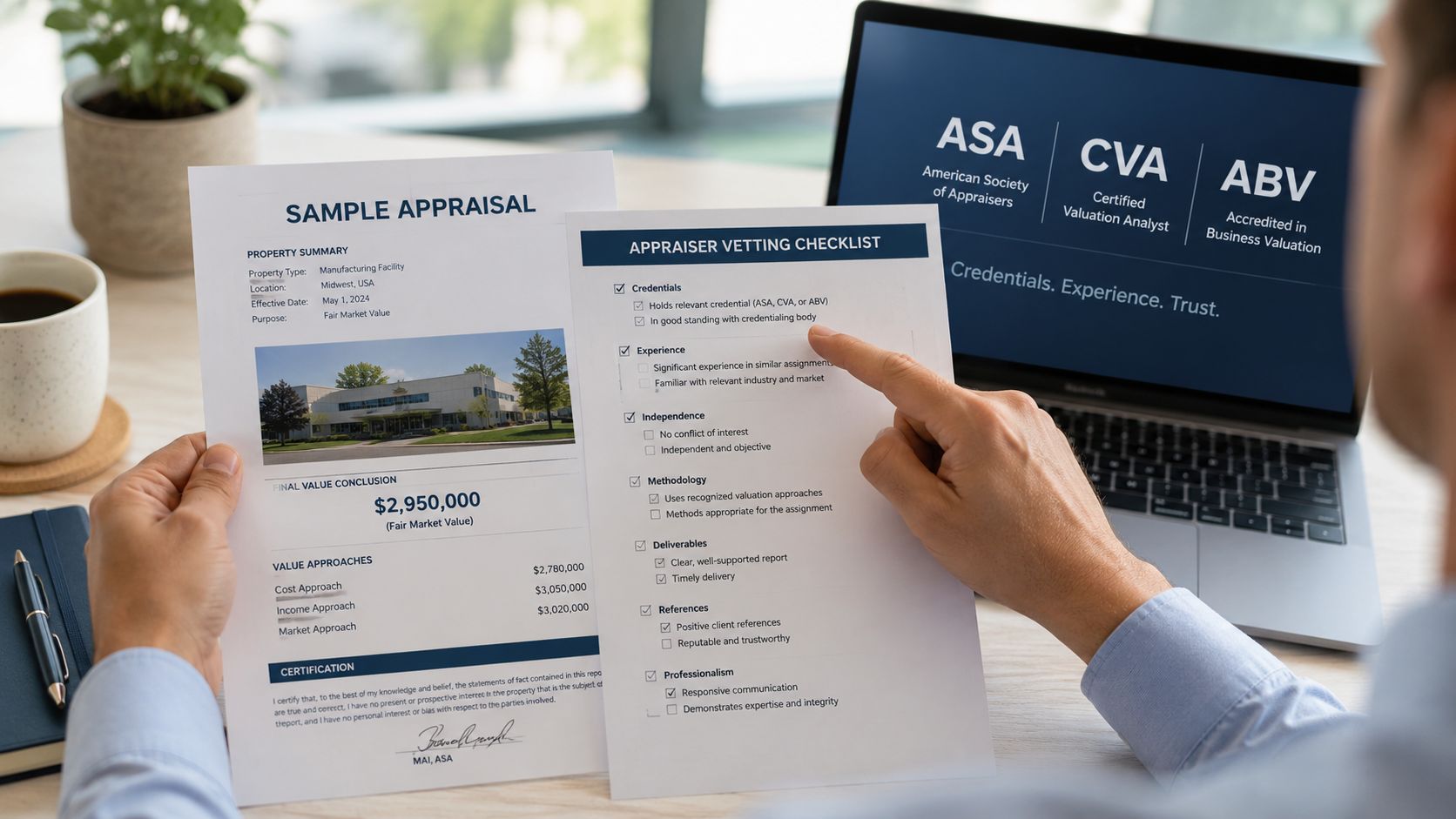
Check credentials and relevant experience first. Ask whether the provider holds a designation such as ASA, ABV, CVA, or CEIV, and how often they value owner-operated companies in your sector. Credentials show training. Sector experience shows whether the appraiser understands customer concentration, field labor, recurring contracts, equipment, and the cost of replacing the owner.
A provider who quotes a valuation before reviewing records is selling confidence, not analysis. Walk away from anyone who refuses to discuss assumptions, avoids a written scope, or treats every company in an industry as interchangeable. The appraiser’s job is to explain why the selected approach reflects the company’s actual economics.
Regional specialists may fit companies whose value depends on local customers, labor, licensing, or transaction conditions. A national firm may offer more resources for complex ownership, litigation, multiple entities, or a larger transaction. Choose based on the assignment and the quality of the proposed work, not the logo.
Before signing, review the process for finding a business valuation specialist. Then request a written proposal, engagement letter, fee schedule, confidentiality terms, timeline, and procedure for scope changes. These documents expose exclusions before they become extra costs or weaken the report’s usefulness in a sale.
You don’t need to hire an appraiser tomorrow to improve your understanding of value. You do need to stop relying on a single optimistic estimate.
Separate owner-specific spending from genuine operating expenses. Identify which costs are nonrecurring, which benefits disappear after a sale, and which responsibilities a buyer would need to replace. Map revenue by customer, contract type, margin, and repeatability. Write down the systems and decisions that still depend on you.
Request written scopes from two or three providers. Compare the purpose, standard of value, methods, report type, assumptions, data requirements, timeline, fee structure, and independence terms. If one quote is dramatically cheaper, find out what work it excludes.
Then use the sector benchmarks cited earlier to form a reasonable expectation range. Don’t argue that a multiple belongs to you. Ask what would need to be true for your business to justify the stronger end of the range.
A formal appraisal makes sense now for a divorce, partner buyout, estate freeze, bank financing, litigation, or an unsolicited offer. For early sale preparation, a limited valuation or peer benchmark may provide enough direction to improve operations before commissioning a full report.
The Owner’s Shortlist connects business owners with curated specialists for valuation, tax, legal, financing, succession, and related decisions, while its practical guides explain the questions to ask before hiring anyone. Visit The Owner’s Shortlist to review business value resources and find an appropriate specialist for your next valuation conversation.
Tell us your situation. We'll connect you with a specialist who works with owners like you. One conversation, no sales pressure.
Found this useful?
Add The Owner's Shortlist as a preferred source and get our articles highlighted in Google Search results.
Add to Preferred SourcesWhat Is SDE. Learn what SDE means in business valuation, how to calculate it with common add-backs, how it differs from EBITDA, and why buyers and lenders focus
October 7, 2026
Discover what a business valuation report includes, how to interpret it, and why it matters for your company's financial strategy.
October 6, 2026
Explore the best value drivers that influence exit value, with practical steps owners can take before engaging a valuation specialist.
October 4, 2026
Confused by SDE vs EBITDA? Learn when each metric applies to your owner-operated business, how adjustments change valuations, and which buyers prefer which
October 3, 2026