What Is SDE and How Does It Shape a Business Sale
What Is SDE. Learn what SDE means in business valuation, how to calculate it with common add-backs, how it differs from EBITDA, and why buyers and lenders focus
October 7, 2026
By Remi Taffin · October 6, 2026
In smaller transactions, sellers typically receive roughly 75%–88% of stated deal value in cash at closing, with seller financing generally representing 10%–19% and earnouts 1%–6%. A headline valuation is therefore an estimate of value, not a promise of the cash you’ll keep.
You’ve owned the company for years, paid the bills, carried the risk, and finally received a valuation number that looks reassuring. Then the buyer mentions debt, a working-capital adjustment, seller financing, and an earnout. Suddenly, the number on the first page no longer resembles the amount you expect to receive on closing day.
A business valuation report is a structured, evidence-based document that translates a company’s financial and operational facts into a supported conclusion of value. It uses valuation approaches, normalized adjustments, market evidence, and explicit assumptions so owners, buyers, lenders, advisers, and tax authorities can understand and challenge the result.
The distinction matters. An online estimate or broker opinion may help you start a conversation, but it usually doesn’t provide the audit trail needed for a sale, succession plan, estate transfer, financing decision, or dispute. A professional report connects the conclusion to the company’s records, risks, ownership rights, intangible assets, and likely economic benefits.
A business valuation report is the written reasoning behind a value conclusion. It connects the owner’s records, operating risks, transferable assets, and expected economic benefits to a defensible result. A calculator can produce a figure. A professional report shows why that figure is reasonable and which assumptions would change it.
For an owner-operated company, the assignment sets the starting point. A report prepared for a potential sale may differ from one prepared for a family transfer, estate planning, litigation, financing, or financial reporting. The purpose affects the standard of value, the valuation date, the ownership interest being examined, and the level of analysis. It also affects how the report treats owner compensation, recurring revenue, customer concentration, and the work required to transfer operations to a buyer.
The historical foundation is IRS Revenue Ruling 59-60, issued in 1959. It identifies eight factors for valuing closely held businesses: the company’s history, economic and industry conditions, financial condition, earning capacity, dividend capacity, goodwill, prior stock sales, and comparable public companies. The practical lesson remains clear. The conclusion should connect to the enterprise’s specific facts, not just a selected multiple.
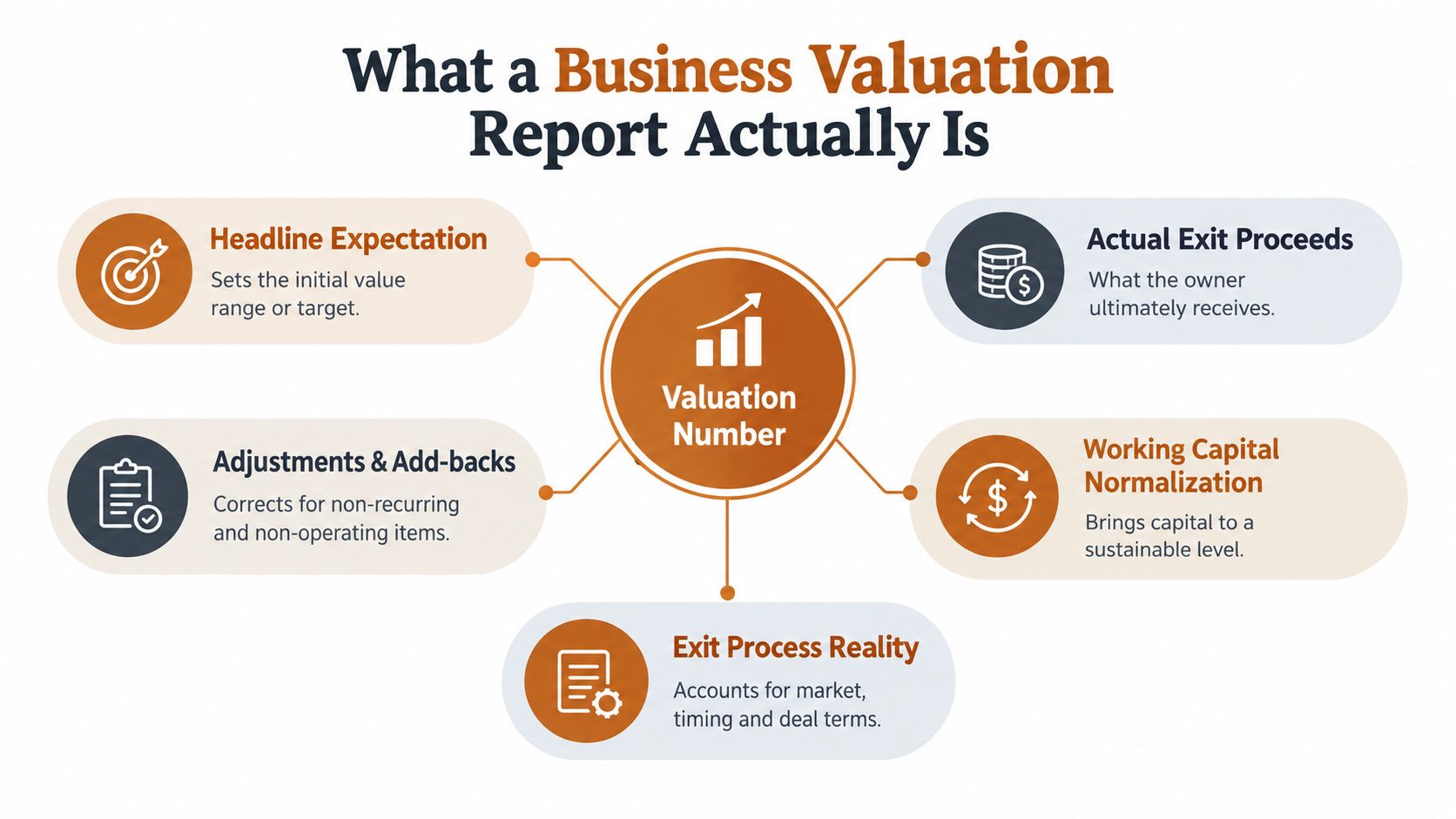
A credible report normally explains:
The same company can support different conclusions under different assignments. A family transfer may require a value that works for active and inactive heirs, the recipient’s financing capacity, tax requirements, and buy-sell terms. A third-party sale may place greater weight on recurring revenue, transfer readiness, and buyer-specific risks.
Practical rule: If the report gives you a number but cannot show how that number changes when an assumption changes, it does not provide enough information for a sound decision.
Start by reading the assignment section, not the conclusion. The first question is what value is being estimated, for whom, and for what purpose.
A report prepared for a potential sale may examine a willing buyer and willing seller under defined market assumptions. An investment-value analysis could reflect a particular buyer’s synergies. A family transfer may focus on fairness, control, minority ownership, tax constraints, and the recipient’s ability to operate the business. The same company can produce different conclusions because the assignment is different.
Look for these items near the front of the report:
The distinction between a conclusion and a calculation matters. A conclusion of value generally reflects a more developed opinion supported by analysis. A calculated value applies agreed procedures and assumptions to produce a result, which may be useful for a defined purpose but shouldn’t automatically be treated as a full appraisal.
Your financial statements also need context. Owners often confuse operating performance with financial position, so it helps to review a plain-language explanation of balance sheet vs income statement before discussing the report with an adviser. The income statement describes performance over a period, while the balance sheet provides a point-in-time view of assets, liabilities, and equity.
A serious report should tell you what financial periods were analyzed, which records were relied on, how forecasts were developed, and how comparable companies or transactions were selected. It should also address debt, excess cash, working capital, contingent liabilities, and material contracts where those items affect the conclusion.
For an owner preparing for diligence, a related quality of earnings report can provide a useful comparison. It typically focuses on whether reported earnings are sustainable and accurately presented, while the valuation report uses that financial understanding to estimate value under a defined assignment.
The three generally accepted approaches are income, market, and asset-based valuation. A professional won’t automatically apply all three with equal weight. The business facts determine which methods are meaningful and how the results should be reconciled.
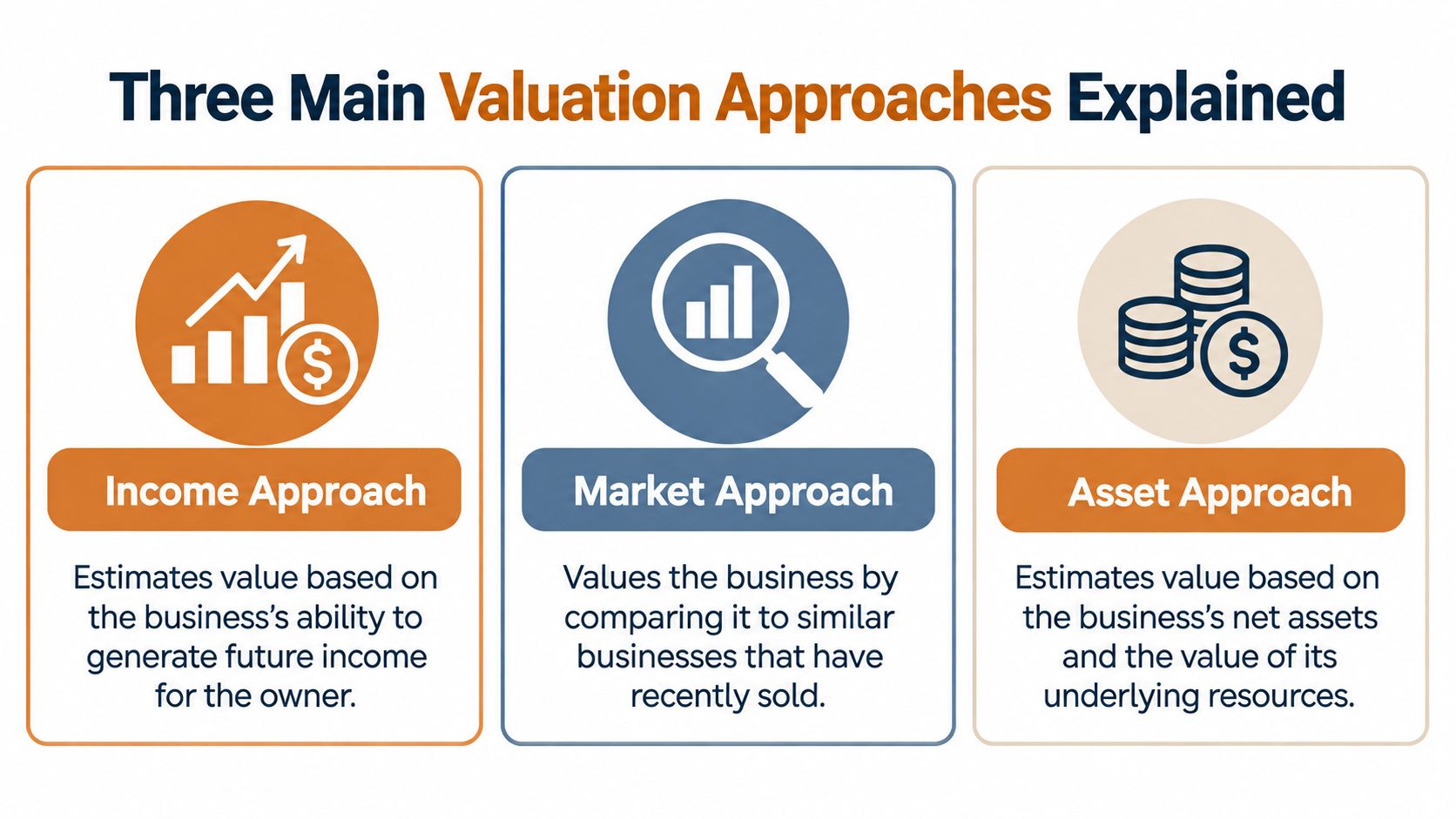
The income approach asks what the company’s future economic benefits are worth today after considering risk. For an owner-operated business, the analysis usually starts by normalizing earnings.
That can mean adjusting owner compensation, removing personal expenses paid by the company, identifying one-time costs, correcting nonrecurring revenue, or recognizing expenses the business must continue to incur. Normalization can increase earnings, but it can also reduce them. An owner who performs essential management work for little compensation may require a replacement-cost adjustment.
Recurring revenue deserves close attention. Service agreements, maintenance contracts, and repeat customer relationships can make future earnings easier to support, but the report still needs to test retention, pricing, delivery capacity, and customer concentration. A recurring invoice isn’t automatically transferable value if the relationship depends entirely on the departing owner.
The market approach compares the business with comparable companies or transactions. Industry labels alone aren’t enough. The analyst should consider size, geography, growth, margins, customer concentration, owner dependence, recurring-revenue mix, and the definition of earnings used in the comparison.
A multiple based on one earnings measure can’t be applied casually to another. A seller’s discretionary earnings multiple and an EBITDA multiple answer different questions because the underlying earnings definitions differ. The report should explain what the comparable prices included, such as working capital, inventory, equipment, debt, or unusual financing terms.
The asset approach estimates value from the company’s assets and liabilities. It can be particularly relevant when tangible assets drive the business, earnings are weak, or the company’s value is closely tied to equipment, inventory, or property.
Its limitation is clear in many service businesses. Customer relationships, workforce capability, brand reputation, contracts, and operating know-how may generate value that doesn’t appear fully on the balance sheet. An asset-based result can therefore understate going-concern value when intangible assets produce economic benefits.
The IRS valuation guidance recognizes these three approaches and supports considering the facts of the specific company rather than relying on one universal formula. A sound report reconciles the indications. It doesn’t mechanically average them or select the highest result.
Read the normalization schedule as if you’re preparing to defend every line to a skeptical buyer. Reported profit is an accounting result. Valuation depends on the earnings a new owner can reasonably expect to receive.
An add-back needs two kinds of support. First, you need evidence that the expense was personal, unusual, nonoperating, or genuinely nonrecurring. Second, you need to consider whether removing it creates a replacement cost or removes a business benefit. An owner’s personal vehicle expense may be partly discretionary, but the company may still need a vehicle for operations.
Forecasts should identify the drivers behind revenue, margins, staffing, capital spending, and working capital. Ask:
The report should avoid counting the same risk twice. If a forecast already reduces earnings because a customer is expected to leave, the analyst shouldn’t automatically apply another unsupported reduction for that identical issue without explaining the distinction.
The reconciliation is where separate method results become a conclusion. Look for the weight assigned to each approach and the reasoning behind it. An income approach may carry more relevance for a stable service company with predictable cash generation, while an asset approach may matter more for an equipment-heavy operation with limited earnings.
The report should also distinguish enterprise value from equity value. Enterprise value concerns the operating business before financing effects. Equity value reflects what belongs to owners after appropriate treatment of debt, excess cash, and other relevant balance-sheet items.
A useful report lets you trace the path:
The AICPA valuation standards history shows how the profession moved from broad principles toward more formal procedures and report-quality expectations. Use that mindset when reviewing your document. You’re not looking for a number that feels flattering. You’re looking for reasoning that survives questions.
A valuation conclusion answers, “What is the business worth under the stated assumptions?” Your proceeds calculation answers, “What will I receive, when will I receive it, and how likely is each payment to arrive?”
Those are different questions. A buyer may agree to an enterprise value and then subtract debt, require a normal level of working capital, retain some equity, or tie part of the price to future performance. Taxes and transaction expenses can reduce the amount that reaches the owner even further.
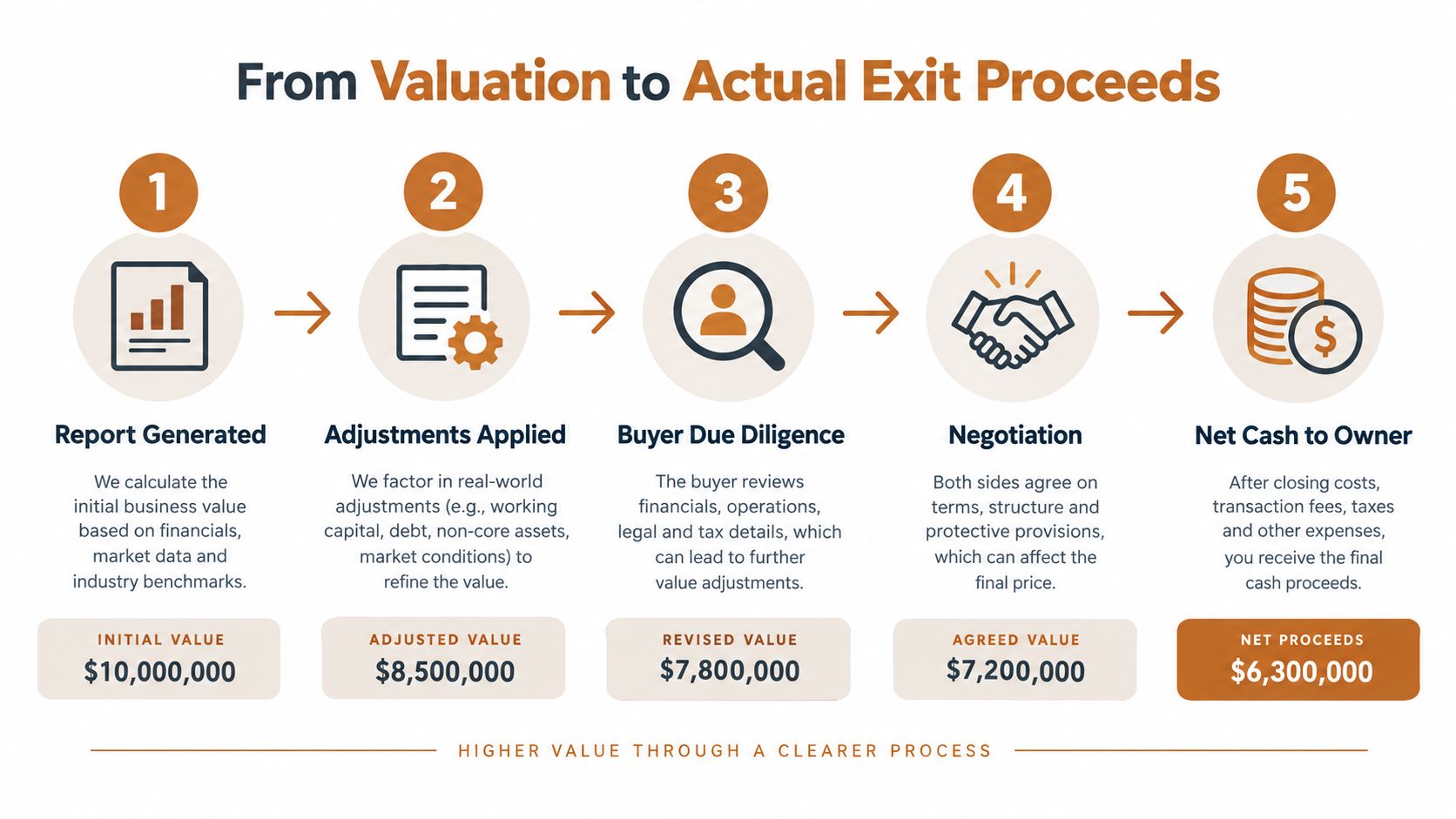
The 2025 IBBA Market Pulse data indicates that sellers in smaller transactions received roughly 75%–88% of stated deal value in cash at closing, while seller financing generally represented 10%–19% and earnouts 1%–6%. The same source notes that smaller transactions can be more credit-constrained, which may reduce the number of buyers able to finance the purchase. (Transaction structure and sale proceeds context)
That doesn’t mean every deal follows those proportions. It means your report shouldn’t stop at a headline value. Ask your adviser to model at least these structures:
| Structure | What to examine |
|---|---|
| All-cash closing | Debt payoff, working capital, taxes, and transaction costs |
| Seller financing | Interest, repayment schedule, security, and default risk |
| Earnout | Performance definition, measurement period, control after closing, and payment certainty |
| Retained equity | Future liquidity, minority rights, dilution, and exit timing |
| Mixed consideration | How each component changes risk and after-tax proceeds |
Working capital is a frequent source of surprise. If the agreed value assumes the buyer receives the normal operating working capital, the owner usually can’t treat that same amount as an additional payment. Debt requires similar care. A valuable operating business can still produce less cash for its owner after debt repayment and other balance-sheet adjustments.
Taxes deserve their own planning conversation. A report can identify value, but it doesn’t replace a tax adviser who understands entity structure, asset allocation, timing, and the seller’s broader financial position. Owners evaluating this issue can also review guidance on capital gains tax when selling a business.
The number on page one is a starting point for negotiation. Your proceeds model is the decision tool.
Weak reports usually fail through omission, not arithmetic. The formulas may be correct, yet the document can still produce an unreliable conclusion because it uses unsupported earnings, poorly matched comparables, or assumptions that don’t fit the assignment.
A useful comparison looks like this:
| Thin report | Defensible report |
|---|---|
| One headline multiple with little explanation | Multiple approaches considered and reconciled |
| Unexplained add-backs | Normalization schedule with support and replacement-cost analysis |
| Generic industry comparables | Comparable evidence assessed for size, margins, geography, growth, and risk |
| Vague discount rate | Documented construction tied to company-specific risks |
| Enterprise value presented as proceeds | Bridge to equity value and payment scenarios |
| Sale purpose assumed | Purpose, standard, date, and ownership interest stated |
Be cautious when the report:
Succession planning creates another trap. Getting a valuation doesn’t mean you’re ready to transfer the company. A 2025 U.S. Bank survey of 1,000 small-business owners found that only 54% had a formal succession plan. The survey also reported that 56% worried they wouldn’t receive a reasonable price, 53% lacked adequate resources or guidance, and 62% found succession planning overwhelming.
The family-transfer question may be different from the market-sale question. A family needs to consider whether the recipient can fund the transfer, whether inactive heirs are treated fairly, and whether control, discounts, buy-sell terms, and tax constraints have been addressed.
For operational diligence, owners may also find a practical SOSfinder vendor software guide useful when organizing supplier information, contracts, and documentation. Better records won’t fix an unsuitable valuation method, but they can reduce avoidable uncertainty during review.
Start before you hire the appraiser. A specialist can analyze imperfect records, but clean evidence gives the report a stronger foundation and makes buyer questions easier to answer.

Gather historical financial statements, tax returns, interim results, debt schedules, major asset records, customer information, contracts, owner compensation details, and explanations for unusual revenue or margin changes. Prepare a separate normalization schedule. Every proposed adjustment should identify the amount, reason, supporting record, and any replacement cost.
Then make transfer-readiness visible. Document who owns customer relationships, how work is estimated and delivered, which services renew, and what would happen if you stopped working in the company. Reduce dependence on a single customer or owner where practical, and preserve evidence of recurring agreements, operating procedures, brand assets, and key employee responsibilities.
Your forecast should show its drivers, not just its output. Explain expected pricing, volume, staffing, capital needs, working capital, and customer retention. A buyer or appraiser can challenge an assumption constructively when the assumption is visible.
For a practical framework on operational improvements, review business value drivers and use it to create a short preparation list.
A report is only as defensible as the records behind it. Treat valuation as an ongoing readiness process rather than a document ordered shortly before negotiations.
Before the engagement begins, ask the appraiser what level of analysis is appropriate, which documents they need, how they’ll treat debt and working capital, and how they’ll distinguish a value conclusion from a proceeds estimate.
Update it when the purpose, business facts, or transaction context changes materially. A report prepared for an internal transfer may not answer a later sale question, and an old forecast may no longer reflect customer, staffing, or financing conditions.
Yes, depending on the purpose. A lower defensible value may affect a family transfer, estate plan, or tax strategy, but owners shouldn’t manipulate assumptions to force a lower result. Accuracy and support matter more than the direction of the conclusion.
A sale focuses on what an arm’s-length buyer may pay. A family transfer also considers fairness among heirs, funding capacity, control, minority interests, tax rules, and whether the recipient can operate the business.
Flag it before the report is finalized. Provide records, explain the operating reality, and ask the appraiser to show how the conclusion changes if the assumption is revised.
Seek one when the assignment is unclear, the report lacks a normalization schedule, comparable evidence is weak, or the conclusion conflicts sharply with documented operating facts. A second opinion is most useful when you provide both advisers with the same records.
Yes, but use it as an evidence framework rather than a guaranteed price. It can help you explain earnings quality, risks, value drivers, and the difference between enterprise value and actual proceeds.
The Owner’s Shortlist connects business owners with curated specialists for valuation, tax, legal, succession, financing, and related exit decisions, alongside practical guides that clarify the process. Visit The Owner’s Shortlist to review the relevant resources and find a specialist conversation suited to your company’s next step.
Tell us your situation. We'll connect you with a specialist who works with owners like you. One conversation, no sales pressure.
Found this useful?
Add The Owner's Shortlist as a preferred source and get our articles highlighted in Google Search results.
Add to Preferred SourcesWhat Is SDE. Learn what SDE means in business valuation, how to calculate it with common add-backs, how it differs from EBITDA, and why buyers and lenders focus
October 7, 2026
Explore the best value drivers that influence exit value, with practical steps owners can take before engaging a valuation specialist.
October 4, 2026
Confused by SDE vs EBITDA? Learn when each metric applies to your owner-operated business, how adjustments change valuations, and which buyers prefer which
October 3, 2026
This business valuation guide explains how to calculate what your company is worth using proven methods. Get clarity for 2026 sale, funding, or planning.
October 2, 2026