What Is Capital Gains Tax: A Plain-English Guide for Owners
Learn what is capital gains tax, how short- and long-term rates work, and how the rules apply when you sell a business. Clear guidance
September 22, 2026
By Remi Taffin · September 30, 2026

You’ve received the offer. The buyer likes the business, the letter of intent is moving, and everyone keeps talking about the headline price. You’re looking at that number and asking the question that really matters: what will I have left after tax?
That answer was not created at closing. It was shaped by decisions made before the LOI became binding, including your holding period, entity structure, asset-versus-stock structure, and purchase price allocation. Those choices can be difficult to change once the transaction documents are signed.
The 2026 deadline around certain deferral strategies adds another reason to act early. The current federal deferral window for new Opportunity Zone investments ends on December 31, 2026, according to recent guidance on business-sale capital gains planning. If you’re waiting until the buyer’s lawyers circulate the final purchase agreement, you may already have lost useful options.
Start with the after-tax number, not the offer price. Ask your CPA to model what you keep under the proposed structure before you accept the buyer’s assumptions about the deal.
Holding period comes first. In the United States, an asset generally needs to be held for more than 12 months for the gain to qualify as long-term capital gain under the federal rules described in this business-sale tax guide. Selling before that threshold can move the gain into ordinary-income treatment.
Entity type matters because the business may be taxed differently from the owner’s interest. A corporation, partnership, LLC, or other pass-through structure can produce different reporting and tax outcomes. Don’t assume the tax result from another owner’s sale applies to yours.
Deal structure is the major fork in the road. The buyer may purchase the company’s stock or ownership interests, or may purchase individual assets. A stock sale often produces cleaner capital-gain treatment at the owner level, while an asset sale divides the proceeds among categories with different tax treatment.
Purchase price allocation decides how much value lands in goodwill, inventory, receivables, equipment, depreciation recapture, or other categories. The gross price can look attractive while the allocation creates a much smaller net result.
Practical rule: Never sign an LOI that treats structure and allocation as administrative details. They’re economic terms.
A useful starting point is to plan your business exit strategy before negotiating the final language. The right plan should connect valuation, ownership, tax, legal, financing, and personal liquidity rather than treating tax as a closing checklist.
Ask the buyer what structure they want, why they want it, and how they expect to allocate the consideration. Then have your advisors model both sides. You may decide that accepting a different headline price produces a better after-tax result.
The practical sequence is simple. Establish your basis, identify the likely tax character of each category, estimate federal and state exposure, and compare the cash you’ll receive. If a deferral strategy might apply, test whether its timing, liquidity demands, and reinvestment requirements fit your life.
You can sign an attractive offer and still misread the tax result. A capital gain is the profit on the business interest or asset sold, measured by the amount your proceeds exceed your adjusted tax basis after transaction adjustments.
Your basis may differ from the amount you originally paid. It can reflect the basis of stock, a membership interest, or the underlying assets, depending on the entity and deal structure. Have your CPA establish it before negotiations begin. Reconstructing basis after the wire arrives is expensive and often incomplete.
The federal rule turns first on how long you held what is being sold. Property held for 12 months or less generally creates short-term gain taxed at ordinary-income rates. Property held for more than 12 months generally creates long-term capital gain with preferential federal rates. The IRS explanation of selling a business also explains that a business sale is usually treated as a sale of multiple assets, not one undivided item.
For long-term gains, the federal rates are 0%, 15%, or 20% depending on taxable income. Higher-income sellers may also owe the 3.8% Net Investment Income Tax, increasing federal exposure before state tax. State treatment can change the result substantially. Some states impose no state income tax on the gain, while others add a significant layer.
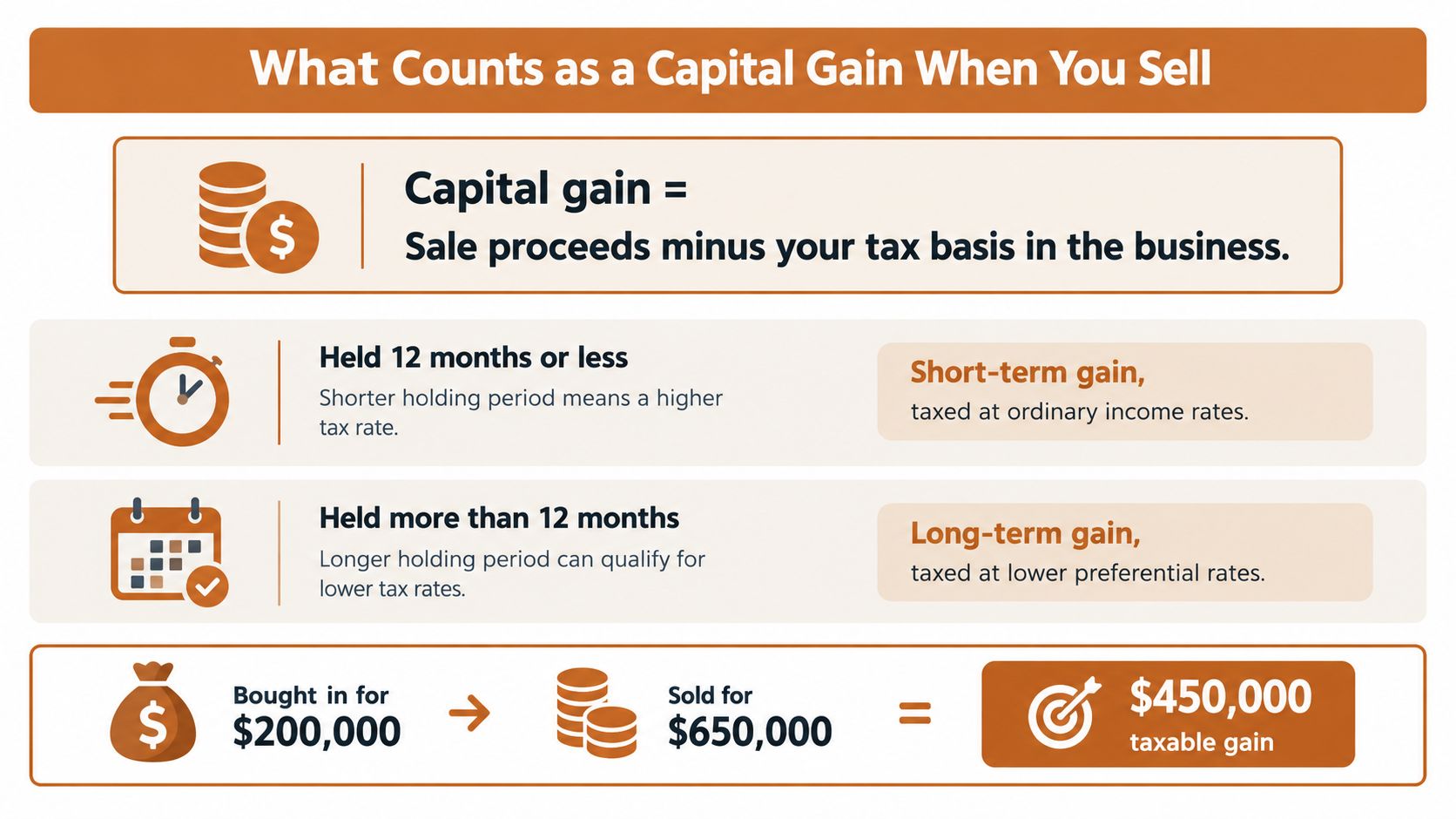
The preferential rate does not apply automatically to every dollar in the purchase price. Inventory, receivables, and depreciation recapture can produce ordinary income or follow different rules. Goodwill held for the long term may generate capital gain, while fully depreciated equipment can create recapture income.
That distinction makes pre-signing planning more valuable than post-close cleanup. Before you agree to the entity, allocation, or payment terms, model the character of each category and test any available deferral strategy. If the strategy has a 2026 deadline, waiting until closing may eliminate the option or leave too little time to meet its conditions.
Owners outside the United States need separate advice. In the United Kingdom, qualifying disposals can receive Business Asset Disposal Relief. The relief rate is 10% for qualifying disposals on or before 5 April 2025, 14% for disposals from 6 April 2025 to 5 April 2026, and 18% for qualifying assets disposed of from 6 April 2026, according to HM Revenue & Customs guidance. For cross-border owners, capital gains tax planning Melbourne reinforces the need to analyze local rules separately from U.S. assumptions.
The buyer’s preferred structure and your preferred structure often point in different directions. In an asset sale, the buyer acquires selected business assets and may leave certain liabilities behind. In a stock sale, the buyer acquires the ownership interest in the entity and takes the company as it exists, subject to the negotiated representations, liabilities, and indemnities.
An asset sale creates several tax buckets. Goodwill may receive capital-gains treatment, while inventory and receivables can produce ordinary income. Equipment may create depreciation recapture. The result is a blended tax bill, not one rate applied to the entire price.
A stock sale generally produces a gain on the stock or ownership interest itself. When the interest has been held for more than 12 months, that gain may receive long-term capital-gains treatment, subject to basis, income, state, and entity-specific rules. S-corporation and LLC interests generally require pass-through analysis rather than a simple assumption that every stock-like transaction works the same way.
The buyer often favors an asset sale because the buyer receives a basis in the acquired assets and can generally obtain more useful future depreciation or amortization treatment. The seller usually prefers a stock sale because the reporting can be cleaner and more of the consideration may qualify for capital-gain treatment.
| Dimension | Asset Sale | Stock Sale |
|---|---|---|
| What the buyer acquires | Individual assets and selected liabilities | Stock or ownership interests in the entity |
| Seller’s tax result | Mixed treatment across asset classes | Often a more unified gain on the ownership interest |
| Ordinary-income exposure | Inventory, receivables, and recapture may create it | Usually less fragmented, subject to entity and transaction facts |
| Buyer’s basis | Buyer generally receives basis in acquired assets | Buyer generally doesn’t receive the same asset-level basis step-up |
| Negotiation pressure | Buyers often prefer the structure | Sellers often prefer the structure |
| Main planning issue | Allocation among asset classes | Basis, eligibility, liabilities, and purchase-price economics |
The deal structure is a tax term, a valuation term, and a risk-allocation term at the same time.
Your legal work still matters. Owners dealing with a transfer in Texas, for example, may benefit from reviewing the Texas business transfer legal steps alongside their tax analysis. The legal transfer, consent requirements, contracts, permits, and ownership records must match the commercial deal.
Use the asset sale versus stock sale comparison to prepare questions for your CPA and transaction attorney. The key question isn’t which structure is universally better. It’s which structure produces the strongest combination of after-tax proceeds, liability protection, buyer acceptance, and contractual certainty.
A buyer may offer a higher price for an asset deal because of the tax benefits the buyer expects. That doesn’t mean you should accept the structure without modeling it. Compare the buyer’s proposed price and structure with the price you’d accept for a stock or ownership-interest sale.
Once the LOI states the structure and allocation principles, your negotiating room narrows. Get the tax model done while the terms are still open.
In a U.S. asset sale, the purchase price is allocated under the residual method. The buyer and seller assign value in a required order, then place the remaining value into later categories, including intangible assets. That allocation affects the seller’s tax bill, the buyer’s future deductions, and the economics you should negotiate before signing a letter of intent.
The allocation is a reporting position, not a casual accounting choice. Buyer and seller generally need to use the same agreed allocation, including on Form 8594 where applicable. Treat the schedule as a pre-signing deal term. If a deferral strategy has a 2026 deadline, the allocation and transaction structure need to be modeled before the LOI fixes the conversation.
The five-step summary below groups the statutory classes so you can connect the negotiation to the categories used for Form 8594:
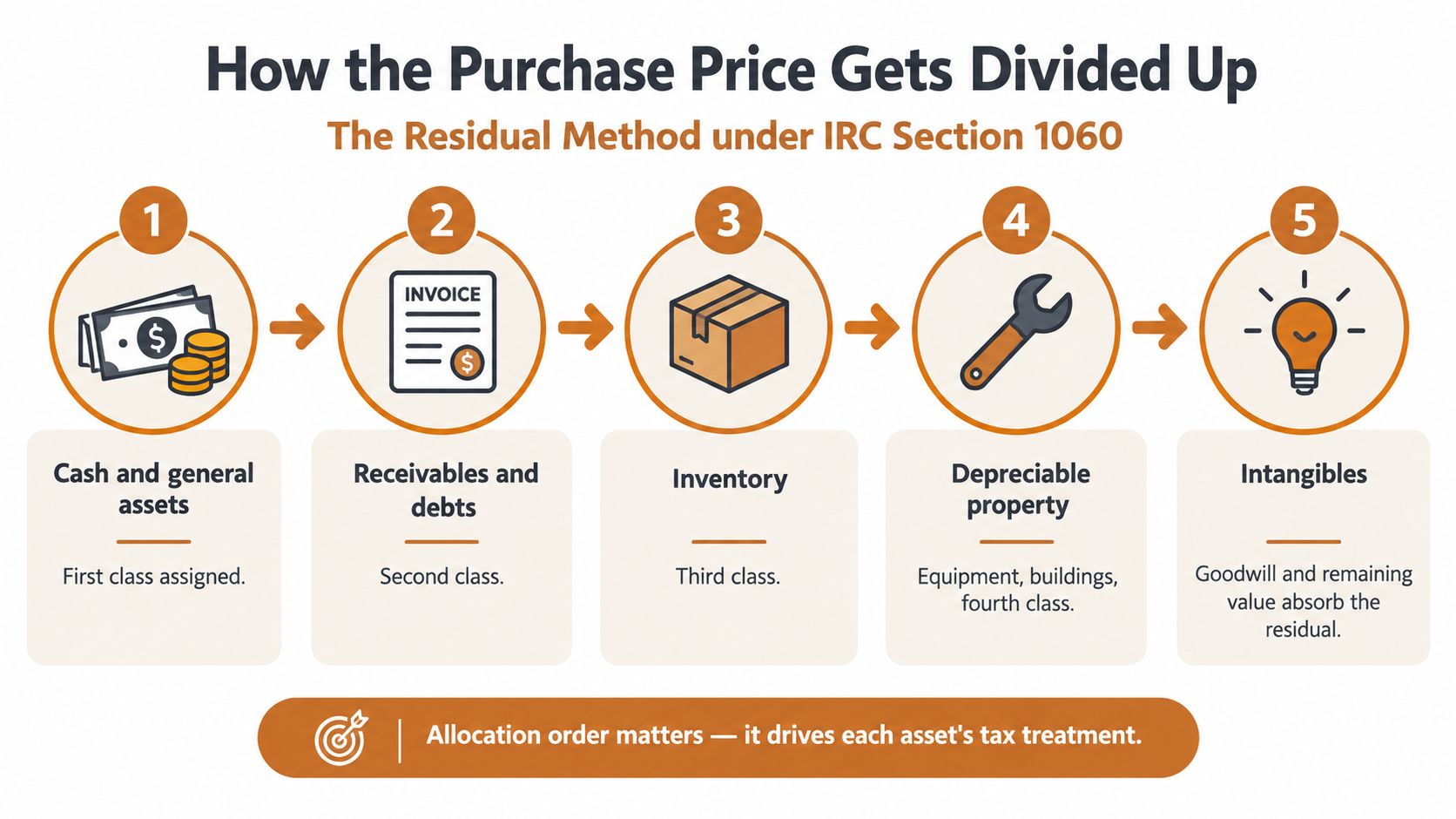
Tax character is the seller’s main concern. Goodwill can often receive long-term capital-gain treatment. Inventory and receivables may produce ordinary income, while depreciation recapture may receive different treatment. A buyer may push for more value in equipment or other assets that support earlier deductions.
The parties are negotiating from opposite tax positions. The buyer wants values that support future deductions. The seller wants a defensible allocation that protects capital-gain treatment where the facts support it. Have your CPA and deal attorney agree on the allocation before the LOI, rather than arguing over it after the purchase agreement is nearly finished.
Request a schedule showing the proposed value for every category. Have your CPA calculate the tax character and estimated tax for each line. If the schedule creates too much ordinary-income exposure, raise the issue while the buyer can still adjust the price or structure.
Allocation is not paperwork after the deal. It is part of the price.
The allocation must match the business and the evidence supporting its value. Do not use goodwill as a catch-all just to pursue a preferred tax result. Build the negotiation around valuation support, operating history, customer relationships, contracts, equipment records, and a clear explanation of how the business creates value.
Two owners accept offers for businesses with the same $2,000,000 commercial value. Their tax results can still differ sharply because the holding period, entity type, allocation, and deal structure determine what the proceeds become for tax purposes. Build both models before signing the LOI, especially if a deferral strategy has a 2026 deadline.
Assume an owner sells a qualifying ownership interest for illustrative proceeds of $2,000,000 after holding it for more than 12 months. Assume the seller’s basis is $400,000. The resulting long-term gain is $1,600,000.
At the illustrative 20% long-term federal rate, the federal capital-gains tax is $320,000. If the 3.8% NIIT applies, it adds $60,800. The combined federal bill is therefore roughly $380,800 before state tax. The applicable 0%, 15%, or 20% long-term federal rate depends on the seller’s income and facts, so this calculation is an example, not a quote.
The model is relatively direct: proceeds less basis equals gain. The seller still needs to account for state tax, transaction costs, escrow, earnout risk, and financing terms. The ownership-interest sale usually avoids dividing every dollar among inventory, equipment, receivables, and goodwill, which makes the tax character easier to review and defend.
Now use the same illustrative $2,000,000 purchase price for an asset transaction. Assume $500,000 is assigned to inventory and depreciation recapture, with no remaining basis in that portion. Assume the remaining $1,500,000 is assigned to goodwill with the same $400,000 basis.
The goodwill gain is $1,100,000. At the illustrative 20% rate plus 3.8% NIIT, the federal tax on that capital-gain portion is roughly $261,800 before state tax. The $500,000 inventory and recapture portion is taxed at ordinary-income rates, so the total federal bill is $261,800 plus the seller’s tax on that ordinary-income amount. The final result depends on the seller’s bracket, available deductions, state, and the basis assigned to each asset.
| Line Item | Example A: Ownership-Interest Sale | Example B: Asset Sale |
|---|---|---|
| Illustrative proceeds | $2,000,000 | $2,000,000 |
| Basis assumption | $400,000 ownership-interest basis | $400,000 goodwill basis |
| Taxable categories | $1,600,000 long-term gain | $1,100,000 long-term gain plus $500,000 ordinary-income items |
| Federal illustration | Roughly $380,800 before state tax | Roughly $261,800 on goodwill, plus tax on $500,000 at ordinary rates |
| Main modeling task | Confirm basis, holding period, and state exposure | Confirm every allocation, basis, recapture amount, and tax character |
The asset buyer may accept a higher price because an asset deal provides an asset-level basis and future deductions. That benefit does not pay your tax bill. Compare the net proceeds after federal tax, state tax, transaction costs, escrow, earnout risk, and financing terms before accepting the buyer’s preferred structure.
A note or earnout can change recognition timing, but it also creates collection risk. Put that risk beside the tax calculation, then make the structure and allocation decisions before signing.
Tax planning works best before the buyer knows you’re selling. Once the LOI is signed, the transaction has momentum, the buyer has bargaining power, and many structural changes become difficult or impossible.
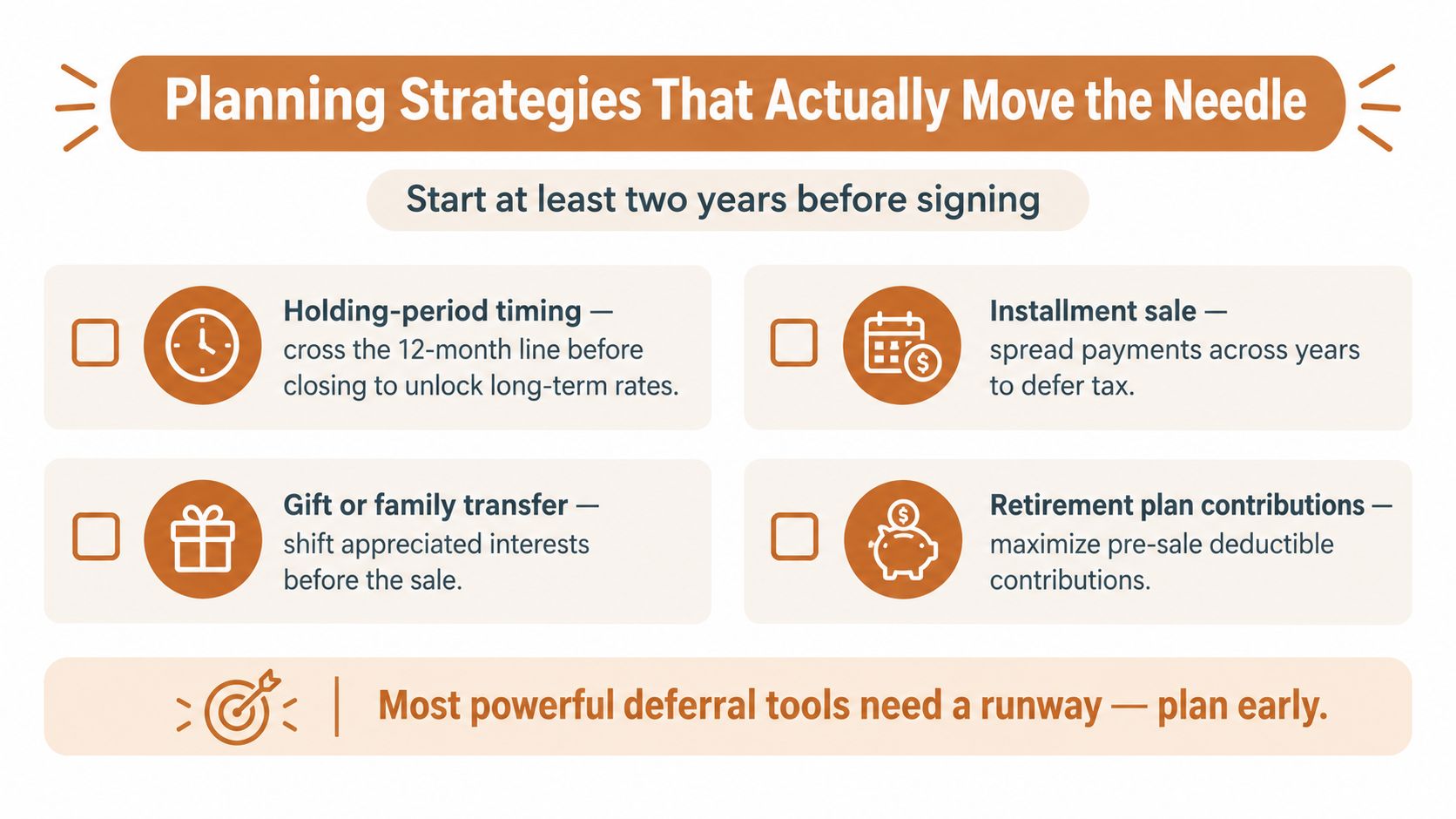
Protect the long-term holding period first. If closing before the 12-month threshold would turn a potential long-term gain into short-term treatment, discuss whether the transaction can wait. A short delay can matter, but only if the commercial deal can tolerate it and the legal documents don’t create an earlier sale.
Installment treatment may spread recognition when payments arrive over time, but it isn’t a free tax reduction. It can create seller-financing risk, and not every category of sale proceeds receives the same treatment. Model the tax deferral against the risk that the buyer may not pay.
Qualified Small Business Stock rules can be relevant to eligible owners of qualifying C-corporation stock, but eligibility depends on strict requirements. This is not a strategy to discover during final diligence. Confirm the company’s history, issuance records, holding period, business activity, and state treatment early.
Charitable planning can also belong before the sale if giving is already part of your goals. A transfer of appreciated interests before a binding sale may produce a different result from donating cash after closing, but the facts and timing must be reviewed by a tax attorney and charitable-planning advisor.
Entity restructuring deserves caution. Changing an entity shortly before a sale can create tax, legal, valuation, and administrative consequences. Don’t convert, merge, or reorganize solely because someone promises a better tax result without modeling the entire transaction.
The current federal deferral window for new Opportunity Zone investments ends on December 31, 2026, according to guidance covering deferral strategies for business-sale gains. That deadline matters only if the strategy fits your investment horizon, liquidity needs, risk tolerance, and tax profile.
Deferral isn’t automatically better than paying tax now. You may give up liquidity, accept investment risk, or lock money into a structure that doesn’t fit your retirement or estate plan. Compare the value of deferral with the value of certainty.
The best tax strategy is the one that survives the business plan, the family plan, and the liquidity plan.
Plan at least two years before signing whenever possible. That gives your advisors time to verify eligibility, correct records, establish supportable valuations, and negotiate terms without making the buyer’s timetable your tax timetable.
Bring in a tax specialist before signing if any of these conditions apply:
The CPA should model basis, asset allocation, entity returns, estimated tax, and state exposure. A tax attorney should review structure, transaction documents, tax representations, indemnities, and unusual payment terms. An M&A advisor can help defend valuation and negotiate the commercial tradeoffs between price, structure, allocation, escrow, and transition obligations.
The tax-planning guide for business owners can help you organize the questions before those meetings. Professional advice is a pre-close investment because every major tax decision flows into the final wire amount.
The Owner’s Shortlist connects long-tenured business owners with vetted specialists for taxes, valuation, legal matters, succession, financing, and related exit decisions. Visit The Owner’s Shortlist to review plain-language guides and find the right advisor before your LOI locks in the structure, allocation, and tax outcome.
Tell us your situation. We'll connect you with a specialist who works with owners like you. One conversation, no sales pressure.
Found this useful?
Add The Owner's Shortlist as a preferred source and get our articles highlighted in Google Search results.
Add to Preferred SourcesLearn what is capital gains tax, how short- and long-term rates work, and how the rules apply when you sell a business. Clear guidance
September 22, 2026
Tax planning for business owners preparing to sell or transition. Learn timelines, entity strategy, and how to keep more of your exit proceeds.
August 4, 2026
Action-oriented tax planning for business owners, covering entity choice, depreciation, exits, and pitfalls, with guidance on when to engage a specialist.
July 24, 2026
Discover what corporate tax planning services cover and why they're critical for your exit. Learn key strategies to maximize your after-tax proceeds.
July 22, 2026