What Is Capital Gains Tax: A Plain-English Guide for Owners
Learn what is capital gains tax, how short- and long-term rates work, and how the rules apply when you sell a business. Clear guidance
September 22, 2026
By Remi Taffin · August 4, 2026

Most owners are told to squeeze every possible deduction out of the current year. That advice is fine if you’re never selling. If you are, it can be the wrong target, because the key measure is after-tax exit value, not just this year’s refund.
That’s the problem with most tax planning for business owners content. It treats tax as a filing exercise, then acts surprised when the deal team and the buyer’s CPA start pricing in recapture, entity friction, state exposure, and bad records. Owners don’t lose money because they failed to claim one more deduction in Q4. They lose money because they made tax choices without thinking backward from the transaction.

If you’re still treating tax planning as a hunt for this year’s deduction, you’re optimizing the wrong number. The owner who accelerates write-offs without a sale plan may feel smart in April and still hand over too much in the transaction. Exit planning changes the question from “How do I lower taxable income now?” to “How do I preserve the most after-tax value when I sell?”
That shift matters because tax planning has become a standard operating function for owners, not a niche compliance chore. In the 2024 NFIB Tax Survey, 90% of small business owners said they used a professional tax preparer for their most recent return, and 88% of those users relied on that professional every year rather than only occasionally, according to the NFIB Tax Survey. The same survey found that 72% of owners reported annual net income under $500,000 in 2023, including 18% below $50,000, which is exactly why cash flow and after-tax survival matter so much.
Practical rule: if a tax move helps this year but hurts the exit, it’s not a win. It’s a prepayment of a problem.
The better frame is sequencing. A depreciation strategy, an entity election, or a retirement contribution can be right in one window and wrong in another. That’s why owners preparing for a sale should look backward from the transaction and ask which moves are still flexible, which ones are locked in, and which ones change the buyer’s price or the seller’s tax bill.
For owners mapping that transition, the planning conversation belongs next to the sale process itself, not beside a stack of receipts. A useful starting point is the exit planning guide for business owners, because the tax questions get clearer once the deal path is clear.
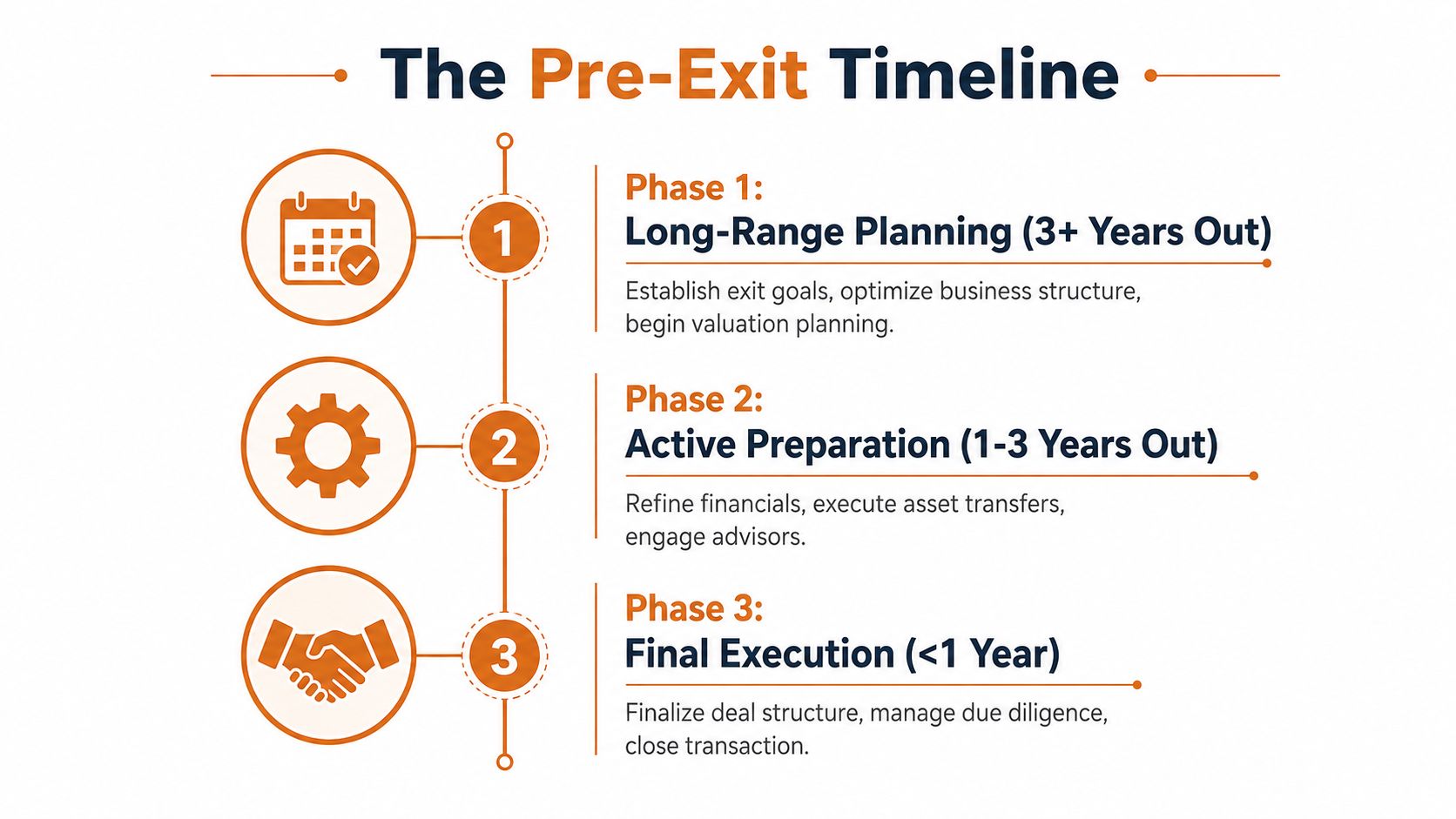
This is the window for decisions that need time to mature. Entity review belongs here, along with retirement plan design and a baseline valuation. If you wait until the year before a sale, you’re no longer planning. You’re reacting.
Start with the structure, not the deduction.
The point of the long-range phase is to preserve options. A business that may be sold, recapitalized, or transferred to family should not be locked into a structure that only makes sense for annual filing. At this stage, the owner and CPA should be asking whether the current entity still supports the likely exit, and whether any change needs seasoning before a transaction.
Ownership records need to be tightened, internal red flags need to be remediated, and the owner should model likely capital gains outcomes under more than one sale structure. The goal is to remove surprises before a buyer finds them for you.
This is also the point where estimated taxes, compensation design, and deductions should be stress-tested against a sale date, not just against year-end income. If a move creates a tax benefit now but complicates buyer diligence later, it’s probably too expensive.
The final year is about implementation, not exploration. Installment sale structuring, recapture planning, and coordination between the CPA and the transaction attorney become the priority. The legal and tax teams need to line up on allocation, timing, and which items are being treated as ordinary income versus capital gain.
The worst mistake is starting this work in the last quarter. At that point, owners usually discover that the window for structural fixes has already closed. The work still matters, but the menu is smaller, and the tax cost of delay is real.
Entity choice is usually sold as a current-year tax decision. That’s too narrow. The right question is which structure produces the cleanest transaction, the fewest due diligence headaches, and the least chance of being taxed twice on the way out.
| Entity Type | Buyer Preference | Tax on Sale | Planning Complexity |
|---|---|---|---|
| C-corp | Often better for some strategic buyers, but structure matters | Can create entity-level tax and then shareholder-level tax on distributions | High |
| S-corp | Common for owner-operated firms, but needs careful timing | Usually flow-through treatment, with built-in gains issues possible after conversion | Medium to high |
| LLC | Flexible and often simple to operate | Depends on tax classification and sale structure | Medium |
| Partnership | Flexible for allocation and economics | Depends on whether the deal is an asset sale or equity sale | Medium |
The double-tax trap is what scares owners for good reason. If the business is a C-corp, the entity can face tax first, then the owner can get taxed again when cash is distributed. That doesn’t mean a C-corp is always wrong. It means you need to know whether you’re building for a strategic buyer, a stock sale, or a structure that can handle the tax chain cleanly.
S-corp timing is where owners get careless. A conversion made too late can leave you with a structure that looks efficient on paper but hasn’t had time to fit the actual deal timeline. Partnership and LLC structures give more flexibility, but they also create more room for misalignment between tax allocations and deal economics.
The cleanest decision framework is simple. If a sale is likely within a few years, ask whether the current structure will survive buyer diligence without awkward adjustments. If it won’t, fix it early enough for the change to matter. If the structure is already aligned, don’t churn it just to chase a small annual savings that could complicate the exit.
Bottom line: the best entity is the one that survives the transaction without forcing you into a costly cleanup.
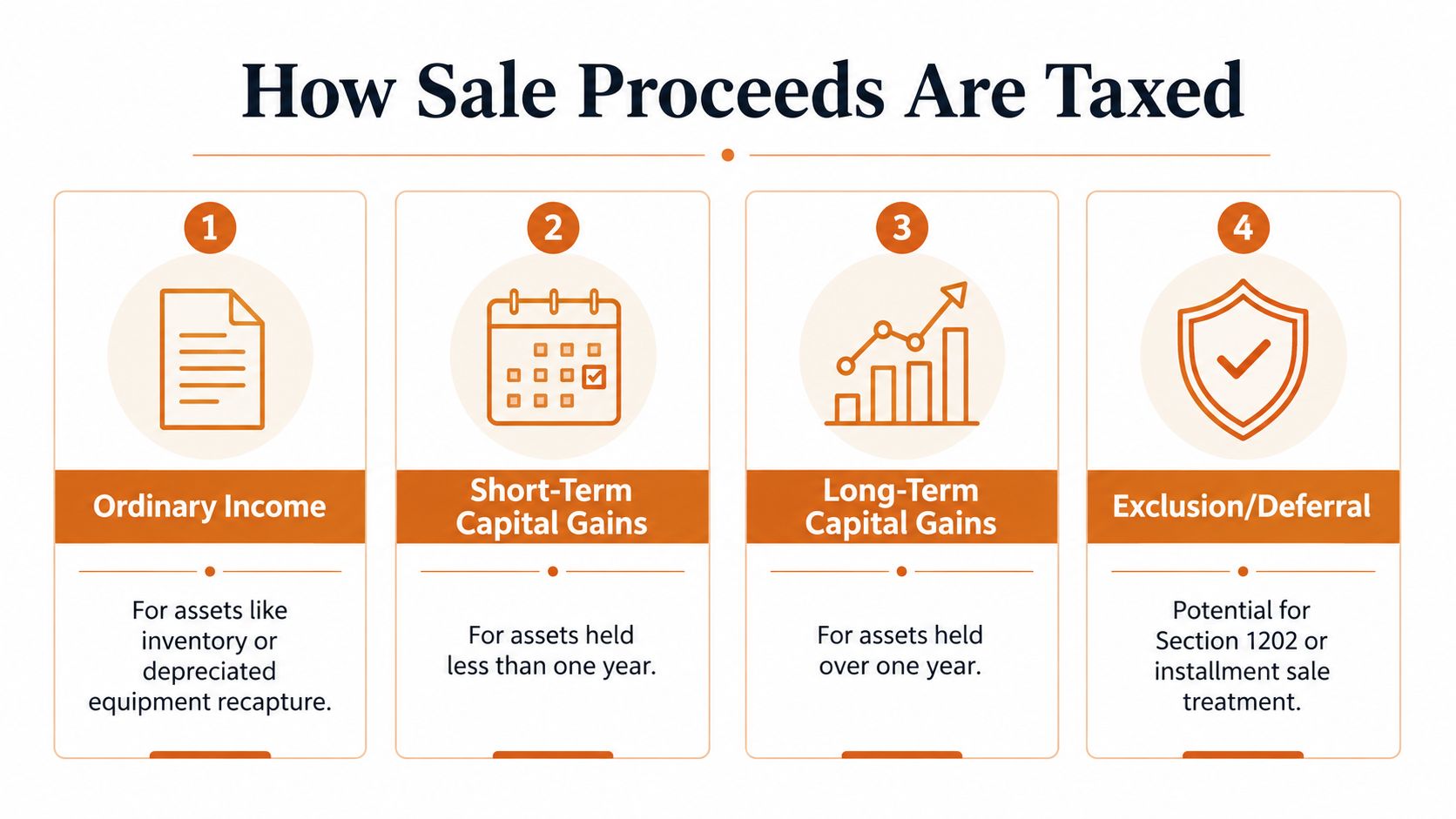
The mistake owners make is assuming all sale proceeds are taxed the same way. They aren’t. A single transaction can include long-term capital gain, ordinary income, depreciation recapture, and potentially exclusion treatment if the stock qualifies for it. That mix is where planning either saves a lot of money or disappears into the weeds.
Here’s the mental model. The buyer isn’t buying one bucket of income. The purchase price gets allocated across different tax characters. Some items are taxed like a clean investment gain. Others are taxed like compensation or recovery of prior deductions. And some deal terms, like earn-outs or consulting arrangements, can move money into ordinary-income territory even if the headline price looks attractive.
The asset sale versus stock sale trade-off matters because it changes who pays what and when. Asset sales often give buyers more basis step-up, which they like. Stock sales can be cleaner for sellers, but the final tax result depends on what’s inside the entity and how the deal is papered.
To make this concrete, use a simple sale scenario. If a business sells for $4 million and $800,000 of that is depreciation recapture, that portion gets treated differently from the rest of the gain. If part of the deal qualifies for a 50% QSBS exclusion, the taxable amount changes again, which can move the seller’s tax by a very large amount even before you get to state tax.
What owners should read on the term sheet is not just the total price, but the character of each dollar. Ask which portion is ordinary income, which portion is capital gain, and which portion is subject to recapture or exclusion. That’s the difference between a deal that looks good and a deal that lands well.
The best levers are the ones that fit the deal, not the ones that look clever in a blog post. Owners should focus on tools that work in the transaction window and ignore the fantasy tactics that sound complex but collapse under buyer scrutiny.
Installment sale treatment can help when the buyer and seller agree to spread payments over time. That doesn’t eliminate tax, but it can smooth the recognition of gain across years if the structure is real and supportable. It works best when the seller is willing to accept timing trade-offs for cash flow or tax planning reasons.
Charitable structures only make sense when there’s genuine philanthropic intent. A charitable remainder trust can help some owners shift a portion of the value out of the immediate taxable sale path, but it needs advance design and a clean fit with the exit goal. It’s not a last-minute patch for a deal that’s already misaligned.
Deferred compensation is useful when ordinary income is the problem and the business still has enough runway to set it up properly. It’s not a final-quarter move. If the plan isn’t in place before the sale process gets hot, the window usually closes.
Like-kind exchanges and defective grantor trust planning get mentioned a lot because they sound elegant. In practice, they’re narrow tools. They can fit specific asset or estate situations, but they’re not the first place I’d send an owner of a mid-sized operating company trying to clean up a sale.
Use the tax lever that matches the buyer, the asset, and the timing. Anything else is theater.
For owners with a longer runway, there are a few more advanced plays worth discussing with the tax team. A transaction attorney, an M&A advisor, and a tax specialist need to agree on which levers are realistic before those levers become negotiation poison. A generalist CPA can keep the books accurate, but once you’re modeling stock versus asset treatment, you want someone who lives in deal tax, not someone guessing from last year’s return.
A plumbing or HVAC company looks simple from the outside. It almost never is. The owner may have recurring service agreements, employees moving across borders, and revenue booked in more than one state, which means state tax can become the bigger surprise at closing.
Take a strategic buyer headquartered in a different state. The seller may think the deal is “just federal” because the business operates locally. It isn’t. The business footprint, the location of the work, and the rules for sourcing revenue can all affect where tax is due. If the company has crews, equipment, or inventory in more than one jurisdiction, the buyer’s diligence team will ask how that income was sourced and whether nexus has been properly tracked.
That’s why the checklist should be built well before a sale.
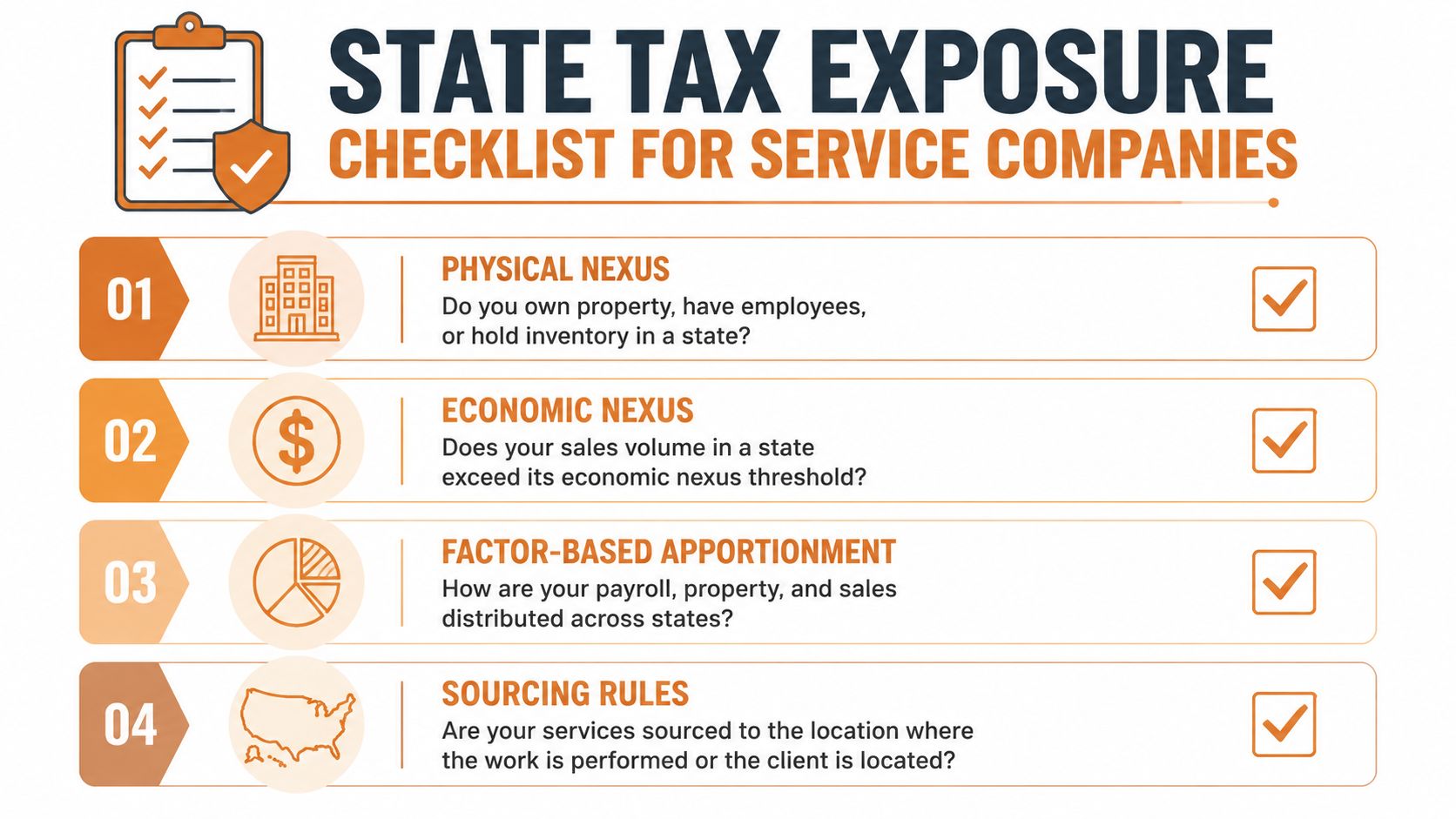
For service companies, the state questions are practical, not academic.
The highest-tax state in the footprint often matters more than the federal bracket everyone obsesses over. Owners who ignore that reality end up surprised by the closing statement, not just the return.
A good CPA should be able to map this, but if the business has multiple jurisdictions, recurring contracts, or a buyer with a different footprint, the owner needs state tax thinking well before diligence starts. The cleanest exit starts with knowing where the income lives.
Tax planning collapses fast when the books can’t support the story. If the buyer’s team sees commingled accounts, unsupported expenses, or payroll filings that don’t match the revenue pattern, they don’t give you the benefit of the doubt. They discount the price, delay the deal, or both.
Start with the basics. Clean books beat clever planning every time. Separate personal and business expenses. Substantiate vehicle use and home-office deductions. Keep payroll current. If 1099 income or contractor payments were handled loosely, fix the documentation before a buyer asks to see it.
The red flags are predictable.
The cleanup timeline matters. A bad bookkeeping habit that’s been running for years is not a six-month fix. A smaller classification issue might be. That’s why owners should separate cosmetic cleanup from structural repair. Cosmetic issues are things like missing labels, uncategorized expenses, or stale accounts. Structural issues are recurring accounting gaps, revenue recognition problems, or patterns that suggest the financials were never really managed for exit readiness.
A useful sequence starts with a baseline valuation, CPA modeling, and entity review. Then move into ownership cleanup, retirement plan optimization, and state-tax mapping. Finish with installment structuring, QSBS qualification work, and coordination among the transaction attorney, tax advisor, and M&A advisor.
If you’re still using a generalist who’s never modeled a stock-versus-asset sale, that’s a mismatch. For planning, diligence prep, and tax modeling tied to an exit, owners need advisors who know how deals get taxed. The financial due diligence guide for owners is a good companion read, because the tax work only holds if the books can survive buyer scrutiny.
The Owner’s Shortlist curates vetted specialists in taxes, valuation, legal work, and related exit decisions, and it’s built for owners who want practical guidance before they engage an advisor. If you’re planning a sale, succession, or recapitalization, visit The Owner’s Shortlist and use it to find the right tax and deal professionals before the window closes.
Tell us your situation. We'll connect you with a specialist who works with owners like you. One conversation, no sales pressure.
Found this useful?
Add The Owner's Shortlist as a preferred source and get our articles highlighted in Google Search results.
Add to Preferred SourcesLearn what is capital gains tax, how short- and long-term rates work, and how the rules apply when you sell a business. Clear guidance
September 22, 2026
Action-oriented tax planning for business owners, covering entity choice, depreciation, exits, and pitfalls, with guidance on when to engage a specialist.
July 24, 2026
Discover what corporate tax planning services cover and why they're critical for your exit. Learn key strategies to maximize your after-tax proceeds.
July 22, 2026
Strategize your small business tax planning before a sale. Discover 2026 insights on entity choice, capital gains, & recordkeeping to maximize after-tax
July 11, 2026