10 Business Transfer Lawyer Options for Owners
Compare 10 business transfer lawyer options for sales, succession, family transfers, and smaller deals, with questions, fee models, and red flags.
October 5, 2026
By Remi Taffin · July 7, 2026 · Updated October 7, 2026

You’ve built a company over years, maybe decades. Then a buyer calls, asks a few sharp questions, and says they’re serious. At first, it feels flattering. Then the request list arrives: financial statements, tax returns, customer contracts, payroll reports, inventory detail, debt schedules, and explanations for every “one-time” expense you’ve added back to profit.
That moment is where many owners first run into financial due diligence.
If you’re selling an owner-operated business, this part can feel invasive and overly technical. It isn’t personal. It’s the buyer’s way of checking whether the business they’re buying matches the story they were told. If your company is in the trades, built around repeat service contracts, or still runs with a lot of owner judgment and owner memory, financial due diligence matters even more because buyers know the books may need translation before they can trust the earnings.
A lot of sales don’t start with a polished exit plan. They start with an inbound call. A competitor reaches out. A private buyer sends a note. A larger regional player says they want to talk. You have a few meetings, share some top-line numbers, and before long there’s a letter of intent on the table.
That’s when the mood changes.
The buyer stops talking in broad terms and starts asking for proof. Not because they’ve lost interest, but because they’re moving from “we like this business” to “we’re willing to risk real money on it.” Financial due diligence is the point where the buyer looks under the hood.

For many owners, this is confusing because they think, “My CPA already does my taxes. My statements are in QuickBooks. What else do they need?” The answer is simple. Buyers aren’t just checking arithmetic. They’re checking whether your reported profit is real, repeatable, and transferable.
According to Advisor Legacy’s discussion of due diligence in mergers and acquisitions, between 50% and 90% of M&A deals fail to deliver their expected value, and poor due diligence is frequently cited as a core reason. That’s why serious buyers dig hard before closing.
Owners usually hit one of these reactions first:
Financial due diligence isn’t a sign your buyer is difficult. It’s a sign they’re serious.
If your records are clean, diligence builds confidence and keeps the deal moving. If they aren’t, diligence still does its job. It just does it in a way that can change price, terms, or timing. For an owner heading into a first sale, that’s the practical meaning of what is financial due diligence. It’s the buyer’s financial verification process, and your first real test as a seller.
Financial due diligence sounds like accounting jargon, but the idea is straightforward. It’s an independent review of the company’s financial history and earnings quality before a sale or investment closes. The buyer wants to know whether the numbers support the price.
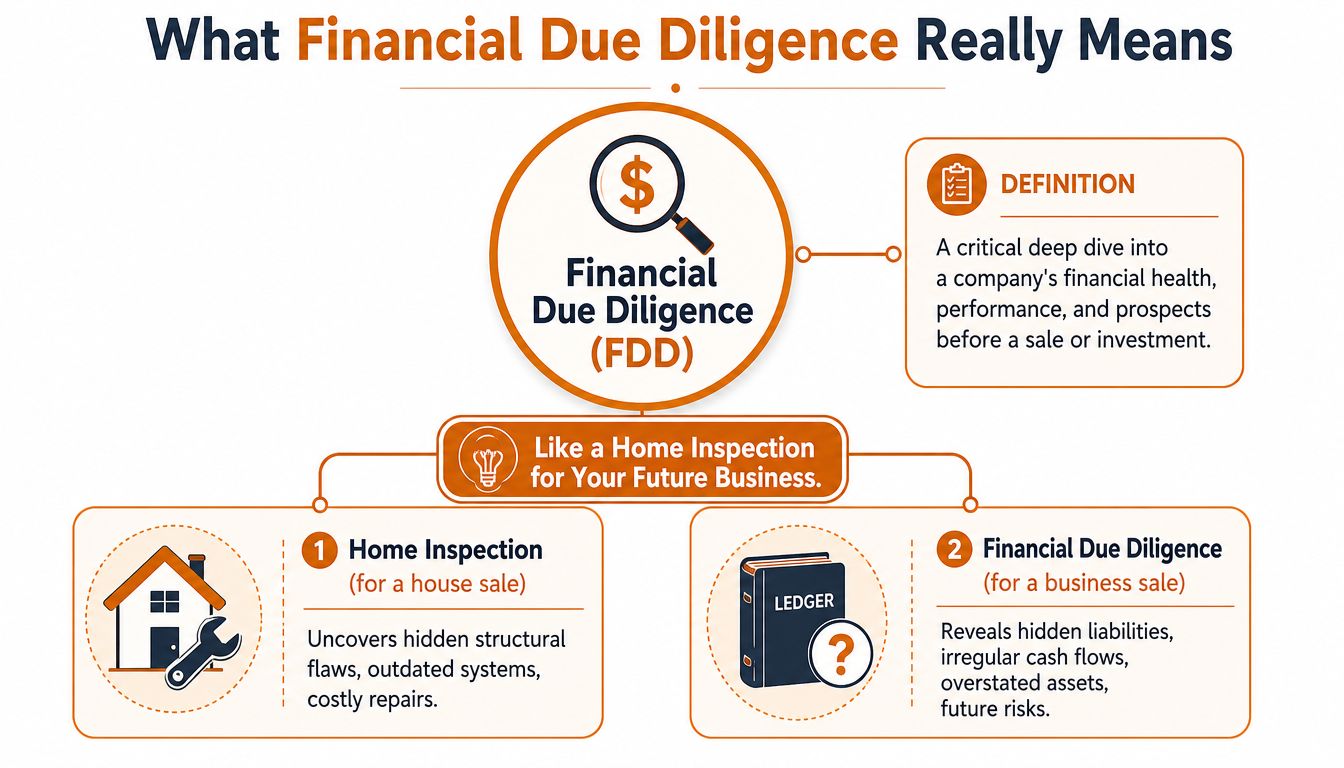
When someone buys a house, they don’t rely only on the seller saying, “The roof is fine.” They hire an inspector. The house may look good during the showing, but the inspector checks for water damage, wiring problems, foundation cracks, and aging systems.
A business sale works the same way. Financial due diligence checks for weak spots that don’t show up in a quick conversation or a tidy profit-and-loss statement. Hidden liabilities, overstated earnings, weak cash conversion, sloppy working capital, and unsupported add-backs all show up here.
A standard audit asks whether financial statements follow accounting rules. Financial due diligence asks a different question: what are the actual earnings of this business, and how dependable are they after the owner leaves?
That difference matters. A business can have tidy statements and still disappoint a buyer if the reported EBITDA is inflated by one-off revenue, personal expenses run through the company, or margins that can’t hold up after a sale.
According to Statista’s 2021 survey of M&A practitioners, about 26% of respondents said high-quality financial due diligence was the single most significant factor in deal success. Practitioners put it at the top because this work tells them whether the valuation stands on solid ground.
Here’s the simplest way to explain it:
| Question | What the buyer wants to know |
|---|---|
| Are the earnings real? | Can revenue and margins be supported with records and business logic? |
| Are the earnings repeatable? | Will the same profit continue after closing, without unusual owner involvement or one-time events? |
| Are there hidden financial risks? | Is there debt, accrual exposure, or balance-sheet cleanup waiting to reduce value later? |
For many owners, the most useful related concept is the quality of earnings report. That review focuses on normalizing earnings, tracing revenue, and showing a buyer what should count as sustainable operating profit.
Practical rule: If you can’t explain a profit adjustment with records, a buyer usually won’t treat it as part of value.
That’s why what is financial due diligence can’t be answered with “they review the books.” They test the story behind the books.
Once a letter of intent is signed, the buyer usually hires a transaction advisory team or accounting firm to run the financial review. That team is separate from your bookkeeper and separate from the lawyer drafting the purchase agreement. Their job is to verify the economics of the deal.
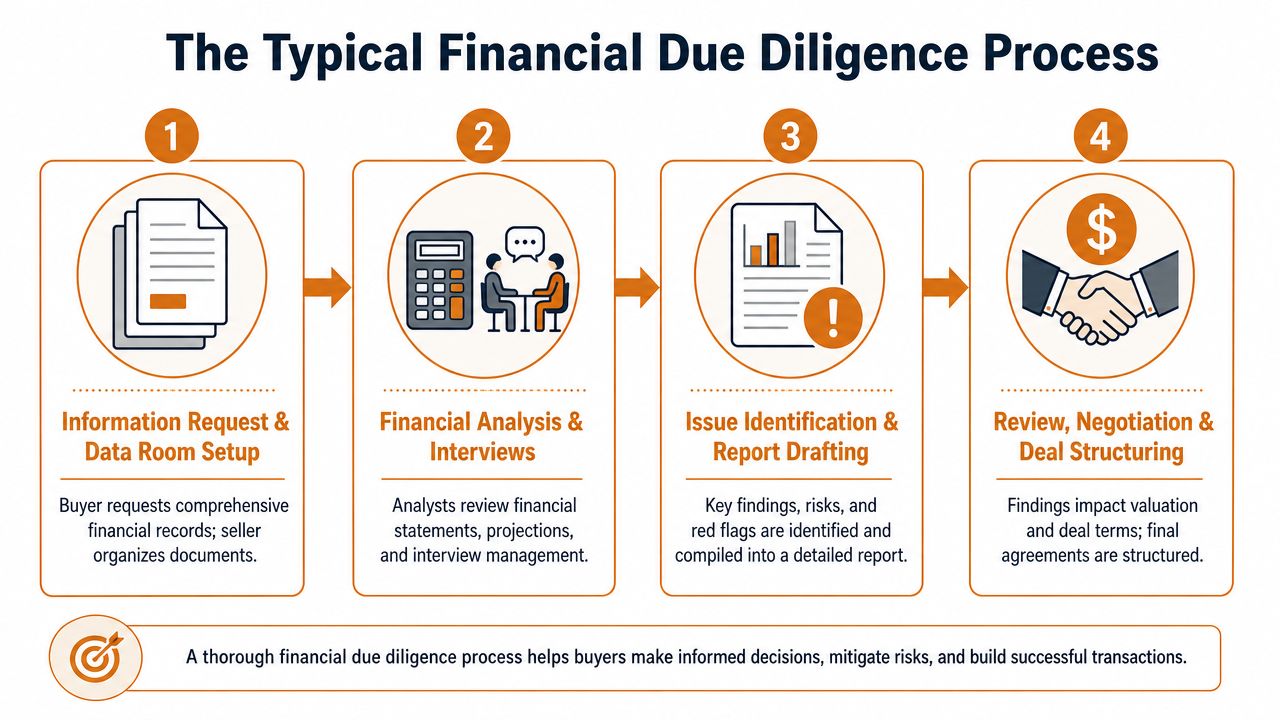
Owners often expect one accountant to skim the statements and send back a few questions. In practice, the work is more methodical. The buyer’s team usually requests multiple years of financial statements, tax returns, general ledger detail, and the most recent last-twelve-month period so they can compare the past to what the business is doing right now.
A good overview of the seller experience appears in this guide on what happens during due diligence, especially if you’ve never been through a deal before.
The early request list often includes:
After the requests go out, management interviews usually follow. During these interviews, owners get tested without realizing it. If the P&L says one thing and the verbal explanation says another, the diligence team notices.
Later in the process, buyers often use a short explainer like this to orient stakeholders:
According to Ansarada’s explanation of financial due diligence, the work often follows a Three-Pillar Framework of income statement, balance sheet, and cash flow analysis.
The buyer conducts a study of revenue trends, gross margin, operating margin, seasonality, and unusual swings. In an owner-operated company, the process also challenges personal expenses, one-time revenue, or loose cutoff practices.
This is less glamorous, but it’s where many deals get repriced. Buyers look for debt-like items, stale receivables, inventory issues, unpaid liabilities, and accrual problems. They also study borrowing levels and risk indicators, including the debt-to-equity ratio.
A profitable business can still create a buyer problem if profit doesn’t turn into cash. The diligence team compares earnings to actual cash generation, working capital needs, and recurring capital spending. If a company shows solid EBITDA but constantly eats cash, the buyer will ask why.
Buyers trust cash more than adjusted profit.
The output is usually a diligence report. It doesn’t say “buy” or “don’t buy.” It highlights what was confirmed, what needs explanation, and what should change in the deal structure.
Common outcomes include:
That’s the process in plain language. The buyer asks for proof, tests the company through the three financial pillars, and uses the findings to decide whether the original offer still makes sense.
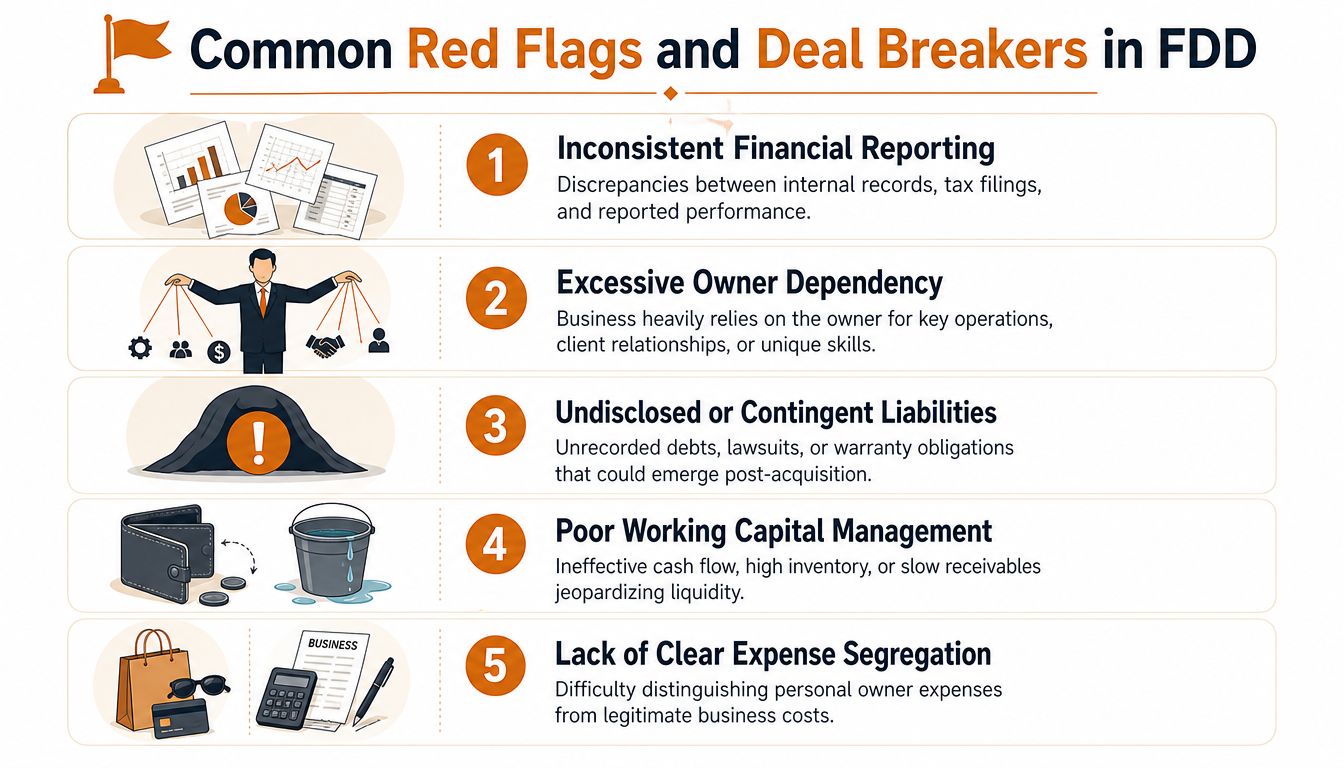
Most owner-operated businesses have quirks. Buyers expect that. What makes them nervous isn’t the existence of quirks. It’s when those quirks change earnings, cash needs, or risk in ways the seller can’t document.
Owners often hear a preliminary value based on EBITDA, then assume that number is locked. It isn’t. During diligence, the buyer tests every adjustment used to reach “adjusted EBITDA.”
According to BPM’s financial due diligence overview, financial due diligence teams typically reject 15% to 25% of a seller’s proposed EBITDA adjustments. The same source notes that a 1% reduction in validated EBITDA for a company valued at a 10x multiple can reduce transaction price by $100,000 per $1M of unadjusted earnings.
That’s why owners should care deeply about support, not just presentation. A spreadsheet full of add-backs isn’t enough. Buyers want invoices, payroll records, contracts, and a clean explanation.
Some problems show up again and again in smaller private companies.
A simple way to see why these matter:
| Red flag | What the buyer hears | Likely effect |
|---|---|---|
| Personal expenses in the books | “Reported profit needs cleanup” | More adjustment scrutiny |
| No support for add-backs | “Seller’s EBITDA may be overstated” | Lower validated earnings |
| Owner controls everything | “Cash flow depends on one person” | More conservative terms |
| Messy accruals or inventory | “Closing balance sheet may be off” | Purchase price adjustment risk |
If a buyer has to guess, the buyer will usually guess in their own favor.
None of these issues automatically kills a deal. But they do change the bargaining position. The more unresolved questions in diligence, the easier it is for a buyer to renegotiate.
The phrase what is financial due diligence gets clearer when you apply it to a real business model. Buyers don’t review an HVAC company the same way they review a subscription business, even if both show healthy top-line revenue.
Take a trade business with installation revenue, repair work, and maintenance agreements. On the surface, the P&L may show strong annual sales and decent earnings. The buyer immediately asks a more useful question: how much of that revenue is recurring, contractual, and predictable?
If the company has a solid base of service agreements, buyers usually want to see the contracts, renewal behavior, billing terms, cancellation language, and whether the revenue repeats as expected. If the business relies heavily on one-time installations, buyers will look more closely at backlog quality, job costing, labor efficiency, and seasonality.
For a trades owner, the records behind the work are particularly important. A maintenance plan that lives in a dispatcher’s memory won’t carry the same weight as signed agreements, organized billing history, and clean customer data.
A recurring revenue company tells a similar story with different documents. The buyer wants to know whether recurring revenue is contractual, how long it lasts, and what evidence supports renewal assumptions.
According to UK Business Angels Association’s discussion of financial due diligence, 73% of valuation for owner-operated businesses hinges on revenue quality. The same source states that businesses with 5+ year recurring contracts see 35% higher due diligence EBITDA adjustments, while buyers discount unverified recurring revenue streams by 20% to 30% without proper contract evidence.
That tells you something important. The label “recurring” isn’t enough. Buyers want proof.
Here’s how the two models often differ in diligence:
| Business type | Buyer focus | Best evidence |
|---|---|---|
| HVAC or plumbing | Service agreement quality versus one-time jobs | Signed maintenance contracts, billing records, retention history |
| Subscription or service contracts | Contract length, renewal terms, and revenue verification | Executed agreements, invoicing, customer cohort support |
For both models, revenue quality drives value. If your best customers are on written agreements, with clear pricing and a history the buyer can trace, diligence tends to go better. If recurring revenue is more of an assumption than a documented fact, the buyer will treat it cautiously.
The best way to survive buyer diligence is to do your own cleanup before the buyer starts asking questions. Most valuation drops don’t happen because the business is bad. They happen because the records are incomplete, the adjustments are unsupported, or the owner waits too long to organize the financial story.
According to Intralinks’ guide to financial due diligence in M&A, 68% of deal failures stem from sellers having unprepared, non-audited financials that buyers reject. The same source says 42% of private equity buyers now require seller-side due diligence reports upfront, while fewer than 15% of owner-operated sellers know how to generate them.
Start with the basics. If your financials need cleanup, do it before a buyer sees the first draft.
If you need a plain-English explanation of one of the most misunderstood topics, this guide on what is an add-back is worth reviewing before you start building your adjustment schedule.
Seller-side preparation can include a quality of earnings review or a broader financial readiness exercise. The point isn’t to create paperwork for its own sake. The point is to find your own weak spots first.
That changes the conversation in three ways:
Owners often think preparation is expensive. Unpreparedness is usually more expensive.
If you’re planning a sale in the next stretch of time, don’t wait for the buyer’s list to teach you what’s missing. By then, every gap feels larger because it appears under pressure.
It depends on the size of the business, the quality of the records, and how quickly management responds. Clean books and organized documents speed things up. Messy records slow everything down.
The buyer usually pays for their own financial due diligence team. If you choose seller-side preparation, that cost is typically yours. Owners often treat that work as a readiness investment because it can prevent larger price or term concessions later.
Financial due diligence tests earnings, cash flow, working capital, and balance-sheet risk. Legal due diligence reviews contracts, ownership, litigation, and compliance. Operational due diligence looks at how the business runs, including systems, processes, staffing, and dependency on the owner.
Most owners benefit from a coordinated group that may include a transaction-focused CPA, an M&A advisor, and legal counsel with deal experience. Your regular accountant may know your books well, but a sale process often needs specialists who understand buyer scrutiny and deal mechanics.
If you’re getting ready for a sale, succession, valuation, or financial cleanup, The Owner’s Shortlist helps long-tenured business owners find vetted specialists in valuation, taxes, legal matters, financing, and transition planning, plus practical articles that explain the process in plain English before you hire anyone.
Tell us your situation. We'll connect you with a specialist who works with owners like you. One conversation, no sales pressure.
Found this useful?
Add The Owner's Shortlist as a preferred source and get our articles highlighted in Google Search results.
Add to Preferred SourcesCompare 10 business transfer lawyer options for sales, succession, family transfers, and smaller deals, with questions, fee models, and red flags.
October 5, 2026
Interest rates, inflation, the headlines. None of it matters as much as owners think. Here's what actually determines whether now is the right time to sell.
October 5, 2026
What is a tuck-in acquisition? Learn how these deals impact owner-operated businesses, trades, valuation, and when to consult an M&A specialist.
September 29, 2026
Learn what reps & warranties mean in M&A deals, why they matter, and how to negotiate them effectively. A clear guide for business owners.
September 27, 2026