Tax Attorney vs CPA for Business Exits and Succession
Tax attorney vs CPA explained for owners planning an exit or succession. See who handles what, where they overlap, what it costs, and which to hire first.
October 8, 2026
By Remi Taffin · July 22, 2026
If you own a profitable HVAC, plumbing, electrical, or service business, you’ve probably had the same thought at least once. The company looks strong, the crew is busy, the phone keeps ringing, and then someone mentions a sale, succession, or tax bill, and the mood changes fast. That’s usually the moment owners realize corporate tax planning services are not a back-office luxury, they’re part of protecting the value you spent years building.
The difference shows up most clearly at exit time. A clean sale process can still leave a bad after-tax outcome if the structure was never planned with the end in mind. That’s why the corporate tax service market matters, it was valued at USD 18.72 billion in 2025 and is projected to reach USD 26.00 billion by 2033, at 6% CAGR (DataHorizzon Research). Owners are not paying for filing help alone anymore, they’re buying strategy, forecasting, and deal readiness.
A plumbing owner gets a serious offer after years of building routes, trucks, and service agreements. The buyer likes the recurring work, likes the books, and likes the brand. Then the owner looks at the tax bill and sees that the sale price is not the same thing as the money that lands in their account.
That gap is why tax planning belongs in the exit conversation from day one. Years of structure, compensation, asset mix, and entity choices shape the final outcome, and those choices are hard to repair once a buyer is already at the table. By then, you are working with fewer options than you should have had.
Practical rule: the best tax planning is the work that gives you choices before a buyer, lender, or family member forces a decision.
A lot of owners still treat tax as a filing task. That mindset costs money. Corporate tax planning services exist to preserve after-tax proceeds, not just to keep you compliant. For owner-operated businesses, the biggest losses usually show up in plain places, a poorly timed distribution, the wrong mix of assets in the company, or an exit structure that pushes more of the gain into tax than it should.
A recurring HVAC maintenance contract, a route-heavy plumbing company, or a specialty contractor with strong referrals can look healthy on the surface and still take a hit if the sale structure is wrong. Deal structure matters because an asset sale versus stock sale mechanics decision can change who pays tax, what carries over, and how much the owner keeps after closing.
The right advisor does not start with last year’s return. They ask what you plan to do with the business, when you might exit, and how much of the value needs to end up in your pocket instead of disappearing into tax leakage.
A tax preparer handles the filing. A tax planner protects the sale price, the cash flow, and the owner’s options before the deal is on the table. That difference matters most for an owner-operated business, where the tax bill can decide how much of the exit stays with the seller.
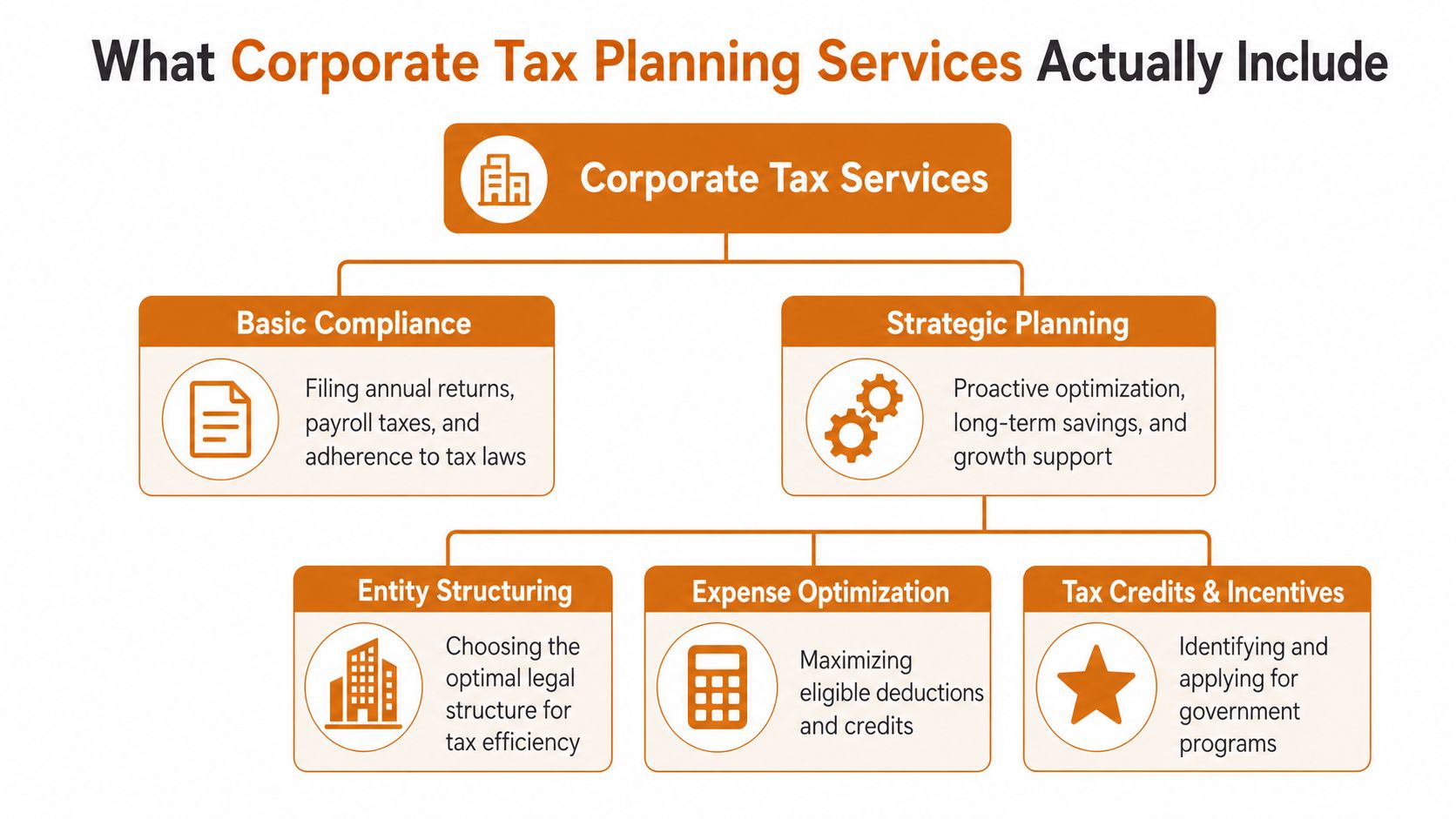
Basic compliance means filing returns, keeping payroll taxes straight, and staying inside the rules. That is the minimum. If your advisor only shows up at filing time, you are buying a required service, not a planning advantage.
Real planning goes further. One technical marker is ASC 740 provision work, where advisors calculate the tax provision, assess valuation allowances, and align documentation with deductions, credits, and intercompany transactions. That work strengthens audit readiness and makes the company’s tax position easier to defend (Corporate Tax Advisors).
For an owner, that matters because a business that looks clean to a buyer or lender should also hold up with the IRS or a state auditor. If the books and tax positions do not match the actual operation, buyers see risk fast.
Entity choice is one of the first levers an advisor should examine. The question is whether the current structure still fits the way the company earns money, hires people, and moves cash to the owner. The business entity and the owner’s personal tax picture both matter, because they collide at exit.
State and local planning matters too. A contractor with crews crossing state lines can create filing exposure, payroll issues, and apportionment headaches long before a sale. If you wait to clean that up during due diligence, you pay for it in time, friction, and sometimes price.
Good planning teams also look for credits and incentives the business can use. They do not spray applications everywhere. They match the company’s activity to the rules, then document the position correctly.
That same discipline matters in a sale. Once a transaction is real, the tax questions change because the planning has to fit the deal structure, not the other way around. Understanding how to structure the deal is a key part of how to minimize taxes when selling your business. A family-owned service company looking at retirement or a management buyout needs the tax strategy tied to the closing terms, not just last year’s return.
A good tax planner does not ask, “What did you owe?” They ask, “What can we still control?”
For an owner-operated company, the biggest wins usually come from plain-English moves, not exotic structures. The point is to control timing, fit the entity to the economics, and make sure the owner’s personal plan lines up with the business plan.

If your company signs a large service contract in December, timing matters. You may want income recognized differently, or expenses pulled forward, depending on where the business stands for the year. That’s especially true when a strong year is about to become a much stronger one.
An HVAC company is a simple example. Suppose the owner is planning to replace vans, compressors, or other equipment. Buying at the right time can change the tax picture for the business, and when the company has a heavy revenue year, that timing can be the difference between a manageable bill and an ugly surprise. The point isn’t to spend for the sake of spending, it’s to place unavoidable spending where it does the most tax work.
Some owners hear about capital gain treatment, QSBS, and other entity-level ideas and think those tactics are only for tech startups. That’s a mistake. The broader lesson is that the structure you use today affects the exit you can execute tomorrow.
If your business is likely to be sold, the current entity choice needs to be tested against the exit path. A service business with recurring contracts, solid management, and transferrable systems might be worth more after a different kind of planning than a business that’s treated as a lifestyle asset. Owners should read small business tax planning basics with that lens, not as generic accounting advice.
A lot of owners leave money on the table because they focus only on the company and ignore their own balance sheet. Retirement contributions, distribution policy, compensation mix, and estate planning all affect the after-tax value of a sale or transition. If the business is the owner’s largest asset, the owner’s personal tax picture is part of the transaction, not an afterthought.
Best practice: plan the owner and the entity together. If those two pieces live in different conversations, the tax strategy is incomplete.
Consider a plumbing company with a long-term maintenance base and a strong year ahead. The owner is thinking about replacing service trucks, smoothing income, and preparing for a possible sale in the next few years. That owner shouldn’t ask, “How do I lower this year’s tax?” They should ask, “How do I shape the next three years so the business looks cleaner, more predictable, and more transferable when a buyer shows up?”
That’s the right frame. Tax planning is not about one move. It’s about sequencing several good moves so the exit is easier to price, easier to diligence, and easier to close.
The worst time to hire a tax strategist is when the deal is already in motion and everyone is asking for answers by Friday. By then, your options are thinner. The better approach is to treat tax planning like planting a tree, the best time was years ago, the second-best time is now.
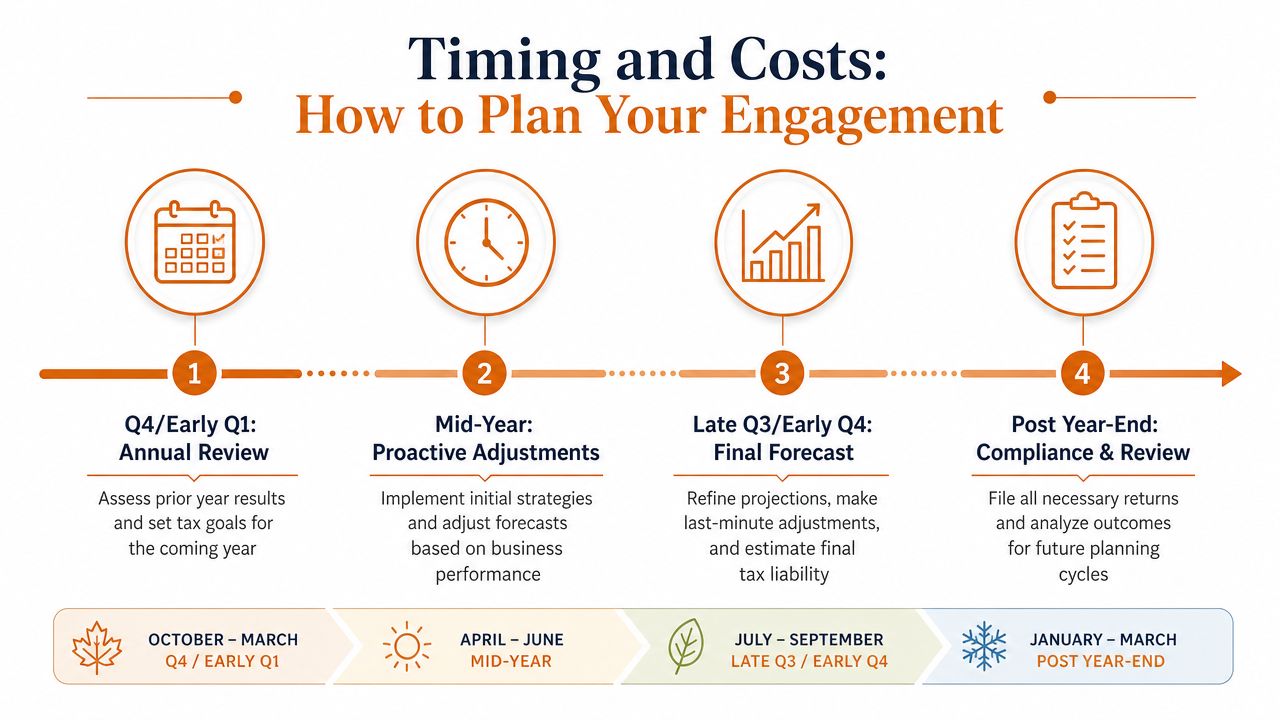
The practical advice is simple. Review the prior 2 to 3 years of returns, build a 3-year forecast, and re-optimize quarterly as results and legislation change (Corporate Tax Advisors). That cadence gives you room to react before year-end locks in the outcome.
For an owner thinking about a sale, structure work often needs a long runway. If there’s any chance you’ll sell, pass the business to family, or recapitalize, starting early keeps more tools on the table. Waiting until late Q4 usually means you’re choosing from fewer strategies and more deadlines.
You’ll typically see three fee models. Some advisors charge hourly, which works for targeted questions. Others use project fees for a specific transaction, which makes sense when the work is tied to a sale, restructuring, or transition. Retainers are common when the owner wants ongoing planning throughout the year.
The right model depends on how much change is ahead. A steady business with minor adjustments may only need periodic advisory time. A company preparing for a sale, a family transition, or a state tax cleanup needs deeper involvement and a broader scope.
Tax planning should be measured against what it protects, not just what it costs. If an advisor helps you avoid a bad structure, clean up a messy footprint before diligence, or align the business with the owner’s personal plan, the fee is part of the exit value, not an overhead line to resent.
Direct answer: if the business might change hands in the next few years, don’t wait for a crisis to buy advice.
A disciplined engagement usually starts with facts, then adds options, then locks in the plan that fits the owner’s real timeline. That sequence keeps the work practical and prevents you from paying for ideas you can’t execute.
Not every CPA is a strategist, and not every strategist understands owner-operated businesses. That difference matters because a filing-focused accountant can be excellent at compliance and still be the wrong person for an exit.
The background problem is bigger than most owners realize. The OECD estimated that multinational tax planning reduced net corporate income tax revenue by 4% to 10% of global corporate tax revenues in OECD and G20 countries, equal to about USD 100 billion to USD 240 billion in 2014, with accumulated losses of about USD 0.9 trillion to USD 2.1 trillion over 2005 to 2014 (OECD). You don’t need multinational scale to need specialist judgment, but you do need someone who can think beyond the return.
Use the first call to test for depth, not charm.
If someone promises a specific savings outcome before seeing your books, move on. If they can’t explain how the plan affects a future sale, move on. If they can’t tell you how they handle state issues, intercompany items, or audit support, move on.
Owners should also listen for language that treats tax as a one-time trick. Good planning is iterative. It changes as the business changes.
The best specialists speak plainly, ask hard questions, and give you a plan that matches the timeline you have, not the one they wish you had.
You don’t need to solve everything this week. You do need to get organized so the next conversation is useful.
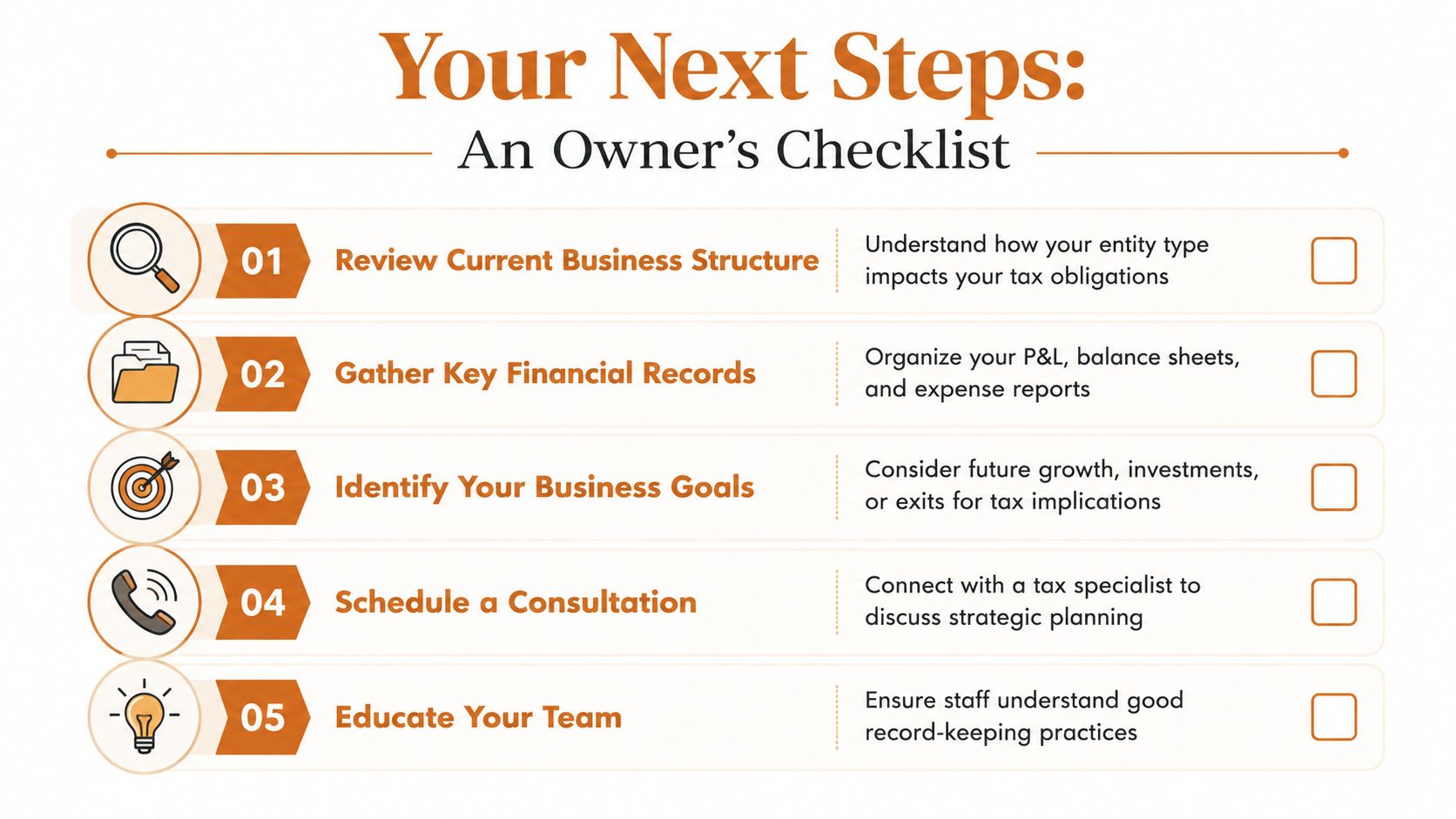
Pull together the last three years of business and personal tax returns. That gives a specialist enough history to see patterns, not just a single year snapshot. Add financial statements, major equipment purchases, debt schedules, and any current contracts that drive revenue.
Be blunt about what you want in the next five years. Sell the business, transfer it to family, keep it and grow it, or prep it for a partner buyout. Tax planning changes depending on that answer, and your advisor should know it before suggesting anything.
Ask a simple question, what would happen if a buyer came forward this year? Even a rough answer can expose whether the current setup is efficient or outdated. If the hypothetical sale outcome looks weak, that’s the signal to get help now, not later.
Book a no-pressure call with a vetted tax specialist and walk through your goals, your current structure, and your likely exit path. The right advisor won’t push a one-size-fits-all answer. They’ll tell you where the greatest opportunities are and where you’re already boxed in.
If your office manager, bookkeeper, controller, or trusted CPA owns part of the process, make sure everyone uses the same records and timeline. Clean records reduce friction, and friction kills planning momentum.
Good tax planning starts with a file drawer, a calendar, and an honest conversation. Get those three things in place, then make the specialist prove where the value is.
A CTA for The Owner’s Shortlist.
Tell us your situation. We'll connect you with a specialist who works with owners like you. One conversation, no sales pressure.
Found this useful?
Add The Owner's Shortlist as a preferred source and get our articles highlighted in Google Search results.
Add to Preferred SourcesTax attorney vs CPA explained for owners planning an exit or succession. See who handles what, where they overlap, what it costs, and which to hire first.
October 8, 2026
Explore business tax planning strategies for small and mid-sized owners preparing for succession or sale, with trade examples and expert guidance.
October 1, 2026
Understand business sale capital gains tax before you sell. Learn short vs long-term rates, asset vs stock sales, and planning strategies to keep more proceeds.
September 30, 2026
Learn what is capital gains tax, how short- and long-term rates work, and how the rules apply when you sell a business. Clear guidance
September 22, 2026