Tax Attorney vs CPA for Business Exits and Succession
Tax attorney vs CPA explained for owners planning an exit or succession. See who handles what, where they overlap, what it costs, and which to hire first.
October 8, 2026
By Remi Taffin · July 11, 2026
If you’re thinking about selling your business, there’s a good chance you’re focused on the obvious numbers. Revenue. EBITDA. buyer interest. headline price. Those matter, but they aren’t the number that changes your life.
The number that matters is what lands in your account after taxes.
Many owners often get blindsided. They spend years building a strong company, negotiate a respectable deal, then discover too late that the tax result was largely set long before the letter of intent arrived. By then, the best moves aren’t available. Entity elections weren’t made early enough. compensation wasn’t cleaned up. records don’t support the deductions they thought they had. Sale structure gets negotiated by the buyer, and the owner is left reacting.
Good small business tax planning for an exit isn’t a year-end exercise. It’s part of succession strategy. If you’re an owner-operator in HVAC, plumbing, manufacturing, distribution, or a service business with recurring customer relationships, the tax side of your sale should be built years ahead of the transaction, not weeks before closing.
Owners usually don’t lose on price first. They lose on taxes.
A sale can produce a large one-time income event, and that event exposes every weak spot in your tax setup. If the entity is wrong, if compensation has been sloppy, if deductions weren’t documented, or if the deal gets structured in a buyer-friendly way without tax analysis, the after-tax result can shrink fast. That pain is worse because it often feels avoidable. It usually is.
The broader problem isn’t a lack of effort. It’s a lack of clarity. A 2023 American University survey on small business tax literacy identified a $496 billion tax problem tied to missed planning opportunities and unclaimed deductions, and the same source notes that 59% of small business owners say federal taxes are one of their most significant operational burdens.
That should sound familiar. Most owners know their business cold. Fewer know how sale structure, basis, depreciation history, compensation policy, installment treatment, and entity status interact when they finally exit.
A buyer may offer an attractive number. That doesn’t tell you what you’ll keep.
Two owners can sell businesses for the same price and walk away with very different after-tax outcomes because one started planning early and the other didn’t. The first owner shaped the entity, tightened the books, documented reimbursements correctly, and entered negotiations knowing which tax points mattered. The second owner showed up with good operations and bad tax positioning.
Practical rule: Judge every exit decision by after-tax proceeds, not by the top-line purchase price.
That mindset changes behavior. Owners stop asking, “How do I save taxes this year?” and start asking, “What structure preserves the most value when I sell?”
Pre-sale tax planning works best when you still have room to act. Several of the biggest decisions only work if you make them well before the market sees your company.
That includes choices about entity type, ownership design, compensation, family transfer planning, and whether certain income should be recognized now or later. Once a deal is active, your flexibility is limited. Buyers want speed. lawyers want clean drafting. lenders want predictability. Tax planning becomes constrained by what already exists.
A practical exit plan treats taxes as part of deal preparation, right alongside valuation, legal cleanup, and management readiness. That’s especially important for owner-operated companies, where personal and business finances often grew together over time and need to be separated cleanly before a buyer starts asking questions.
The best tax moves are rarely last-minute moves. They depend on lead time.
Think in phases, not in filing seasons. An owner who starts early can change structure, clean up records, and enter negotiations from a position of control. An owner who waits until the deal is imminent usually ends up choosing among weaker options.
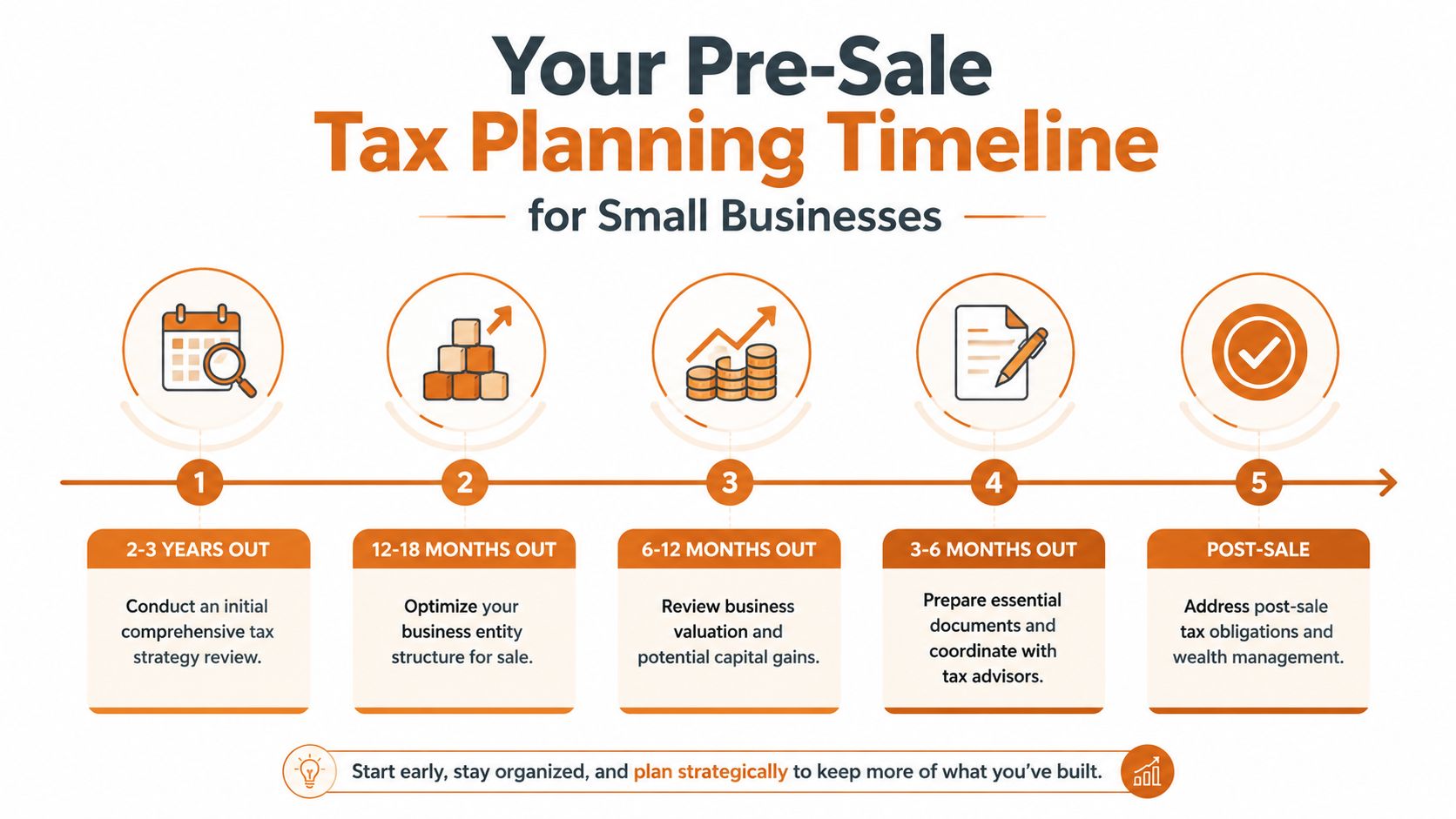
If you’re a few years out, this is the stage for structural decisions.
Review the entity first. If you’re operating as an LLC, S corporation, or C corporation, don’t assume the current setup is optimal for a sale. The right structure for running a business isn’t always the right structure for exiting one. This is also when owners should examine whether family ownership, trust planning, or other succession-related changes belong in the plan before a buyer appears.
A useful way to think about the early phase:
Owners in trades often skip this because they’re busy running jobs, managing crews, and protecting margins. That’s understandable, but it creates a pattern I see often. The business performs well operationally, yet the owner enters a sale process with tax planning that was never built for an exit.
As the likely sale window gets closer, the work becomes more tactical.
Clean financial statements matter. Buyers and tax advisors need a coherent record of earnings, payroll, equipment, reimbursements, and owner-related expenses. If your books still contain personal charges, inconsistent distributions, or missing support for deductions, fix that before diligence starts.
In the sale year, estimated taxes become a real issue. The IRS uses a pay-as-you-go system for taxpayers expecting to owe $1,000 or more, with quarterly due dates and underpayment penalties that can accrue at 0.5% per month on unpaid balances, as outlined in this small business estimated tax guide. In a sale year, static estimates are one of the easiest mistakes to make because income can spike suddenly.
Recalculate estimated taxes during the sale year. Don’t assume last year’s pattern still applies once a transaction changes your income.
That means the timeline near closing should include cash planning, not just tax planning. Sale proceeds don’t automatically solve liquidity timing if estimated payments, state taxes, earnout treatment, or escrow holdbacks distort when cash is available.
A practical closing-year checklist looks like this:
| Period | Priority |
|---|---|
| Earlier planning window | Review entity, compensation, ownership, and likely sale structure |
| Pre-market phase | Clean financials, separate personal items, organize tax support |
| Deal negotiation phase | Analyze purchase price allocation and payment structure |
| Year of sale | Recalculate estimated payments and prepare for filing complexity |
| Post-close | Coordinate amended returns, elections, and wealth planning decisions |
The owners who keep more usually didn’t “find” a clever strategy at the end. They built a timeline that gave those strategies time to work.
Entity and compensation decisions sit underneath almost every tax result in a sale. If those two pieces are weak, the rest of the planning often turns into damage control.
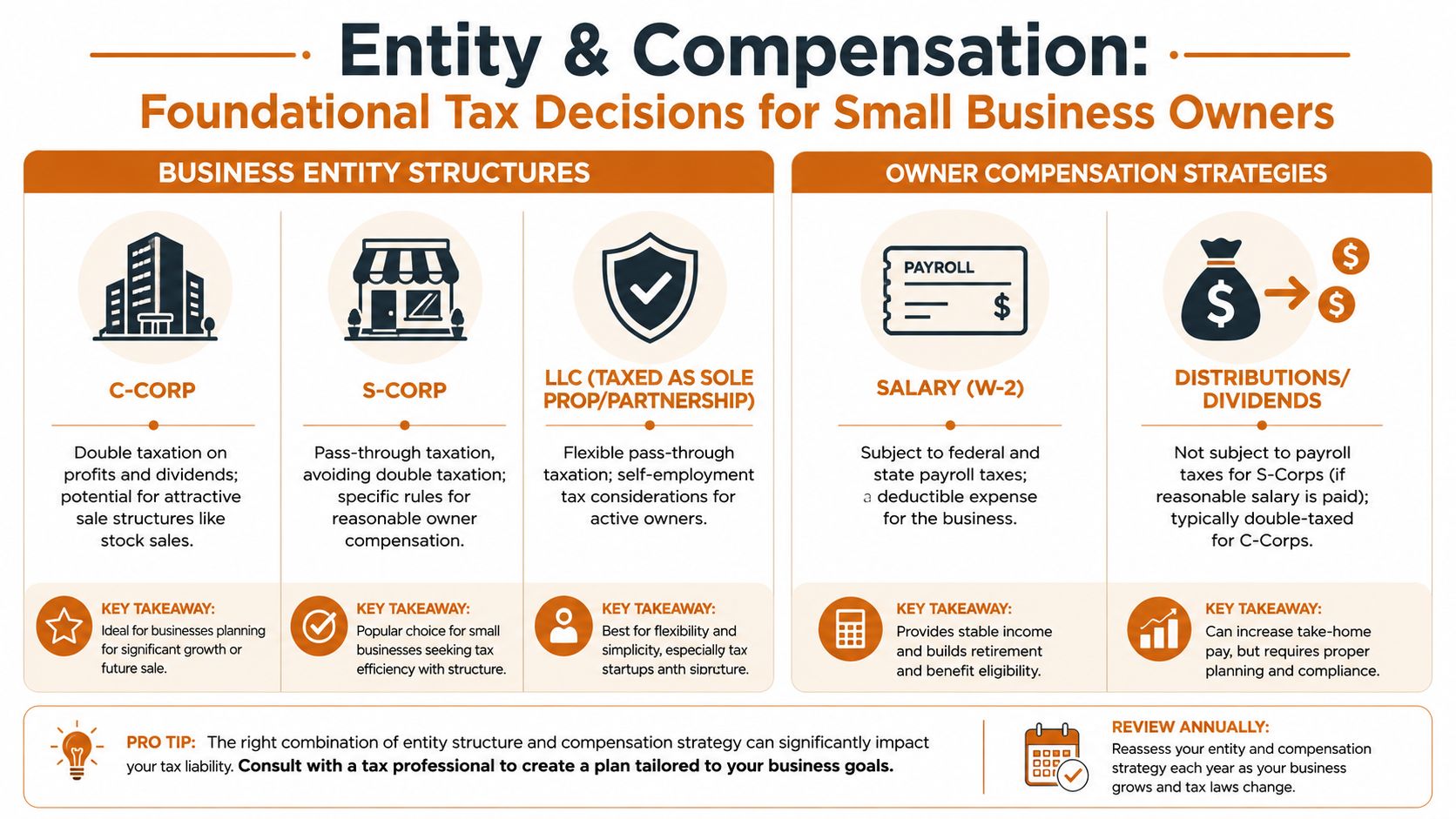
Owners tend to discuss entity type in operational terms. liability protection, simplicity, payroll tax treatment, or filing burden. For an exit, the better question is different. How will this entity behave if a buyer wants assets, and how will it behave if a buyer wants equity?
Here’s the practical contrast:
| Entity | Typical planning appeal before a sale | Common trade-off in a sale |
|---|---|---|
| S corporation | Pass-through treatment and flexibility around salary and distributions | Asset sale dynamics can create pain depending on basis and prior depreciation |
| C corporation | May align better with certain stock-sale outcomes | Double-tax exposure can be severe in the wrong deal structure |
| LLC taxed as partnership or sole proprietorship | Flexibility and straightforward pass-through treatment | Buyer preferences and asset allocation issues still matter |
This isn’t academic. Buyers often push for an asset deal because it may give them a cleaner tax basis in what they acquire. Sellers often prefer stock treatment. Those interests don’t automatically line up. If you want a plain-language breakdown before negotiating, this guide on asset sale vs. stock sale is worth reviewing.
For pass-through owners, the Qualified Business Income deduction remains a meaningful planning tool. According to this QBI update and OBBBA summary, the deduction has been made permanent starting in 2026, can allow up to a 20% deduction on qualified business income, and the limitation threshold for joint filers increases to $150,000 beginning in 2026.
That doesn’t solve exit tax by itself, but it does affect how owners think about pass-through structure over time. Stability in the deduction makes long-range planning less speculative.
Many owners think compensation planning is mainly about reducing self-employment or payroll tax. Before a sale, it’s bigger than that.
Reasonable salary for an S corporation owner matters. So do distributions, shareholder loans, reimbursements, and any personal expenses that have been run through the business. These choices affect not only current tax exposure but also the credibility of your books and the quality of your due diligence package.
A few patterns separate sound planning from weak planning:
If your compensation approach would be hard to explain to a buyer, it will also be hard to defend to a tax advisor during a sale.
Owners sometimes underestimate how much these foundational choices influence negotiations. A buyer who sees disorganized compensation records may not use tax language, but the result is the same. Lower confidence, more diligence, and less willingness to accommodate seller-friendly structure.
Once the foundation is sound, strategy becomes much more effective. Small business tax planning then moves from cleanup to optimization.
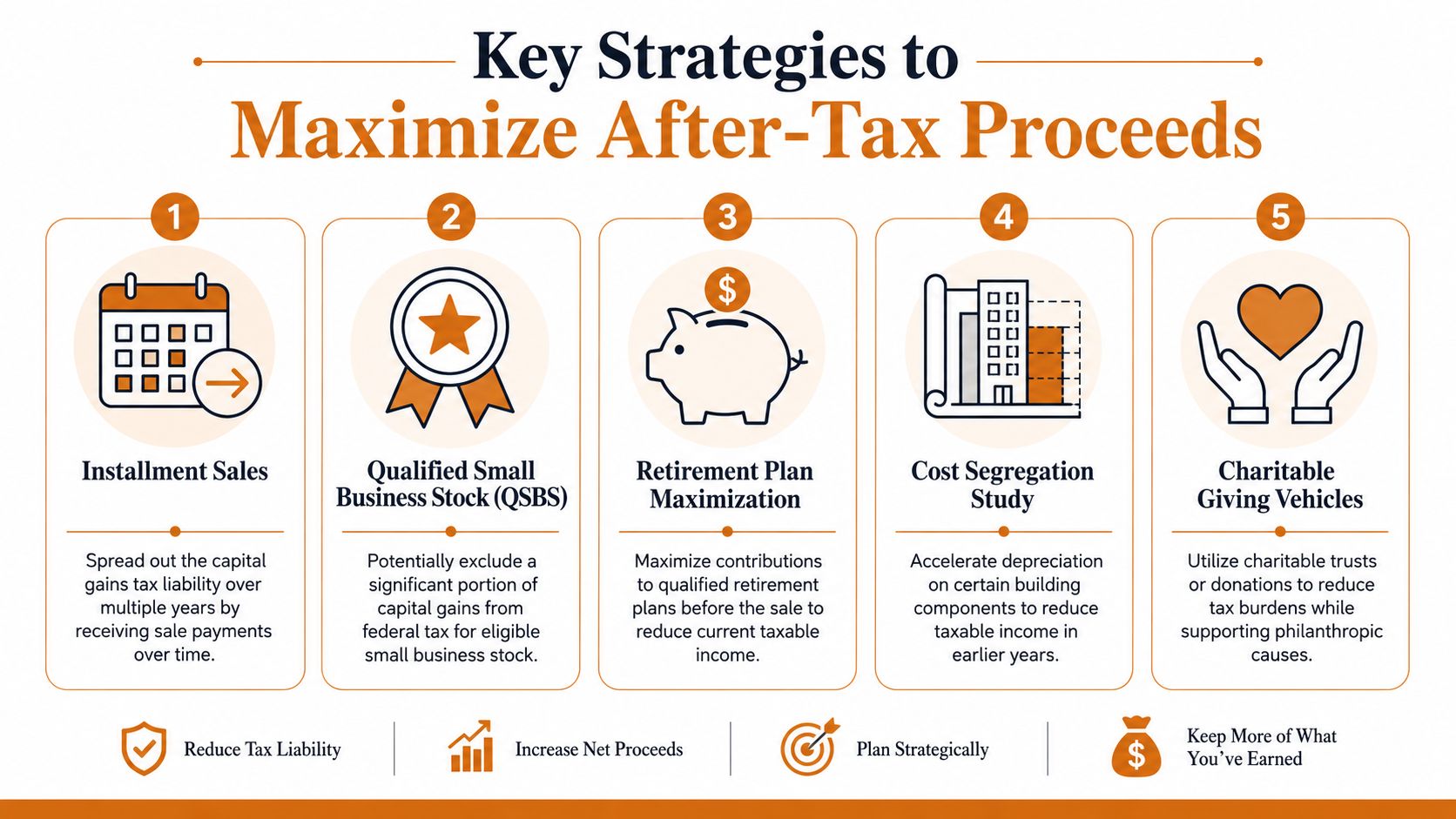
Some of these techniques are familiar. Others are missed because they sit at the intersection of tax, deal structure, and succession planning. The key is not to chase every idea. It’s to use the right combination for your facts, your buyer, and your timing.
The purchase agreement is not just a legal document. It’s a tax document with legal drafting around it.
Allocation of purchase price matters. So does the split between tangible assets, intangible assets, goodwill, restrictive covenants, consulting arrangements, and earnouts. Different buckets can produce very different tax treatment. A seller who negotiates only on total price is leaving one of the largest levers untouched.
Installment treatment can also be useful in the right deal. If part of the price is paid over time, an owner may spread recognition rather than taking the full tax impact immediately. That doesn’t make installment treatment automatically better. It introduces credit risk and collection risk. For some owners, especially those selling service businesses with recurring revenue and seller-financed components, it can still be worth modeling.
If you’re weighing these issues in an actual transaction, this article on how to minimize taxes when selling your business gives a practical overview of the moving parts.
A few strategy levers deserve special attention:
One of the most missed opportunities right now involves research and development costs.
The One Big Beautiful Bill Act allows businesses to retroactively amend returns from 2022 through 2024 so that domestic R&D expenses that were previously amortized can be deducted immediately, according to this OBBBA small business planning update. For owners with qualifying activity, that can change the tax picture before or after a sale. It can also affect how cleanly prior years are presented to a buyer.
This matters even for businesses that don’t think of themselves as “R&D companies.” A manufacturer refining a process, a software-enabled service firm building internal tools, or a technical contractor testing improved workflows may have activity worth reviewing. The tax code doesn’t care whether you describe your company as advanced in a pitch deck. It cares whether the underlying activity qualifies.
Before using any strategy, ask three practical questions:
Here is a useful primer to frame that mindset:
Some of the best tax moves don’t look dramatic. They look organized, timely, and fully documented.
Other high-value tactics are less flashy but consistently effective. Reviewing depreciation schedules. identifying assets that may create recapture issues. coordinating charitable giving plans before liquidity arrives. maximizing retirement contributions while there is still compensation and business income to support them. None of these should be treated as generic checklist items. Each one has to be modeled against the expected deal terms.
Owners often ask for a single best strategy. There usually isn’t one. There is a stack of medium-sized decisions that, when coordinated early, can materially improve what you keep.
By the time a buyer enters due diligence, your tax planning is only as strong as your records.
Most tax strategies fail in practice for boring reasons. Missing schedules. poor reconciliation. undocumented reimbursements. personal expenses mixed into business accounts. These aren’t minor bookkeeping annoyances. They affect credibility, they slow down diligence, and they weaken your position when a buyer or advisor starts testing the numbers.
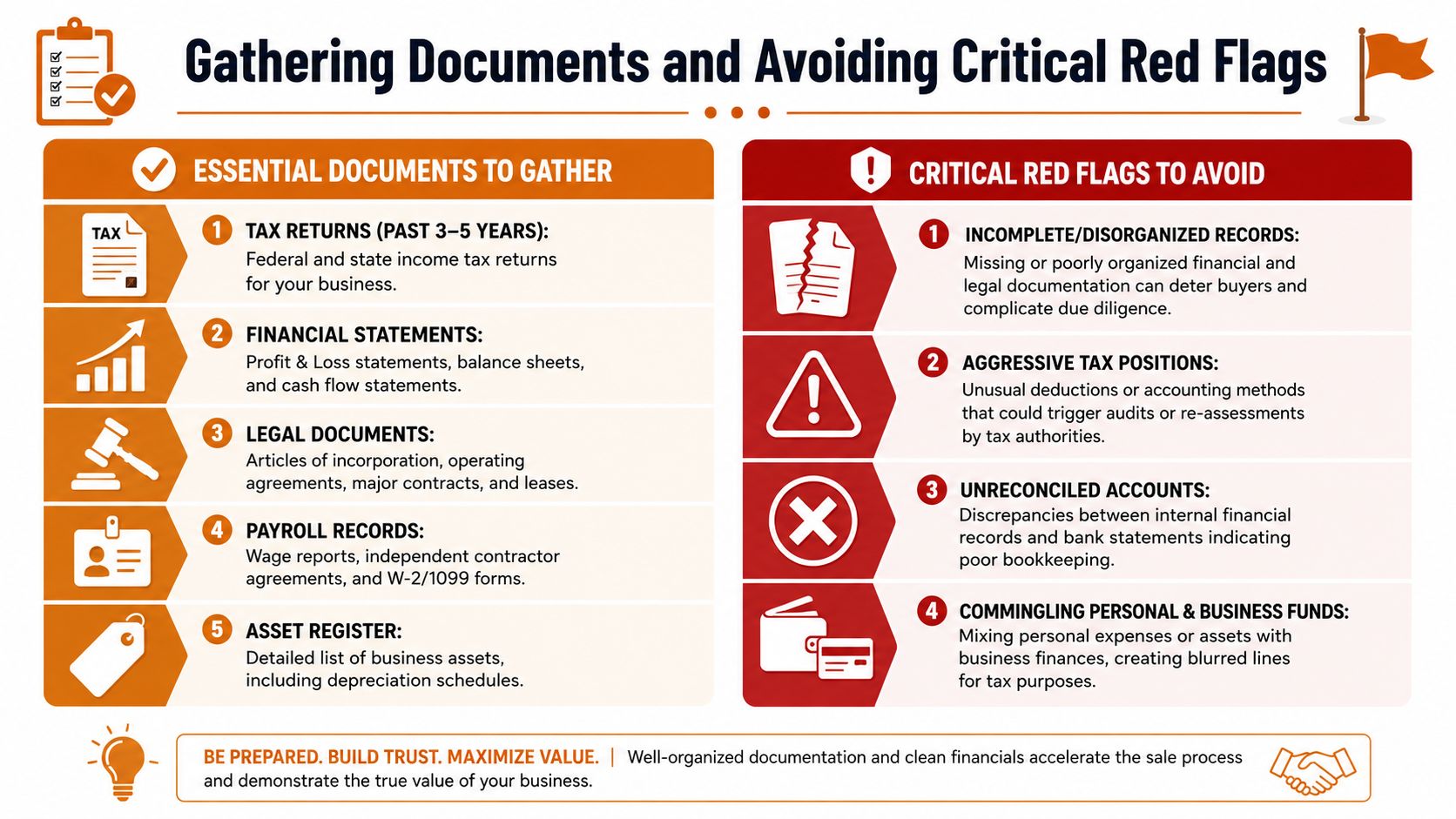
You don’t need a perfect archive. You do need an organized one.
At minimum, assemble a package that lets a tax advisor trace how the business has reported income, handled expenses, and tracked assets over multiple years. That typically includes the materials buyers review in financial due diligence, along with the tax support behind them.
Focus on these categories:
The biggest red flag is commingling. Once personal and business transactions blend together, every deduction becomes harder to defend and every diligence request takes longer to answer.
For S corporation owners, one issue deserves special attention. A written accountable plan for reimbursements is critical. As explained in this discussion of accountable plans and business records, if that written policy isn’t in place, the IRS can treat reimbursements as taxable income to the owner rather than non-taxable business expense reimbursement.
That matters for two reasons. First, it can increase tax unnecessarily. Second, it signals that owner-level transactions weren’t handled with discipline.
A few warning signs should be fixed immediately:
Buyers don’t just review your earnings. They review how believable those earnings are.
Owners who prepare well often find that the tax process becomes simpler, not more complex. Once the records are clean, advisors can spend their time on strategy instead of reconstruction.
A business sale is usually the largest financial event of an owner’s life. It’s also one of the easiest times to get bad tax advice from well-meaning people.
Your bookkeeper may be excellent. Your long-time CPA may be reliable for annual filings. Your attorney may be skilled in contracts. None of that guarantees they regularly handle transaction-specific tax planning for owner-operated businesses headed toward a sale.
Exit tax work is specialized because it sits across several domains at once. entity planning, compensation, diligence readiness, purchase agreement review, estimated tax management, and post-close filing strategy. The right advisor understands how those pieces interact under time pressure. Just as important, they know what doesn’t work. Last-minute entity changes with no business purpose. aggressive positions that won’t survive diligence. casual assumptions about allocations that were never negotiated.
When you interview a specialist, ask practical questions:
A good specialist won’t promise a magic percentage saved. They will identify the decisions that matter, model trade-offs clearly, and tell you where the risks sit. That’s what you want.
If you’re preparing for a succession event, sale, or ownership transition, The Owner’s Shortlist helps long-tenured owners find vetted specialists in taxes, legal matters, valuation, succession, and related decisions. It’s a practical place to start if you want to understand your options and connect with someone who knows how to protect after-tax proceeds before a deal is already underway.
Tell us your situation. We'll connect you with a specialist who works with owners like you. One conversation, no sales pressure.
Found this useful?
Add The Owner's Shortlist as a preferred source and get our articles highlighted in Google Search results.
Add to Preferred SourcesTax attorney vs CPA explained for owners planning an exit or succession. See who handles what, where they overlap, what it costs, and which to hire first.
October 8, 2026
Explore business tax planning strategies for small and mid-sized owners preparing for succession or sale, with trade examples and expert guidance.
October 1, 2026
Understand business sale capital gains tax before you sell. Learn short vs long-term rates, asset vs stock sales, and planning strategies to keep more proceeds.
September 30, 2026
Learn what is capital gains tax, how short- and long-term rates work, and how the rules apply when you sell a business. Clear guidance
September 22, 2026