Tax Planning for Business Owners: The Exit-Ready Roadmap
Tax planning for business owners preparing to sell or transition. Learn timelines, entity strategy, and how to keep more of your exit proceeds.
August 4, 2026
By Remi Taffin · September 22, 2026

Capital gains tax is a separate tax on the profit you make when you sell an asset for more than you paid for it. The taxable amount is the difference between the sale price and your cost basis.
You may be asking because a buyer has made an offer for the company you’ve spent years building. The number on the letter of intent looks substantial, but the amount you keep depends on more than the headline purchase price. Your basis, holding period, deal structure, asset allocation, entity, and closing date can all change the result.
For an individual investment, the calculation may involve a few lines on a tax return. For an owner-operated company, the sale can divide the proceeds into several tax categories. Some dollars may qualify for capital-gains treatment, while others may be treated as ordinary income or subject to a special rule. Understanding that split before signing can help you negotiate with a clearer view of your actual exit proceeds.
Suppose you’ve operated a company for fifteen years and receive an offer to buy it. You know the proposed price, but you don’t yet know how much of the check will remain after taxes. That uncertainty starts with the definition of capital gains tax, which is generally a separate tax on the profit from selling an asset for more than its adjusted basis.
The asset might be publicly traded stock, a rental property, equipment, or an ownership interest in a business. The basic formula is simple:
Amount realized on sale minus adjusted basis equals realized capital gain or loss.
Your basis usually begins with what you paid. It can then change because of improvements, depreciation, fees, prior transactions, or other tax adjustments. The gain becomes taxable when you sell or otherwise dispose of the asset, not merely because its market value has increased.
Practical rule: A rising valuation is not the same as taxable cash. Tax generally follows realization, and basis records determine how much of the sale is treated as profit.
The OECD describes broad variation in how countries tax capital gains. Across OECD countries, gains may be taxed at flat or progressive rates that are often lower than labor-income taxes, although the treatment differs widely by jurisdiction and asset type. The OECD’s historical review also shows that U.S. federal long-term capital-gains treatment has changed repeatedly, including a 12.5% rate in 1922, 28% under the Tax Reform Act of 1986, 20% in 1997, and 15% for much of the 2003 to 2012 period, before returning to a 20% top statutory rate in later years. (OECD analysis of capital-gains taxation)
That history matters to an owner because an exit often concentrates years of appreciation into one transaction. The tax question isn’t only, “What rate applies?” It’s also, “What exactly am I selling, what is my basis, how long have I owned it, and which rules apply on the closing date?”
A capital-gain calculation has three core inputs: basis, sale proceeds, and adjustments. You can think of basis as the running scorecard for your investment. If the scorecard is incomplete, the taxable gain may be overstated or understated.
Consider a rental property purchased for $200,000. You later spend $30,000 on qualifying improvements and sell the property for $310,000. Ignoring selling costs and depreciation for this simplified illustration, the adjusted basis is $230,000 and the gain is $80,000.
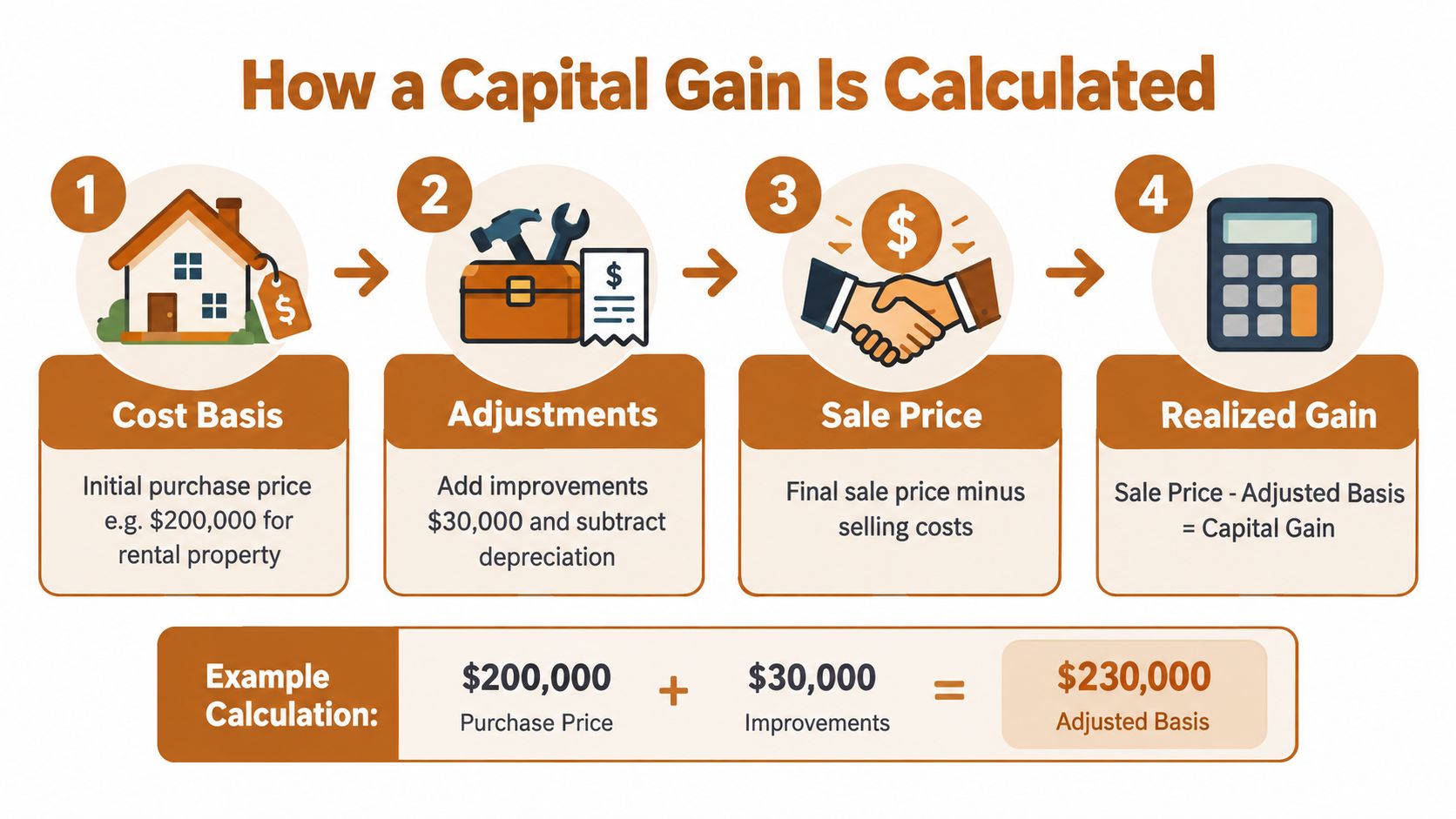
The arithmetic looks like this:
$200,000 original basis + $30,000 improvements = $230,000 adjusted basis
$310,000 sale price minus $230,000 adjusted basis = $80,000 realized gain
The taxable amount isn’t automatically the amount deposited into your bank account. A buyer may withhold funds, a lender may receive payoff proceeds, and transaction expenses may reduce what you receive. Those details affect the transaction economics and may affect the tax calculation as well.
If the property’s market value rises while you still own it, that increase is an unrealized gain. It exists on paper but generally hasn’t triggered capital-gains tax. A sale, exchange, or another taxable disposition can convert it into a realized gain.
The basis rule is especially important for business owners. A company’s value may rise substantially over time, but the tax result depends on the ownership interest or assets being transferred, the documented basis, and the structure of the transaction. The OECD describes the taxable amount as the difference between the amount realized and the adjusted basis, which is why careful recordkeeping belongs in exit preparation, not just year-end tax filing. (OECD statutory tax rates and capital-gains framework)
For an owner nearing a sale, the closing date can change the tax character of the gain. In the United States, an asset held for one year or less generally produces a short-term gain taxed under ordinary-income rules. Holding it for more than one year generally places the gain in the long-term category, which may qualify for federal capital-gains rates of 0%, 15%, or 20%, depending on taxable income. The IRS Topic No. 409 explains this basic distinction.
The holding period works like a classification switch. A sale completed before the applicable long-term period ends can move the gain into a different tax category. That gain may also sit alongside wages, business income, or other taxable income, affecting the rate applied to the overall return.
| Jurisdiction | Short-Term Treatment | Long-Term Treatment | Holding Period |
|---|---|---|---|
| United States | Generally ordinary-income treatment for assets held one year or less | Federal long-term rates commonly include 0%, 15%, or 20%, depending on taxable income | More than one year generally qualifies as long-term |
| United Kingdom | Treatment depends on the asset, taxpayer, and applicable rules | Capital-gains treatment varies by asset and taxpayer circumstances | No single universal threshold should be assumed for every asset |
| Canada | Gains are generally included under the country’s capital-gains inclusion framework | The inclusion treatment can change through legislation and administrative implementation | The result depends on the asset and applicable rules rather than a universal U.S.-style classification |
India shows why international owners need an asset-specific review. The holding period runs from acquisition to transfer, and the threshold differs by asset class, including 12 months for listed equity shares and 24 months for immovable property and unlisted shares. Long-term gains on many assets are taxed at 12.5% without indexation. Certain pre-2024 land or building transfers can elect 20% with indexation, as discussed in the OECD report on capital-gains taxation.
For a business owner, the practical question is which part of the sale receives capital-gains treatment. The answer can depend on whether the transaction transfers equity, business assets, real estate, or specific rights, because each component may have its own tax treatment. A holding-period trap can therefore reduce after-tax proceeds even when the headline sale price stays unchanged.
Across OECD countries, the average top marginal rate on long-term gains from shares is 18.19%, with substantial variation between jurisdictions. That average cannot determine an individual result. Cross-border owners need to compare residence-country rules, source-country rules, and the relevant holding-period test before setting an exit date.
A clean example makes the calculation less intimidating. Assume you bought a building for $500,000, invested $50,000 in capital improvements, and later sold it for $750,000. For this illustration, assume there are no selling costs, depreciation adjustments, or other basis changes.
| Step | Item | Amount |
|---|---|---|
| 1 | Original purchase price | $500,000 |
| 2 | Capital improvements added to basis | $50,000 |
| 3 | Adjusted basis | $550,000 |
| 4 | Sale price | $750,000 |
| 5 | Realized gain | $200,000 |
The calculation is:
$500,000 purchase price + $50,000 improvements = $550,000 adjusted basis
$750,000 sale price minus $550,000 adjusted basis = $200,000 realized gain
If you held the building for more than one year, the gain generally falls into the long-term category in the United States. If you held it for one year or less, it generally falls into the short-term category and receives ordinary-income treatment. The holding period doesn’t change the size of the gain. It changes the tax framework applied to that gain.
The tax return follows the documented transaction, not the rough estimate you made when you accepted the offer.
Real transactions add complications. Legal fees, transfer taxes, brokerage costs, depreciation, refinancing, prior exchanges, and ownership changes may affect basis or the amount realized. Depreciation can also create recapture or other special treatment rather than allowing every dollar of appreciation to receive the same capital-gains rate.
The same arithmetic applies to a business interest, but a business sale may contain several assets and several tax treatments. That allocation question is where many owners discover that the headline capital-gains rate tells only part of the story.
A business sale isn’t always one asset sold for one price. A buyer may acquire the company’s equipment, inventory, contracts, intellectual property, customer relationships, and goodwill separately. The purchase agreement then allocates the consideration among those assets, and that allocation can determine which portion is taxed as ordinary income, recaptured depreciation, or capital gain.
In an asset sale, the seller generally analyzes each asset category separately. Inventory may produce ordinary income. Equipment may involve depreciation recapture. Goodwill and certain other intangible assets may generate capital gain, subject to the facts, holding period, and applicable rules.
In a stock sale, shareholders generally sell their ownership interests directly. The seller’s gain on the stock itself is typically analyzed under the capital-gains rules, including the holding period and basis of the shares. The buyer may prefer an asset deal because of the tax basis received in acquired assets, while the seller may prefer a stock deal because it can produce a cleaner capital-gain result.
A Section 338 election can create a bridge between these concepts by treating certain stock acquisitions in a manner similar to an asset acquisition for tax purposes. Its consequences depend on the parties, the transaction, and the election requirements, so it belongs in modeling before the agreement is finalized.
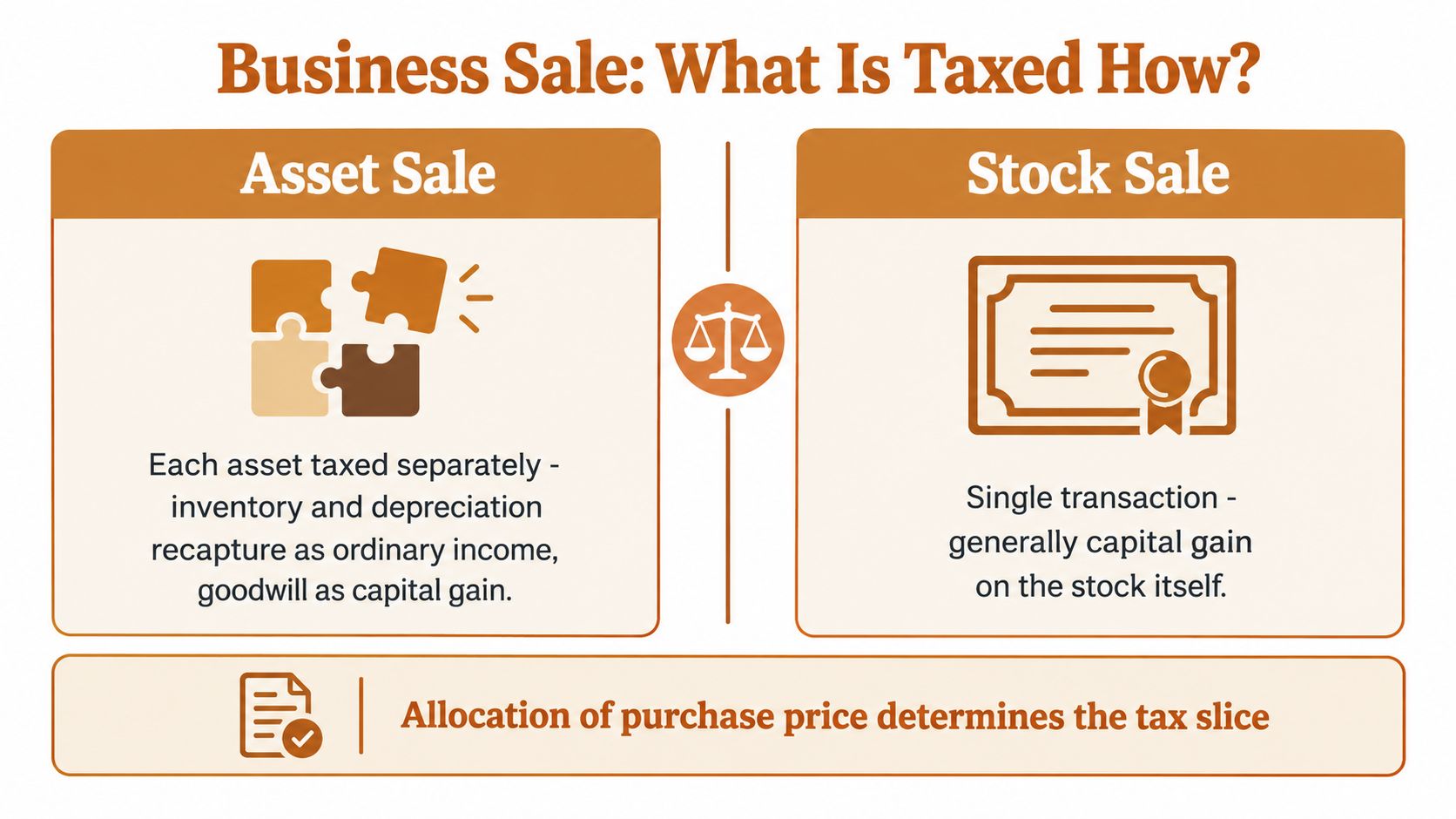
For your exit: Ask for a tax allocation schedule, not just a purchase price. The allocation may affect your after-tax proceeds more than a small movement in the advertised rate.
An owner selling a Wisconsin company may also benefit from a transaction-focused legal review, such as the Wisconsin business sale assistance available from Lein Law Offices. A lawyer can help examine representations, indemnities, purchase-price allocation, and whether the agreement matches the intended tax structure. For a broader planning checklist, review this guide to the tax implications of selling a business.
If the buyer pays over time, an installment structure may spread recognition across payment periods rather than treating every dollar as received at closing. That can affect cash flow and tax timing, but it also creates credit risk, reporting obligations, and potential complications if the buyer defaults.
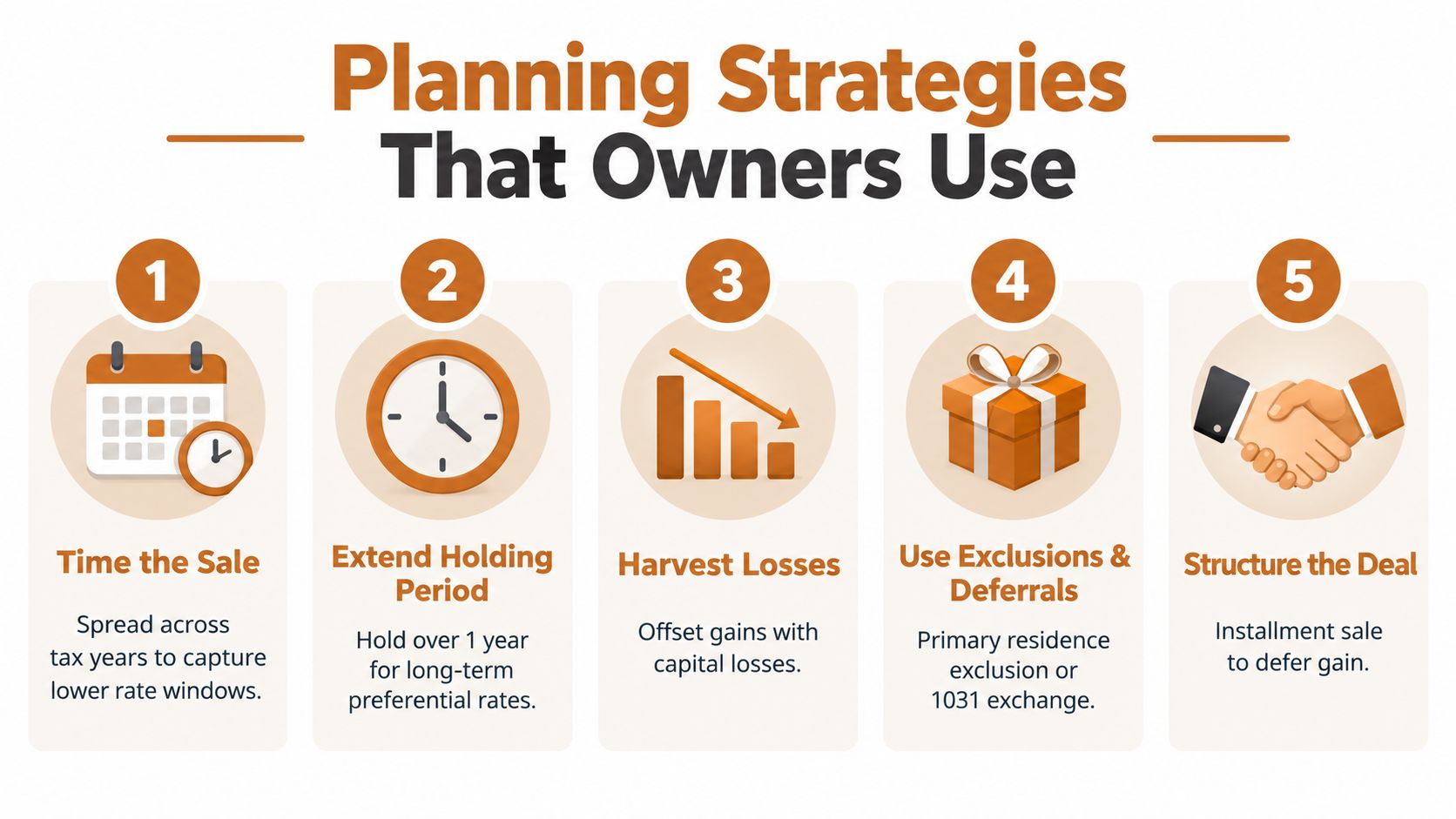
A business owner usually has several planning levers before signing a sale agreement: the closing date, deal structure, timing of other dispositions, and use of the proceeds. Each lever changes something else. A tax benefit may require a longer holding period, delayed cash, continued investment, or greater commercial risk.
A sale close to a holding-period breakpoint deserves a calendar review, not a rough estimate. Waiting long enough for long-term treatment may improve the tax result, while delay can expose the owner to operating changes, buyer risk, or weaker market conditions.
Tax-year timing can also stack the gain with wages, bonuses, distributions, and other gains. Model each possible closing year with those items included. The date that looks best on a spreadsheet may not be the right date for the business or the buyer.
For a practical discussion of reinvestment choices, Brillant Law Firm tax reinvestment tips offers another perspective to raise with a tax adviser. Owners can also review tax planning for business owners before signing a letter of intent.
The owner-specific question is which part of the sale receives capital-gain treatment and which part becomes ordinary income. Asset allocation, compensation, inventory, depreciation recapture, and the entity can change that split. Review the allocation before accepting the headline purchase price.
For your exit, compare the after-tax proceeds, timing of cash, and risks attached to each structure. A lower projected tax bill may come with delayed payment, continued capital exposure, or a buyer arrangement that changes the owner’s legal and commercial position.
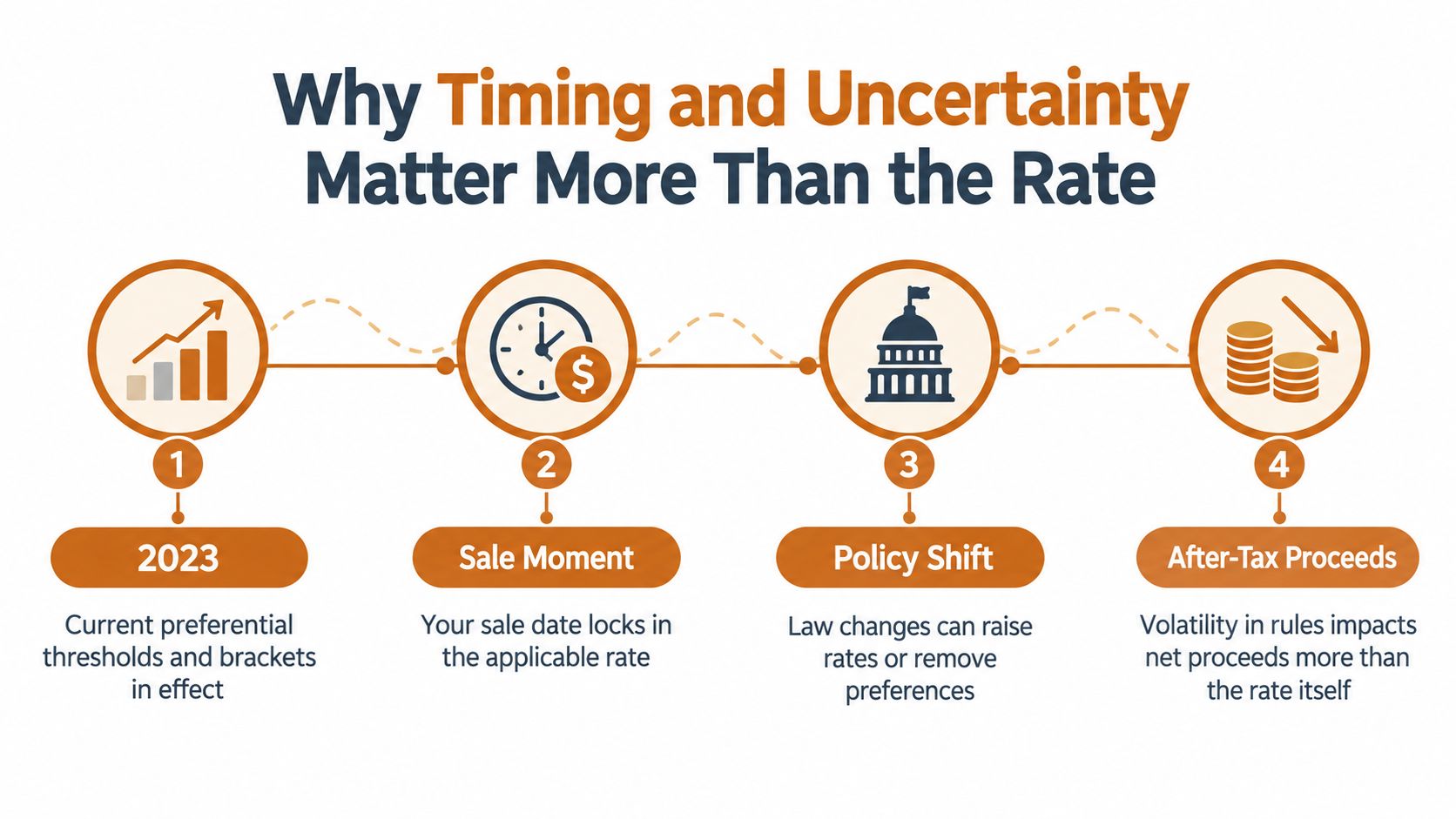
Owners often focus on the advertised rate because it is easy to place in a spreadsheet. The harder risk is uncertainty about which rule, threshold, inclusion method, or implementation date applies when the transaction closes.
Canadian policy developments in 2025 show how quickly planning assumptions can change. The government announced a deferral of the planned capital-gains inclusion-rate change, and the CRA later confirmed in April 2025 that gains realized before January 1, 2026 remained subject to the one-half inclusion rate, unless an exemption applied. (Government of Canada announcement on the inclusion-rate change)
That kind of reversal can affect whether an owner accelerates a sale, delays signing, changes the payment schedule, or revisits a family transfer. The headline rate may move less than the total result created by classification, carryforwards, trust treatment, entity-level taxation, and the date on which a gain is recognized.
A useful exit model may compare:
Holding-period traps deserve special attention. A closing date that slips across a classification boundary can change the treatment of the entire relevant interest. Partial dispositions, rollover equity, earn-outs, and contingent consideration can create separate timing questions that aren’t answered by looking only at the original acquisition date.
For an owner considering payments after closing, this guide to installment sale tax treatment can help frame the questions for a specialist. The practical conclusion is straightforward: model timing risk first and rate risk second. A precise rate applied to the wrong tax year or wrong asset category still produces the wrong answer.
A tax-planning meeting works best when you bring the transaction facts before the transaction becomes binding. Your specialist needs enough information to distinguish the proposed price from the taxable gain and to separate the business sale’s asset categories.
Bring the letter of intent, draft purchase agreement, proposed closing date, payment schedule, earn-out language, rollover-equity terms, and any reference to an asset sale, stock sale, or election. Include the buyer’s proposed purchase-price allocation if one exists.
Gather the company’s financial statements, ownership records, shareholder loan balances, depreciation schedules, prior exchange or installment filings, and documents supporting the original basis of the shares or assets. If the business has acquired equipment, real estate, intellectual property, or another company, bring those purchase records too.
Your specialist will need to know your state and country of residence, intended closing window, plans for reinvesting proceeds, charitable intentions, family-transfer goals, and whether you expect to keep a role in the business after closing.
Use questions that force the analysis into practical terms:
Ask for a written comparison that shows gross price, estimated taxes by category, professional fees, debt repayment, retained funds, and projected net proceeds. That format helps you compare a buyer’s offer with your retirement needs rather than reacting to the largest number on the first page.
The Owner’s Shortlist offers plain-language guides and a curated directory connecting business owners with specialists in taxes, valuation, legal matters, financing, succession, and related exit decisions. Visit The Owner’s Shortlist to review the tax and sale-planning resources, then identify the right specialist before you sign a binding deal document.
Tell us your situation. We'll connect you with a specialist who works with owners like you. One conversation, no sales pressure.
Found this useful?
Add The Owner's Shortlist as a preferred source and get our articles highlighted in Google Search results.
Add to Preferred SourcesTax planning for business owners preparing to sell or transition. Learn timelines, entity strategy, and how to keep more of your exit proceeds.
August 4, 2026
Action-oriented tax planning for business owners, covering entity choice, depreciation, exits, and pitfalls, with guidance on when to engage a specialist.
July 24, 2026
Discover what corporate tax planning services cover and why they're critical for your exit. Learn key strategies to maximize your after-tax proceeds.
July 22, 2026
Strategize your small business tax planning before a sale. Discover 2026 insights on entity choice, capital gains, & recordkeeping to maximize after-tax
July 11, 2026