Confidential Information Memorandum Example: 5 Guides
Explore 5 confidential information memorandum examples for owner-operated businesses, with required sections, practical guidance, and common pitfalls.
October 22, 2026
By Remi Taffin · August 31, 2026
You’ve signed a letter of intent, the buyer’s headline price looks excellent, and you’re already mentally allocating the proceeds to retirement, family, or the next venture. Then your tax advisor sends a draft projection. The sale price is no longer one clean number. It’s divided among ordinary income, depreciation recapture, capital gain, deferred payments, escrow, and return of basis.
That surprise is avoidable. The tax implications of selling a business depend less on the number printed in the purchase agreement than on what the buyer is purchasing, how the price is allocated, your entity type, your basis, and where you live when the transaction closes. The federal capital gains headline rate is only the starting point.
A founder sells a profitable services firm for $12 million after a competitive process. The offer looks like a clean reward for years of work. Then the tax projection splits the transaction into ordinary income, capital gain, and recapture. The closing statement shows money changing hands. The tax return shows several separate tax results.
Those documents answer different questions. The purchase agreement may start with a headline price, then subtract assumed liabilities, escrow, transaction expenses, and working-capital adjustments. The seller may receive part of the consideration through a note, earnout, or rollover equity instead of cash at closing. Each item needs its own tax analysis.
In an asset sale, the buyer and seller allocate consideration across asset classes under the residual method. The OECD explanation of capital-gains taxation describes the governing principle: tax treatment generally depends on the type of transaction and the type of asset, not solely on gross proceeds.
Start with basis. If the business or an asset has an adjusted tax basis, the portion of proceeds that returns that basis generally is not gain. The excess is taxable, but its character depends on the asset:
An asset sale can produce a blended result even when the buyer describes it as one acquisition. Federal long-term capital gains rates generally fall at 0%, 15%, or 20%. The 3.8% net investment income tax may apply at higher income levels, creating a potential top federal capital-gains rate of 23.8%. Those rates apply only to the portion that qualifies. They do not convert receivables, recapture, or service payments into capital gain.
Practical rule: Request an after-tax proceeds schedule before negotiating the final price. A higher headline price can leave you with less cash after tax if the buyer obtains a favorable allocation.
Read the deal in this order: start with the purchase price, subtract deal adjustments and amounts not immediately received, calculate basis, then classify every remaining slice. Make the decision from the blended after-tax outcome, not the headline number.
A buyer may offer an attractive price, yet the seller’s after-tax cash can differ sharply depending on the deal structure. Buyers often favor an asset sale because they can choose the assets and liabilities they want, limit inherited risks, and receive a new tax basis in what they acquire. Sellers generally prefer a stock sale because the seller typically reports gain on the shares instead of recognizing separate gains throughout the company.
In an asset sale, the buyer purchases selected assets, such as customer relationships, inventory, equipment, contracts, and goodwill. The parties allocate the consideration among asset classes under Internal Revenue Code Section 1060. That allocation determines which proceeds may be treated as ordinary income, depreciation recapture, or capital gain. Buyers usually want more value assigned to depreciable assets and amortizable intangibles because those categories can create future deductions. Sellers usually want more value assigned to goodwill and other assets that may receive capital-gain treatment.
In a stock sale, the buyer acquires the seller’s equity interest. The seller generally calculates gain by comparing the proceeds with the tax basis in the shares. Shares held for more than one year will generally produce long-term capital gain, subject to the owner’s circumstances and applicable rules.
| Dimension | Asset Sale | Stock Sale |
|---|---|---|
| What changes hands | Selected business assets and selected liabilities | Equity interests in the legal entity |
| Seller’s tax calculation | Multiple asset-level gains and losses | Generally gain or loss on the shares |
| Buyer’s tax basis | New basis in acquired assets | Usually inherits the company’s existing asset basis |
| Main seller concern | Ordinary income, recapture, and allocation risk | Buyer may demand indemnities, escrows, or price protection |
| Main buyer concern | Assumed liabilities and asset selection | Historical liabilities and tax exposures |
| Negotiation pressure | Allocation and purchase-price adjustments | Representations, warranties, holdbacks, and risk transfer |
A stock sale is not always available. Strategic acquirers may insist on an asset deal because they do not want unknown liabilities or unwanted contracts. If the buyer insists on that structure, the seller should price the tax cost directly through a higher purchase price, a holdback limit, an earnout, seller financing, or a negotiated tax adjustment.
The allocation table affects both parties. Buyers want deductions after closing. Sellers want more proceeds in capital-gain categories before closing. The IRS-focused discussion of business sale tax risks explains why owners should examine the mix of proceeds instead of relying on a single capital-gains headline.
Do not accept the buyer’s draft allocation as the default. Obtain a defensible valuation of the relevant assets, compare the resulting tax outcomes, and adjust the economics of the deal accordingly. The structure changes the cash you keep, not just the paperwork you sign.
A $10 million sale can leave very different after-tax results depending on how the consideration is allocated. The useful question is not the federal capital-gains headline. Ask what percentage of the proceeds falls into each tax bucket: return of basis, ordinary income, depreciation recapture, Section 1231 gain, and long-term capital gain.
Return of basis generally is not gain. After removing that portion, accounts receivable and inventory commonly fall into ordinary-income treatment. Equipment can create Section 1245 recapture, taxed at ordinary rates up to 37%. Unrecaptured Section 1250 gain on certain real property has a maximum 25% rate. Remaining qualifying appreciation may receive long-term capital-gains treatment.
Section 1231 requires its own review. Qualifying business property held long term may receive capital-gain treatment, but the result depends on the property, prior losses, and recapture rules. Goodwill can also produce capital gain. A payment labeled compensation, consulting income, or a covenant not to compete may receive different treatment.
| Gain Type | Tax Character | Federal Rate |
|---|---|---|
| Return of adjusted basis | Generally not gain | No tax on the basis portion |
| Receivables and inventory | Ordinary income | Ordinary rates, potentially up to 37% |
| Section 1245 depreciation recapture | Ordinary income | Up to 37% |
| Unrecaptured Section 1250 gain | Special real-property gain | Up to 25% |
| Qualifying Section 1231 gain | Often long-term capital gain | Generally 0%, 15%, or 20% |
| Long-term capital gain | Capital gain | Generally 0%, 15%, or 20%, with possible 3.8% NIIT |
| Qualified small business stock gain | Potential special treatment | Certain gains can face a maximum 28% rate under IRS guidance |
Capital-gain treatment does not automatically make every sale proceeds tax-efficient. Qualified small business stock can receive special treatment, while certain gains can face a maximum 28% rate under IRS guidance. Asset class, ownership structure, and the allocation agreement must be reviewed together.
Use a written allocation model before negotiating price. Assume an asset sale assigns $10 million of consideration across the business. One portion may return basis, another may represent inventory and receivables taxed as ordinary income, another may reflect equipment subject to recapture, and the balance may be goodwill or qualifying long-term appreciation.
A projection containing $2 million of ordinary income, $1 million of recapture, and $7 million of long-term capital gain is not taxed as though the entire $10 million qualified for one rate. Apply each tax character to its own slice, then add applicable investment-income and state taxes.
The blended result is the figure that belongs in negotiations. Require your advisor to show the allocation, rate, tax, and after-tax proceeds for every category. Do not approve a purchase-price allocation that reports a favorable number without tying it to defensible asset values and the cash you will keep.
Your entity determines where the sale is reported and how many tax layers can apply. Owners often focus on the buyer’s structure request and overlook the company’s existing basis, prior elections, shareholder accounts, and distribution mechanics.
| Entity Type | Where Tax Is Paid | Typical Rate Stack | Key Gotcha |
|---|---|---|---|
| Sole proprietorship | Owner’s individual return | Personal ordinary and capital-gain rates | No separate equity interest to sell |
| Single-member LLC | Usually owner’s return, depending on tax election | Pass-through treatment | Asset characterization flows directly to the owner |
| Partnership or multi-member LLC | Entity reports, partners receive final K-1s | Partner-level tax on allocated items | Multiple owners and states can create separate filings |
| S corporation | Passes items through to shareholders | Shareholder-level tax, with possible built-in-gain issues | Basis, AAA, and prior C-corporation history matter |
| C corporation | Corporation reports its gain, then shareholders are taxed on distributions or liquidation | Potential corporate and shareholder tax layers | Double taxation can dominate the negotiation |
A sole proprietor or single-member LLC typically reports the sale items on the owner’s individual return. There isn’t a second owner-level equity sale to simplify the calculation. Receivables, inventory, equipment, and goodwill retain their separate tax character.
Partnerships and multi-member LLCs generally issue a final K-1. Each partner pays tax on the allocated items, and the partners may face different outcomes because of basis, ownership percentages, residence, and other income. A sale can also create filing obligations in states where individual members don’t live.
S corporations follow a pass-through path, but the analysis must include shareholder basis, accumulated adjustments account balances, and any history as a C corporation. A prior C-corporation conversion can create built-in-gain exposure when appreciated assets are sold.
A C corporation generally pays tax on gain from an asset sale. Shareholders can then face tax when the corporation distributes proceeds or liquidates. That two-layer result is why sellers of C corporations often fight hard for a stock sale or evaluate elections such as Section 338(h)(10), Section 336(e), or a qualifying reorganization.
The buyer may offer an asset-style tax result through an election while insisting on stock-sale legal mechanics. Treat that proposal as a pricing event. Have counsel and the tax advisor model the election before accepting it.
Federal tax gets attention because the rates are familiar. State and transaction taxes create trouble because they depend on facts owners often don’t model until closing: residence, business operations, property location, payroll, inventory, and the legal form of the transfer.
The owner’s residence on the closing date can matter, but moving shortly before a sale isn’t a magic eraser. States may examine domicile, prior residence, business connections, and the source of the gain. The business’s operating footprint can also create state filing and allocation obligations, especially when a partnership or S corporation passes sale items through to owners.
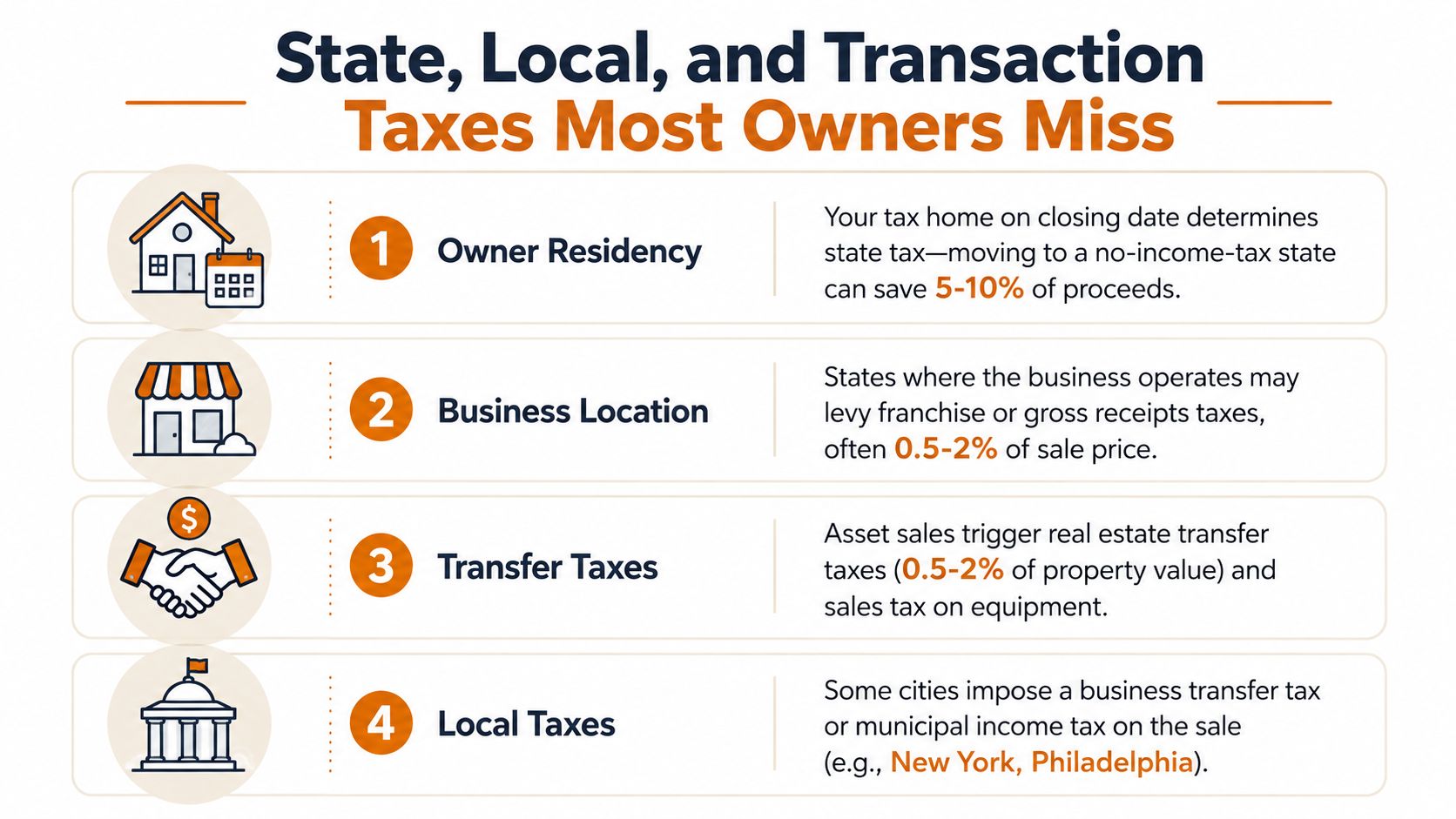
An asset transfer can raise sales and use tax questions for equipment or inventory. Real property transfers may create documentary or transfer taxes. Buyers may also require payroll tax liabilities, sales-tax exposures, or other obligations to be funded through escrow.
Cross-border transactions add another layer. In Canada, the Canada Revenue Agency guidance on selling a business says a seller may jointly elect with the purchaser for no GST/HST to be payable when the buyer acquires at least 90% of the property necessary to carry on the business.
The United Kingdom has its own timing issue. For the 2026/27 tax year, standard CGT rates are 18% for basic-rate taxpayers and 24% for higher- and additional-rate taxpayers, according to the UK-focused business sale tax analysis. That analysis also describes Business Asset Disposal Relief increasing from 14% to 18% for disposals made on or after 6 April 2026, reducing the benefit for qualifying sellers.
Ask for a state and transaction-tax schedule before signing the letter of intent. It should identify every filing jurisdiction, tax on transferred property, withholding requirement, escrow exposure, and residency assumption.
Tax planning works best before a buyer appears. Once the letter of intent is signed, the buyer, valuation, allocation, and financing terms can restrict your choices. Your strongest moves usually involve holding period, transaction structure, payment timing, entity planning, and deliberate classification of compensation-related payments.
The baseline for long-term treatment is holding the relevant interest for more than one year. Short-term gains can be taxed as ordinary income, so a sale date that falls just before the holding-period threshold can be expensive.
Qualified small business stock may offer a larger opportunity for eligible C corporation shareholders. Section 1202 can potentially exclude up to $10 million of qualifying gain for stock held more than five years, subject to the applicable limits and eligibility requirements described in the business sale tax planning guide. Verify original issuance, corporate eligibility, active-business requirements, and holding-period records. Don’t assume that calling the company a small business makes the stock qualify.
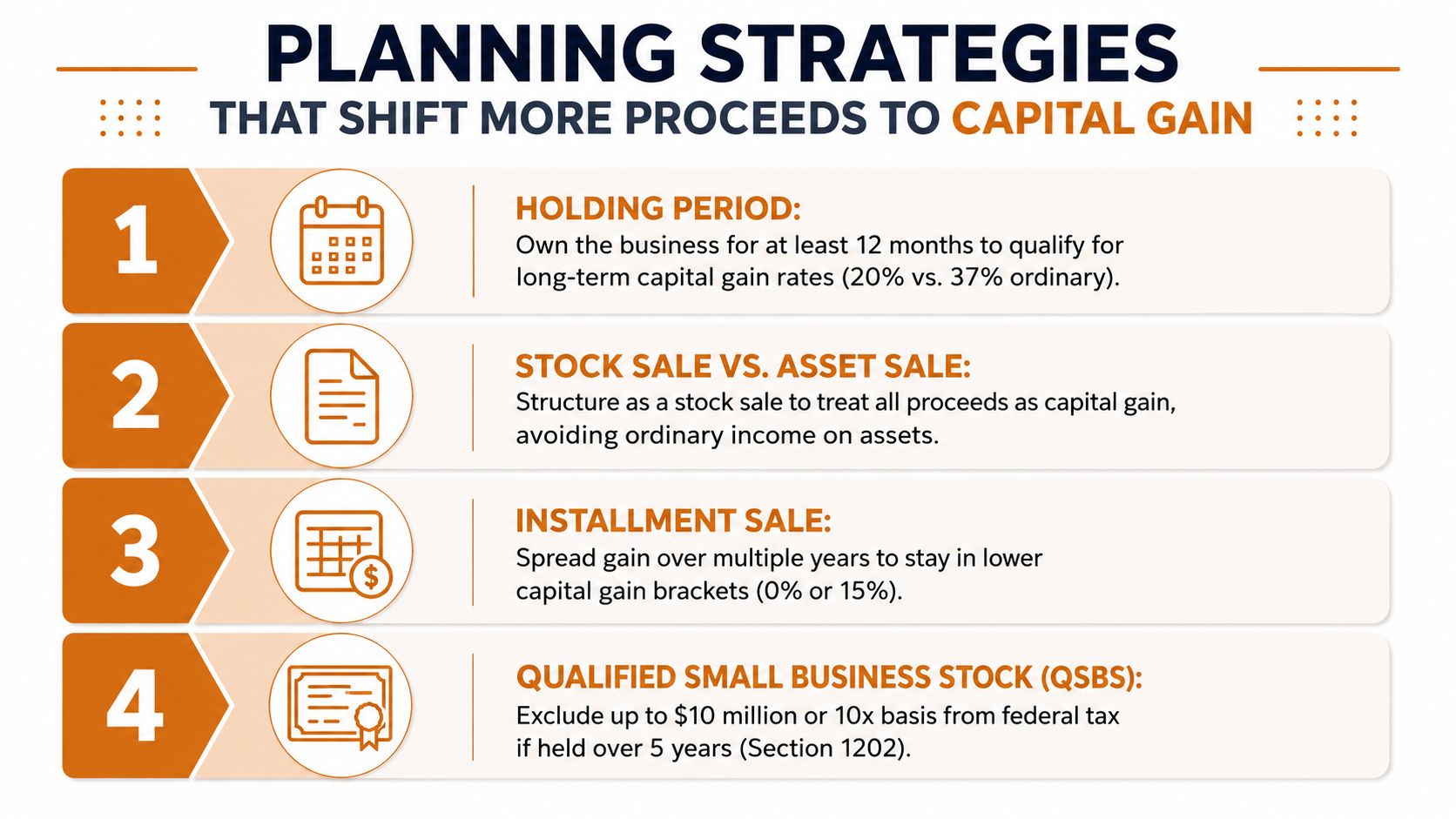
An installment sale can spread eligible gain across the years in which payments arrive. It can help manage brackets, but it also transfers credit risk to the seller and doesn’t automatically defer every category. Inventory and depreciation recapture require separate treatment, and interest on a seller note is generally ordinary income.
Earnouts need equally careful drafting. A payment tied to continued employment may look like compensation rather than purchase price. A payment tied to business performance can receive different treatment, but the wording, economics, and post-closing obligations must agree. Have the tax advisor review the earnout definition before the buyer inserts it into the purchase agreement.
Rollover equity can defer recognition in some structures, but it also leaves you invested in the business. Treat it as both a tax decision and a liquidity decision.
A charitable remainder trust may allow an owner to contribute appreciated interests, receive an income stream, and claim a charitable deduction, subject to detailed rules. A Section 1045 rollover can defer eligible qualified small business stock gain when the seller reinvests in replacement small business stock within 180 days, if the statutory conditions are satisfied.
These tools aren’t interchangeable. A CRT involves charitable planning and future distributions. A rollover keeps capital committed to another business. An installment sale creates buyer-credit exposure. Choose based on your cash needs, estate plan, risk tolerance, and tax character, not on the name of the strategy.
Practical resources such as The Owner’s Shortlist can help owners compare tax, valuation, legal, financing, and succession specialists before selecting an advisor. Use the planning period to assemble a team, not to collect disconnected opinions.
The embedded video offers another overview of planning considerations:
Bring a transaction-focused tax specialist into the process 12 to 18 months before closing. The specialist needs time to review entity history, basis schedules, depreciation records, ownership documents, state exposure, and possible elections. Waiting until the purchase agreement is nearly complete turns planning into damage control.
Certain deal signals make early engagement essential:
Demand three concrete deliverables: a written structure memo, side-by-side after-tax models for asset and stock alternatives, and a state-residency timetable. The model should show basis, allocation, withholding, escrow, payment timing, and net cash.
The tax specialist shouldn’t replace your CPA or M&A attorney. The CPA knows your books and filing history. The attorney controls representations, elections, indemnities, and contract language. The tax specialist connects those pieces so the deal terms match the intended tax result.
Before accepting the final purchase agreement, direct your team to resolve these decisions:
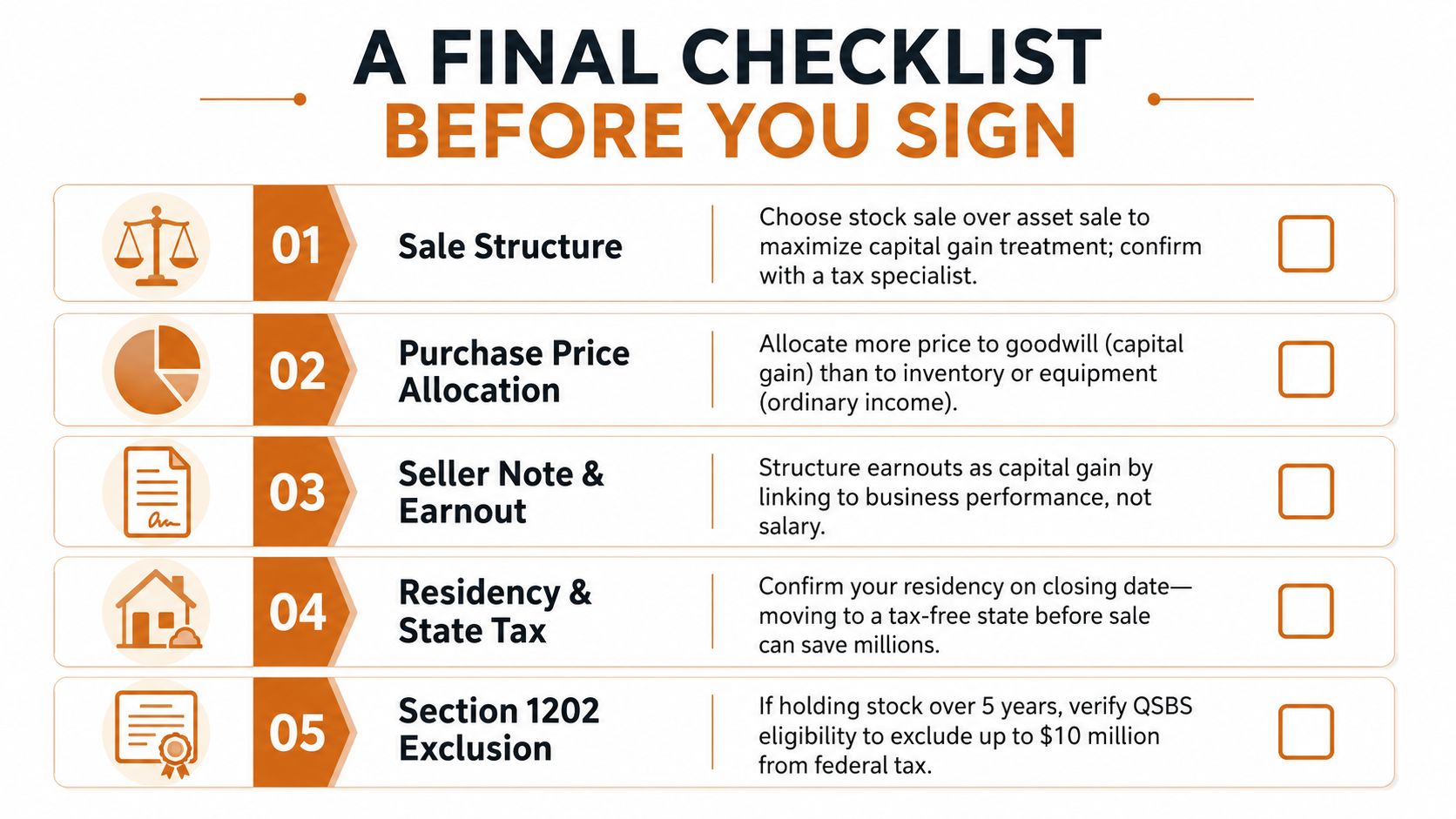
Your instruction to the team should be simple: show the after-tax cash outcome, not just the purchase price. If the model doesn’t identify the tax character of each major slice, it isn’t ready for signature.
The Owner’s Shortlist helps business owners find curated specialists for taxes, valuation, legal matters, financing, succession, and related exit decisions. Visit The Owner’s Shortlist to review plain-language guidance and connect directly with an appropriate specialist before your transaction terms become difficult to change.
Tell us your situation. We'll connect you with a specialist who works with owners like you. One conversation, no sales pressure.
Found this useful?
Add The Owner's Shortlist as a preferred source and get our articles highlighted in Google Search results.
Add to Preferred SourcesExplore 5 confidential information memorandum examples for owner-operated businesses, with required sections, practical guidance, and common pitfalls.
October 22, 2026
Partners who disagree on selling usually settle it one of four ways: a buyout, a partial sale, a sale together, or what the agreement forces.
October 20, 2026
What is deal structuring, explained for service business owners. Learn asset vs stock sales, earnouts, seller financing, holdbacks, and the questions
October 19, 2026
Learn how to identify well qualified buyers for your service business. Covers vetting criteria, red flags, sample questions, and next steps
October 17, 2026