When should I first talk to a business broker about selling?
Talk to a good broker 2 to 3 years before you want to sell. They'll show you what buyers will pick apart and who you need on your side to fix it.
October 8, 2026
By Remi Taffin · August 28, 2026

The most popular advice about a working capital peg is also the advice that gets sellers into trouble: take the trailing twelve-month average and move on. That shortcut works only when the business is stable, nonseasonal, and carrying a consistent mix of receivables, inventory, and payables. Trades, home services, and other owner-operated companies rarely fit that description.
A lower peg can look attractive because it appears to reduce the amount you must deliver at closing. But if the target understates what the business needs to operate, the buyer may lower the valuation, demand more protection, or leave you financing the shortfall through the purchase price mechanics. The right peg isn’t the lowest possible number. It’s a defensible measure of the working capital the buyer needs to receive on day one.
The working capital peg can change the cash you receive at closing. It is a purchase price mechanism that sets the operating working capital the seller must deliver. If the actual amount falls below the target, the purchase price generally drops dollar-for-dollar. If it exceeds the target, the price rises by the excess.
The headline valuation assumes the business arrives with enough receivables, inventory, and other agreed operating resources to keep trading normally. The peg tests that assumption against the closing balance sheet. It therefore belongs in the price discussion, not in the final accounting cleanup.
Owners often focus on enterprise value, the multiple, taxes, and fees, then address the peg after signing the letter of intent. That timing creates avoidable risk. Once the buyer has exclusivity and its accountants have prepared the preferred schedule, the seller has less room to challenge definitions, exclusions, and the benchmark.
Practical rule: Negotiate the peg alongside price and deal structure from the start. Do not leave it for your CPA to resolve at the end.
A low peg is not automatically a seller win. It may reduce the amount the seller must deliver, but it can also signal that the business is underfunded for normal operations. Buyers can respond with a lower headline price, a larger holdback, tighter representations, or a more aggressive true-up position. In trades and home-services businesses, seasonality, growth, slow collections, or excess inventory can make a supposedly low target misleading.
The right question is not, “How low can we set it?” Ask whether the target reflects the working capital the buyer needs on day one, across the business’s normal operating cycle. A defensible peg gives the buyer adequate resources and gives the seller a credible basis for protecting proceeds. Review the monthly history, adjust for unusual inventory or receivables, and agree the methodology before closing pressure takes over.
Start with net working capital, or NWC. In a cash-free, debt-free transaction, the calculation usually focuses on operating current assets and liabilities rather than every balance-sheet account. Typical operating assets include accounts receivable, inventory, and certain prepaid expenses. Typical operating liabilities include accounts payable, accrued operating expenses, and other agreed current obligations. Cash, debt, and debt-like items are generally handled separately, as explained in this working capital peg reference.
The formula is simple:
Operating current assets minus operating current liabilities equals net working capital.
The working capital peg is the negotiated, normalized target for that figure. It isn’t the purchase price, and it isn’t necessarily the closing balance. It is the reference point against which the closing balance gets measured.
Suppose the parties agree to a $1.2 million peg on a $5 million transaction. If the closing calculation shows actual NWC of $1.05 million, the shortfall is $150,000. The purchase price falls by that amount. If the closing figure exceeds the peg, the seller receives the excess, subject to the agreement’s calculation rules.
Those figures illustrate the core mechanic, not a forecast of what any particular deal should produce. The adjustment is generally dollar-for-dollar, which is why a disagreement over one account classification can affect real proceeds.
The purchase agreement must define the included accounts and the accounting hierarchy used to calculate them. Without that detail, the buyer and seller can agree on the peg itself and still fight over whether customer deposits, aged receivables, inventory reserves, or accrued expenses belong in the calculation.
A seller should ask three questions before accepting any target:
The number matters, but the definition controls whether the number survives the true-up.
A trailing average is only the starting point, not the answer. Buyers and sellers often review the last 6 or 12 months of current assets and current liabilities to smooth short-term fluctuations and seasonality. A common method uses a trailing 12-month average of monthly NWC, then adjusts it for seasonality, one-time items, and growth-related changes, as explained in this working capital peg guide.
The benchmark must reflect what the business needs to operate on day one after closing. A simple average can miss that requirement. An HVAC contractor may stock up before its busy period. A landscaping company may carry different receivable and payable balances during peak production. A roofing company may buy materials or absorb labor costs before collecting customer payments. A pool service business may show a very different operating profile in its active season than in quieter months.
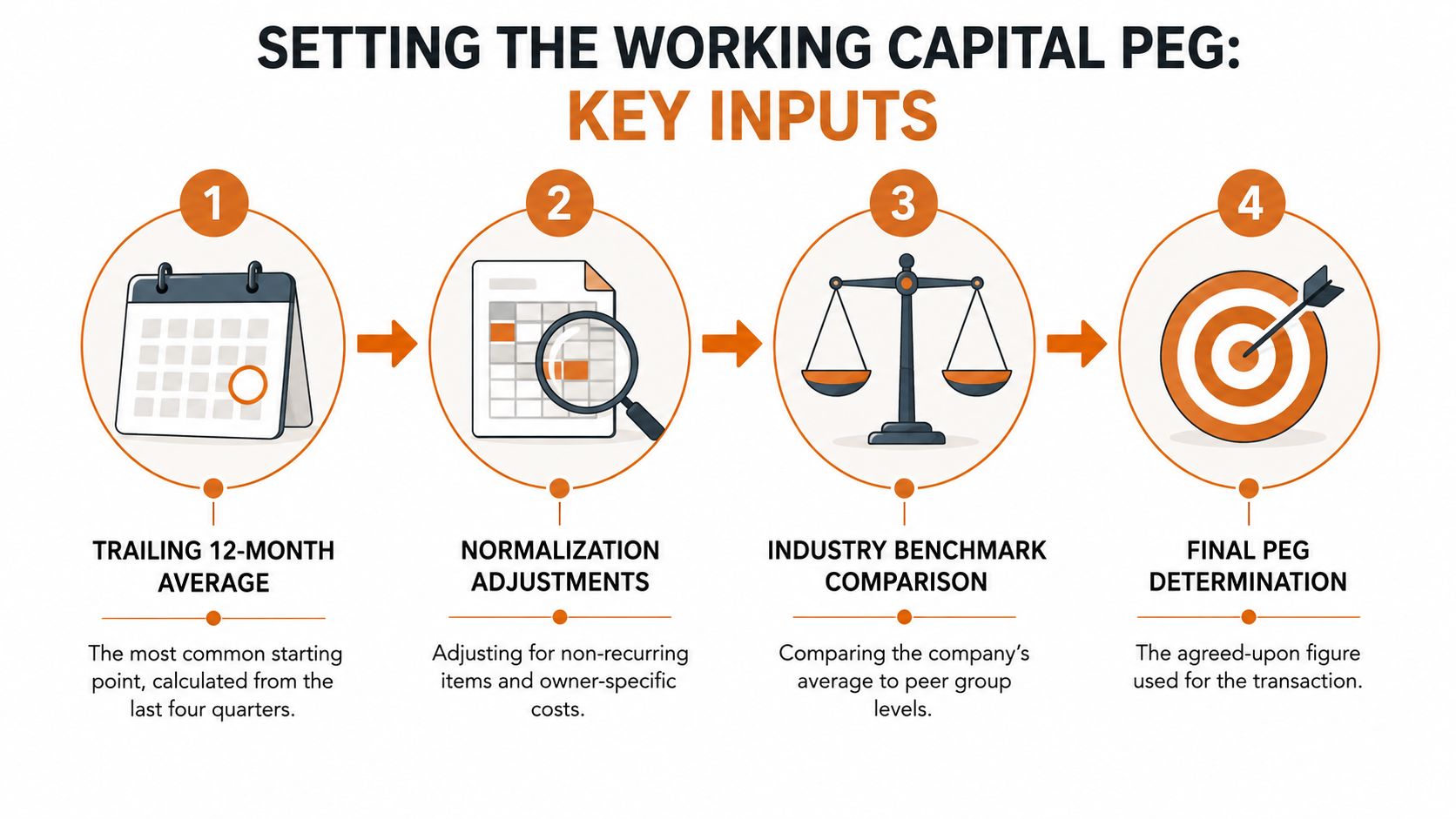
Do not argue seasonality from memory. Build a monthly schedule showing receivables, inventory, payables, accruals, and the resulting NWC balance. Mark the months that reflect ordinary operations, then identify unusual purchases, delayed collections, storm-related demand, or other temporary conditions.
A cyclical business may need a full operating cycle or a mid-cycle level rather than one month’s balance. The aim is to prevent a closing adjustment that systematically overcompensates or undercompensates either party. Sellers should support the proposed level with records, not intuition, because a buyer can challenge any unexplained spike or dip.
A growing company can outgrow its historical average. Higher sales, additional headcount, a larger backlog, or greater inventory requirements may raise the NWC needed to support the current run rate. An older baseline can therefore make the peg look attractive to the seller while leaving the buyer underfunded at closing.
Separate genuine operating growth from temporary balance-sheet noise. Show which recent balances are sustainable and which arose from a one-time purchase, delayed collection, or unusual expense pattern. Buyers usually favor recent performance because it appears closer to closing. Sellers may favor a longer period because it absorbs unusual peaks and troughs. The right benchmark follows the business’s normal day-one requirements, not whichever averaging period produces the lower peg.
Use a trade or home-services business with a negotiated $500,000 working capital peg. The calculation covers operating accounts only. Cash and debt remain outside it because a cash-free, debt-free structure usually addresses them elsewhere in the purchase agreement.
At closing, the seller’s estimated schedule could look like this:
| Line Item | Closing Balance | Calculation Step | Adjustment to Price |
|---|---|---|---|
| Accounts receivable | $360,000 | Add operating receivables | $360,000 |
| Inventory | $220,000 | Add usable operating inventory | $220,000 |
| Prepaid operating expenses | $20,000 | Add agreed operating prepaids | $20,000 |
| Accounts payable | ($140,000) | Subtract operating payables | ($140,000) |
| Accrued payroll and expenses | ($40,000) | Subtract accrued operating liabilities | ($40,000) |
| Deferred revenue | ($0) | Apply the purchase agreement’s treatment | $0 |
| Estimated NWC | $420,000 | Add assets and subtract liabilities | $80,000 increase |
The operating assets total $600,000. After subtracting $180,000 of operating liabilities, estimated NWC is $420,000. Compared with the $500,000 peg, that creates an $80,000 shortfall. Under a dollar-for-dollar adjustment, the purchase price decreases by $80,000.
The direction matters. Actual working capital below the peg reduces the price. Actual working capital above the peg increases it. A seller who describes the result as an $80,000 increase has reversed the deal math.
Change only the closing balances. If the company delivers $560,000 of actual NWC, it finishes $60,000 above the peg, so the purchase price increases by $60,000.
The table shows the arithmetic, but the purchase agreement determines which balances qualify and how they are measured. The buyer may challenge receivables that are not collectible, inventory that is damaged or excess, missing accruals, or deferred revenue that requires future service. The seller should prepare support for every line item, including aging reports, inventory records, payable listings, payroll accruals, and the agreed accounting rules. A total that matches the target does not protect the seller if the underlying balances fail the agreement’s definitions.
No single method works for every company. The right choice depends on the business cycle, growth pattern, accounting quality, and closing timing.
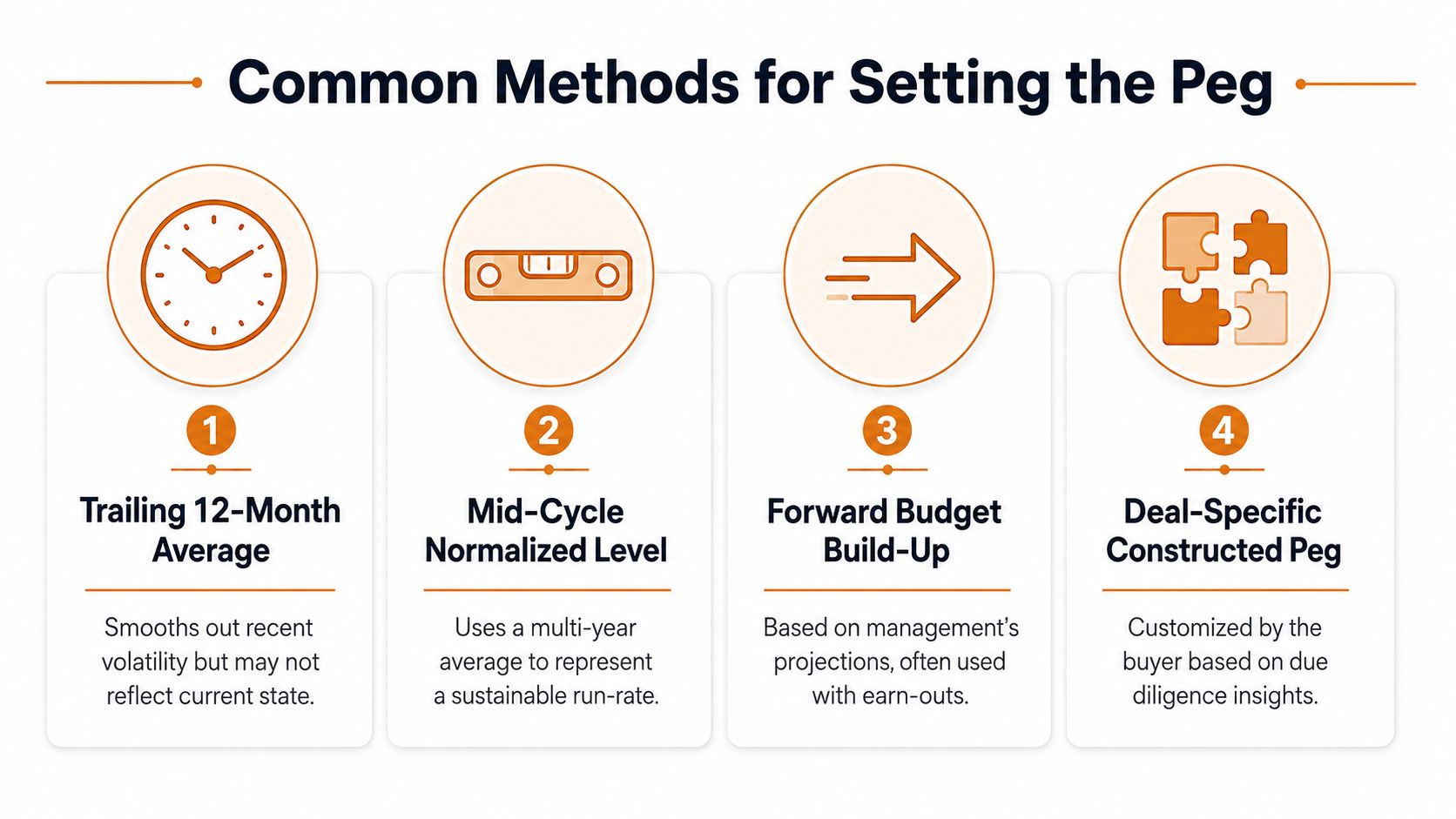
The trailing average smooths monthly volatility and gives both sides a record-based starting point. Buyers like it because it relies on actual financial history. Sellers like it when the company has experienced temporary working capital spikes or unusually weak months that shouldn’t define the closing target.
Its weakness is obvious in a growing or highly seasonal business. The average can lag the current operating model or land between two very different seasonal states.
A mid-cycle peg aims to represent sustainable operations after removing unusual highs and lows. It can work well when the business has a clear operating cycle and the parties can identify outliers with records.
The risk falls on the seller when the selected mid-cycle level ignores the cash needed during the company’s peak buying or production period. A buyer may describe that as normalization. The seller should ask whether the business can function on that level when demand is strongest.
A budget-based peg starts with expected sales, collection timing, inventory needs, vendor terms, payroll, and other operating requirements. It may make sense when historical statements no longer describe the business, but it puts pressure on management’s projections.
If the forecast misses, the seller bears the practical consequences at closing. Buyers may also use the budget to argue that the seller promised a higher operating level than the historical records support.
A buyer may build a customized peg from diligence findings, account by account. That can identify genuine issues, but it also creates room for unilateral buyer preferences.
Push back on methodology, not just the final number. A reasonable peg built from a bad definition is still a bad deal.
The buyer usually pushes hardest for the method that best protects day-one liquidity. The seller should push for the method that reflects ordinary operations without forcing the seller to fund a future growth plan.
The purchase agreement is where the peg starts affecting the price. It must identify every account included in NWC, exclude cash, debt, and debt-like items where agreed, and specify the accounting rules used to prepare the calculation.
The agreement should also set a calculation hierarchy. A practical order may give priority to the negotiated working capital schedule, followed by the agreement’s definitions, consistently applied accounting principles, and general accounting standards only when the contract is silent. Negotiate that order before signing. If the hierarchy is vague, a disagreement over one account can become a dispute over the entire adjustment.
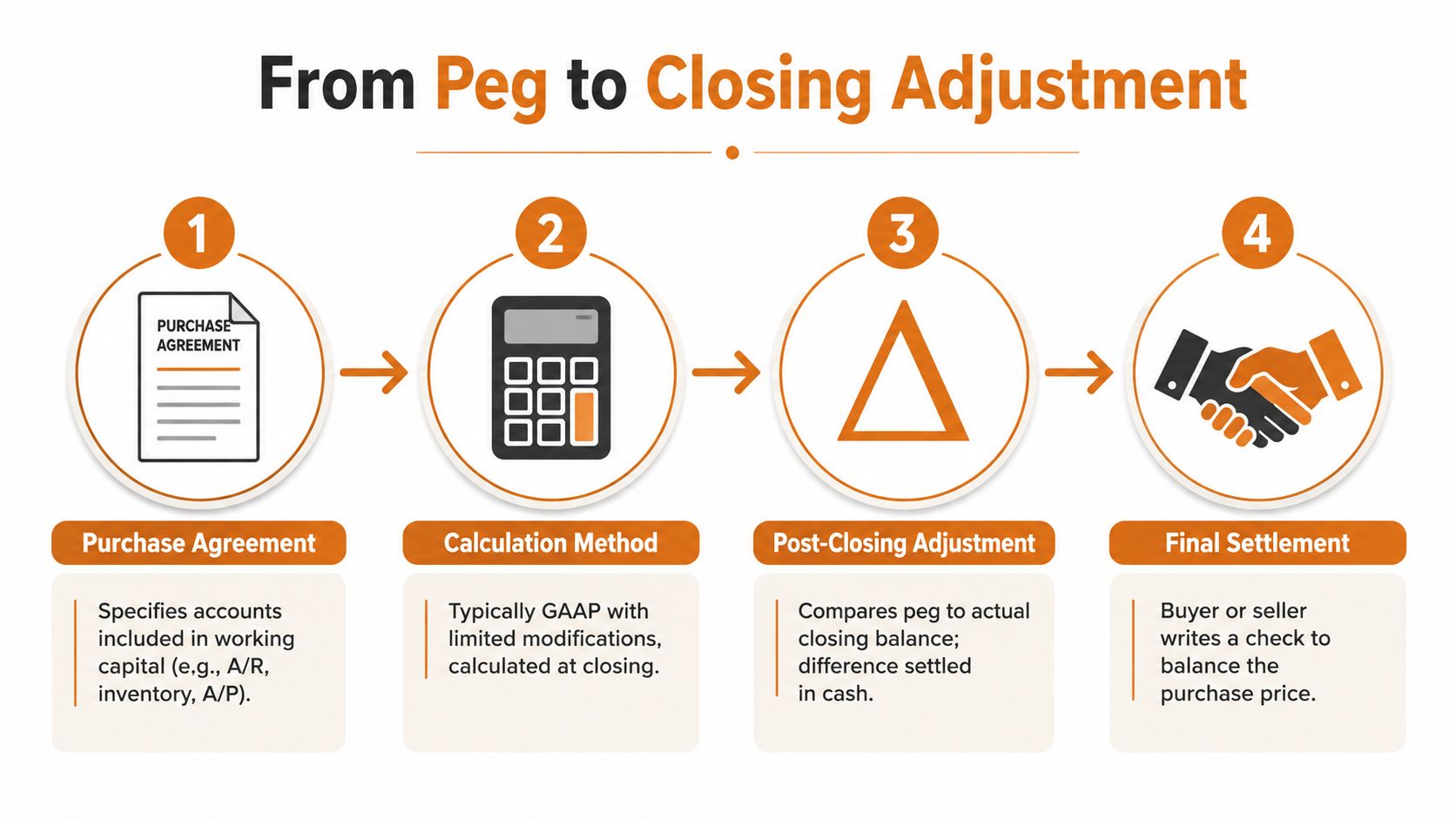
The seller commonly prepares an estimated closing statement from the latest financial information. The buyer uses it to calculate the initial purchase price paid at closing. Require the statement to show each included account, its assigned balance, and the resulting difference from the peg.
The buyer then prepares a final statement from the books and records available on the agreed review date. The seller needs a defined period to examine and dispute that calculation. The agreement should name a neutral accountant or another agreed procedure if the parties cannot resolve a disputed line item.
The agreement may retain part of the seller’s proceeds until the final adjustment is resolved. That holdback protects the buyer while the records are reviewed, but it delays the seller’s access to cash.
Set limits on the claims covered, the holdback period, notice requirements, and release of undisputed amounts. Do not accept a broad right to reopen the balance sheet when the disagreement concerns one narrow account.
The contract should separate a calculation disagreement from a breach of representation. They involve different issues and should not automatically draw on the same protection.
Closing day starts with an estimated working capital statement. It lists the included operating assets and liabilities, then compares net working capital with the peg. Require support for each balance, the agreed cutoff policy, and any account excluded from the calculation.
| Line Item | Closing Day Estimate ($) | Treatment | Notes |
|---|---|---|---|
| Accounts receivable | $285,000 | Included | Support with an aging schedule |
| Inventory | $175,000 | Included | Confirm usable and properly valued stock |
| Prepaid expenses | $15,000 | Included if agreed | Exclude items with no buyer benefit |
| Accounts payable | ($125,000) | Included | Apply the agreed cutoff policy |
| Accrued expenses | ($35,000) | Included | Test for completeness |
| Deferred revenue | As calculated | Contract-specific | Follow the negotiated definition |
| Net working capital | $315,000 | Compare with peg | Difference changes price |
If the peg is $350,000, this estimate produces a $35,000 shortfall and reduces the seller’s proceeds under the agreed adjustment method. The calculation must show whether the difference comes from ordinary operations, a cutoff error, or a disputed classification.
The first statement is not always final. After closing, the buyer may review invoices, receipts, inventory records, payroll accruals, customer deposits, and cutoff entries. A customer deposit may prompt disagreement over whether the buyer must provide the related service. A vendor rebate may raise a separate question about whether the benefit belongs in working capital or another purchase price adjustment.
The buyer’s accounting team may challenge a receivable’s collectability or classify inventory as obsolete. The seller should preserve evidence of ordinary collection practices, inventory policies, vendor terms, and the records available at closing. Those records give the seller a factual basis to defend the estimate.
The agreement may hold back part of the seller’s proceeds until the true-up is resolved. Set a defined holdback period, notice deadline, dispute process, and release of undisputed amounts. Escrow should secure a specific adjustment risk, not remain frozen while the buyer conducts an open-ended review.
Separate calculation disputes from representation breaches. They concern different problems and should not automatically draw on the same protection. The contract should also identify the neutral accountant or procedure that decides unresolved line items.
A lower target can create more apparent room between the business’s normal working capital and the contractual minimum. That sounds seller-friendly. It isn’t always.
If the peg understates the resources required to operate, the buyer may need to inject cash after closing. An experienced buyer will account for that need somewhere. The response may be a lower valuation, a larger escrow, a stronger indemnity request, or more resistance to the seller’s other economic terms.
The seller can also lose through indirect financing. By delivering a business with less working capital than it normally needs, the seller effectively leaves the buyer to fund the gap. The buyer won’t necessarily pay full value for a company that requires immediate funding, especially if the shortfall appears predictable.
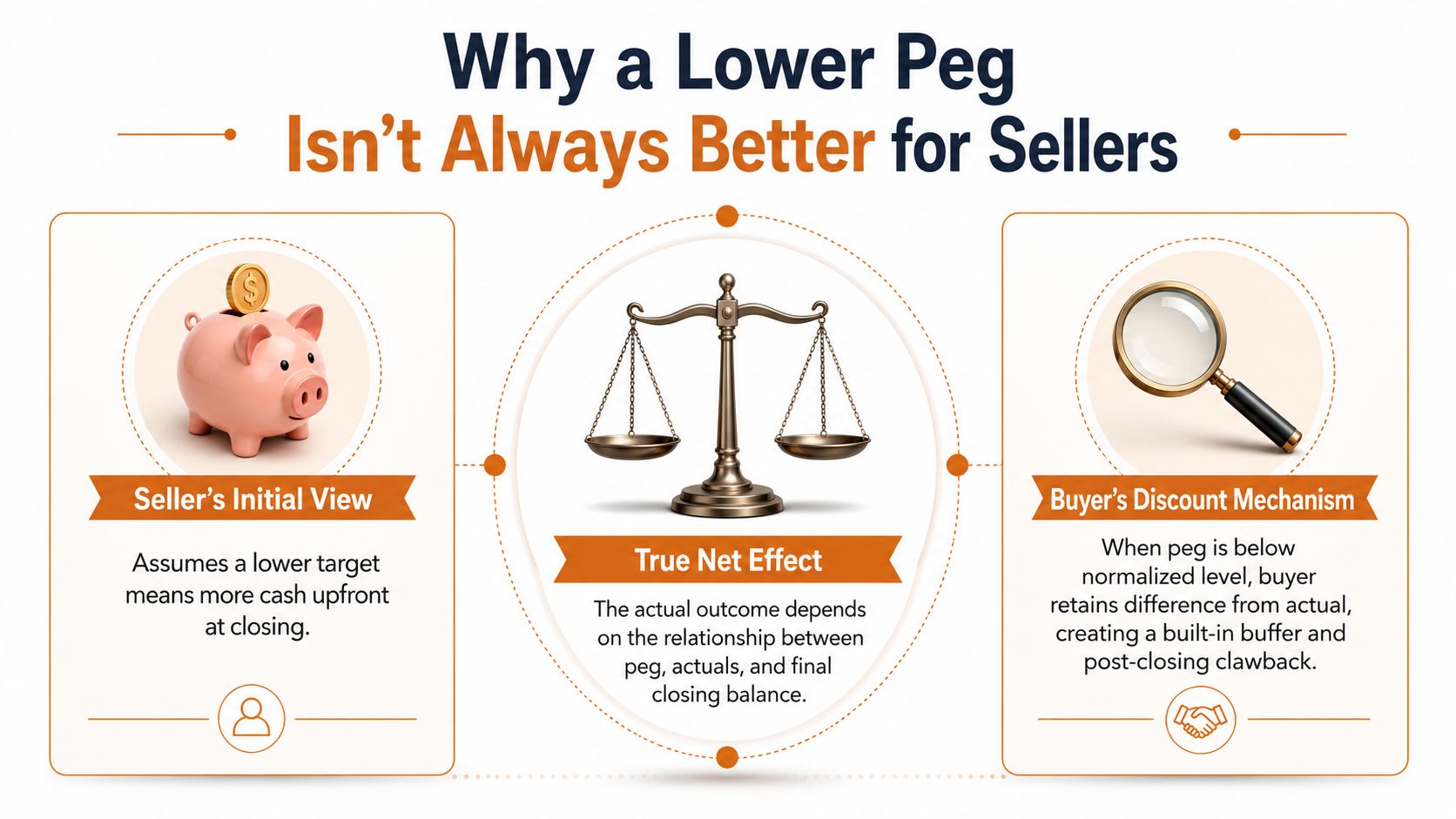
For a trades business, the target must support ordinary payroll, supplier purchases, inventory replenishment, and the collection cycle. If peak buying or backlog growth requires more resources, a low peg doesn’t eliminate that requirement. It merely changes who funds it and how the buyer prices the risk.
A lower peg can also increase the buyer’s negotiating power during the true-up. If the closing balance is below the target, the buyer has a direct price adjustment. If the definitions are vague, the buyer may challenge several accounts at once and keep more seller proceeds tied up in escrow.
The best seller outcome isn’t the smallest peg. It’s the peg that accurately describes normal operations and leaves little room for a buyer to discount the business twice.
A defensible target can support a cleaner valuation discussion. It tells the buyer that the operating balance sheet is understood, documented, and sustainable.
Prepare working capital before a buyer requests a schedule. Clean the balance sheet while you still control the business, because diligence will expose weak accounts and inconsistent practices.
Write off obsolete stock, exit dead product lines, and rationalize raw materials that no longer support current work. Unsellable inventory does not become useful operating capital because it remains on the ledger.
For HVAC, plumbing, roofing, and similar trades, separate normal service inventory from project-specific materials and unusual bulk purchases. Apply the same policy each month so the closing snapshot reflects ordinary operations. Growth can also make a trailing average misleading, especially when inventory rises ahead of booked work.
Tighten credit terms where commercially reasonable, follow up on aged balances, and document collection practices. Do not accelerate collections artificially before closing. The buyer should see a process that can continue after the sale, not a temporary improvement in cash conversion.
Clear balances that are not realistically collectible. Maintain aging reports and reconcile them to the general ledger. This gives the buyer a documented basis for assessing receivables instead of leaving disputed estimates in the closing calculation.
Replace aging vehicles or equipment when maintenance has been deferred. An unresolved repair backlog can lead the buyer to argue that the closing balance sheet does not support normal operations, or to seek protection elsewhere in the agreement.
Seasonality requires the same discipline. Schedule major purchases, inventory replenishment, and payroll cycles around ordinary needs, not a manufactured closing balance. In a growing trades or home-services business, cutting inventory or delaying repairs may produce a lower peg while leaving the buyer with a real funding requirement. Run the company consistently, retain the records, and explain unusual movements before negotiations begin.
Give your deal team a working file that answers the buyer’s likely questions before they ask.
Start a monthly internal review six months before signing. Compare actual NWC with the proposed peg, explain every major movement, and preserve supporting documentation. A seller who knows the history can negotiate from evidence. A seller who sees the buyer’s schedule for the first time is negotiating from reaction.
A recurring-revenue business usually gives the buyer a more predictable working capital profile. Subscription arrangements, service contracts, and repeat wholesale relationships can make collections, payables, and inventory requirements easier to model. That predictability can support a tighter peg, because the buyer has less uncertainty about what the business needs at closing.
Project-based and inventory-heavy businesses are different. A contractor may carry materials before billing. A service company may collect deposits before performing work. A wholesale operator may need inventory that moves with customer demand. In those businesses, the peg can become a larger negotiating issue because the closing snapshot may not resemble the historical average.
The peg also interacts with other deal terms. Seller financing, earnouts, and holdbacks can all defer economic value. If the same seller proceeds are held back for working capital disputes and other obligations, an aggressive peg reduction may weaken the seller’s practical floor even when the headline price remains unchanged.
Quality of earnings work connects the pieces. Clean monthly statements, consistent revenue recognition, controlled receivables, and defensible inventory policies help the buyer understand both earnings and working capital. A clean working capital story can support confidence in the overall valuation, independent of the dollar-for-dollar adjustment.
Owners should evaluate the offer as a complete package:
The strongest deal isn’t necessarily the one with the highest headline number. It’s the one whose operating assumptions the seller can deliver without financing the buyer after closing.
Can the buyer change the peg after signing? Only if the agreement allows it or both parties approve a written change. Lock down the methodology, account definitions, calculation schedule, and treatment of disputed items before signing. A buyer should not be able to revise the target because the closing balance produces an unfavorable adjustment.
What happens if closing NWC is overstated or understated? The final calculation compares qualifying working capital at closing with the agreed peg. A shortfall generally reduces the purchase price, while excess generally increases it, subject to the agreement’s definitions and dispute process. The fight is often over classification, such as whether a receivable, customer deposit, prepaid expense, or inventory item qualifies.
Can the buyer use the peg to reduce the price twice? Yes, if the purchase agreement does not separate working capital from other price mechanisms. A buyer may seek a working capital reduction while also treating the same item as debt, a debt-like liability, or an excluded transaction expense. Require the agreement to state that each item is counted once and that operating assets and liabilities are not reclassified after closing.
What if the parties disagree after closing? Follow the notice, review, and dispute timetable in the agreement. Preserve the closing ledger, supporting invoices, aging reports, inventory records, and calculation workbook. A clean audit trail gives the seller a stronger position than arguing from memory.
The Owner’s Shortlist connects business owners with vetted specialists in valuation, taxes, legal matters, financing, succession, and related decisions. Its plain-language guides help owners prepare before engaging an advisor. Visit The Owner’s Shortlist to review sale guidance and find a specialist who can help model and negotiate the working capital peg early.
Tell us your situation. We'll connect you with a specialist who works with owners like you. One conversation, no sales pressure.
Found this useful?
Add The Owner's Shortlist as a preferred source and get our articles highlighted in Google Search results.
Add to Preferred SourcesTalk to a good broker 2 to 3 years before you want to sell. They'll show you what buyers will pick apart and who you need on your side to fix it.
October 8, 2026
Compare 10 business transfer lawyer options for sales, succession, family transfers, and smaller deals, with questions, fee models, and red flags.
October 5, 2026
Interest rates, inflation, the headlines. None of it matters as much as owners think. Here's what actually determines whether now is the right time to sell.
October 5, 2026
What is a tuck-in acquisition? Learn how these deals impact owner-operated businesses, trades, valuation, and when to consult an M&A specialist.
September 29, 2026