Is It a Good Time to Sell My Business Right Now?
Interest rates, inflation, the headlines. None of it matters as much as owners think. Here's what actually determines whether now is the right time to sell.
October 5, 2026
By Remi Taffin · October 5, 2026

You’re preparing to sell the company you built, transfer it to a child, or buy an operating business, and the legal question seems deceptively simple: which lawyer should handle the transfer? A business transfer lawyer might draft an asset purchase agreement, negotiate indemnities, review leases and licenses, manage diligence, coordinate the closing, or structure a family succession. One provider may focus almost entirely on sale execution, while another may be better suited to estate planning, buy-sell agreements, or a complex regulated transaction.
The right choice depends on the type of transfer, transaction complexity, jurisdiction, engagement scope, pricing model, and coordination required with your accountant, lender, broker, valuation specialist, or estate adviser. This shortlist starts with an owner-first resource, then separates document-focused support, sale counsel, complex transaction teams, and succession specialists. The profiles are informational. Confirm licensing, availability, fees, scope, conflicts, and expected outcomes directly with each provider. For broader preparation, owners can also review this guide to a virtual legal assistant and decide which administrative work should stay separate from legal advice.
The Owner’s Shortlist is a useful starting point when you know a transition is coming but haven’t yet decided whether you need sale counsel, a succession lawyer, a tax adviser, or a broader advisory team. It’s a curated, editorial directory designed for long-tenured, owner-operated businesses. Rather than presenting thousands of listings, it organizes specialists across eight categories, including Future Options, Business Value, Taxes, Legal & Estate, Growth & Financing, Keeping It in the Family, Your Team, and Finding the Right People.
The site combines a short specialist directory with practical articles about valuation, tax planning, estate planning, deal structure, and owner-specific situations such as HVAC and plumbing businesses. The publisher describes the library as containing free, plain-language articles, with materials covering topics such as attorney SEO insights by CitationOS among its wider editorial resources. Browsing is free, and owners can contact specialists directly without a middleman or lead-reselling process. An optional matching workflow can also introduce an owner to an appropriate specialist for an initial conversation.
Practical rule: Use a directory to clarify your next professional conversation, not to replace that conversation.
The main advantage is focus. The roster is intentionally limited, which can save time when generic searches produce irrelevant listings, but it also means you may encounter geographic gaps. The site doesn’t publish specialist-service pricing, and any engagement fees are arranged directly with the adviser. It also positions its materials as informational rather than legal, tax, or financial advice.
For an owner who hasn’t assembled a transition team, that distinction matters. A lawyer may identify an ownership problem, but your CPA may need to model the tax result, a valuation professional may need to support the price, and an estate adviser may need to align the transfer with the rest of your plan. Start with The Owner’s Shortlist when you need plain-English preparation and a curated route to the right kind of specialist.

Mantle is aimed at the owner who has decided to sell and wants dedicated sell-side counsel rather than a general business lawyer. Its positioning centers on owner-operated and lower-middle-market exits, with support beginning before the buyer’s diligence process and continuing through closing.
Pre-sale legal cleanup can be valuable when contracts, ownership records, employment arrangements, or corporate documents are scattered across personal files and operating systems. Mantle emphasizes readiness work intended to reduce avoidable diligence friction. That makes the firm a logical candidate for a founder or family owner who wants to prepare before signing a letter of intent.
The firm also describes end-to-end support from LOI through closing. That scope should be confirmed in writing, because “transaction support” can mean anything from reviewing a buyer’s draft to leading negotiation, managing disclosure schedules, and coordinating closing deliverables. Ask whether diligence organization, contract assignment analysis, entity cleanup, and post-closing obligations are included or billed separately.
Mantle’s plain-English, hands-on approach may suit an owner handling a first liquidity event. A boutique practice can also provide continuity, with fewer handoffs between the initial consultation and the closing lawyer. The trade-off is capacity. A small team may have limited availability during a busy deal period, and the site doesn’t publish a standard price list.
Request an engagement proposal from Mantle, the law firm for small business exits that identifies the transaction assumptions, expected negotiation rounds, excluded work, and treatment of unusual issues. If the matter shifts from a straightforward sale into litigation, tax restructuring, or a multi-jurisdiction transaction, ask when outside specialists would be brought in.
Conveyance Law, PLC stands out for owners who want clearly scoped work on a relatively straightforward business sale, particularly an asset purchase. The Iowa-based firm publishes flat-fee pricing for core documents and explains related paperwork in practical terms.
An asset purchase agreement is only one part of an asset transaction. The supporting documents may include a bill of sale, assignment and assumption agreement, non-compete terms, lease assignment, seller note, and security arrangements. Conveyance Law’s materials address that wider document set and explain how landlord consent and financing can affect the deal.
That focus can help an owner avoid comparing a low document quote with a full-service transaction engagement as if they were identical products. Before hiring, confirm whether the quoted work includes negotiation, diligence review, closing coordination, and revisions requested by the buyer’s counsel. A flat fee is useful only when the scope is equally clear.
This option may work well for a defined asset deal with Iowa connections or for an owner comfortable working remotely with counsel based elsewhere. Equity purchases are handled case by case rather than through the same published flat-fee structure. A transaction involving multiple states, regulated licenses, complicated real estate, or significant financing may require additional local or specialist counsel.
Review the Conveyance Law, PLC business transfer services with a list of every asset, contract, lease, permit, and liability that must move or remain behind. The lawyer can then tell you whether the core package fits or whether the matter needs a broader engagement.

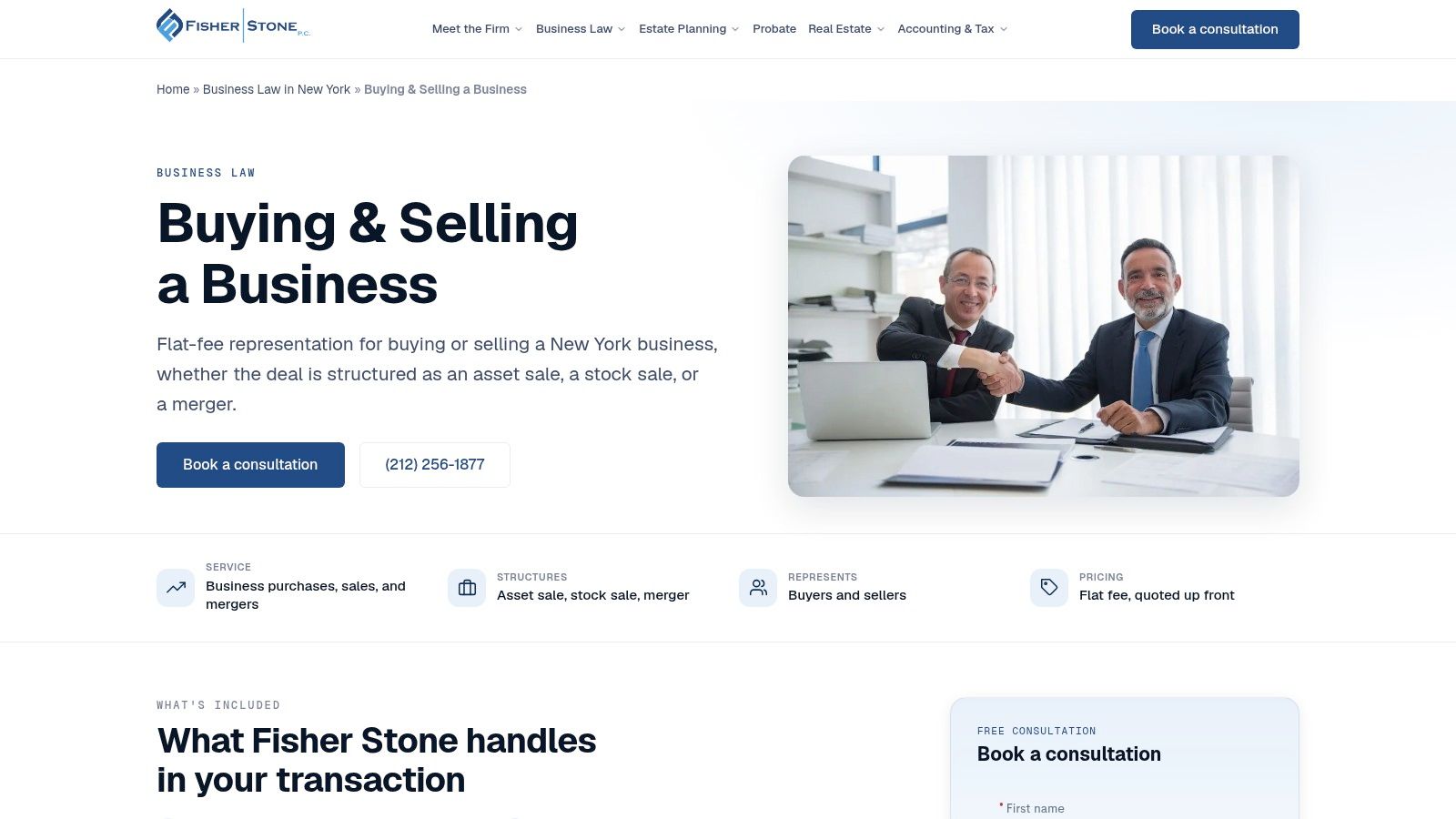
Fisher Stone is a New York business firm offering flat-fee representation for buying or selling a business, with the final fee quoted after consultation. Its published process addresses the path from LOI through closing, including diligence, purchase or merger agreements, indemnities, escrow, and certain New York tax considerations.
The firm’s guidance distinguishes between asset and stock sales, a decision that can affect what the buyer acquires, which liabilities remain with the seller, and what consents or filings are needed. Its stated scope also includes bulk-sale and New York sales-tax review. Those issues make local knowledge relevant, particularly when the transaction includes inventory, leased premises, taxable assets, or state-specific compliance questions.
Direct access to the handling attorney may be attractive to an owner who doesn’t want a call-center intake process. Educational material can also help you prepare better questions before the consultation. Still, a quoted flat fee isn’t automatically an all-inclusive fee. Ask whether it covers buyer or seller negotiations, disclosure schedules, lender documents, third-party consents, and closing adjustments.
Owners considering a transfer should first understand whether they need an attorney to sell a business, then discuss the specific legal work with counsel.
Fisher Stone is primarily positioned for New York matters. A deal involving an entity, property, employee base, license, or contract in another jurisdiction may need local coordination. Confirm who will handle those issues and whether outside counsel’s fees are separate.
Contact Fisher Stone’s business purchase and sale team with a concise description of the deal, the entity structure, the intended transaction form, and the state connections. That will produce a more useful scope discussion than asking for a generic “business sale price.”
Flat Rate Legal, operated by Agarunov Law Firm, P.C., focuses on small and mid-sized purchases and sales with a flat-fee M&A model. Its process is organized around LOI, diligence, documentation, and closing, with attention to asset purchase agreements, stock purchase agreements, indemnities, and escrow.
A fast quote can help an owner decide whether a proposed transaction is financially practical before investing heavily in the process. Flat Rate Legal emphasizes quick pricing responses, but the exact amount still depends on the consultation and scope. Ask what assumptions support the quote. A price based on a clean, cooperative transaction may change if the buyer demands extensive revisions, financing conditions, earnout provisions, or a long diligence process.
The firm’s New York and New Jersey emphasis makes it a natural candidate for owners whose businesses, entities, or counterparties are tied to those jurisdictions. It also highlights work involving New York and Delaware entities. That doesn’t automatically make it the right choice for every multi-state deal. Confirm admission, local filing responsibilities, and whether co-counsel will be needed elsewhere.
A useful intake conversation should establish who controls the negotiation, who reviews the buyer’s diligence requests, and who prepares final closing documents. It should also identify whether tax advice, valuation work, lender negotiations, broker commissions, and post-closing disputes fall outside the legal engagement.
Owners can review the Flat Rate Legal business purchase and sale service and ask for the proposed scope in writing. Predictable pricing works best when both sides agree on what counts as ordinary work and what triggers a revised fee.
Reib Law is a North Texas option for owner-operators buying or selling a business. It publishes tiered flat-fee pricing tied to deal size and complexity, rather than relying solely on an hourly estimate. The stated scope covers LOI work, legal diligence, transaction structure, purchase agreements, and closing.
Published tiers make it easier to compare legal expense with other transaction costs before committing. Reib Law also describes coordination with CPAs, lenders, and deal advisers, which is important when the buyer needs financing or the seller needs tax and valuation input. An access plan may provide discounts, but the specific terms and whether they suit your matter should be confirmed directly.
A tiered structure won’t fit every fact pattern. A transaction can look small by purchase price but still require substantial work because of multiple entities, real estate, environmental concerns, franchise restrictions, intellectual property, or regulatory approvals. Reib Law indicates that a custom tier may apply to unusual matters.
North Texas knowledge can be an advantage for local owners dealing with area lenders, leases, permits, and business practices. Remote work may be possible, but the best fit is likely a transaction with meaningful Texas connections. Ask how the firm handles assets, contracts, or filings outside its primary region.
Visit Reib Law’s mergers and acquisitions practice with a preliminary deal summary. Include whether you’re a buyer or seller, whether the transaction is an asset or equity purchase, and which professionals are already involved. The more concrete the facts, the more meaningful the tier discussion will be.
Sari Law Firm is a California business and intellectual property practice with a focused offering for asset purchase agreements and related M&A documents. It emphasizes flat-fee predictability for much of its APA work and direct contact with the attorney handling the matter.
The firm addresses California issues involving licenses, bulk sales, and assignment requirements. Those details can matter when the business depends on permits, customer agreements, leased equipment, intellectual property, or a location-based operating license. A document lawyer should understand not just the purchase price, but which rights and assets allow the company to keep operating after the closing.
A focused APA engagement may be efficient when the deal is small, the structure is settled, and the parties have already agreed on the commercial terms. It may be less suitable when the transaction requires extensive buyer representation, a complicated earnout, a merger, multiple entities, or significant negotiations across several states.
Owners sometimes describe a family handoff as a simple change of ownership. The legal work may still involve governance documents, valuation, buy-sell provisions, and estate coordination. Before choosing document-focused counsel, read about company ownership transfer and family succession and decide whether the transfer is truly a sale, a gift, a staged transfer, or part of a broader estate plan.
Sari Law represents clients throughout California through remote and in-person options. Exact fees are quoted after consultation, so ask whether revisions, negotiations, license work, assignment review, and closing support are included in Sari Law Firm’s asset purchase practice.
Coleman & Horowitt is a California firm suited to owners whose transfer involves more than a standard purchase agreement. Its business purchase and sale practice handles asset and stock transactions, mergers, complex corporate structures, and real-estate-heavy deals.
A transaction involving property, franchises, regulated operations, several entities, or unusual ownership arrangements can create work across multiple legal disciplines. A full-service team may coordinate corporate, real estate, employment, franchise, regulatory, and transaction issues under one firm. That can reduce the risk that an important operational dependency is treated as an afterthought.
The trade-off is cost and process. Traditional firms generally don’t offer the same public flat-fee schedule as document-focused providers. For a micro-deal with cooperative parties and limited assets, a multidisciplinary engagement may be more than the owner needs. For a complex transaction, however, choosing counsel solely because the initial document quote is low can create expensive gaps.
Ask who will lead the matter, which specialists will participate, and how the firm controls communication and billing. Confirm whether real estate review, title issues, lease assignments, franchise approvals, and post-closing filings are part of the proposed scope.
A buy-sell agreement can be central to ownership continuity, so review what a buy-sell agreement does before the consultation if the company has multiple owners or a family transfer is under consideration. Then contact Coleman & Horowitt’s business purchase and sale practice with a clear list of the business’s assets, entities, locations, and regulatory dependencies.

Obermayer Rebmann Maxwell & Hippel LLP is a regional option for owners who are deciding between a third-party sale and a transfer within the family. Its business succession practice combines estate and tax planning with ownership and control planning for closely held companies.
A family transfer isn’t a sale with a familiar buyer. The owner may need to address control, compensation for future leaders, fairness among heirs, liquidity, spouse or beneficiary concerns, and the relationship between the operating agreement and the estate plan. Obermayer’s stated approach includes coordination with CPAs and valuation professionals, along with governance and family-harmony planning.
This kind of counsel is particularly relevant because succession planning remains active among family businesses. PwC’s 2025 U.S. Family Business Survey is cited in the supplied research as reporting that 44% of U.S. family firms reported succession-planning impacts in the past year. That figure is used here only to show why succession deserves its own legal workstream, not as a prediction about any individual company.
A succession lawyer may help structure the transfer, coordinate estate and tax advice, and create governance protections. That doesn’t mean the same firm will run a competitive sale process, negotiate with an outside buyer, or manage every closing deliverable. Ask whether the firm executes third-party transactions or recommends separate deal counsel.
The practice has no public pricing schedule, and a larger-firm model may cost more than a narrow document engagement. For owners weighing a sale against a family transfer, explore Obermayer’s business succession planning practice and request a phased proposal that separates planning, drafting, coordination, and transaction execution.

Sprintlaw US, delivered through ElevateNext US, LLC, offers an online, fixed-fee route for asset purchase agreement support. The model uses online intake, documented scope, and delivery through U.S. legal professionals.
An online platform can work well when the parties understand the commercial terms, the transaction is relatively simple, and the owner primarily needs an APA drafted or reviewed. Fixed-fee scoping can make the initial decision easier, while an online workflow may reduce scheduling friction. National delivery can also help an owner who doesn’t need a lawyer physically located near the business.
The limitations are just as important. A packaged APA service may not fit a heavily negotiated deal involving multiple jurisdictions, unusual liabilities, major financing conditions, complex intellectual property, or extensive diligence. A platform that’s efficient for a defined document can become inefficient once the matter needs strategic negotiation and continuous coordination.
Ask who provides the legal service, where that lawyer is licensed, how many revision rounds are included, and what happens when the buyer introduces new terms. Confirm whether the service includes diligence, assignment analysis, closing support, and review of leases or licenses. A quote that covers only the agreement may not cover the legal work needed to make the transfer operationally effective.
Review Sprintlaw US’s asset purchase agreement service and compare its scope with the needs identified by your CPA, lender, broker, or valuation adviser. If you’re also researching software for a legal team, this guide to comparing legal research platforms addresses a separate technology question and shouldn’t be confused with transaction counsel.

| Provider | Core offering | Pricing & Value 💰 | Target audience 👥 | Quality / Experience ★ | Unique selling points ✨ |
|---|---|---|---|---|---|
| The Owner’s Shortlist 🏆 | Curated specialist directory + plain-language guides; optional matching workflow | 💰 Free to browse; specialist fees arranged directly | 👥 Long-tenured owner-operated businesses exploring sale, succession, taxes | ★★★★☆ | ✨ Curated, privacy-first shortlist + ~176 practical articles; direct contact with vetted experts 🏆 |
| Mantle – The Law Firm for Small Business Exits | Boutique sell-side M&A counsel; pre-sale legal cleanup; LOI→closing | 💰 Engagement-based quotes (no public rates) | 👥 Founder/family owners preparing first liquidity event | ★★★★☆ | ✨ Hands-on sell-side representation in plain English |
| Conveyance Law, PLC | Transaction-focused shop with flat-fee APA & ancillaries | 💰 Published flat fees for core documents | 👥 Owners of straightforward asset deals; remote counsel | ★★★★ | ✨ Transparent flat-fees and clear scoping of included work |
| Fisher Stone (NY) | Flat-fee buy/sell representation; LOI→closing; NY tax guidance | 💰 Flat-fee quoted after consult | 👥 NY businesses or deals with NY considerations | ★★★★ | ✨ Detailed process guidance + direct attorney access |
| Flat Rate Legal (Agarunov Law) | Fast flat-fee M&A representation; staged deal flow | 💰 Quick flat-fee quotes (quote required) | 👥 Small/mid-market NY/NJ transactions | ★★★☆☆ | ✨ Speedy pricing transparency and practical checklists |
| Reib Law (North Texas) | Tiered flat-fee pricing by deal size; full-scope LOI→close | 💰 Published tiered flat-fees by deal size | 👥 North Texas owner-operators; first-time sellers/buyers | ★★★★☆ | ✨ Upfront tiered pricing + coordination with CPAs & lenders |
| Sari Law Firm (CA) | California-focused APA/SPAs with flat-fee predictability | 💰 Most APA work offered flat-fee; quoted after consult | 👥 California owners needing state-specific compliance | ★★★★ | ✨ CA regulatory & bulk-sale expertise; direct attorney contact |
| Coleman & Horowitt, LLP (CA) | Full-service firm for complex/real-estate-heavy transactions | 💰 Traditional firm rates; no public flat fees | 👥 Complex or regulated California transactions | ★★★★ | ✨ Multi-disciplinary bench for complex deals |
| Obermayer Rebmann Maxwell & Hippel LLP | Business succession & ownership-transfer planning; estate/tax alignment | 💰 Larger-firm rates; no public pricing | 👥 Family & closely-held companies planning transitions | ★★★★ | ✨ Integrated estate/tax + governance planning; valuation referrals |
| Sprintlaw US (via ElevateNext) | Online fixed-fee APA support with documented quotes & workflow | 💰 Fixed-fee quote after intake; predictable pricing | 👥 Well-scoped, smaller transactions nationwide | ★★★☆☆ | ✨ Fast online intake, clear scoping, national platform delivery |
Choosing a business transfer lawyer starts with defining the transfer, not searching for the most impressive firm name. Write down whether you’re selling assets, selling equity, buying an operating business, transferring ownership to family, making a gift, or coordinating a change through an estate plan. A lawyer who routinely negotiates third-party acquisitions may not be the best person to handle family governance. A lawyer who drafts succession documents may not be the right lead for a competitive sale process.
Next, narrow the candidates by jurisdiction and transaction experience. Confirm where the business is organized, where its assets and employees are located, and which states govern important contracts. Ask whether the lawyer has handled businesses with similar operating dependencies, such as recurring customer agreements, equipment, real estate, local permits, professional licenses, franchises, or regulated services.
Then ask for a written scope. It should say whether the engagement includes the LOI, diligence, transaction structure, purchase or merger agreement, disclosure schedules, indemnities, escrow, seller notes, financing coordination, third-party consents, closing documents, and post-closing obligations. A transfer can lose value when a contract, lease, license, title, or tax registration cannot move cleanly to the buyer. Practitioner guidance also highlights the need to review ownership records, key assets, regulatory filings, and the IRS responsible-party information reported through Form 8822-B. Discuss those items before the closing is imminent, not after a buyer has found the gap.
Ask directly: Which documents and consents must be ready before the buyer can operate the business on the first day after closing?
Pricing deserves the same precision. Some firms publish flat fees or tiers, while others quote after reviewing the facts. Neither model is automatically better. A flat fee can provide predictability, but only if the assumptions and exclusions are clear. Hourly billing can make sense when the deal is unusual or likely to change, but ask for an estimate, billing increments, staffing assumptions, and approval rules for work outside the initial scope.
Confirm who will perform the work. The lawyer you meet may supervise associates, paralegals, local counsel, or outside specialists. That can be entirely appropriate, but you should know who handles diligence, negotiation, document drafting, tax coordination, and closing logistics. Also ask how the firm checks conflicts, especially if the business has lenders, investors, minority owners, family members, or a buyer who may already be connected to the firm.
Your wider team matters. A CPA can model the tax consequences and help compare transaction structures. A valuation professional can support the business value or the value of an ownership interest. A lender may impose conditions that affect timing and collateral. A broker or M&A adviser may manage buyer communications, while an estate adviser may need to align trusts, wills, beneficiary designations, and ownership documents. The lawyer should explain which decisions require input from those professionals rather than presenting legal drafting as a substitute for every other form of advice.
For family succession, ask about governance after the transfer, voting rights, compensation, buy-sell triggers, death or incapacity, divorce, creditor exposure, and disagreements among heirs. A family relationship doesn’t eliminate the need for clear documents. In some ownership structures, the governing agreement may control transfer rights even when an estate document points in another direction. Have counsel explain how the documents interact before anyone assumes that inheritance alone will transfer control.
Watch for red flags:
The legal-services market also gives owners a useful reality check. For comparable U.S. legal-services transactions sold from 2021 through 2025, BizBuySell reports a median sale price of $500,000, median owner earnings of $281,411, an average sale-to-ask ratio of 0.90, median time on market of 206 days, and an average earnings multiple of 1.96x. Review the BizBuySell law firm valuation benchmarks for the source and context. These figures are market benchmarks, not a valuation of your business and not a legal-fee quote.
The broader succession problem is also substantial. One legal industry source estimates that about 40% of family businesses are in the process of transferring ownership at any given moment, that two-thirds of initial transfers fail, and that about one-half of surviving businesses make it through a second transfer. The same source projects that $10.4 trillion in family business owner net worth is expected to transfer by 2040, while estimating that 50% to 75% of an owner’s net worth may be tied up in the company itself. Those figures come from business succession planning guidance for family business owners and illustrate why ownership transfer should be treated as a continuity and wealth-planning matter, not just a closing appointment.
Use The Owner’s Shortlist to prepare in plain language, identify whether your situation belongs in sale execution, document support, complex transaction counsel, or family succession planning, and find specialists worth contacting. Confirm every legal conclusion, license, fee, engagement term, and service boundary directly with the lawyer you choose.
The Owner’s Shortlist offers a curated Legal & Estate directory and practical guides for owners planning a sale, family transfer, succession, valuation, tax decision, or financing step. Visit The Owner’s Shortlist to clarify your situation before contacting a business transfer lawyer and connect with relevant specialists without sorting through generic listings.
Tell us your situation. We'll connect you with a specialist who works with owners like you. One conversation, no sales pressure.
Found this useful?
Add The Owner's Shortlist as a preferred source and get our articles highlighted in Google Search results.
Add to Preferred SourcesInterest rates, inflation, the headlines. None of it matters as much as owners think. Here's what actually determines whether now is the right time to sell.
October 5, 2026
What is a tuck-in acquisition? Learn how these deals impact owner-operated businesses, trades, valuation, and when to consult an M&A specialist.
September 29, 2026
Learn what reps & warranties mean in M&A deals, why they matter, and how to negotiate them effectively. A clear guide for business owners.
September 27, 2026
Your business's sale price and your retirement number are two different figures. Here's how to build the second one before you rely on the first.
September 21, 2026