Succession Planning for Small Business: A Practical Roadmap
A practical roadmap for succession planning for small business owners — readiness, exit options, valuation, legal prep, and a working timeline.
September 15, 2026
By Remi Taffin · September 17, 2026

A company ownership transfer is often treated as a sale, a family gift, or a retirement formality. That framing misses the larger decision. For many owner-operated businesses, the question is how to move control, economic benefit, and leadership to the next person while protecting liquidity, continuity, and the value built over years.
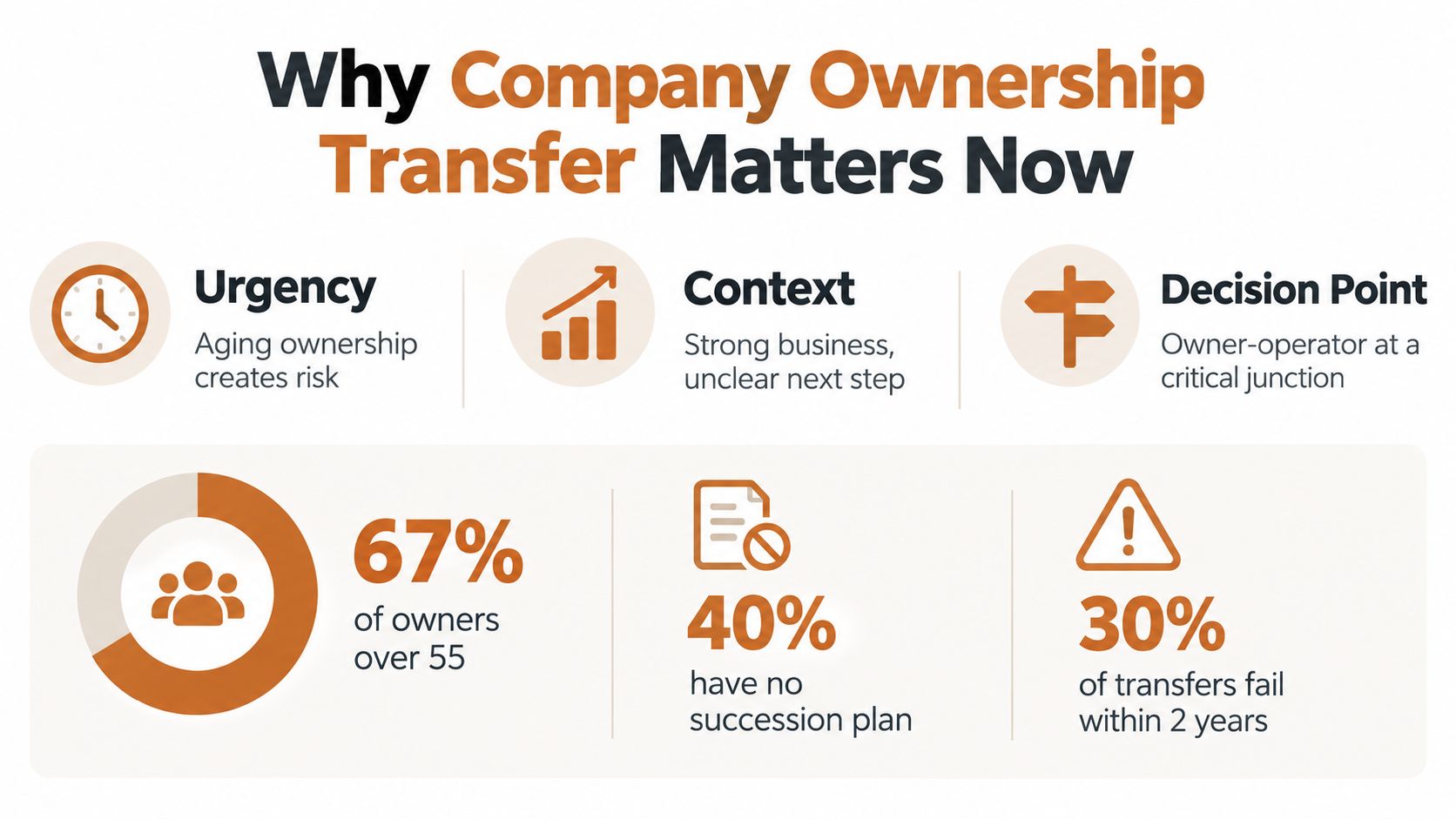
By 2035, about 6 million small and mid-sized businesses are projected to face ownership transitions, with more than 1 million viable sale candidates representing up to $5 trillion in enterprise value, according to Deloitte’s 2026 family-business succession analysis. The opportunity is substantial, but an owner who waits until retirement, illness, or family pressure forces a decision may leave fewer workable options.
In 2022, 510,000 SMBs exited the market. Only 5% were completed as sales and 3% transferred to new owners, while 92% closed outright, according to Deloitte’s succession planning analysis. The figures point to a practical problem: businesses with customers, employees, contracts, and saleable assets often disappear because ownership planning starts too late.
Consider a regional HVAC company with repeat service agreements, experienced technicians, and loyal commercial customers. Its owner wants to retire. One child is not ready to run it, the operations manager cannot finance a full purchase, and an outside buyer might change the company culture. An outright sale or closure may seem simpler, but neither option is the only possible design.
Ownership transfer is a capital-structure and timing decision. The owner might sell a minority interest to an outside investor, transfer voting control in stages, bring in a management successor, or arrange a buy-sell agreement funded by insurance or other resources. A partial transfer can provide cash while preserving some control. A staged succession can give the next leader time to build skills and let the company fund part of the purchase. The trade-off is that the original owner may retain risk, decision rights, or exposure to future performance.
Each route creates a different balance among cash now, control retained, tax exposure, and successor readiness. The right question is not whether to sell or give the company to family. It is which combination of ownership, voting power, and payment timing fits the business and the people involved.
Preparation is widespread but often incomplete. Deloitte found that 27% of families and 40% of family businesses are already navigating succession or expect to do so within the next decade. Although 89% of families and 82% of family businesses reported having some form of succession plan, only about half described that plan as thorough and well developed, as reported in Deloitte’s global succession preparedness summary.
Practical rule: A written succession plan is a starting point, not proof that the ownership transfer can close smoothly.
Begin by listing the owner’s priorities: retirement cash, family continuity, employee protection, control over future decisions, or a clean exit. That list turns a forced decision into a transfer design with clear trade-offs.
Ownership, leadership, and economic benefit are separate parts of a company. Ownership works like holding the title to a house. Leadership resembles managing and maintaining the property. Economic benefit means receiving rent or carrying the costs. One person may hold the title, another may run operations, and a third may receive part of the income.
A company follows the same pattern. The legal owner holds shares, membership interests, or another equity interest. The leader makes daily operating decisions. The person receiving profits, sale proceeds, or distributions receives the economic benefit. A transfer may move all three together, or it may move them at different times.
Who owns the equity? A share or membership-interest transfer changes legal ownership of the entity. An asset sale transfers selected items, such as equipment, inventory, contracts, or intellectual property, while the original entity may remain in place.
Who controls decisions? Voting rights, board authority, employment agreements, and governing documents determine whether the successor can direct the company. A buyer may hold an economic interest without directing daily operations.
Who receives the money? Profits may flow to the original owner, successor, investor, or several owners under the governing agreements. A staged transfer can provide cash before the successor receives full control.
What must be transferred or renegotiated? Customers, employees, lenders, landlords, licensors, and contract counterparties may respond differently to an equity transfer than to an asset transfer. Change-of-control clauses and consent requirements should be reviewed before anyone promises a closing date.
This separation supports more than a sale-or-gift decision. An owner might transfer a minority interest to raise capital, retain voting control while a successor gains operating authority, or arrange payments over time. The trade-off is that retained ownership can also preserve exposure to future performance, debt, and disputes.
Ownership and leadership are diverging in many family enterprises. Only 36% of family businesses expect family members to hold most senior leadership roles over the next decade, despite confidence in the next generation as owners and board members, according to coverage of Deloitte’s family-business survey.
An estate transfer adds another layer after an owner’s death. A practical Texas estate transfer guide explains how probate, business documents, and real estate interests may interact. Use one mental model throughout: identify title, control, cash flow, and obligations separately, then specify which elements the proposed transaction moves and when.
There isn’t one universally correct path. The best option depends on whether the owner needs immediate liquidity, wants to preserve family involvement, has a capable successor, or needs a structure that works if an owner dies or becomes unable to work.
| Transfer Path | Control Retained | Liquidity and Timing | Best Fit |
|---|---|---|---|
| Outright sale to a third party | Usually limited after closing | Largest potential liquidity at closing, subject to deal terms and financing | Owners seeking a clean exit and market-based process |
| Gift to family | Can be retained temporarily through staged rights or agreements | Little immediate cash unless paired with notes or another funding structure | Families prioritizing continuity and willing to plan for tax consequences |
| Management or family succession | Often retained during a transition period | Liquidity may arrive gradually through installments, distributions, or a later sale | Businesses with a prepared successor who understands operations |
| Employee Stock Ownership Plan | Control can shift over time through the plan structure | Can provide a structured liquidity event while preserving employee ownership | Companies with stable operations and a workforce suited to shared ownership |
| Buy-sell agreement execution | Governed by predetermined rights and triggers | Funding and timing depend on the agreement and available resources | Co-owned businesses planning for death, disability, retirement, or departure |
A strategic or financial buyer may provide the clearest route to liquidity. The trade-off is reduced control over employees, brand decisions, investment priorities, and the owner’s continuing role. Buyers may also request representations, transition support, and protections that make the process more demanding than a simple handover.
A family transfer can preserve identity and relationships, but “gift” doesn’t mean “free.” Market-value rules, documentation, governance, and fairness among family members still matter. A parent might transfer voting control now while retaining a nonvoting interest or receiving scheduled payments, but that structure needs careful legal and tax design.
A key employee may understand the business better than an outside buyer but lack the capital for an outright purchase. Seller financing, minority investment, staged equity, or performance-based payments can bridge that gap. Owners of recurring-revenue trades businesses should also separate personal relationships from operational readiness. A technician who is excellent at service work may need help with pricing, hiring, cash management, and customer concentration.
Franchise owners face related questions about rights and territory. Understanding the difference between a master franchisor and area developer can clarify which party controls expansion, contracts, and revenue streams before ownership changes hands.
An ESOP can create employee participation, but it brings governance, valuation, administration, and financing requirements. A buy-sell agreement is different. It sets rules for a future trigger rather than automatically creating a full succession plan. Read the matrix as a narrowing tool. Choose the two paths that best match your liquidity and control priorities, then test those paths against valuation, taxes, financing, and successor capacity.
An owner’s internal number isn’t automatically the value used for a transfer. In a closely held company, valuation usually needs to be anchored to fair market value on the transfer date, rather than the owner’s preferred or negotiated figure. Independent appraisers commonly compare income-based, market-based, and asset-based approaches because the method can affect the tax base, estate inclusion amount, and the defensibility of the transaction price, as explained by Charles Schwab’s business succession valuation guide.
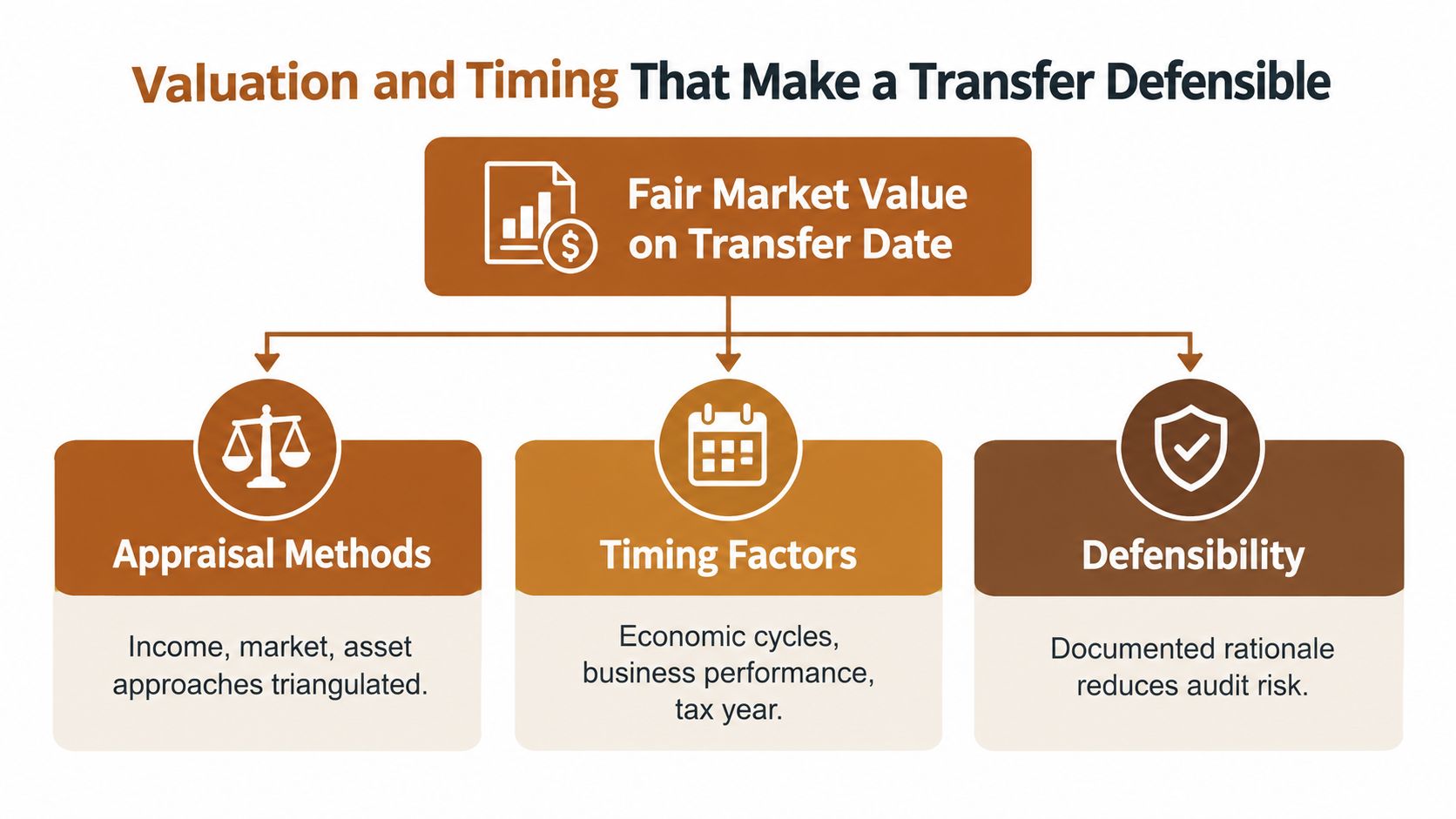
The income approach examines the company’s ability to generate future economic benefit. Recurring service agreements, normalized owner compensation, customer retention, margins, and capital needs may matter. The market approach compares relevant transactions or market indicators, although private-company comparisons often require judgment. The asset approach focuses on the value of equipment, inventory, property, intellectual property, and liabilities.
An appraiser does not choose the method that produces the highest result. The company’s size, industry, asset profile, earnings history, customer concentration, and transfer structure influence which approaches deserve weight. Owners should ask what assumptions drive the conclusion and whether the records support those assumptions.
A defensible valuation isn’t the number that feels fair to the seller. It’s the number supported by evidence, assumptions, and a clear transfer date.
Timing affects the evidence available. A business with improving recurring revenue may look different from the same business after a major customer loss. Seasonality can change working capital needs and reported earnings. A successor may also require time to learn the operation, secure financing, and earn confidence from employees and customers.
Owners should assemble clean financial statements, separate personal expenses, document unusual items, and record key contracts before commissioning the report. A business valuation guide can help organize the questions, while Bookkeeping and Accounting of Florida Inc’s business valuation services provides a useful example of the type of specialist support owners may seek. The goal is not to manufacture a favorable value. It’s to create a contemporaneous record that both sides can understand and defend.
A transfer between related parties can look simple on paper and still create a significant tax obligation. Tax authorities in major markets may treat a discounted or gifted transfer as though it occurred at market value. That can create capital gains, gift, estate, or deemed-dividend consequences, even when little or no cash changes hands, according to Oliver Group’s analysis of business valuation for family succession.

Suppose a parent transfers equity to a child for less than its supported market value. The family may view the difference as help with the transition. A tax authority may view it as a gift, a distribution, compensation, or another taxable event depending on the jurisdiction and structure. The company’s entity type, the seller’s basis, the buyer’s basis, retained interests, debt, and payment terms can all change the result.
That’s why owners shouldn’t rely on a handshake or a short transfer document. The legal team may need to review operating agreements, shareholder rights, employment arrangements, leases, intellectual property, loans, restrictive covenants, and estate documents. If multiple owners are involved, the buy-sell agreement should match the funding and valuation provisions rather than sit in a drawer with outdated assumptions.
A staged transfer can reduce the shock of a single handover, but it also creates more reporting events and governance decisions. Each stage should identify what changed, what consideration was paid, who has voting rights, how distributions work, and what happens if the successor leaves. Contemporaneous valuation, signed agreements, and post-transfer reporting give the parties a shared record.
Owners who want a plain-language overview of exit exposure can review the tax implications of selling a business before speaking with a tax professional. That reading isn’t a substitute for advice. It helps the owner arrive with better questions and avoids treating a family transfer as automatically tax-free.
Before signing: Ask the attorney and tax adviser to model the same transaction from the seller’s, buyer’s, company’s, and estate’s perspectives.
The right specialist depends on the jurisdiction and transaction. A tax adviser can analyze reporting and basis. A business attorney can draft and coordinate the transfer documents. An estate lawyer can align ownership with wills, trusts, powers of attorney, and incapacity planning. Those professionals should work from the same valuation and transaction description.
The costliest transfer mistakes often happen before anyone drafts an agreement. An owner may treat good intentions as readiness, assume a relative will accept the role, or wait until declining results force a decision. A checklist turns those assumptions into questions that can be answered.
Family continuity needs the same practical testing. Long-standing ownership-transfer research summarized in Deloitte reporting indicates that roughly 30% of family businesses survive to the second generation, 12% to the third, and 3% to the fourth. These figures do not predict one company’s outcome. They show why family intent needs governance, preparation, and a structure that can withstand disagreement.
About 24 months before the target transition, clarify personal goals, identify possible successors, clean up ownership records, and separate the owner’s personal role from the company’s operating systems.
During preparation, commission a valuation, review tax scenarios, update estate documents, examine debt and contracts, and build a financing plan. If the successor will lead operations, grant authority gradually and record what happens.
As the transaction approaches, settle the structure, approvals, purchase price or gift terms, representations, employment arrangements, voting rights, and communication plan. Employees and customers do not need every private detail, but they need a credible explanation of continuity.
After closing, track payments, distributions, reporting, ownership records, and promised transition duties. Signatures mark a legal milestone, not the end of the handoff. The arrangement is working only when responsibilities are clear, cash flows as agreed, and the records support the new ownership structure.
Begin with the decision that is still unclear. If you are weighing an outright sale against recapitalization, a minority investment, or a staged handoff, start with Future Options. These paths change who owns the company, who controls decisions, and when the owner receives cash. If the parties cannot agree on value, consult a Business Value specialist. A gift, installment sale, or retained interest brings Taxes and Legal & Estate into the first discussion.
The right support depends on the structure. A capital-heavy transition may need Growth & Financing advice. A family handoff may require Keeping It in the Family guidance, governance, and a clear process for resolving disagreements. If a successor will take an operating role, include Your Team. If you need to identify and qualify a buyer, this guide to finding a business broker explains what that relationship should cover.
A partial transfer can serve as a bridge rather than a compromise. Deloitte’s global family-business reporting indicates that 26% of family businesses expect to seek outside investment in the next three to five years, 19% plan to increase nonfamily ownership, and only 3% expect an outright sale. Outside capital, minority ownership, or staged succession may provide liquidity and new capability while preserving some control.
The Owner’s Shortlist organizes plain-language guides and curated specialists across valuation, taxes, legal and estate matters, financing, succession, and buyer selection. Visit The Owner’s Shortlist to compare options and prepare questions.
Tell us your situation. We'll connect you with a specialist who works with owners like you. One conversation, no sales pressure.
Found this useful?
Add The Owner's Shortlist as a preferred source and get our articles highlighted in Google Search results.
Add to Preferred SourcesA practical roadmap for succession planning for small business owners — readiness, exit options, valuation, legal prep, and a working timeline.
September 15, 2026
What is business succession planning? Learn the definition, transfer options, valuation, tax and legal steps, common pitfalls, and how
September 3, 2026
Learn what intergenerational wealth transfer means for owner-operated businesses. Explore structures, tax considerations, family governance, and next steps
August 30, 2026
What is buy sell agreement. Learn what is buy-sell agreement, how it works, common trigger events, funding methods, and next steps
August 26, 2026