Family Inheritance Law for Business Owners
Navigate family inheritance law for your business. Learn how to structure succession, avoid family disputes, and protect your company's future value.
September 25, 2026
By Remi Taffin · August 26, 2026
A buy-sell agreement is a legally binding contract that controls what happens to an owner’s shares when they leave, die, or want out. It decides who can buy the interest, how the price is determined, and how the departing owner or their heirs get paid.
That answer becomes much more important when a co-owner dies unexpectedly, files for divorce, becomes disabled, declares bankruptcy, or resigns without warning. The business may still have customers to serve, employees to pay, and contracts to fulfill, but ownership can suddenly become uncertain. Without a clear plan, the remaining owners may face an estate, ex-spouse, creditor, or former partner who now has a claim to the company.
A buy-sell agreement is the plan written while relationships are still cooperative. It turns a stressful ownership event into a defined process, provided the document covers the right triggers, valuation method, purchase structure, and funding source.
A partner dies, a marriage ends in divorce, or an owner suddenly wants out. The business still has customers, employees, and bills, yet ownership can change overnight. The remaining owners then face a practical question: who should hold the departing owner’s interest, and how can that person or their family receive its value?
A buy-sell agreement sets that process before pressure and personal conflict enter the discussion. It is a contract for controlling ownership transfers in a closely held business. The agreement can require an interest to be sold to the company or to the remaining owners, as described in the Cornell Legal Information Institute’s buy-sell agreement overview.
The document works like a prearranged handoff at a busy service counter. The owners decide in advance who takes responsibility, how the value is calculated, and how payment is made, rather than trying to settle those questions during a death, divorce, or sudden exit.
Practical rule: A buy-sell agreement coordinates ownership, price, payment, and business continuity in one document.
Each structural choice affects the owner’s decision. With a cross-purchase, the remaining owners buy the departing owner’s interest personally. That may give the purchasing owners a basis step-up equal to the price paid. With a redemption, the company buys the interest, and the remaining owners generally do not receive that same basis increase, according to the Cornell reference. A hybrid arrangement can divide those responsibilities between the company and the owners.
Funding also changes what the agreement can accomplish. A purchase obligation without money behind it may leave the surviving owners unable to complete the buyout or force the company to strain its cash flow. Owners therefore need to connect the trigger, purchase structure, valuation method, and funding source when they set the agreement.
A buy-sell agreement acts as a gate that blocks unauthorized ownership transfers. An owner generally cannot hand shares to a stranger, an ex-spouse, an estate, or another outside party without following the agreed process. The document may give the company or remaining owners a right of first refusal, or require a sale back to them after a defined trigger.
The purpose becomes clear when an owner dies, divorces, or leaves without warning. The departing owner or their heirs may want cash, while the remaining owners need to protect management and keep control with people who understand the business. The agreement gives the appropriate buyer the first opportunity, much like reserving a seat for an existing member before offering it to someone outside the group. It controls who may receive the interest, while the valuation and payment provisions address what that interest is worth and how the buyer pays.
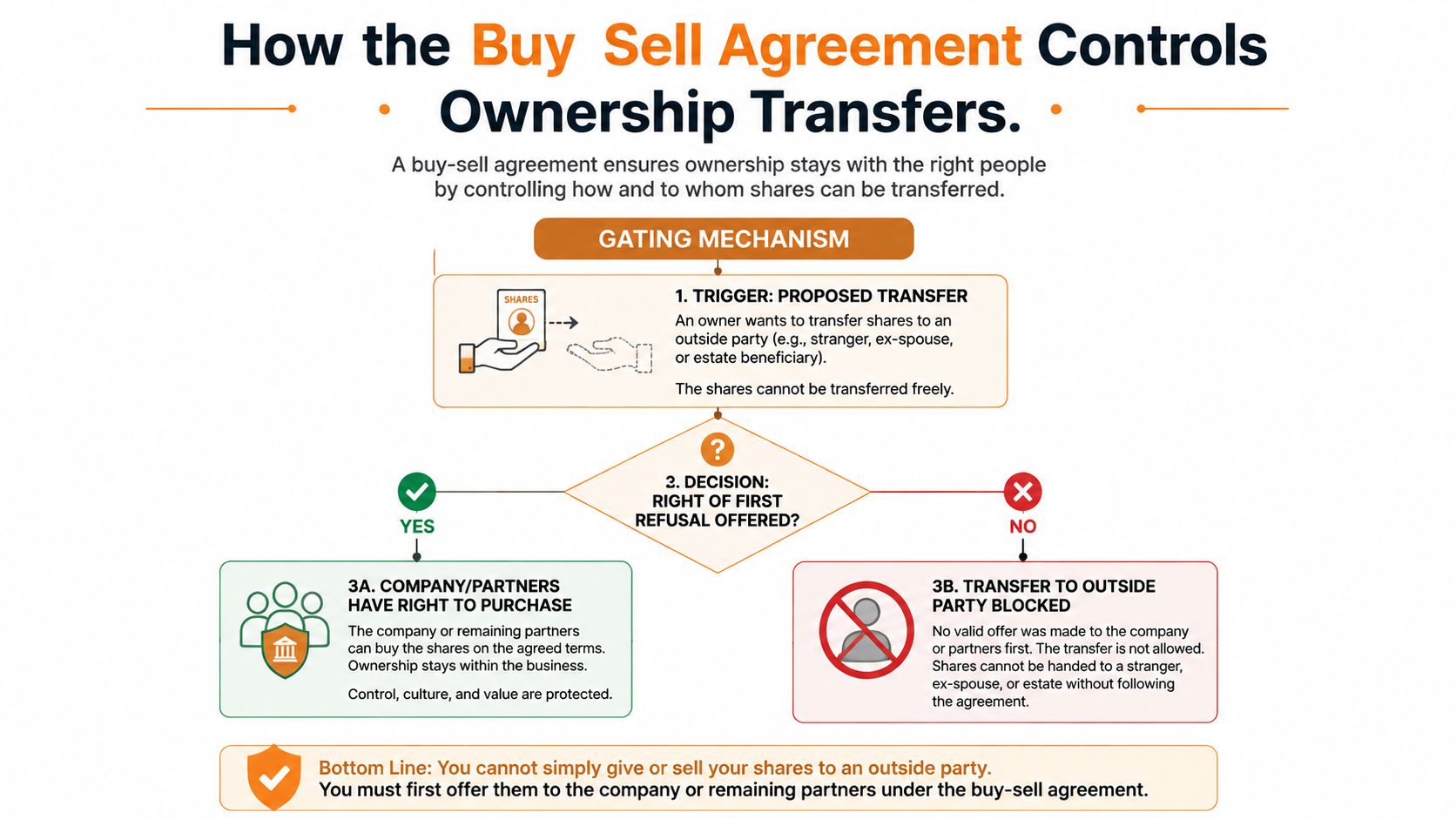
The agreement should answer these questions in order:
Without this gate, an ex-spouse might claim a marital interest in shares, a creditor could pursue an ownership interest during bankruptcy, or an estate might seek a role in a family company. The remaining owners could then spend time arguing about control instead of operating the business.
A well-drafted clause cannot prevent every disagreement. It gives the parties a defined route through one, leaving fewer decisions to improvisation and default legal rules.
A partner dies, a co-owner divorces, or one owner suddenly leaves. The agreement now has to answer a practical question: who writes the check? That choice determines who controls the purchase, where the money comes from, and what happens to the ownership interest afterward.
In a cross-purchase agreement, the remaining owners buy the departing owner’s interest directly. Each buyer pays an agreed share of the price, using personal funds, financing, or insurance owned by the individual owners. The purchasing owners generally receive a basis step-up equal to what they paid. This structure often suits two or a few partners who can clearly identify who will buy from whom.
In an entity-purchase agreement, also called a redemption arrangement, the business buys back the departing owner’s interest. The company becomes the purchaser, using company cash, financing, or insurance owned by the business. The remaining owners generally do not receive the same basis increase that can arise from a cross-purchase. Owners should review that entity-level tax result with their tax advisers.
A hybrid or wait-and-see agreement leaves the final buyer undecided until the trigger occurs. The company may receive the first opportunity to redeem the interest. If it buys only part, or chooses not to buy, the remaining owners can purchase the balance under the agreed process. This can help when the business’s cash position or the owners’ availability may change.
| Feature | Cross-Purchase | Redemption, Entity Buyback | Hybrid / Wait-and-See |
|---|---|---|---|
| Buyer | Remaining owners personally | The business | The business and owners, depending on the agreed process |
| Payment source | Personal funds, financing, or individually owned insurance | Company cash, financing, or company-owned insurance | Funding can be allocated after the trigger |
| Basis result | Purchasing owners generally receive a basis step-up equal to the price paid | Remaining owners generally don’t receive that basis increase | Depends on which party completes the purchase |
| Administrative fit | Straightforward with a small ownership group | Centralizes the purchase in the entity | Offers flexibility but requires precise drafting |
| Policy ownership | Policies are commonly coordinated among individual owners | Policies may be owned by the business | Ownership should match the final purchase responsibility |
| Scaling concern | More owners can mean more purchase relationships and policies | Fewer individual purchase arrangements | More moving parts can create uncertainty if options aren’t sequenced |
The choice becomes clearer when tied to the event. Two partners may prefer a cross-purchase because each already knows who would buy after a death or exit. A company with many shareholders may prefer redemption because the business handles one purchase rather than coordinating every owner-to-owner relationship. A hybrid can fit owners who want the company to check its cash and financing capacity before assigning the remaining purchase.
Before choosing a label, compare the ownership count, entity type, available liquidity, insurance ownership, and tax objectives. The agreement should also state which option comes first, how long that option lasts, and who buys any interest left over. Those details turn structural flexibility into an actual process.
A buy-sell agreement only works for events it defines. If the document addresses death but says nothing about divorce or resignation, the owners may discover that their preferred transfer rule doesn’t apply when they need it most.
A co-owner’s death can leave the estate holding an ownership interest while the surviving owners continue operating the company. The agreement can establish a purchase route for the interest and provide liquidity for estate taxes and costs, a purpose described in the Louisiana Law Review discussion of buy-sell planning.
An owner may survive an illness or accident but no longer be able to perform their role. The agreement should define how disability is determined, when a buyout can begin, and whether the purchase is immediate or staged. A vague reference to being “unable to work” can invite disagreement.
A spouse may claim an interest in shares during a divorce proceeding. The remaining owners usually want to avoid gaining a former spouse as a business partner, while the owner needs a process that respects the marital claim. The agreement should coordinate with the company’s governing documents and applicable family law.
A creditor may seek value from an owner’s interest. A transfer restriction can give the business or remaining owners a path to purchase the interest before an unwanted creditor influence reaches the ownership group.
An owner may want to leave, pursue another opportunity, or cash out and travel. The agreement should distinguish a planned voluntary exit from a harmful departure, then set notice, valuation, payment, and transition rules.
Before signing, confirm that the document spells out:
A trigger list should reflect the owners’ real concerns, not a copied template. The legal consequences of an omitted event may depend on state law and the company’s other governing documents.
A partner’s death, disability, divorce, or sudden exit can activate the agreement before the business has spare cash. The buyer still needs to complete the purchase without cutting payroll, delaying suppliers, or leaving the departing owner’s family waiting for years. Funding is the bridge between a purchase obligation and money available on the trigger date.
Life or disability insurance provides money for a defined risk. If the policy is properly owned, maintained, and coordinated with the agreement, its proceeds can provide liquidity after death or a qualifying disability. The structure determines who applies for the policy and receives the proceeds. With a cross-purchase, individual owners may need policies supporting their personal purchase obligations. With a redemption, the business may own the policies and receive the proceeds.
A policy does not answer every question. Owners must confirm coverage amounts, beneficiaries, premium responsibility, claim procedures, and what happens if coverage ends or an owner becomes difficult to insure.
An installment note works like a mortgage between buyer and seller. The buyer pays over an agreed schedule, while the departing owner or estate receives money over time. This may fit a business with limited cash, but the agreement should state interest, security, payment dates, default remedies, acceleration, and what happens if the company later struggles. In a cross-purchase, the individual buyer makes the payments. In a redemption, the company becomes the debtor.
A sinking fund builds cash inside the business for a future buyout. It gives the company control of the reserve, which can support a redemption more naturally than a cross-purchase. The reserve may still be too small if the trigger occurs early, or operating needs may consume it.
| Funding Method | Cross-Purchase Interaction | Redemption Interaction | Main Limitation |
|---|---|---|---|
| Life or disability insurance | Owners fund their personal purchase obligations | Business owns policies and receives proceeds | Underwriting, premiums, and claim timing |
| Installment note | Buyer pays the seller or estate | Company pays the departing owner or estate | Collection and cash-flow risk |
| Sinking fund | Buyer may need access to company-supported funds | Company uses its reserve for the redemption | Reserve may be insufficient or spent |
The cheapest option on paper may not be safest in practice. Insurance requires ongoing premiums. Notes create collection risk. Reserves compete with payroll, inventory, equipment, and expansion.
Funding test: Ask who can write the check when the trigger occurs, then test whether that source still works during a difficult operating year.
Consider a representative two-owner service company. The owners manage sales, scheduling, field operations, and customer relationships themselves. They choose a cross-purchase structure because each owner wants the surviving owner to become the buyer, rather than having the company redeem the interest.
Their next decision is valuation. They use a formula based on a multiple of earnings, with adjustments for debt and other agreed items. A formula can make the price easier to calculate, but it must be reviewed as the business changes. The valuation methodology guidance from Kreischer Miller describes fixed prices, formulas, and independent appraisals as different approaches with different tradeoffs.
The owners then list the events that should activate the purchase. Their draft addresses death, disability, divorce, bankruptcy, retirement, and resignation. It also sets notice requirements, the valuation date, payment terms, and the documents needed to complete the transfer.
For funding, each owner applies for term life insurance on the other owner, with ownership and beneficiary designations coordinated with the cross-purchase obligation. They also examine disability coverage and the company’s cash flow, because life insurance doesn’t solve every possible trigger.
Several problems can surface during this exercise:
When a trigger occurs, the process should move from notice to valuation to funding to closing. The agreement doesn’t make the event painless, but it gives the owners a prepared sequence instead of forcing them to negotiate ownership while handling grief, illness, or conflict.
Start with the facts already in your files. Gather the current cap table, ownership percentages, operating agreement or shareholder agreement, prior valuation work, debt information, and every life or disability policy connected to the business. You’re looking for mismatches, such as an agreement that names owners who no longer hold shares or insurance that no longer reflects the purchase obligation.
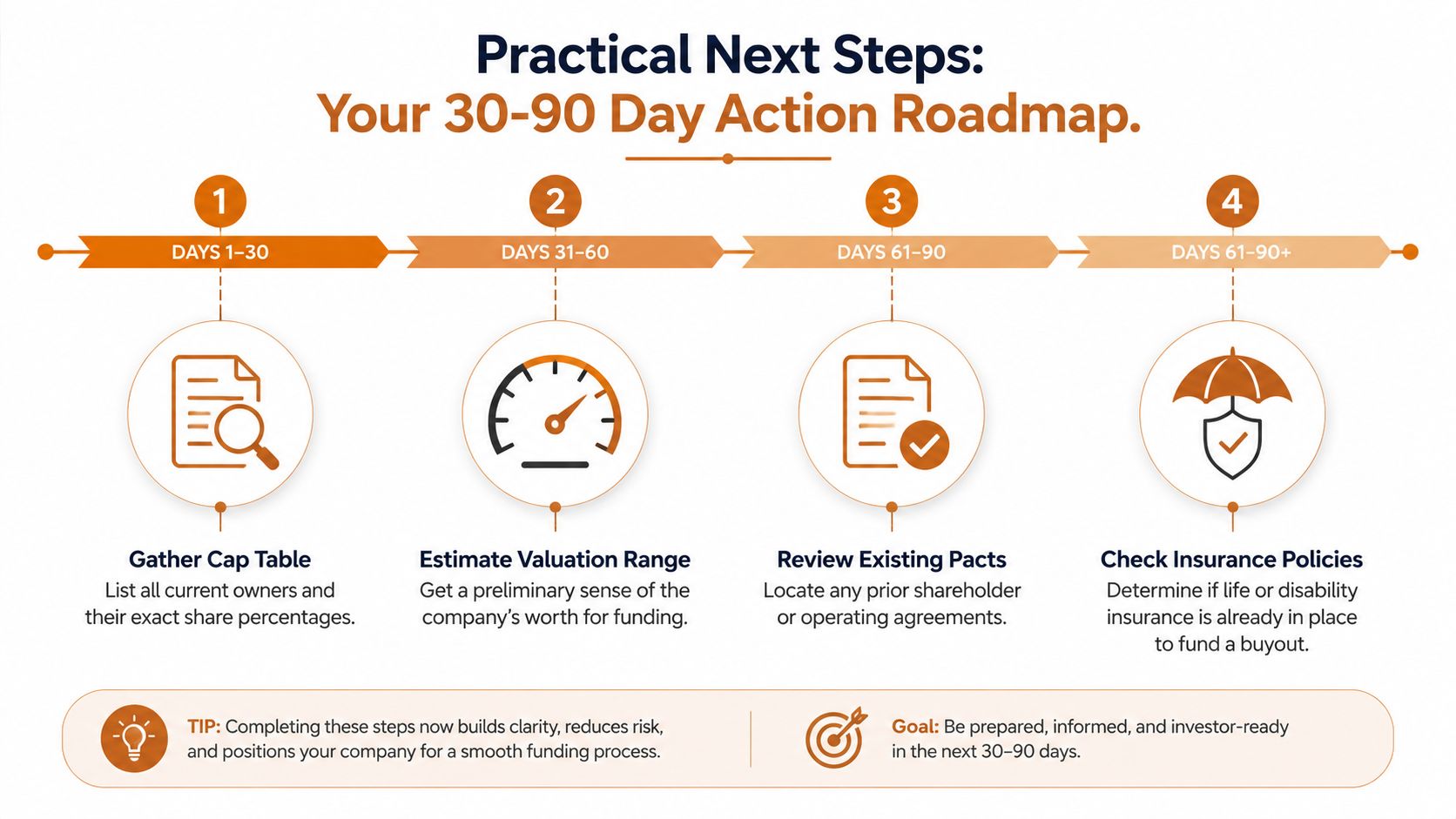
Before anyone drafts language, the owners should discuss the decisions that are hardest to make under pressure:
Professional help becomes especially important when owners have unequal contributions, multiple ownership interests, family relationships, different tax positions, or a pending divorce. A business attorney should draft and coordinate the legal terms. A CPA or valuation specialist can test the pricing method. A life insurance adviser can review whether the policies and beneficiaries match the purchase obligations.
The Owner’s Shortlist offers plain-language guides and a curated directory of specialists across areas such as business value, taxes, legal and estate planning, financing, and family succession. Owners can use it to understand the issues before contacting an adviser, or to find a specialist for an initial conversation.
Review the agreement after a major ownership change, a significant shift in business value, a new insurance arrangement, or a triggering life event. Even without a major change, schedule a periodic review so the names, valuation method, funding, and governing documents don’t fall out of alignment.
If you’re unsure whether your current agreement would work after a partner’s death, divorce, disability, or sudden exit, use The Owner’s Shortlist to explore plain-language guidance and connect with vetted specialists in valuation, legal planning, taxes, financing, and succession. Gather your ownership records and insurance documents first, then use the directory to start a focused conversation about the decisions your business needs to make.
Tell us your situation. We'll connect you with a specialist who works with owners like you. One conversation, no sales pressure.
Found this useful?
Add The Owner's Shortlist as a preferred source and get our articles highlighted in Google Search results.
Add to Preferred SourcesNavigate family inheritance law for your business. Learn how to structure succession, avoid family disputes, and protect your company's future value.
September 25, 2026
Learn how succession of business works, from choosing a pathway to timing the handoff. A clear guide for owners planning their next chapter.
September 20, 2026
Plain-language estate planning wills and trusts guide for business owners covering definitions, tax implications, and questions to ask attorneys.
September 18, 2026
Learn company ownership transfer options, valuation, taxes and timing. Compare sale, gift, succession and ESOP paths with checklists.
September 17, 2026