Estate Planning Wills and Trusts for Business Owners
Plain-language estate planning wills and trusts guide for business owners covering definitions, tax implications, and questions to ask attorneys.
September 18, 2026
By Remi Taffin · September 20, 2026
If you’re like most owners I meet, you’re not avoiding succession because you don’t care. You’re avoiding it because every advisor starts in a different place. Your CPA asks about taxes. Your attorney asks about documents. A broker asks what the company is worth. Your family asks who gets what. Your managers want to know whether they’ll still have a job.
Meanwhile, you’re still running the business.
A founder in their late fifties with a solid industrial services company usually doesn’t have a succession problem. They have a decision-order problem. They know the business has value. They know they won’t run it forever. They may even have a son, daughter, general manager, or outside buyer in the picture. What they don’t have is a sequence for making the decision without blowing up family relationships, employee trust, or after-tax proceeds.
That’s why succession of business isn’t mainly a legal project. It’s a leadership transfer problem first, a communication problem second, and only then a tax, valuation, and documentation problem.
Owners get in trouble when they treat succession like a closing date.
They assume they’ll decide later, sign papers when they’re ready, and move on. That mindset creates forced timelines. Health changes. A partner dispute erupts. A key customer starts asking who’s in charge next. Then what should have been a deliberate transition turns into a rushed transaction.
The subject of succession isn’t the stock transfer, asset sale, or estate document. It’s whether the business keeps producing cash, serving customers, and retaining people when the founder steps back.
That means succession touches five things at once:
Practical rule: If the business still depends on the owner to sell, decide, approve, calm, and rescue, succession hasn’t started yet. It doesn’t matter how many documents are signed.
The planning gap is real. A 2025 U.S. Bank survey reported that 54% of U.S. small-business owners had a formal succession plan, yet 70% were still in the early stages of planning and only 8% said they had reached an advanced stage. The same survey found 85% started their businesses to build something they could pass on and 84% wanted to create generational wealth for their family. The intent is there. The operational readiness often isn’t, as reported in the U.S. Bank succession planning survey summary.
Owners who wait usually discover the same thing too late. A business can be profitable and still be hard to transfer if the owner never developed management depth, documented how decisions get made, or clarified who takes over.
Smart owners treat succession as a multi-year strategic process. That keeps options open longer. It lets them compare family transfer, employee buyout, outside sale, and even wind-down from a position of strength instead of pressure.
That’s the right order. First continuity. Then leadership. Then structure.
Business succession means the planned transfer of ownership, leadership, and control from one party to another. All three matter.
A lot of owners confuse succession with estate planning. They’re related, but they aren’t the same. Estate planning answers who inherits assets and how. Succession of business answers who runs the company, who owns it, who gets paid, and what happens to employees, customers, and decision rights during the handoff.
Most situations fit into four pathways.
| Pathway | Who Acquires Ownership | Typical Funding Source | Business Continuity |
|---|---|---|---|
| Family transfer | Child, sibling, or other relative | Family capital, gifting strategies, internal financing, seller financing | Usually high if the successor is already active in the business |
| Employee or management buyout | Key manager or management team | Seller financing, bank financing, internal cash flow | Often strong if managers already run daily operations |
| Outside sale | Strategic buyer, competitor, independent buyer, or financial buyer | Buyer capital, acquisition financing, private capital | Varies by buyer and transition plan |
| Wind-down or orderly liquidation | No successor acquires the whole going concern | Asset sales and collection of remaining business value | Low as an operating company, but may preserve value better than a weak transfer |
If your child already works in the company and people naturally follow them, you’re likely looking at family transfer.
If your top manager knows the customers, the field crews, and the numbers, but doesn’t have the cash to buy you out today, you’re in employee or management buyout territory.
If nobody inside the business is both willing and capable, and the company has transferable earnings, an outside sale is the obvious lane.
If the business depends almost entirely on you, the team is thin, and there’s no credible buyer or successor, wind-down may be the most honest answer.
Succession isn’t a morality test. Selling outside the family isn’t failure, and passing an unready business to family isn’t legacy.
Each path has different emotional weight, funding mechanics, and timing. The mistake is thinking you can compare them on purchase price alone. You can’t. A lower-price internal transition can leave you with more actual control over the handoff and fewer cultural disruptions. A higher-price outside sale can come with stricter terms and a shorter runway for your people.
The pathway has to fit the business and the humans in it.
Most owners don’t need more theory here. They need a blunt comparison.
The right path depends on four questions. Is the successor ready? How much control do you want to keep during the transition? What’s the tax cost of the structure you’re considering? And will customers and employees stick through the handoff?
Family transfer works best when one fact is already obvious inside the company. The next leader has earned operational credibility.
The upside is clear. You preserve identity, history, and often customer trust. The downside is also clear. Family systems are rarely neat. One child may work in the business while another doesn’t. Parents often want equality. Businesses usually require something different from equality.
If you’re in that lane, this practical guide to succession planning for family-owned businesses is worth reading before you start promising outcomes at the dinner table.
A management buyout is often the most operationally stable route. The people already running field teams, sales, service delivery, or production stay in place. Customers don’t feel a sharp break.
The catch is money. Good operators don’t always have acquisition capital. That usually means seller financing, staged ownership transfer, or a longer overlap period. If the owner can’t tolerate carrying risk after stepping back, this path can fall apart quickly.
An outside buyer may pay more, especially if the company has clean financials, recurring revenue, and limited founder dependence. But owners need to stop romanticizing the clean exit. Buyers don’t pay for sentiment. They pay for transferable earnings and control.
After closing, it’s their company. They may keep your people, or they may not. They may preserve your operating style, or they may replace it in ninety days.
Not every business should be sold. If no qualified successor exists and the company cannot operate well without the founder, winding down can be smarter than forcing a bad transfer.
If that becomes the decision, owners need to handle shutdown mechanics cleanly, including tax accounts and registrations. A practical explanation of how to cancel EIN with IRS can help if you’re closing operations rather than transferring them.
Experienced owners often combine paths instead of picking one pure version.
The best structure is usually the one that solves for continuity first and price second. Price matters. A broken handoff costs more.
Most owners look at succession variables like a checklist. That’s backward. These drivers are connected. Change one, and the others move.
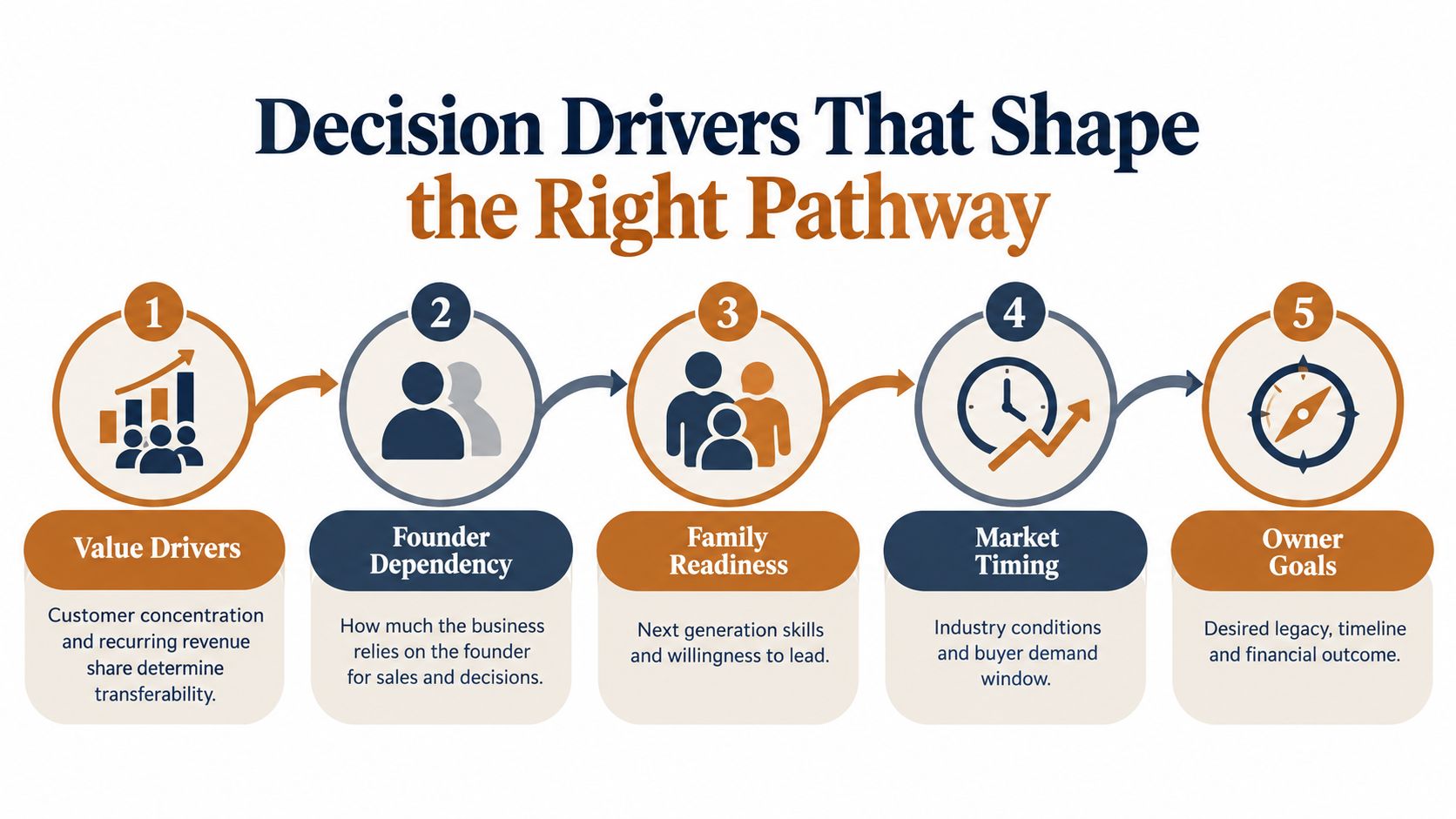
The first question is simple. Can this business run without you?
That comes down to practical value drivers:
A family successor doesn’t get a pass on economics. If the company only works because the founder holds it together, the handoff is weak no matter who inherits it.
This is where many deals quietly break.
If customers call you first, vendors trust only your word, and managers still wait for your final call on hiring, pricing, or capital spending, you don’t have a succession-ready company. You have a founder-centric company.
Reduce dependency before you debate structure. Structure won’t fix a business that still routes every important decision through one person.
A transfer to family, management, or an outside buyer all get harder when tacit knowledge lives only in the owner’s head.
Owners often ask who should take over before asking who wants to and who can.
Those are different questions. A child may be loyal and still be the wrong operator. A nonfamily general manager may be the best leader and still need time, authority, and financing support. Siblings who don’t work in the business may still expect economic fairness, even if they never expect operating control.
European Commission-linked family business research has long shown how fragile transitions can be. About 30% of family businesses fail in the context of business transfers, and broader benchmarks in the same research say only about 30% survive into the second generation, roughly 12% into the third, and about 3% into the fourth generation or beyond, according to the European family business succession report.
Once you know what’s operationally plausible, then tax and financing become meaningful.
Entity type, basis, holding period, state residency, and transfer structure all affect after-tax outcomes. Buyer funding matters too. A child or manager may need seller financing. An outside buyer may offer cash but demand tighter terms. If you’re not willing to carry paper, some internal paths disappear immediately.
This is why succession of business can’t be solved with a single meeting. Value, dependency, family readiness, tax, and financing are one chain.
Owners love the idea of a tidy one-year succession plan. Real transitions rarely work that way. A realistic process often runs three to seven years, with phases overlapping rather than lining up neatly.
To anchor the timeline, start with the visual below.
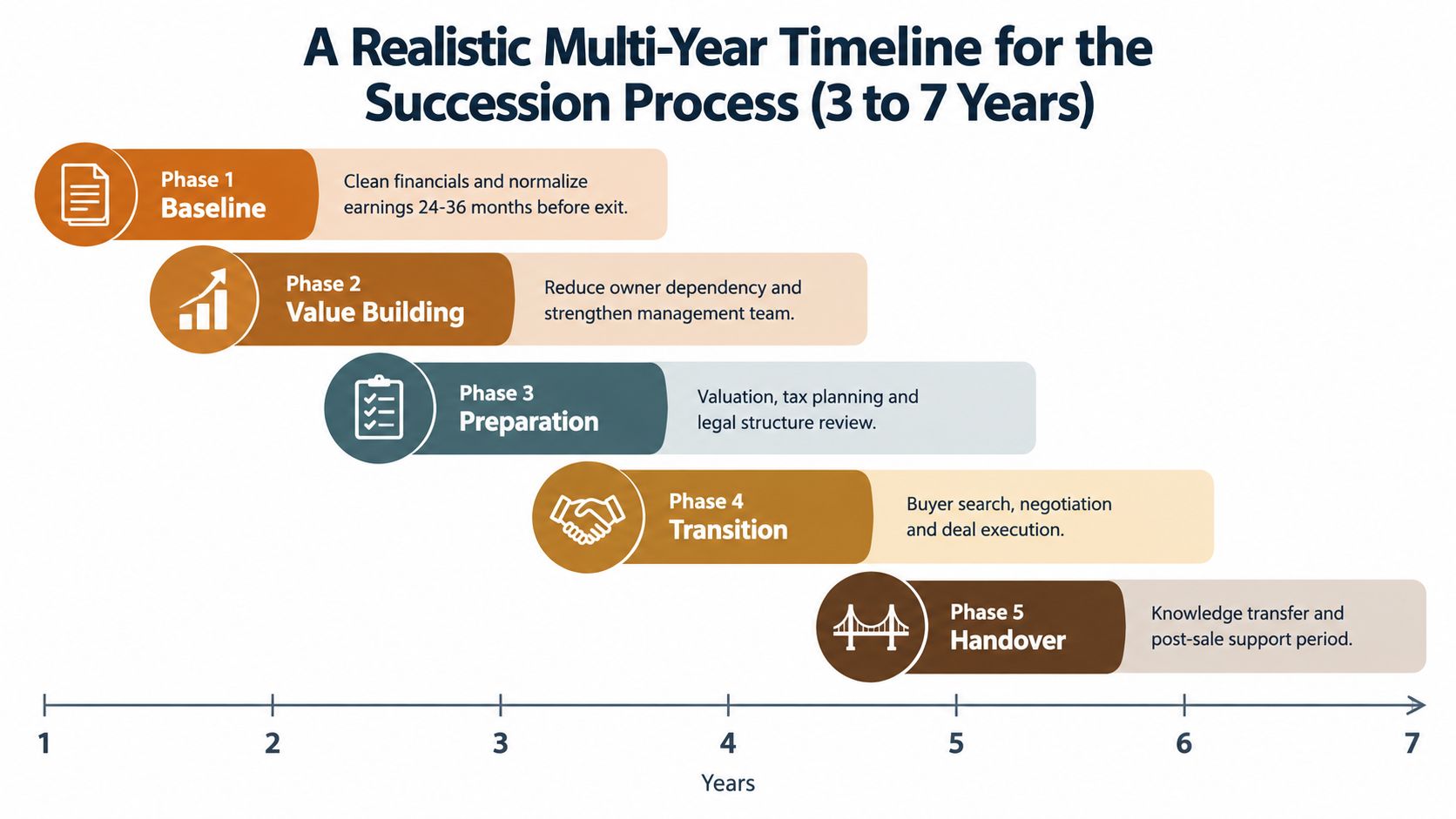
Baseline work comes first. Clean up financial statements. Normalize owner compensation and personal expenses. Document core processes. If your books don’t tell the story, every later decision gets harder.
At the same time, start option analysis. That means pressure-testing possible paths, not declaring one. Family conversations begin here. So does preliminary valuation thinking and pathway-specific tax modeling.
The middle years are where owners either build transferability or expose that they never had it.
A successor needs real authority before the transfer, not ceremonial authority after it. That means customer introductions, decision rights, budget responsibility, and visible accountability with the team. If you’re still rescuing every major issue, the timeline is slipping whether you admit it or not.
Here’s a useful benchmark from recent family-business research. A 2025 survey of U.S. family firms found succession planning affected 44% of respondents in the prior year, while talent and leadership development affected 47%, according to PwC’s family business survey. That’s exactly right. Succession and management depth are tied together.
This video gives a practical overview of how owners often think about timing and handoff decisions:
The final phases include deal terms, financing documents, entity adjustments, transition agreements, and post-close role definition.
Use this simple sequence as a working model:
Most transitions don’t fail because the documents were late. They fail because the people work started too late.
Compression happens when health changes, industry timing shifts, or owner disputes force speed. That’s why early work matters. It buys you choices.
Owners routinely tell me they have a plan. Then I ask the successor what the plan is, and the room gets quiet.
This gap isn’t small. Recent survey data found only 35% of small business owners had any succession plan, while 59% of potential successors believed one probably or definitely already existed, a 24-point perception gap, according to the Revenue-Based Financing SMB report. That mismatch explains a lot of stalled transitions. The owner thinks the issue is handled. The successor assumes someone else has already defined the path.
Owners often communicate mood, not decisions.
They say things like, “You’ll be taken care of,” or “Someday this could be yours.” Successors hear encouragement and mistake it for structure. A written plan may exist, but if nobody has reviewed roles, timing, buy-in terms, or authority boundaries, it isn’t operational.
Independent succession research points to the same weakness from another angle. Many families and family businesses report having some plan, but far fewer describe that plan as broad and well-developed, as summarized in Deloitte’s succession preparedness gaps report. A plan that sits in a drawer isn’t readiness.
Use a simple communication system. Not a giant binder. Not a vague family meeting. A working set of documents and recurring conversations.
| Planning Element | Owners Who Say It’s in Place | Successors Who Agree |
|---|---|---|
| Any succession plan exists | 35% | 59% believe one probably or definitely exists |
| Shared understanding of the plan | Often assumed | Frequently unclear or overstated |
| Readiness for near-term retirement | Many owners expect retirement within a decade | Successors often lack concrete timing and role clarity |
Start with these moves this quarter:
Silence doesn’t preserve harmony. It preserves ambiguity, and ambiguity turns into conflict under pressure.
Owners often waste money by hiring every specialist at once. That’s usually insecurity dressed up as thoroughness.
Bring in experts when a decision justifies their fee. Not earlier.
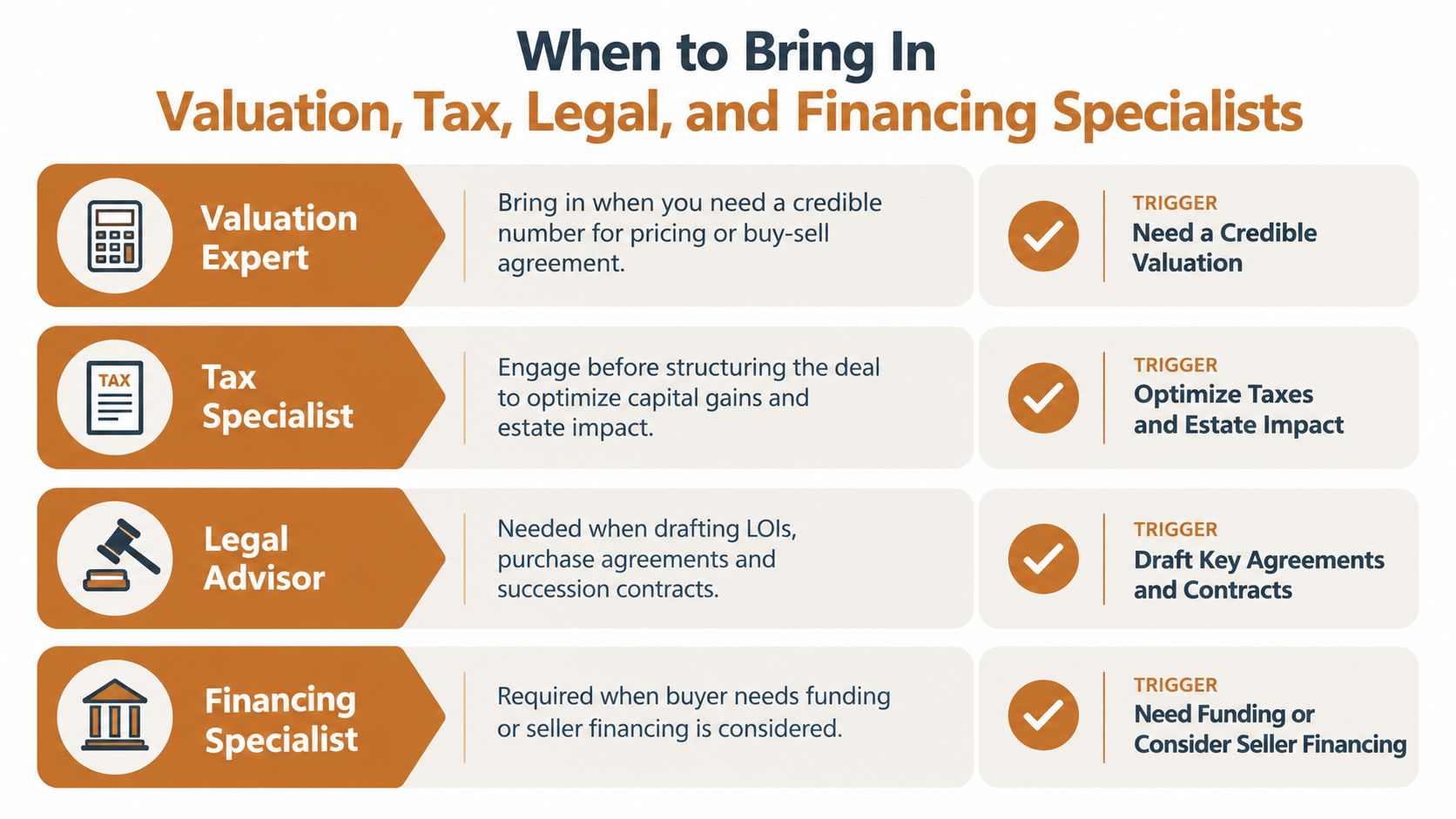
A valuation specialist earns their keep when you need a credible number for one of four reasons. Negotiation. Buy-sell planning. Tax reporting. Internal fairness between family members or partners.
If you’re still asking whether the successor is your daughter, your COO, or an outside buyer, a full valuation may be premature. You may need a range discussion first. When it’s time for a formal number, a resource like this overview of a business appraisal service can help owners understand what the analyst is doing and what documents they’ll need.
Tax planning matters enormously, but it becomes most useful once you’ve narrowed the pathway. Structure changes the economics. The source material even shows policy design can move real operating behavior. A study of a 2002 Greek tax change found that a substantial reduction in tax on intrafamily transfers led to a more than 40% decline in investment around family successions, along with slower sales growth and reduced cash reserves, as noted in the Journal of Finance abstract on succession tax design. The lesson is straightforward. Tax structure changes owner behavior, so don’t leave it until the end.
Legal counsel comes in when actual drafting starts. That includes letters of intent, ownership transfer documents, revised governing agreements, employment terms, estate documents, and buy-sell mechanics.
If you’re not sure which attorney fits the issue, a plain-language guide to matching your case to a lawyer can help you avoid hiring the wrong specialist first.
Financing specialists matter when a buyer needs capital, a lender needs support materials, or seller financing becomes part of the structure.
Use a staged approach:
The Owner’s Shortlist can be useful here as a directory and editorial resource because it organizes specialists across valuation, taxes, legal matters, financing, and family-transition issues in one place. That’s helpful when you know the decision you need to make but not who should be in the room first.
Don’t leave this as reading material.
Your next step is simple. Write down your current working succession decision. Not your final answer. Your current answer.
Include three things on one page:
Then share that page with one trusted advisor, partner, or successor and ask them where your assumptions are weak.
That’s the move that changes succession from background anxiety into an actual process. You stop pretending you’ll “deal with it later” and start testing a real hypothesis. Revisit the page annually, or sooner if health, family involvement, leadership depth, or buyer interest changes.
If you want a practical tool to support that review, this business succession planning checklist is a useful next read.
Succession of business rewards owners who prepare options early. It punishes owners who wait until only one option is left.
If you’re sorting through succession and need clearer next steps, The Owner’s Shortlist offers practical articles and a curated directory of specialists across valuation, tax, legal, financing, and family-transition decisions. It’s built for long-tenured owners who want to understand the process before hiring the wrong expert or starting in the wrong order.
Tell us your situation. We'll connect you with a specialist who works with owners like you. One conversation, no sales pressure.
Found this useful?
Add The Owner's Shortlist as a preferred source and get our articles highlighted in Google Search results.
Add to Preferred SourcesPlain-language estate planning wills and trusts guide for business owners covering definitions, tax implications, and questions to ask attorneys.
September 18, 2026
Learn company ownership transfer options, valuation, taxes and timing. Compare sale, gift, succession and ESOP paths with checklists.
September 17, 2026
A practical roadmap for succession planning for small business owners — readiness, exit options, valuation, legal prep, and a working timeline.
September 15, 2026
What is business succession planning? Learn the definition, transfer options, valuation, tax and legal steps, common pitfalls, and how
September 3, 2026