What Is Business Succession Planning: A Guide for Owners
What is business succession planning? Learn the definition, transfer options, valuation, tax and legal steps, common pitfalls, and how
September 3, 2026
By Remi Taffin · August 25, 2026 · Updated October 1, 2026

Your HVAC company is profitable, your phone keeps ringing, and customers trust your name. Yet if every major decision still runs through you, the business may be difficult to sell or transfer. A buyer, family successor, or management team isn’t acquiring a dependable operation when pricing knowledge, vendor relationships, customer loyalty, and emergency decisions live mostly in the owner’s head.
This business succession planning checklist is built for owner-operators considering a third-party sale, family transfer, management transition, or phased exit. The sequence matters. First, make the business transferable. Then establish its value and records, choose a transition path, and coordinate tax, legal, people, financing, communication, and specialist support. (If you want the full definition and transfer options first, see what business succession planning is. For a month-by-month timeline instead of a checklist, see the succession planning timeline.)
A 2025 Gallup study of small-business owners and succession planning found that 74% of U.S. employer-business owners planned to sell or transfer ownership at retirement, while most still lacked a formal plan. That gap makes early preparation practical, not theoretical. Tax, legal, and financial decisions require qualified specialists. The Owner’s Shortlist can help you explore relevant vetted professionals and plain-language guidance before you choose a route.
A succession decision starts with a defensible answer to one question: what is the business worth without relying on the owner’s optimism or a buyer’s opening offer?
A valuation specialist will examine the company’s earnings, assets, liabilities, customer relationships, recurring revenue, concentration risk, and dependence on the owner. For an HVAC contractor, maintenance agreements and repeat service work can make revenue easier to forecast than one-time installation projects. A plumbing company with documented service agreements may present a stronger continuity story than a business that depends almost entirely on emergency calls and the owner’s personal relationships.
Valuation isn’t just for a sale listing. It helps you compare a third-party sale with a family transfer, management buyout, or gradual ownership change. It also gives your tax and legal advisors a working baseline for deal structure, estate planning, and transfer decisions. The number may change as the company adds contracts, hires leaders, loses a major account, or reduces owner dependency.
Ask the valuation professional to explain the assumptions, not just deliver a report. You should understand which revenue streams support the valuation, where risk discounts arise, and which operational changes could improve transferability.
Practical rule: Treat valuation as a planning instrument. If the result is lower than expected, use it to identify business risks while you still have time to address them.
Before engaging anyone, gather clean financial statements, customer and service-agreement information, owner compensation details, debt records, and a list of personal expenses running through the company. You can begin by reviewing business appraisal services for owner-operated companies. Avoid choosing a valuation method because it produces the highest answer. A defensible value that a buyer, lender, and tax professional can understand is more useful than an inflated figure that collapses under scrutiny.

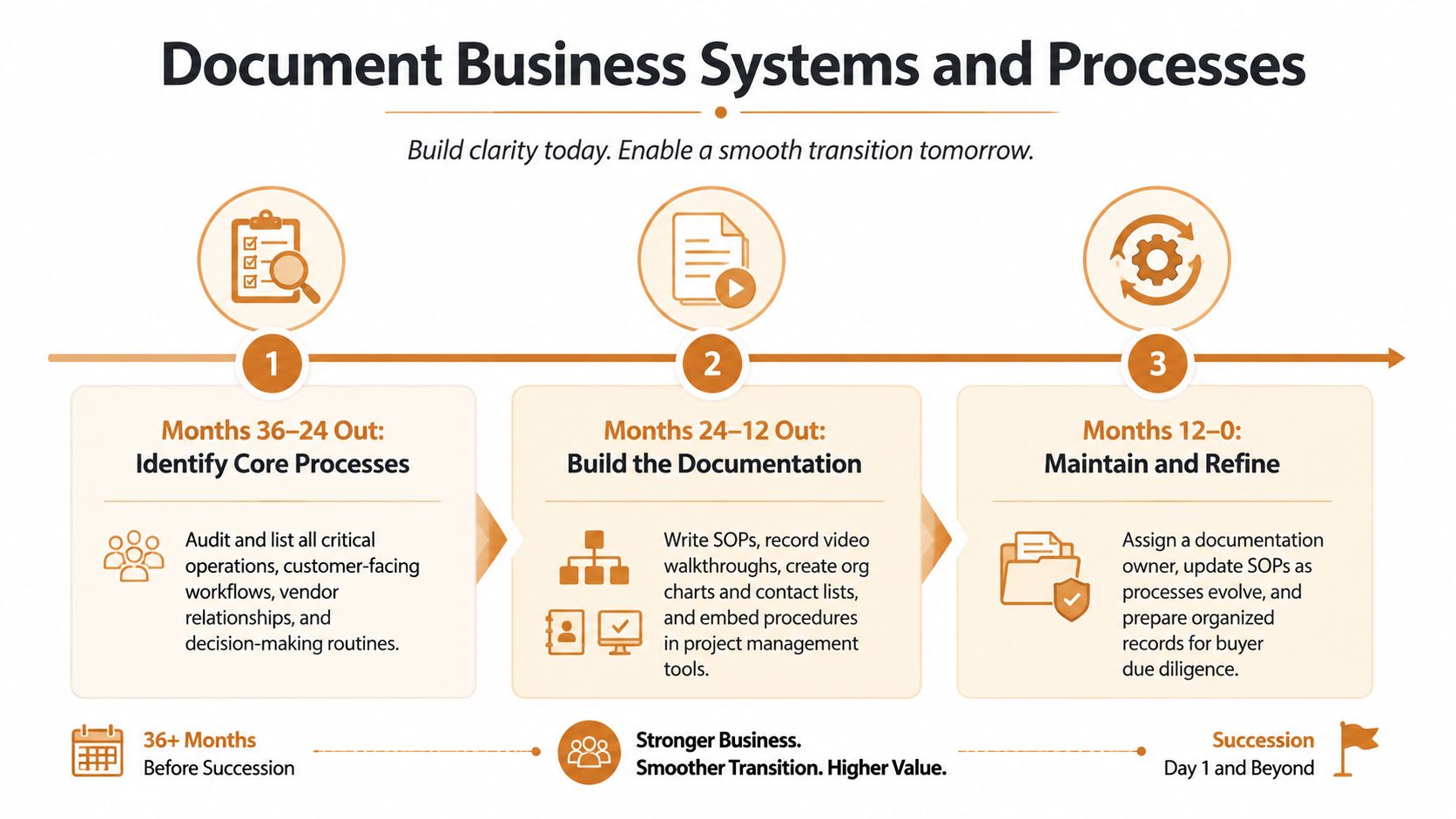
A buyer can’t confidently take over a business that operates through undocumented habits. Your team may know how to dispatch technicians, handle an after-hours call, price a difficult repair, order parts, and calm an unhappy customer, but informal knowledge doesn’t transfer reliably.
Start with the processes that protect revenue and customer trust. An HVAC company should document seasonal maintenance scheduling, technician dispatch, warranty handling, quoting, and customer communication. A plumbing service provider might begin with emergency response, pricing by service type, job approval, billing, and follow-up procedures. Administrative tasks matter, but customer-facing and revenue-producing workflows deserve attention first.
Ask the employees who perform each task to help write the procedure. Their version will usually be more accurate than an owner’s recollection. Keep each SOP practical. Include the trigger, responsible role, required information, decision points, software used, escalation path, and definition of completion.
Don’t create a large manual that sits untouched in a shared folder. Store procedures where employees already work, whether that’s a structured cloud drive or a platform such as Asana, Monday.com, or ClickUp. Add an owner for each document and a review routine so the material changes when pricing, software, licensing, or staffing changes.
Use short videos for complex technical or administrative routines. A screen recording can show how to schedule a maintenance agreement, while a field video can capture equipment-specific steps that are difficult to describe in text. Protect customer and employee information with appropriate access controls, especially when preparing materials for outside parties.
Have someone other than the owner test the instructions. If a crew lead can’t complete a routine using the documentation, the process isn’t ready for handoff. The strongest system is the one a capable employee can follow without repeatedly asking, “How does the owner want this done?”
Write down everything that stops, slows, or becomes uncertain when you’re unavailable. Include obvious responsibilities, such as sales approval and major purchasing, along with less visible ones, such as knowing which commercial customer needs a call before a price change or which supplier will release a rush order.
Then rank those responsibilities by operational and relationship risk. Don’t delegate the highest-risk decision on day one. Start with repeatable activities, give a capable employee authority to act, review the outcome, and expand the decision boundary as confidence grows.
An HVAC owner might first let a service manager approve routine discounts, then introduce that manager to commercial accounts, and later transfer responsibility for maintenance renewals. A plumbing owner can move vendor negotiations, scheduling exceptions, and customer recovery decisions to an operations leader in stages. Customers should experience a gradual shift from owner-only contact to dependable relationships with the wider team.
Shadowing alone doesn’t prove readiness. A successor needs defined responsibilities, access to the relevant information, and permission to make decisions. Set milestones such as leading a customer meeting, approving a hiring decision, managing a vendor dispute, or presenting operating results.
Deloitte’s 2026 global family-business succession report identifies successor inexperience at 35%, difficulty identifying a suitable successor at 33%, and founder reluctance to let go at 32% as leading barriers. Those findings point to a practical distinction. Naming a successor is not the same as preparing that person to lead.
Build capability through hiring, promotion, training, and incentives. Be honest about gaps. If nobody can currently manage pricing, key accounts, or field operations, an external hire or interim leader may be safer than forcing a family member into an unprepared role.
The headline sale price isn’t the amount you keep. Tax results depend on the company’s structure, the assets or interests being transferred, purchase-price allocation, payment timing, earnout terms, basis, and applicable state rules.
A tax professional should compare the consequences of a stock or membership-interest transfer with an asset sale where relevant. The same business can produce different after-tax outcomes under different structures. A family transfer also requires careful coordination with estate and gift planning, while a management transition may raise questions about financing, compensation, and ownership interests.
Don’t wait until a signed letter of intent to ask these questions. Early analysis gives your advisors time to review entity structure, depreciation records, basis adjustments, installment arrangements, and the treatment of contingent payments. It also helps you decide whether a proposed structure supports your personal income needs.
Ask for side-by-side modeling of the realistic paths you’re considering. Include cash at closing, deferred payments, earnouts, seller financing, transaction expenses, estimated taxes, and the timing of your proceeds. A tax professional can explain the applicable treatment, but the business owner still needs to understand the trade-offs.
For family transfers, tax efficiency shouldn’t override operational viability. A structure that minimizes immediate tax but leaves the successor unable to fund the purchase or the company unable to support payments may not be a workable plan. For an employee ownership route, bring in an advisor with relevant transaction experience rather than treating it as a simple tax election.
Review tax planning for business owners as background, then engage your own CPA, attorney, or tax advisor. This article can help organize questions, but it can’t replace advice based on your entity, residence, ownership history, and intended transaction.
Succession touches too many disciplines for one generalist to handle well. The right team depends on your route. A third-party sale may require a valuation specialist, tax advisor, transaction attorney, and business broker or M&A advisor. A family transfer may need an estate attorney, tax professional, family-business consultant, and facilitator. A management transition may add lenders or financing specialists.
Start with valuation and tax because those conversations shape the options that follow. Then define what each advisor owns, what each advisor doesn’t own, how information will be shared, and who coordinates the timetable. A fragmented team can create contradictory advice even when every individual is competent.
Interview more than one candidate in each relevant category. Ask how often they work with trades, service companies, and owner-operated businesses, how they handle customer concentration and owner dependency, and whether they’ve advised on your preferred transition route. Request references from clients with comparable complexity, not just larger companies.
Clarify fees and conflicts before signing. A broker may have a transaction incentive, while a valuation professional may be engaged for an independent opinion. Neither arrangement is automatically wrong, but you should understand whose interests each person represents and when their incentives change.
A useful advisor should turn technical analysis into decisions you can act on. If a recommendation can’t be explained in plain English, ask for the assumptions and practical consequences. The Owner’s Shortlist is designed as a starting point for finding specialists across valuation, taxes, legal matters, financing, succession, and related owner decisions. You can also use referrals from other contractors, trade associations, your existing CPA, or trusted lenders.
Family succession fails when relatives confuse family standing with business authority. The oldest child may be the intended successor, but that doesn’t automatically make the person ready to run operations, negotiate with vendors, manage employees, or make capital decisions.
Separate ownership from management. One family member may own shares without serving as CEO. Another may manage field operations without holding controlling ownership. Define responsibilities, reporting lines, compensation, approval thresholds, board or advisory roles, and the process for resolving disagreements.
For a plumbing company, an operating agreement might establish one child’s role as CEO and another’s as operations manager, while setting market-based compensation and clear decision rights. A multi-generational HVAC company could hold a family council for family concerns while reserving business decisions for the management team or board. The structure should fit capability and business needs, not birth order.
A buy-sell agreement can address what happens when an owner wants to leave, becomes unable to work, dies, or disagrees with the direction of the company. It should coordinate with wills, trusts, insurance, operating agreements, shareholder agreements, and financing documents. Your attorney must draft and reconcile these instruments because a casual promise between relatives won’t provide reliable protection.
Deloitte’s 2026 report on family-business succession preparedness says 27% of families and 40% of family businesses are already navigating succession or expect to do so within the next decade. The report also projects that family businesses expecting to appoint a non-family CEO will rise from 13% to 26%, which reinforces an important point. A family-owned company may still need professional management after ownership changes.
Use a neutral family-business consultant or mediator when conversations become personal. Early neutrality costs less than allowing unresolved expectations to affect employees, customers, and capital decisions.
Due diligence is where a buyer tests whether the business presented in conversation matches the business in its records. Missing contracts, inconsistent financial statements, unclear employee files, and unexplained add-backs create questions that can slow a transaction or reduce confidence.
Create a secure digital data room with a logical structure. Include financial statements, tax returns, bank and debt records, customer and vendor contracts, leases, licenses, insurance, employee information, equipment schedules, intellectual property, software access details, litigation records, and operational reports. Follow privacy rules and limit sensitive information until the appropriate stage of a transaction.
A service contractor should separate recurring maintenance agreements from transactional work so a buyer can evaluate revenue quality and renewal practices. Keep contract terms, expiration dates, pricing, service obligations, and assignment provisions easy to verify. If a major customer represents a meaningful concentration, document the relationship and the steps the business takes to protect continuity.
Prepare summary schedules that explain revenue by service type, customer concentration, gross margin trends, owner-related expenses, fleet and equipment, and outstanding obligations. Don’t hide a known problem. Identify it, explain the history, and show the corrective action or risk control.
The American Bankers Association’s coverage of a U.S. Bank survey on small-business succession planning reports that 54% of small-business owners had a formal succession plan, while 85% said they started their business to create something they could pass on. Those figures make documentation especially relevant. Owners may have a transfer intention without the records a successor or buyer needs to act on it.
Begin with the documents that affect revenue, legal rights, and financial credibility. If the data room is disorganized, a financial due diligence guide such as this explanation of the process can help you frame the initial request list.

Selling or transferring the company changes more than your title. It changes how you receive income, where your wealth is held, how much liquidity you need, and how much financial risk you can tolerate.
Start with a personal balance sheet that distinguishes business value from accessible cash, real estate, retirement assets, debt, insurance, and expected transition proceeds. Model the chosen path under different assumptions about closing proceeds, deferred payments, taxes, consulting income, healthcare, estate goals, and investment returns. Your financial advisor should show what happens if payments arrive later than expected or the transition takes longer than planned.
Diversification deserves special attention because many owner-operators have built most of their wealth inside one company. Reinvesting every sale dollar into another familiar business may feel comfortable, but it can recreate the concentration risk you’re trying to leave behind. A broad investment plan may be less exciting, yet it can provide a clearer foundation for future income.
A phased exit can preserve knowledge and reassure customers, but it can also blur authority if the successor can’t make decisions. Define your post-transition role, compensation, schedule, access to information, and end date. If you remain as a consultant or board member, establish who has final authority and how disagreements will be handled.
For a family transfer, decide whether your income comes from salary, distributions, loan payments, rent, or another arrangement, and have specialists review the structure. For a sale with seller financing or deferred consideration, evaluate the credit risk and security terms rather than treating the promised amount as cash in hand.
Your financial plan should support the life you want after the business. That may mean full retirement, part-time advising, a new venture, community work, or continued involvement with customers and employees. The best transition structure is one that protects both business continuity and your personal financial independence.
| Item | Implementation Complexity (🔄) | Resource Requirements (⚡) | Expected Outcomes (⭐) | Ideal Use Cases (📊) | Key Advantages (💡) |
|---|---|---|---|---|---|
| Establish Clear Business Valuation | Moderate–High 🔄🔄🔄, specialist methods and assumptions | Specialist fees, financial records, periodic revaluations ⚡⚡ | Defensible value, clearer sale/succession decisions ⭐⭐⭐⭐ | Pre-sale planning, tax/estate planning, comparing succession options | Clarifies worth; identifies value drivers; supports tax/legal defense |
| Document Business Systems and Processes | Moderate–High 🔄🔄🔄, comprehensive SOPs and updates | Time from staff, templates/tools (PM, video) for ongoing maintenance ⚡⚡ | Reduced owner dependency; smoother transitions; higher buyer confidence ⭐⭐⭐⭐ | Succession, scaling, buyer due diligence, training new managers | Enables continuity; eases training; lowers perceived operational risk |
| Assess and Reduce Key-Person Dependency | High 🔄🔄🔄🔄, cultural and capability change | Significant time for cross-training, incentives, possible hires ⚡⚡⚡ | Higher valuation (often +20–40%); resilient operations; exit readiness ⭐⭐⭐⭐⭐ | Owner-dependent businesses, family succession, sale prep | Increases value; enables owner exit; builds leadership bench |
| Understand Tax Implications and Optimize After-Tax Proceeds | Moderate 🔄🔄, technical planning with advisors | Tax and legal advisor fees; scenario modeling; structural changes ⚡⚡ | Maximized after-tax proceeds; lower audit/tax risk ⭐⭐⭐⭐ | Any transaction; complex deal structures; ESOP or installment considerations | Preserves more sale proceeds; times income across years; reduces tax surprises |
| Identify and Engage Appropriate Succession Specialist Advisors | Low–Moderate 🔄🔄, coordination of advisors | Advisor fees ($10k–$100k+), time to vet and coordinate ⚡⚡⚡ | Smoother execution; better negotiations; integrated planning ⭐⭐⭐⭐ | Complex sales, family transitions, need for buyer networks | Prevents costly errors; access to expertise and buyers; credibility in deals |
| Plan for Family Governance and Succession Structure (If Transferring to Family) | High 🔄🔄🔄🔄, legal and interpersonal work | Legal, consultant/mediator fees; time for family processes ⚡⚡ | Clear roles, reduced conflict, protected continuity ⭐⭐⭐⭐ | Family transfers, multi-generational businesses, succession with multiple heirs | Prevents disputes; defines governance and compensation; protects continuity |
| Prepare Comprehensive Due Diligence Documentation | Moderate 🔄🔄🔄, systematic document organization | Staff time, secure digital data room, possible professional help ⚡⚡ | Faster due diligence; fewer surprises; improved buyer confidence ⭐⭐⭐⭐ | Preparing to sell, lender/investor reviews, formal valuations | Speeds sale process; supports valuation; reveals and allows remediation of issues |
| Develop Financial Transition Plan and Diversification Strategy | Moderate 🔄🔄, modeling and advisor coordination | Financial planner/advisor fees; scenario modeling, tax coordination ⚡⚡ | Stable post-exit income; diversified wealth; tax-aware withdrawals ⭐⭐⭐⭐ | Post-exit planning, retirement planning, earnout/deferred payments | Prevents lifestyle disruption; aligns proceeds with goals; manages tax and risk |
A checklist becomes useful when every item receives an owner, a deadline, and a definition of completion. Start several years ahead with valuation, systems documentation, and owner-dependency work. Those steps create options. They give you time to develop a successor, recruit missing leadership, strengthen customer relationships, and correct records before a buyer or family member needs to rely on them.
Then match the remaining work to your chosen path. A third-party sale may emphasize valuation, due diligence, buyer qualification, financing, and transaction counsel. A family transfer needs governance, ownership mechanics, role clarity, estate coordination, and conflict-management processes. A management transition may depend on leadership development, financing capacity, incentives, and a carefully staged authority handoff. A phased exit needs explicit boundaries so the owner remains helpful without continuing to control every decision.
Don’t commit to one route because it feels familiar. Compare a sale, family transfer, management buyout, and phased transition against your financial needs, successor readiness, tax position, desired timeline, and appetite for ongoing involvement. A route that works for an HVAC business with dependable maintenance contracts may not suit a plumbing company whose revenue and customer relationships are concentrated around the owner. Your advisors can help test the assumptions, but you need to state the personal outcome you want before they can structure the right plan.
Execution details deserve the same attention as legal documents. The 2026 succession-planning statistics roundup reports that only 14% of organizations include onboarding and orientation procedures for an incoming CEO, while 49% discussed emergency CEO succession planning in the previous 12 months. Those findings highlight the handoff questions owners often overlook: who receives training, who controls bank and software access, who communicates with key customers, who leads if the owner is suddenly unavailable, and how the successor makes decisions during the first operating period.
The Owner’s Shortlist can help you explore its eight specialist categories, including Business Value, Taxes, Legal & Estate, Growth & Financing, Keeping It in the Family, Your Team, Future Options, and Finding the Right People. Its plain-language articles are designed to help owners understand valuation, tax, legal preparation, estate planning, and deal structure before engaging an expert. You can browse specialists directly or use its optional matching workflow to describe your situation and receive an introduction for an initial conversation.
Take one practical step this week. Schedule an initial valuation or tax-planning conversation, then write down the next three decisions, the person responsible for each, and the deadline for completing it. A dated plan turns succession from an intention into an operating project.
The Owner’s Shortlist offers a curated directory of specialists for valuation, taxes, legal and estate matters, financing, succession, and related owner decisions, along with plain-language guides for owner-operated companies. Visit The Owner’s Shortlist to compare relevant expertise, understand your options, and begin a focused conversation about your transition.
Tell us your situation. We'll connect you with a specialist who works with owners like you. One conversation, no sales pressure.
Found this useful?
Add The Owner's Shortlist as a preferred source and get our articles highlighted in Google Search results.
Add to Preferred SourcesWhat is business succession planning? Learn the definition, transfer options, valuation, tax and legal steps, common pitfalls, and how
September 3, 2026
A month-by-month succession planning timeline for small business owners, plus a readiness scorecard that tells you when to start each step.
September 15, 2026