8-Step Business Succession Planning Checklist
Use this business succession planning checklist to prepare your valuation, finances, taxes, legal structure, team, family transition, and sale.
August 25, 2026
By Remi Taffin · September 3, 2026 · Updated October 12, 2026

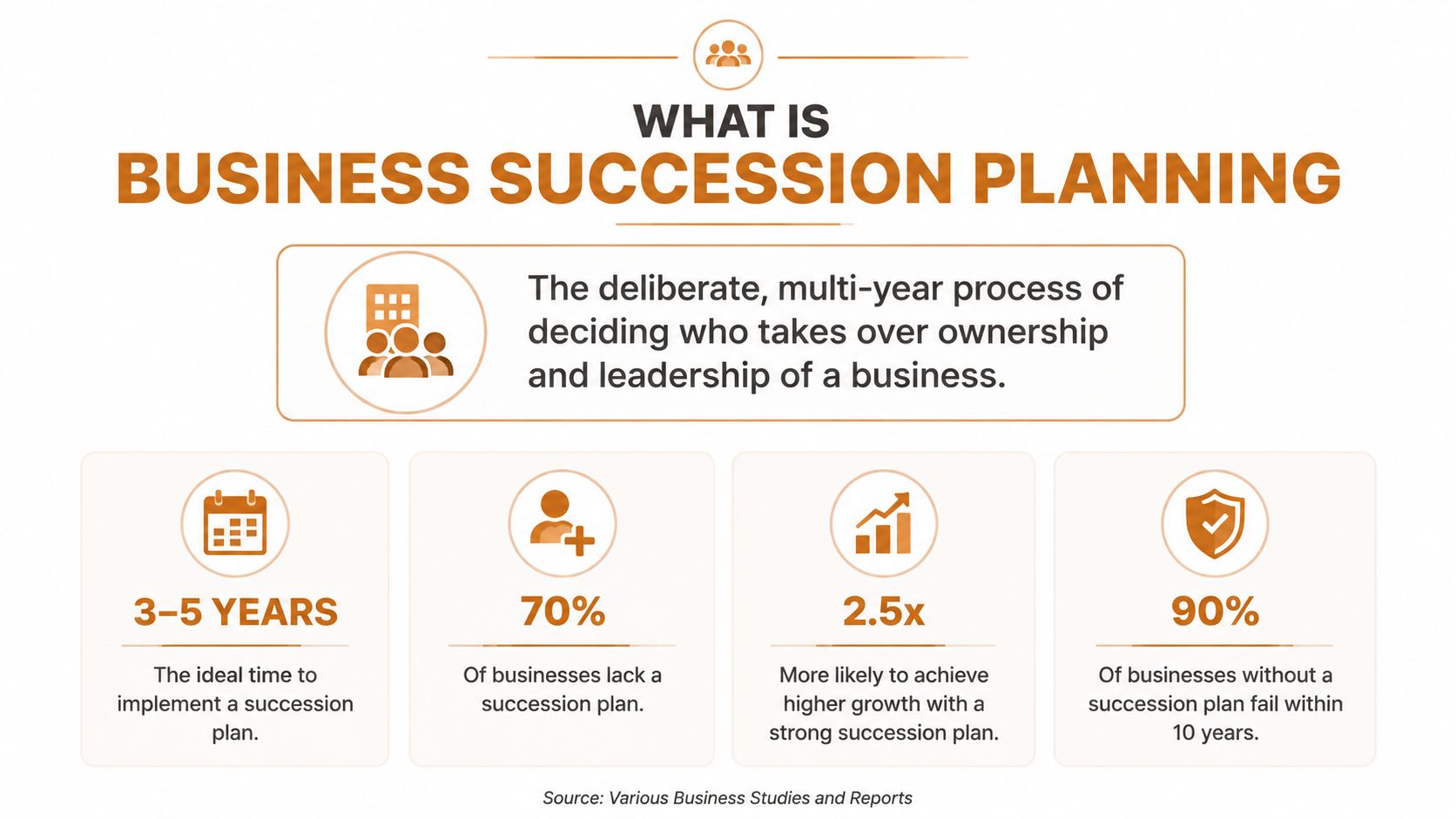
Business succession planning is the deliberate, multi-year process of deciding who takes over ownership and leadership of a company, and how the transfer is valued, financed, taxed, and legally executed so the business survives the owner’s exit. A 2026 Deloitte Private survey found that 78% of family business executives expect a CEO transition within the next decade, yet only 57% had an established succession plan and just 23% were actively implementing one (Deloitte Private).
That gap captures the core issue. Most owners understand that leadership will eventually change. Far fewer have tested whether the successor can run the company, whether the business has a defensible value, or whether the proposed transfer can be financed without putting operations under strain.
For an HVAC contractor, succession may involve a child taking over field operations while a general manager handles dispatch, hiring, and customer relationships. For a plumbing company, the central question may be whether recurring service agreements belong to the company in a way a buyer or successor can rely on. In both cases, a succession plan must work in practice, not merely exist in a binder.
A plan only matters when the successor can run the company. Business succession planning connects the future leader, ownership transfer, valuation, financing, tax treatment, and legal steps into one workable arrangement. It also protects continuity for employees, customers, suppliers, family members, and the owner’s financial interests.
The practical questions are specific:
These answers must hold up under operating pressure. An HVAC company may need a successor who understands field work, hiring, dispatch, and customer retention. A plumbing company may depend on recurring service agreements that are properly documented and transferable. The plan is only workable if the successor can protect those relationships while the financing leaves enough cash for payroll, vehicles, tools, and normal operations.
Timing also matters. Forty-two percent of family business executives expect a CEO transition within three to five years, while only 23% were actively implementing a plan, according to Deloitte’s survey findings. Illness, conflict, or a serious buyer can bring a decision forward before an owner feels ready.
A complete approach has two tracks. A planned transition may involve retirement or a staged sale. An emergency continuity plan identifies who can make decisions if the owner suddenly cannot. One prepares the handoff. The other keeps the company operating until that handoff is possible.
A succession plan resembles a relay race. The written agreement is the baton, but the result depends on the handoff. If the outgoing owner hasn’t transferred customer knowledge, pricing judgment, vendor relationships, and decision-making authority, the successor may receive ownership without receiving the ability to lead.
Owners often combine three separate issues under the single word “succession.”
Management succession asks who will run the business day to day. That person may not be the person who owns the shares. An owner might transfer equity to children while appointing a non-family president with deeper operating experience. A plumbing company might keep ownership within the family but place a service manager in charge of scheduling, technician development, and customer retention.
Ownership succession concerns equity, voting rights, distributions, and control. A successor can be ready to manage but unable to fund a purchase. Several family members can inherit ownership but have different expectations about dividends, reinvestment, or selling later.
Execution readiness is the test many plans fail. Can the successor make unpopular decisions? Can they retain key technicians without relying on the former owner’s personal relationships? Can they read financial statements, manage working capital, and protect margins when demand changes?
Long-running family-business research has repeatedly found that only about 30% of family businesses survive into the second generation, around 12% into the third, and roughly 3% into the fourth (Deloitte’s global succession research). These figures don’t prove that every failed transfer lacked planning, but they show why a signed document isn’t a sufficient readiness test.
A 2026 global family-business study found that 89% of families and 82% of family businesses reported some form of succession plan, yet only about half described those plans as thorough and well-developed. Confidence was also uneven, with 48% highly confident in current leadership preparedness and 37% in next-generation preparedness (Deloitte’s executive summary).

The practical test is simple: Could the successor operate the business for a meaningful period without the owner making every important decision? If the answer is no, the plan is still developmental.
A short video can help owners visualize succession as a coordinated handoff rather than a single signing event:
No transfer route is automatically correct. The right choice depends on the owner’s priorities, the successor’s capability, the company’s cash flow, family relationships, and the amount of control the owner wants to retain during the transition.
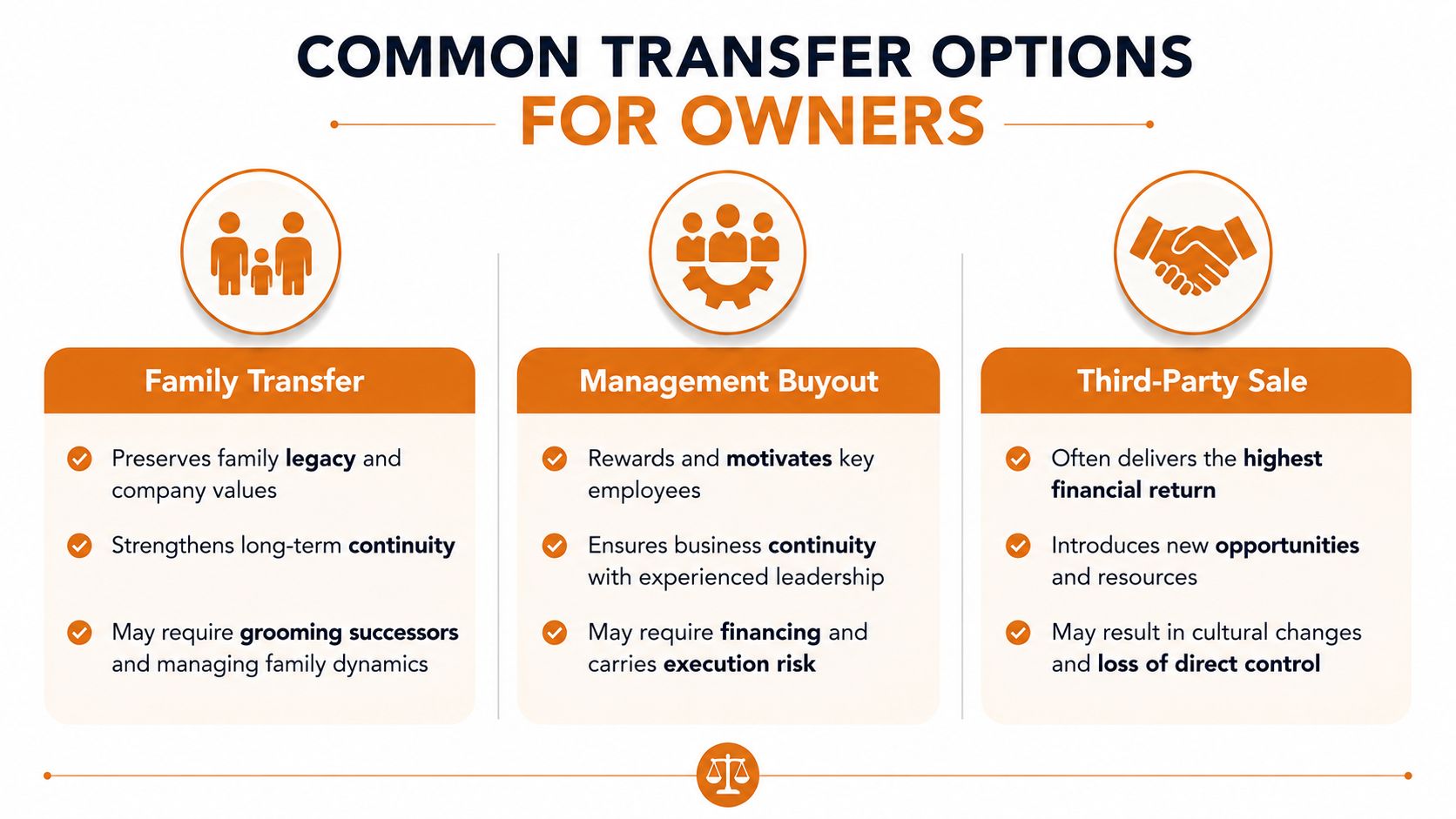
A family transfer can preserve the company’s identity and keep ownership among relatives. It may suit an owner who values legacy and wants the next generation involved, but family connection shouldn’t substitute for leadership preparation. The plan must address unequal contributions, voting rights, compensation, and what happens if one family member wants liquidity.
A management buyout can preserve operational continuity because the buyers already understand the customers, workforce, and systems. The challenge is funding. The buyer group may need seller financing or company-supported payments, and the company must continue investing while servicing the transfer obligation.
An employee ownership structure can broaden participation, but it brings its own legal, appraisal, governance, and financing requirements. It isn’t just a way to give employees shares without planning.
An outside buyer may offer the clearest separation between the owner and the business, often with greater potential for cash at closing. The trade-off can include less control over the company’s future, greater scrutiny of records, and possible changes to employees, brand, or service methods.
A staged transition lets the owner reduce involvement while the successor assumes responsibility over time. This can expose readiness problems early, but it requires clear authority. If the outgoing owner continues overriding every decision, the successor can’t build credibility.
| Transfer Option | Best Suited For | Typical Cash Outcome | Key Trade-Off |
|---|---|---|---|
| Family transfer | Owners prioritizing legacy and family continuity | Often structured over time rather than entirely at closing | Family expectations and funding can complicate control |
| Management buyout | Businesses with capable internal leaders | Frequently depends on financing and future company cash flow | The buyer may lack immediate purchasing capacity |
| Employee ownership structure | Owners seeking broad employee participation | Structured through a formal ownership and financing process | Requires specialized valuation, governance, and legal work |
| Third-party sale | Owners prioritizing separation and liquidity | May provide more cash at closing than an internal route | The buyer may change culture, leadership, or operations |
| Staged management transition | Owners willing to remain involved during handoff | Payments can be spread across the transition | Unclear authority can frustrate both leaders |
Recurring revenue can strengthen any route, but only when it is real, documented, and transferable. An HVAC company with written maintenance agreements, reliable renewal practices, and organized customer records gives a successor something more durable than the founder’s personal memory. A plumbing company that relies on informal repeat calls may have loyal customers, but the buyer still needs evidence that those relationships belong to the company.
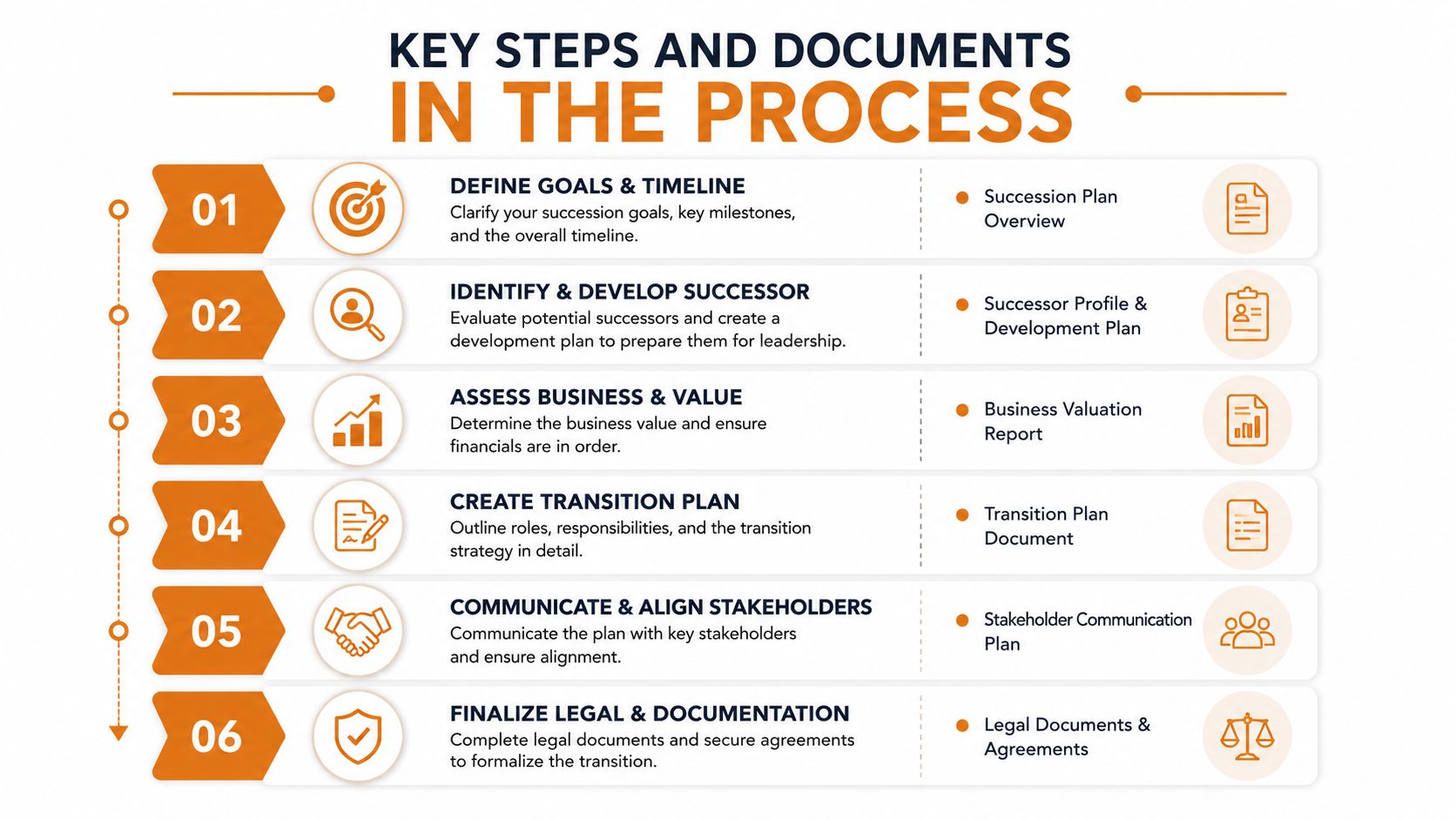
Succession becomes manageable when the owner separates the work into decisions that can be tested. The sequence may vary, but skipping a foundational step usually creates trouble later.
Start with personal and business goals. Does the owner want to retire completely, keep a minority interest, protect employees, preserve a family legacy, or maximize liquidity? A timeline should include both the preferred transition and an emergency alternative.
Write down decision rules before family or buyers begin negotiations. Otherwise, the loudest voice in the room may determine the structure.
Assess the successor against the actual job, not the owner’s hopes. Development can include exposure to financial reporting, customer negotiations, hiring, vendor management, field operations, and difficult personnel decisions.
For an HVAC business, technical excellence doesn’t automatically prepare someone to manage dispatch capacity, sales conversion, maintenance agreements, and cash collection. The owner should assign responsibility gradually and observe results.
For a tax-sensitive transfer, fair market value is the governing standard. The business should be valued as if it were sold between willing, unrelated parties, with assumptions documented and supported.
Revenue Ruling 59-60 remains a foundational U.S. framework. It calls for analysis of business history, industry outlook, book value, earning capacity, dividend capacity, goodwill, prior sales, block size, and comparable public-company pricing (the University of Washington Law review discussion). Related-party transfers deserve particular care because the price can affect tax reporting and the feasibility of the buyer’s financing.
The plan may involve:
Formal valuations should be refreshed every two to three years, or annually for fast-changing firms and ESOP structures, according to the valuation guidance cited above. A valuation is a snapshot based on assumptions, not a permanent label.
Owners often focus on the purchase price because it feels concrete. The better question is what the owner keeps after tax, transaction costs, financing terms, and collection risk.
A family transfer can show a high value on paper but leave the successor unable to make payments. A management buyout can preserve the team yet require a long payout period. An outside sale can produce more immediate liquidity but may impose stricter representations, warranties, or post-closing obligations.
The transfer structure changes the economics. Taxes can affect whether a business is sold, retained, or transferred internally. Academic and policy research indicates that higher succession and inheritance taxes increase the likelihood of business sales, while research on family-firm transfers identifies potential valuation bias when owners have incentives to optimize tax outcomes rather than reflect standalone market value (valuation and succession planning research).
Compare routes on an after-tax, after-cost, present-value basis. That means examining:
A lower headline price with dependable, secured payments may be economically stronger than a higher price spread across uncertain terms. The reverse can also be true if the buyer has strong financing and the seller values immediate liquidity.
An attorney should align the transfer agreement with the owner’s estate documents, entity structure, insurance arrangements, and governance rules. A tax advisor should model consequences rather than just calculate a tax bill after the terms are fixed. The valuation professional should remain independent enough to support a defensible conclusion.
The owner shouldn’t ask one document to solve every problem. Legal agreements establish rights, valuations establish economic assumptions, and financing documents establish payment obligations. The plan works only when those pieces agree.
An HVAC owner once told an advisor that his son would “obviously” take over. The son knew installations, had earned several technicians’ trust, and had worked in the business. Yet no one had asked whether he wanted ownership, responsibility for payroll, or accountability for every customer complaint.
The warning sign was an assumption standing in for a conversation. A structured discussion clarified the son’s goals. A readiness plan then gave him responsibility for budgeting, hiring, and customer retention before any ownership transfer. That period tests execution, not just family expectations.
Family transfers can also fail when siblings contribute unequally. One sibling may run field operations for years, while another expects an equal ownership share because the family views the company as a shared inheritance. If the plan treats ownership, pay, management authority, and inheritance as one question, resentment can surface during the handoff.
The warning sign is disagreement about fairness that has never been made explicit. The remedy is to define roles, compensation, decision rights, and ownership separately, then record how each sibling’s contribution will be recognized. Equal treatment may require equal ownership, but it does not always require identical roles or pay.
Another pattern begins with a health event. An owner planned to “get to succession planning next year,” but an unexpected absence left an employee keeping the doors open while family members tried to determine who could sign contracts and access accounts. A rushed sale narrows the owner’s choices and weakens negotiations because buyers can see the lack of preparation.
The early warning sign is operational dependence: no one else can approve purchases, explain key accounts, or run weekly financial reviews. The remedy is an emergency authority plan and gradual delegation while the owner still has time to coach. It is like testing a backup generator before the outage, rather than discovering its limits during one.
A 2025 survey of family businesses found that only 11% had completed a formalized succession process, while 47% had not started the reflection stage and 52% had not identified a successor (Deloitte’s 2025 succession preparedness report). Those findings reflect a familiar owner experience. Avoidance leaves fewer choices when the decision becomes unavoidable.
Practical rule: If the business cannot operate without the owner for a short period, begin with continuity and delegation before debating the final transfer route.
A succession plan needs coordinated specialists, not isolated advice.
During the first 90 days, an owner can create useful momentum without choosing a final successor.
For a step-by-step action list, see the business succession planning checklist. To check whether you’re actually ready to start and build a month-by-month plan, see the succession planning timeline.
The Owner’s Shortlist is a free service that helps owners find a business broker or other specialist. A person, not software, makes the introduction. The site also has about 180 free plain-language articles covering valuation, taxes, legal preparation, estate planning, financing, and deal structure. It can serve as a research and referral resource while the owner decides which professionals fit.
If you’re unsure whether your successor, valuation, or financing plan can withstand a real handoff, use The Owner’s Shortlist to review plain-language guidance and identify specialists for the decisions in front of you. Start by documenting your goals and dependencies, then arrange an initial conversation with the valuation, tax, and legal professionals your situation requires.
Tell us your situation. We'll connect you with a specialist who works with owners like you. One conversation, no sales pressure.
Found this useful?
Add The Owner's Shortlist as a preferred source and get our articles highlighted in Google Search results.
Add to Preferred SourcesUse this business succession planning checklist to prepare your valuation, finances, taxes, legal structure, team, family transition, and sale.
August 25, 2026
A month-by-month succession planning timeline for small business owners, plus a readiness scorecard that tells you when to start each step.
September 15, 2026