Family Inheritance Law for Business Owners
Navigate family inheritance law for your business. Learn how to structure succession, avoid family disputes, and protect your company's future value.
September 25, 2026
By Remi Taffin · August 30, 2026 · Updated October 12, 2026
You’ve spent decades turning a skill, a crew, and a customer base into a business that pays the bills. The company may be profitable, but most of its value sits in equipment, contracts, goodwill, working capital, and future cash flow, not in an account you can divide neatly among heirs. One day, you’ll need to decide whether that value should stay in the family, move to selected employees, or be converted into cash through a third-party sale.
That decision is the practical heart of intergenerational wealth transfer for business owners. It involves far more than writing a will. You’re deciding who will own the company, who will operate it, how family members will be treated, how taxes will be funded, and whether the business can continue serving customers after your role changes.
Consider a 58-year-old founder who runs a profitable contracting company. Her shares may be valuable, but there’s no public market where her children can sell them tomorrow. The company’s worth depends on recurring service work, experienced employees, supplier relationships, licences, equipment, and her ability to win and retain customers. If she leaves the shares to her children without planning the operating handover, the family could inherit an asset they can’t manage, divide, or sell easily.
Intergenerational wealth transfer means deliberately moving three connected things from one generation to another:
These elements don’t have to move at the same time. A parent might transfer some economic value while retaining voting control. A child might receive shares but lack the authority to run operations. A trust might hold the legal title while several beneficiaries receive benefits under defined rules.
A portfolio of marketable securities can usually be divided or sold with relative ease. An owner-operated company works differently. Enterprise value is locked inside an operating system, including people, processes, contracts, reputation, and cash flow.
Family employees add another layer of difficulty. A daughter may run finance, a son may manage field operations, and a sibling may own shares without working in the company. A fair inheritance plan must distinguish pay for work from returns on ownership. If it doesn’t, one family member can feel underpaid while another receives benefits without carrying operational responsibility.
Contracts and licences can matter just as much as share certificates. Customer agreements, supplier terms, permits, and employment arrangements may depend on the company remaining properly owned and managed. A transfer that looks simple in an estate document can create consent requirements, financing problems, or uncertainty for customers.
Practical rule: Treat the business as both an asset and an operating institution. A successful transfer must protect the value on the balance sheet and the relationships that produce future revenue.
The structures discussed below include gifts, sales, trusts, and operational succession. Their tax treatment depends on jurisdiction and facts, so owners should use qualified legal and tax advice before acting. The central question remains practical: who should own the business, who should run it, and how can the transition preserve value without forcing a rushed sale?
Owners generally combine legal ownership tools with an operating succession plan. The instrument you choose determines who pays, when payment occurs, what value is transferred, and how much control remains with the founder.
An outright gift is similar to handing over the keys while you’re still available to explain how the building works. You transfer shares or interests to the next generation, either all at once or gradually. The recipient doesn’t necessarily pay you a purchase price, but the transfer can have gift-tax, income-tax, valuation, and control consequences.
Annual exclusions and lifetime exemptions may create planning room, but the amount available depends on the applicable jurisdiction, the year, the donor, and the recipient. A tax professional must calculate the result from current law rather than relying on a general rule.
A gift can work when the owner wants to transfer future appreciation early and has enough personal liquidity to reduce dependence on the company. It’s less comfortable when the owner still needs the business to fund retirement.
A sale transfers ownership in exchange for a defined price. The next generation might use outside financing, company distributions, or a promissory note that the parent receives over time. An installment arrangement can make the transaction more manageable, but it also leaves the parent exposed to the child’s ability to operate the company and meet payment obligations.
Valuation becomes central. A business interest with limited marketability or minority voting power may not be worth the same as a controlling interest in an active sale. Those valuation differences require defensible analysis, not a convenient family number.
A trust acts like a locked container. A trustee holds the shares under written rules, while beneficiaries receive income or access according to those rules. This can help separate ownership from immediate control and may protect the transfer from impulsive decisions, creditor issues, or disagreements among beneficiaries.
Trusts are technical instruments. The grantor, trustee, beneficiaries, voting rights, distribution standards, and tax treatment must fit together. A trust that looks efficient on paper can create confusion if nobody understands who can approve a sale, appoint a director, or receive distributions.
Succession is broader than a legal transfer. It answers who will lead the warehouse, approve hiring, negotiate with customers, manage debt, and make decisions during a difficult quarter. Ownership may pass before management, after management, or not at all.
| Structure or lever | Main movement | Question it answers |
|---|---|---|
| Gift | Economic value and possibly ownership | What can the owner transfer without a purchase? |
| Sale | Ownership for a contracted price | Who pays, and over what period? |
| Trust | Legal title under defined rules | Who benefits, and who controls the shares? |
| Succession | Management and decision authority | Who runs the company day to day? |
A family can execute a valid share transfer and still fail at succession. The documents move the asset, but the successor must still earn trust from employees, lenders, suppliers, and customers.
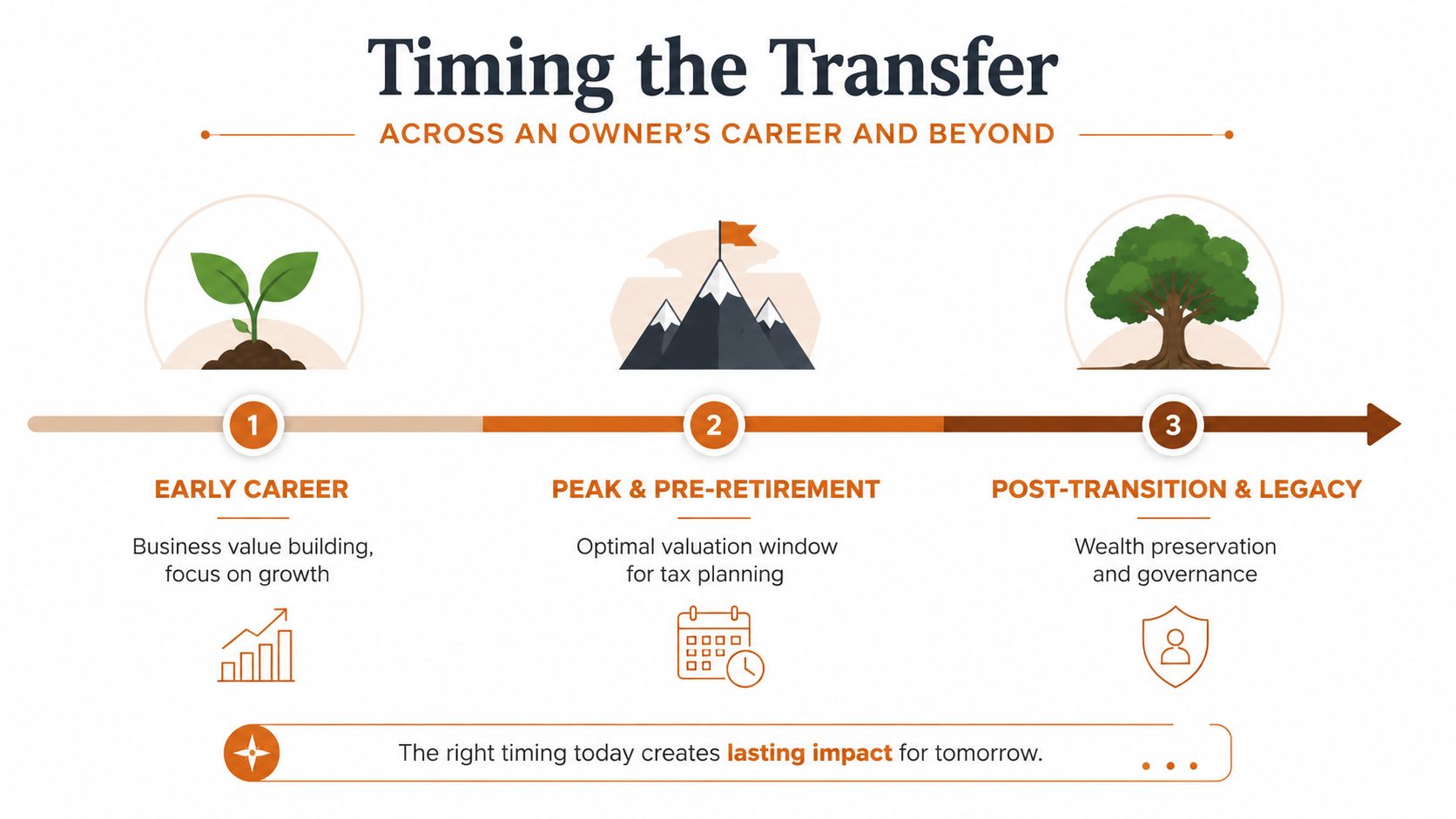
Transfer planning works better as a series of decisions than as one retirement event. The owner’s age, health, earnings trajectory, personal liquidity, and successor readiness all affect which structures remain practical.
During the growth phase, retirement may feel distant. That’s still the right time to identify potential successors and document the ownership mechanics. A shareholder agreement, buy-sell provisions, and powers of attorney can clarify what happens if an owner dies, becomes incapacitated, or wants to exit unexpectedly.
The owner should also separate business dependency from personal identity. If every important customer relationship runs through the founder, the company may be difficult to transfer even if the shares have a clear legal owner.
Several years before an expected exit, owners can compare a gift, sale, trust arrangement, employee transition, or third-party sale. This is when valuation work becomes particularly useful because the owner can see which factors create value and which risks reduce it.
A company with recurring revenue contracts, a strong second layer of management, and documented processes may support more transfer options than a business whose customers and decisions depend entirely on the founder. The planning window also gives family members time to gain outside experience, learn financial statements, and demonstrate whether they want the responsibility.
If planning runs out of time, the estate may need to address ownership, valuation, taxes, debt, and liquidity simultaneously. Estate inclusion and potential basis consequences depend on the structure and applicable law. Life insurance or other liquidity arrangements may help, but they need to be designed before a crisis and coordinated with the ownership documents.
A useful planning conversation asks three separate questions:
The answers may use different documents and funding methods. Timing matters because a structure that works while the owner is healthy and actively involved may be unavailable or unaffordable after a sudden event.
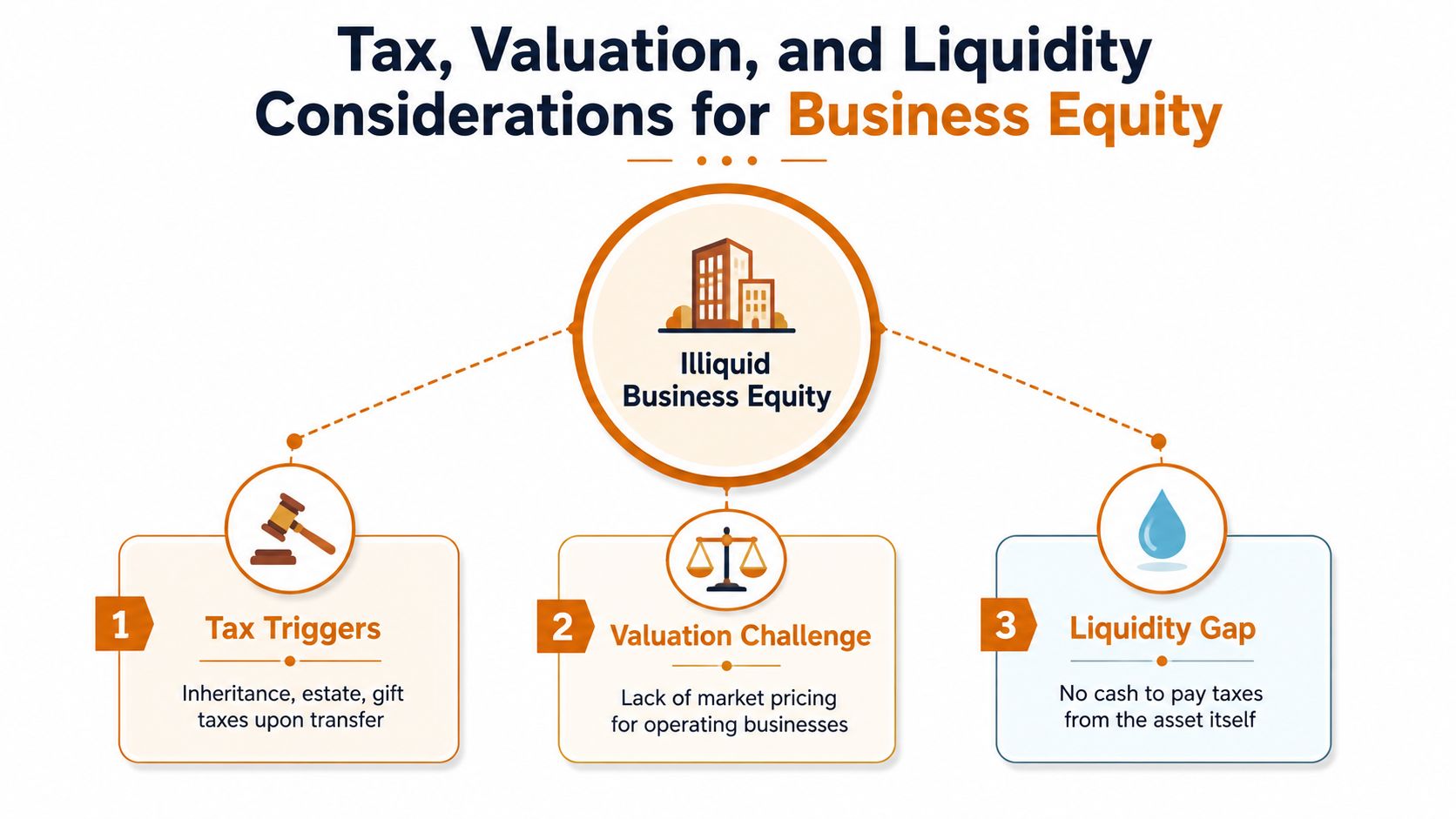
Illiquid business equity creates a problem that a portfolio investor rarely faces. The tax system may assign a market value to an operating company at the transfer date even though the family can’t turn that value into cash immediately.
Across 24 OECD countries, inheritance or estate taxes generated an average of 0.5% of total tax revenues in 2018 among countries that levied them, as reported by the OECD analysis of inheritance taxation. That figure doesn’t mean transfer taxes are irrelevant to an individual owner. It shows that these taxes play a relatively small role in national tax revenue while still creating concentrated obligations for families transferring valuable assets.
The OECD also explains that estate or inheritance tax valuation usually occurs at market value on the transfer date. For a family business, that valuation may require an appraisal based on earnings, assets, comparable transactions, control rights, marketability, and business risk. There may be no live market price to settle the question.
Suppose a manufacturing company is valued at $20 million. If the transfer creates a $7 million tax obligation, the company doesn’t automatically produce $7 million in cash. Its value may sit in machinery, inventory, customer relationships, receivables, and expected future earnings.
The owner’s family then faces an uncomfortable choice. They can borrow against the company, use insurance or other liquidity, sell assets, distribute cash that the company needs for operations, or sell part of the business. A rushed sale can reduce the family’s control and weaken the company’s negotiating position.
A valuation is not a bank balance. It’s an estimate of enterprise value, while a tax bill is a payment obligation.
A planning team may examine valuation discounts for minority or restricted interests, installment sales, trust structures, phased gifting, and buy-sell insurance. Each tool has conditions and trade-offs. A discount must reflect real restrictions and be supported by appropriate valuation work. An installment sale needs credible payment terms and a plan for default risk. Insurance must be owned and coordinated correctly so it creates liquidity where the family needs it.
Business owners should also review whether the company has enough cash reserves and borrowing capacity to support a transition. A transfer plan that extracts too much cash can leave the company unable to fund payroll, equipment, customer commitments, or growth.
Tax efficiency is only one test. The family must also ask whether the successor can run the company and whether the ownership structure gives that person enough authority to make timely decisions. Without that operating foundation, a tax saving can preserve a fragile asset rather than a durable enterprise.
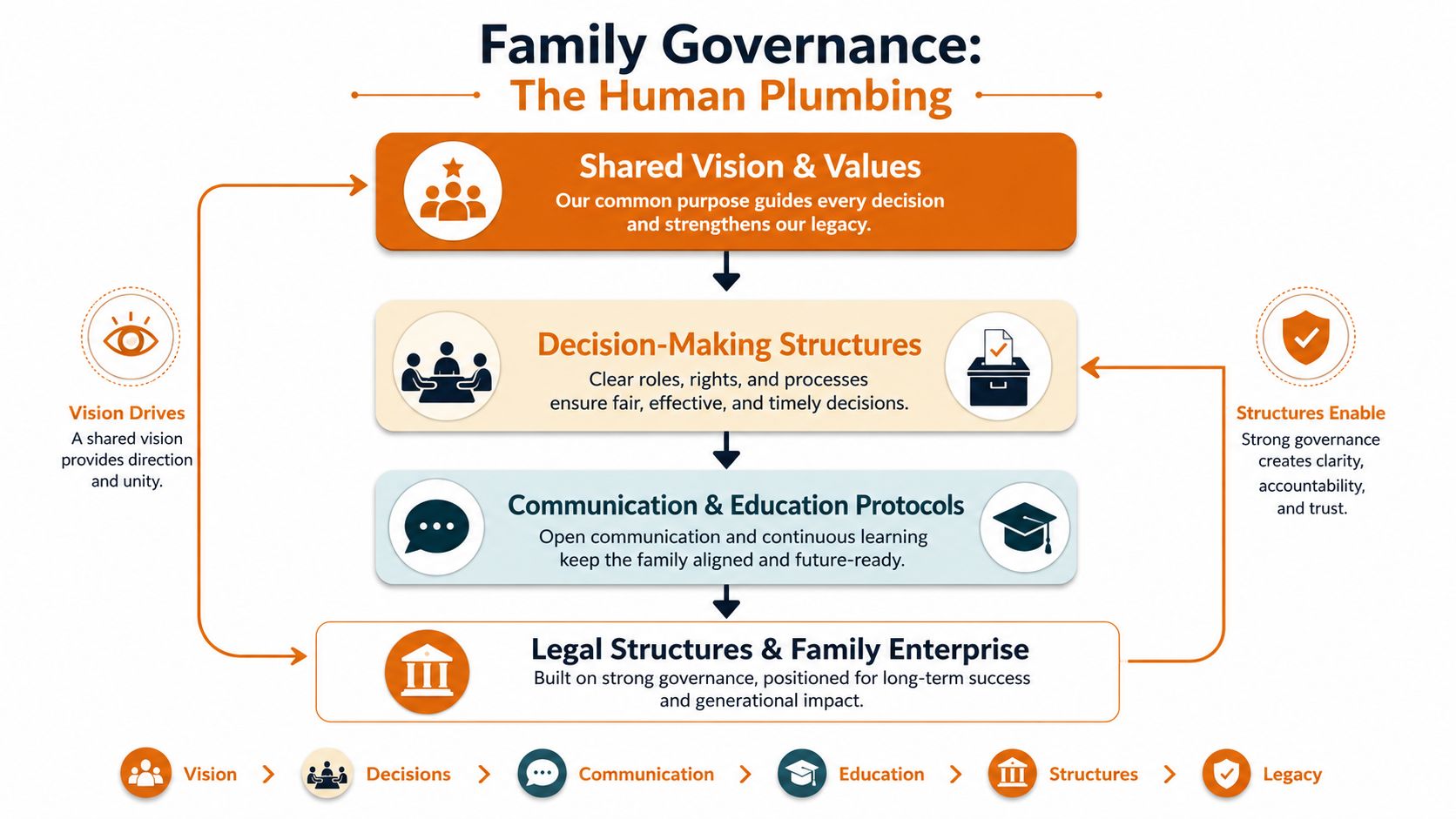
A trust can define who receives shares, and a shareholder agreement can establish voting rights. Neither document can decide whether the sibling running the warehouse respects the sibling responsible for finance. Family governance is the human plumbing that allows legal structures to function under pressure.
A practical framework usually includes four connected parts:
Family members should know what they receive because they work and what they receive because they own. A child who manages operations should have a role description, performance expectations, and market-based compensation. A sibling who doesn’t work in the company may still receive dividends, but shouldn’t automatically receive an operating title.
This distinction prevents a common source of conflict. Ownership gives economic rights, but it doesn’t prove management ability.
Preparation should be visible and practical. Useful steps include rotating through departments, learning how the company makes money, gaining experience outside the family business, and reading financial statements with confidence. The successor should understand customer concentration, supplier dependency, debt obligations, recurring revenue, and the operational risks hidden behind reported profit.
Independent directors or external advisors can serve as referees. They can challenge family assumptions, evaluate performance, and give nonfamily employees confidence that promotions and major decisions won’t be based solely on birth order.
Practical rule: Don’t make the first leadership test the day the founder leaves. Give successors smaller decisions, clear feedback, and real accountability while the founder can still coach them.
Governance should also address spouses and in-laws before conflict arises. The documents might specify who can own shares, whether a spouse receives economic benefits, how a divorce or death affects ownership, and who may become an employee or director. Clarity feels formal at first, but it’s kinder than asking relatives to negotiate these rules during a crisis.
The same legal tools can produce very different outcomes because the owner’s objective changes the design. A family continuity plan prioritizes control, successor readiness, and fairness among working and nonworking relatives. A third-party exit prioritizes a clean transaction, retention, tax treatment, and management of sale proceeds.
A second-generation owner of a logistics company with 45 employees wants the business to remain family-owned. Three children work in the company, but they don’t contribute in the same way. One manages operations, one handles finance, and one leads customer relationships.
A suitable planning direction might combine phased gifting with a grantor trust, subject to professional review of valuation and tax treatment. Buy-sell insurance can provide liquidity among the three working children, while a shareholder agreement can require employment standards, performance expectations, and a process for resolving deadlock.
The owner may transfer economic value gradually while retaining specific voting rights during a transition period. The family constitution can explain why compensation follows job responsibility while dividends follow ownership. That distinction lets the logistics company reward performance without pretending that every child has the same role.
A sole founder of a SaaS company has no family successor and wants to convert the business into personal and family wealth. The company may explore a third-party sale, while an employee stock ownership plan could support retention or employee participation if it fits the company’s legal and financial circumstances.
A charitable remainder trust may be considered as part of a broader plan for concentrated tax exposure, but its suitability depends on the owner’s goals, tax profile, charitable intent, and professional advice. After the transaction, the family may need an investment and governance framework for the proceeds rather than an operating succession plan.
| Structure or lever | Scenario A: Keep in family | Scenario B: Sell to third party |
|---|---|---|
| Primary objective | Preserve family ownership and operating continuity | Convert enterprise value into liquid wealth |
| Ownership path | Phased gifts and trust-based ownership may be considered | Buyer receives control through a negotiated sale |
| Management | Working children earn roles through performance | Buyer or new management team operates the company |
| Liquidity | Insurance, company cash flow, or installment terms may support the transfer | Sale proceeds provide the main liquidity event |
| Governance | Shareholder rules, family constitution, and decision rights | Sale agreement, retention terms, and post-sale investment governance |
| Family fairness | Separate pay for work from returns on ownership | Define how proceeds are divided and managed |
Neither scenario is automatically superior. The right structure follows the owner’s actual goal. A family transfer can preserve identity and relationships but demands preparation and governance. A sale can provide clarity and liquidity but ends family control of the operating company.
Your first advisory meeting will be more useful if you arrive with organized facts and clear questions. You don’t need to diagnose the tax structure or choose a trust before speaking with a lawyer, valuation professional, accountant, or succession advisor. You do need to show them what you own, what you want, and where the uncertainty sits.
Write a short summary of your own position:
These answers help specialists distinguish a transfer designed for control from one designed for personal financial security.
Collect the current ownership cap table, recent financial statements, debt information, major customer and supplier contracts, licences, insurance policies, and a simple description of who does what. Include the factors that drive value, such as recurring service agreements, customer concentration, equipment, intellectual property, or dependence on the founder.
Also list the managers below you. A successor may be technically capable but still lack a team that can run sales, operations, finance, and customer service without constant founder involvement.
Bring your current shareholders’ agreement, buy-sell provisions, wills, powers of attorney, trust documents, insurance records, prior gift documentation, loan agreements, and any written family arrangements. If a document is old, incomplete, or difficult to understand, bring it anyway. The specialist needs to see the starting point before recommending changes.
Bring information, not conclusions. Your job is to describe the facts and desired outcome. Your advisors’ job is to test structure, valuation, tax, and implementation.
Prepare a one-page summary with your goals, ownership picture, successor candidates, major risks, and open questions. The Owner’s Shortlist is a free service that helps owners find a business broker or other specialist. You talk to a real person, who introduces you to one specialist whose past work fits your business. When that summary is ready, tell us about your business. Owners pay nothing.
Tell us your situation. We'll connect you with a specialist who works with owners like you. One conversation, no sales pressure.
Found this useful?
Add The Owner's Shortlist as a preferred source and get our articles highlighted in Google Search results.
Add to Preferred SourcesNavigate family inheritance law for your business. Learn how to structure succession, avoid family disputes, and protect your company's future value.
September 25, 2026
Learn how succession of business works, from choosing a pathway to timing the handoff. A clear guide for owners planning their next chapter.
September 20, 2026
Plain-language estate planning wills and trusts guide for business owners covering definitions, tax implications, and questions to ask attorneys.
September 18, 2026
Learn company ownership transfer options, valuation, taxes and timing. Compare sale, gift, succession and ESOP paths with checklists.
September 17, 2026