Company Ownership Transfer Options and Next Steps
Learn company ownership transfer options, valuation, taxes and timing. Compare sale, gift, succession and ESOP paths with checklists.
September 17, 2026
By Remi Taffin · September 18, 2026
You’ve spent twenty years building a company, paying employees, serving customers, and reinvesting in the next season of growth. Then a hospital call changes everything. Your family knows the business matters, but nobody knows who can sign the next payroll, approve a supplier contract, access the accounts, or decide whether your ownership interest should be sold, transferred, or held.
That situation is why estate planning wills and trusts deserves a business-owner lens. A will or trust isn’t just about distributing personal property after death. For an owner-operator, the plan also has to address incapacity, ownership transfer, beneficiary designations, tax basis, and the people who depend on the company for their income.
The planning gap is substantial. A major 2026 U.S. estate-planning report found that 56% of American adults had no estate-planning documents at all, including no will, trust, Medical Power of Attorney, Financial Power of Attorney, or HIPAA authorization. The same report found that will ownership fell from 31% in 2025 to 26% in 2026, while trust ownership rose from 11% to 14% (2026 Estate Planning Report).
For a business owner, the right question isn’t just, “Should I have a will or a trust?” It’s, “What happens to the company, its people, and my family if I can’t make decisions tomorrow?”
A family can often wait while an executor gathers statements, identifies accounts, and follows instructions for ordinary personal assets. A business usually can’t. Customers still expect service, employees still expect pay, and vendors still expect someone with authority to approve invoices and sign agreements.
Consider an owner who built a regional service company over two decades. The owner dies without a clear succession plan. The spouse inherits an ownership interest but has no operating experience. One child wants to run the company, another wants cash, and a long-time manager believes they should take control. The company’s value may depend on customer relationships, licenses, key employees, and the owner’s personal involvement, yet the family is forced to negotiate those issues while grieving.
That’s the central distinction. A business interest isn’t merely an investment. It may represent payroll, contracts, equipment, intellectual property, supplier access, and the livelihood of non-family employees. A personal estate plan that ignores those operating realities leaves the hardest decisions for the people least prepared to make them.
A useful plan starts with five practical criteria:
A will may answer some ownership questions. A trust may add continuity and control. Neither replaces the company’s governing documents or a valid incapacity plan.
Owners also need to distinguish inheritance from management. Your spouse might be the right person to receive the economic value of the company but not the right person to supervise field crews or negotiate commercial contracts. A child might be an excellent operator but an unsuitable sole owner. The documents should reflect those differences rather than assuming one person must do everything.
For a practical discussion of transferring ownership within a family, see this guide to company ownership transfer. The important point is simple: estate planning is business continuity planning expressed through legal and financial documents.
A will is a written set of instructions that takes effect after death. Think of it as a carefully written note left on the kitchen counter. It tells the right person what you own, who should receive it, and who should handle the process, but the legal system still has to recognize and administer those instructions.
A trust is different. Think of it as a container already sitting in the garage, with assets placed inside and a manager named to follow your instructions. A revocable living trust can operate during your lifetime, usually with you retaining control, and a successor trustee can step in if you become incapacitated or die.
Neither document is automatically better. The practical choice depends on the business, the family, the state involved, and how much control must continue without court involvement.
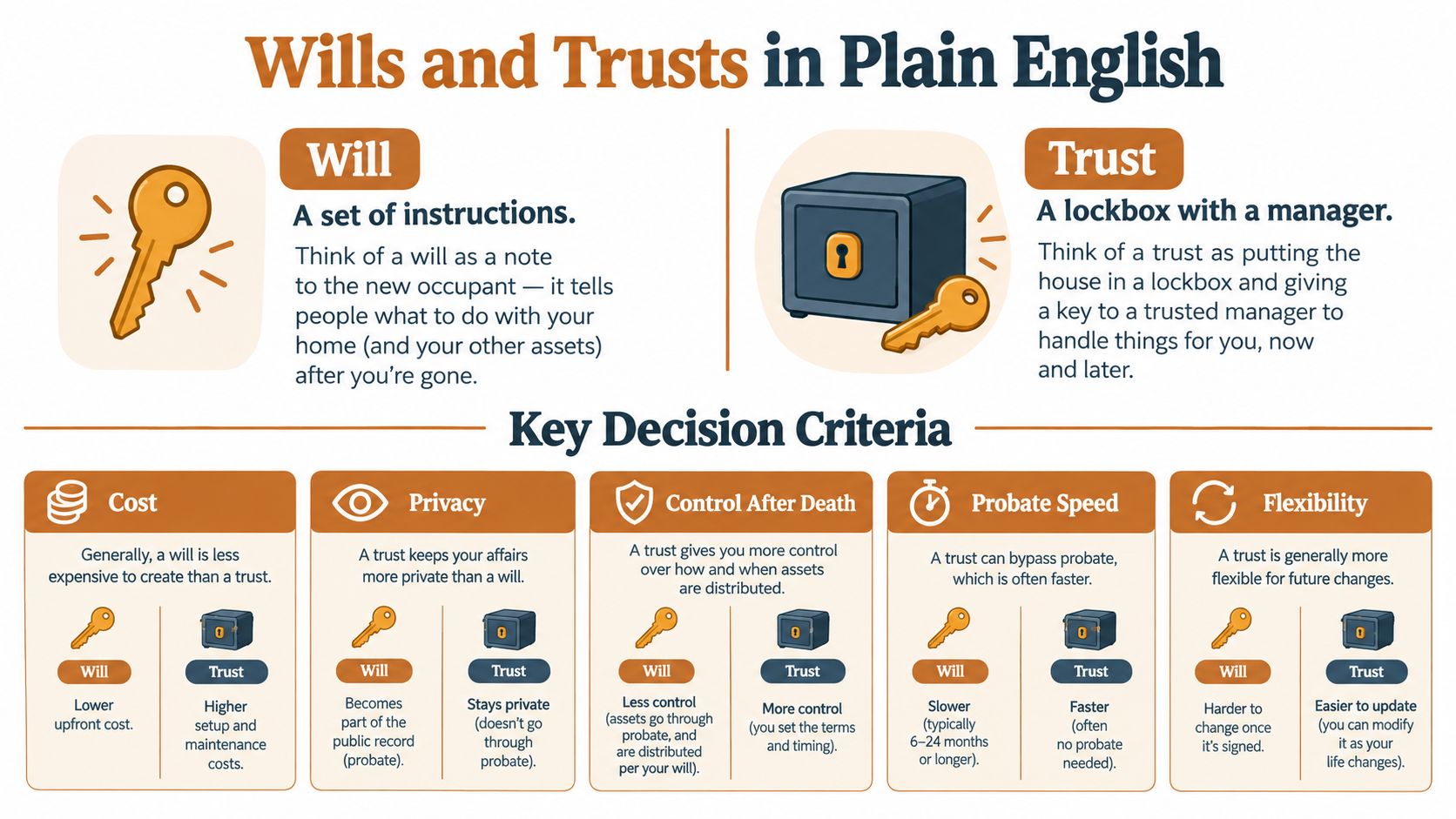
Probate exposure: Assets passing under a will generally go through probate. Probate can provide a formal process for validating the will and transferring ownership, but it may require time, filings, and court administration. Assets properly held in a revocable trust generally pass under the trust’s instructions instead.
Privacy: Probate proceedings can make estate information more accessible through public records. A trust administration is generally more private. That distinction can matter when a business valuation, ownership transfer, or family disagreement could affect employees, competitors, or customers.
Timing: A will doesn’t control assets until death and acceptance through the required legal process. A funded trust already has an ownership structure, so the successor trustee can generally administer trust-held assets without first transferring them through probate.
Control during incapacity: A will can’t authorize someone to manage the business while you’re alive and unable to act. A durable Financial Power of Attorney may help, and a properly structured trust can give a successor trustee authority over assets held by the trust. If you’re hospitalized and your LLC interest is outside the trust, the trust alone won’t solve that gap.
Cost and maintenance: A will is often simpler to create and maintain, but it still needs supporting documents and regular review. A trust requires correct funding, recordkeeping, and administration. An unfunded trust may provide impressive instructions without controlling the assets you expected it to control.
Families looking beyond the basic comparison may find this resource on family estate planning for Texans useful, particularly because state law affects probate, property, and administration. The document choice should follow the owner’s actual problems, not a sales pitch about one structure.
Practical rule: A trust only controls assets that are properly titled to it or otherwise coordinated with it.
Suppose you own 100% of an LLC membership interest or all the stock of an S corporation. At death, the business doesn’t automatically know who should operate it. The answer depends on state law, entity documents, beneficiary designations where relevant, your estate documents, and any buy-sell arrangement.
With intestacy, meaning no valid will, state law determines who inherits. That may identify heirs, but it won’t necessarily identify the best operator, establish a practical management transition, or resolve competing interests among a spouse and children.
With a will-based plan, the will directs the executor and eventually the beneficiaries. The ownership interest may pass through probate before the successor owner receives control. A will can nominate the recipient, but it generally doesn’t make the business interest private or allow a successor to manage the owner’s assets during lifetime incapacity.
With a revocable trust, the ownership interest can be held by the trust during the owner’s lifetime. The successor trustee then follows the trust terms after incapacity or death. That can reduce a transfer gap, but only if the LLC interest or corporate shares were properly transferred and the entity documents permit the intended administration.
A revocable living trust generally preserves the federal income-tax basis step-up at death because trust assets are included in the grantor’s gross estate. By contrast, assets transferred to an irrevocable trust usually retain carryover basis unless estate-inclusion rules apply. The tax result depends on estate inclusion status, not the label on the trust (step-up in basis explanation).
That distinction matters when heirs may later sell appreciated business interests or real estate. The fair-market value at death must be documented for each asset, particularly when the asset is closely held or difficult to value. The automatic tax rule doesn’t create a valuation report by itself. Appraisal quality and asset-level records can affect later capital gains, liquidity needs, and negotiations among successors (business and estate planning guidance).
| Mechanic | Intestacy, no plan | Will-based plan | Trust-based plan |
|---|---|---|---|
| Who identifies the recipient | State intestacy rules | Will, subject to probate and applicable law | Trust terms, if the interest is properly held by the trust |
| Who manages during incapacity | No automatic business solution | Usually requires a separate power of attorney or court process | Successor trustee may act over trust-held assets |
| Probate exposure | Usually present for assets in the estate | Usually present for assets passing under the will | Often reduced for properly funded trust assets |
| Business control | May be divided among heirs | Follows the will and entity documents | Follows the trust and entity documents |
| Basis records | Estate still needs valuation documentation | Estate still needs valuation documentation | Trust-held assets still need valuation documentation |
| Buy-sell coordination | Agreement may control or restrict transfer | Must be coordinated with the will | Must be coordinated with the trust and trustee powers |
A buy-sell agreement can establish purchase rights, trigger events, valuation methods, and funding arrangements. It may control the transfer more directly than the will or trust, so owners should review what a buy-sell agreement is alongside their estate documents.
A will can state who should inherit your company interest. It can’t, by itself, keep an incapacitated owner’s business operations moving, keep ownership details private, or manage an inheritance over time. Those are the moments when a trust may solve a problem that a will alone can’t.
Take a single-member LLC owner who suffers a serious illness. If the LLC interest is properly held in a revocable trust, the successor trustee may be able to administer that interest under the trust terms. The company still needs appropriate operating authority, and the trustee must understand the documents, but the family has a defined path instead of starting with uncertainty.
Staged distributions: A trust can hold a child’s inherited business interest and distribute value in stages or under conditions. That may be useful when an heir is inexperienced, vulnerable to creditors, facing a divorce, or not ready to manage a company. A will can create a testamentary trust, but the estate may still pass through probate before that structure becomes active.
Successor continuity: A trust can name a successor trustee before an emergency occurs. That person may handle trust-owned interests, coordinate with managers, and preserve continuity while the owner is unable to act. The trustee isn’t automatically a business operator, so the plan should distinguish trustee duties from day-to-day management.
Privacy: A trust can keep many ownership and distribution details outside the public probate process. For a family enterprise with non-family employees, privacy can reduce unnecessary speculation about valuations, control, and future ownership.
Buy-sell coordination: A trust can hold an interest subject to a properly drafted buy-sell agreement. The trust terms can direct the trustee to comply with purchase rights or offer procedures, while the entity agreement addresses the co-owners’ rights. The documents must work together. A trust can’t override a restriction in an operating agreement just because the trust says otherwise.
| Decision lever | Will only | Revocable trust |
|---|---|---|
| Incapacity management | Usually needs separate authority | Can provide successor trustee authority over funded assets |
| Staged inheritance | Possible through testamentary provisions, usually after probate | Can administer staged distributions under trust terms |
| Privacy | Probate may expose estate details | Trust administration is generally more private |
| Business continuity | Depends on executor, powers of attorney, and entity documents | Successor trustee can act over properly funded interests |
| Maintenance | Generally simpler, but still requires updates | Requires funding, records, and trustee administration |
A trust is a container for instructions, not a substitute for judgment. Owners should understand the funding, trustee, and entity steps before signing. This guide on how to avoid trust setup mistakes can help identify questions to raise with counsel.
The most expensive planning mistake often isn’t choosing the wrong document. It’s assuming that a signed document automatically controls every asset and every business decision.
A signed trust that was never funded is a classic example. If the LLC interest, real estate, or investment account remains outside the trust, that asset may still follow a different transfer process. The trust may contain clear instructions, but the title and beneficiary records determine whether the instructions reach the asset.
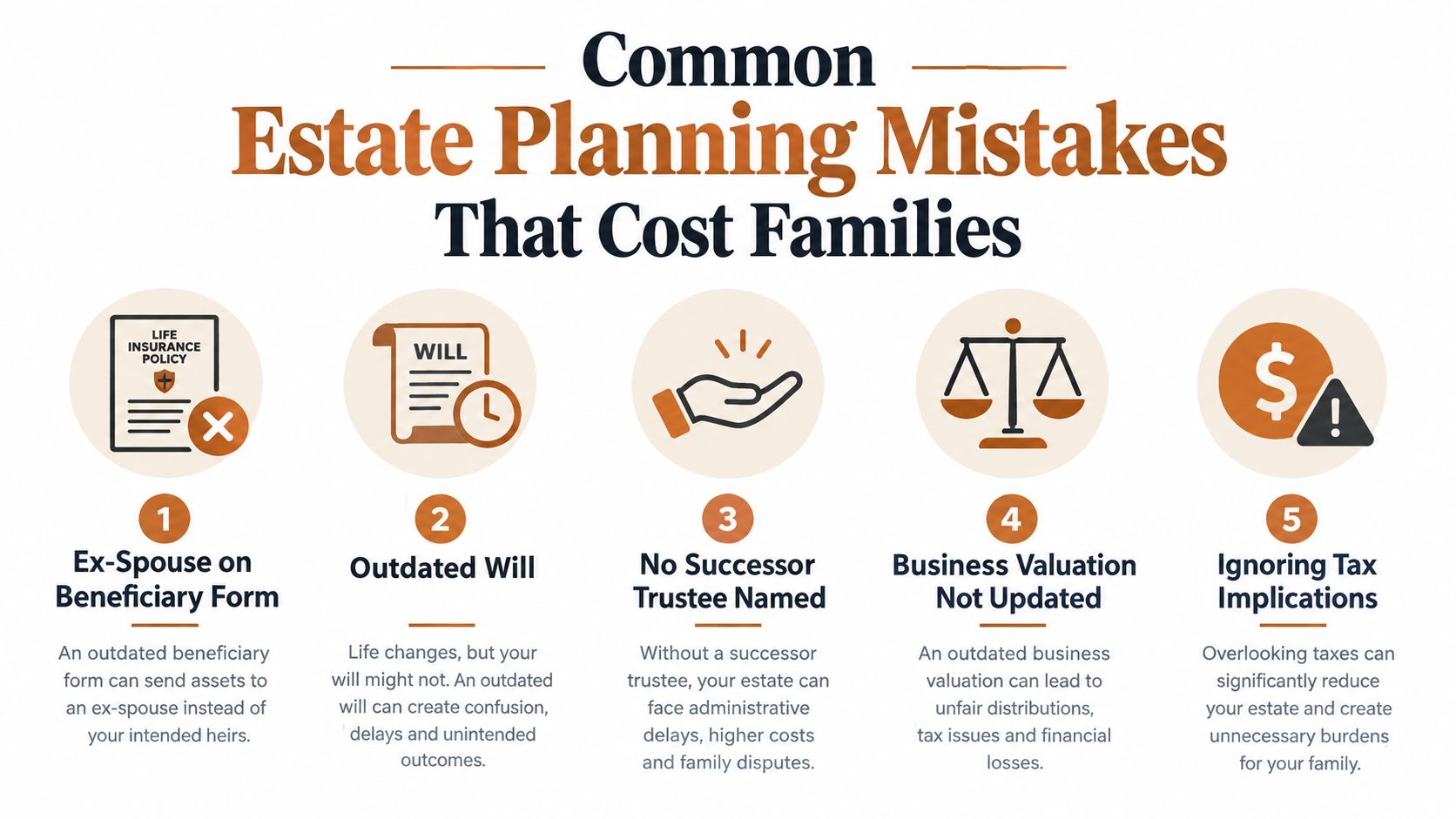
Ex-spouse on a beneficiary form: Life insurance, retirement accounts, and transfer-on-death arrangements may follow their own beneficiary designations. A later will may not replace an outdated form. Pull the forms and verify the names directly.
Outdated documents: A durable Financial Power of Attorney or healthcare directive may name someone who has died, moved away, become estranged, or no longer understands the business. An old document can create a practical authority problem during a medical emergency.
No successor trustee: Naming yourself as trustee is common for a revocable trust. Failing to name a capable successor leaves the family without a clear administrator when you can’t serve.
Stale business valuation: A buy-sell agreement that uses an old valuation method or omits current ownership terms can turn a transfer into a dispute. Closely held interests need records that explain how value was determined.
Assuming a child will take over: A child may love the family, respect the company, and still not want to operate it. Ask about interest, skills, location, and leadership expectations before placing ownership and management in the same hands.
The historical survey series from Caring.com shows why this review matters. It reported that 42% of Americans said they had a will or another estate-planning document in 2017, compared with 32% in 2020, 34% in 2023, 32% in 2024, and 24% in 2025. In the 2020 survey, wills were the most common document at 23.9%, while 13% reported a living trust and 6.2% an advance healthcare directive (Caring.com wills survey).
Tonight’s diagnostic is straightforward. Gather every will, trust, power of attorney, healthcare directive, deed, beneficiary form, operating agreement, shareholder agreement, and buy-sell agreement. Check the dates, names, ownership titles, successor appointments, and funding instructions.
A first meeting becomes more useful when the owner brings facts instead of trying to remember everything from memory. You don’t need a perfect valuation or a finished succession plan. You need enough material for the attorney and CPA to see how the pieces connect.
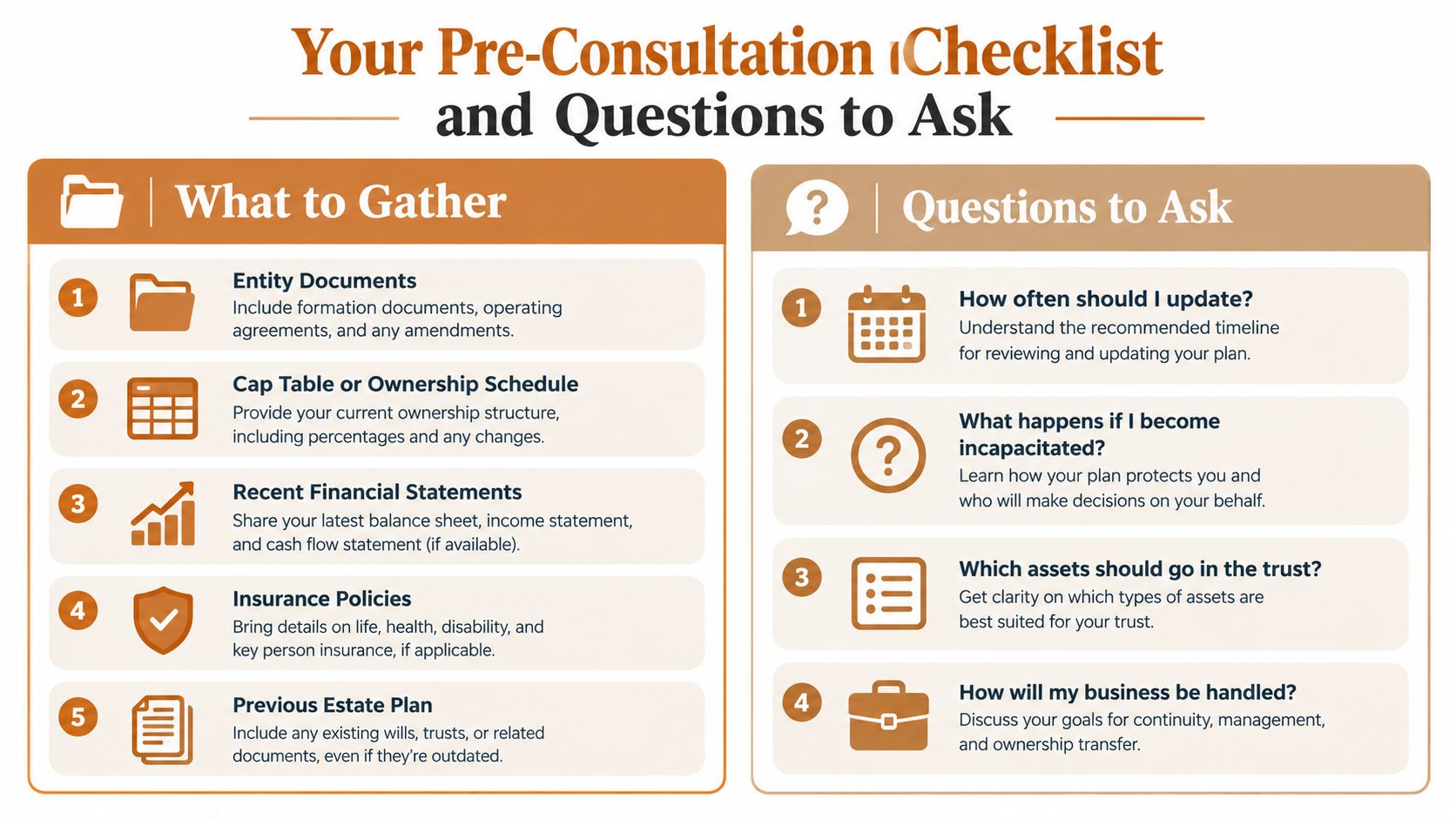
Bring copies or secure digital access to:
That last page often exposes the issue. An owner may want a spouse to receive the economic value, a child to become an eventual owner, and a general manager to run operations immediately. Those are three separate decisions.
For the estate attorney:
For the CPA:
Owners who want a broader interview guide can review these questions for a Texas estate planning attorney. If you’re comparing professional options, this guide to an estate planning law firm can help you evaluate experience and fit.
The embedded video offers another way to prepare before the conversation:
Your first consultation is a scoping conversation, not a signing session. Use it to identify missing documents, conflicting instructions, valuation questions, and the professionals who need to coordinate.
A workable estate plan matches the owner’s age, business complexity, and number of people who depend on the company. A simple service business with one owner and a clear retirement horizon may need a different structure from a multi-entity family enterprise with partners, real estate, and key employees.
Start with the simplest plan that addresses the primary risks. A sole proprietor approaching retirement may begin with a will, durable Financial Power of Attorney, healthcare documents, and carefully reviewed transfer-on-death or beneficiary designations. That plan still needs to address what happens to contracts, equipment, accounts, and customer relationships.
An owner with partners, key employees, or business real estate may need a revocable trust layered over the basic documents. The trust can support continuity and privacy for assets it holds, while the company’s operating or shareholder documents define ownership restrictions and management rights.
An owner facing complex family dynamics, multiple entities, active children in the company, or significant transfer-tax concerns may need advanced structures. Those can include irrevocable trusts, gifting strategies, and a carefully funded buy-sell agreement. The technical tax consequences depend on the structure and applicable law, so an estate attorney and CPA must work from the same ownership chart.
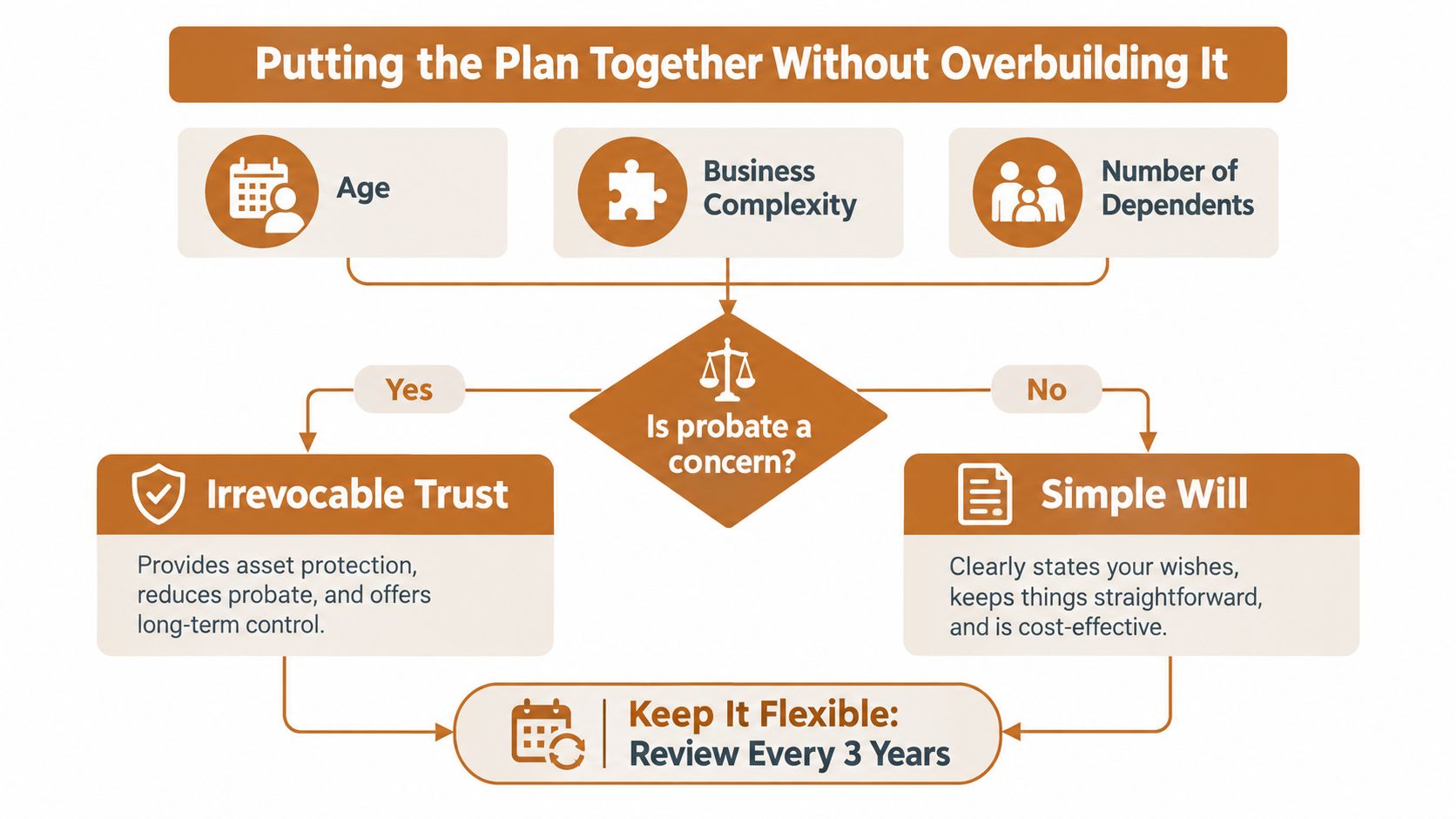
Your plan may include:
Treat the plan as a living system. Review it after a major ownership change, marriage, divorce, death, acquisition, sale, relocation, or change in the child who is expected to operate the company. A periodic review also gives your advisors a chance to confirm that the trust remains funded and the beneficiary forms still match your intentions.
Look for professionals through state bar association referral panels, established CPA networks, and NAPFA-registered advisors where appropriate. Choose people who understand both estate documents and owner-operated businesses, and make sure they’re willing to coordinate rather than hand each issue to the next professional.
The Owner’s Shortlist offers a curated directory and plain-language articles connecting long-tenured owners with specialists in legal and estate matters, valuation, taxes, succession, and related decisions. Visit The Owner’s Shortlist to review practical guidance and identify the type of specialist to speak with before your family has to make these decisions under pressure.
Tell us your situation. We'll connect you with a specialist who works with owners like you. One conversation, no sales pressure.
Found this useful?
Add The Owner's Shortlist as a preferred source and get our articles highlighted in Google Search results.
Add to Preferred SourcesLearn company ownership transfer options, valuation, taxes and timing. Compare sale, gift, succession and ESOP paths with checklists.
September 17, 2026
A practical roadmap for succession planning for small business owners — readiness, exit options, valuation, legal prep, and a working timeline.
September 15, 2026
What is business succession planning? Learn the definition, transfer options, valuation, tax and legal steps, common pitfalls, and how
September 3, 2026
Learn what intergenerational wealth transfer means for owner-operated businesses. Explore structures, tax considerations, family governance, and next steps
August 30, 2026