What Is Business Succession Planning: A Guide for Owners
What is business succession planning? Learn the definition, transfer options, valuation, tax and legal steps, common pitfalls, and how
September 3, 2026
By Remi Taffin · September 15, 2026
By 2035, about six million small and medium-size businesses may face an ownership transition, according to McKinsey’s analysis summarized by Gallup. Yet succession planning for small business remains badly underdeveloped. Gallup reported that 52.3% of U.S. employer businesses are owned by people aged 55 or older, while 27% of employer firms led by owners in that age group were either unsure of their long-term plan or intended to close permanently.
That gap isn’t a minor administrative problem. It determines whether the company transfers smoothly, sells under pressure, or disappears when the founder steps away. The right approach isn’t a giant checklist that gets filed and forgotten. It’s an ordered sequence of decisions: first assess readiness, then choose the exit path, then align valuation, tax, legal, people, and financing work around that choice.
The ownership-transfer wave is already large enough to change the competitive environment for small companies. McKinsey estimates that about six million small and medium-size businesses will face ownership transitions by 2035, compared with roughly 4.5 million in the prior decade. Gallup’s reporting also places owners aged 55 or older at 52.3% of U.S. employer businesses, which means retirement timing is no longer a distant concern limited to a few established firms. It’s a structural business-transfer issue affecting millions of companies in one generation. (Gallup)
Small operators face sharper exposure because the owner often remains the company’s operating system. The founder may approve every major quote, hold the customer relationships, negotiate with suppliers, train new managers, and remember why informal processes exist. A larger company can distribute that knowledge across departments. A small company may lose it when one person leaves.
A buyer doesn’t acquire your memories or personal network. A buyer acquires an operating business that must continue producing revenue without your constant intervention. If customers call only because they trust you, if pricing lives in your head, or if vendor terms depend on your personal relationship, the buyer sees transition risk rather than transferable value.
That risk also affects internal transfers. A family member or manager may inherit authority on paper but still lack the judgment, relationships, and decision history required to run the company. The ownership change then exposes weaknesses that the founder had been covering.
Practical rule: A business isn’t succession-ready because the owner has chosen a retirement date. It’s ready when another capable person can make sound decisions without needing the founder for every important answer.
Gallup reported that 74% of employer-business owners said they have plans to sell or transfer ownership, but only 23% said they plan to sell and 26% said they plan to give the business to a family member or someone else. Those figures show broad intent, not necessarily a documented transaction plan. (Gallup)

Waiting creates a predictable failure pattern. An owner postpones the decision, a health event or family conflict compresses the timeline, and the business enters the market with incomplete records, no successor, and no tax structure. At that point, the owner isn’t choosing the best path. The owner is accepting the path still available.
Before choosing a sale, family transfer, or management buyout, grade the business in a fixed order. Start with financial clarity, then test management capacity, operating systems, personal readiness, and market timing. A succession plan built on unclear earnings, undocumented work, or an untested successor is paperwork without a dependable transfer.
Score each signal as strong or weak. For every weak result, write one corrective action and assign an owner. Do not move to exit-path decisions until the weakest foundations are addressed.
| Readiness Signal | Strong | Weak | What to Fix First |
|---|---|---|---|
| Financial clarity | Clean books, reliable statements, normalized earnings | Personal expenses mixed with operations or inconsistent reporting | Reconcile accounts and prepare reliable financial reporting |
| Management depth | Business can operate for an extended period without the founder | Owner approves critical decisions and solves daily problems | Delegate authority and test managers through real decisions |
| Customer concentration | Revenue comes from a diversified customer base | One or a few customers control business stability | Protect relationships, expand the customer base, and document account ownership |
| Documented systems | SOPs, pricing rules, contracts, and workflows are written | Processes depend on memory or informal conversations | Capture critical procedures and assign process owners |
| Personal readiness | Owner understands the post-exit life and has aligned family expectations | Retirement, identity, or family roles remain unresolved | Hold structured conversations and define the owner’s desired role |
| Market timing | Industry conditions and buyer demand support the chosen path | The niche faces disruption, weak demand, or declining margins | Improve positioning and reassess timing before going to market |
If three or more signals are weak, spend six to twelve months improving readiness before pursuing a sale or transfer. That period is a controlled investment in cleaner decisions, stronger buyer confidence, and fewer emergency concessions. A shorter timeline may force you to accept a weaker price, less favorable terms, or a successor who is not prepared.
Recent SMB survey data reported that 34.6% of owners already had any succession plan in place, while 29.2% were still working on one and 21.5% knew they should start but hadn’t begun. Among owners with 10 or more years of tenure, only 21.6% reported having any plan, and 40.5% had identified a successor. (Revenue)
Those findings point to execution risk. Time operating the company does not create preparedness by itself. Founder dependence can deepen unless the owner deliberately transfers knowledge, decision rights, and key relationships.
Use this sequence to decide what happens next: repair the weakest readiness signal first, retest the business, then choose an exit path. Do not decide that your child, manager, or outside buyer is the answer until the company can clearly demonstrate what that person is acquiring.
Exit paths aren’t interchangeable. They produce different liquidity outcomes, require different financing, and impose different emotional and operational demands on the owner.
| Exit Option | Typical Timeline | Liquidity | Owner Role After Close | Best Fit |
|---|---|---|---|---|
| Third-party sale | Often requires a structured sale process and transition period | Usually strongest potential for cash proceeds | Limited transition support, followed by a clean break if negotiated | Owners prioritizing liquidity and independence |
| Family transfer | Requires a longer development and governance runway | Often lower immediate liquidity | Continued involvement may be substantial | Owners prioritizing legacy and family ownership |
| Management buyout | Depends on successor readiness and financing | Moderate, often supported by seller financing | Transition support helps the management team assume control | Owners who trust the team and want cultural continuity |
| Internal management succession | Gradual and operationally dependent | Valuation may build more slowly | Owner commonly remains involved for longer | Companies with strong managers but limited buyer capital |
An outside sale can provide the clearest separation between ownership and retirement. It also creates the most demanding diligence process. Buyers will test revenue quality, customer retention, contracts, margins, working capital, legal exposure, and owner dependence.
The trade-off is cultural. A financially attractive buyer may change staffing, pricing, service standards, or the company’s local identity. If employees and community reputation matter, cultural fit belongs in the buyer-screening criteria, not in the closing-week conversation.
A family transfer preserves ownership within the family, but family connection doesn’t equal operating readiness. The successor needs defined authority, relevant experience, financial discipline, and the ability to earn trust from employees who may have worked beside the founder for years.
The owner also needs to separate fairness from competence. Giving ownership to the oldest child, the most loyal child, or the relative who wants the title can damage both the company and the family. A family transfer should include objective successor testing, written governance rules, and a plan for relatives who won’t receive control.
A management buyout preserves institutional knowledge and may protect the existing culture. The weakness is usually capital. Managers can understand the business thoroughly and still lack the equity, borrowing capacity, or transaction experience required to complete a purchase.
Seller financing can help bridge that gap, but it shifts repayment risk back to the departing owner. The agreement must define security, payment terms, default remedies, management control, and what happens if performance falls short.
Internal succession works when the company has dependable leaders who can assume responsibility in stages. It’s less dramatic than a sale, but it often demands more patience from the owner. The founder may need to remain available while authority moves gradually to the successor.
Shortlist two paths, not one. For example, pair a management buyout with a third-party sale, or a family transfer with an internal succession plan. That preserves advantage and gives you a credible alternative if the preferred path fails. Path selection should follow readiness grading, never precede it.
Valuation and tax planning must be developed together because the deal structure changes both the headline price and the money you keep. Start with three years of clean financial statements, then normalize owner compensation, remove personal expenses, separate unusual costs, and identify recurring versus one-time revenue.
The valuation method should match the likely buyer. An earnings-based approach is usually relevant for an operating-company sale or management buyout. An asset-based approach may make more sense for a holding company or asset-heavy operation. Market comparisons can help test whether the proposed price fits transactions for similar businesses, but comparisons are only useful when the businesses resemble each other.
| Exit Path | Preferred Valuation Method | Key Value Drivers |
|---|---|---|
| Third-party sale | Earnings-based analysis supported by market comparisons | Recurring earnings, customer diversity, documented systems, growth quality |
| Management buyout | Earnings-based analysis tied to debt capacity | Cash flow available for repayment, management depth, seller financing terms |
| Family transfer | Defensible fair-market valuation | Governance, successor capability, tax objectives, continuity |
| Asset or holding-company transfer | Asset-based analysis | Equipment, property, contracts, liabilities, and asset condition |
Build the valuation 18 to 24 months before the planned exit. That gives you time to fix weak margins, clarify add-backs, reduce owner dependence, and demonstrate that improvements are real rather than a last-minute presentation exercise.
Tax modeling belongs beside the valuation file. Ask your CPA to model capital gains, ordinary income from recapture, state liability, installment payments, and the differences between a stock sale and an asset sale. Entity restructuring, asset transfers, and ownership changes should happen before the transaction locks in an unfavorable structure.
For a practical owner-level review of positioning and preparation, use these tips for a profitable business sale. The useful principle is simple: buyers pay for durable earnings, while tax planning determines how much of the proceeds remain after closing.
You should also review tax planning for business owners with a professional who understands transaction tax, not only annual compliance.
Bring in a credentialed business appraiser when the value will affect a family transfer, gift, estate, shareholder dispute, or a material negotiation. Bring in a transaction-tax CPA when the proposed structure includes installment payments, recapture, entity changes, or multiple jurisdictions.
Before opening negotiations, have the following ready:
Legal work starts with documents you already have. Review shareholder agreements, operating agreements, buy-sell provisions, transfer restrictions, and rights of first refusal before selecting an exit path. An owner who promises a third-party sale without checking those provisions may discover that another shareholder, partner, or entity has the contractual right to block or redirect the transaction.
Next, test whether the current entity structure supports the transfer. The right answer depends on the ownership, tax, liability, and governance facts. A holding company or trust may support a particular plan, but it can also create administration, valuation, reporting, and control issues. Don’t add entities because a template recommends them. Ask the attorney and CPA to explain exactly what problem the structure solves.
Estate documents need the same scrutiny. Wills, revocable trusts, powers of attorney, beneficiary designations, and successor-trustee appointments must identify the people who can act when the owner can’t. A business that transfers cleanly during life can still become trapped in probate or family disagreement after death if the estate documents conflict with the ownership records.
The transfer vehicle also matters. A stock sale, asset sale, gift, valuation-discount strategy, grantor-retained annuity trust, and installment sale each carry different legal and tax consequences. These aren’t interchangeable tactics, and they shouldn’t be selected from a generic online checklist.
A transaction normally develops through an LOI, controlled due-diligence access, a definitive agreement, escrow arrangements, and negotiated terms such as indemnities, holdbacks, and earnouts. The LOI should establish the commercial framework without giving away sensitive information before confidentiality protections are in place.
Use estate planning for business owners as a plain-language starting point for identifying questions to raise with counsel. Then engage a transactional attorney before signing an LOI or sharing extensive diligence material, and engage an estate-planning attorney before making gifts, changing trusts, or transferring ownership within the family.
Before closing, the signed document set should include:
A buyer doesn’t just evaluate financial statements. The buyer evaluates whether the company can keep operating when the founder stops making decisions. Start by listing every employee whose departure would disrupt delivery, customer retention, compliance, or sales. Then identify the knowledge each person controls and assign someone to learn it.
Retention tools should match the risk. A stay bonus may protect a key employee through closing. Phantom equity can align a manager with future value without transferring voting ownership. A defined promotion path gives the successor a reason to stay, while enforceable confidentiality and non-solicitation terms can protect relationships where local law allows them.
Designate an acting leader for the transition window and write down decision rights. The document should answer practical questions: Who can approve spending? Who signs customer contracts? Who handles employee disputes? Who speaks to the lender? Who can change pricing? Ambiguity causes delays precisely when the organization needs fast decisions.
Cross-training should include live delegation, not just observation. Let the successor lead a vendor negotiation, handle a difficult customer, review cash flow, and run an operating meeting while the founder watches without taking control. That exposes capability gaps early enough to fix them.
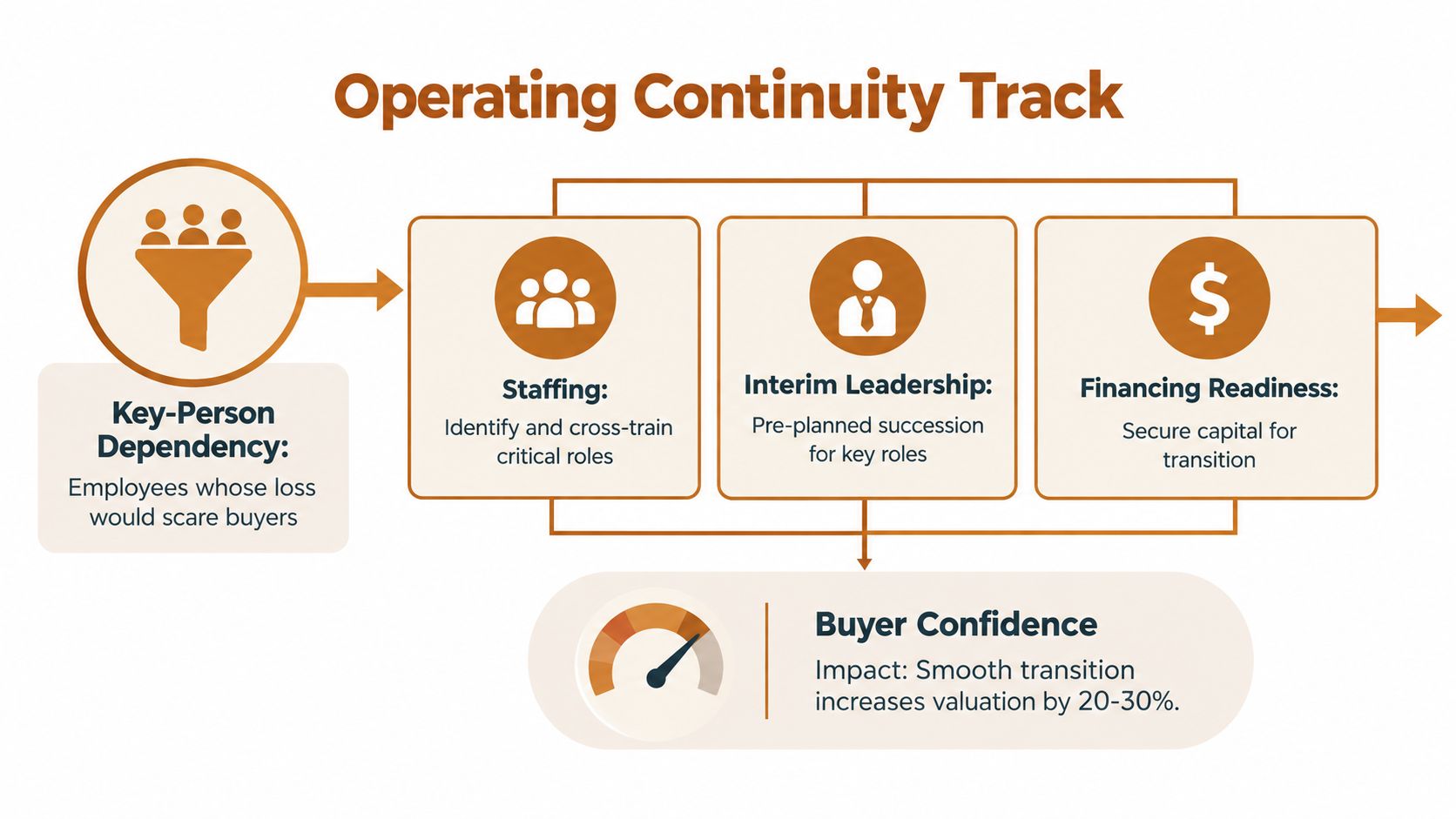
Financing must support the chosen structure. Potential components include SBA 7(a) financing, buyer equity, seller financing, seller notes, and earnouts. Each shifts risk differently between buyer and seller. A seller note can make a management buyout possible, but it also makes the seller a creditor after retirement. An earnout can bridge disagreement over value, but it ties proceeds to post-close performance and control you may no longer possess.
Review seller financing for small business before committing to a structure. Engage a fractional CEO when the business lacks an interim operator, an SBA-experienced lender when debt will fund the transfer, and an M&A advisor when buyer qualification, negotiation, or diligence will consume the owner’s operating time.
Create a one-page control sheet with four columns: key person, backup owner, retention action, and capital dependency. Update it alongside the broader timeline so staffing decisions don’t drift away from valuation, tax, or legal decisions.
A workable succession timeline starts with evidence, not an announcement. The first months are for finding weaknesses. The middle period is for making the business transferable. The final period is for executing a transaction or transfer with fewer surprises.
| Months | Owner Action | Specialist to Engage |
|---|---|---|
| 1 to 3 | Grade readiness, pull financial and legal records, map owner duties, identify key-person risks | Bookkeeper, controller, or fractional CFO if records need cleanup |
| 4 to 6 | Shortlist two exit paths, identify possible successors, begin market and value analysis | Valuation analyst at Month 4, tax advisor at Month 5, family-transition coach at Month 6 if relevant |
| 7 to 12 | Normalize earnings, build tax scenarios, document operations, review entity structure, and prepare successor development | M&A attorney at Month 7, business appraiser as valuation complexity requires |
| 13 to 18 | Match with buyers or successors, assemble capital, test leadership authority, and negotiate structure | Financing broker at Month 12, M&A advisor as buyer outreach begins |
| 19 to 24 | Execute LOI, manage diligence, finalize agreements, secure approvals, and complete closing mechanics | Transactional counsel, CPA, lender, estate attorney, and transition leadership team |
At Months 1 to 3, don’t market the company. Establish the facts. Pull bank records, contracts, payroll information, tax filings, customer data, and a complete list of decisions only the owner can make.
At Months 4 to 6, choose the two most plausible paths. A valuation analyst can show whether the business supports the owner’s financial expectations. A tax advisor can identify structural problems before they become transaction costs. If family ownership is possible, bring in a family-transition coach before relatives start campaigning for control.
At Months 7 to 12, turn the preferred path into a defensible plan. The attorney reviews governing documents and entity structure. The CPA models the tax result. The successor takes on real authority. The owner should be able to explain not only what the business is worth, but why the value is supportable.
At Months 13 to 18, financing and successor matching become concrete. Lenders need reliable financials, a credible operator, and a repayment story. Buyers need controlled access to diligence materials. Employees need operational continuity without premature disclosure that creates uncertainty.
At Months 19 to 24, treat the LOI as the start of execution, not the finish line. Run diligence through a secure process, track every request, resolve contract issues quickly, and keep the operating business stable while negotiations continue.
Owners who want a separate process reference can use this step-by-step succession planning guide, but the governing rule remains the same: make the next decision only after the previous decision has produced evidence.
A 2025 Gallup survey found that fewer than one in three small-business owners have a documented exit plan, as summarized by McKinsey and reported by Teamshares. The remedy isn’t another generic checklist. It’s a calendar with owners, deadlines, documents, and consequences for missed decisions.
The Owner’s Shortlist connects business owners with vetted specialists across valuation, taxes, legal and estate planning, financing, family transition, and team readiness. Visit The Owner’s Shortlist to review plain-language guides, compare relevant specialists, and choose the right professional before your succession timeline becomes an emergency.
Tell us your situation. We'll connect you with a specialist who works with owners like you. One conversation, no sales pressure.
Found this useful?
Add The Owner's Shortlist as a preferred source and get our articles highlighted in Google Search results.
Add to Preferred SourcesWhat is business succession planning? Learn the definition, transfer options, valuation, tax and legal steps, common pitfalls, and how
September 3, 2026
Learn what intergenerational wealth transfer means for owner-operated businesses. Explore structures, tax considerations, family governance, and next steps
August 30, 2026
What is buy sell agreement. Learn what is buy-sell agreement, how it works, common trigger events, funding methods, and next steps
August 26, 2026
Use this business succession planning checklist to prepare your valuation, finances, taxes, legal structure, team, family transition, and sale.
August 25, 2026