Sale-Leaseback: How to Sell Your Business and Keep the Building
Selling the business doesn't mean selling the building. Here's how a sale-leaseback works, what rent to charge, and what you give up along the way.
September 25, 2026
By Remi Taffin · September 2, 2026

You’ve found a business you want to buy. The cash flow looks workable, the seller has agreed on a price, and then the bank says it won’t fund the entire purchase. The seller, meanwhile, wants a clean exit and doesn’t love the idea of becoming your lender. That tension is where seller financing for small business transactions becomes practical, not theoretical.
Seller financing means the owner accepts part of the purchase price over time instead of receiving all proceeds at closing. The buyer gets a funding source that may fill a bank shortfall. The seller keeps a repayment claim against the buyer and the business. The deal succeeds or fails based on the structure, documentation, collateral, and the buyer’s ability to operate profitably after closing.
A buyer may qualify for a bank loan but still come up short after the lender applies its valuation, collateral, cash-flow, or equity requirements. A seller may have a willing buyer in front of them but no all-cash offer worth waiting for. In that situation, the owner can carry a portion of the price as a loan, allowing the transaction to close without forcing either side to solve the entire funding problem alone.
This arrangement appears often because seller financing has become a standard feature of many small-business transactions. Industry guidance reports that roughly 80% of small-business sales include some form of seller financing, while broader estimates range from 60% to 90%, depending on deal size and market conditions, as described in industry guidance on seller financing. In the lower middle market, the seller-financed portion is often about 10% to 20% of the purchase price, which shows the note usually bridges a capital gap rather than replacing senior financing.
Practical rule: Treat the seller note as a negotiated piece of the capital stack, not as proof that the buyer can afford the business.
The first question isn’t whether the seller will finance. The useful questions are more specific:
Buyers need seller financing because conventional funding may not cover the full price. Sellers use it to keep a credible transaction moving while spreading part of their proceeds over time. The negotiation becomes difficult when the buyer wants maximum control and the seller wants minimum exposure. The terms decide whether both sides can live with the risk.
Seller financing is a loan from the seller to the buyer. The buyer pays some consideration at closing and signs a promissory note for the balance the seller agrees to carry. That note states the principal, interest, payment schedule, maturity date, late-payment rules, default remedies, and any balloon balance.
The note is only one part of the arrangement. It creates the repayment obligation, but it doesn’t automatically give the seller a useful claim against the business or the buyer’s other assets. The parties need a separate security agreement and properly recorded collateral rights.
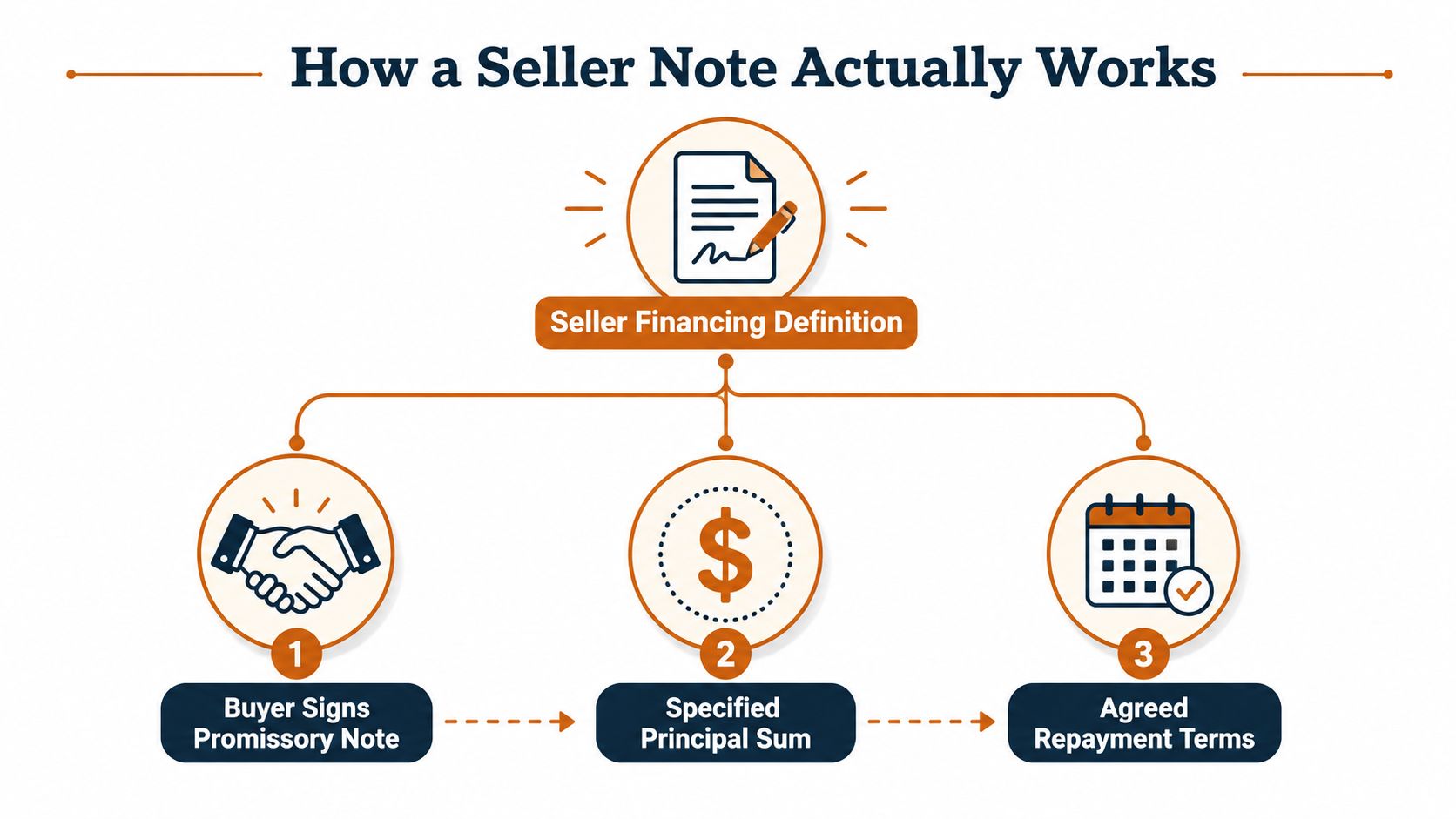
The promissory note answers, “How much does the buyer owe, and how will the buyer repay it?” A schedule with monthly principal and interest payments gives both parties a defined path. Interest-only payments may preserve buyer cash flow early, but they leave principal outstanding and can create a severe refinancing problem later.
A seller note can serve several roles:
A security agreement grants the seller rights in identified collateral. A UCC filing provides public notice of the seller’s claim on business assets, although the seller’s priority depends on existing liens and the intercreditor arrangement.
The seller may also seek a personal guarantee, a mortgage on real estate, or a pledge of other assets. None of these guarantees a full recovery. A struggling business may have declining asset value, and a bank with first priority may receive payment before the seller.
The capital stack matters because the same note can carry very different risk depending on its position. A secured junior note behind a senior lender is not equivalent to a note secured by unencumbered assets. Buyers should understand the restrictions attached to the note, while sellers should understand what they can seize or enforce if the business underperforms.
Market data exposes the central problem in seller financing for small business sales. Buyers often view the note as a way to reduce their cash requirement. Sellers view it as delayed consideration with credit risk. Those are different objectives, so the first offer rarely reflects a workable midpoint.
One survey found that 48% of business sales in 2023 involved seller financing, and seller financing appeared in 34% of transactions in the $5 million to $50 million range that year, compared with the 8% to 10% range reported in prior years, according to The Deal Sheet’s seller-financing guide. The same source reports that 90% of buyers expected seller financing to form part of their acquisition strategy, while only 29% of owners planned to offer it, and nearly half said they wouldn’t provide it.
Another market comparison reports that 22.8% of sellers planned to offer seller financing, while 62.3% of buyers were considering it. Buyers often seek 30% to 40% seller financing, while sellers are more comfortable around 10% to 20%, as covered in BizBuySell’s 2025 SBA seller-financing update. These figures shouldn’t be treated as a universal pricing sheet. They do show why a buyer’s opening request can feel aggressive to a seller, even when the buyer considers it normal.
| Term | Buyer Expectation | Typical Seller Offer |
|---|---|---|
| Seller-financed share | Often seeks 30% to 40% | Often more comfortable around 10% to 20% |
| Repayment period | Wants extended payments and manageable monthly debt service | Prefers a shorter path to repayment and a meaningful balloon |
| Senior lender interaction | Wants the seller note to solve the bank’s equity shortfall | Wants clear priority, payment rights, and protection from lender restrictions |
| Standby terms | Prefers immediate payment rights | May accept standby only when required by senior debt documents |
Neutral financing guidance places the seller’s share around 20% to 25% in many deals, with bank loans often funding 30% to 50% and equity contributing 30% to 35%, as explained in the Library of Congress guide to small-business financing. That mix illustrates the practical answer: seller debt frequently fills the gap left after senior debt and buyer equity are established.
Don’t negotiate from a headline percentage alone. First determine what the lender permits, what the business can repay, and how much risk the seller can carry without compromising their post-sale plans.
The right structure depends on the business’s cash flow, the quality of its records, its asset base, and the presence of a senior lender. A service company with dependable recurring work may support scheduled debt better than a volatile operation with thin records. An asset-heavy company may offer more tangible collateral than a goodwill-driven consulting practice, but its existing liens must be checked carefully.
| Structure | Typical Down Payment | Seller Note Size | Seller Position | Best Fit |
|---|---|---|---|---|
| Senior bank loan plus junior seller note | Buyer contributes negotiated equity alongside senior debt | Often a minority portion that fills the funding gap | Junior to the bank, subject to intercreditor terms | Stable cash flow with lender-quality records |
| Seller-financed down payment | Buyer brings some cash, seller note supports the required equity mix | Sized to the lender’s rules and the buyer’s shortfall | Often subordinated or placed on standby | Businesses where the bank approves the acquisition but the buyer needs help meeting equity requirements |
| Full seller carryback | Buyer contributes negotiated cash or other consideration | Covers most of the purchase price | Seller carries primary repayment exposure | Smaller transactions, motivated sellers, or businesses that don’t fit conventional underwriting |
This is usually the most balanced arrangement when a bank is willing to fund the business but not the entire price. The bank receives senior priority, and the seller note sits behind it. The seller may receive regular payments, but the bank’s documents can limit payment timing, additional debt, and enforcement actions.
This structure helps when the buyer has operating ability but lacks enough cash for the required equity contribution. The seller note may be permitted only under specific standby conditions. The 2025 SBA update described by BizBuySell says seller notes in SBA-backed deals can cover only 50% of the buyer’s equity injection and must remain on full standby during the loan term, which can make this option less attractive to sellers.
A full carryback can close a deal that no lender will touch, but it transfers underwriting responsibility from the bank to the seller. The seller must assess the buyer’s experience, liquidity, operating plan, and ability to withstand ordinary business volatility. If the seller needs a clean exit, this structure is usually the wrong answer.
A seller note can solve a real problem, but it can’t turn an unaffordable business into an affordable one. It changes the timing and source of payment. It doesn’t eliminate the purchase price, operating risk, or the need for reliable cash flow.
For buyers, the immediate benefit is lower cash required at closing. The note may bridge a bank shortfall, preserve working capital for payroll and inventory, and show that the seller has enough confidence to keep financial exposure after the sale. It can also give the buyer room to negotiate terms that a rigid lender wouldn’t offer.
For sellers, financing can widen the buyer pool and keep a transaction alive when bank underwriting falls short. Interest adds a return on the unpaid balance, and installment treatment may spread taxable gain over the payment period, subject to the seller’s tax situation and professional advice.
The buyer exchanges lower upfront cash needs for a continuing obligation. A balloon payment can create refinancing risk. A personal guarantee can put personal assets at risk. Covenants may restrict additional borrowing, asset sales, distributions, or major operating changes.
The most dangerous mistake is using the note to justify a price the business cannot support. If debt service works only under optimistic projections, the seller note has hidden an overvaluation rather than solved a financing issue.
The seller keeps credit exposure after handing over control. If the buyer defaults, the seller may face collection costs, declining collateral value, and a difficult choice between enforcing rights and preserving the business’s going-concern value. A junior seller note is especially vulnerable when senior debt absorbs available cash flow or collateral proceeds.
The seller note is valuable only if the buyer can repay it and the documents let the seller enforce it.
Sellers should also examine their personal objective. A higher nominal price with delayed payments may be sensible for an owner seeking income, but it conflicts with a seller who needs liquidity, certainty, or a clean break. Buyers should make the same assessment from the other side: a lower cash requirement isn’t useful if the repayment schedule leaves no room to operate.
A handshake may establish trust, but it won’t define priority, collateral, or remedies. The note should be drafted as a real credit instrument, with the same seriousness applied to any commercial loan.
The core documents usually include:
Sellers shouldn’t approve a buyer based on enthusiasm or a polished business plan. Review personal and business financial statements, tax returns, existing debt, credit history, relevant operating experience, and the source of the buyer’s equity.
Then test the business itself:
Financial covenants can require timely reporting, minimum liquidity, limits on new debt, or restrictions on distributions. They should protect the seller without making ordinary operations impossible. A covenant that triggers a technical default over a manageable reporting delay creates conflict instead of protection.
The documents should also address notice, cure periods, acceleration, collection costs, insurance, maintenance of collateral, and what happens after a change of ownership. Have a business attorney coordinate these terms with any bank loan documents. A CPA should review tax treatment before the parties sign, especially when payments cross tax years.
Most seller-financed negotiations fail because the parties argue over the note percentage while ignoring the other levers. A buyer may accept a smaller note if the term reduces monthly pressure. A seller may carry more if the buyer offers stronger collateral, a personal guarantee, or a faster payoff path.
Interest rate should compensate the seller for delayed payment and risk, but it shouldn’t make the business impossible to operate. A fully amortizing note at a commercially sensible rate can be better for both sides than a low-rate structure with a large balloon. Don’t use an invented market rate as a negotiating weapon. Price the risk based on senior debt, collateral, cash flow, buyer strength, and enforcement limits.
Term length changes monthly debt service and refinancing exposure. A shorter term protects the seller and increases payment pressure. A longer term improves affordability but keeps the seller tied to the business for longer.
Down payment and equity mix should reflect the buyer’s actual liquidity. Cash at closing gives the seller immediate recovery and gives the buyer meaningful commitment. A seller note can cover a shortfall, but the buyer shouldn’t drain every operating reserve to create a larger upfront payment.
Balloon timing deserves more attention than it usually gets. Ask where the payoff will come from. If the buyer expects refinancing, identify the assumptions behind that plan and what happens if refinancing isn’t available.
Standby provisions must be written precisely. “On standby” can affect payment rights, default remedies, and enforcement. A buyer should understand the restriction, and a seller should know whether the limitation is acceptable before signing.
A small price concession tied to a faster payoff can protect the seller’s effective yield more effectively than holding firm on price while accepting weak repayment terms. Purchase price is often the least flexible lever in a competitive sale. Rate, term, collateral, guarantees, and equity mix usually offer more room to create a workable package.
Use the video below as a conversation starter, not as a substitute for transaction-specific legal and financial advice.
Bring in a specialist before signing when the seller note is large enough to change the seller’s retirement, tax, or liquidity plan. A note exceeding 40% of the purchase price deserves independent financing and legal review because the seller is no longer making a minor accommodation. The same applies when a seller carry crosses two tax years, when the buyer requests a multi-year interest-only period, or when the deal includes real estate or heavy equipment requiring separate liens.
The buyer’s file also tells you when to stop improvising. Missing tax returns, incomplete financial statements, unclear debt, weak operating experience, or a business plan built on unsupported projections should trigger deeper underwriting. If reported EBITDA swings more than 20% year over year, the parties need to understand whether that movement reflects seasonality, customer loss, owner adjustments, capital spending, or a structural decline.
The seller’s objective should drive the structure. An owner seeking maximum cash at closing should resist a large carryback. An owner prioritizing a broader buyer pool may accept a note with strong protections. An owner who wants continued involvement needs transition terms, reporting rights, and a defined end date for that involvement.
The buyer should be equally candid. If the business requires working capital, don’t offer a down payment that leaves no cushion. If the buyer expects to grow through new borrowing, negotiate covenant flexibility before closing. Seller financing can bridge a transaction, but it won’t repair weak cash flow, unclear ownership of assets, or an unrealistic valuation.
For practical guidance on seller notes, deal structure, valuation, taxes, and legal preparation, visit The Owner’s Shortlist. Its curated directory and plain-language resources help business owners identify the right financing, legal, tax, and valuation specialist before signing a seller-financed agreement.
Tell us your situation. We'll connect you with a specialist who works with owners like you. One conversation, no sales pressure.
Found this useful?
Add The Owner's Shortlist as a preferred source and get our articles highlighted in Google Search results.
Add to Preferred SourcesSelling the business doesn't mean selling the building. Here's how a sale-leaseback works, what rent to charge, and what you give up along the way.
September 25, 2026
Business loan vs line of credit explained for owners. Compare cost, flexibility, collateral, cash-flow impact, and the right scenarios for trades and SMBs.
September 24, 2026
Understand seller financing tax implications for owners, from installment sale rules and capital gains to depreciation recapture and state tax considerations.
September 16, 2026
Learn what is seller financing, how it structures business sales, and why 80% of small deals use it. Clear examples, math, and red flags for owners.
September 6, 2026