Sale-Leaseback: How to Sell Your Business and Keep the Building
Selling the business doesn't mean selling the building. Here's how a sale-leaseback works, what rent to charge, and what you give up along the way.
September 25, 2026
By Remi Taffin · August 19, 2026

Most advice about how to do seller financing starts with a template: choose a down payment, write a promissory note, file a lien, and collect monthly payments. That approach is incomplete. A seller note can help close a strong transaction, but it can also leave an owner acting as an undersecured lender to a buyer who can’t operate the business or refinance the balance.
The right structure depends on deal size, buyer quality, financing conditions, business cash flow, and the seller’s tolerance for delayed payment. Smaller owner-operated transactions often rely more heavily on seller financing, while larger deals typically use the note as one component in a broader capital stack. The terms matter, but enforcement matters just as much.
Seller financing isn’t automatically a sign of a good deal. It’s a negotiation instrument, and its usefulness changes sharply as transaction size increases.
Industry guides place seller financing in roughly 60% to 90% of small-business sales, with some U.S. reports narrowing the figure to about 80% or approximately 90%. Industry guidance on seller financing structures explains why the method is so common. Many buyers don’t have enough cash to fund an acquisition, and conventional lenders rarely cover the entire purchase price. The seller note fills part of that gap.
That pattern doesn’t carry over unchanged into larger transactions. In many Main Street and lower-middle-market deals, seller notes have historically covered roughly 10% to 16% of deal value, while the seller-financed portion falls to around 5% for transactions between $5 million and $50 million, according to market reporting on lower-middle-market transaction structures. A buyer may still ask for a note, but the seller’s role is less often to finance the acquisition and more often to support the financing stack, bridge a valuation gap, or demonstrate confidence in the business.

Ask what you’re trying to accomplish before discussing interest rates.
The buyer-seller expectation gap is significant. BizBuySell’s Insight Report says about 90% of buyers expect seller financing to form part of their acquisition strategy, while only 29% of owners plan to offer it, and almost half say they won’t provide it at all. That mismatch gives a willing seller a negotiating advantage, but it also shows why owners shouldn’t assume that offering a note is a standard practice.
A practical decision rule is simple. Use seller financing when the buyer is credible, the business can support the debt, and the note improves the overall risk-adjusted outcome. Push for more cash at close when the buyer needs an unusually large note, has thin equity, lacks operating experience, or wants the seller to absorb nearly all financing risk.
Practical rule: A seller note should solve a defined transaction problem. It shouldn’t exist merely because the buyer asks for it.
A seller-financed sale needs more than a sentence in the purchase agreement saying the buyer will pay later. The promissory note should stand as a separate, enforceable debt instrument, supported by security documents that match the assets and ownership structure involved.
A common small- to mid-market structure finances about 10% to 30% of the purchase price, with three- to five-year terms, monthly or quarterly amortizing payments, and interest commonly in the 5% to 8% range, according to guidance on practical seller-financing terms. Those figures are starting points for negotiation, not a universal prescription.
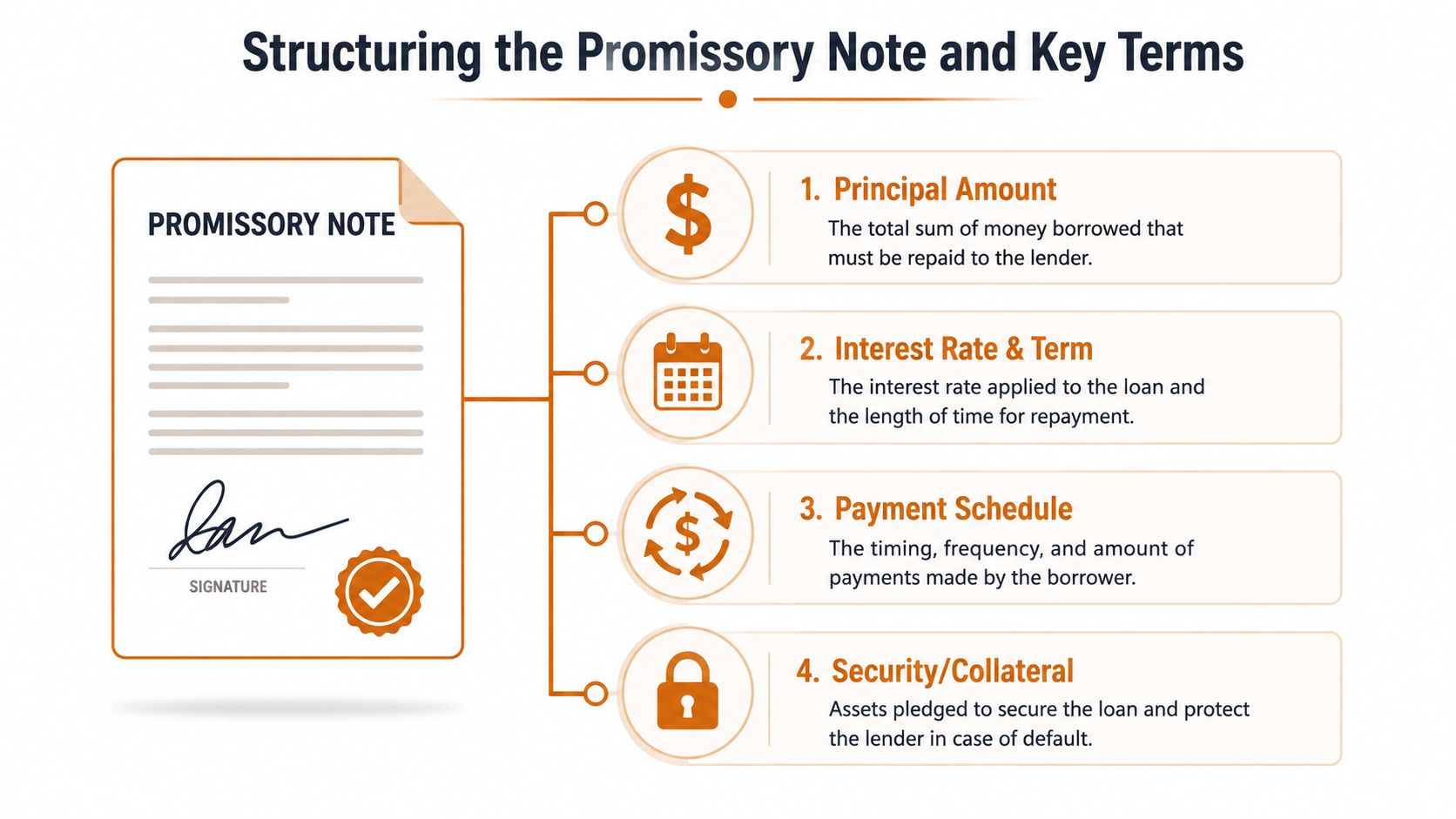
Principal amount is the unpaid purchase price financed by the seller. A down payment commonly ranges from 10% to 50% of the purchase price, based on seller-financing market guidance. A larger down payment reduces the outstanding balance and gives the buyer meaningful financial exposure from day one.
Interest and term determine both the seller’s return and the buyer’s debt burden. A shorter term can reduce the period of exposure, but it may create a payment the business can’t comfortably support. A longer term may improve affordability while leaving the seller exposed to operational deterioration for longer.
Payment schedule should specify the first payment date, due date, application of payments between interest and principal, late charges, payment method, and whether prepayment is allowed without penalty. A balloon payment can make a deal easier to close, but it creates refinancing risk for the buyer and repayment risk for the seller.
For SBA-backed transactions, a 12- to 24-month standby period is common, according to seller-financing guidance for SBA-backed deals. If payments are delayed, the seller should model household and business liquidity without relying on expected note income.
Security and recourse determine what the seller can pursue after default. Recourse may include a personal guarantee, while non-recourse terms limit recovery to specified collateral. The note should identify the collateral, the seller’s priority relative to bank lenders, permitted liens, insurance obligations, restrictions on asset transfers, and the buyer’s obligation to preserve business records.
For a plain-English explanation of the instrument itself, see what a seller’s note is in a business sale. The legal documents should then be drafted for the actual transaction, not copied from a generic form.
A note also needs clear default definitions. Missing a payment, violating a financial covenant, selling collateral, failing to maintain insurance, or misrepresenting financial information may each require different notice and cure periods. Have counsel coordinate the note, security agreement, purchase agreement, guarantees, and any lender subordination documents so one document doesn’t undermine another.
A buyer’s enthusiasm isn’t underwriting. Before accepting a note, the seller needs evidence that the buyer can operate the company and service the debt under ordinary conditions, not only under an optimistic forecast.
Start with the buyer’s personal financial statement, credit history, tax returns where appropriate, financing commitments, and source of equity. Review the buyer’s experience in the industry and their plan for retaining employees, customers, vendors, and key managers. A technically qualified buyer may still struggle if they haven’t managed working capital, payroll, collections, or vendor relationships.

The buyer should provide a credible operating model showing how the business will fund debt service after closing. Test the model against weaker sales, delayed customer payments, margin pressure, and the loss of a key employee. You don’t need to invent a precise stress-case percentage to identify the issue. You need to see whether the company still has room to make payments when results aren’t perfect.
A larger down payment serves two purposes. It reduces the seller’s principal exposure, and it demonstrates that the buyer has meaningful capital at risk. A buyer who wants the seller to finance most of the purchase while contributing little equity may be asking the seller to underwrite both the acquisition and the buyer’s learning curve.
The seller is often the lender of last resort. Treat the buyer’s repayment capacity with the same seriousness a bank would.
Security should be layered rather than symbolic:
The seller should also confirm whether a senior bank lender requires subordination or a standby agreement. A seller may have a valid lien and still face practical limits on collection if another lender has priority.
For a focused process for assessing the buyer, use this guide to checking out a business buyer. If the buyer can’t provide consistent financial information, resists reasonable security, or refuses a personal guarantee without offering equivalent protection, slow the transaction down. Those objections reveal risk before the note is outstanding.
Seller financing, an earnout, and cash at close shift risk in different directions. The mistake is treating them as interchangeable ways to justify a price.
A seller note creates a fixed payment obligation. If the buyer signs a properly drafted note, payments are due according to its terms whether the business performs above expectations or falls short, although collection still depends on the buyer’s ability to pay and the seller’s remedies. An earnout makes part of the price contingent on future performance. It can preserve upside, but it also creates disputes over accounting, business decisions, expenses, customer allocation, and the measurement period.
A cash-heavy deal gives the seller the greatest closing certainty but may require accepting a lower headline price or waiting while the buyer secures more capital. That trade can be worthwhile when the seller values liquidity more than future interest income.
| Structure | Seller’s main advantage | Seller’s main exposure |
|---|---|---|
| Seller financing | Contractual payments and interest income | Buyer default, collateral recovery, and delayed liquidity |
| Earnout | Potential to capture future performance value | Measurement disputes and dependence on post-closing decisions |
| Cash at close | Maximum payment certainty at closing | Possible pressure on price or buyer affordability |
Guidance on earnouts in business sales is useful when the valuation disagreement concerns future growth that neither party can confidently price today. An earnout should define the metric, accounting rules, reporting access, buyer conduct obligations, dispute process, and consequences if the business is sold or materially changed.
The broader market has moved toward shared-risk structures. Seller financing and earnouts together reached 50.2% of transactions in 2025, the highest level tracked since 2020, according to the cited market report. That doesn’t mean every seller should accept more contingent consideration. It means buyers and sellers are increasingly negotiating how to divide uncertainty rather than pretending the valuation question can always be solved at closing.
For larger small-business transactions, stronger buyer equity and more cash at close may preserve more certainty than stretching a seller note. For an owner-operated company with stable recurring revenue and a well-qualified buyer, a moderate note may be the cleaner solution. For a business whose value depends heavily on the seller’s relationships or future performance, an earnout may create more conflict than protection.
Choose the structure that fits the uncertainty. Don’t use a note to conceal a weak buyer, and don’t use an earnout to disguise a price that neither side can defend.
The closing process should make enforcement easier, not merely transfer ownership. Before signing, confirm that the purchase agreement, promissory note, security agreement, guarantees, lien filings, insurance requirements, and lender consents all describe the same transaction.
Keep the debt separate from the purchase agreement. A standalone note should state the principal, interest, maturity, payment schedule, late charges, prepayment rights, notices, governing law, waiver provisions, and events of default. The security agreement should identify the collateral and explain how the seller can exercise remedies, subject to applicable law and any senior lender rights.
The documents should distinguish between a missed payment and a serious breach. They should state how the seller gives notice, how long the buyer has to cure, and when the seller can accelerate the unpaid balance. Acceleration means the seller may demand the outstanding debt instead of waiting for future installments, but its enforceability depends on the documents and governing law.
If a payment is missed, act promptly:
The seller’s recovery options depend on the collateral. Equipment may be repossessed or sold under applicable commercial rules. Inventory and receivables require careful handling because customer relationships, proceeds, and competing liens complicate recovery. A personal guarantee can widen the recovery path, but it doesn’t guarantee that the guarantor has collectible assets.
A lien you never filed, a guarantee you never signed, or a notice you never delivered may provide no practical protection after default.
Default risk is not theoretical. One industry source estimates seller-note defaults at roughly 2% to 5%, and seller-financing risk guidance identifies oversized notes, weak buyer vetting, and insufficient security as common pitfalls. The response isn’t to eliminate every risk. It’s to limit exposure, document the debt correctly, and maintain remedies that match the assets.
Tax planning belongs before closing. An installment sale may spread recognition as payments arrive, but the outcome depends on the transaction’s asset allocation, interest treatment, depreciation recapture, entity structure, and applicable tax rules. Ask a tax professional to model both the timing of taxable income and the consequences of a buyer default before you agree to delayed payment.
Owners can negotiate commercial terms themselves, but seller financing becomes dangerous when the documents, tax consequences, or valuation assumptions exceed their experience. A generic form won’t identify priority issues, protect a complex collateral package, or model the effect of delayed cash receipts.
Bring in a valuation specialist when the buyer disputes the price, the company has several revenue streams, goodwill represents a major part of value, or the business depends heavily on the owner’s personal relationships. An independent valuation can separate transferable earnings from owner-specific income and give both sides a defensible basis for negotiating the cash portion, note amount, and any contingent consideration.
Legal review is essential for multi-entity businesses, asset sales involving intellectual property, real estate, equipment leases, existing bank debt, family transfers, and transactions with restrictive covenants. Counsel should coordinate the purchase agreement with the note, security agreement, UCC filings, guarantees, subordination terms, insurance provisions, and default remedies. If the buyer is inexperienced, the documents need to protect the seller without creating obligations the business can’t realistically meet.
Tax advice should come before terms are final, not after the closing statement is prepared. Ask the adviser to review allocation, installment treatment, interest, recapture, entity-level taxes, and the seller’s cash needs during the repayment period. Estate and succession counsel may also be necessary when the note will become part of the seller’s estate or when family members are involved.
Choose specialists who regularly work with owner-operated companies, not only large corporate acquisitions. Ask what types of transactions they handle, whether they understand trades and service businesses, how they approach buyer default, and whether they coordinate with the broker, lender, accountant, and closing attorney. A specialist who can explain the downside in plain English is more useful than one who only presents an elegant structure.
The Owner’s Shortlist provides a curated directory of specialists across valuation, taxes, legal and estate planning, financing, succession, and related owner decisions. You can use The Owner’s Shortlist to review plain-language resources and identify advisers suited to a seller-financed business transition.
Don’t sign a seller note until you can answer three questions in writing: how much cash you need at closing, how the buyer will repay the note, and exactly what you can do if repayment stops. If any answer depends on hope, revise the structure or bring in the specialist who can close the gap.
Visit The Owner’s Shortlist to compare vetted valuation, tax, legal, financing, and succession specialists for an owner-operated business sale. Use its practical guides to clarify your seller-note options before contacting an adviser and negotiating final terms.
Tell us your situation. We'll connect you with a specialist who works with owners like you. One conversation, no sales pressure.
Found this useful?
Add The Owner's Shortlist as a preferred source and get our articles highlighted in Google Search results.
Add to Preferred SourcesSelling the business doesn't mean selling the building. Here's how a sale-leaseback works, what rent to charge, and what you give up along the way.
September 25, 2026
Business loan vs line of credit explained for owners. Compare cost, flexibility, collateral, cash-flow impact, and the right scenarios for trades and SMBs.
September 24, 2026
Understand seller financing tax implications for owners, from installment sale rules and capital gains to depreciation recapture and state tax considerations.
September 16, 2026
Learn what is seller financing, how it structures business sales, and why 80% of small deals use it. Clear examples, math, and red flags for owners.
September 6, 2026