Sale-Leaseback: How to Sell Your Business and Keep the Building
Selling the business doesn't mean selling the building. Here's how a sale-leaseback works, what rent to charge, and what you give up along the way.
September 25, 2026
By Remi Taffin · September 6, 2026 · Updated October 12, 2026
Seller financing is a deferred-payment structure where the seller acts as the lender, carrying part of the purchase price in a promissory note that the buyer repays over time. Roughly 80% to 86% of small-business sales include some form of seller financing, so it isn’t a niche workaround reserved for distressed companies.
For an owner-operated business seller, the important point is this: you aren’t just agreeing to a different payment schedule. You’re accepting credit risk after closing. Part of your sale proceeds becomes a loan, often sitting behind bank or SBA debt, and your outcome depends on the buyer’s ability to operate the company and make the required payments.
That makes seller financing a capital-structure decision, not merely a way to defend your asking price. It can bridge the gap between buyer cash, senior lender proceeds, and your valuation expectations. It can also leave you enforcing a secured claim against a business you used to own. The terms matter more than the label.
Seller financing means the seller accepts a promise to be paid later instead of receiving the entire purchase price at closing. The buyer receives ownership of the business, signs a promissory note, and pays principal and interest according to an agreed schedule.
The seller is effectively lending money to the buyer. In a business sale, the note commonly carries a minority portion of the purchase price, often around 10% to 20%, with reported terms around five years and interest rates in the 6% to 8% range, according to industry guidance on seller financing.

Seller financing appears frequently because a buyer’s financing rarely lines up perfectly with a seller’s expectations. A bank may lend against predictable cash flow and tangible assets but remain cautious about goodwill, customer relationships, owner reputation, or other intangible value. The buyer may have enough capital to make the acquisition work, but not enough to pay every dollar at closing.
The note fills that gap. It allows the buyer to preserve operating cash and gives the seller a path to a higher total consideration than the buyer could fund entirely with cash and senior debt. It also gives both sides a way to keep negotiating when the business is viable but the financing package falls short.
The structure has become standard enough that one market report cited in industry commentary found seller carry in roughly 86% of closed small-business transactions in 2024, while another industry guide puts the broader prevalence at about 80%. Those figures come from different sources and should not be treated as a precise universal rate, but they point to the same practical conclusion: seller financing is a mainstream deal feature.
Practical rule: Treat every seller note as a loan you may have to collect, not as sale proceeds you already possess.
If your business sells for an agreed price, the buyer might bring cash, obtain a bank loan, and ask you to carry the remaining balance. You receive the cash portion at closing. The unpaid portion becomes a note, and the buyer sends you scheduled payments after the transaction.
That arrangement changes the risk allocation. A cash seller has liquidity but no continuing repayment exposure. A seller carrying a note has an ongoing income stream, but also depends on the buyer’s management, the company’s cash flow, and the legal protections in the documents.
Seller financing can therefore help a good deal close. It doesn’t make a weak buyer stronger, and it doesn’t turn an unsupported valuation into a safe receivable.
A seller note has four basic economic components: principal, interest, repayment timing, and default protection. The purchase agreement should address those terms before closing. Don’t accept a vague promise that the note details will be finalized later, because the buyer gains an advantage after the broader deal is already difficult to unwind.
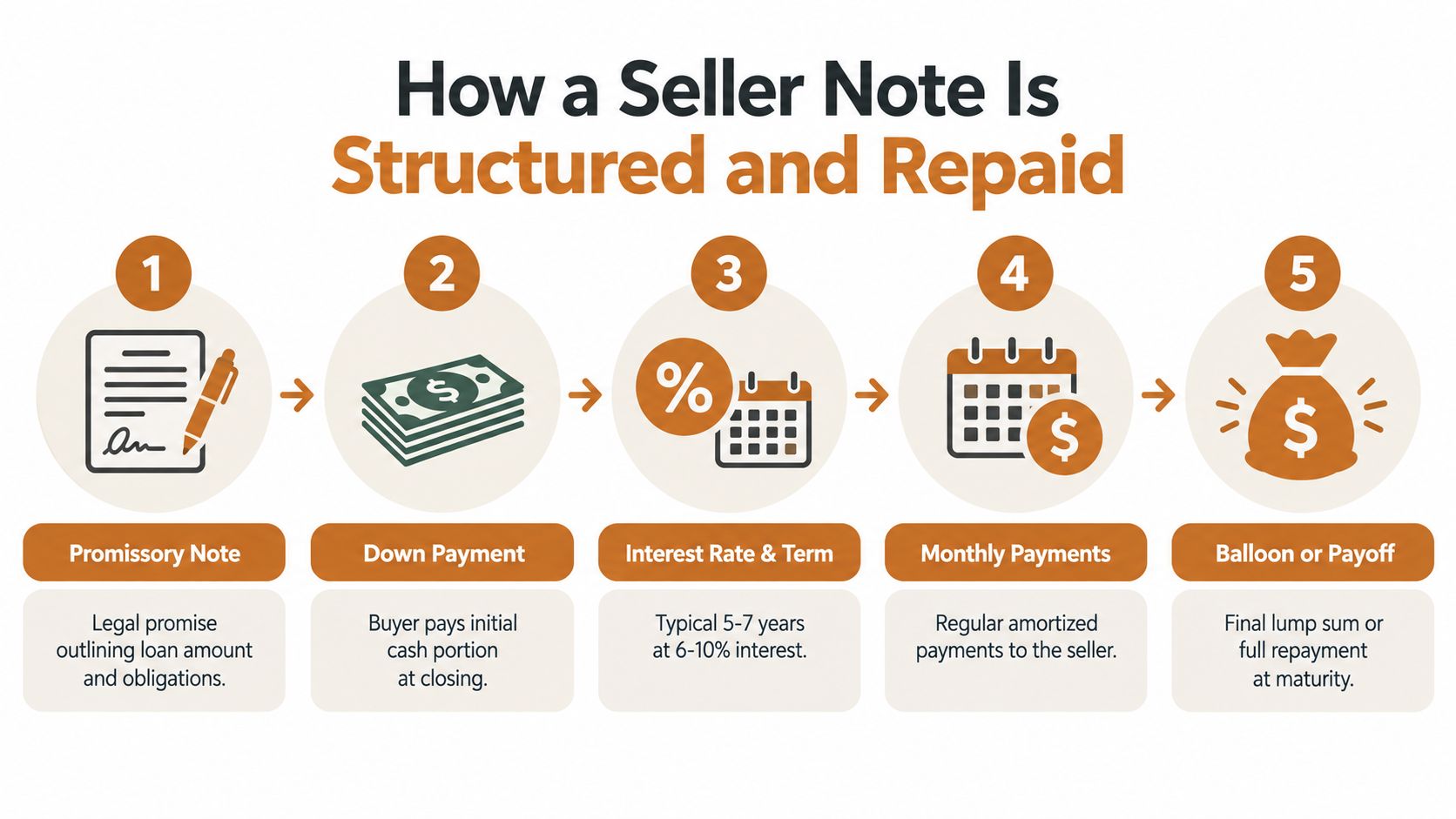
The principal is the amount the seller carries. Interest compensates the seller for waiting and for taking buyer credit risk. The note also needs an amortization schedule, payment dates, maturity date, prepayment rules, and consequences for missed payments.
A note may require regular installments with a larger balloon payment at maturity. That structure lowers periodic payments but creates a refinancing risk for the buyer and a collection risk for the seller. If the buyer expects to refinance the balloon, the underwriting should address whether the business can support that future debt.
Industry guidance reports seller notes commonly using terms around five years and interest rates in the 6% to 8% range, though the negotiated rate depends on senior debt, collateral, buyer strength, cash flow, and the seller’s negotiating position. The figures are reference points, not automatic terms. Seller-financing guidance explains the common structure and risk allocation.
Consider a hypothetical HVAC company with a purchase price of $1,000,000. The buyer pays $200,000 in cash, obtains $600,000 from a bank, and asks the seller to carry $200,000. At an illustrative 7% annual interest rate amortized over five years, the seller would receive scheduled monthly payments calculated from that principal, rate, and amortization period, with the exact payment determined by the note’s formula. If the note instead uses a shorter amortization with a balloon, the monthly payment changes and the unpaid balance comes due earlier.
The point isn’t the calculator result. The point is that the seller has not received $200,000 at closing. The seller has received a contractual claim whose value depends on enforceability and repayment.
When a bank or SBA lender finances the acquisition, the seller note is commonly subordinated to the senior facility. That means the senior lender generally has priority in a default, and the seller may need permission before enforcing remedies or receiving certain payments.
The seller should ask for appropriate security, usually through a security agreement and a UCC filing that helps perfect collateral rights. A personal guarantee may also matter, especially when the buyer uses a new acquisition entity with few assets outside the business.
The note, security documents, subordination agreement, guarantees, and purchase agreement must work together. A strong interest rate won’t rescue a note with weak collateral language or an unclear remedy after default.
A short explainer can help buyers understand the concept, but your attorney must draft and coordinate the documents for the actual transaction.
Seller financing makes a transaction more financeable, but it doesn’t eliminate risk. It moves risk from one party to the other and creates obligations that continue after ownership changes hands.
For sellers, the attraction is obvious. A note can expand the buyer pool, support a transaction that bank financing alone won’t fund, and create interest income. In many jurisdictions, installment-sale treatment may allow gain to be recognized as payments are received rather than entirely at closing, although the tax result depends on the transaction and the seller’s circumstances. A practical overview of seller financing discusses tax timing, buyer access, and credit exposure.
The cost is equally clear. You lose immediate liquidity on the carried portion, accept the buyer’s repayment risk, and may sit behind a senior lender. If the buyer defaults, you may need to enforce a secured claim rather than just reclaim the business.
For buyers, the note reduces the cash required at closing and can finance goodwill or intangible value that a bank may discount. The buyer may also gain flexibility on payment timing. But the buyer pays interest, must meet the note alongside payroll and working-capital needs, and could face a balloon or accelerated balance after default.
| Party | Advantages | Disadvantages |
|---|---|---|
| Seller | More deal flexibility: Can bridge a financing gap and reach buyers who cannot fund the full price at closing. Tax timing: May qualify for installment-sale treatment where applicable. Ongoing return: Receives principal and interest under the note. | Credit risk: Repayment depends on the buyer and business cash flow. Lower priority: Senior bank or SBA debt may rank ahead of the seller. Reduced liquidity: Capital remains tied up after closing. |
| Buyer | Lower upfront cash need: Combines buyer funds, senior debt, and seller credit. Goodwill financing: Makes intangible value more fundable. Negotiated terms: May offer flexibility unavailable from a conventional lender. | Additional debt service: Payments compete with operating needs. Interest cost: Total repayment exceeds principal. Default exposure: Missed payments can trigger remedies, acceleration, or loss of collateral. |
My recommendation to sellers is simple: don’t carry a note solely to preserve a headline price. Carry it when the buyer is credible, the business produces dependable cash flow, the documents give you practical protection, and the return compensates you for delayed payment and subordinated risk.
The old explanation, “the seller acts like the bank,” is incomplete for an SBA-backed acquisition. In those deals, the seller note may be governed by lender and program requirements that limit when the seller can be paid and how much of the buyer’s equity it can satisfy.
Recent 2025 commentary says qualifying seller notes may cover only 50% of the buyer’s required equity injection, often translating to about 5% of total project cost, and may need to remain on full standby for the full SBA term. The SBA-focused discussion of seller financing rules explains those constraints.

Full standby can mean the seller cannot receive ordinary payments on the note while the senior SBA facility remains subject to its required conditions. That changes the seller’s expected cash flow and may reduce the seller’s willingness to accept a note as part of the price.
A seller who expects monthly income may instead discover that the note is effectively frozen for a substantial period. The buyer gets a lower cash burden at closing, but the seller takes delayed recovery without the ordinary payment stream that justified carrying the paper.
Don’t negotiate the seller note in isolation. Ask the SBA lender, before signing a letter of intent, whether the proposed note qualifies, what standby language is required, whether payments are restricted, and how the note interacts with the equity injection.
Tighter capital conditions have pushed buyers and sellers toward structures that combine seller financing with earnouts, contingencies, and operating performance requirements. Deal-term reporting for 2025 found seller financing and earnouts in 50.2% of transactions, the highest level in the tracked 2020 to 2025 period, while another market report says seller notes appeared in 60% of winning LOIs in the $10 million to $25 million range. The reported transaction-term data describes this broader shift.
That doesn’t mean every seller should agree to more complicated terms. It means the note is increasingly being used as part of a negotiated risk-sharing package. Buyers may seek protection against overpaying, while sellers seek protection against underfunding. The result can be workable, but only when the performance definitions, payment priority, reporting rights, and default remedies are precise.
Seller warning: A seller note may help close the deal, but SBA compliance can determine whether it functions as income, standby paper, or delayed recovery.
Consider a plumbing company owned by an operator who wants to exit but doesn’t want to sell at a price dictated solely by a buyer’s available cash. A qualified buyer offers a combination of cash, senior financing, and a seller note.
The seller receives the cash and bank proceeds at closing. The remaining balance becomes a note payable by the buyer’s acquisition company. The purchase agreement identifies the interest rate, payment frequency, maturity, collateral, personal guarantee, and the conditions under which the note can be prepaid.
The seller’s economics now have two parts. The first is the money received at closing. The second is the future principal and interest stream, which is valuable only if the buyer continues operating the company successfully and honors the note.
The seller shouldn’t disappear immediately after signing. If the transition agreement includes training or customer handoff obligations, those responsibilities should be separate from the credit terms and clearly defined. The seller also needs a reporting package that shows whether the business is meeting obligations without giving the former owner operational control.
A missed payment is not automatically a reason to seize the company. The seller must follow the note, security agreement, senior lender restrictions, and applicable law. A UCC filing may help establish collateral priority, but it doesn’t replace proper default notices, cure periods, and enforcement procedures.
If the buyer struggles because a major customer leaves, working capital tightens, or the owner can’t manage the operation, the seller faces an unpleasant choice. The seller can pursue collection, negotiate a restructure, or enforce available remedies. Recovering the business may sound attractive, but the former owner may not want to resume employees, leases, vendors, and customer obligations.
The buyer may be capable of running the plumbing company but unable to fund every dollar of goodwill at closing. Seller credit can preserve liquidity for payroll, vehicles, inventory, marketing, and the transition itself. That can make the transaction more practical than requiring the buyer to drain operating reserves.
The seller may also prefer a note to accepting a lower all-cash offer. But the seller should compare the choices based on risk-adjusted value, not nominal price. A larger offer with weak security and an unrealistic payment schedule may be worse than a lower offer with stronger cash at closing, credible senior financing, and enforceable protections.
The right question isn’t, “What price did I get?” Ask, “How much cash do I receive, how much remains at risk, and what can I do if repayment stops?”
Seller financing becomes dangerous when the documents describe an intention instead of a complete lending arrangement. The note should state the principal, interest, payment dates, maturity, amortization, prepayment treatment, late charges, default triggers, cure rights, and remedies.
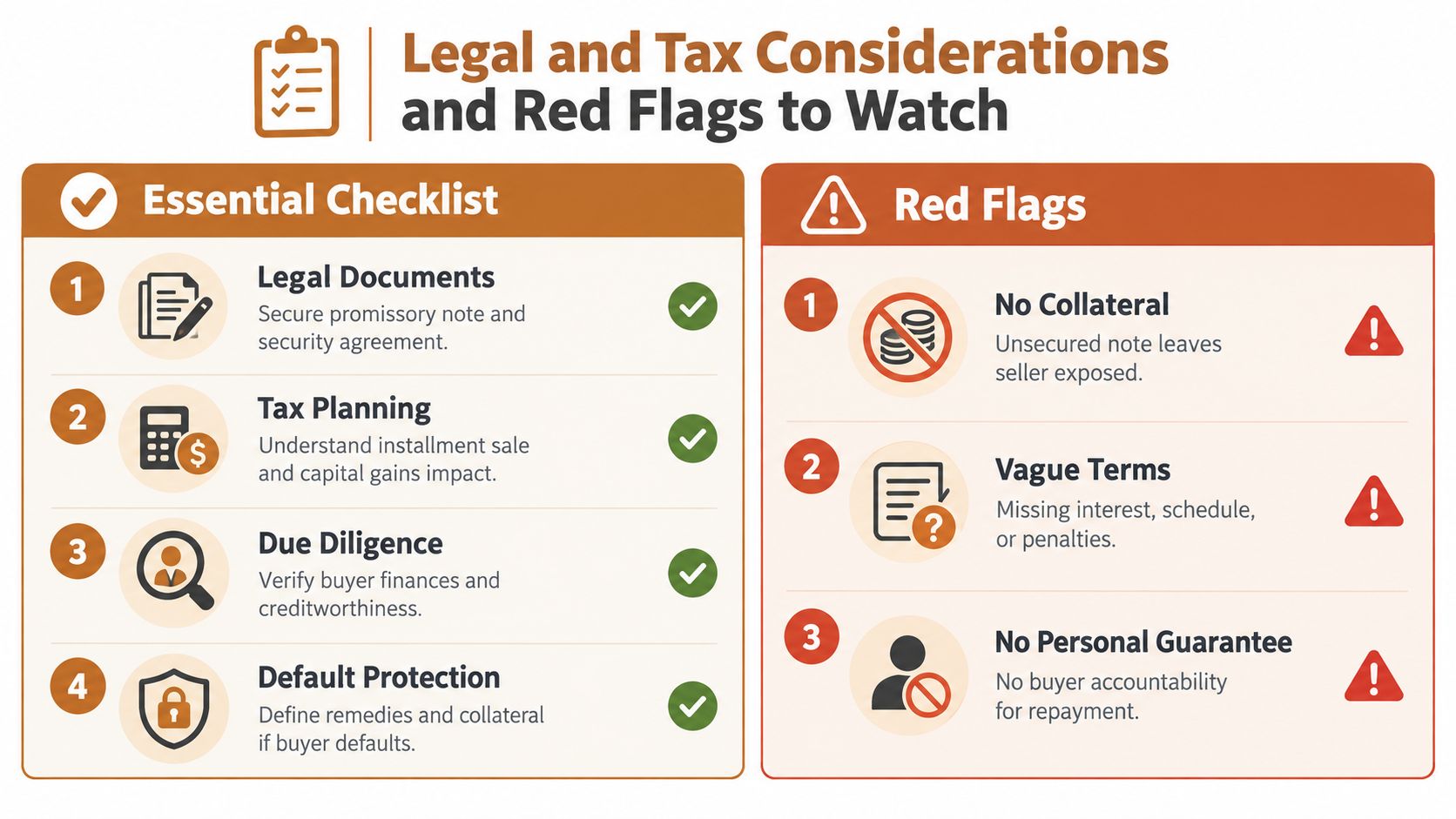
Use a promissory note for the repayment obligation and a security agreement for collateral rights. A UCC filing may perfect the seller’s interest, but counsel must confirm the collateral description, filing position, permitted liens, and any senior lender consent.
If a bank or SBA lender is involved, review the subordination agreement line by line. It may restrict payments, enforcement, amendments, and the seller’s ability to exercise remedies after default.
Ask your attorney:
Installment-sale treatment may align gain recognition with payments received, but it isn’t automatic and doesn’t eliminate tax. The seller should ask a tax professional how basis, interest income, depreciation recapture, entity structure, and a later default affect the reporting.
Red flags deserve direct action:
Don’t let a tax benefit persuade you to accept inadequate credit protection. Tax timing helps only if the buyer pays.
Seller financing can make sense when the buyer is credible, the business has durable cash flow, the note is properly secured, and the return compensates you for delayed payment. It makes less sense when you need all proceeds immediately, the buyer’s projections are aggressive, or senior lender restrictions leave you with little practical control.
Take these questions to your specialists:
The Owner’s Shortlist is a free service that helps owners find a business broker or other specialist. You talk to a real person, who introduces you to one specialist whose past work fits your business. Before you agree to carry a note, tell us about your business. Owners pay nothing.
Visit The Owner’s Shortlist to review practical seller-financing guidance and find vetted specialists for the financing, tax, and legal pieces of your business sale. Start with the terms of the note, not just the purchase price, and get the structure reviewed before you sign.
Tell us your situation. We'll connect you with a specialist who works with owners like you. One conversation, no sales pressure.
Found this useful?
Add The Owner's Shortlist as a preferred source and get our articles highlighted in Google Search results.
Add to Preferred SourcesSelling the business doesn't mean selling the building. Here's how a sale-leaseback works, what rent to charge, and what you give up along the way.
September 25, 2026
Business loan vs line of credit explained for owners. Compare cost, flexibility, collateral, cash-flow impact, and the right scenarios for trades and SMBs.
September 24, 2026
Understand seller financing tax implications for owners, from installment sale rules and capital gains to depreciation recapture and state tax considerations.
September 16, 2026
Explore seller financing for small business, including how notes work, typical structures, and what buyers and sellers should know before agreeing to terms.
September 2, 2026