Sale-Leaseback: How to Sell Your Business and Keep the Building
Selling the business doesn't mean selling the building. Here's how a sale-leaseback works, what rent to charge, and what you give up along the way.
September 25, 2026
By Remi Taffin · August 10, 2026
Gross revenue is the total income a business generates from all sales before any expenses or deductions are taken out. It’s the top-line number on the income statement, the first figure that tells you how much business moved through the company.
That number matters when you’re staring at a month-end report and trying to answer a simple question, are sales really strong, or does the business just look busy on paper? Gross revenue is the starting point lenders, buyers, and tax advisors all use, but they don’t use it in the same way. If you run a service firm, a trade business, or a recurring-revenue company, that difference can change how your business is judged.
You pull up the financials, see revenue, gross profit, net revenue, and maybe a few more lines your accountant added, and the whole thing starts to blur together. That’s a common moment for a business owner, because the same word, revenue, gets used in different ways depending on who’s talking.
Gross revenue is the clean starting point. It tells you what the business brought in before deductions, and that makes it the easiest way to measure sales volume and demand. It’s also why it shows up first in many income statements and why so many later decisions, from margin analysis to valuation, start there.
Practical rule: if you want to understand the business’s scale, start with gross revenue. If you want to understand whether the business is actually making money, keep moving down the statement.
That distinction is especially important if you’re thinking about financing or exit planning. Lenders look for scale, buyers look for quality, and tax advisors look for how the numbers are recognized and taxed. Those audiences may all inspect the same report, but they’re not asking the same question.
A simple way to think about it is this. Gross revenue is the starting line, not the finish line. If the starting line is unclear, every conversation that follows gets sloppy, including whether you can support a loan, what a buyer might pay, or whether the business is growing.
For owners comparing valuation drivers, a practical starting point is a small-business valuation guide. The better you understand the top-line number, the easier it is to have a serious conversation about what the company is worth.
Gross revenue is the total amount earned from sales before any deductions are removed. Those deductions can include returns, discounts, allowances, taxes, cost of goods sold, and operating expenses, but they don’t belong in the gross figure itself. That’s why gross revenue is best read as the raw measure of commercial activity, not profitability.
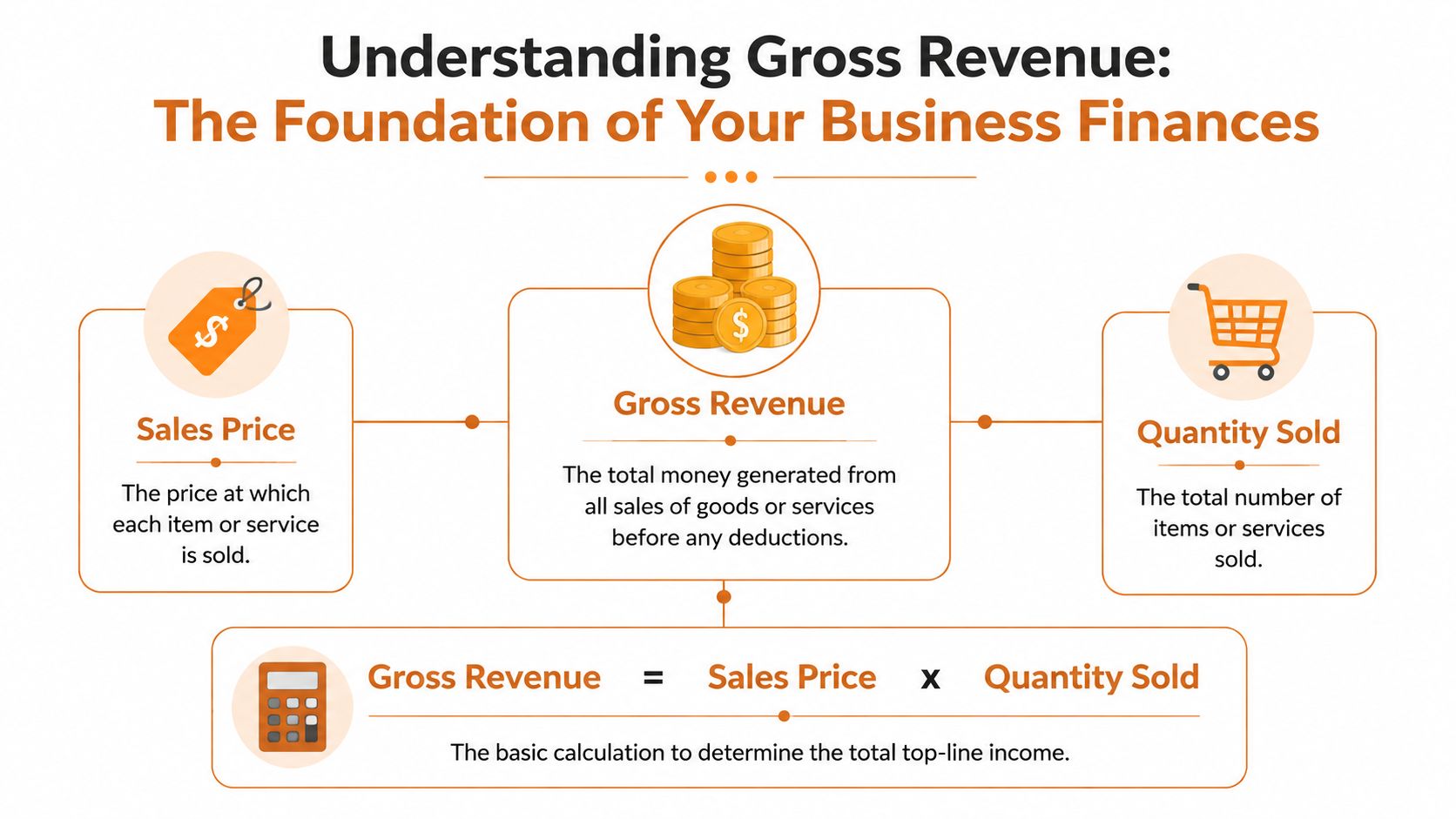
The simplest formula is straightforward, Units Sold × Price Per Unit. One practical example is selling 500 units at $20 each, which produces $10,000 in gross revenue before any deductions. That’s the right mental model because it isolates the sales event itself, not what happens after the sale.
A car’s speedometer offers a helpful comparison. The speedometer tells you how fast the car is moving right now, but it doesn’t tell you how far you can go on a full tank or how efficiently you’ll get there. Gross revenue works the same way. It measures activity and demand, not how efficiently the business converts that activity into profit.
For product businesses, the calculation is usually simple. For service companies, it may be based on billable labor, project invoices, or recurring contracts, but the logic stays the same, total sales before deductions. That’s why gross revenue is such a durable metric. It gives you a common language for comparing periods, pricing decisions, and sales momentum.
Gross revenue tells you what customers were willing to buy. It does not tell you what you kept.
That’s the line many owners miss. A company can post strong gross revenue and still struggle with margin pressure, overhead, or cash flow. The number is foundational because it comes first, but it never stands alone.

A retail business usually has the cleanest gross revenue math. If a store sells products at listed prices during a reporting period, gross revenue is the total before returns or discounts are taken out. Owners often like this number because it shows whether customers are buying at scale and whether pricing is landing in the market.
The useful question isn’t just, “How much came in?” It’s, “How much of that came from full-price sales versus concessions?” Gross revenue gives the first answer. Net revenue and margin analysis answer the rest.
Trades businesses, especially HVAC, plumbing, electrical, and similar owner-operated firms, need a little more care. Gross revenue may include both labor and parts, because both are part of the company’s sales stream. If you invoice a repair call and the invoice includes labor plus materials, the full invoice amount belongs in gross revenue before deductions.
That matters because service owners often track activity by jobs completed, calls booked, or parts sold, but outside readers usually care about the total billed amount. A lender wants to know the scale of the operation. A buyer wants to know whether the revenue is dependable. A tax advisor wants to know how the receipts are recognized and what belongs where.
Recurring-revenue businesses create the most confusion. Subscription services, service contracts, maintenance agreements, and retainers may all produce revenue that feels less like a one-time sale and more like an ongoing relationship. Gross revenue still means the total sales value before deductions, but readers often compare it against ARR, MRR, or net revenue instead.
That’s where interpretation changes. The metric itself stays broad, but the audience changes the lens. Lenders may focus on scale and predictability. Buyers may care about what’s recurring and transferable. Investors may separate gross sales from the amount the business retains under accounting rules like ASC 606 and IFRS 15.
The practical takeaway is simple. In recurring revenue businesses, gross revenue shows demand, but it doesn’t answer durability by itself. That’s why deal discussions often slow down when the numbers aren’t framed clearly. As noted in independent coverage of revenue presentation by business model, the same top-line figure can be interpreted very differently depending on who’s buying the business and how the revenue is structured.
Gross revenue is useful, but owners get into trouble when they treat it as the whole story. The income statement exists in layers, and each layer answers a different question. If you mix them up, you’ll overstate performance, understate risk, or both.
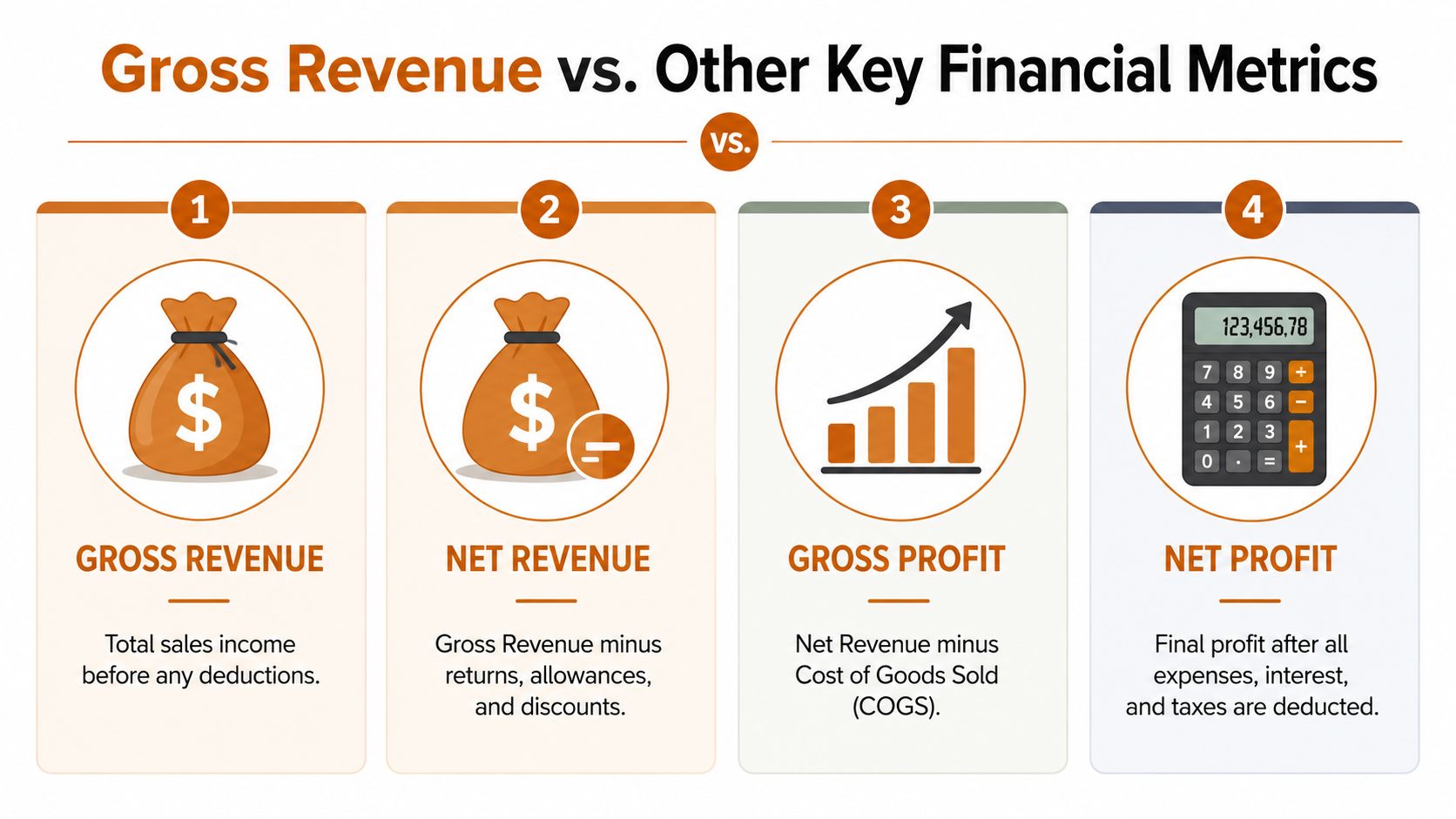
Gross revenue is the full sales figure before deductions. Net revenue is what remains after returns, allowances, discounts, refunds, and similar reductions are removed. That difference matters because gross revenue measures sales activity, while net revenue is closer to what the business keeps from that activity.
For a retail company, the gap can reveal how much pricing was conceded after the sale. For a recurring-revenue business, it can show how much churn or discounting is eating into billed sales. That’s why buyers and investors often read net revenue more closely than gross revenue when they’re trying to judge earnings quality.
Gross profit comes later. It starts with revenue and then subtracts COGS, the direct cost of producing or delivering the product or service. Gross revenue tells you how much came through the door. Gross profit tells you what’s left after direct delivery costs.
Many owners often misunderstand this crucial aspect. They see a big top line, assume the business is healthy, then discover that labor, materials, or fulfillment costs have already taken a large bite out of it. Gross profit is the bridge between sales strength and true operational efficiency.
Taxable income sits much farther down the statement. By the time you get there, operating expenses, interest, depreciation, amortization, and tax rules have all had a chance to reduce the number. Gross revenue is still the top-line starting point, but taxable income is what matters when the tax advisor is calculating the final bill.
A lender might care about your gross revenue to understand scale. A buyer might care about gross profit and owner earnings to understand repeatability. A tax advisor cares about the rules that govern what’s recognized, what’s deductible, and when it hits the return. Same business, different lens.
| Metric | Formula | What It Tells You |
|---|---|---|
| Gross Revenue | Sales before deductions | Total sales activity and demand |
| Net Revenue | Gross revenue minus returns, allowances, discounts, and similar deductions | What the business actually retains from sales |
| Gross Profit | Net revenue minus COGS | Profit after direct delivery or production costs |
For owners preparing for a sale or financing conversation, the difference between gross revenue and seller earnings is especially important. A buyer may look past the top line and focus on normalized earnings, so it helps to understand how those layers connect in a seller discretionary earnings overview.
The biggest gross-revenue mistakes usually happen when owners confuse timing, terminology, or audience. The number itself is simple. The interpretation is where things go sideways.
One common issue is cash versus accrual accounting. Under cash accounting, revenue is recognized when money comes in. Under accrual accounting, it’s recognized when the sale is earned, even if the cash hasn’t arrived yet. That timing difference can change the gross revenue number you think you have, which is why owners need to know which method their books follow.
Another common issue is assuming every revenue figure means the same thing across every business model. It doesn’t. A subscription company, a contractor, and a retailer may all report gross revenue, but the composition of that number can differ a lot. That’s one reason lenders and buyers ask follow-up questions instead of taking the headline number at face value.
If the accounting method isn’t clear, the revenue discussion won’t be clear either.
There’s also a frequent confusion between gross revenue and gross revenue retention, or GRR. GRR measures the percentage of recurring revenue retained from an existing customer base after churn and contraction, excluding expansion revenue. It’s a stability metric, not a top-line sales total, and it matters most in recurring-revenue businesses where retention affects valuation and durability. Stripe’s explanation of GRR draws that line clearly.
If you’re reviewing records with your bookkeeper, ask which revenue figure is being used, when it’s recognized, and whether recurring contracts are being tracked separately from one-time work. If you’re preparing for diligence, that clarity becomes even more important because buyers will test how the numbers were built.
For owners who want to understand how revenue data shows up during a sale process, a practical next read is financial due diligence basics. That’s where accounting definitions meet buyer scrutiny.

Gross revenue is the starting point for almost every serious business conversation. It helps lenders judge scale, gives buyers a first read on demand, and gives tax advisors a baseline for how the business is reported. On its own, it doesn’t prove profitability, but without it, you don’t have the foundation for anything else.
Three practical moves make the number more useful right away. First, confirm whether your books are on cash or accrual accounting. Second, separate recurring revenue from one-time revenue so you can see what’s durable. Third, track gross revenue over time instead of treating it like a one-month snapshot.
If you’re planning financing, a sale, or a tax review, don’t wait until someone else asks hard questions. Build your own clean view of gross revenue first, then use that number to guide the next conversation.
The Owner’s Shortlist helps business owners make sense of valuation, taxes, financing, and succession before they sit down with a specialist. If you want plain-language guidance and a vetted path to the right help, visit The Owner’s Shortlist and start with the topic that matches your next decision.
Tell us your situation. We'll connect you with a specialist who works with owners like you. One conversation, no sales pressure.
Found this useful?
Add The Owner's Shortlist as a preferred source and get our articles highlighted in Google Search results.
Add to Preferred SourcesSelling the business doesn't mean selling the building. Here's how a sale-leaseback works, what rent to charge, and what you give up along the way.
September 25, 2026
Business loan vs line of credit explained for owners. Compare cost, flexibility, collateral, cash-flow impact, and the right scenarios for trades and SMBs.
September 24, 2026
Understand seller financing tax implications for owners, from installment sale rules and capital gains to depreciation recapture and state tax considerations.
September 16, 2026
Learn what is seller financing, how it structures business sales, and why 80% of small deals use it. Clear examples, math, and red flags for owners.
September 6, 2026