What Is SDE and How Does It Shape a Business Sale
What Is SDE. Learn what SDE means in business valuation, how to calculate it with common add-backs, how it differs from EBITDA, and why buyers and lenders focus
October 7, 2026
By Remi Taffin · July 6, 2026
You’re probably reading this at one of two moments.
Either you’re tired, curious, and starting to wonder what your business could sell for if you stepped away. Or something has forced the question. A health issue. A family conversation. A buyer who called out of nowhere. A banker asking for a valuation. A child who may or may not want to take over.
That question sounds simple. “What’s my business worth?” In practice, it’s one of the most loaded questions an owner can ask.
For an owner-operator, valuation isn’t just math. It’s the point where years of risk, long Saturdays, customer trust, payroll pressure, and your own identity get translated into a number that a buyer will stand behind. That’s where many owners get blindsided. They value sweat, reputation, and history. Buyers value transferable cash flow, clean records, and risk.
If you want to understand how to value a small business, start there. The job isn’t picking a formula off the internet. It’s turning what you’ve built into something another person can own, operate, and believe in.
A plumbing owner once put it to me in the plainest possible way: “If I’m not here answering the phone, approving the estimates, and calming down the upset customers, what exactly is someone buying?”
That’s the right question.
Most owners start with the wrong one. They ask what multiple people are paying. They ask what a competitor sold for. They ask what their trucks, tools, and customer list are worth. Those matter, but only after you answer the harder issue. Can the business keep producing earnings when the owner steps back?
That’s why valuation matters long before a sale. It shapes succession decisions, partner buyouts, financing conversations, estate planning, and the timing of an exit. It also exposes weak spots that owners tend to overlook because they’ve learned to work around them. A buyer won’t work around them. A lender won’t ignore them. They’ll price the risk.
Practical rule: Your business is worth more when its results are transferable, explainable, and documented.
For trades and local service businesses, that distinction is huge. Owners often assume their reputation in town, loyal customers, and years of being “the trusted guy” carry obvious value. Sometimes they do. Often they don’t, at least not in the form owners expect.
If the loyalty lives in your head, in your cell phone, or in personal relationships only you can maintain, buyers discount it. If that loyalty shows up in signed service agreements, technician routing systems, price books, documented operating procedures, and repeatable customer retention processes, buyers can underwrite it.
That’s the difference between emotional value and buyer value. One feels real to you. The other survives due diligence.
A buyer will forgive a small dip in sales faster than sloppy books.
I see this all the time with owner-operated businesses. The company may be solid. The customers may be loyal. The crew may know the work cold. Then the buyer opens the financials and finds personal expenses mixed in, missing balance sheet detail, or add-backs with no backup. That is where the valuation gap shows up. The business may have real value, but the owner cannot prove it in a way a buyer, lender, or CPA will accept.
Clean records do more than support a price. They help translate the parts of the business that feel intangible into something defensible. If customer loyalty produces repeat service revenue, show it in the numbers. If your reputation supports higher margins than competitors, show that too. Good financial prep turns a story into evidence.
The IRS guidance on business valuations makes the point plainly. Reliable valuation work depends on complete financial records and support for adjustments that affect reported earnings.
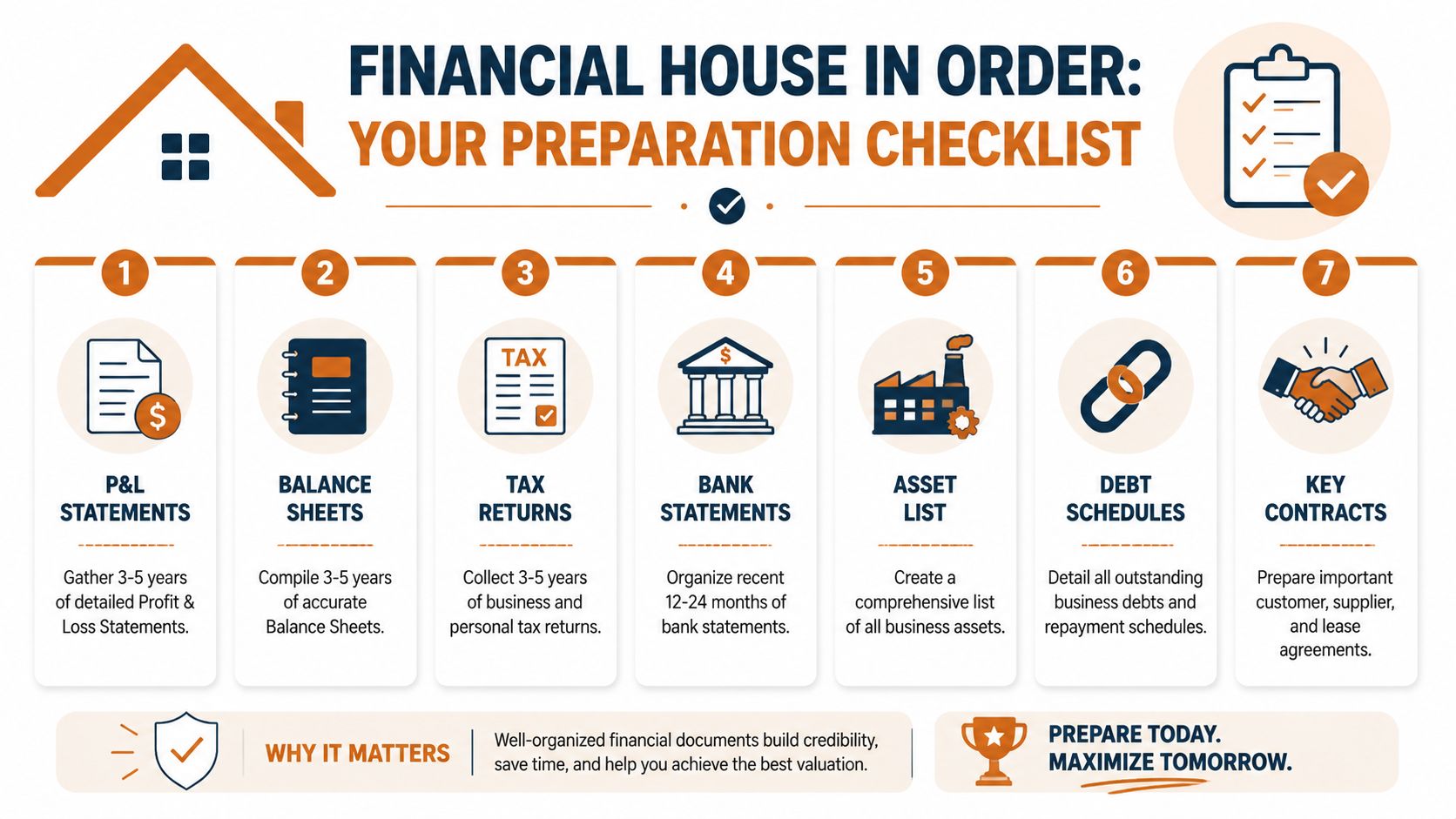
Buyers want enough history to follow the money without needing you in the room to explain every line.
For a plumbing shop, this might mean separating true truck expenses from the owner’s personal fuel purchases. For an HVAC company, it often means showing which maintenance agreement revenue is recurring and which sales came from a one-off weather spike. For an electrical contractor, it may mean cleaning up job costing so gross margin by project type means something.
Normalization is the process of adjusting the books so a buyer can see ongoing earning power.
Common examples include a one-time lawsuit, an unusual equipment repair, above-market family payroll, personal auto expenses run through the business, or owner compensation that does not match what a replacement manager would cost. Those adjustments are often reasonable. They are not automatically accepted.
This is the blind spot in a lot of small-business valuation advice. Add-backs affect taxes, and buyers know it. Some expenses reduce taxable income today but will not survive scrutiny in a sale process unless they are documented and consistently handled. If you want a plain-English primer, this explanation of what an add-back is in business valuation is a good place to start.
The practical rule is simple. If an adjustment would make a buyer or lender ask for proof, put the proof in a folder now.
For each add-back or unusual item, keep:
That file matters more than owners expect. A buyer is not just checking math. They are deciding whether your earnings are real, repeatable, and clean enough to finance. The easier it is to verify your adjustments, the easier it is to defend the value of the business, especially the part tied to loyal customers, recurring work, and operating habits that can survive after you leave.
A buyer looking at your business usually asks three different questions. What could be sold if things went sideways? What have similar companies sold for? What cash flow can a new owner count on after you step out?
Those questions lead to the three standard valuation approaches. Good valuation work checks more than one. In practice, one method usually carries the decision, and the others act as guardrails.
Asset-based valuation starts with the balance sheet, then adjusts it to reflect economic reality. The formula is simple. Fair market value of assets, minus liabilities.
This method matters most for equipment-heavy companies, inventory-heavy businesses, distressed operations, and any situation where earnings are weak or unreliable. A small machine shop with paid-for CNC equipment and usable inventory may have real value here even if recent profit is uneven. A service business with modest hard assets usually does not.
That distinction matters because this approach often creates the valuation gap owners struggle with. The books may show trucks, tools, and receivables, but not the value of repeat customers, fast scheduling, low callback rates, or a crew that works well without constant owner involvement. Those intangibles can be real. They just need to show up through earnings quality or market evidence, not owner optimism.
The market approach compares your business to actual sale transactions or quoted valuation multiples for similar companies.
Owners like this method because it feels grounded. The hard part is finding comps that are comparable. Two electrical contractors can have the same revenue and very different value if one has maintenance contracts, a trained service manager, and clean job costing, while the other relies on the owner to bid every job and calm every unhappy customer.
That is why market multiples are a starting point, not a verdict. A headline multiple from a broker email does not tell you whether the sold business had recurring revenue, customer concentration, deferred maintenance, weak books, or aggressive add-backs. Buyers adjust for those differences fast.
For owner-operated companies, market data is often translated into an earnings multiple rather than a public-company style ratio. If you want the plain-English version of how buyers use earnings multiples, this guide to what EBITDA means for a business owner helps frame the difference between a rule of thumb and a defensible value conclusion.
For a profitable operating business, the income approach usually gets the most attention because it asks the question that drives a deal. What earnings can a buyer take over and keep?
Many online guides get too tidy. Value is often treated as a formula problem, but the core issue is transferability. A roofing company with loyal builders and repeat commercial clients may deserve a stronger valuation than the raw numbers suggest, but only if that loyalty is tied to contracts, account history, service records, trained staff, and systems a buyer can inherit. If the relationships live only in the owner’s cell phone, the value is harder to defend.
Income-based methods usually rely on normalized earnings and a multiple, or on a discounted cash flow model if future performance can be forecast with some confidence. According to GValue’s guide to valuing a small business for sale, median P/E ratios for owner-operated firms in the U.S. range from 3.0 to 5.5, depending on industry risk and growth trajectory. The same GValue guide to valuing a small business for sale states that small businesses with consistent net profit margins above 10% and stable historical earnings over 3 to 5 years were valued at an average premium of 22% compared with businesses showing fluctuating or declining earnings.
DCF can be useful, especially when a business has visible future cash flow. It can also mislead owners who build a forecast first and ask hard questions later. According to GValue’s guide to valuing a small business for sale, discount rates in small business DCF models typically fall between 15% and 25%. That same GValue guide to valuing a small business for sale notes that risk adjustments tied to marketability and concentration can reduce a projected valuation by 30% to 40%.
That is the practical takeaway. Better value does not come from prettier math. It comes from lowering the risks a buyer sees.
| Method | Best For | Key Advantage | Key Disadvantage |
|---|---|---|---|
| Asset-based | Asset-heavy, distressed, or low-profit businesses | Gives a floor value grounded in tangible items | Misses earning power in healthy service businesses |
| Market-based | Businesses with strong comparable sale data | Helps anchor expectations to actual transactions | Truly comparable small business sales are hard to find |
| Income-based | Profitable operating businesses | Focuses on cash flow a buyer can actually receive | Assumptions around risk and future earnings can swing value |
The right method is the one a buyer, lender, and diligence team can verify. Owners get into trouble when they argue for value that depends on personal goodwill, undocumented adjustments, or comparisons that do not really match the business.
A plumbing company shows $180,000 in net income. The owner says the business should sell off that number. A buyer looks closer and finds the owner also ran salary, a family health plan, a truck used partly for personal trips, and a one-time legal bill through the business. Now the discussion changes. Value does not rest on reported profit alone. It rests on earnings a buyer can verify, keep, and legally structure after closing.
For most owner-operated companies, that means Seller’s Discretionary Earnings, or SDE.
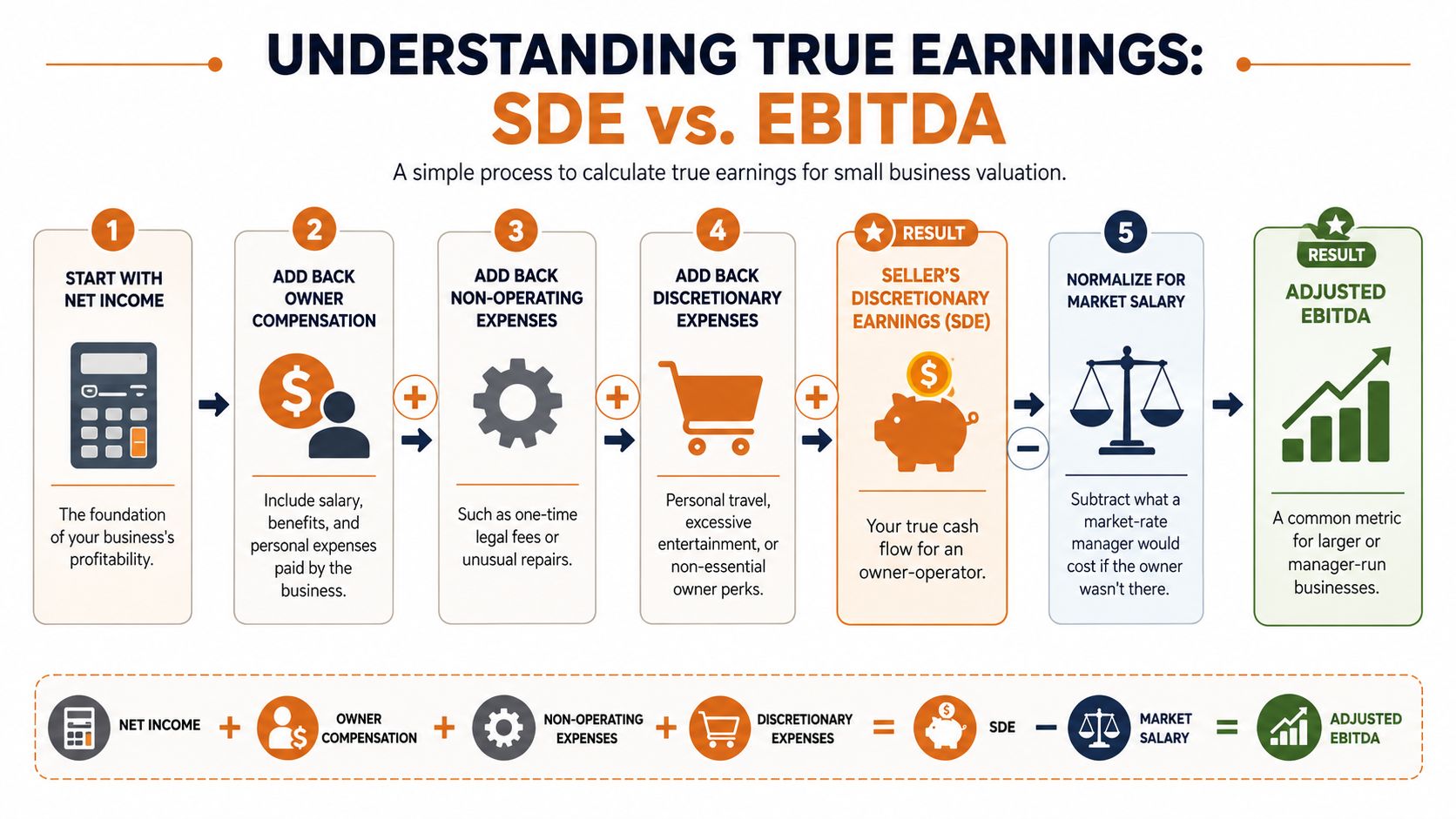
According to Beancount’s valuation guide for small businesses, owner-operated businesses under $5 million in revenue are commonly valued on SDE. Their explanation is the standard one: start with net income, then add back owner pay, interest, depreciation, amortization, certain benefits, and legitimate one-time expenses. From there, buyers apply a multiple, often in the 1.5x to 4x range depending on risk, transferability, and industry.
Net income rarely shows the business’s actual earning power for a working owner. In small trades and service businesses, owners often mix personal compensation, tax planning, and business spending in ways that make the P&L look weaker or noisier than the operation actually is.
That is the valuation gap in plain English. A loyal customer base, long-tenured techs, strong Google reviews, or repeat service calls may produce steady cash flow, but buyers still want those advantages translated into earnings they can defend in diligence. If you cannot show how those intangibles turn into repeat revenue and consistent margins, they stay a story instead of becoming value.
A workable SDE process looks like this:
That last step is where deals hold together or fall apart.
If you want a plain-English comparison, this guide on EBITDA for a business owner explains when EBITDA becomes the better measure and when SDE still fits the deal.
Here’s a useful visual walk-through of the logic behind owner earnings:
Owners usually do not miss value because they forgot an add-back. They miss value because they push weak add-backs that do not survive buyer review.
A clean add-back is unusual, supportable, and not required for normal operations. A weak one is payroll for a relative who works in the office, vehicle expense for trucks the company needs every day, or marketing spend the owner labels discretionary even though leads would dry up without it.
I see this most often in trades. An HVAC owner may try to add back his own salary, which is fair in SDE, but then also add back the service manager he hired because he wants the business to look more profitable. A buyer will usually reject that second adjustment if the manager is the person holding dispatch, technicians, and customer relationships together. The same logic applies to a roofing company that claims every warranty callback was a one-off event. If the problem shows up every year, it is an operating cost.
Tax treatment is the blind spot. An add-back accepted for valuation is not automatically accepted for tax reporting. The IRS does not care that a buyer agreed to recast earnings for deal purposes. If the books have personal expenses, inconsistent payroll treatment, or sloppy classification, you may improve the valuation discussion while creating tax exposure at the same time. Nav’s discussion of small business valuation methods notes that owners often overstate SDE by leaving in personal or non-essential expenses, and it also points out that tax issues are a common reason succession planning gets delayed.
Owner warning: If you want higher SDE, clean up the books before going to market. Buyers, lenders, and tax authorities do not use the same standard, and unsupported add-backs weaken your position with all three.
EBITDA matters more once the company can run without you day to day. If a general manager handles operations, the sales process is documented, and customer relationships are spread across the team, buyers start looking at company-level earnings instead of owner benefit. For many Main Street deals, though, SDE remains the better lens because the owner is still part operator, part salesperson, and part problem-solver.
A buyer walks through two companies that both show $2 million in annual revenue. One is a plumbing business with signed maintenance agreements, a dispatcher who runs the schedule, and pricing rules the team follows without the owner in the room. The other gets repeat work because the owner knows everyone in town and can calm down angry customers on the phone. On paper, they can look similar. In a sale process, they do not.
Value sits in what survives the handoff.

Owners want a clean number. Buyers price risk.
That gap explains why one company sells at the high end of the market and another gets pushed into a lower multiple, a seller note, or an earnout. I see the same pattern in trades all the time. The business with service agreements, stable gross margins, and a team that can quote and deliver work without the owner gets treated as transferable cash flow. The business that runs on memory, relationships, and owner intervention gets treated as fragile.
The multiple usually improves when a buyer can verify four things:
A lower multiple usually follows when one person holds the customer relationships, the pricing logic, and the operating rhythm in their head. If you want a sharper framework for those factors, this guide on what drives a business valuation multiple is worth reading.
Here, the valuation gap shows up.
Owner-operated businesses often have real intangible value. Loyal customers, strong local reputation, referral momentum, and a name people trust. Owners feel that value because they live it every day. Buyers discount it when they cannot test it, document it, or transfer it.
I have had owners tell me, “Customers ask for us by name.” That can help a sale, but only if the business has built a system around that trust. If every strong relationship points back to the owner, the buyer is not acquiring a brand asset. The buyer is renting the owner’s personal goodwill until it fades.
That is why local service businesses often get undervalued against what the owner believes they are worth. The missing piece is not effort. It is evidence.
If you want customer loyalty to count in the price, convert it into something a lender, buyer, and diligence team can verify:
Key-person risk is where deals stall. In trades, that risk usually shows up in estimating, sales, dispatch, or long-held customer relationships. If the owner is the only person who can price a job correctly, calm down a key client, or keep the crew moving, a buyer will lower the valuation or change the terms to protect their downside.
The practical question is simple. If you were out for 60 days, what would still work, who would keep customers, and what revenue would hold up? Your answer says more about value than a spreadsheet alone.
Owners often ask whether they can estimate value themselves. Yes, they can. In fact, they should. A rough internal estimate helps you think more clearly and spot the weaknesses that will come up in a real process.
But a do-it-yourself number is only useful if it leads to action.
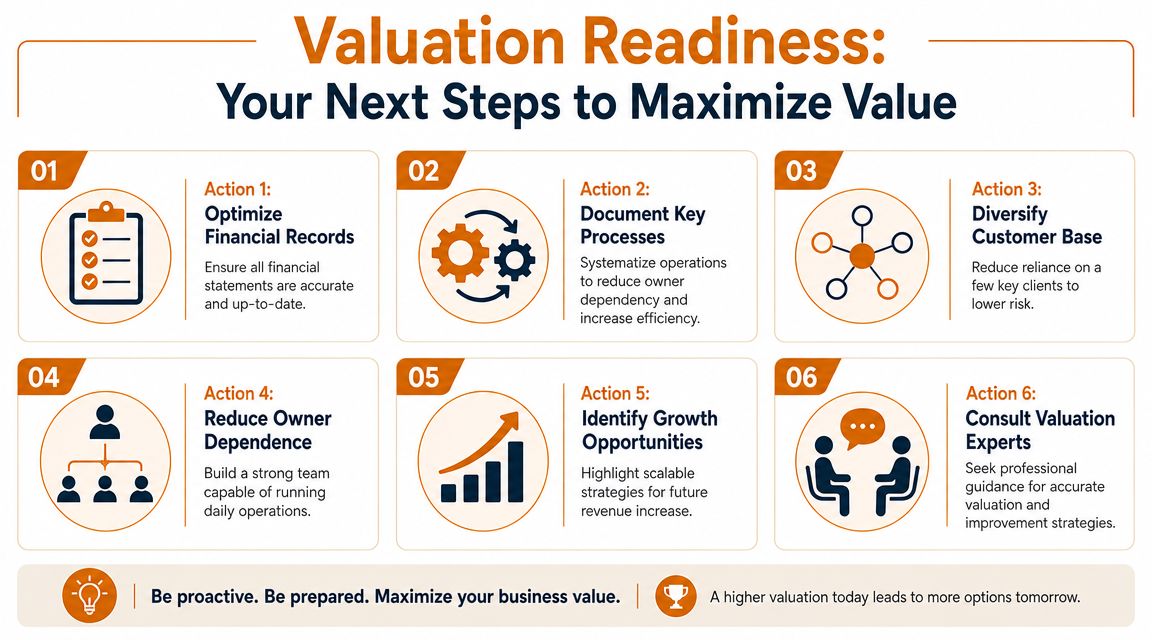
Start with the items that buyers and lenders test first.
A business becomes easier to sell when the next owner can understand it quickly and operate it predictably.
A rough estimate is fine for planning. It’s not enough for a sale, partner dispute, succession decision, tax strategy, or financing event.
That’s when professional valuation work earns its keep. A good specialist doesn’t just hand you a number. They pressure-test the assumptions, challenge weak add-backs, identify transferability issues, and help you understand what needs fixing before you go to market. That can change not only headline value, but also deal structure, negotiating strength, and after-tax outcome.
If you’re serious about an exit, the cost of expert help usually isn’t the expensive part. Going to market with weak records, owner-heavy operations, and unrealistic expectations is.
If you’re weighing a sale, succession, tax planning move, or want a clearer view of what your business is worth, The Owner’s Shortlist is a practical place to start. It brings together vetted specialists across valuation, taxes, legal planning, financing, and succession, along with plain-English guides that help owner-operators ask better questions before they hire anyone.
Tell us your situation. We'll connect you with a specialist who works with owners like you. One conversation, no sales pressure.
Found this useful?
Add The Owner's Shortlist as a preferred source and get our articles highlighted in Google Search results.
Add to Preferred SourcesWhat Is SDE. Learn what SDE means in business valuation, how to calculate it with common add-backs, how it differs from EBITDA, and why buyers and lenders focus
October 7, 2026
Discover what a business valuation report includes, how to interpret it, and why it matters for your company's financial strategy.
October 6, 2026
Explore the best value drivers that influence exit value, with practical steps owners can take before engaging a valuation specialist.
October 4, 2026
Confused by SDE vs EBITDA? Learn when each metric applies to your owner-operated business, how adjustments change valuations, and which buyers prefer which
October 3, 2026