Seller Financing Tax Implications Every Owner Should Know
Understand seller financing tax implications for owners, from installment sale rules and capital gains to depreciation recapture and state tax considerations.
September 16, 2026
By Remi Taffin · September 24, 2026

You’re staring at a real trade-off, not a finance quiz. The truck needs to be paid for, payroll still lands every Friday, and two customers are paying slower than promised. In that moment, the wrong financing choice doesn’t just cost a little more, it changes how much control you keep over the business.
| Mechanic | Term Loan | Line of Credit |
|---|---|---|
| Money arrives | Lump sum at closing | Revolving draws as needed |
| Repayment | Fixed installment schedule | Pay down and borrow again |
| Interest base | Usually the full outstanding principal | Only the drawn balance |
| Rate behavior | Often fixed or more stable | Often variable and tied to the lender’s pricing formula |
| Best fit | One-time purchase, expansion, equipment | Working capital, seasonal gaps, receivables timing |
| Renewal risk | Usually ends when the balance is paid | Can be re-underwritten at renewal |
A contractor buying an excavator while waiting on unpaid invoices faces two separate cash-flow problems. The excavator is a durable asset with a defined cost and useful life. The receivables gap is temporary and may change from month to month. A business loan fits the purchase, while a line of credit fits the timing problem.
That distinction governs the financing relationship from approval through payoff. A business loan is a fixed installment product, usually funded in one lump sum and repaid on a set schedule. A business line of credit is revolving. You draw what you need, repay it, and draw again only while the lender keeps the facility available.
The choice affects more than the first funding decision. A loan creates a predictable repayment obligation that should end with the asset’s useful financing life. A line requires ongoing monitoring of usage, repayments, availability, and the lender’s renewal decision. Treating either product as interchangeable can leave the business carrying the wrong obligation when cash flow changes.
Put a long-life purchase on a revolving line, and the balance may still be outstanding when the facility comes up for renewal. Use a term loan to cover recurring payroll or receivables delays, and a temporary gap becomes a permanent monthly payment. That mismatch can restrict hiring, inventory purchases, and debt capacity.
Practical rule: Match financing to the job and the full life cycle of the cash need. Use revolving credit for expenses that rise and fall with operations. Use term debt for a specific, durable purchase with a clear repayment source.
The broader borrowing market reinforces the need for discipline. In the Federal Reserve’s Small Business Credit Survey, 37% of U.S. small employer firms applied for a loan, line of credit, or merchant cash advance in 2023. 53% used or carried a balance on business loans regularly, 34% used lines of credit regularly, and only 48% of firms seeking financing received the full amount requested (Federal Reserve survey context). Approval alone does not settle the decision. Owners must assess whether the structure will remain workable through daily use, renewal underwriting, and exit.
For a broader view of available financing routes, review The Owner’s Shortlist financing resources.
Your financing choice starts affecting cash flow before the first payment. A term loan creates a fixed repayment obligation from day one. A line of credit creates access to capital, then leaves you responsible for controlling when and how that access becomes debt. The difference matters through qualification, daily use, renewal, and exit.
A term loan delivers the approved amount in one lump sum. You repay principal and interest on a scheduled basis, usually over an agreed term. That structure suits a defined purchase because the debt declines according to a known plan.
A line of credit approves a borrowing limit rather than depositing the entire amount. You draw only what the business needs, repay it, and may draw again while the facility remains open. The FDIC’s 2024 Small Business Lending Survey links lines of credit with working-capital needs such as liquidity, inventory, and accounts receivable financing (FDIC survey fundamentals). That reflects the product’s operating role: managing timing gaps between expenses and collections.
| Mechanic | Term Loan | Line of Credit |
|---|---|---|
| Disbursement | One lump sum | Multiple draws from an approved limit |
| Repayment style | Fixed principal and interest schedule | Interest and paydown based on usage |
| Re-borrowing | No, you need a new loan after payoff | Yes, if the line remains open |
| Interest charge | On the borrowed principal | On the amount drawn, not the unused limit |
| Rate type | Often fixed or longer fixed periods | Often variable |
| Common life cycle | Amortize, then exit | Draw, repay, renew, repeat |
The table hides the main governance issue. A term loan forces a repayment plan, which can expose weak cash flow quickly but also prevents temporary needs from becoming open-ended borrowing. A line offers control over timing, yet that control depends on limits, repayment habits, and continued lender approval.
Treat a line as short-term operating capacity, not a substitute for permanent capital. If draws remain outstanding because the underlying need never disappears, the facility has outlived its proper job. A term loan fits a durable asset or expansion project with a clear repayment source. A line fits recurring fluctuations that should reverse as customers pay and inventory moves.
The lender will judge the borrowing pattern, not just the product name. Set the facility around the cash-flow job, define when draws must be repaid, and decide what happens if renewal underwriting tightens before you commit.
An owner who finances equipment and an owner who covers a seasonal cash gap are buying different types of certainty. The headline APR does not settle the decision. For a line of credit, monthly cost changes with each draw, repayment, and renewal. Judge the facility by the cash-flow job it performs across its full life, from approval through exit.
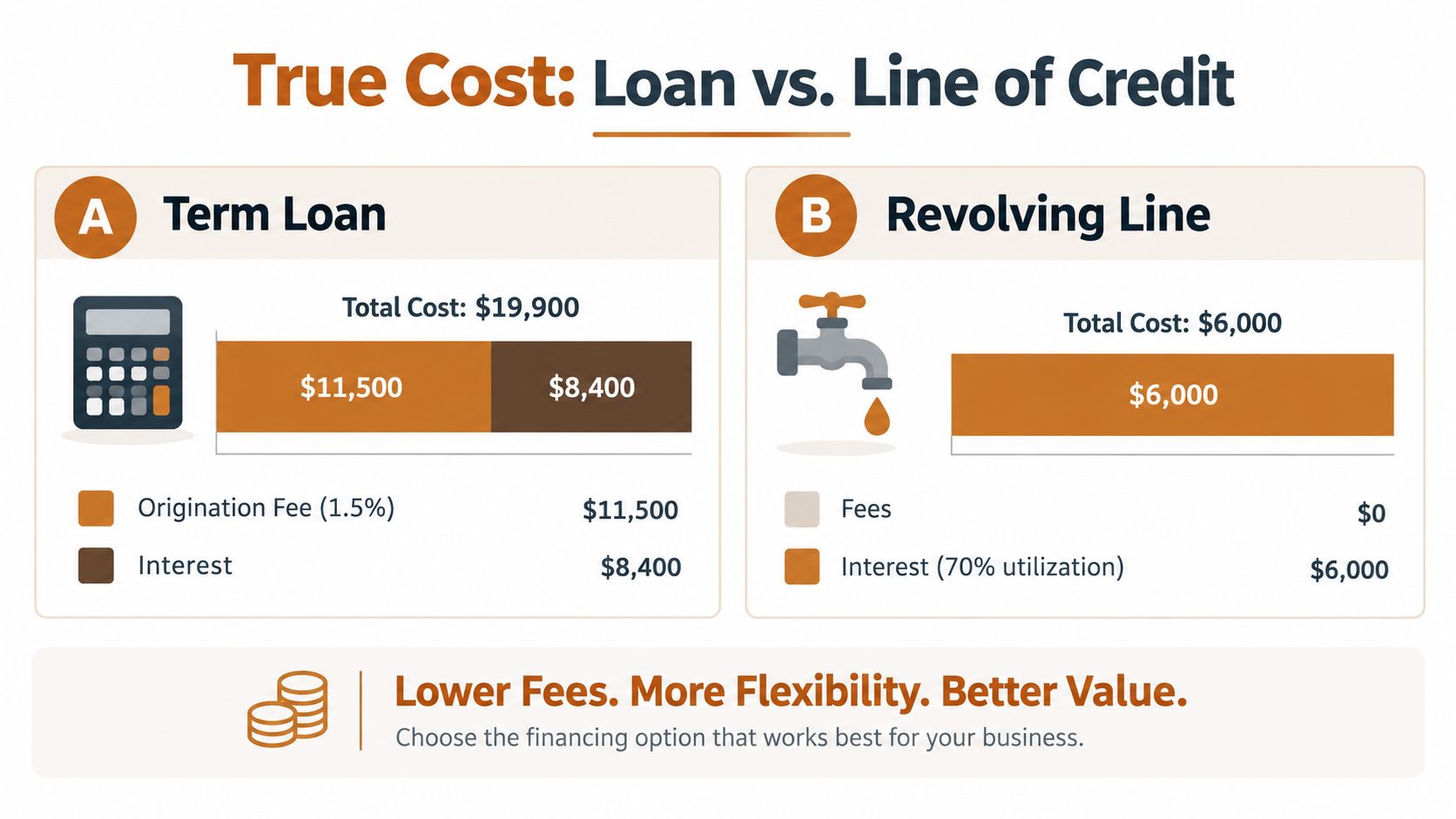
A term loan generally charges interest on the full outstanding balance, and the lender may add origination or documentation fees. A line charges interest only on the amount drawn, yet its fee structure can include origination, draw, annual or maintenance, and unused-line fees, as outlined in Bill.com line of credit guidance. Those charges can outweigh the interest savings when the facility sits mostly unused.
A line is cheaper only when its usage matches its design. Short draws that are repaid as invoices arrive can keep the cost controlled. A balance that stays partially drawn for months turns flexibility into an expensive substitute for permanent capital.
Pricing also reflects access and speed. Traditional-bank lines may run roughly 8% to 15% APR and take 2 to 6 weeks to fund. Online or fintech lines can reach 10% to 60%+ APR while funding in 1 to 3 business days. Use those ranges as a warning: fast access often carries a higher price.
For a 60-month equipment loan, the term loan is usually the cleaner choice when the purchase is definite, the asset will remain productive, and the full amount is needed immediately. The debt then follows the asset’s useful life, with scheduled payments that can be built into the revenue plan. Qualification and documentation may take more effort, but the facility has a defined repayment path and exit.
For a 12-month revolving line drawn to 40 percent average utilization, the line can fit better when borrowing is temporary and demand arrives in uneven waves. You pay for the portion you use, preserve access for later needs, and repay as cash returns. Track utilization, fees, and renewal conditions throughout the year. A low current balance does not guarantee the same limit at renewal.
The governing rule is direct. Repeatedly borrowing the same money calls for term financing. Drawing, repaying, and redrawing against genuine operating swings calls for a line. Tie either choice to your gross revenue structure, then set a repayment deadline and an exit plan before signing.
The rate is only one part of the deal. Before signing, identify what the lender can claim, which promises you must maintain, and how the facility can change after a weak quarter. Financing is a cash-flow governance decision, not just a pricing decision.
Because lines of credit support working-capital needs, lenders often focus on liquidity and receivables when evaluating them. A term loan usually connects to a defined purchase or asset, while a line of credit often carries a broader claim over business assets.
| Risk Element | Term Loan | Line of Credit |
|---|---|---|
| Collateral focus | Often tied to equipment or other specific assets | Often broader lien on business assets |
| Guarantee pressure | Frequently personal, especially for smaller firms | Frequently personal, with renewal potentially changing the exposure |
| Covenant style | Financial tests tied to repayment capacity | Ongoing liquidity, revenue, or borrowing-base checks |
| Default effect | Lender can accelerate the debt | Lender can freeze, reduce, or call the line |
| Negotiation risk | Mostly at origination | At origination and again at renewal |
A personal guarantee can put the owner’s house, savings, or other holdings at risk if the business defaults. Neither product automatically avoids that exposure. A revolving line can feel safer because you draw only what you need, yet the lender may still hold a blanket lien, require a guarantee, and reassess the facility when renewal arrives.
The facility’s life cycle matters. At qualification, the lender tests repayment capacity and collateral. During use, it may monitor liquidity, revenue, borrowing-base compliance, or receivables. At renewal, it can reduce the limit or impose new conditions. At exit, a default can accelerate a term balance or freeze and call a line.
Read the guarantee and default provisions together. Cross-default clauses and springing covenants can turn one missed obligation into a wider financing problem. In a family-business sale or transition, seller financing pros and cons also belong in the risk review, because the financing stack determines who remains exposed after closing.
Set a borrowing limit your weakest realistic quarter can support. Ask what happens if revenue falls, receivables age, or the lender lowers availability. If the bank can tighten the line at renewal, you do not control the same financing relationship throughout its life. You control the terms currently offered.
A plumbing contractor should not use one financing tool for every cash need. A service van and compressor require long-term funding. The delay between issuing an invoice and collecting payment requires short-term liquidity. Strong financing matches each obligation to the cash flow that will repay it.

Consider a trades operator buying a $90,000 service van and compressor. A term loan is the better fit because the equipment has a defined useful life, and scheduled payments can be matched to the revenue it produces. The debt has a clear balance, repayment path, and exit.
A line of credit is poorly suited to that purchase. It is designed to rise and fall with working-capital needs, not to carry a durable asset indefinitely. Using it for equipment can leave the owner dependent on a facility that may be reviewed or changed while the asset remains in service.
Now consider a service firm with uneven contract billing and slow collections. A line of credit fits because it covers payroll and operating costs between labor outlays and customer payments. Draws increase when receivables lag and fall as cash arrives. That is the operating pattern revolving credit is built to support.
The owner is not financing an asset. The owner is funding the gap inside the business’s working cycle.
For self-employed operators comparing short-duration cash relief with traditional credit, this guide to cash advance for self-employed provides a useful contrast. The repayment structure and speed may differ, so treat it as a separate financing category rather than a substitute by default.
A term loan used for working capital imposes fixed payments during slow months, even when the cash need is temporary. That can turn a collection delay into a payment problem. A line used for long-life equipment creates the opposite mismatch. The business ties a recurring liquidity facility to an asset that should have its own amortization schedule.
Choose term debt when the purchase should outlast the debt. Choose revolving credit when the cash need follows customer timing and should disappear as collections arrive. Then test the choice across the facility’s full life: qualification, daily use, renewal, and exit. The right product is the one the business can repay and replace without losing control of its cash flow.
A line of credit can work beautifully for years, then suddenly tighten when the lender changes its risk view. That happens more often than owners expect, and it’s why renewal risk deserves as much attention as rate. A cheap facility that disappears at the wrong time isn’t cheap.
Lines of credit are usually short-dated and re-evaluated at renewal, which means the lender can revisit your limit, pricing, and conditions. The owner may still be profitable and still be paying on time, but that doesn’t guarantee the facility stays untouched. The bank’s view of the sector, the customer mix, or the borrower’s balance sheet can shift the rules.
Recent survey evidence shows 24% of small businesses applying for a line of credit were denied in the latest Small Business Credit Survey discussion, while only 45% were fully approved and 31% were partially approved (CreditSuite summary of Small Business Credit Survey discussion). That’s a reminder that approval is not the finish line. Access can be partial, conditional, or unstable.
A term loan is different. The principal is locked, the payment schedule is set, and amortization does the work until payoff. You’re not renegotiating the core obligation every year. That certainty matters if you’re planning a sale, a succession, or a gradual deleveraging.
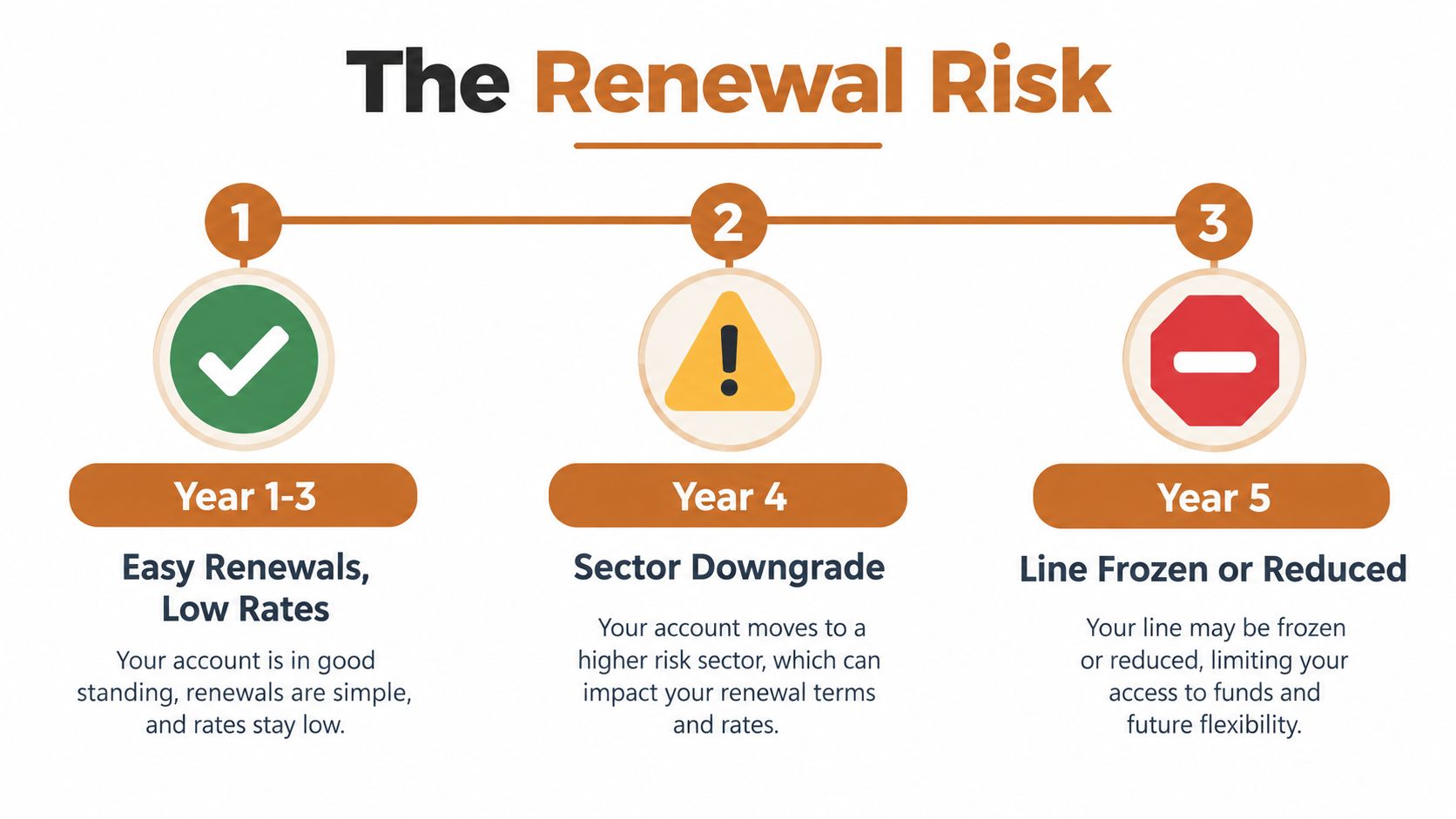
Older owners, succession-bound firms, and businesses with thin margins should care most about renewal risk. If you need to know what your liabilities will look like when the business changes hands, a term loan gives you cleaner visibility. A line of credit can still be useful, but only if you have a clear exit path before the renewal gets hard.
The practical move is simple. Don’t let every facility mature at once. Stagger the dates so you’re never renegotiating your whole borrowing stack in the same weak quarter. That small planning habit keeps one lender conversation from becoming an operational crisis.
The danger isn’t that a line of credit exists. The danger is assuming the line you have today will be the line you renew tomorrow.
If a contractor is waiting on several invoices while payroll is due, a line of credit can protect operations. If an owner is buying equipment that will serve the business for years, a term loan usually fits better. Start with the cash-flow job, not the rate sheet. The right choice must work at approval, during use, at renewal, and at exit.
How predictable is the cash flow? Contractors with uneven collections and seasonal service firms often need revolving flexibility. Businesses with stable monthly receipts can usually carry fixed amortization more comfortably. Review the payment against a weak month, not only an average month.
How long will the asset or use of funds last? A purchase that supports the business for years belongs with a repayment structure built for a long obligation. A short-lived working-capital gap should not become a long repayment schedule. Match the debt’s duration to the benefit it creates.
What’s the exit horizon? If you may sell, transfer, or recapitalize the business in the next few years, favor financing with a clear payoff path. A facility that depends on annual renewal can create pressure just when buyers, successors, or lenders need clean visibility.
This matters more than most owners expect once a sale gets close. Most sales are structured cash-free and debt-free, meaning whatever the business owes gets paid off at closing, straight out of the sale proceeds. A term loan with a known, shrinking balance is easy to account for. A line of credit sitting at a high utilization looks like a structural cash need to a buyer’s lender, not a timing gap, and it invites more questions during diligence.
Two other details are easy to miss until they hold up a closing. A personal guarantee does not go away on its own; the lender has to formally release it as part of the sale, and that takes coordination. And some term loans carry a prepayment penalty that only becomes visible when the full balance has to be paid off early to clear the sale. Ask about both before you sign, not after you have a buyer.
Bring a financing specialist the documents that expose the actual need: 12 months of bank statements, a 24-month profit and loss statement, equipment quotes or accounts receivable aging, and your personal financial statement. This package helps distinguish an asset purchase from a liquidity bridge, or show where both are involved. It also gives the lender a clearer basis for deciding how much debt the business can carry.
A line of credit is a poor fit when utilization stays low while fees continue, or when renewal is approaching as revenue weakens. Treat the renewal date as a second underwriting event. The lender may reassess cash flow, collateral, guarantees, and borrowing needs rather than just extend today’s terms.
A term loan is a poor fit when scheduled payments strain the business during seasonal dips, or when the owner repeatedly borrows again to solve the same operating shortfall. That pattern turns a temporary cash problem into layered debt and obscures the true cost of running the business.
In practice, term loans remain the backbone for durable capital, while lines of credit serve the day-to-day liquidity role. Use the loan for an asset or obligation with a defined life. Use the line for timing gaps that should disappear as customers pay.
Five-minute rule: If the money buys something with a life of its own, choose a loan. If it keeps the operating cycle moving, choose a line. If neither description fits, pause before borrowing.
The Owner’s Shortlist organizes financing and other specialist categories in plain language. Visit The Owner’s Shortlist to compare options before committing to a structure that could restrict cash flow or complicate succession.
Tell us your situation. We'll connect you with a specialist who works with owners like you. One conversation, no sales pressure.
Found this useful?
Add The Owner's Shortlist as a preferred source and get our articles highlighted in Google Search results.
Add to Preferred SourcesUnderstand seller financing tax implications for owners, from installment sale rules and capital gains to depreciation recapture and state tax considerations.
September 16, 2026
Learn what is seller financing, how it structures business sales, and why 80% of small deals use it. Clear examples, math, and red flags for owners.
September 6, 2026
Explore seller financing for small business, including how notes work, typical structures, and what buyers and sellers should know before agreeing to terms.
September 2, 2026
Learn how to do seller financing with practical deal structures, risk controls, and closing steps tailored for owner-operators preparing to sell their business.
August 19, 2026