What Is Seller Financing and How It Works for Business Sales
Learn what is seller financing, how it structures business sales, and why 80% of small deals use it. Clear examples, math, and red flags for owners.
September 6, 2026
By Remi Taffin · September 16, 2026

You’ve signed the deal. The deposit is in your account, the buyer has the keys, and the note says you’ll receive the rest over time. It feels like the ideal compromise: the buyer gets workable financing, and you avoid recognizing the entire gain in one tax year.
That assumption can be expensive. Seller financing tax implications don’t run on one schedule. Every payment can contain basis recovery, capital gain, and interest. Depreciation recapture may pull taxable income forward, while a default or note restructuring can disrupt the deferral you expected. The IRS treatment is explained in Publication 537, but applying it to an owner-operated business or property sale requires more than reading a payment schedule.
Seller financing turns a sale into two connected transactions: an asset transfer and a lending arrangement. If you sell a business, rental property, or another appreciated asset, tax reporting continues after closing. Each payment requires you to separate principal, gain, and interest.
Start with imputed interest. A note with little or no stated interest can still require interest treatment under federal rules. The IRS may reclassify part of the buyer’s payments as interest, even when both parties intended a friendly accommodation. For certain 2025 below-market seller-financed transactions of $7,296,700 or less, the IRS states that the test rate cannot exceed 9%, compounded semiannually. The applicable terms depend on the transaction and the rate rules described in IRS Publication 537.
Depreciation recapture creates a separate tax trap. If you claimed depreciation on equipment, vehicles, or real estate, part of the gain may receive ordinary-income treatment instead of capital-gain treatment. The installment method can defer eligible gain, but it does not automatically defer every tax category produced by the sale.
Default risk can also undo the expected tax timing. Repossession, foreclosure, bankruptcy, and note modifications may produce results that differ sharply from the original payment plan. The Tax Adviser’s discussion of seller-financed real estate repossessions warns that Section 1038 treatment can generally prevent a seller from claiming the bad-debt deduction expected after repossession.
Before signing, review a practical explanation of how seller financing works and consult a lawyer. Use this tax considerations legal guide to identify provisions requiring tax review. Have counsel confirm the stated interest rate, allocation schedule, and security instrument before signing.
Think of the transaction as a mortgage that you originate instead of a bank. The buyer gives you a down payment, signs a note, and sends payments over time. You generally report the eligible profit as principal arrives, rather than treating every dollar of the future note as taxable in the closing year.
Under the federal installment method, a sale generally qualifies when at least one payment is received after the tax year of sale. The seller calculates the gross profit ratio, which compares total eligible gain with the contract price. That ratio determines how much of each principal payment represents gain. The remaining principal generally represents recovery of adjusted basis, which isn’t itself taxable income.
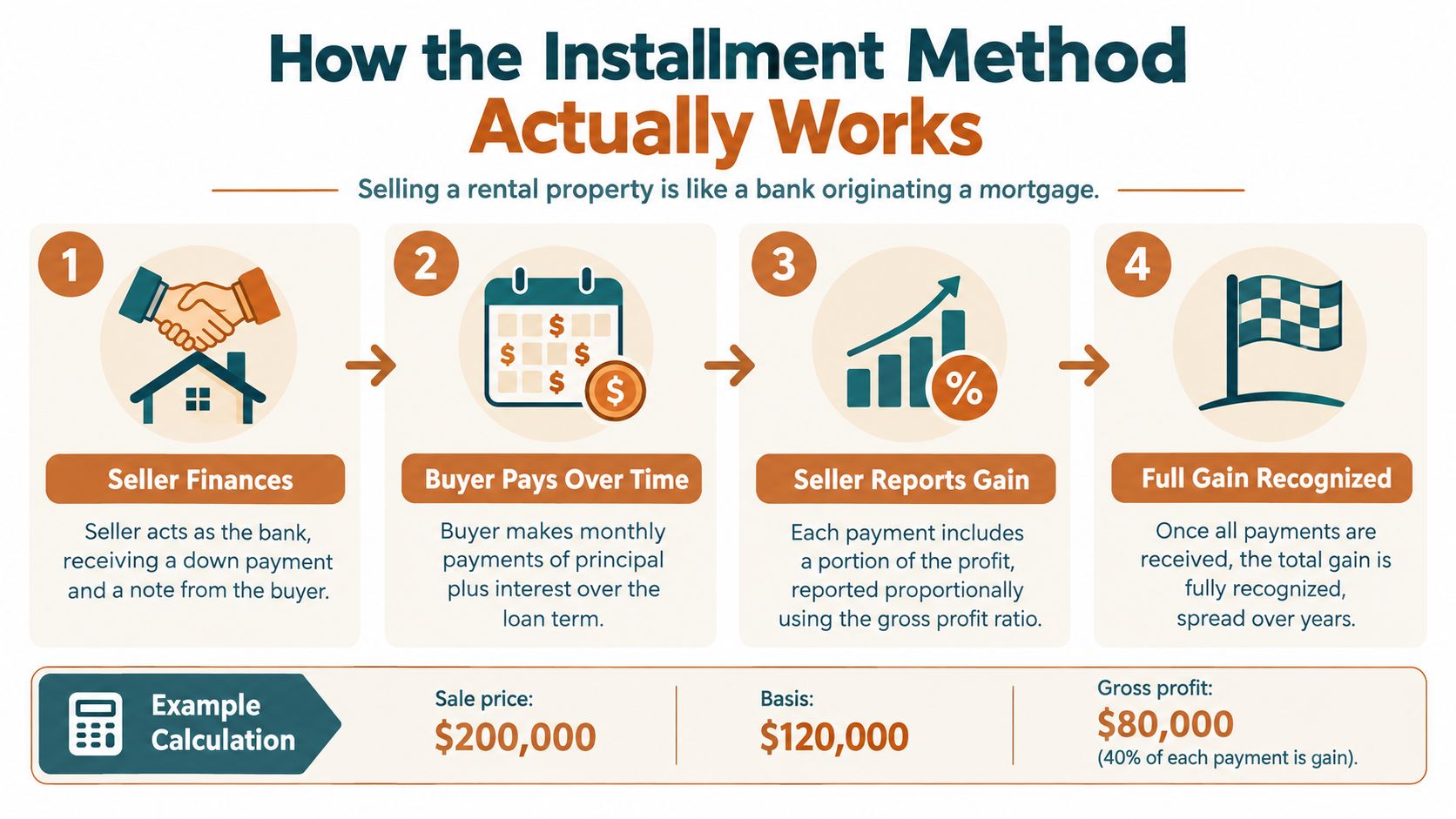
The IRS generally requires installment treatment unless you elect out by the due date of the return. Electing out means recognizing the eligible gain immediately. That can make sense if you have losses available, expect a more favorable tax position in the closing year, or want to eliminate future reporting complexity. It can also be a poor choice if the immediate gain creates an income spike.
The IRS’s installment sale tax treatment provides a useful plain-language companion, while this guide to installment sale treatment helps connect the formula to a business sale. The method defers eligible gain. It doesn’t convert interest, recapture, inventory, or every other asset category into deferred capital gain.
A seller-financed payment should never be treated as one taxable amount. Break it into three buckets before you estimate your after-tax proceeds:
| Bucket | Annual Amount | Tax Character | Rate Exposure |
|---|---|---|---|
| Basis recovery | Depends on the gross profit ratio | Return of capital, generally not taxable | No income-tax character by itself |
| Capital gain | Depends on eligible gain and principal received | Often long-term capital gain when the asset qualifies | Preferential capital-gain rates may apply, with possible NIIT |
| Interest | Stated or imputed under the note | Ordinary income | Ordinary rates, with possible NIIT |
The first bucket is basis recovery. You’re getting back money you already invested in the asset, so that portion generally isn’t gain. The second bucket is eligible capital gain, which may receive long-term treatment when the asset and holding period qualify. The third is interest income, and it’s the bucket owners routinely underestimate.
Interest is compensation for carrying the buyer’s debt. It isn’t part of the gross-profit ratio, and it doesn’t become tax-free merely because the buyer calls the entire payment principal. The IRS says deferred-payment sales may require unstated interest or original issue discount when a contract has little or no stated interest. That reclassification can move part of the expected sale proceeds into ordinary-income treatment.
Consider a hypothetical note with a $1.5 million principal balance, a 6% stated rate, and a $900,000 adjusted basis. A payment schedule might show an annual payment of roughly $19,000, but the actual allocation depends on the amortization schedule and the exact contract terms. The table above should be used as a framework, not a substitute for the schedule that calculates the payment.
Practical rule: Never ask only, “How much tax do I defer?” Ask, “How much of each payment is basis, eligible gain, interest, recapture, or another category?”
The underlying asset also controls the result. A business sale with goodwill may produce a different capital-gain profile from a sale of inventory or depreciated equipment. The IRS identifies inventory and publicly traded securities as examples of assets that don’t qualify for installment treatment, while the IRS guidance on installment sales also notes that the 3.8% net investment income tax may apply. For a qualifying main residence, the IRS states that a seller may exclude up to $250,000 of gain, or $500,000 for a joint return, even when part of the price is paid later.
Depreciation recapture is where many seller-financing projections lose credibility. You may have a large headline gain and a long payment schedule, but prior depreciation deductions can convert part of that gain into ordinary income.
For Section 1245 property, such as trucks, machinery, and equipment, depreciation recapture generally reaches the depreciation taken, subject to the applicable tax rules. For real estate, Section 1250 rules can create ordinary-income treatment for certain recapture amounts, while unrecaptured Section 1250 gain can be subject to a maximum 25% rate under federal rules. Those categories don’t follow the same treatment as ordinary eligible capital gain.
Suppose a service company sells its operations and includes depreciated vehicles and equipment in the asset allocation. The buyer may pay the purchase price through a down payment and a note, but the seller can’t apply the installment ratio to every category and postpone everything. Recapture must be identified in the allocation and handled under the rules governing the specific asset.
Separate the assets before you negotiate the note:
Cost segregation or basis-planning work may help in selected circumstances, but it isn’t a magic eraser. A higher basis can reduce future gain, yet changing basis or depreciation before a sale requires a tax professional to verify the legal and economic consequences. Don’t commission a study merely because someone promises to eliminate recapture.
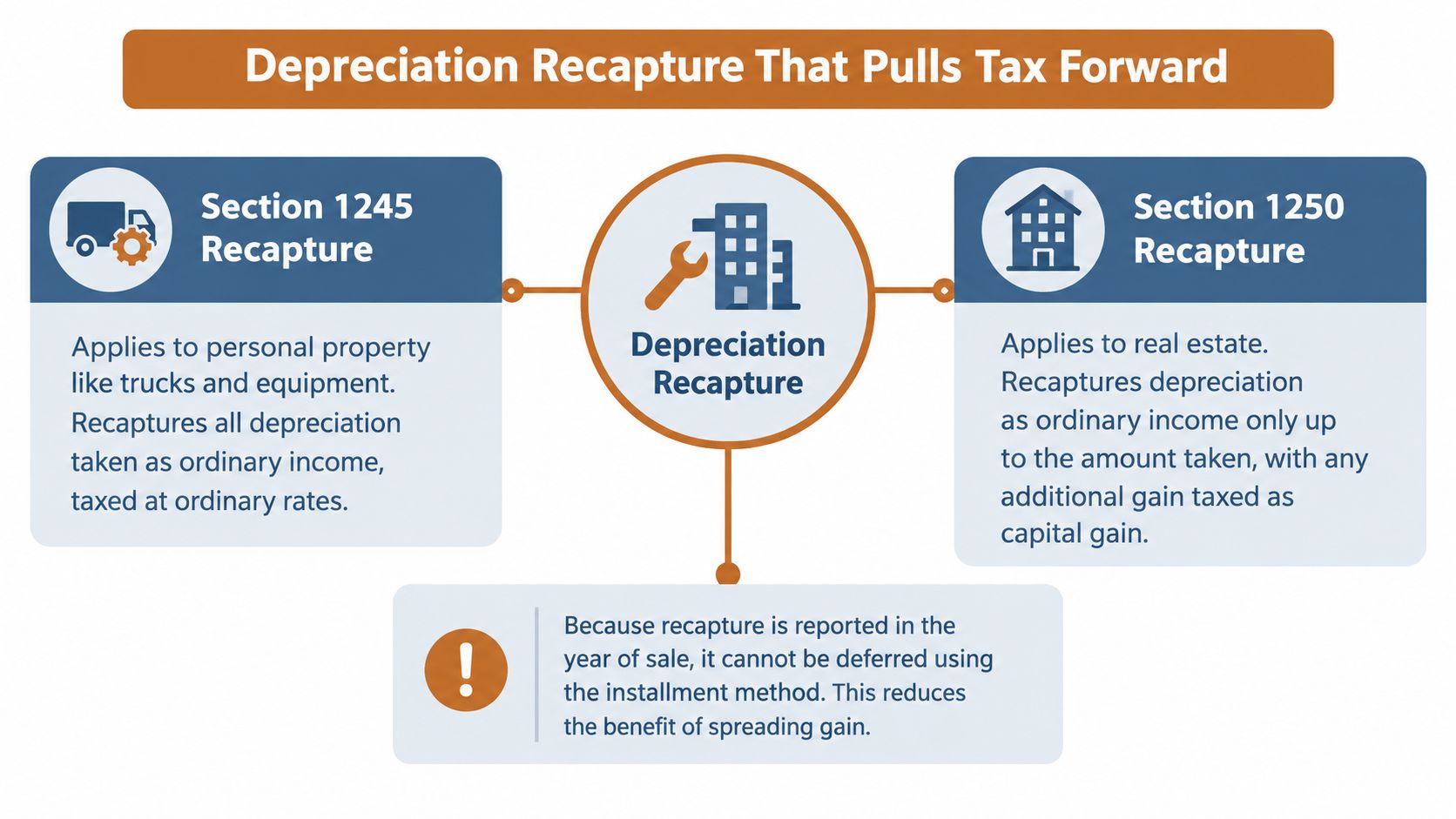
The IRS treatment means seller financing may provide timing relief on eligible capital gain while leaving ordinary-income exposure at closing or during the relevant reporting period. That’s why a tax projection must begin with an asset-by-asset allocation, not with the note’s face value.
Federal installment treatment doesn’t settle the state question. States may conform closely to federal rules, modify the treatment, or apply their own sourcing and reporting requirements. Your federal return can show deferred gain while one or more states continue to examine where the income arose and who owes it.
| State Treatment Category | Conformity with Federal Installment Method | Common Seller Exposure |
|---|---|---|
| Full conformity | Generally follows the federal timing framework | State reporting still requires accurate residency and sourcing |
| Modified conformity | Uses federal concepts with state adjustments | Deferred gain may be recalculated or reported differently |
| Limited conformity | Follows selected federal rules only | Timing, basis, or asset treatment can diverge |
| No meaningful conformity | Doesn’t follow the federal approach in full | Immediate or alternative state reporting may apply |
Four pressure points deserve attention. A buyer’s operations can create nexus for an entity or continuing business activity. Property or customer relationships tied to a state can source income there even after you move. A buyer may face withholding obligations involving nonresident sellers. Finally, the selling entity’s structure, whether a corporation, pass-through, or holding company, can change who reports the income and whether composite filings are involved.
Recent movers need special caution. So do owners selling businesses with customers, employees, or property across jurisdictions. A holding company in a tax-favored domicile doesn’t automatically erase exposure created by operations elsewhere.
Ask your state tax adviser to map:
The tax implications of selling a business should be reviewed with federal and state reporting in the same conversation. If the transaction involves property distress, debt enforcement, or a counterparty with financial trouble, resources such as LifeBack Law Firm bankruptcy help can provide legal context. Don’t wait until the first payment arrives to discover that the state treatment doesn’t match your federal model.
Take a service-business sale with a $1.5 million purchase price. The transaction includes $300,000 of depreciated equipment, $600,000 of adjusted basis in goodwill, and a $1 million seller-financed note carrying 7% interest over 10 years.
The first job is allocation. The equipment’s tax history must be reviewed for recapture. The goodwill calculation begins with the stated adjusted basis, but the final gain depends on the complete purchase-price allocation, selling expenses, down payment, and other contract terms. The note’s interest is analyzed separately from principal.
Assume, only for illustration, that the $600,000 goodwill basis is the relevant basis for the portion being financed and that the seller receives $200,000 of principal recovery during the period being analyzed. The actual tax result can’t be finalized from those facts alone because the payment schedule, allocation, recapture history, and total contract price control the calculation.
| Tax Bucket | Amount Per Payment | Tax Rate Applied |
|---|---|---|
| Basis recovery | Determined from the adjusted basis and gross profit ratio | Generally not taxable as income |
| Equipment recapture | Determined from depreciation previously claimed | Ordinary-income treatment under applicable recapture rules |
| Eligible capital gain | Remaining qualifying gain after basis and recapture | Applicable capital-gain rate, with possible NIIT |
| Interest | Calculated from the note and payment schedule | Ordinary-income treatment, with possible NIIT |
The $300,000 equipment figure isn’t itself the recapture amount. Recapture depends on original cost, depreciation taken, adjusted basis, disposition price, and the governing asset rules. Likewise, the $200,000 principal recovery isn’t automatically tax-free unless the gross-profit calculation shows that it represents basis recovery.
A reliable projection therefore works in this order:
The first-year tax bill cannot be totaled without the seller’s filing status, other income, deductions, state, participation level, asset history, and exact payment schedule. A spreadsheet that produces a precise answer from incomplete facts is performing, not planning.
Default is the scenario sellers discuss least and should model first. You can structure a note that looks attractive at closing, then discover that the tax system doesn’t give you a clean deduction when the buyer fails to pay.
In a real estate installment transaction, Section 1038 treatment is generally mandatory when the seller repossesses. The seller typically recognizes neither gain nor loss on the repossession, and the seller generally can’t claim a bad-debt deduction for the unpaid obligation. That result can leave you with property back in hand, tax history tied to the original transaction, and no deduction matching the cash shortfall.
The legal mechanics matter. A voluntary deed-back, foreclosure, negotiated surrender, and other enforcement paths can produce different legal and tax facts. Don’t let a distressed buyer hand you the property without coordinating the note, security instrument, settlement documents, and tax reporting.
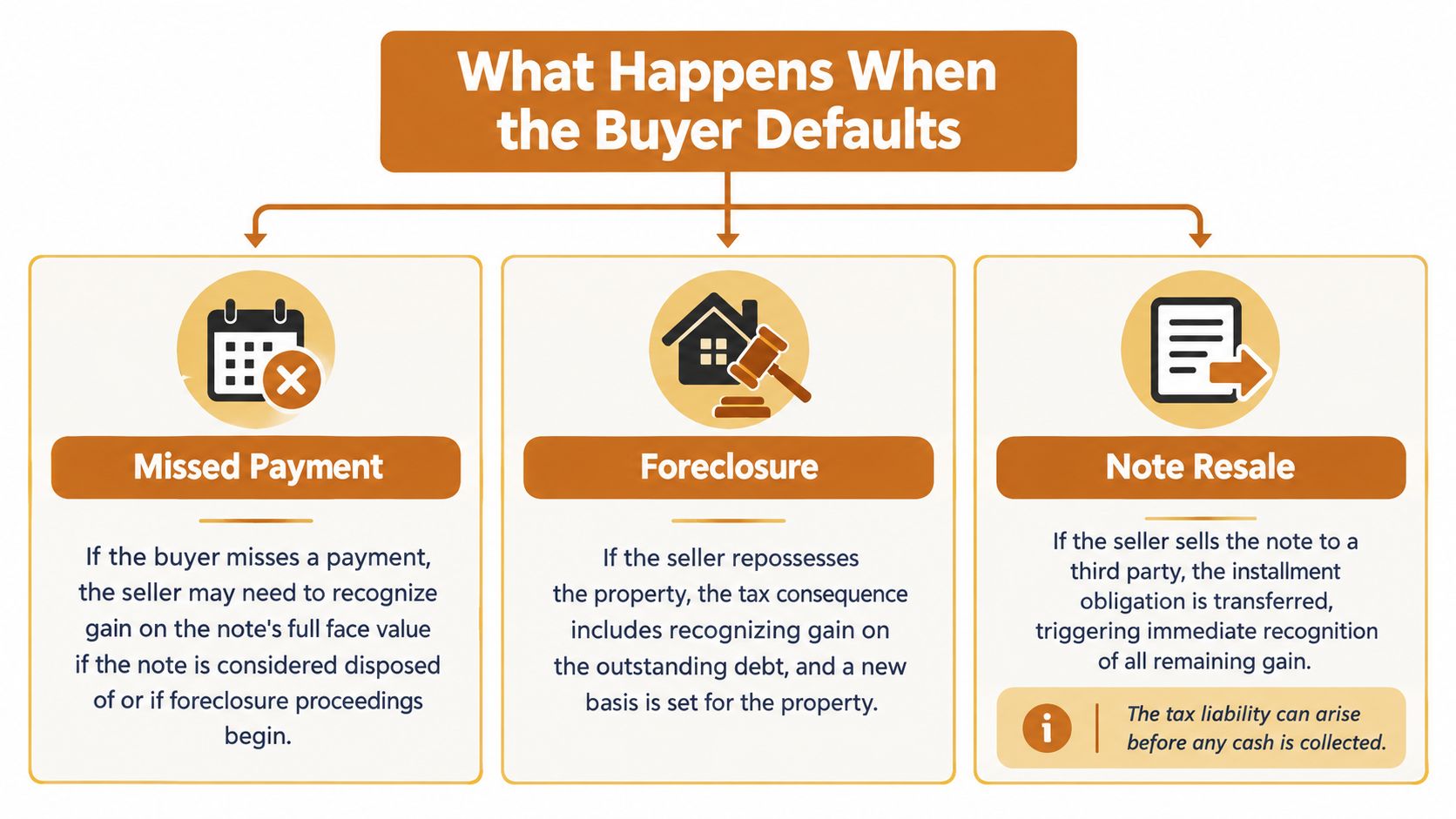
If the buyer files bankruptcy, you become a creditor. Recovery depends on the note, collateral, priority, bankruptcy process, and applicable law. Tax treatment doesn’t automatically follow the amount you hoped to collect, and a closely held installment obligation may not produce the bad-debt result you expected.
A restructuring creates another danger. Extending maturity, reducing principal, converting accrued interest into principal, or forgiving part of the obligation can be treated as a disposition or other taxable event depending on the facts. The modification should be modeled before anyone signs it.
Before accepting a deed-back or signing a modified note, have your tax adviser model the tax result and your attorney document the enforcement path.
Write the default section of the note while everyone still expects success. Define cure periods, notices, collateral rights, insurance, property maintenance, foreclosure remedies, and treatment of unpaid interest. A seller-financed note is a credit instrument, not a handshake with installments attached.
“Ask a professional” is too vague. Here are the situations where a CPA or tax attorney should review the transaction before the note is signed.
| Trigger | Why a Specialist Matters | Approximate Risk |
|---|---|---|
| Depreciable equipment, vehicles, or real estate | Separates recapture from eligible installment gain | Ordinary-income exposure may arise despite deferred payments |
| Multi-state seller or buyer activity | Tests residency, sourcing, nexus, and withholding | Multiple state filings or unexpected state tax |
| Below-market or unusual interest | Reviews imputed-interest and original issue discount rules | Part of the payment may be reclassified as interest |
| Planned note restructuring | Models modification, forgiveness, or conversion consequences | Immediate recognition or altered income character |
| Estate, trust, or pass-through ownership | Coordinates entity, fiduciary, and beneficiary reporting | Timing and allocation can become difficult |
| Complex asset allocation | Verifies goodwill, inventory, equipment, and property treatment | Some assets may not qualify for installment treatment |
Bring in the specialist before closing when the sale includes depreciated assets. Recapture can change the cash you need for taxes even when the buyer’s note looks generous. Get help before agreeing to an interest rate that may be below the applicable federal test, and before accepting a balloon, forgiveness provision, equity conversion, or principal reduction.
Use a state specialist when you’ve moved recently, operate across state lines, own property in multiple jurisdictions, or sell through an entity with pass-through reporting. Federal installment treatment doesn’t answer state sourcing, withholding, or entity-level questions.
A tax attorney earns the fee when the buyer is weak, collateral is complicated, the note is subordinated to another lender, or the agreement contains unusual default and restructuring rights. A CPA may be enough for a straightforward capital-gain-only sale with clean records and a conventional note. Even then, have the professional confirm the adjusted basis, gross-profit ratio, interest treatment, and annual Form 6252 reporting.
The right test is not whether the transaction is large enough to justify advice. It’s whether one wrong allocation, missed recapture item, or poorly documented modification could cost more than the review.
The Owner’s Shortlist helps owner-operators compare practical guidance and connect with vetted specialists for taxes, legal matters, valuation, financing, and succession planning. Visit The Owner’s Shortlist to review seller-financing resources and find the right adviser before you sign the note.
Tell us your situation. We'll connect you with a specialist who works with owners like you. One conversation, no sales pressure.
Found this useful?
Add The Owner's Shortlist as a preferred source and get our articles highlighted in Google Search results.
Add to Preferred SourcesLearn what is seller financing, how it structures business sales, and why 80% of small deals use it. Clear examples, math, and red flags for owners.
September 6, 2026
Explore seller financing for small business, including how notes work, typical structures, and what buyers and sellers should know before agreeing to terms.
September 2, 2026
Learn how to do seller financing with practical deal structures, risk controls, and closing steps tailored for owner-operators preparing to sell their business.
August 19, 2026
Discover what is gross revenue and its crucial role in business valuation, loans, and taxes. Get a practical guide for business owners in 2026.
August 10, 2026