What Is a Tuck-In Acquisition Explained
What is a tuck-in acquisition? Learn how these deals impact owner-operated businesses, trades, valuation, and when to consult an M&A specialist.
September 29, 2026
By Remi Taffin · August 15, 2026

You’ve sold your plumbing or HVAC company, but the buyer can’t pay the full purchase price at closing. Instead, you agree to take a down payment and receive the balance through seller financing over several years. The deal looks workable until one question interrupts the celebration: When does the tax become due if the cash arrives later?
That question can affect more than your tax return. It can shape the note’s payment schedule, your need for cash at closing, the risk you’re willing to accept from the buyer, and whether spreading gain fits your broader exit plan. Installment sale tax treatment can generally align gain recognition with payments collected, but it doesn’t make every part of every payment taxable in the same way.
The central tradeoff: spreading gain can reduce the size of the tax event in the sale year, but it also leaves you waiting for cash, exposed to buyer default, and responsible for tracking the tax treatment of future payments.
This guide starts with the basic mechanics, then moves through the gross profit ratio, Form 6252, exceptions, interest, state considerations, and a worked example. If you’re still deciding whether seller financing belongs in your transaction, review how seller financing works alongside the tax questions below.
This is educational information, not tax advice. A qualified tax professional should review your specific agreement, entity structure, asset allocation, basis, and state filing obligations before you sign.
Suppose an owner has spent years building a dependable service company. The trucks, tools, customer relationships, service agreements, and reputation all have value, but the buyer needs time to produce enough cash from the business to pay the seller in full. Seller financing bridges that gap. The owner receives some cash at closing and accepts a promise for the rest.
Tax treatment becomes important because the transaction has two separate timelines. The legal sale may happen at closing, while the cash collection happens over the note term. For a qualifying installment sale, the seller generally reports gain as payments are collected rather than reporting the entire gain in the sale year, as explained in IRS Publication 537.
That timing can make the transaction feel more manageable. A seller who recognizes gain gradually may avoid concentrating the entire taxable gain in one return. But deferral isn’t the same as elimination. The gain remains connected to the payment schedule, and interest is handled separately from the gain portion.
The structure also changes the negotiation. A buyer may offer a higher total price in exchange for time to pay. The seller must then weigh that price against credit risk, the value of immediate cash, security for the note, and the possibility that future payments will arrive in years with different income levels.
A payment plan is both a financing decision and a tax-timing decision.
The most useful way to understand the arrangement is to follow one payment from the buyer to the seller. First identify the seller’s basis and the gain embedded in the sale. Then separate principal from interest, apply the gross profit ratio to the principal received, record the result on the appropriate tax forms, and test the deal for exceptions that may pull some gain forward.
Suppose you sell your business and agree to let the buyer pay over time. The sale may be completed in one year, while the money arrives through later payments. A qualifying installment sale generally lets you recognize gain as payments are collected, rather than reporting the full gain in the sale year. You can also elect out by the filing deadline for that year, reporting the entire gain at once instead.
Each payment works like a sealed envelope containing separate tax pieces. Although the buyer may send one combined amount, the analysis divides it into return of basis, gain, and interest. Return of basis recovers your tax investment. The gain portion is taxed under the applicable gain rules, while interest is reported separately as ordinary income.
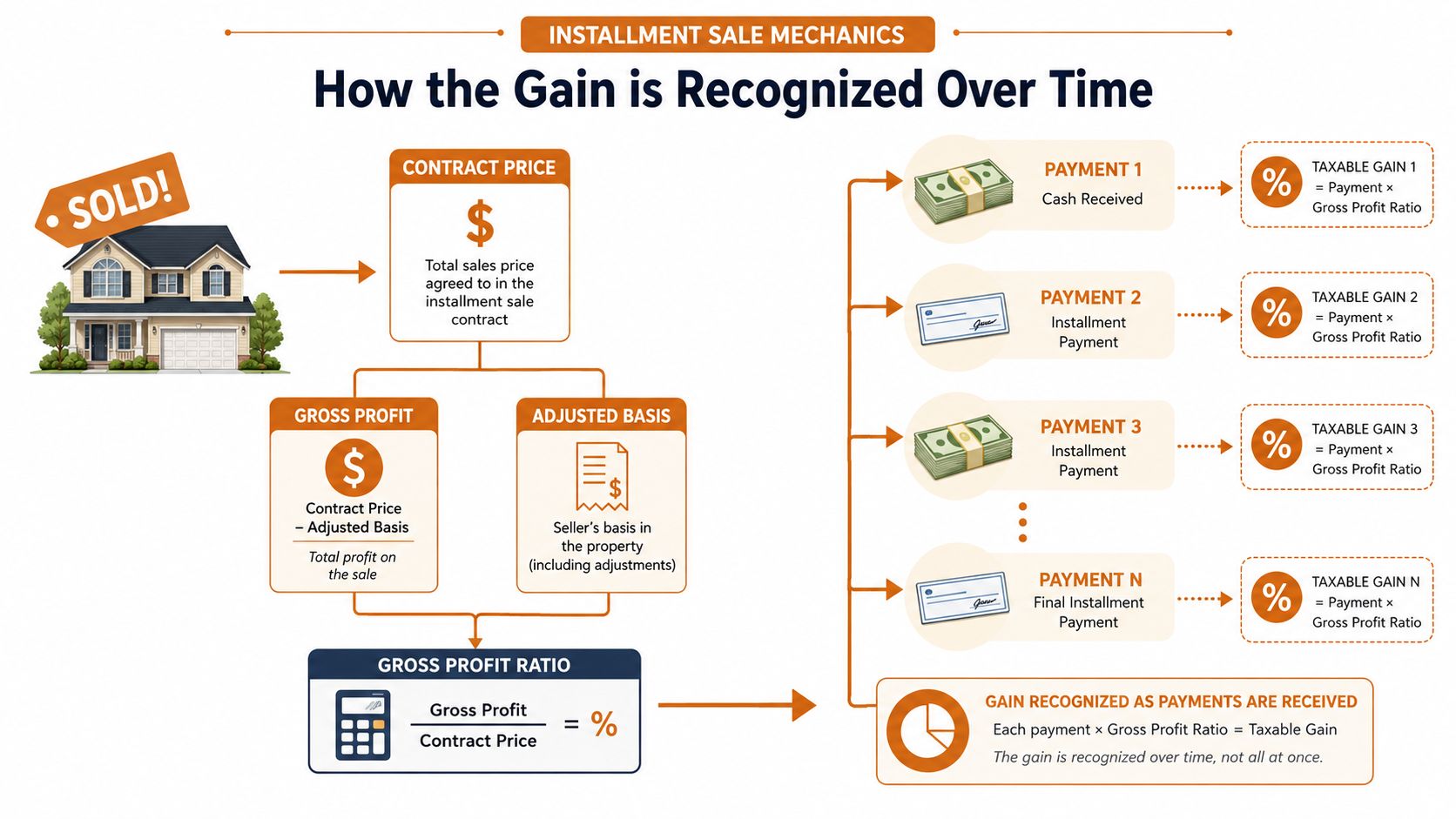
Each payment under the installment method contains the same basic categories:
Each payment received under the installment method is split into return of basis, gain, and interest. The gain portion is recognized using the gross profit ratio, while any stated or imputed interest is taxed separately as ordinary income.
For an owner-operator, this means a note payment is not automatically one block of taxable gain. One portion may recover basis, another may represent gain, and another may be interest. The sales agreement and payment records should make those parts identifiable.
The method commonly applies when a qualifying property sale includes at least one payment after the year of sale. It does not automatically cover every asset transferred in a business sale. Inventory and certain property treated as ordinary income property may fall outside the method. Special rules can also affect depreciation recapture, related-party sales, and installment obligations used as collateral.
For a plain-language overview of what an installment sale is, the key idea is simple: payment over time alone does not settle the tax treatment. The property sold, agreement terms, payment timing, and seller’s actions must satisfy the applicable rules.
Electing out may fit a seller who prefers to recognize the full gain in the sale year. It can also reduce the need to track gain across future payments, but it gives up the usual payment-by-payment deferral. Because the election is due by the filing deadline for the sale year, the choice should be considered while negotiating the seller-financed deal, not after the documents are complete.
The gross profit ratio turns a complicated payment stream into a repeatable calculation. It compares the seller’s total gross profit with the contract price, then applies that ratio to principal payments received. You don’t need to prepare the return yourself to understand the logic, but you should be able to explain the inputs to the person who does.
Start with the transaction’s economic building blocks:
The simplified relationship looks like this:
Recognized gain on principal received = principal received × gross profit ratio
Interest doesn’t go into that multiplication. Stated or imputed interest is reported separately as ordinary income, while the principal portion carries the return-of-basis and gain components.
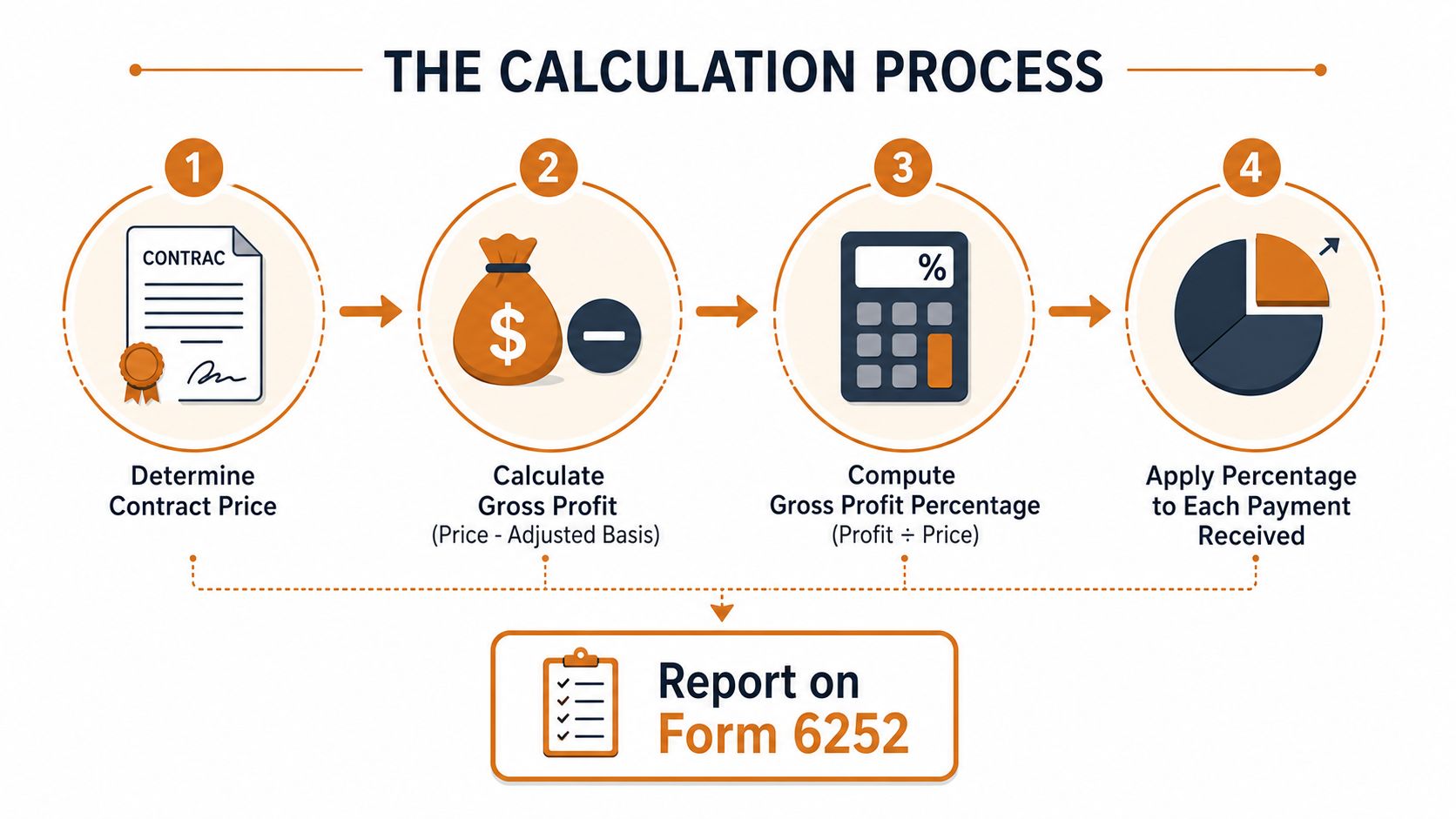
Assume a seller’s contract price is 900,000 monetary units and the adjusted basis is 300,000 monetary units. The gross profit is therefore 600,000 monetary units, and the gross profit ratio is 600,000 divided by 900,000, or two-thirds.
If the seller receives 90,000 monetary units of principal during a payment period, two-thirds of that principal is treated as recognized gain. The remaining one-third is treated as return of basis. Any interest paid with the installment is added separately as ordinary income, not included in the gain calculation.
The point isn’t to memorize a result from one example. It’s to understand the pattern. The same ratio generally follows principal payments through the note, unless a special rule, adjustment, disposition, or other event changes the calculation.
Form 6252 is the reporting framework for installment sales. The seller generally uses it for the sale year and for later years in which payments are received. The form helps organize the sale price, basis, gross profit, payments, and gain recognized.
Before meeting a tax specialist, gather:
Good records make the annual process less fragile. They also help the seller test whether the note is producing the expected cash flow and whether the tax reporting still matches the deal documents.
An owner may offer seller financing expecting each principal payment to spread the taxable gain. That result is not automatic. Asset classification and later actions can override the normal payment schedule. A business sale may combine equipment, inventory, vehicles, real estate, goodwill, and other assets, each with a different tax history. The purchase price must be examined by asset category before the seller treats the note as one uniform transaction.
A service business with little depreciable property may face different issues from an equipment-heavy contractor. For example, an HVAC owner might transfer trucks, tools, warehouse equipment, and customer relationships together. The customer relationships may follow one tax treatment, while the trucks and tools may trigger separate rules.
Depreciation recapture can require recognition in the sale year, even when other gain is reported under the installment method. The seller could therefore owe tax on the recapture portion before receiving all sale proceeds. The note spreads some gain, not necessarily every tax consequence connected to the assets.
Inventory and stock in trade sold in the ordinary course of business generally do not receive the same installment treatment as qualifying investment or business property. Separate the company’s operating inventory from assets whose gain may qualify. Treating the entire purchase price as one pool can produce the wrong timing.
Don’t apply the installment method to the total purchase price until the asset allocation has been reviewed.
Dealer property creates another limitation. A person who regularly sells property of the same type as part of a trade or business may not receive installment treatment for that property in the same way as a nondealer seller. The seller’s business activity matters, not only the wording of the purchase agreement.
Related-party sales also require careful review. A later disposition by the related buyer can accelerate the seller’s deferred gain. If the buyer resells the property under circumstances covered by the related-party rules, the seller may recognize gain earlier than the original note schedule indicates.
The installment obligation itself can create a separate problem. Selling, gifting, pledging, or otherwise transferring the note may trigger tax or accelerate recognition. A seller planning to use the note as borrowing collateral should obtain advice before making the pledge, while the transaction can still be structured correctly.
The practical question is simple: which part of the deal fits the normal installment calculation, and which part requires immediate or accelerated treatment? An allocation review, supported by the agreement and asset records, can answer that question before the first return is filed.
A short video can reinforce the difference between the general rule and these exceptions:
Interest creates a second tax layer in a seller-financed deal. The buyer’s payment may include principal and interest, but only the principal portion feeds the gross profit ratio. Interest is taxed separately as ordinary income, including stated or imputed interest under the applicable rules described by the IRS.
That distinction can change the economics of a note. A seller may like the idea of receiving interest over time, but interest isn’t treated as installment gain. The agreement should state the interest terms clearly, and the tax professional should test whether the stated terms produce the required treatment.
State taxes add another point of uncertainty. States don’t always follow federal installment treatment in the same way, so a seller may face a different timing result depending on the state involved, the seller’s residence, the business location, and where the income is sourced. A move during the note term can make the analysis harder rather than simpler.
| Question | Taking cash upfront | Accepting seller financing |
|---|---|---|
| Cash timing | The seller receives the purchase price sooner. | The seller receives cash according to the note. |
| Gain timing | The seller generally recognizes the transaction’s gain in the sale year. | A qualifying arrangement generally recognizes gain as principal payments are collected. |
| Credit exposure | The buyer’s future payment risk is reduced for the seller. | The seller remains exposed to missed payments and default. |
| Interest | There may be less future note interest. | Interest can create a separate ordinary-income stream. |
| Planning flexibility | The tax event is concentrated. | The tax event may be spread, subject to exceptions and future circumstances. |
Spreading gain may help a seller manage income across years, but that benefit isn’t guaranteed. Future income, tax law, state rules, and the buyer’s ability to pay can all change. A seller should compare the after-tax cash flow of a financed offer with the certainty and liquidity of an all-cash offer.
The small-business tax planning guide can help frame the broader exit discussion. The right question isn’t “Can I defer tax?” It’s “Does the payment structure compensate me for waiting, taking credit risk, and accepting the tax consequences of future interest and gain?”
Consider an HVAC business sold for 900,000 monetary units. Assume the seller’s adjusted basis in the assets allocated to the installment portion is 300,000 monetary units, producing gross profit of 600,000 monetary units. The resulting gross profit ratio is two-thirds, so two-thirds of each principal payment is recognized as gain and the remaining one-third is treated as return of basis.
Assume the buyer pays 180,000 monetary units as a down payment at closing and signs a note for the remaining 720,000 monetary units. To keep the illustration focused, assume the note repays 144,000 monetary units of principal each year for five years. Interest is shown separately, with the example using declining annual interest amounts of 36,000, 28,800, 21,600, 14,400, and 7,200 monetary units.
These amounts are illustrative only. The actual contract price, basis, interest terms, asset allocation, and tax classification must come from the transaction documents and the seller’s records.
The down payment is principal for this illustration. Applying the two-thirds gross profit ratio produces 120,000 monetary units of recognized gain, while 60,000 monetary units represents recovered basis. The first year also requires a separate review for depreciation recapture and other exceptions, which aren’t included in the table.
Each later principal payment of 144,000 monetary units produces 96,000 monetary units of recognized gain and 48,000 monetary units of basis recovery. Interest is not included in those figures. It is reported separately as ordinary income.
| Year / Payment | Principal Received | Interest Received | Gain Recognized |
|---|---|---|---|
| Sale year and down payment | 180,000 | 36,000 | 120,000 |
| Later payment | 144,000 | 28,800 | 96,000 |
| Later payment | 144,000 | 21,600 | 96,000 |
| Later payment | 144,000 | 14,400 | 96,000 |
| Later payment | 144,000 | 7,200 | 96,000 |
| Final payment | 144,000 | No amount assumed | 96,000 |
Across the principal schedule, the seller receives 900,000 monetary units, recognizes 600,000 monetary units of gain, and recovers 300,000 monetary units of basis. The interest column is separate and doesn’t increase the installment gain total.
The example assumes a clean allocation and no special adjustment. A real business sale may require separate treatment for inventory, depreciable equipment, recapture, noncompete rights, goodwill, real estate, or other transferred property. The buyer’s note may also have different principal amounts, a balloon payment, late charges, or prepayment terms.
If the seller elects out by the filing deadline for the sale year, the payment schedule no longer controls the timing of the entire gain. If the stated interest is inadequate, imputed interest rules may change the split between interest and sale proceeds. If the buyer defaults or the seller pledges the note, the tax result may also depart from this simple schedule.
The table’s purpose is practical. It shows why a seller should maintain a payment ledger that records principal, interest, recognized gain, recovered basis, and remaining obligation separately for every payment period.
A seller-financed exit works best when the note is designed around both business cash flow and tax reporting. Before signing, compare different down-payment levels, payment schedules, security terms, and interest provisions. A smaller initial payment may preserve more deferral, while a larger one provides more liquidity and accelerates recognized gain.
Keep the tax file active throughout the note term. Store the agreement, amendments, payment records, basis support, depreciation history, and annual Form 6252 workpapers together. Ask the buyer’s payment processor or bookkeeper to identify principal and interest clearly so the tax records match the cash records.
Bring a tax specialist into the negotiation before the purchase agreement is final, especially when the sale includes multiple asset classes, substantial equipment, related parties, a note pledge, or sellers in more than one state. Prepare a draft term sheet, basis records, asset list, payment schedule, and preferred cash-flow outcome so the advisor can analyze the actual choices.
The Owner’s Shortlist connects business owners with vetted specialists across taxes, valuation, legal matters, financing, succession, and related decisions. Visit The Owner’s Shortlist to review plain-language resources and find a tax specialist who can help test your seller-financed structure before you commit. Use the installment tax treatment questions as part of the negotiation, not as a surprise after closing.
Tell us your situation. We'll connect you with a specialist who works with owners like you. One conversation, no sales pressure.
Found this useful?
Add The Owner's Shortlist as a preferred source and get our articles highlighted in Google Search results.
Add to Preferred SourcesWhat is a tuck-in acquisition? Learn how these deals impact owner-operated businesses, trades, valuation, and when to consult an M&A specialist.
September 29, 2026
Learn what reps & warranties mean in M&A deals, why they matter, and how to negotiate them effectively. A clear guide for business owners.
September 27, 2026
Your business's sale price and your retirement number are two different figures. Here's how to build the second one before you rely on the first.
September 21, 2026
Ten straight questions to work through before you set a retirement date, with a short answer to each and where to go deeper on your own time.
September 21, 2026