How Much Money Do You Need to Retire as a Business Owner?
Your business's sale price and your retirement number are two different figures. Here's how to build the second one before you rely on the first.
September 21, 2026
By Remi Taffin · September 27, 2026
You’ve spent years building a business, and now a buyer is asking for access to your financial records, customer contracts, tax files, employee information, and operating procedures. Then the purchase agreement arrives, filled with statements about what your company owns, owes, earns, and has disclosed. The language may look routine, but those promises can determine how much of the sale proceeds you keep after closing.
Reps & warranties aren’t just legal wording for attorneys to negotiate. They’re the seller’s description of the business and the buyer’s protection against undisclosed problems. Understanding them before you hire advisors helps you find missing records, explain unusual risks, and make better decisions about escrow, indemnification, and insurance.
Consider an owner who has operated a regional HVAC company for many years. The company has loyal customers, recurring maintenance agreements, a stable technician team, and clean-looking financial statements. A buyer expresses interest, and the owner expects the hardest conversation to involve price.
Instead, the buyer’s lawyer asks whether every customer agreement can remain in force after a change of control, whether technicians were classified correctly, whether equipment leases contain transfer restrictions, and whether all intellectual property belongs to the company. The owner knows the business well, but hasn’t reviewed every contract or checked whether an old founder agreement still affects ownership.
Those questions become representations and warranties in the purchase agreement. If the owner confirms something inaccurately, the buyer may later seek compensation under the indemnification provisions. That doesn’t mean every mistake creates a valid claim, but it does mean casual answers can create avoidable exposure.

Owners often focus on the headline purchase price and leave the risk terms to their advisors. That approach can backfire because the reps and warranties determine:
A buyer doesn’t expect an owner to remember every historic detail. The buyer does expect the seller to disclose known problems and provide accurate information. Your preparation should therefore begin before a lawyer drafts the first serious version of the agreement.
Practical rule: Treat every answer in diligence as a potential contract disclosure, not as an off-the-cuff conversation.
Your legal entity, ownership records, signing authority, and contract history affect how advisors assess the deal. Owners who want background on how different legal structures work can review Attorney Assistant legal structures before discussing transaction documents with counsel.
The important point is simple. Reps and warranties allocate risk between buyer and seller. They aren’t merely obstacles designed to slow closing. A carefully defined set of promises can protect the buyer from hidden liabilities while protecting you from open-ended claims based on matters that were disclosed, immaterial, or outside the agreed scope.
Think of the purchase agreement as a handoff record. The seller describes the condition of the business at signing and closing. The buyer relies on those descriptions when deciding whether to proceed and how much to pay.
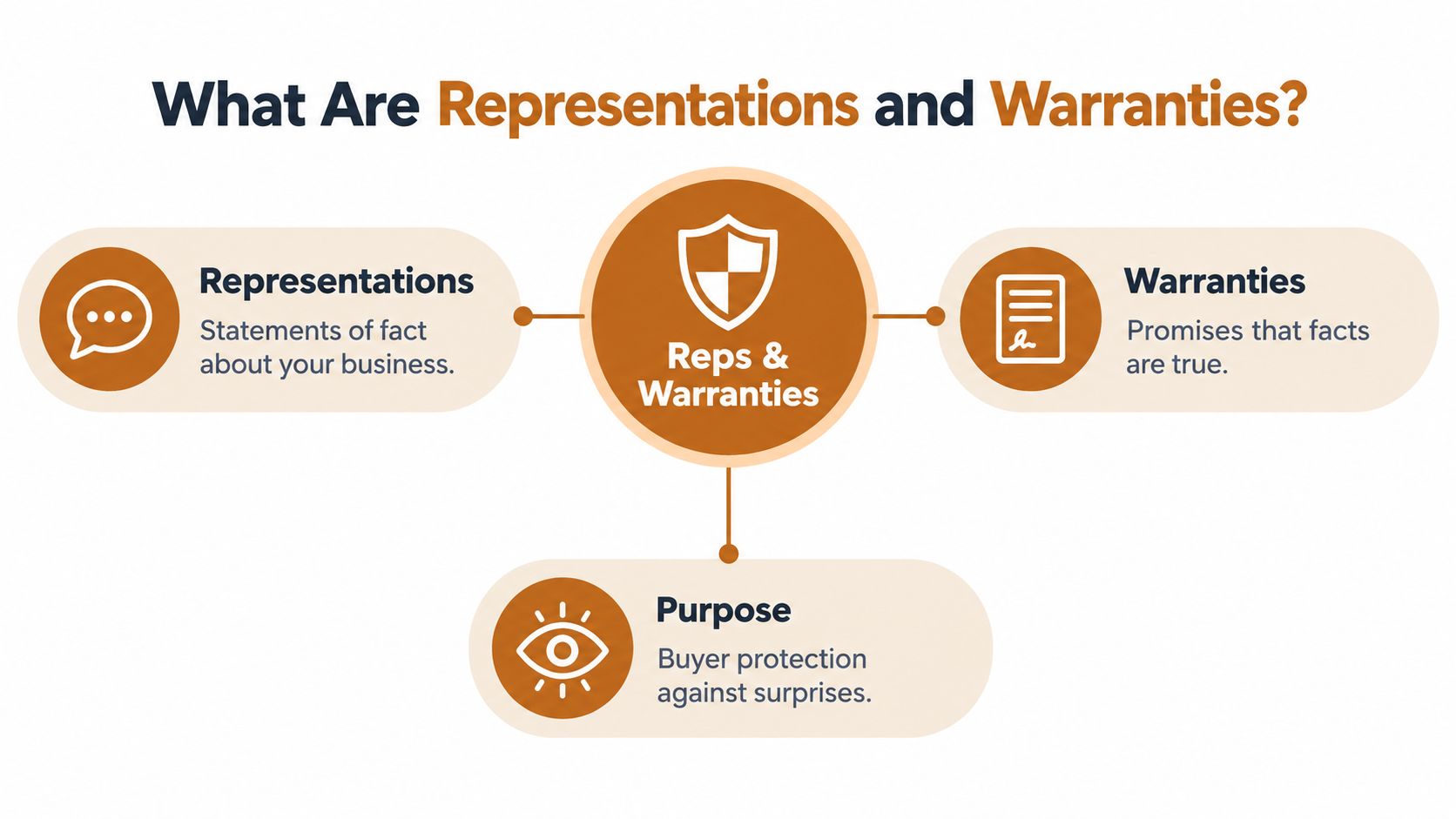
A representation is generally a statement about a fact. For example, the seller may state that the company owns its customer database, has disclosed its material contracts, or has filed required tax returns. A warranty operates as a promise that the stated condition is accurate and carries contractual consequences if it isn’t.
The buyer can inspect records, interview managers, and test financial information, but diligence will never reveal everything. The seller has operated the company for years and usually knows more about its history, informal practices, disputes, and obligations.
Reps and warranties reduce that information gap. They force the seller to make clear statements instead of leaving important assumptions unspoken. If the buyer discovers that a material statement was false, the indemnification provisions may provide a path to recovery.
A simple example helps. Suppose the agreement says that the company has no pending litigation, but the owner knows that a former employee has threatened a claim and has already sent a lawyer’s letter. The owner should disclose the matter rather than sign the statement without qualification. Disclosure may lead to a special indemnity, a purchase-price discussion, or further diligence, but silence can create a much more difficult post-closing dispute.
Owners sometimes see reps and warranties as buyer protection only. That’s incomplete. The seller benefits when the agreement clearly defines:
Without those boundaries, a buyer could argue that a later business problem traces back to an inaccurate statement. With them, both sides have a clearer process for determining whether the seller should pay.
The negotiation is therefore not about promising that the company has no risk. Every operating business has risk. The objective is to identify the risk, disclose it, and assign responsibility in a way that matches the deal.
The exact language depends on the industry, transaction structure, and buyer, but most owner-operated sales return to a familiar set of categories. You should know where the information lives before your advisors ask you to confirm it.
Financial reps address whether the financial statements fairly describe the company’s condition and whether important liabilities have been disclosed. Buyers may ask about revenue recognition, accounts receivable, debt, inventory, working capital, unusual expenses, and income that won’t continue after closing.
For a plumbing company, an owner might need to separate ordinary service revenue from a one-time commercial installation. For a professional practice, the buyer may examine collections, payer mix, recurring clients, and owner-specific expenses. The issue isn’t whether every month looks identical. It’s whether the financial presentation gives the buyer a reliable picture of the business being purchased.
Owners should also understand the difference between an accounting disagreement and a concealed liability. A buyer may challenge an assumption without proving a breach. Clear records and consistent explanations make that distinction easier to manage.
Contract reps can cover major customer agreements, supplier arrangements, leases, franchise documents, software subscriptions, loans, and employment agreements. Buyers want to know whether a sale requires consent or gives a customer, landlord, lender, or vendor a termination right.
Review contracts for:
A financial due diligence review can help connect these documents to reported results. Owners may also consult this practical guide to financial due diligence before organizing their records.
Tax reps usually address filing history, payment status, audits, payroll taxes, sales taxes, and undisclosed liabilities. A small business can face meaningful exposure from inconsistent sales-tax treatment or worker-classification practices even when its income statements look healthy.
Operational reps may cover employees, benefits, intellectual property, permits, environmental matters, data practices, and compliance with applicable laws. Litigation reps require more than listing filed lawsuits. They may also require disclosure of threatened claims, regulatory inquiries, demand letters, or disputes that haven’t reached court.
Owner’s perspective: The most dangerous answer is often not “yes” or “no.” It’s an unexplained “probably.” Flag uncertainty early so counsel can investigate and draft an accurate disclosure.
A breach claim becomes financially important through the indemnification structure. The agreement answers practical questions: Who pays? How much? From what source? For how long?
The main alternatives are holdbacks, escrow arrangements, representative accounts, and reps & warranties insurance. They can appear separately or in combination. Each changes the seller’s cash at closing and post-closing exposure.
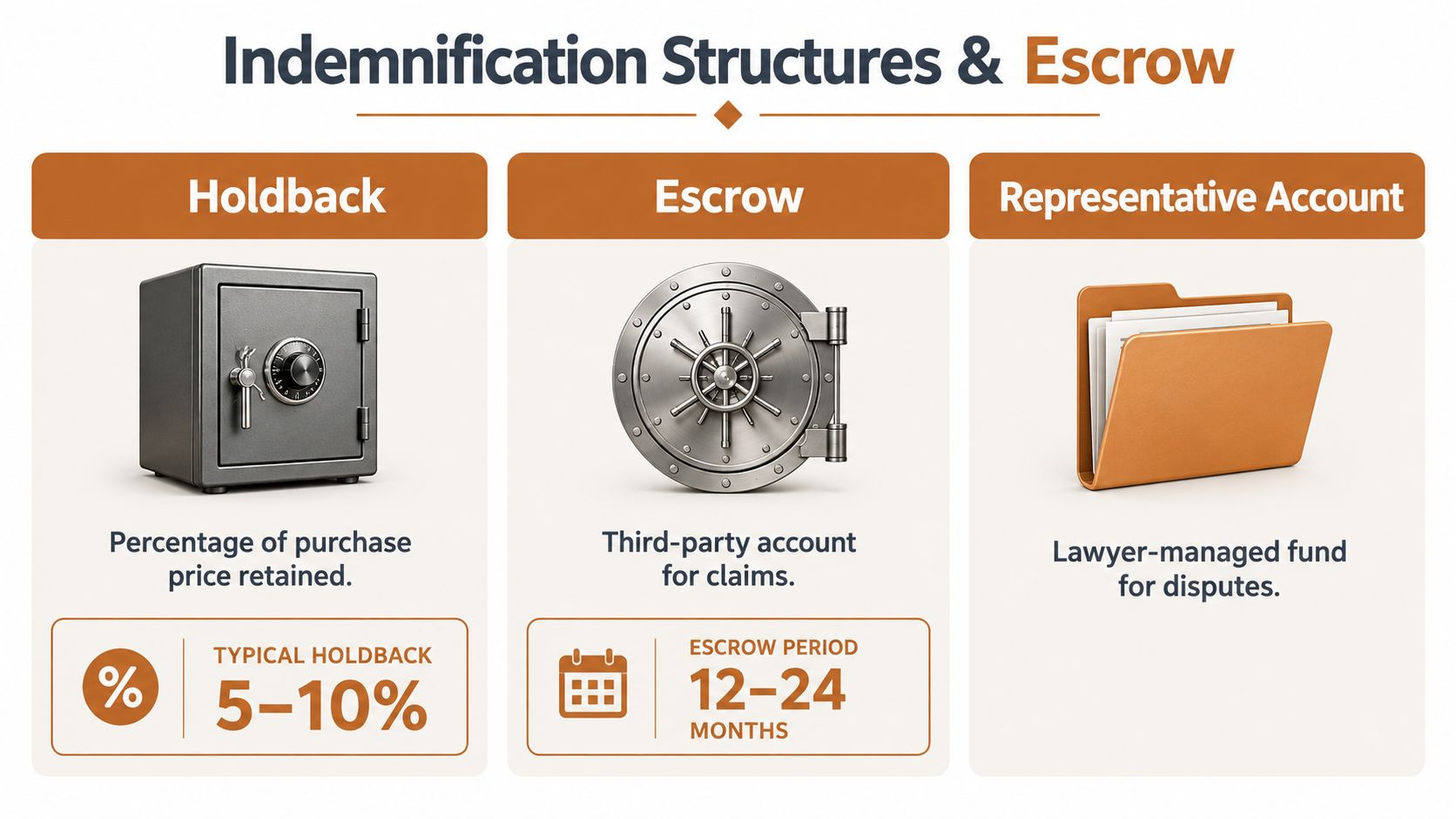
A holdback leaves part of the purchase price unpaid until an agreed date or condition. The buyer retains direct control, while the seller carries the risk that the funds won’t be released as expected.
An escrow places money with a third party. The funds remain available for valid claims under the agreement, but the buyer usually cannot take them without following the dispute process.
A representative account can be managed by a seller representative or lawyer for claims involving a group of sellers. It can be useful when several owners sell together, although the governing agreement must explain who controls decisions and how disputes are handled.
Reps & warranties insurance shifts covered breach risk to an insurer. It can reduce the amount held back from the seller, but the policy has underwriting requirements, exclusions, retention, and claim procedures. It doesn’t cover known issues or every promise in the purchase agreement.
| Structure | Typical Duration | Seller Risk Level | Cash Impact |
|---|---|---|---|
| Holdback | Defined release period | Higher, because the buyer retains funds | Less cash received immediately |
| Escrow | Defined survival period | Moderate, subject to escrow terms and claims process | Funds remain restricted |
| Representative account | Agreement-specific period | Depends on representative authority and dispute rules | Funds may remain available for claims |
| R&W insurance | Policy period and applicable survival terms | Lower for covered claims, but exclusions remain | Premium and retention costs reduce proceeds |
The infographic’s stated figures for holdback and escrow terms should be treated as illustrative deal guidance, not as a universal market rule. Your attorney should compare the proposed terms with the buyer’s diligence findings and the size and complexity of the transaction.
Ask whether the basket is deductible or tipping. A deductible basket means the buyer absorbs losses up to the threshold, while a tipping basket can allow recovery from the first dollar once the threshold is crossed. Ask which reps are treated as fundamental, whether tax claims have separate treatment, and whether a known issue receives a special indemnity.
Claims can arrive early. An Aon review of roughly 340 claims across more than 2,450 North American policies issued between 2013 and 2019 found claims on 22% of policies placed between 2013 and 2017, with notification rates increasing from 18.6% for 2014-vintage policies to 25.3% for 2016-vintage policies. Another industry study reported that about 27% of claims arrived within six months of closing, 51% within twelve months, and about 76% within eighteen months. Aon’s claims analysis illustrates why the release date and claims procedure deserve close attention.
A useful explainer on indemnification structures is available below.
Your first advisor meeting will be more productive if you arrive with facts, not just questions. You don’t need to interpret the purchase agreement yourself. You do need to know where the records are and which areas may require explanation.

Create a secure folder with the records your advisors will likely request:
Don’t edit old records to make them look cleaner. Preserve the original information and write a short explanation of anything unusual. Advisors can usually work with an imperfect history. They have a much harder time working with missing context.
Reps & warranties insurance is no longer relevant only to large sponsor-backed transactions. A 2026 market update describes a softer pricing environment in which premiums have compressed and retention has dropped, while another market discussion says deal activity has picked up and the market remains stable even as claims continue to rise. These observations come from the 2026 RWI market update, and they don’t mean insurance automatically makes sense for a smaller sale.
For an owner-operated transaction, compare the cost of a policy with the cash tied up in escrow, the buyer’s willingness to accept insurance, the scope of exclusions, and the risks revealed during diligence. Self-insuring through escrow may be cheaper when the deal is straightforward and the buyer accepts a reasonable cap and survival period. Insurance may be worth exploring when the buyer wants substantial protection or when preserving more cash at closing matters.
Before engaging counsel, owners can also review this guide on whether you need an attorney to sell a business. It won’t replace legal advice, but it can help you prepare for the conversation.
Before your first meeting, write down the promises you believe you can make about the business and the records supporting them. A buyer may rely on those promises after closing, so your advisors should connect each provision to your facts, proceeds, and post-closing exposure.
Start with scope:
Then ask how the agreement assigns risk:
Bring examples from your own company. If a customer contract was renewed informally, ask whether that creates a representation issue, a disclosure item, or a request for updated paperwork. If payroll records contain a classification concern, ask how it should be described and whether the risk needs a separate cap or survival period.
Insurance requires separate questions. Ask whether the buyer expects a policy, who selects the insurer, who pays the premium and underwriting expenses, and which exclusions could leave you responsible. Ask specifically about cyber, data privacy, and ESG-related reps. A 2026 carrier comparison says insurers are tightening exclusions in those areas, including carve-outs associated with Scope 3 emissions and supply-chain certifications. The 2026 carrier comparison can prompt questions, but your team must review the actual policy wording.
A long period between signing and closing can also affect coverage. If the interim period may extend beyond 12 months, ask counsel whether the insurer could reintroduce material adverse effect concepts or limit the benefit of a double-materiality scrape. Have the answer tied to your agreement and timeline.
Ask your broker how buyers are qualified, how competing bids are handled, and when sensitive information is released. This guide to questions to ask a business broker can help you prepare. The Owner’s Shortlist provides practical resources for valuation, taxes, legal matters, financing, succession, and related sale decisions. Review The Owner’s Shortlist before negotiating reps and warranties.
Tell us your situation. We'll connect you with a specialist who works with owners like you. One conversation, no sales pressure.
Found this useful?
Add The Owner's Shortlist as a preferred source and get our articles highlighted in Google Search results.
Add to Preferred SourcesYour business's sale price and your retirement number are two different figures. Here's how to build the second one before you rely on the first.
September 21, 2026
Ten straight questions to work through before you set a retirement date, with a short answer to each and where to go deeper on your own time.
September 21, 2026
Being financially ready to sell and having a plan for your time are two different things. Here's why the second one catches so many owners by surprise.
September 21, 2026
Understand exit tax rate for business owners — how federal and state taxes, asset vs stock sales, and planning affect your after-tax proceeds.
September 14, 2026