What are all my options as a business owner?
Selling isn't your only option. Compare all seven paths, prepared sale to letting the business wind down, with the odds and gotchas for each.
September 12, 2026
By Remi Taffin · September 14, 2026
You’ve spent years building a profitable business, and a buyer has finally put a serious number on the table. The headline price looks exciting until someone asks the question that matters more: how much will you keep?
Many owners assume the answer is a single exit tax rate applied to the sale price. It usually isn’t. Your after-tax proceeds can depend on whether the deal is structured as an asset sale or stock sale, how the purchase price is allocated, which parts of the gain receive capital-gains treatment, whether depreciation recapture applies, your federal and state position, and what planning happened before the buyer appeared.
Two businesses can sell for the same headline amount and leave their owners with very different cash proceeds. That’s why tax planning belongs near the beginning of an exit process, not at the closing table. A useful starting point is this exit planning guide for business owners, which helps connect valuation, deal preparation, ownership goals, and tax questions.
The practical goal isn’t to discover a magical flat percentage. It’s to identify the layers that create your personal result, understand which layers you can influence, and model the net proceeds before you sign a letter of intent.
Consider an HVAC owner who has built a company around service agreements, replacement work, and a dependable field team. A buyer offers $3 million. The owner mentally subtracts a capital-gains rate, estimates the remaining cash, and starts thinking about retirement.
During diligence, the buyer proposes an asset purchase rather than a stock purchase. Part of the price is assigned to inventory, equipment, customer relationships, and goodwill. Some assets may produce capital gain, while other amounts can be treated as ordinary income because of inventory or depreciation recapture. State taxes and investment-related taxes may add more layers. The owner’s first estimate of net proceeds is no longer reliable.
That surprise isn’t caused by one hidden percentage. It comes from treating the sale price as though every dollar receives the same tax treatment.
An owner’s real calculation looks more like this:
Gross sale price, less selling expenses, less debt or other adjustments, less federal taxes, less state taxes, less ordinary-income items, equals estimated after-tax proceeds.
Each line can change. The buyer’s preferred structure may not match the seller’s preferred structure. A seller’s tax basis can differ from the amount shown in the company’s accounting records. A state move may affect residency analysis, but moving doesn’t automatically erase tax on income connected to the former state.
The phrase exit tax rate also creates confusion because it can refer to different situations. A business owner may be asking about taxes on selling a company, while a search result may discuss the U.S. expatriation regime for people giving up citizenship or ending certain long-term residency status. Those are separate questions with different triggers.
The earlier you model the transaction, the more choices you may have. You can review entity structure, document basis, evaluate a potential stock sale, discuss charitable planning, and examine whether timing or installment treatment fits your objectives.
Waiting until the purchase agreement is nearly complete narrows those choices. It can also turn a tax issue into a negotiation problem, because changing allocation or structure may affect the buyer’s tax position and willingness to pay.
Practical rule: Treat the first serious offer as the start of tax modeling, not the finish line.
Exit tax rate isn’t generally an official label for one tax charged to every business seller. For an owner-operator, it’s useful shorthand for the combined tax bite created by a business exit.
Think of your business as a collection of buckets rather than one asset. The buckets may include cash, inventory, vehicles, equipment, real estate, contracts, intellectual property, and goodwill. When you sell the company, tax authorities may analyze each bucket differently. One part may produce capital gain, another may produce ordinary income, and another may have a special recapture rule.
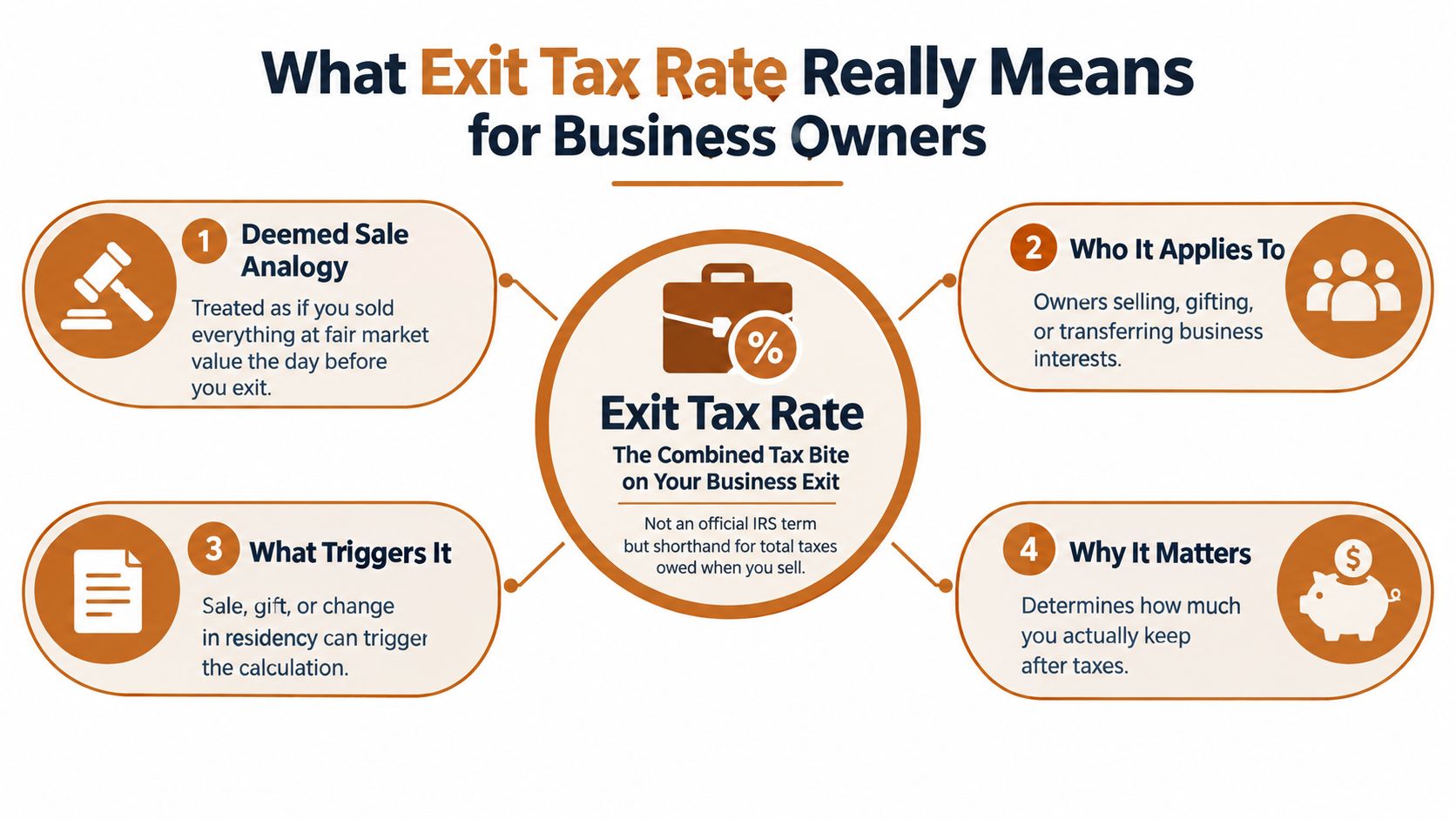
A deemed sale is a helpful analogy. Imagine that the tax rules treat an asset as sold at fair market value even though you haven’t handed the keys to a buyer. The calculation compares that assumed value with your tax basis, which is broadly the amount the tax system recognizes as your investment in the asset.
A business sale is an actual transaction, but the same mental model helps explain why unrealized appreciation, basis, and asset character matter. If an asset has risen substantially in value, the gain may be taxable even though the seller’s cash arrives through a larger transaction rather than a separate sale of every item.
This is different from saying that every business owner faces a special departure levy. The word “exit” can describe a sale, a transfer, a liquidation, or a change in tax residency. The trigger and tax base depend on the event.
The U.S. expatriation regime applies to covered expatriates, not to every owner who sells a company or moves away. The IRS describes a system that can treat certain unrealized gains as though assets were sold, using an annual exclusion and capital-gains framework rather than one standalone exit-tax percentage. The rules have also changed through legislation and inflation indexing, so owners should distinguish a business transaction from a residency termination event. The IRS expatriation tax guidance is the appropriate starting point for that separate issue.
For a business owner selling a company, the central questions are different:
If you want broader background on how federal capital-gains rules can affect planning, this guide to capital gains tax changes 2024 offers useful context. The key lesson is simple: the rate is an outcome of the transaction, not a number you can safely apply to the headline price without further analysis.
A business sale can produce several tax layers. The federal result may include long-term capital gains, ordinary income, depreciation recapture, or taxes connected to investment income. State tax can then add another charge based on residency, source rules, and the jurisdiction’s treatment of the relevant income.
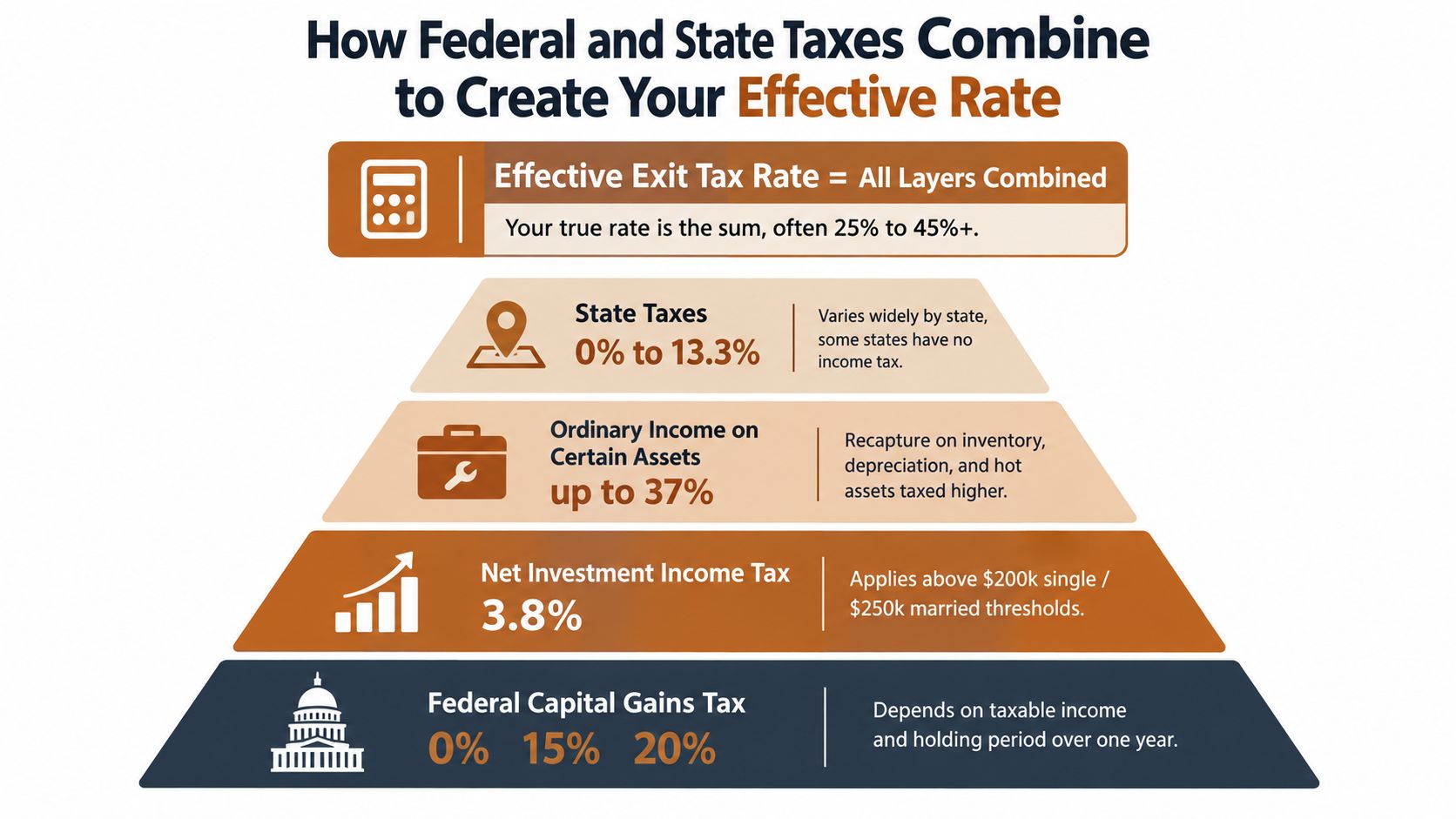
Start with the federal capital-gains layer. Long-term gains may receive capital-gains treatment, while short-term gains and certain business assets may be treated differently. Your income level, holding period, asset type, and transaction structure all matter.
Next, test whether the net investment income tax applies. The tax can affect investment income for taxpayers above applicable income thresholds, but you shouldn’t assume it applies to every dollar of a business sale. Your tax adviser needs to examine the nature of the gain and your broader income picture.
The third layer is ordinary income. Inventory, receivables, depreciation recapture, and other “hot asset” categories can receive less favorable treatment than goodwill or qualifying long-term capital assets. This is often where an asset sale creates a result that surprises sellers.
Finally, examine state taxes. A state may tax a resident’s income broadly, while a nonresident may still owe tax on income sourced to that state. The sale of a business with local operations, property, or ongoing services needs a sourcing analysis rather than a simple assumption based on the seller’s mailing address.
Suppose one portion of the transaction receives capital-gains treatment and another portion is taxed as ordinary income. Applying one rate to the entire price would overstate the tax on one portion and understate it on another. The result is a blended effective rate, calculated after each component has been assigned its own treatment.
The same logic applies to deductions, basis, transaction expenses, debt, and installment payments. A seller may owe tax on gain rather than gross proceeds, and the taxable gain may be spread across different categories.
The useful question isn’t “What’s the exit tax rate?” It’s “Which dollars are taxable, under which rules, and when?”
Ask your adviser to show the estimate in layers:
This format lets you challenge assumptions before the deal becomes difficult to change.
The difference between an asset sale and a stock sale is one of the most important structural choices in a business transaction.
In an asset sale, the buyer purchases selected assets and may leave certain liabilities behind. The price is allocated among categories such as equipment, inventory, customer relationships, and goodwill. Sellers often prefer more allocation to goodwill or other capital-gain assets, while buyers may prefer allocations that provide favorable deductions or faster recovery.
In a stock sale, the buyer purchases the owner’s shares or membership interests. The company itself generally continues to own its assets. That can create a cleaner capital-gain profile for the seller, but buyers may resist because they inherit the company’s history, liabilities, and tax attributes.
| Feature | Asset Sale | Stock Sale |
|---|---|---|
| What changes hands | Selected business assets and possibly assumed liabilities | Shares or ownership interests in the company |
| Price allocation | Allocated across individual asset categories | Generally tied to the ownership interest, subject to transaction rules |
| Inventory treatment | May produce ordinary income | Usually not separately sold by the shareholder |
| Depreciation recapture | Can create ordinary-income treatment on relevant assets | Often avoids a direct asset-level sale by the shareholder |
| Buyer preference | May provide a more favorable basis in acquired assets | Buyer may inherit historical risks and existing basis |
| Seller concern | One price can produce multiple tax characters | Capital-gain treatment may be more consistent, but negotiations can be harder |
| Due diligence | Focuses on assets, contracts, liabilities, and allocation | Focuses heavily on company history, liabilities, and representations |
A buyer’s offer isn’t just a number. It’s also a proposal about what that number represents.
If a buyer assigns substantial value to equipment with prior depreciation, the seller may face recapture. If the buyer assigns value to inventory, that portion can receive ordinary-income treatment. If the agreement places more value on goodwill, the tax result may differ, but the buyer may negotiate hard because allocation affects the buyer’s future deductions.
That negotiation is why sellers need a tax model before accepting a structure. A higher price in an asset sale may not produce more cash after tax than a lower price in a stock sale.
Owners closing a company after a sale also need to distinguish the sale itself from the company’s wind-up. A liquidation can involve distributions, retained liabilities, final filings, and tax consequences that vary by entity type and jurisdiction. An Australian company liquidation guide provides useful background for readers dealing with an Australian company context, although it shouldn’t be substituted for advice on a U.S. transaction.
For a broader owner-focused discussion of the tax implications of selling a business, focus on the questions that affect your own agreement:
The right answer depends on the full deal, not on a universal preference for one structure.
Legal tax planning usually works by changing the taxable base, timing, or character of income. It doesn’t create a guaranteed lower flat rate, and it shouldn’t begin with a last-minute request to “make the tax disappear.”
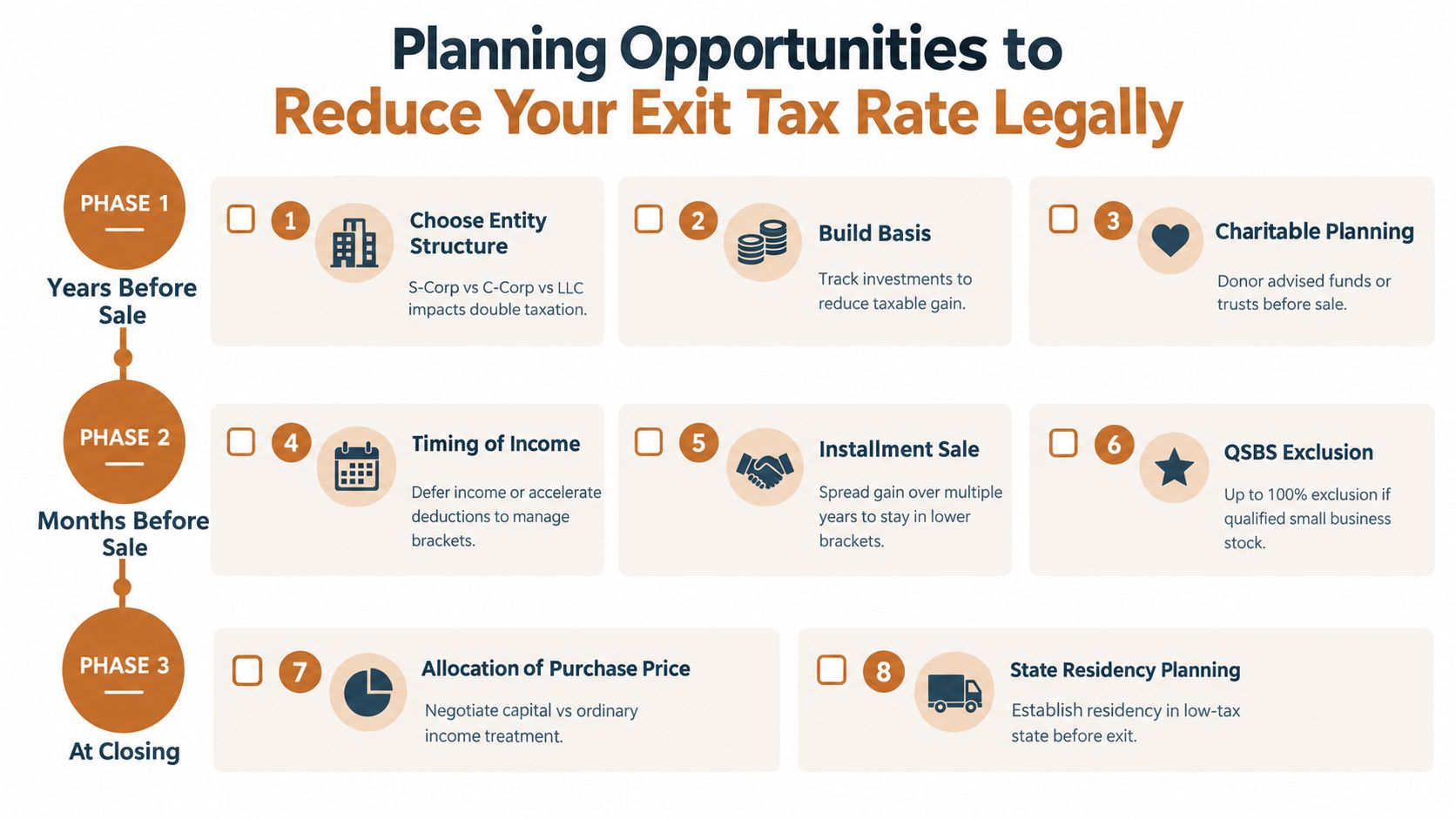
Entity structure deserves an early review. An S corporation, C corporation, partnership, and LLC can produce different tax consequences on sale, including differences in basis, pass-through treatment, and the possibility of tax at more than one level. Changing structure can also create its own tax and legal complications, so this is a planning conversation, not a form-selection exercise.
Build and document basis while the company is operating. Keep records of owner contributions, retained investments, qualifying improvements, and other items that may affect the amount of recognized gain. Poor records can force an owner into an unfavorable assumption.
Charitable planning may also deserve attention before negotiations begin. A donor-advised fund or trust can be appropriate in some situations, but the timing, valuation, substantiation, and anti-abuse rules require professional review. Donating after a binding sale obligation may not produce the same result as donating before the sale is effectively fixed.
Timing can influence the year in which income, deductions, bonuses, distributions, and transaction expenses appear. Owners should model the consequences rather than move items casually, because changing timing can affect cash flow, payroll, business value, and other tax rules.
An installment arrangement may spread recognition across payment periods, but it also creates collection risk and may not fit every asset or transaction. Review installment sale tax treatment before accepting a seller note or deferred payment schedule.
Some owners may also examine whether an available qualified small business stock exclusion applies. Eligibility depends on detailed statutory requirements, including the corporation, original issuance, business activity, holding history, and transaction facts. Never assume that calling a company “small” makes the exclusion available.
Purchase-price allocation is a negotiation lever. Ask for a schedule that shows how every major category is treated for both parties, then compare the tax result with the buyer’s commercial proposal.
State residency planning requires facts, documentation, and genuine change. A new address alone doesn’t settle residency, and income connected to a former state can remain relevant. Coordinate tax, legal, and personal planning well before the transaction so the plan reflects reality rather than a paper trail created at the last minute.
The following examples use the figures supplied for illustration. They aren’t predictions for any particular seller, and the simplified calculations leave out transaction fees, debt, basis differences, credits, deductions, and other items that can materially change the result.
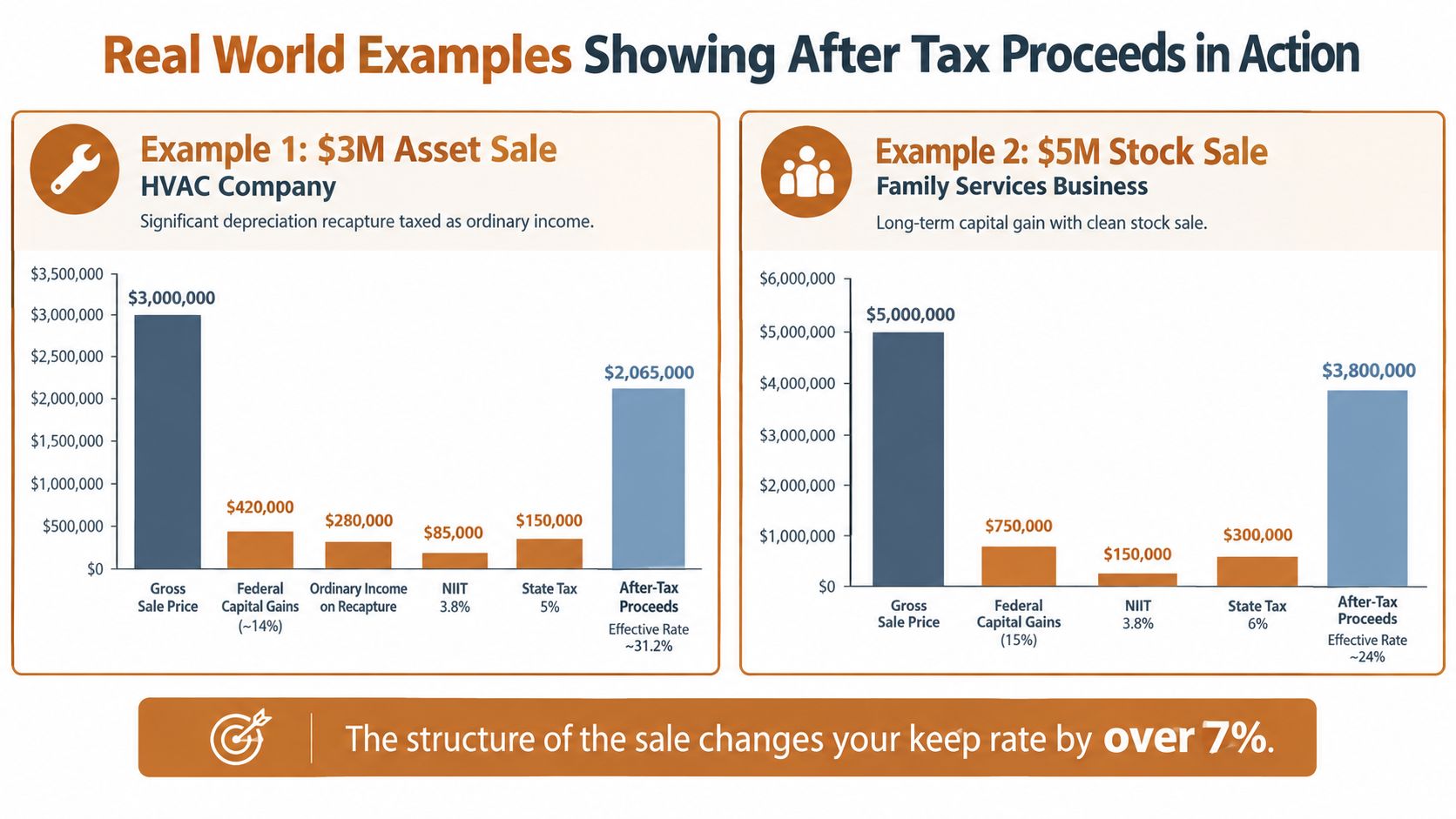
An HVAC company sells its assets for $3 million. The simplified allocation includes significant depreciation recapture, which produces an estimated $280,000 of ordinary income tax. The illustration also assumes $420,000 of federal capital-gains tax, approximately $85,000 of net investment income tax, and $150,000 of state tax.
The estimated tax total is $935,000, leaving approximately $2,065,000 in after-tax proceeds. Dividing that tax estimate by the gross price produces an effective burden of approximately 31.2%, based on the assumptions shown in the example.
The important feature isn’t the exact result. It’s the allocation. The seller didn’t pay one rate on the entire $3 million. Different portions of the transaction received different treatment.
A family-owned services business completes a $5 million stock sale. The illustration assumes $750,000 of federal capital-gains tax at 15%, approximately $150,000 of net investment income tax, and $300,000 of state tax at 6%.
The estimated tax total is $1.2 million, leaving approximately $3.8 million. The resulting effective burden is approximately 24% under the stated assumptions.
The second company sells for more, so its owner keeps more in absolute dollars. Yet the comparison also shows why structure matters. The asset sale includes a heavier ordinary-income component, while the stock sale is modeled primarily as long-term capital gain.
Two headline prices can produce sharply different after-tax outcomes when allocation, tax character, and state treatment change.
Before relying on a proceeds estimate, verify the tax basis, allocation schedule, recapture exposure, state assumptions, transaction costs, debt payoff, payment timing, earnout terms, and whether the buyer’s structure creates tax at the company level.
A credible exit tax estimate has three drivers:
Bring your adviser more than the asking price. Prepare the company’s balance sheet, fixed-asset schedule, inventory records, ownership documents, prior returns, debt schedule, major contracts, expected purchase-price allocation, and a summary of your personal tax position.
Ask direct questions:
The goal is not false precision. It’s a transparent model that shows the assumptions, ranges, timing, and decisions that affect your net proceeds. An owner who understands those moving parts can negotiate from the amount they need to keep, not just the price they hope to receive.
The Owner’s Shortlist offers plain-language guides and a curated directory of specialists for taxes, valuation, legal matters, succession, and related exit decisions. Visit The Owner’s Shortlist to review practical resources and find a vetted specialist for modeling the after-tax value of your sale.
Tell us your situation. We'll connect you with a specialist who works with owners like you. One conversation, no sales pressure.
Found this useful?
Add The Owner's Shortlist as a preferred source and get our articles highlighted in Google Search results.
Add to Preferred SourcesSelling isn't your only option. Compare all seven paths, prepared sale to letting the business wind down, with the odds and gotchas for each.
September 12, 2026
What Is Listing Price. Learn what listing price means when selling a business, how it differs from asking price and valuation, and what drives the gap between
September 12, 2026
Learn how the buy and build strategy works for owner-operated companies. Covers deal logic, financing, integration, valuation impact, and prep steps.
September 11, 2026
Learn how to calculate annual recurring revenue with clear formulas, real examples, and practical adjustments for churn, upgrades, and mixed-revenue businesses.
September 10, 2026