How to Finance Buying a Business: A Step-by-Step Playbook
Learn how to finance buying a business using SBA loans, bank debt, seller notes, and earnouts. A practical playbook for buyers of service companies.
October 23, 2026
By Remi Taffin · September 12, 2026

A business listing price is the dollar amount the seller initially puts on the table when offering the company for sale. For perspective, Zillow’s June 30, 2026 housing data showed a median list price of $408,333 compared with a median sale price of $381,333, illustrating why a list price is a starting point, not a guaranteed result.
You may be hearing the term because retirement is getting closer, a broker has asked what you want for the company, or another owner has mentioned that businesses are “listing” at attractive prices. After two decades of paying employees, serving customers, replacing trucks, and keeping the books moving, it’s natural to look at that headline number and wonder, “Is that what I’ll receive?”
Usually, no.
A listing price is a strategic anchor. It reflects the seller’s opening position, the business’s financial performance, current buyer demand, the likely buyer pool, and the structure of the proposed deal. The eventual sale price can change after buyer conversations, financial review, tax planning, financing discussions, and negotiation.
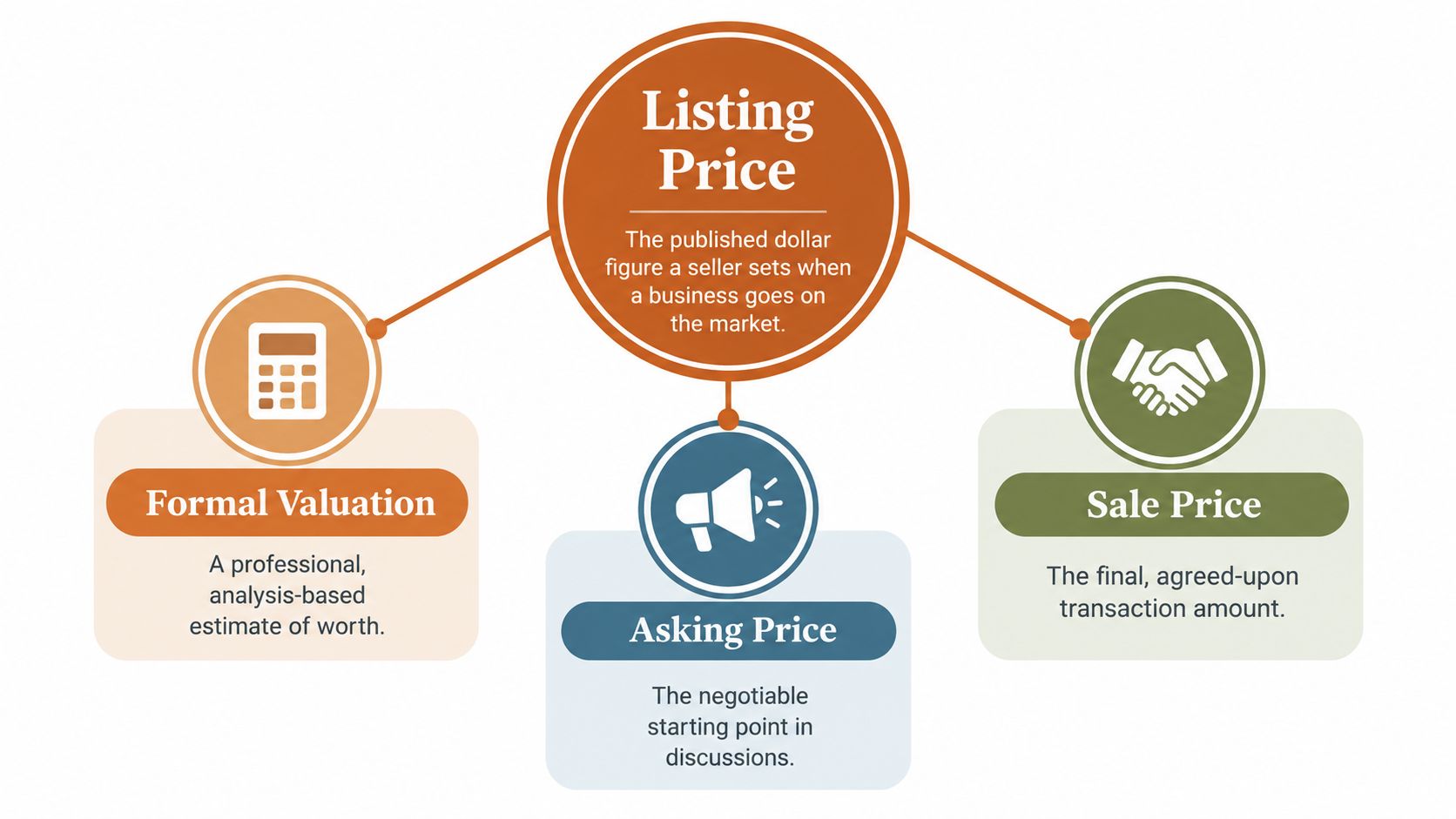
In plain English, listing price is the published dollar figure a seller sets when a business goes on the market. It appears in a broker’s confidential marketing materials, an online business-for-sale listing, or a direct presentation to prospective buyers. It tells the market what the owner would like to discuss, not what a buyer must pay.
That distinction matters because a listing price isn’t the same as a formal valuation. A valuation is an analysis-based estimate that may consider earnings, assets, comparable transactions, industry conditions, and business risk. A listing price uses that information, but it also reflects strategy. An owner may choose a number designed to attract several buyer types, test demand, leave room for negotiation, or support a particular financing structure.
The words listing price and asking price are often used interchangeably. In practice, both usually describe the seller’s initial public or semi-public request. Sale price, however, means the amount the buyer and seller ultimately agree to in the transaction documents.
The phrase carries different practical weight in different markets.
The owner ultimately approves the listing price, but a broker or M&A advisor often helps create it. The owner knows the company’s history, strengths, customer relationships, and personal goals. The advisor brings market context, buyer feedback, transaction experience, and a view of how the business will look under due diligence.
They may start with a valuation range, then discuss questions such as:
A first-time seller often makes one costly mental mistake: treating the headline listing price as personal proceeds. The amount eventually reaching the owner can be affected by debt, transaction expenses, taxes, working capital adjustments, seller financing, earnouts, and the division between company assets and liabilities.
Practical rule: Treat the listing price as the beginning of a conversation, then calculate the likely net proceeds separately.
These terms sit close together, but they answer different questions. The listing price asks, “What number has the seller published?” The valuation asks, “What does the analysis suggest the business may be worth?” The sale price asks, “What did the parties agree to?”
For many small businesses, listing price and asking price mean nearly the same thing. A broker may call the number a listing price in a marketing package and an asking price during a buyer call. Technically, the listing price is the published figure, while asking price can also describe a figure stated privately during negotiations.
Market value is different. It represents an estimate of what informed buyers may pay under current conditions. An appraised value is a formal professional opinion prepared using a defined methodology. Neither figure automatically becomes the listing price. An owner can list above an appraisal, below it, or close to it, although each choice creates a different buyer response.
The Federal Reserve Bank of Philadelphia’s discussion of asking prices describes an asking price as a negotiation anchor and notes that sellers may still consider lower offers. That idea transfers neatly to business sales. A posted amount frames the discussion, but a buyer can challenge it after reviewing the company.
| Term | Who Sets It | What It Represents |
|---|---|---|
| Listing price | Owner, often with a broker or advisor | The published starting figure for marketing the business |
| Asking price | Seller | The amount requested in a public or private discussion |
| Market value | Valuator or market analysis | An estimate of what buyers may pay under current conditions |
| Appraised value | Credentialed appraiser | A formal, analysis-based opinion of value |
| Sale price | Buyer and seller together | The final agreed transaction amount |
Consider a plumbing company with dependable revenue but aging vehicles and a customer base concentrated in a few commercial accounts. The owner might publish a price that reflects the company’s earnings and the potential of those accounts. During diligence, the buyer could find that one major contract isn’t transferable or that equipment replacement is overdue. The parties may then negotiate a lower cash amount, add seller financing, or use an earnout tied to customer retention.
The number on the brochure may remain unchanged for a time, but the economic deal has shifted. That’s why sellers should ask two separate questions: What is the business listed for? and What will I likely receive at closing, after adjustments and taxes?
A listing price usually comes from several connected judgments rather than one formula. Owners often begin with earnings, then adjust the result for market conditions, buyer type, and transaction design.
Small-business advisors may examine Seller’s Discretionary Earnings, or SDE, EBITDA, and revenue. SDE can be useful for an owner-operated company because it may add back certain owner-specific expenses and compensation to show the economic benefit available to one working owner. EBITDA focuses on earnings before interest, taxes, depreciation, and amortization, which can help buyers compare operating performance across businesses.
A plumbing shop might show strong reported profit, but the owner also handles estimating, emergency calls, scheduling, and supplier negotiations. The advisor must separate genuine business earnings from compensation for work the buyer will need to perform or replace. Owners who want a plain-language review of this distinction can consult the Seller’s Discretionary Earnings guide.
Revenue multiples can provide another reference point, but revenue alone doesn’t tell a buyer whether the company produces durable cash flow. Two HVAC companies with similar sales can support different listing prices if one has better margins, stronger retention, cleaner records, and less owner dependence.
Buyer demand and financing access change the practical range. Realtor.com reported a U.S. median listing price of $428,950 in July 2026, down 2.4% year over year, and later reported a national median list price of $424,500 in August 2026, down 1.0% month over month and 1.3% year over year. The same August update reported regional declines of 3.0% in the Northeast, 2.3% in the South, and 2.1% in the West, while the Midwest was flat, showing how local conditions can produce different pricing environments. These housing figures aren’t business valuations, but they illustrate the broader principle that advertised prices respond to local supply and demand, as shown in Realtor.com’s market research.
For a business seller, the relevant questions are local and industry-specific. Are buyers actively seeking service companies? Can lenders support acquisitions? Are strategic buyers competing with individual operators? A strong business may still need a realistic anchor if the qualified buyer pool is narrow.
A strategic acquirer may value customer access, geographic coverage, trained technicians, or purchasing efficiencies. A financial buyer may focus more heavily on repeatable earnings, management depth, debt capacity, and the ability to operate without the founder. An owner-operator may care about personal income, financing terms, and whether the transition feels manageable.
The same company can therefore attract different pricing reactions from different buyers. A multi-location HVAC company may be more valuable to a regional service group than to a first-time buyer who plans to work in the field.
Seller financing, earnouts, working capital requirements, and an asset-versus-stock structure can all affect the price a buyer is willing to discuss. A seller might accept a higher headline amount if part of it is contingent on future performance, or accept a lower cash price in exchange for a cleaner closing and fewer ongoing obligations.
A listing price is defensible only when the earnings, operations, and deal terms support the story behind it.
Pat owns an HVAC company with 12 employees, steady maintenance contracts, and two service trucks. She still reviews major estimates, but customers don’t call only for Pat. Dispatchers schedule work, technicians complete jobs, and maintenance agreements create a continuing relationship that a buyer can examine and potentially transfer.
Pat’s advisor might anchor the listing price around SDE, then assess whether the recurring service work supports a premium. The premium wouldn’t come from using the phrase “recurring revenue.” Buyers would want to inspect contract terms, renewal behavior, customer concentration, pricing history, technician capacity, and whether customers would remain after Pat leaves.
Her trucks and equipment also matter. Well-maintained vehicles reduce immediate replacement pressure, while weak records or deferred maintenance can give buyers a reason to reduce their offer. Pat’s willingness to stay for a defined transition can strengthen buyer confidence, particularly if she can introduce key commercial customers and explain the company’s operating routines.
Carl owns a one-truck plumbing shop built almost entirely around his own labor. Customers ask for Carl by name, he handles the calls, performs most of the work, prepares estimates, and manages the schedule from his phone. The company may produce attractive revenue, but the buyer isn’t acquiring the same transferable operating platform as Pat’s buyer.
Carl’s listing price would likely face closer scrutiny around documented EBITDA, replacement labor, customer relationships, and equipment condition. A buyer may value the customer list and reputation, but also recognize that the business could lose momentum if Carl exits immediately. The listing anchor therefore needs to reflect owner dependence rather than assume that all historical earnings will continue unchanged.
Suppose both companies show similar revenue on their income statements. That doesn’t make them equivalent businesses. Pat’s buyer may see contracts, employees, systems, and pricing power that can continue under new ownership. Carl’s buyer may see a job attached to a truck, with more work required to build a team and preserve customer loyalty.
The owner’s transition plan can change the conversation. So can customer concentration, contract assignability, online reviews, equipment age, financial reporting quality, and the consistency of margins.
The business-sale market report from Bsale is useful context because it distinguishes advertised asking prices from final transaction outcomes. For an owner, that distinction is practical: a rising headline ask doesn’t prove that buyers are closing at the same level.
A buyer rarely accepts a listing price at face value. The buyer turns it into a private model based on earnings, risk, financing, required improvements, and personal objectives.
A strategic buyer may look for overlap with an existing service area, purchasing savings, technician recruitment advantages, or access to customers the buyer already serves. That buyer may tolerate a higher headline if the combination creates value that the seller’s standalone financial statements don’t show.
A financial buyer typically tests whether the business can support the proposed financing and whether management can operate the company without the founder. The buyer also considers how the business might perform under a future ownership change. A first-time owner-operator often evaluates the listing through personal affordability, expected income, available cash, and the practical demands of running the company.
The same listing price can therefore look reasonable to one buyer and impossible to another.
| Buyer Type | Primary Lens | Typical Pushback on Listing Price | Deal-Structure Lever |
|---|---|---|---|
| Strategic acquirer | Synergies, territory, customers, operating efficiencies | “Which benefits are proven rather than assumed?” | Earnout or performance-based consideration |
| Financial buyer | Repeatable earnings, management depth, financing capacity | “Can cash flow support the purchase and future investment?” | Seller financing or staged payments |
| Owner-operator | Personal income, workload, available funds | “What will I need to replace after the owner leaves?” | Transition support and training period |
A high number can communicate confidence, but it can also discourage qualified buyers before they ask questions. The plan notes for this article suggest that an anchor 20% to 40% above the expected closing range can shrink the buyer pool. Because that range isn’t included in the verified source data supplied for this article, the safe practical conclusion is qualitative: a listing price materially above realistic closing expectations can cause serious buyers to self-select out.
A low number creates a different risk. Buyers may assume the company has hidden problems, or they may treat the price as an invitation to negotiate downward. The right anchor should attract the buyers who can complete the transaction, not merely generate attention.
Owners who want to examine the underlying reasoning can use this guide to calculating business worth, then ask an advisor to test the result against buyer financing and transaction terms.
Price often changes through deal mechanics rather than a simple argument over value. Buyers may request a working capital adjustment so the company is delivered with enough ordinary operating resources. They may propose seller financing, an earnout, a longer non-compete, or a holdback tied to representations and warranties.
That means two offers with the same headline price can produce very different risk and cash-flow outcomes for the seller. Compare the amount paid at closing, the amount contingent on future events, the interest and security on deferred payments, and the obligations that survive closing.
Specialists earn their fees at different stages. Bringing in the right person too late can leave you defending a number that doesn’t survive review or accepting terms that create avoidable risk.
Engage a valuator before finalizing the listing price. The valuator can test SDE or EBITDA adjustments, examine comparable evidence, identify customer or owner concentration, and flag issues a buyer will likely raise.
This is the stage for separating aspiration from support. If you believe the company deserves a premium because of recurring contracts, pricing power, or a trained workforce, the valuator can help identify the evidence needed to defend that position. A business appraisal service can also clarify which valuation approach fits the company and the purpose of the analysis.
Your CPA or sale-side tax advisor should review the proposed structure before the listing goes public. The advisor can compare asset and stock sale consequences, examine installment-sale treatment, and discuss whether the qualified small business stock exclusion may apply if you qualify.
Tax planning can change the preferred deal structure even when the headline price stays the same. A seller may prefer more cash at closing, while a buyer may prefer asset treatment or staged payments. You need to understand the after-tax effect before you make promises in marketing materials or negotiate from an incomplete picture.
M&A or business-sale counsel should review the listing agreement, confidentiality agreement, and later letter of intent before you sign them. The engagement letter may establish exclusivity, fees, authority to market the business, and termination rights.
Counsel also helps examine representations and warranties, non-compete obligations, indemnity exposure, lease assignments, employee matters, and customer-contract transfer provisions. Those terms can affect your risk long after the listing price has disappeared from the conversation.
The sequence is simple: test the number, model the tax, then protect the deal terms.
You don’t need to decide on a final listing price during one conversation. Start by preparing the evidence that allows an advisor to set a defensible range.
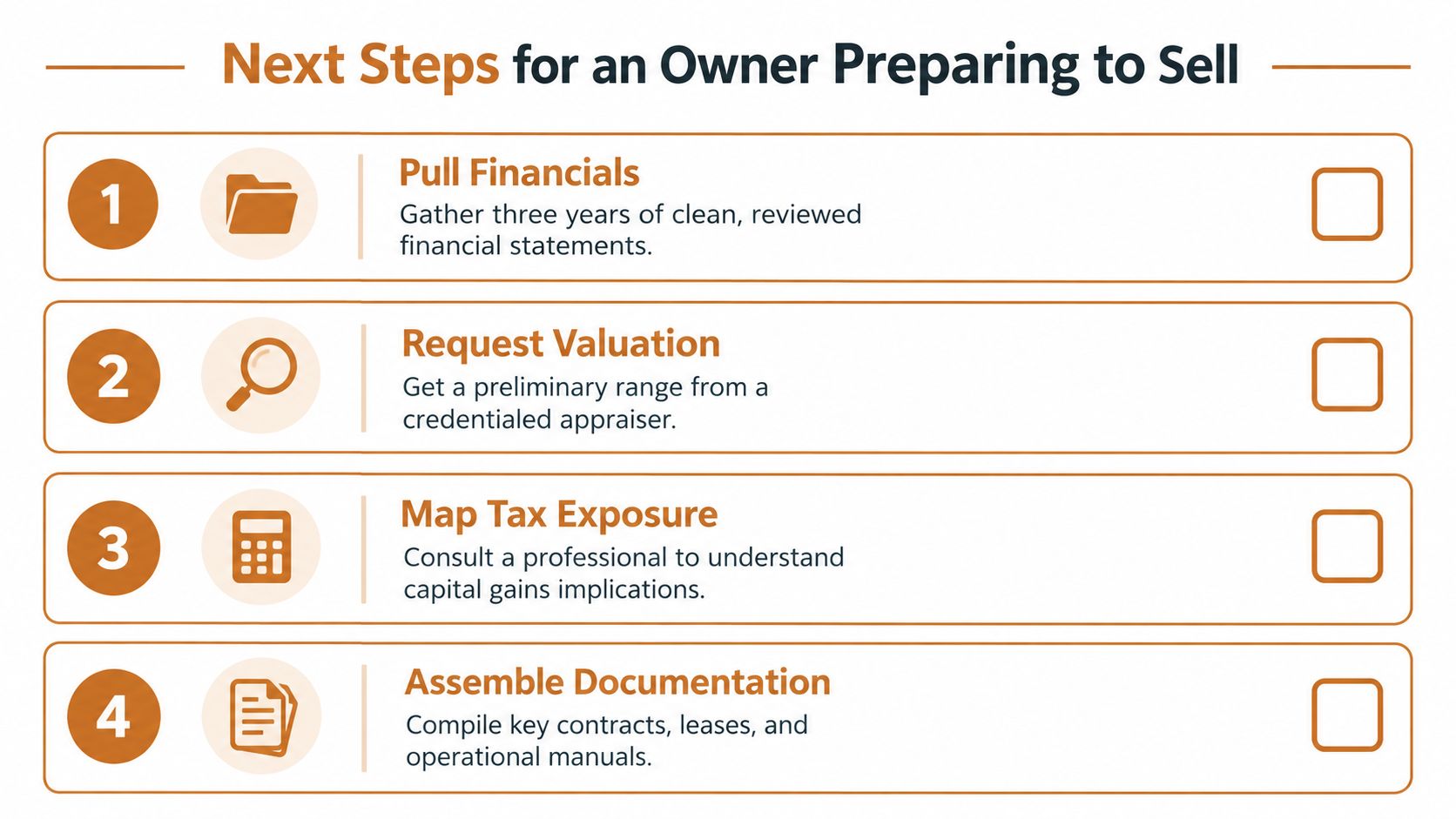
Interview two or three M&A advisors or business brokers who understand your industry and local buyer market. Ask what comparable transactions they can discuss, how they qualify buyers, how they handle confidentiality, and how they distinguish a marketing price from expected net proceeds.
For a broader planning framework, the Nexist exit strategy guide can help you think beyond the initial listing and consider the decisions that shape the full transition. Revisit the anchor when buyer feedback, diligence findings, financing conditions, or market conditions change.
The best listing price isn’t the highest number you can print. It’s the number a qualified buyer can understand, finance, negotiate against, and ultimately close on.
The Owner’s Shortlist connects long-tenured business owners with curated specialists in valuation, tax, legal matters, financing, succession, and related sale decisions. Visit The Owner’s Shortlist to compare practical guides and find an appropriate specialist before you publish a listing price.
Tell us your situation. We'll connect you with a specialist who works with owners like you. One conversation, no sales pressure.
Found this useful?
Add The Owner's Shortlist as a preferred source and get our articles highlighted in Google Search results.
Add to Preferred SourcesLearn how to finance buying a business using SBA loans, bank debt, seller notes, and earnouts. A practical playbook for buyers of service companies.
October 23, 2026
Explore 5 confidential information memorandum examples for owner-operated businesses, with required sections, practical guidance, and common pitfalls.
October 22, 2026
Partners who disagree on selling usually settle it one of four ways: a buyout, a partial sale, a sale together, or what the agreement forces.
October 20, 2026
What is deal structuring, explained for service business owners. Learn asset vs stock sales, earnouts, seller financing, holdbacks, and the questions
October 19, 2026