How to Finance Buying a Business: A Step-by-Step Playbook
Learn how to finance buying a business using SBA loans, bank debt, seller notes, and earnouts. A practical playbook for buyers of service companies.
October 23, 2026
By Remi Taffin · September 10, 2026
You’re looking at a revenue report that says the business produced a strong year, but a buyer keeps asking a narrower question: how much of that revenue should still exist after the sale? If your books combine maintenance agreements, emergency calls, installation work, parts, and setup fees, the answer won’t be found by multiplying the top line. You’ll need to separate the revenue a customer is committed to repeat from the revenue that requires another sale.
That’s the practical purpose of annual recurring revenue, or ARR. This guide shows you how to calculate annual recurring revenue for a subscription, service-contract, or hybrid business, then defend the result in a valuation conversation. The central recommendation is simple: report less ARR if that’s what the contracts support, and make the number auditable.
A service business can report strong sales while having very little revenue a buyer can count on after closing. Maintenance agreements, scheduled support, and subscription charges belong in the recurring base. Installations, emergency calls, parts, setup fees, and project work require separate treatment because they depend on a new purchase or variable customer need.
Annual recurring revenue, or ARR, measures the annualized value of active revenue supported by current agreements. It is a decision about revenue quality, not a second version of annual sales. My recommendation is direct: calculate the recurring portion conservatively, document the contract terms, and leave uncertain revenue outside ARR.
Practical rule: If the customer must make a new decision each time before the revenue occurs, do not automatically classify it as ARR.
For software, ARR usually comes from subscription contracts. An HVAC company may earn it through maintenance agreements, while a plumbing business may have scheduled commercial service contracts. A hybrid operator may have recurring service fees on the same invoice as variable parts, emergency labor, and project work. Separate those components before discussing valuation.
Buyers and lenders use recurring revenue to assess predictability and the durability of future cash generation. A defensible ARR figure can support a better valuation discussion than a larger top-line number padded with one-time work. ARR still does not replace profit, cash flow, or recognized revenue. It answers a narrower question: what contracted economic base is active now?
Subscription ARR comes from repeatable subscription charges. Service-contract ARR comes from scheduled maintenance or ongoing support agreements. Hybrid ARR requires line-item judgment. Include the contracted service component, then exclude variable charges and project work unless the agreement clearly supports their recurring treatment.
ARR is not cash collected. A customer can pay an annual contract upfront while the related service revenue is recognized across the contract term. The ARR guide for SaaS leaders provides the software-focused definition. Trades and service businesses should apply the same discipline to the actual commitments in their contracts.
“Recurring” and “reoccurring” are also different labels. Repeated purchases without a defined agreement or schedule may show customer loyalty, but they are not automatically ARR. Review the distinction in this guide to recurring versus reoccurring revenue.
At exit, show the calculation by customer, contract, revenue type, and exclusion. That schedule gives a buyer something better than an optimistic run-rate claim: an ARR number that can be tested.
Start with the revenue commitment, not the accounting software’s total sales line. For a business with stable monthly recurring contracts, the basic calculation is:
ARR = MRR × 12
MRR is the monthly recurring revenue from active contracts, after converting annual and multi-year agreements into monthly amounts. The Corporate Finance Institute’s ARR reference sets out this standard framework.
Suppose 120 subscribers pay $49 per month. The calculation is:
120 × $49 = $5,880 MRR
$5,880 × 12 = $70,560 ARR
That result is correct for the stated inputs. $58,800 ARR would be wrong because it annualizes the customer count and price for only part of a full year. Use the same discipline for trades and service businesses, but apply it to active contracts rather than assuming every repeat sale is recurring.
For hybrid revenue, calculate the contracted service portion separately. Exclude emergency calls, variable usage charges, materials, installations, and project work unless the agreement clearly makes them recurring commitments. Setup fees and other one-time charges do not belong in ARR.
A single month can distort the run rate when customers upgrade, downgrade, start, or cancel during the period. Use this formula when the current month is not representative:
ARR = average monthly recurring revenue over the last 3 months × 12
If the last three MRR figures were $5,700, $5,880, and $6,060, average MRR would be $5,880, producing $70,560 ARR. The arithmetic is simple. The review point is whether those months reflect normal active-contract revenue.
| Method | Formula | Best used when | Result for 120 subscribers at $49 per month |
|---|---|---|---|
| Current-month run rate | Current MRR × 12 | Contracts are stable and the month is representative | $70,560 |
| Three-month average | Average MRR over last 3 months × 12 | Contract changes make one month unusually high or low | Depends on the three-month average |
| Contract-based normalization | Sum of each active contract’s annualized value | Billing frequencies and terms differ | Depends on active contracts |
For a valuation file, contract-based normalization is usually the strongest method for service businesses. It exposes which revenue is committed and which depends on future jobs. Use the trailing-twelve-month revenue guide to keep historical revenue separate from the forward-looking ARR run rate.
If two subscribers upgraded during the month, use the contracted amount and effective date. Do not count a full month at the higher plan when the upgrade applied only partway through the month. Remove a canceled subscriber in the period when the cancellation became effective, then reconcile each movement to the contract schedule.
Consider a hypothetical residential HVAC company with a maintenance program and a commercial service division. Its accounting software contains recurring invoices, repair tickets, installation invoices, parts charges, and miscellaneous add-ons. The owner wants one ARR figure for a valuation discussion.
Start with the active residential agreements:
Together, the defensible contract ARR is:
$81,600 + $39,600 = $121,200 ARR
This calculation follows the contract-based approach described by Chargebee, which recommends annualizing active recurring contracts and reconciling new, expansion, contraction, and churn in a revenue waterfall. You can review that framework in its ARR calculation guide.
The owner should export the following from QuickBooks or ServiceTitan:
The residential agreements contribute because they represent contracted maintenance revenue. The commercial agreements contribute because their annual values are recurring commitments. A one-time compressor replacement doesn’t contribute because the customer has bought from the company before.
Suppose the company also sells a monthly pest-and-mold add-on. Don’t add the gross invoice total until you separate active recurring subscriptions from one-time treatments, remediation, and variable materials. The correct approach is to sum the current recurring monthly charges for active add-on customers and multiply that normalized MRR by 12, then add the result to the $121,200 contract base.
If the add-on schedule is incomplete, report the $121,200 figure as the clean contract ARR and show the add-on as a separate pending reconciliation. That’s better than burying uncertain revenue inside the headline number. A buyer can accept a clearly documented adjustment. They’ll question a number that changes when someone rebuilds it from customer contracts.
A current ARR balance should explain how it changed from the prior period. The cleanest format is a revenue waterfall:
Beginning ARR + new ARR + expansion ARR − contraction ARR − churned ARR = ending ARR
This structure prevents owners from reporting new contracts while leaving canceled or reduced contracts in the base. Paddle’s ARR guidance also emphasizes excluding non-recurring revenue and accounting for expansion, contraction, and churn when calculating the recurring run rate. You can review its explanation in this ARR framework for subscription businesses.
Use the customer contract, not the invoice date, to determine the movement. A plumbing customer adding a sump-pump maintenance line is expansion once the amendment is effective. A restaurant moving from quarterly service to semi-annual service creates contraction because the recurring commitment has fallen. A canceled HVAC maintenance agreement becomes churn when the cancellation takes effect.
| Component | Definition | Treatment | Monthly $ | Annualized impact |
|---|---|---|---|---|
| Beginning recurring base | Active recurring contracts at the start of the period | Starting point | $5,000 | $60,000 |
| New ARR | New contracts activated during the period | Add | $800 | $9,600 |
| Expansion ARR | Upgrades, added service lines, or effective price increases | Add | $300 | $3,600 |
| Contraction ARR | Downgrades, reduced frequency, or discounts | Subtract | $150 | $1,800 |
| Churned ARR | Canceled recurring contracts | Subtract | $200 | $2,400 |
| Ending recurring base | Reconciled active base | Result | $5,750 | $69,000 |
The table is an illustrative structure, not a benchmark. Replace each amount with the customer-level movement in your own records. The annualized impact is the monthly movement multiplied by 12, consistent with the standard MRR-to-ARR framework.
If an existing customer expands, don’t classify the entire customer as new ARR. Keep the original recurring amount in the beginning base and record only the incremental amount as expansion. Apply the same logic to downgrades. Subtract only the lost recurring value.
This distinction gives you two useful management views. Net new ARR shows the total change after additions and losses. Gross retention shows how much of the opening customer base remained before expansion is credited. If new logos are carrying the headline growth while existing agreements are shrinking, the business has a weaker recurring foundation than the top-line ARR suggests.
For each revenue stream, apply one rule:
Include revenue only when it’s contracted, recurring, and reasonably expected to renew under the stated terms.
That standard fits software, maintenance, commercial service, and hybrid trades. It also prevents a single recurring line item from turning an entire invoice into ARR.
Reconcile reported revenue to clean ARR, then label every adjustment:
A hybrid HVAC company may sell maintenance agreements, installations, and repairs to the same customers. Lift only the active maintenance contracts into ARR. Keep installation invoices, repair tickets, and other project work in separate revenue categories. Customer overlap does not change the nature of each charge.
Review the bridge at the customer and contract level before a valuation conversation. Record the reason beside every exclusion, such as “excluded, emergency repair ticket.” That note gives a buyer a clear audit trail and keeps variable service revenue from inflating the recurring base.
This approach also protects the owner’s operating decisions. A contract can produce valuable customer relationships without every related dollar qualifying as recurring revenue. Separate the contracted base from variable work first, then use the clean ARR figure for retention analysis and valuation discussions.
Aggressive ARR reporting does not increase business value. It gives a buyer more reasons to rebuild the number and challenge the quality of your revenue.
The first mistake is counting MRR as ARR without annualizing. Monthly recurring revenue becomes annual recurring revenue only after applying the appropriate annualization method. Show the MRR, the multiplier, and the resulting ARR together so the calculation can be checked quickly.
The second mistake is treating backlog as ARR. A signed project or booked contract that has not started producing active recurring revenue belongs in a separate bookings or backlog schedule. A customer signature does not turn future work into current ARR.
The third mistake is adding multi-year contract value in full. Normalize the recurring contract value over its contract length in years. Future contract value is not all current-year ARR. Use the contract term to calculate the recurring annual portion.
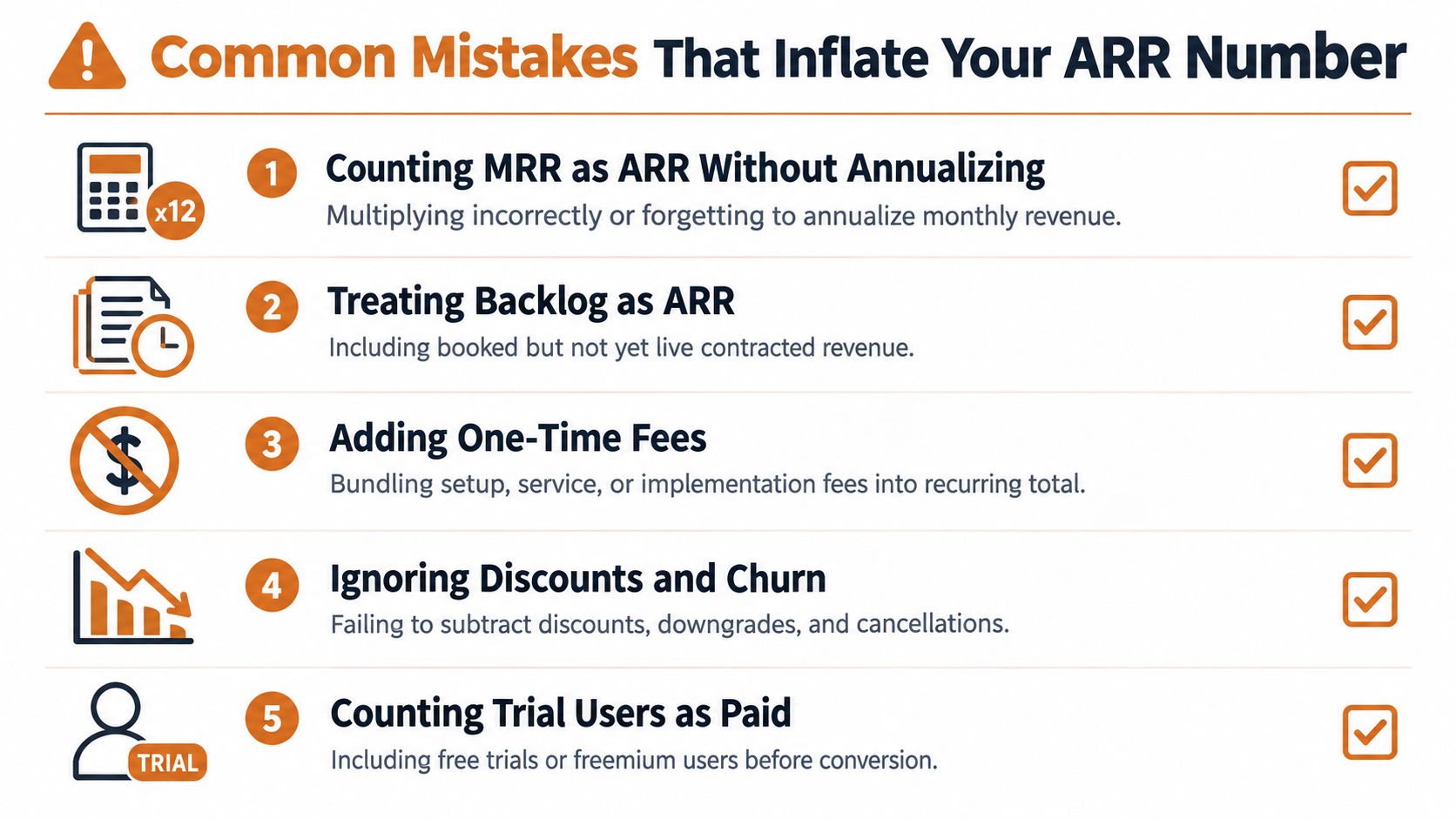
One-time fees, including installation, implementation, and setup charges, stay in non-recurring revenue. Expected renewals stay outside ARR until the renewal is signed or supported by documented contract terms. Unbilled pipeline belongs in a pipeline schedule, not the active recurring base.
Discounts, credits, downgrades, and cancellations must reduce the recurring value payable under the contract. A schedule based on list price is difficult to defend when customers receive a lower contracted price.
Buyers rarely punish a conservative definition. They do punish a definition that changes when they inspect the contracts.
Make the correction process visible in billing exports, contract schedules, deferred revenue records, and the general ledger. If a cancelled customer still appears as active ARR, or a setup fee shifts between recurring and non-recurring categories, the buyer will question the entire schedule. Review those classifications before the valuation conversation, especially where one customer generates both contract revenue and variable project work.
Treat ARR preparation as a documentation exercise, not a presentation exercise. Before you share a headline number, make sure another person can reproduce it from contracts, billing records, and the general ledger without asking you to interpret every customer.
Prepare these schedules:
A buyer’s analyst will typically focus first on gross retention, net retention, weighted average contract length, customer concentration, and the recurring share of total revenue. The specific definitions must be written down, because management metrics can otherwise shift from one report to the next.
Run the schedule through a fractional CFO, valuation advisor, or transaction accountant before sending it externally. Last-minute corrections often come from misclassified fees, contract timing, discounts, or partial-year terms. Those corrections can change the headline figure without changing the underlying customer relationships or operating performance.
For broader preparation, use this small business valuation guide alongside your ARR schedule. It helps place recurring revenue within the larger valuation picture, where profitability, owner dependence, customer risk, and transferability also matter. You can also review guidance on how to calculate business worth before presenting a valuation narrative.
Should I present ARR instead of trailing revenue? Present both. ARR shows the current recurring run rate, while trailing revenue shows what the business generated over the historical period. Neither substitutes for profit and cash-flow analysis.
How long does an ARR figure remain valid? It remains valid only while the underlying contracts and terms remain active. Update it when customers renew, cancel, downgrade, expand, or move into a different billing arrangement.
What ARR multiple should an owner-operated trade use? Don’t lead with a generic multiple. Buyers will assess the quality, retention, contract terms, margins, customer concentration, and owner dependence behind the recurring revenue. A clean ARR number supports the discussion, but it doesn’t determine value by itself.
The Owner’s Shortlist helps business owners find curated specialists for valuation, succession, taxes, legal planning, financing, and related exit decisions. Visit The Owner’s Shortlist to review practical guidance and connect with a relevant advisor before you present ARR to a buyer.
Tell us your situation. We'll connect you with a specialist who works with owners like you. One conversation, no sales pressure.
Found this useful?
Add The Owner's Shortlist as a preferred source and get our articles highlighted in Google Search results.
Add to Preferred SourcesLearn how to finance buying a business using SBA loans, bank debt, seller notes, and earnouts. A practical playbook for buyers of service companies.
October 23, 2026
Explore 5 confidential information memorandum examples for owner-operated businesses, with required sections, practical guidance, and common pitfalls.
October 22, 2026
Partners who disagree on selling usually settle it one of four ways: a buyout, a partial sale, a sale together, or what the agreement forces.
October 20, 2026
What is deal structuring, explained for service business owners. Learn asset vs stock sales, earnouts, seller financing, holdbacks, and the questions
October 19, 2026