Business Valuation Meaning for Owner Operated Firms
Explore business valuation meaning for owner-operated firms. Learn valuation methods, drivers, misconceptions, and steps to secure a defensible valuation.
September 28, 2026
By Remi Taffin · August 14, 2026

You’re staring at a business that’s paid your family, your crew, and your mortgage for years, and now you want one straight answer on what it’s worth. Maybe you’re talking to a buyer, maybe a lender, maybe your spouse. Either way, you don’t need a fantasy number. You need a number a serious person can believe.
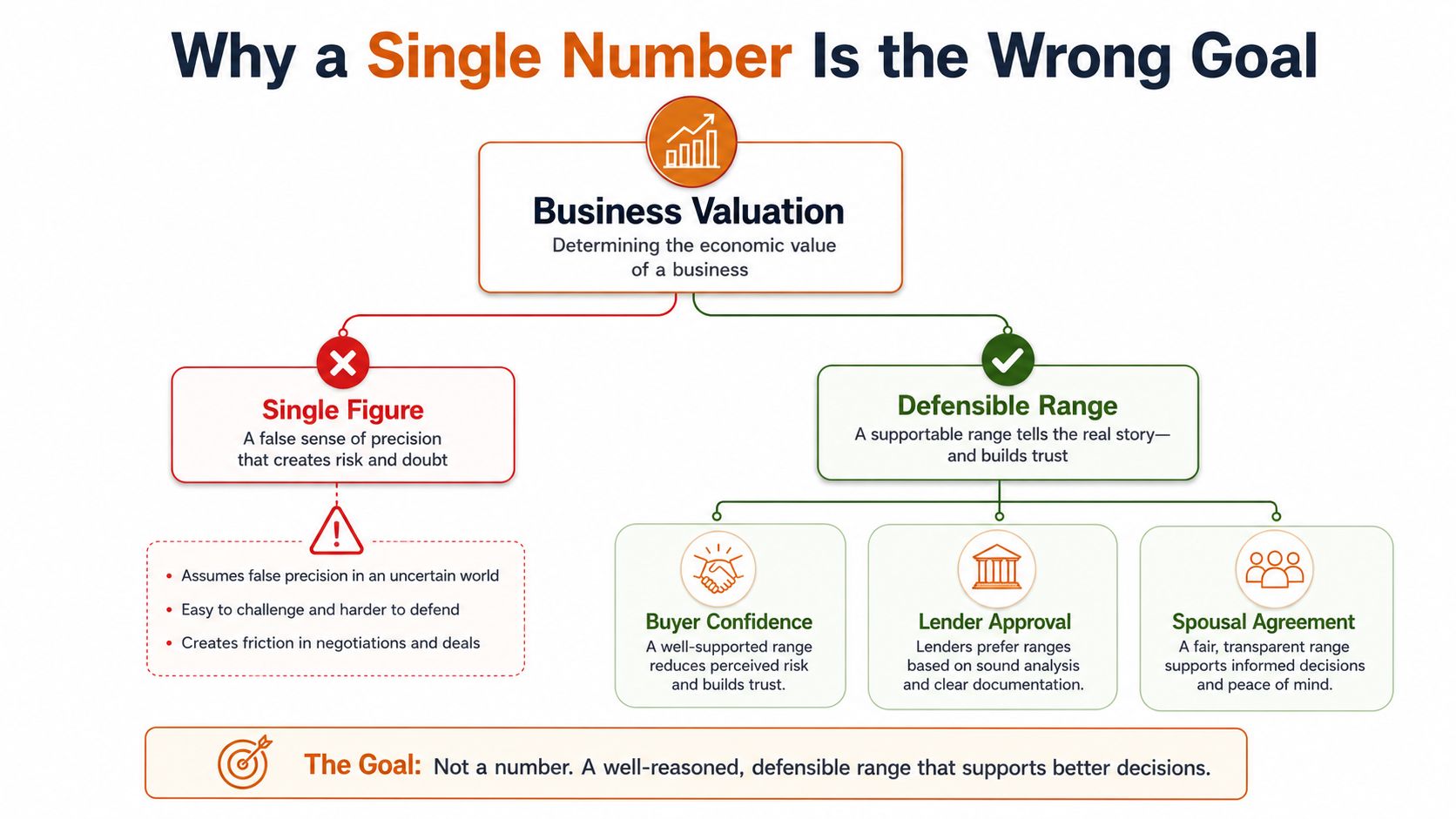
The mistake most owners make is treating business value like a magic sticker price. It isn’t. Business worth is a range, and the range gets stronger when you use the right method for the right business, normalize the earnings correctly, and then test the result against real market logic. For many owner-operated companies, the starting point is the income approach, because buyers care most about cash they can take home, not just accounting profit Xero’s business valuation guide.
An HVAC owner sits at the kitchen table with a calculator, a yellow pad, and a gut feeling that the company is worth “somewhere around two million.” A buyer does not care about the gut feeling. The buyer looks at whether the cash flow holds up, whether the owner is carrying the whole business on their back, and whether the earnings still make sense after the handoff.
That is why a single number usually creates more friction than clarity. A seller wants the highest figure, a buyer wants the lowest, and a deal can stall fast if the owner cannot defend the number with a method that fits the business. The better goal is a range tied to the actual operation, then a clear explanation for why the low end and high end both belong there.
Practical rule: If you cannot explain the method in plain English, the number will not hold up in a real deal.
For many small businesses, the income approach does the heavy lifting because it ties value to the company’s cash-generating power, and buyers start with that question first Xero’s valuation overview. The U.S. Chamber of Commerce also recommends gathering at least three years of balance-sheet, cash-flow, and income-statement data before you apply a valuation method, because historical earnings quality and trends matter.
A plumbing-shop buyer does not stop at what the books show. The buyer wants to know what the business produces after normal owner perks and one-time noise are stripped out, and whether that result can survive a real transition. That is why the method is part of the valuation, not a separate exercise. Use a method that matches the business, and the range gets believable. Use the wrong one, and the number looks polished while still falling apart in negotiation.
Owners also need a current earnings view, not a stale year-end snapshot. For that reason, trailing 12 months is often the cleaner lens when you are working through the current-year profit picture.
A buyer of an HVAC company or plumbing shop does not need a fancy valuation formula. The buyer needs a clean earnings figure, the right multiple, and a reason to trust both. That is how you calculate business worth for most owner-run service businesses, and it is why the answer should be a range, not a single number.
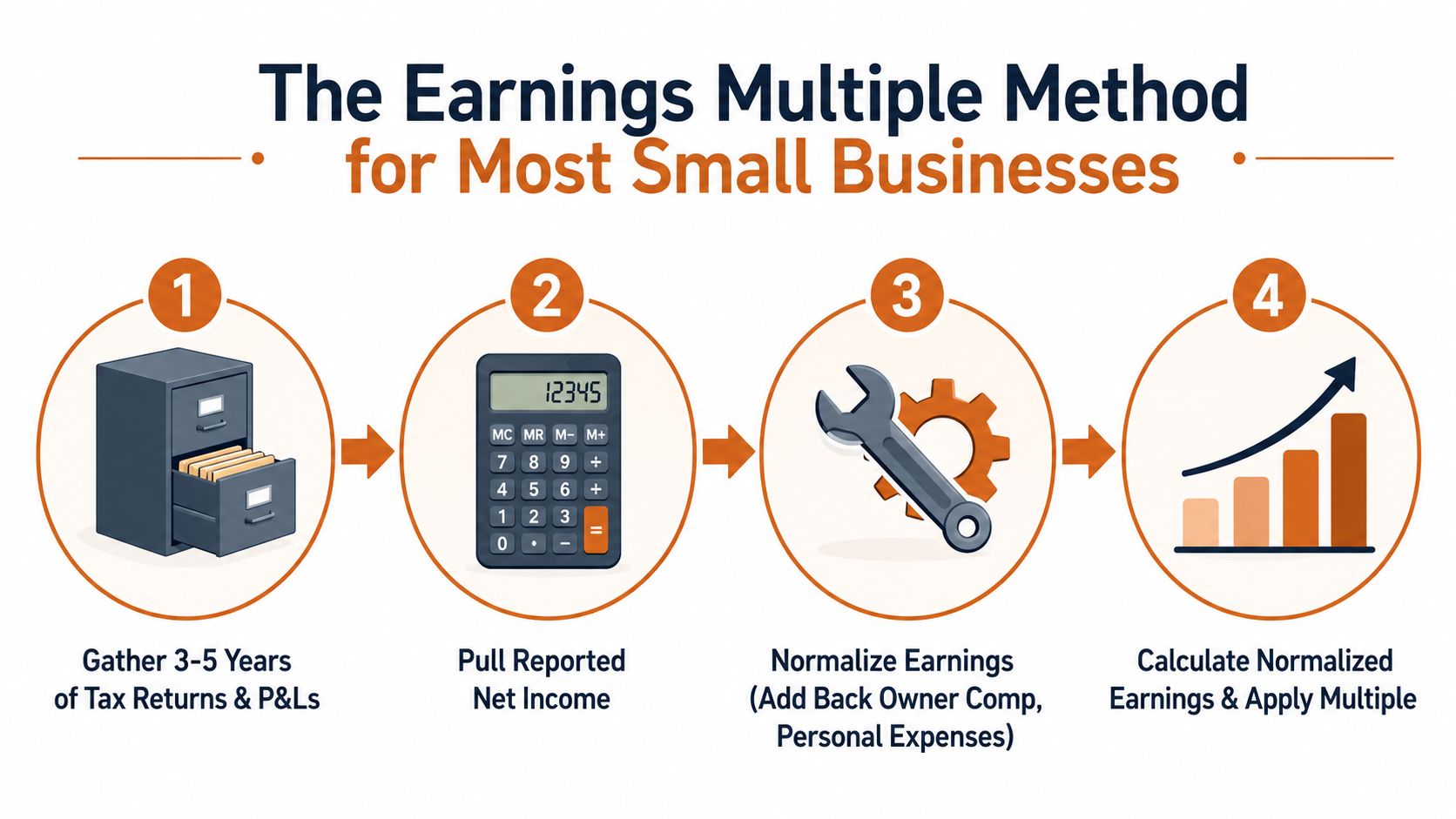
Owner-operated companies usually start with Seller’s Discretionary Earnings, or SDE. It begins with net income, then adds back the owner’s salary, benefits, personal expenses, and one-time costs. For businesses with professional management, EBITDA is the better anchor CTA Acquisitions’ valuation guide.
Owner-run HVAC and plumbing shops typically use SDE. Companies with professional management use EBITDA. That is the cleaner split, and it matches how buyers look at control, dependency, and transferability.
If you need a quick reference on SDE itself, Seller’s Discretionary Earnings explained is the place to start.
A practical guide recommends gathering tax returns, profit-and-loss statements, and balance sheets, then removing owner perks, one-time events, and non-arm’s-length costs before you triangulate a value range CTA Acquisitions’ valuation guide. That cross-check matters because a multiple means little if the earnings number is inflated or incomplete.
Once the earnings figure is clean, apply a market multiple the buyer can defend. In owner-operated businesses, SDE multiples are commonly lower than EBITDA multiples used for businesses with a management layer Xero’s valuation guide. Another practitioner guide shows that owner-operated businesses with under roughly $1M to $1.5M in cash flow often trade in a narrower SDE range CTA Acquisitions’ valuation guide.
A plumbing company with $400,000 of normalized SDE and a 2.75x multiple lands at $1.1 million. That is the work of the method. The earnings figure sets the base, the multiple reflects risk and buyer confidence, and the product gives you a credible range.
The multiple is where owners lose the argument. Recurring revenue, customer concentration, service mix, and owner dependence all push it up or down. If the business leans heavily on the owner, the multiple usually suffers. If the company has repeat customers, stable operations, and a team that can carry the load, the multiple gets better.
A good valuation also needs a live earnings view, not a stale year-end snapshot. That is why trailing 12 months often gives a sharper picture when you are sizing up current performance.
Use the financials the way buyers do, not the way tax prep software does. That difference usually decides whether the number holds up in negotiation.
Normalization is where owner-operated deals get decided. A buyer does not value the tax return as filed. A buyer values the operating earnings after you strip out personal spending, one-off expenses, and anything that will disappear when the seller leaves.

Start with reported net income, then add back items that do not reflect the business’s normal earning power. In owner-run companies, that usually includes owner compensation, owner benefits, personal expenses, and one-time or nonrecurring costs. If the company paid for a family trip, a personal vehicle, or a legal bill tied to a one-off issue, those belong in the normalization work, not in the ongoing earnings picture.
A worked example makes the point fast. If a plumbing company has reported net income that trails its true earning power, and normalization adds back $90,000, the value picture changes fast. That is the job of the adjustment. It shows the business a buyer would be purchasing, not the tax return the seller filed.
Buyers will challenge anything that looks personal, unusual, or hard to repeat.
Recurring add-backs get tested hard. A seller can argue that a cost is temporary, but if it shows up year after year, a buyer will usually treat it as a real operating expense. Leave legitimate costs alone. If an expense is necessary to run the business, it stays in the calculation. That includes normal labor, normal marketing, and other costs the next owner will keep paying.
Higher revenue does not automatically mean higher value. If the business depends on the owner’s labor, client relationships, or purchasing decisions, the normalization exercise can cut the apparent worth even when sales look strong. That is not a penalty. It is the market forcing the owner to separate revenue from transferable earnings.
The U.S. Chamber guidance on business valuation points out that intangible assets and market conditions also shape value. Two businesses with similar earnings can still land in different places if one has stronger customer loyalty, a cleaner brand, or tighter operations. Those traits matter because they affect how much of the earnings a buyer believes will survive after the handoff.
A buyer will ask one blunt question. If you step away, does the business still perform? If the answer is shaky, the valuation usually gets shaky too.
For a deeper look at the add-back logic buyers care about, the operational issue around Seller’s Discretionary Earnings is where most owners need to start.
The earnings multiple is the workhorse, but it isn’t the only method that matters. The right answer depends on what kind of business you own, what kind of buyer is likely to show up, and how stable the cash flow really is.
Discounted cash flow, or DCF, forecasts future cash flows and discounts them back to today using a rate that reflects risk. That makes it a better fit for larger or fast-growing businesses with predictable projections. It’s useful when the future matters more than the cleanest snapshot of last year’s earnings.
Comparable sales, also called precedent transactions, uses sales of similar businesses as a reality check. If recent deals in the same industry are available, this method can anchor the multiple and keep you from drifting into wishful thinking. It’s a cross-check, not a shortcut.
Asset-based valuation is the right answer when the business is asset-heavy, project-based, distressed, or too volatile for an earnings multiple to tell the whole story. If the company owns meaningful equipment, inventory, or other tangible assets, a buyer may care more about what sits on the balance sheet than what the last year of earnings says.
A method is only useful if a buyer would believe it.
That’s the standard. Not what sounds advanced. Not what produces the biggest number. What a buyer would trust.
Neutral guidance from TD says valuation methods should vary by business type, with earnings-based methods fitting profitable service firms, book value fitting asset-heavy companies, and discounted cash flow serving larger or fast-growing businesses TD’s guide to business value. That lines up with what owners face in the field. A plumbing shop with steady service calls does not need the same model as a company sitting on heavy equipment or projecting aggressive growth.
The mistake is forcing every business into the same box. That’s how owners end up defending a number that doesn’t match the deal reality.
The first question isn’t “What’s my business worth?” It’s “Which method would a buyer trust for this business, and why?” Answer that and half the fight is over.
| Method | Best Fit | Key Data Needed | Watch Out For |
|---|---|---|---|
| SDE multiple | Owner-operated service businesses | Tax returns, P&Ls, add-backs, recent earnings history | Weak normalization, owner dependency |
| EBITDA multiple | Professionally managed businesses | Clean financial statements, management structure, earnings history | Using it too early for a small owner-run company |
| DCF | Larger or fast-growing businesses | Forecasts, discount rate inputs, multi-year projections | Garbage forecasts create garbage value |
| Asset-based valuation | Asset-heavy or distressed businesses | Balance sheet, asset schedules, liabilities | Can miss earnings power in a healthy firm |
For a family-run HVAC or plumbing company, the SDE multiple usually leads. The owner is still the engine, and the buyer wants to know what cash flow remains after stripping out personal and nonrecurring items. For a larger company with a management team, EBITDA usually becomes the better anchor because the owner’s day-to-day role matters less.
The strongest answer usually comes from triangulation. Pick one primary method, then cross-check it against a second method so you’re not relying on a fragile point estimate. That doesn’t mean averaging everything together mindlessly. It means testing whether the result still makes sense when viewed from another angle.
If the business is asset-heavy, project-based, or uneven from year to year, the earnings multiple alone can mislead you. If the business has clear forecasts and a growth story, DCF can help frame the future. If recent sales data for similar companies exists, comparable sales can keep the range grounded.
The right method is the one that matches how the next buyer will underwrite the deal. Anything else is just spreadsheet theater.
The quickest way to underprice a business is to use the right method badly. Owners do it all the time, then wonder why the number comes back low.
Start with normalization. If you leave owner salary, personal spending, or one-time legal and marketing costs buried in the books, the company looks less profitable than it really is. That pushes the value down before the buyer ever looks at the deal.
A second mistake is grabbing one industry multiple and treating it like gospel. A generic multiple ignores customer concentration, recurring revenue, and owner dependency, all of which shape buyer confidence. A plumbing shop with sticky service agreements and a balanced customer base deserves a different result than a shop that lives off a few accounts.
Confusing revenue growth with value growth causes another bad result. More sales can still produce a weaker valuation if margins slip or the owner remains the whole operation. Buyers pay for durable cash flow, not just a bigger top line.
Mixing owner income with business value is another trap. A company can pay the owner well and still leave little transferable profit for a buyer.
That mistake shows up a lot in trades and local services. Owners say, “I take a great living out of this business.” That may be true. It does not mean a buyer sees the same thing. A business that depends on one person’s labor or relationships is harder to transfer, even if the bank deposits look healthy.
For a sharper look at one of the biggest valuation pressure points, see customer concentration risk. A company that leans too heavily on a few accounts usually deserves a harder look than a quick multiple suggests.
Another mistake is treating today’s estimate like a permanent truth. Multiples shift. Markets shift. The business itself shifts. If you calculated value six months ago and the company lost a major customer, added debt, or changed how the owner is involved, the old number is already stale.
Keep the number flexible. Buyers do.
You can build a credible estimate yourself if the financials are clean and the business is straightforward. You should stop and bring in a specialist when the number will be used in a real transaction, a lender review, a tax matter, a dispute, or an estate plan. That’s where the method choice and the normalization choices start carrying real consequences.
A tax advisor should be in the loop before you finalize the number, not after. Normalization and method selection affect what gets taxed, when it gets taxed, and how the value is defended later. If you’re moving toward a sale, succession transfer, or financing event, the cheapest mistake is usually the one you catch early.
The Owner’s Shortlist organizes vetted specialists across valuation, taxes, legal, financing, and succession, so owners can move from a rough estimate to the right next conversation without wasting time on the wrong advisor. It’s a practical handoff point when the calculation stops being academic and starts affecting money.
If you’re ready to pressure-test your number, start with The Owner’s Shortlist. It connects owners with vetted specialists who handle valuation, tax, legal, and succession work, so you can turn a rough estimate into a defensible next step.
Tell us your situation. We'll connect you with a specialist who works with owners like you. One conversation, no sales pressure.
Found this useful?
Add The Owner's Shortlist as a preferred source and get our articles highlighted in Google Search results.
Add to Preferred SourcesExplore business valuation meaning for owner-operated firms. Learn valuation methods, drivers, misconceptions, and steps to secure a defensible valuation.
September 28, 2026
What Is Recurring Revenue. Learn what recurring revenue is, how ARR and MRR work, real trade examples, and why this revenue model shapes business value and exit
September 23, 2026
Learn how much to sell a business for with SDE and EBITDA multiples, adjustments, and deal tips to set a defensible price and maximize proceeds.
September 21, 2026
Understand business valuation cost, fee structures, price ranges and what drives fees so you can budget wisely and get accurate quotes.
September 19, 2026