What Is Recurring Revenue and Why It Matters
What Is Recurring Revenue. Learn what recurring revenue is, how ARR and MRR work, real trade examples, and why this revenue model shapes business value and exit
September 23, 2026
By Remi Taffin · September 28, 2026

You’ve built a respected HVAC, plumbing, or electrical company, and customers keep calling. The trucks are busy, technicians know their routes, and the books show healthy revenue. Yet one question keeps returning as you think about retirement or a sale: what is the business worth?
That question is harder than multiplying revenue by a convenient number. Business valuation is a formal process for estimating the economic value of a company or an ownership interest, using defined standards, financial analysis, market evidence, and professional judgment. A defensible result can support a transaction, tax matter, dispute, succession plan, or internal decision, while a casual estimate can create unrealistic expectations at exactly the wrong time.
For an owner-operated trade business, valuation starts with more than the latest income statement. A buyer wants to understand the cash flow that can continue after the owner leaves, the strength of customer relationships, the condition of equipment, and whether technicians can deliver the work without constant owner intervention. A business with recurring maintenance agreements may deserve a different analysis from one that depends on occasional replacement projects, even if both report similar revenue.
The scale of the profession reflects how many decisions depend on reliable valuation work. A 2026 market report estimated the global business valuation services market at $8.69 billion in 2026, with North America the largest region at $3,215.4 million and Asia-Pacific the fastest-growing region, according to Kroll’s business valuation market analysis. Those figures describe an advisory industry connected to transactions, reporting, litigation, restructuring, tax compliance, and investment analysis.
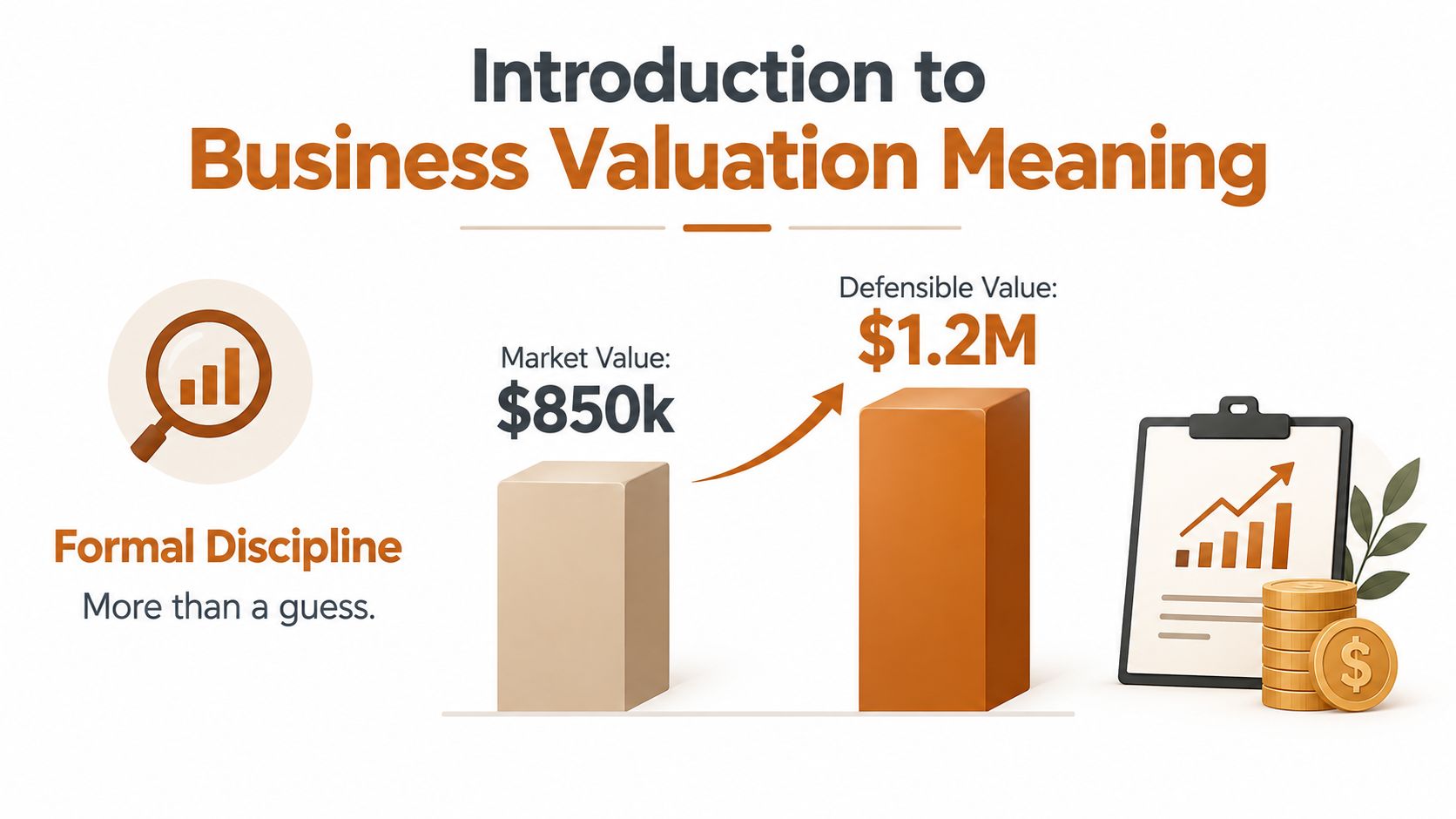
This guide focuses on the business valuation meaning most relevant to owner-operated firms. You’ll see how professionals define value, compare the main approaches, assess recurring revenue and operational risk, distinguish market price from defensible value, and prepare for a specialist engagement.
Practical rule: A valuation isn’t a reward for years of effort. It’s an evidence-based opinion about the economic benefits a buyer or owner can reasonably expect.
Business valuation means determining the value of a business enterprise or an ownership interest in it. Major professional standards treat it as a formal discipline, not an informal guess, as summarized in this overview of business valuation. The professional doesn’t just select a multiplier and apply it to sales. They define the assignment, examine the company, select appropriate methods, and explain the reasoning behind the conclusion.
The need for formal valuation expanded in the 1920s, when Prohibition forced many alcoholic-beverage businesses to close and owners needed defensible estimates of loss. That period helped establish valuation as a professional niche. Today, the work supports mergers and acquisitions, tax compliance, litigation, financial reporting, restructuring, and strategic planning.
Different assignments ask different questions. Fair market value generally considers the price that a willing buyer and willing seller, both informed and under no compulsion, might agree on. Fair value can have a legal or reporting meaning, while investment value reflects what a particular buyer might pay based on that buyer’s own strategy and expected returns. Intrinsic value refers to an investor’s assessment of fundamental worth based on available facts.
That’s similar to a property appraisal. A home’s value for an open-market sale isn’t necessarily the same as its value to a developer who wants the land, or its value in a court proceeding. The address is the same, but the question and assumptions differ.
Owners who want a practical introduction before meeting an adviser may find business value training for accountants useful for learning the terminology and basic logic. The most important question to ask a specialist is simple: what standard of value and premise of value does this assignment require?
Professionals usually compare three broad approaches rather than relying on one formula. The income approach asks what future economic benefits are worth today. The market approach compares the company with relevant public peers or completed transactions. The asset approach examines the value of assets and liabilities, often after adjusting recorded amounts.
Modern valuation generally triangulates among these approaches, with discounted cash flow and EBITDA multiples especially important for operating businesses, as explained in this guide to valuation methods.
| Approach | Method | Best Use Case |
|---|---|---|
| Income | Project future free cash flow and discount it to present value | A service company with reliable forecasts and continuing operations |
| Market | Apply relevant EV/EBITDA or transaction multiples after comparison and adjustment | A business with credible peer or transaction evidence |
| Asset | Adjust assets and liabilities toward current economic values | An asset-heavy company, holding company, or business where earnings are weak |
A discounted cash flow model projects future free cash flows and discounts them using a rate that reflects risk, inflation, and opportunity cost. A recurring-revenue HVAC firm may be easier to forecast when maintenance agreements renew consistently, service histories are organized, and customer retention is visible. The model still depends on judgment. Higher risk or a weaker long-term growth assumption reduces present value.
Income analysis may also capitalize a stable level of earnings. In either case, the specialist must distinguish transferable earnings from benefits tied only to the current owner.
The market approach uses comparable companies or transactions to establish a benchmark. EBITDA multiples are common for operating businesses, but the multiple isn’t a universal price tag. A buyer will examine margin quality, growth, customer mix, risk, management depth, and the reliability of the reported EBITDA.
For a plumbing firm, the adviser may normalize owner compensation, remove non-recurring expenses, and consider working-capital needs before applying a multiple. The result should reflect transferable earning power, not an accounting figure distorted by personal expenses or unusual events.
An adjusted asset analysis can matter when trucks, equipment, property, inventory, or other tangible assets represent much of the company’s economic value. It may carry less weight for a service firm whose strongest assets are customer relationships, brand reputation, trained staff, and repeat contracts.
Owners comparing methods can use this business valuation guide to organize questions before hiring a professional. The strongest conclusion often comes from reconciling the approaches, then explaining why one deserves more weight in the specific business.
A trade company’s value often depends on how safely a buyer can transfer its future cash flow. Two HVAC companies may own similar vans and tools, but the one with documented maintenance agreements, trained dispatch staff, and broad customer coverage may present a more dependable investment.

Recurring contracts create visibility. A plumbing company that services commercial properties under renewable agreements gives a buyer a clearer starting point than a company that wins every job from scratch. Recurring revenue isn’t automatically risk-free, but it can make forecasting more grounded when customers renew and the agreements produce suitable margins.
Customer diversification reduces fragility. If one property manager supplies a large share of an HVAC company’s work, the buyer faces a material concentration risk. A broader base of residential, commercial, and institutional customers can reduce the impact of losing any one account.
Documented processes make the company transferable. Written estimating procedures, dispatch rules, maintenance schedules, safety practices, and customer follow-up routines help demonstrate that the company is an operating system, not just the owner’s personal network.
Management depth protects continuity. A buyer will ask who handles quoting, scheduling, complaints, purchasing, and technician development after closing. A capable service manager can support continuity. If every important decision goes through the owner, the buyer may need to price the transition risk into the deal.
Project-based revenue can be profitable but harder to forecast. A replacement-heavy HVAC business may have strong years when large installations arrive, followed by uneven demand. Similarly, a plumbing company that depends on the owner’s emergency-response reputation may struggle to transfer customer loyalty.
A useful test is to ask, “What would keep working if the owner stopped answering the phone tomorrow?” The answer reveals both operational strength and valuation risk.
Review recurring agreements, renewal patterns, customer concentration, technician retention, gross margins by service line, and the owner’s weekly responsibilities. A practical recurring revenue explanation can help owners separate repeat sales from contracted or predictable revenue.
A headline transaction price can look precise, but it may not answer the same question as a professional valuation. A recent sale might involve a strategic buyer that expects cost savings, cross-selling, geographic expansion, or access to a valuable customer base. That buyer may pay investment value, meaning value specific to its own plans, rather than the price a hypothetical market participant would pay.
The transaction structure matters too. A negotiated sale, a competitive auction, and a distressed disposal can produce different outcomes. The seller’s urgency, buyer access, financing conditions, representations, and included assets all influence the final price.
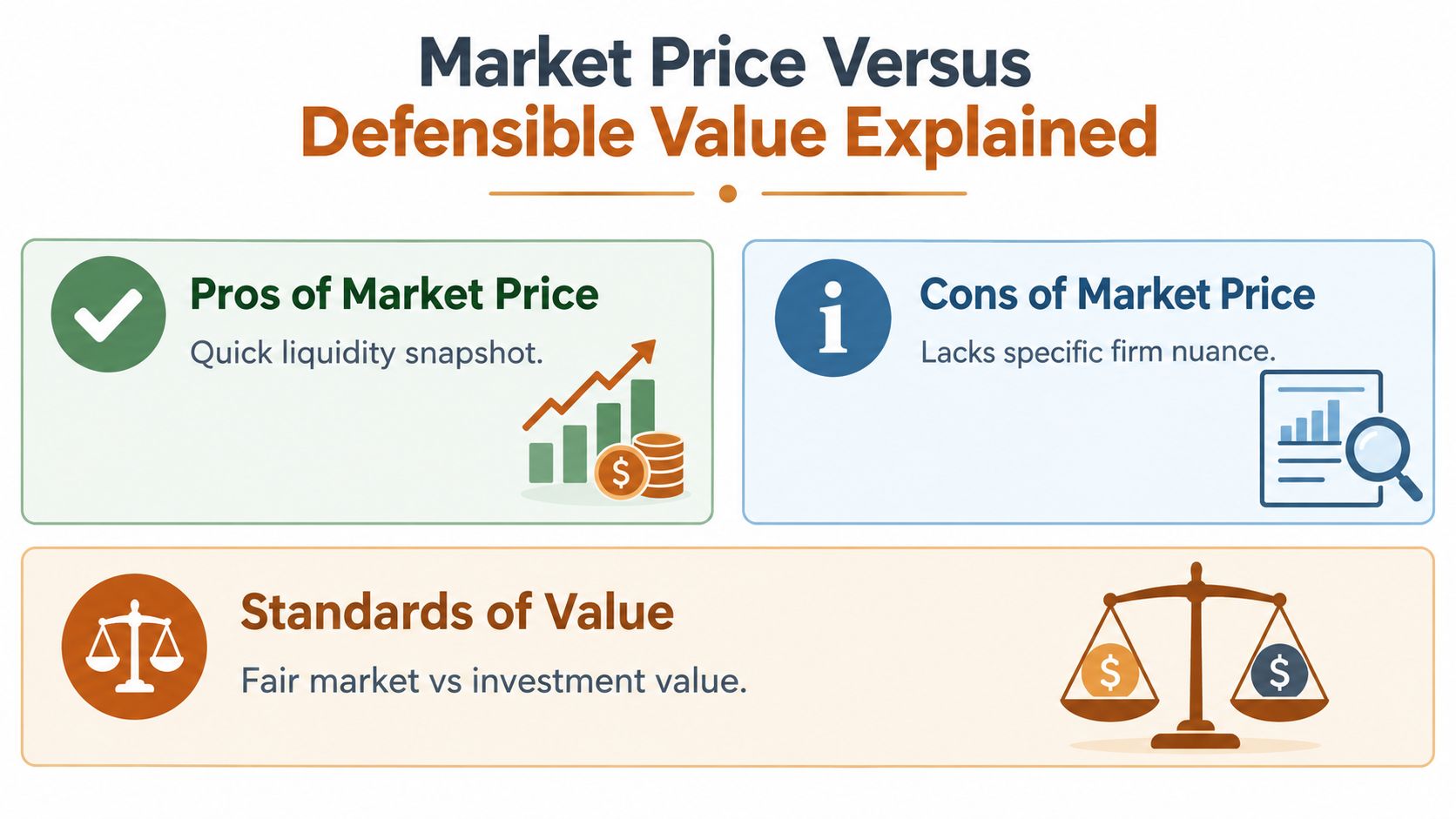
A public-company multiple may reflect a larger, more diversified enterprise with deeper management and better access to capital. Applying it directly to a local plumbing firm can overlook owner dependence, customer concentration, uneven reporting, or the need to replace equipment.
Ownership level also changes the analysis. As discussed in the distinction between fair market value and other standards, a control-level valuation for a strategic buyer can differ from a minority-interest value even when the underlying financials are identical. Control can provide authority over compensation, operations, distributions, and a future sale. A minority interest may lack those powers and may also be harder to sell.
Market price can help when:
Market price can mislead when:
A defensible valuation doesn’t predict the exact closing price. It gives the owner a reasoned range or conclusion tied to a defined purpose, standard, premise, and evidence.
“Revenue determines value.” Revenue shows activity, not what the owner or buyer keeps. A high-revenue contractor with thin margins, heavy rework, weak collections, and concentrated customers may be less valuable than a smaller firm with cleaner cash flow.
“There’s one correct formula.” Valuation depends on the assignment, standard of value, ownership interest, risk, assets, and expected future performance. Professionals commonly compare income, market, and asset evidence rather than treating one calculation as universal.
“Higher EBITDA always means higher value.” EBITDA matters, but quality matters too. A temporary spike caused by unusual project work may not deserve the same weight as stable earnings supported by recurring agreements and repeatable operations.
“Small businesses don’t need formal valuation.” Size doesn’t remove uncertainty. Owners may need a defensible number for a sale, succession arrangement, tax matter, shareholder dispute, or financing conversation. A casual estimate can create conflict when family members, partners, or buyers rely on different assumptions.
“The owner’s effort is goodwill.” Personal relationships can support revenue, but a buyer may discount value if customers follow the owner rather than the company. Transferable goodwill rests on systems, brand, contracts, staff capability, and customer relationships that survive the handover.
Start by organizing financial statements, tax returns, bank records, customer agreements, equipment lists, and operating procedures. Prepare a clear schedule of owner compensation, discretionary spending, non-recurring costs, and business expenses that a buyer won’t inherit.
Ask each specialist which standard of value, premise, methods, and ownership interest they’ll use. Confirm credentials, expected deliverables, timing, fees, and whether the report is designed for a transaction, tax, dispute, or planning purpose. Owners seeking regional guidance can review company valuation support in Australia and compare it with a focused business appraisal service.
The Owner’s Shortlist connects owner-operated companies with curated specialists for valuation, tax, legal, succession, financing, and related decisions, while its plain-language resources help owners prepare informed questions. Visit The Owner’s Shortlist to review valuation guidance and find a relevant specialist for your next step.
Tell us your situation. We'll connect you with a specialist who works with owners like you. One conversation, no sales pressure.
Found this useful?
Add The Owner's Shortlist as a preferred source and get our articles highlighted in Google Search results.
Add to Preferred SourcesWhat Is Recurring Revenue. Learn what recurring revenue is, how ARR and MRR work, real trade examples, and why this revenue model shapes business value and exit
September 23, 2026
Learn how much to sell a business for with SDE and EBITDA multiples, adjustments, and deal tips to set a defensible price and maximize proceeds.
September 21, 2026
Understand business valuation cost, fee structures, price ranges and what drives fees so you can budget wisely and get accurate quotes.
September 19, 2026
Learn how a sustainable growth model works for owner-operated businesses. Covers core metrics, valuation impact, trade examples, and when
September 13, 2026