Business Valuation Cost Explained What Owners Pay
Understand business valuation cost, fee structures, price ranges and what drives fees so you can budget wisely and get accurate quotes.
September 19, 2026
By Remi Taffin · September 21, 2026
You’re probably carrying around a number in your head right now.
Maybe it came from a friend who sold. Maybe a broker tossed out a rough multiple. Maybe you backed into it from what you need for retirement, debt payoff, or your next move. That’s normal. It’s also where owners get into trouble.
Buyers don’t pay for the number in your head. They pay for the cash flow they believe they can keep, the risk they think they’re taking on, and the deal structure they can finance. If you want to know how much to sell a business for, stop chasing a magic number and start building a price range you can defend.
You get an offer for $2.5 million. It sounds like the answer. Then the draft LOI shows a seller note, an earnout, a working capital target, and your tax bill. Now the question shows up. How much do you keep?
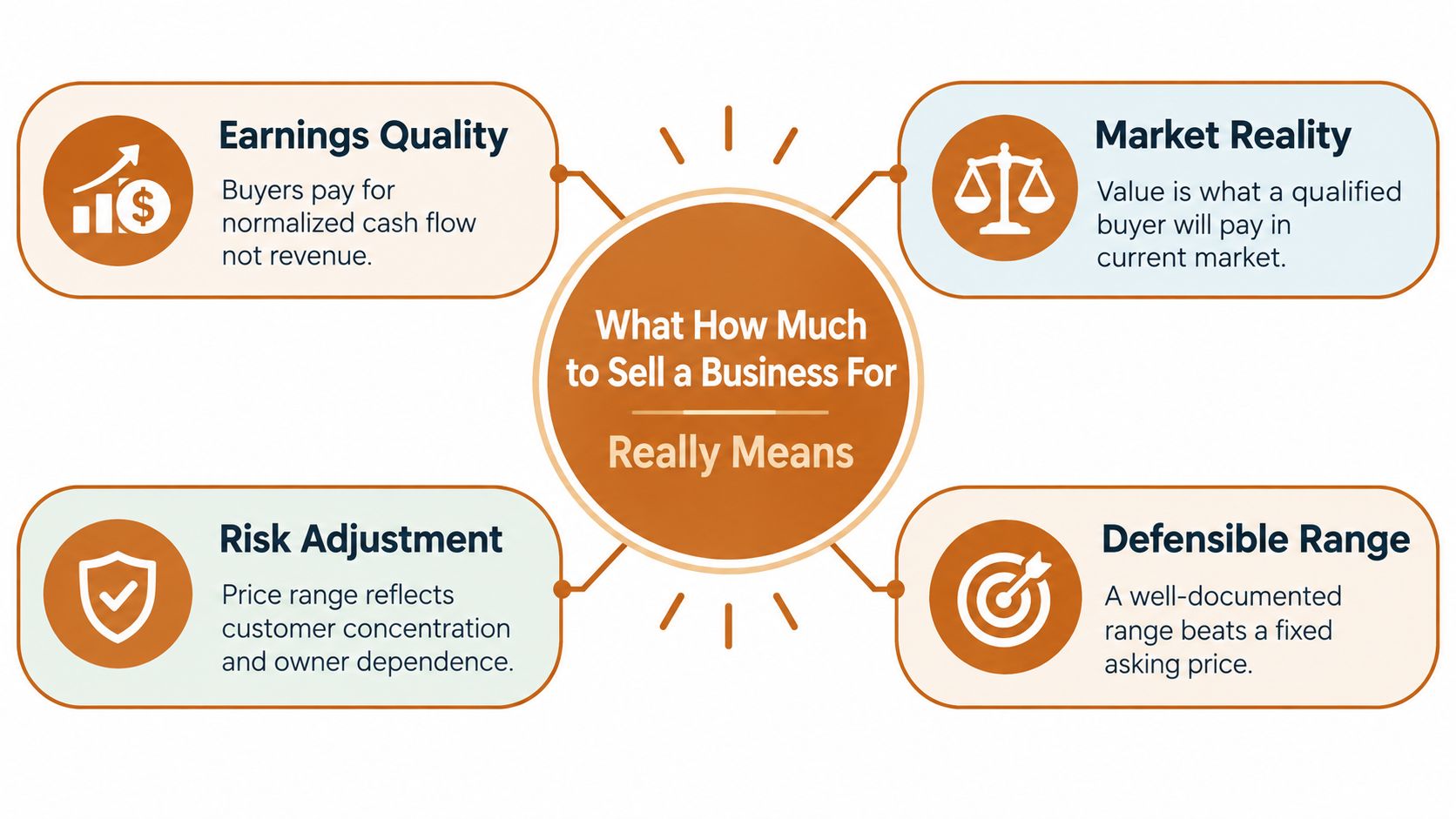
That is what owners should mean when they ask how much to sell a business for. The headline number matters, but it is not the finish line. Your real price is the after-tax, after-fee cash you collect, adjusted for how much risk stays with you after closing.
For owner-operated businesses, buyers usually start with seller’s discretionary earnings, not revenue. Broad small-business transaction data from BizBuySell valuation multiples data shows many deals clustering around the mid-2x range on SDE, with median sale prices that reinforce the same point: cash flow drives value far more than vanity revenue.
Owners get in trouble when they treat these as the same number:
Cash at close is the number to manage toward.
A business with recurring revenue, low owner dependency, and clean books often gets stronger terms even if the headline multiple is not dramatic. A business that depends on the owner for sales, key relationships, or daily operations usually gets discounted somewhere. If not in the multiple, then in the structure.
A useful explanation of what listing price means when selling a business can help you separate the marketing number from the amount you are likely to put in the bank.
Practical rule: If you cannot tie your price to normalized earnings, transferability, and buyer risk, the buyer will spend the deal explaining why your number should come down.
Waiting for a better market is usually overrated. Improving the business is not.
Three factors change outcomes more than owners want to admit. First, recurring revenue reduces perceived risk and supports better pricing. Second, lower owner dependency makes the business easier to transfer, which buyers pay for. Third, deal structure can turn a strong headline offer into an average result if too much of the price is deferred or contingent.
That is the frame to use. Do not ask, “What number can I list at?” Ask, “What deal gets me the most cash with the least risk at closing?”
You need a baseline before you talk to buyers. Not a guess. Not a round number. A worksheet.
For most owner-operated businesses, the cleanest workflow is straightforward: normalize trailing twelve month earnings, document every add-back, choose a realistic multiple, and stress test the result against risk. A practical guide for businesses under about $5M EBITDA uses exactly that logic, with many owner-operated companies commonly falling in a 2.5x to 4.0x SDE range, while larger non-tech businesses often shift into roughly 4x to 7x EBITDA conversations (CTA valuation guide).
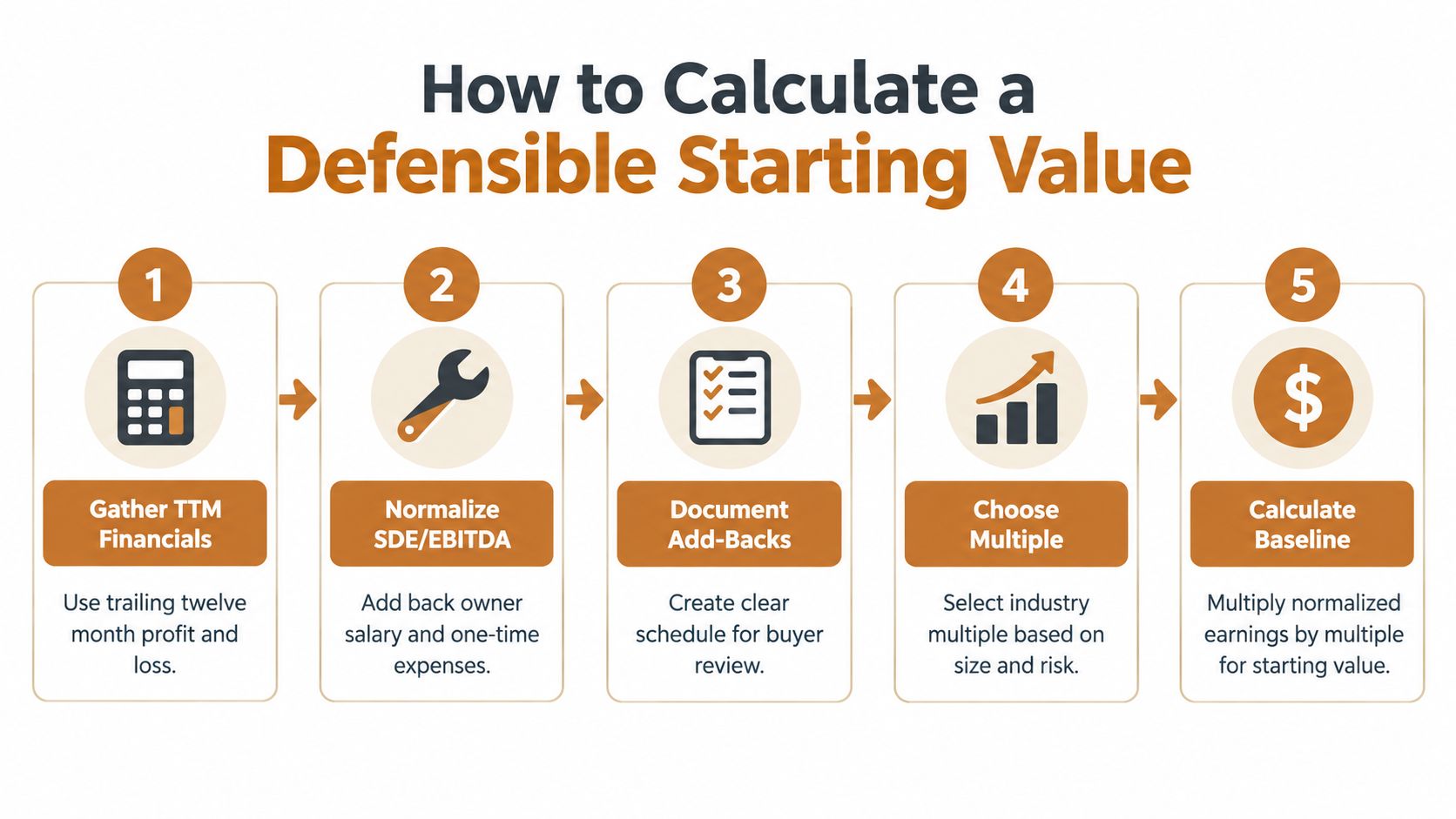
Use the last twelve months of actual operating performance. That matters more than an old tax return and more than a forward-looking story.
For smaller owner-operated businesses, start with SDE. For larger businesses with a real management layer, cleaner accounting, and less owner dependence, use EBITDA. If you’re not sure which one fits, you probably still belong in SDE territory.
Your baseline should answer one question: what did the business produce for an owner, after stripping out noise?
Sloppy sellers lose credibility.
You can add back legitimate owner-specific or non-recurring expenses. You can’t throw every personal charge, family payroll item, or bad investment into an add-back schedule and expect buyers to salute. Every add-back needs a paper trail and a reason.
Use a simple review pass:
A plain-language walkthrough of how to calculate business worth is useful if you want to build this before speaking with a buyer or advisor.
If your add-back schedule needs a speech to make sense, it’s not ready.
A credible valuation file usually includes:
That last item gets ignored too often. If the business still runs through your phone, your judgment, or your relationships, buyers will haircut value even if the reported earnings look fine.
For HVAC, plumbing, and other home-service businesses, recurring maintenance agreements often help because buyers can see future work more clearly. But don’t oversell it. A stack of service agreements only lifts value if the revenue sticks, the renewal pattern is understandable, and the field operation isn’t tied to you personally.
Here’s a useful break in the process before you go further:
Don’t grab the highest multiple you found online. Match your business to its size, quality, and buyer pool.
A buyer will usually adjust your multiple based on things like:
Run a low, middle, and high case.
Use the same normalized earnings number and vary the multiple based on risk. Then check whether your upper end would still make sense to a financed buyer after lender review and diligence. If it doesn’t, it’s not a real number.
That’s your starting value. Not your ego. Not your retirement target. The number a buyer can understand, underwrite, and defend to a bank, partner, or investment committee.
Owners get into trouble when they hear one multiple and apply it everywhere. That’s how a small owner-led service company gets priced like a bigger professionally managed operation. It doesn’t work.
The biggest valuation divider isn’t industry alone. It’s size and transferability. Smaller businesses usually trade on SDE. Larger ones shift toward EBITDA because the buyer is assessing the company more as a system and less as a job with profits attached.
A market summary of recent deals shows the pattern clearly. Under $500K enterprise value, businesses commonly trade near 2.0x SDE. $500K to $1M deals often land around 2.8x to 3.0x SDE. $1M to $2M deals often move to about 3.1x to 3.3x SDE. Once a business reaches about $2M to $5M, pricing often shifts to 3.5x to 4.1x EBITDA, and $5M to $50M deals can command roughly 4.5x to 5.5x EBITDA (ARX business valuation guide).
| Deal Size | Common Multiple Basis | Typical Range |
|---|---|---|
| Under $500K enterprise value | SDE | 2.0x |
| $500K to $1M | SDE | 2.8x to 3.0x |
| $1M to $2M | SDE | 3.1x to 3.3x |
| $2M to $5M | EBITDA | 3.5x to 4.1x |
| $5M to $50M | EBITDA | 4.5x to 5.5x |
Buyers pay more for businesses that are easier to transfer and less fragile.
A company with stronger systems, cleaner reporting, broader customers, and management in place creates fewer surprises after closing. That lowers buyer risk. Lower risk usually supports a better multiple.
This is why two plumbing or HVAC companies with similar revenue can sell very differently. One may have contract revenue, trained field leadership, and documented operating procedures. The other may still revolve around the owner, with weak reporting and too much business from a handful of accounts.
Better scale doesn’t just mean bigger earnings. It means the buyer believes those earnings survive your exit.
Not every buyer values the same thing.
A financial buyer tends to focus on stable earnings, lender support, and downside protection. An individual buyer using acquisition financing often wants a business they can understand, operate, and service debt on. A strategic buyer may care more about route density, service territory, technicians, customer list quality, or cross-sell opportunities.
That doesn’t mean a strategic buyer always pays more. It means they may justify value differently.
If you want a reality check on where your business sits against public-company style thinking, comparable company analysis is useful as a concept, but don’t force public-market logic onto a small owner-operated sale. Most of these deals still come back to transferability, financing, and risk.
A seller gets two offers.
One is $3.2 million with an earnout, a seller note, and a heavy working capital target. The other is $2.9 million with more cash at close, cleaner terms, and fewer ways for the buyer to claw value back in diligence. The second offer often puts more money in your pocket.
That is what “how much to sell a business for” really means at this stage. It means after-tax, after-fee cash at close, plus the odds of collecting the rest.
Buyers usually agree with your price before they pressure-test your business. Then the structure starts changing.
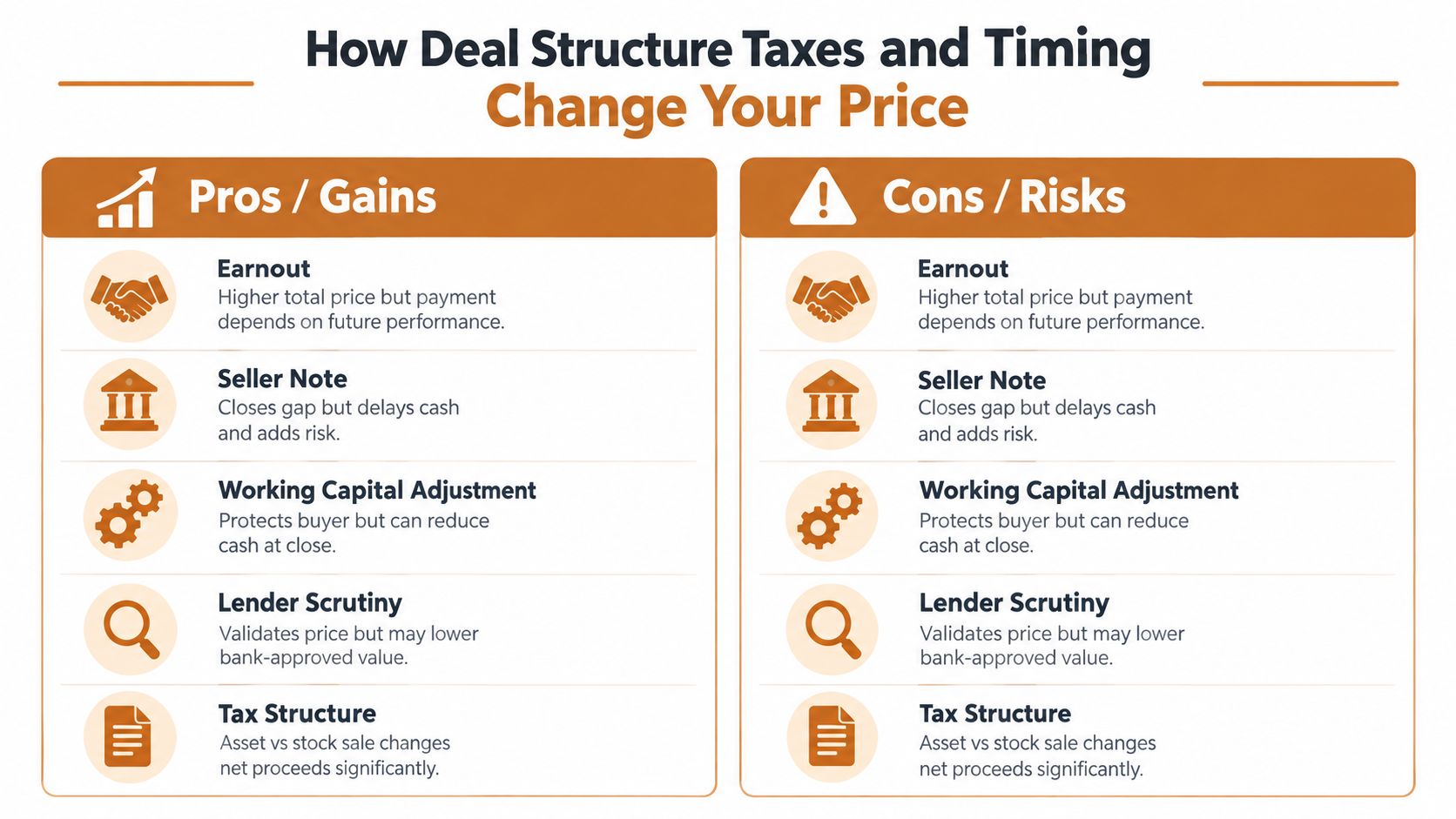
If recurring revenue is weak, customer concentration is high, or too much of the operation still depends on you, buyers do not just argue about multiple. They shift risk into the terms. Part of the price becomes a seller note. More gets tied to future performance. Working capital targets get tighter. Holdbacks get bigger.
This is why owner-operators get blindsided. They negotiated the number and ignored the collection mechanics.
A stretched asking price can also cost you in a different way. It drags out the process, attracts buyers who cannot close, and leaves you tired by the time a serious buyer shows up. Fatigue kills discipline. Discipline protects proceeds.
These are the terms I tell sellers to model before they get attached to an offer:
The best offer is the one you can collect, keep, and close with the fewest ways to get chipped down later.
Timing matters, but not for the reason sellers usually think.
Waiting for a better market rarely fixes a business with messy books, inconsistent margins, weak recurring revenue, or heavy owner dependence. Buyers still see the same risk. They just express it through lower cash at close and tougher terms.
The better move is to sell when the business is clean enough to transfer well. If contract revenue is growing, reporting is credible, and a manager can run day-to-day operations without you, buyers are more willing to pay in upfront cash. Those changes do more for your multiple than sitting on the sidelines hoping valuations rise.
Rushing is just as expensive. If you go to market before your numbers tie out and your story is clear, buyers smell it immediately. Then diligence becomes a price-cut exercise.
Tax planning done late is expensive.
Asset sale versus equity sale, purchase price allocation, goodwill treatment, depreciation recapture, and the split between sale proceeds and employment-related payments all change what you keep. Fees matter too. Broker fees, legal fees, and state taxes can take a meaningful bite out of proceeds.
Run the math early. Compare the offers on net cash, not headline price. A lower nominal deal with better tax treatment and cleaner structure can beat a higher offer that looks good only in the teaser.
A valuation range is not your asking price. It’s your anchor.
Your asking price needs to leave room for negotiation, buyer psychology, and diligence surprises without drifting into fantasy. Sellers who price too tightly often box themselves in. Sellers who price too high usually invite delay, weak buyer flow, and painful re-trades later.
The better approach is simple: set a supportable ask, prepare the file, control the narrative, and qualify buyers before they burn your time.
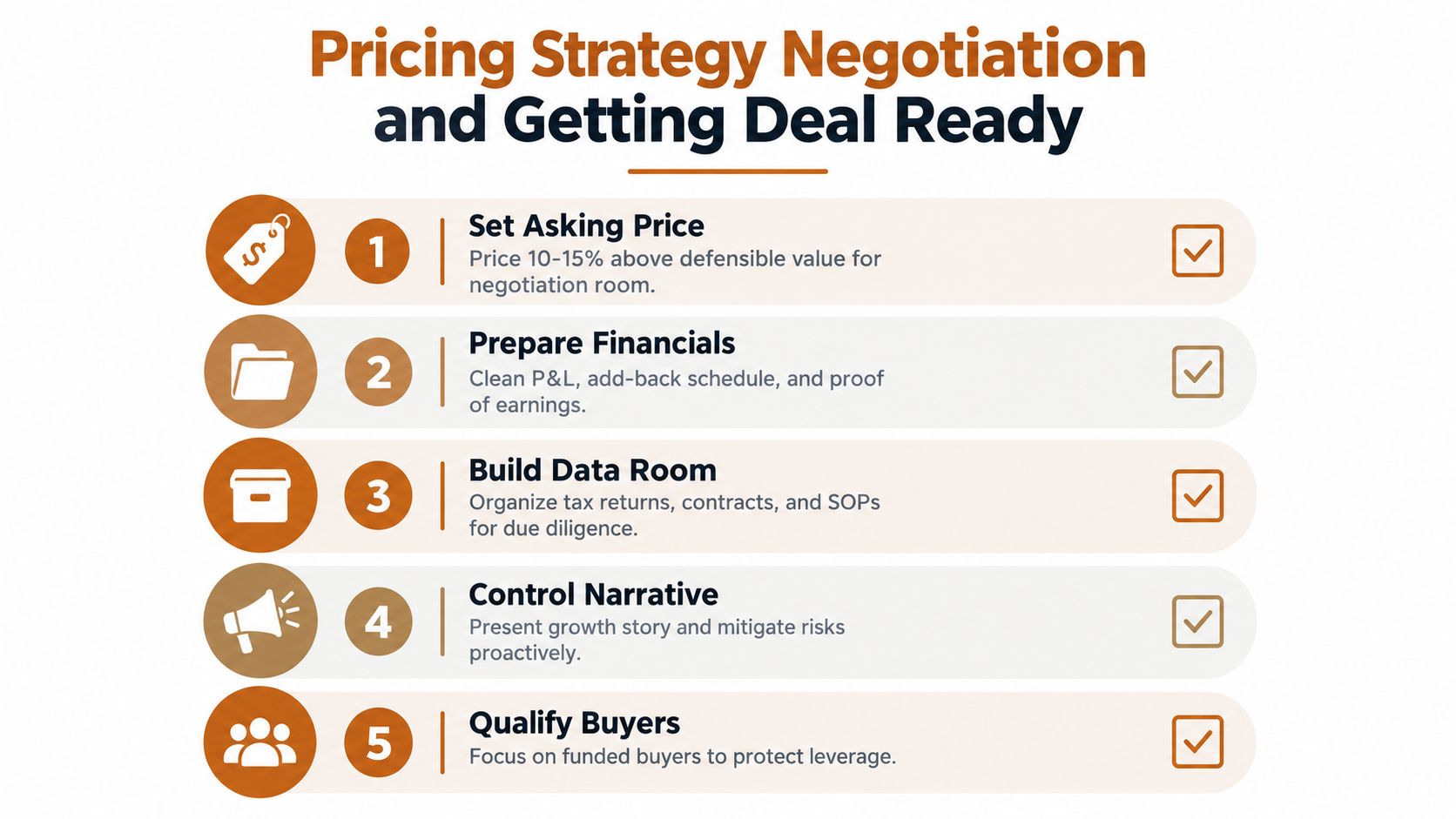
If your baseline value says one thing and your asking price says something wildly different, expect friction.
I’d rather see an owner use a firm rationale for an ask than chase an inflated number they can’t defend. The ask should reflect quality, scarcity, and upside, but it still has to survive underwriting. If a lender-backed buyer can’t get there, your “price” is only a talking point.
Negotiation gets easier when your documents are organized.
Prepare these before going to market:
That preparation matters because not every business that hits the market closes. One review of small-business M&A data found that only about 20% to 30% of businesses brought to market sell, and even advisor-run lower-middle-market processes still see roughly 31% of engagements end without a transaction. The same source points to common failure reasons like valuation gaps at 26%, unreasonable buyer or seller demands at 14%, and lack of market demand at 12% (CTA small-business M&A statistics).
Those numbers should sober up any seller who thinks pricing is just about ambition.
Not every interested party is a buyer.
Ask direct questions early. Do they have capital? Do they need financing? Have they closed a deal before? Are they the decision-maker? Can they explain why your business fits them?
The fastest way to lose your advantage is to spend weeks with someone who can’t close.
Owners usually get the best return by improving sale readiness before they launch. Survey evidence shows many owners still aren’t prepared for succession, with 70% only in the early stages of succession planning and just 8% reporting advanced planning (CPA Australia small business survey).
That gap shows up in value. Buyers pay more for less owner dependence, stronger recurring revenue, and cleaner earnings support.
A practical pre-sale checklist looks like this:
If you need specialists for valuation, tax, legal, or sale prep, The Owner’s Shortlist is one place owners use to identify vetted professionals in those categories without going through lead forms or resellers.
If you’ve read this far, here’s the blunt version.
The right answer to how much to sell a business for is almost never a single number. It’s a range built from normalized earnings, adjusted for risk, then filtered through buyer financing, tax structure, and closing certainty.
The owners who do best usually get three things right:
Revenue alone won’t save you. Buyers focus on whether earnings are real, transferable, and likely to survive your exit.
The biggest levers are usually:
A better market won’t fix a business that still depends on you for sales, operations, and decision-making.
If you can spend time improving transferability, do that first. In many cases, that work changes proceeds more than trying to squeeze another turn out of the market.
A sale is won before the LOI when the numbers are clean, the risks are visible, and the buyer can see themselves owning the business without you.
Bring in help when any of these are true:
Tax planning deserves special attention because the wrong structure can cost more than a pricing mistake. If you’re evaluating legal-tax support, this plain-English guide with tips for choosing a tax lawyer is worth reading before you hire anyone.
The sale price matters. Your after-tax, after-fee, collected proceeds matter more.
If you’re trying to turn a rough idea into a real exit plan, The Owner’s Shortlist gives you a direct way to find specialists in valuation, taxes, legal matters, financing, and succession. It’s built for owner-operators who want plain-language guidance and a cleaner path to figuring out what their business is worth, what could change that number, and who to call before they go to market.
Tell us your situation. We'll connect you with a specialist who works with owners like you. One conversation, no sales pressure.
Found this useful?
Add The Owner's Shortlist as a preferred source and get our articles highlighted in Google Search results.
Add to Preferred SourcesUnderstand business valuation cost, fee structures, price ranges and what drives fees so you can budget wisely and get accurate quotes.
September 19, 2026
Learn how a sustainable growth model works for owner-operated businesses. Covers core metrics, valuation impact, trade examples, and when
September 13, 2026
What is a quality of earnings report? Learn what a QoE covers, who prepares it, key adjustments, red flags, and how it shapes valuation and deal terms.
September 9, 2026
Learn the key methods for a plumbing business valuation. This guide covers SDE, multiples, value drivers, and how to prepare for a defensible assessment.
September 7, 2026