How to Sell My Plumbing Business: A Practical Roadmap
Ready to sell my plumbing business? Follow a step-by-step roadmap for valuing, marketing, and closing the sale with confidence and clarity.
October 15, 2026
By Remi Taffin · September 9, 2026 · Updated October 12, 2026
A quality of earnings report is a transaction-focused, third-party analysis that tests whether reported earnings are sustainable, recurring, cash-backed, and transferable to a new owner. It rebuilds revenue and normalizes EBITDA for deal purposes, rather than issuing an audit opinion on whether financial statements are fairly presented.
You may be running an HVAC, plumbing, electrical, or other service business with healthy profits on paper. Then a buyer, lender, or M&A advisor asks for a QoE, short for quality of earnings report, and the request arrives late enough to feel threatening. You may wonder whether your audited statements are being challenged, whether every expense will be questioned, or whether the buyer is looking for a reason to reduce the price.
Those concerns are understandable. A QoE isn’t a second bookkeeping exercise, and it isn’t automatically a sign that something is wrong. It is a structured attempt to answer a more practical question: What earnings will still exist after the transaction and after the owner steps away?
That distinction matters in an owner-operated company. A business can report strong profit while depending heavily on the owner’s relationships, using unusual accounting policies, carrying working-capital pressures, or relying on revenue that won’t repeat. A buyer isn’t only purchasing historical profit. They’re evaluating the cash generation and operating system they’ll inherit.
This guide translates the process into plain English. You’ll see what a QoE examines, how it differs from an audit, which adjustments commonly affect adjusted EBITDA, and why buyers, lenders, and owners can interpret the same findings differently. The central lens is portability, especially for recurring-revenue trades and home-services businesses.
The information here is educational, not legal, tax, accounting, valuation, or financial advice. Owners should use it to ask better questions before engaging a qualified specialist.
An owner might spend years building a reliable service company, keeping customers happy, and reinvesting in employees and equipment. The financial statements show profit, the tax returns support the reported activity, and the owner expects the sale process to focus on a price. Then the buyer requests a QoE and asks for general-ledger detail, bank records, tax returns, customer data, and explanations for adjustments.
The first confusion is usually simple: “Isn’t this what my audit or tax accountant already does?”
Not quite. An audit and a QoE answer different questions. The audit addresses financial-statement presentation under applicable accounting standards. The QoE asks whether the earnings are economically durable and whether another owner can generate comparable cash flow from the business.
Owner’s perspective: A buyer isn’t only asking what the business earned. They’re asking what they can reasonably expect to earn without you.
That question can affect more than a report. QoE findings can influence the buyer’s view of adjusted EBITDA, the amount of working capital expected at closing, debt-like items, financing capacity, purchase price, and other closing terms. A disputed add-back may become a negotiation point. A customer concentration issue may affect the buyer’s confidence in projections. A cash-conversion gap may make reported profit look less dependable.
For sellers, the timing matters. A buyer-led QoE often becomes the first detailed interpretation of the company’s earnings during negotiations. A seller-side review can identify unsupported add-backs, unusual revenue timing, related-party arrangements, and working-capital surprises before the business is marketed. Because QoE scope isn’t standardized and is customized to the transaction, early scoping can determine which issues receive enough attention to be resolved.
This is particularly relevant to trades businesses. Recurring service agreements may look attractive, but a buyer will still ask who owns the customer relationships, who handles estimates, whether contracts transfer, and whether the owner’s daily involvement is embedded in the reported margin.
The practical objective isn’t to make the numbers look perfect. It’s to make them understandable, supportable, and portable.
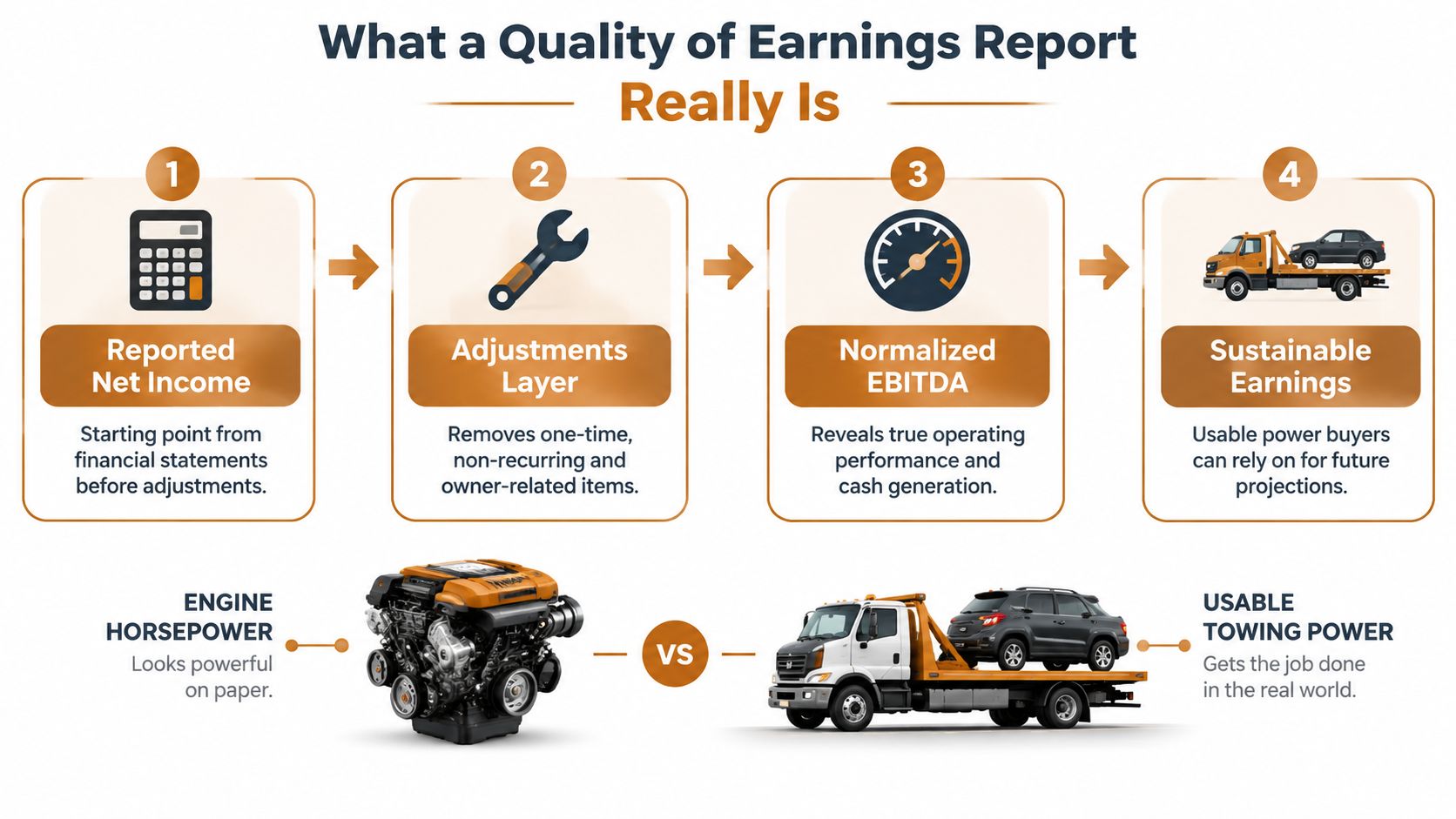
Start with the number most owners recognize: reported net income. That figure follows the company’s accounting records and financial-statement policies, but it may include items that don’t describe normal future operations. A QoE takes that starting point and tests what portion reflects repeatable business performance.
The process usually moves through four ideas:
A useful analogy is engine power. A truck may have a high horsepower rating, but that doesn’t tell you how much usable power it has while towing a loaded trailer up a hill. Reported profit is like the headline horsepower. Sustainable earnings are the usable towing power. A buyer cares about the power that remains available under real operating conditions.
A typical QoE reviews revenue, expenses, EBITDA adjustments, working capital, cash conversion, customer concentration, and accounting practices. The analyst may rebuild monthly activity from the general ledger, bank activity, tax returns, and other transaction records to understand how the reported results were produced. This helps separate ordinary operations from items that won’t continue or won’t transfer to a buyer.
The report isn’t asking whether every unusual item is improper. A one-time legal matter may be a legitimate business expense. The question is whether it belongs in the buyer’s expectation of ongoing operating performance, and whether the supporting evidence justifies the proposed adjustment.
These concepts overlap, but they aren’t identical. Reporting quality concerns how financial information is prepared and presented. Earnings quality concerns whether the earnings are sustainable, free from manipulation, and informative about future cash flows. The CFA Institute’s material on earnings quality distinguishes the concept from reporting quality and discusses the effect of estimates, judgment, and noncash items on how users interpret earnings. Read the CFA Institute material on earnings quality.
A company can maintain compliant financial records while still presenting earnings that require normalization for a transaction. Conversely, a QoE may find legitimate add-backs that improve the buyer’s understanding of ongoing performance, but only when the owner can demonstrate that the costs were unusual and won’t return.
The commonly used transaction definition is summarized in this quality of earnings analysis guide, which describes QoE as a financial diligence product focused on sustainability and future cash flow rather than audited statements alone.
The cleanest way to understand a QoE is to compare its purpose with the purpose of other financial work. These services may use some of the same records, but they don’t produce the same conclusion.
| Review type | Primary question | Typical transaction relevance |
|---|---|---|
| Quality of earnings report | Are earnings recurring, sustainable, cash-backed, and transferable? | Helps normalize earnings and evaluate deal readiness |
| Audit | Are the financial statements fairly presented under the applicable accounting framework? | Provides an audit opinion for financial-statement users |
| Review | Do analytical procedures and inquiries reveal a known material issue? | Offers limited assurance, not a transaction-specific earnings analysis |
| Financial due diligence | What financial risks and conditions could affect the transaction? | Covers a broader financial assessment, often incorporating QoE work |
An audit is built around financial-statement fairness and compliance with the relevant accounting framework. It may test balances, transactions, controls, and supporting evidence to form an opinion. A QoE doesn’t issue that opinion.
Instead, a QoE asks whether the business’s reported earnings represent the economic performance a buyer can expect after closing. It may challenge the persistence of revenue, normalize owner compensation, examine customer concentration, analyze working capital, and compare adjusted EBITDA with cash conversion. Those questions can arise even when the financial statements have been audited.
That isn’t a contradiction. The services measure different things. An accounting policy may be acceptable for financial reporting while still requiring analysis because it affects the timing or durability of earnings in a transaction.
Plain-English distinction: An audit asks whether the statements are fairly presented. A QoE asks whether the earnings number is deal-ready.
A review generally provides less assurance than an audit and relies heavily on inquiry and analytical procedures. It isn’t designed to rebuild the company’s earnings for a buyer’s valuation model. A QoE is more targeted to the transaction and normally requires detailed discussions about adjustments, revenue behavior, cash flow, working capital, and transferability.
Financial due diligence is an umbrella concept. It may include a QoE, balance-sheet analysis, debt-like item review, tax considerations, working-capital assessment, forecast testing, and other transaction questions. The exact scope depends on the deal and the parties’ concerns.
The phrase earnings quality also appears outside private M&A. Public-company investors may analyze SEC filings and management disclosures for durability, recurring performance, and cash-backed results. The same phrase therefore depends on context. In a private-company sale, the focus is usually the target’s earnings and the buyer’s post-close economics.
Because no single regulated definition governs every QoE, owners should ask the provider to state the scope, period, records, procedures, and intended users before work begins.
A QoE report isn’t a new version of the income statement. It reconstructs the financial story behind the income statement and then documents the reasoning used to normalize it. In private M&A and lender diligence, that work commonly draws from the general ledger, bank activity, tax returns, monthly financial data, and management explanations.
The analysis often begins with revenue. The reviewer looks for recurring versus nonrecurring activity, changes in revenue recognition, unusual customer orders, customer concentration, and the relationship between recorded revenue and cash collection. For a service contractor, that may mean separating recurring maintenance agreements from one-time installation work or identifying whether a large project reflects normal demand.
Expenses receive similar treatment. The reviewer examines operating costs, owner compensation, related-party arrangements, unusual professional fees, and expenses that may not continue under new ownership. The objective isn’t automatically to add back anything personal or unusual. The objective is to estimate the cost structure a buyer will inherit.
| Adjustment Category | Example | Why It Matters |
|---|---|---|
| Owner compensation | Compensation above the market cost of a replacement manager | A buyer may need to replace the owner’s role, so only the defensible difference may be considered |
| One-time legal or restructuring cost | A discrete dispute or unusual restructuring engagement | The cost may not recur, but the owner needs evidence that it was isolated |
| Related-party arrangement | Rent or services provided by an entity connected to the owner | The reported amount may need to reflect an arm’s-length ongoing cost |
| Deferred maintenance | Maintenance postponed during the period under review | An apparent expense benefit may reverse after closing |
| Revenue timing | Revenue recorded before the related work or collection is complete | The reported period may overstate the sustainable run rate |
Adjusted EBITDA is a central output, but it isn’t the entire conclusion. The analyst also considers working capital and cash conversion. A company can report earnings while requiring substantial receivables, inventory, or other operating investment to produce those earnings. Buyers and lenders need to understand whether the reported profit turns into usable cash under normal conditions.
A documented add-back should answer several questions:
The quality of earnings report explanation from Warren Averett emphasizes this reconstruction approach and notes that QoE findings can affect price, debt capacity, and closing terms. That is why an unsupported add-back can create friction instead of value.
A buyer, lender, and owner can read the same QoE and focus on different consequences.
The buyer wants to know whether the normalized earnings can support the acquisition after closing. That includes testing the achievability of projections, the durability of revenue, the cash required to operate, and the effect of working-capital requirements. A buyer may accept an adjustment that removes an isolated expense but reject an adjustment that removes an ongoing cost.
The lender focuses on repayment capacity and downside risk. Adjusted EBITDA may be relevant to debt sizing, but the lender also cares whether earnings convert into cash and whether the business needs operating capital that the headline number doesn’t reveal. Debt-like obligations and balance-sheet conditions can affect the lender’s view of the transaction.
The owner needs a different answer: which parts of the business create value, and which parts depend on the owner personally? A pre-sale QoE can expose add-back disputes, working-capital surprises, and debt-like items while the owner still has time to correct records, change processes, or explain the issue.
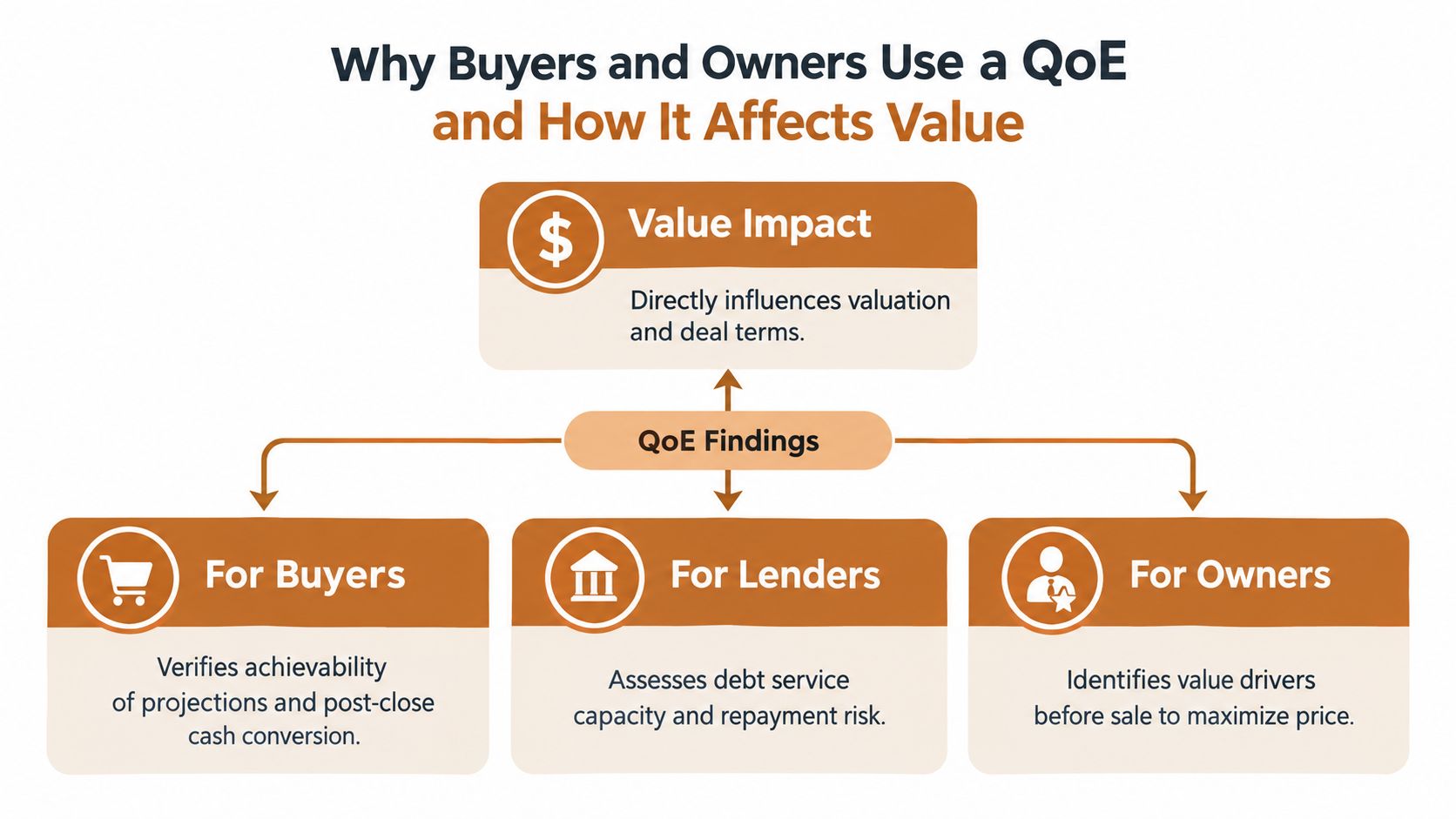
QoE findings can flow into several negotiation points:
These effects explain why a QoE isn’t merely a diligence memo. The report can change the earnings base used in negotiations and the protections attached to uncertain items.
For a recurring-revenue trades business, ask whether the earnings travel with the company. A maintenance agreement may be valuable, but its value depends on contract transferability, renewal behavior, service quality, customer relationships, and operational capacity. If the owner personally controls estimates, dispatch decisions, vendor relationships, and the sales pipeline, the buyer may view the earnings as less portable.
The practical question is:
Could a capable new owner operate the same system, retain the customers, and produce comparable cash flow without inheriting the seller’s personal network?
The plain-language discussion of QoE and transaction readiness from BD Emerson highlights this distinction between an audit opinion and an analysis of economically durable earnings. Owners should treat that distinction as a preparation tool, not only as a buyer’s test.
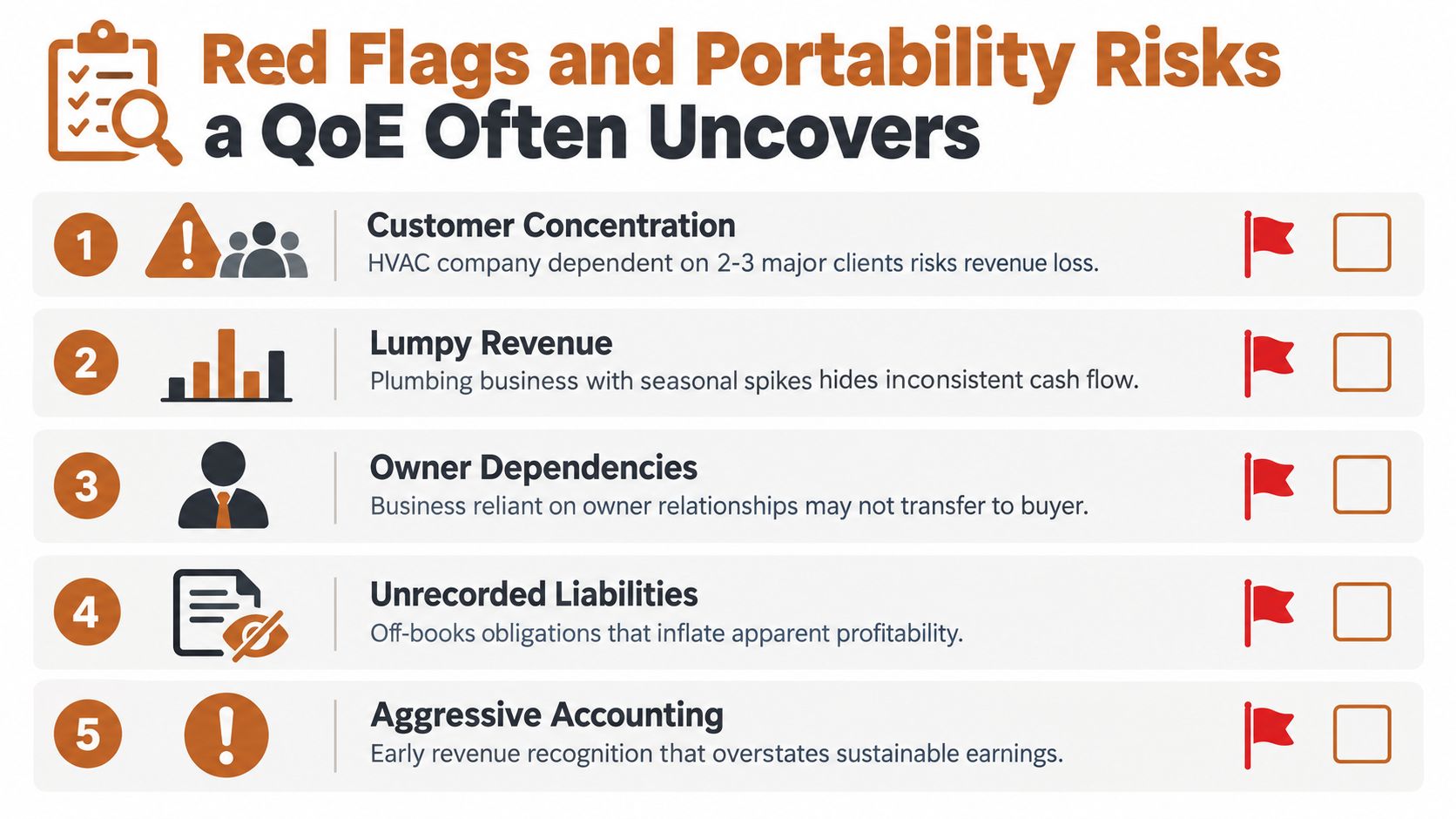
A QoE becomes especially useful when it reveals a gap between accounting profit and portable operating performance. The gap may come from revenue concentration, owner dependence, timing, cash conversion, or obligations that aren’t obvious from a quick income-statement review.
Consider an HVAC company whose largest commercial relationships sit entirely with the owner. The customers may be loyal to the company, or they may be loyal to the individual. A buyer will want evidence that the relationships, contracts, service history, and renewal process belong to the business rather than to the owner’s personal reputation.
A plumbing business may show strong revenue during project-heavy periods while cash collection remains uneven. The issue isn’t necessarily poor performance. It may indicate that the buyer needs to understand billing milestones, receivables, labor requirements, and the working capital required to deliver future work.
Recent guidance on earnings quality distinguishes transaction analysis from public-company analysis and places greater emphasis on revenue durability, transferability, and cash-backed earnings. This guide to earnings quality also describes how analysis can extend beyond historical EBITDA to projections, working capital, and balance-sheet considerations.
For owners, that means a clean add-back schedule isn’t enough. A buyer is purchasing a business model, customer base, workforce, processes, and future cash flow. If those elements remain tied to the seller, the buyer may discount the earnings even when the bookkeeping is orderly.
Start by deciding which question the engagement must answer. A buyer-led QoE may be appropriate when you’re evaluating an acquisition. A seller-side QoE may make sense before marketing a business if the records contain owner-related expenses, related-party transactions, complex revenue patterns, customer concentration, or other issues likely to become negotiation points.
Then define the scope with the proposed provider. Ask:
Don’t wait until a buyer has formed a negative view of an unfamiliar expense. Use the analysis to fix records where possible, preserve evidence for legitimate adjustments, and explain the owner’s role. The purpose isn’t to manufacture a higher number. It’s to establish a defensible view of earnings that another owner can understand and operate.
A QoE is informational and transaction-focused, so it shouldn’t replace advice from qualified accounting, legal, tax, valuation, or financing professionals. The Owner’s Shortlist is a free service that helps owners find a business broker or other specialist. You talk to a real person, who introduces you to one specialist whose past work fits your business.
The Owner’s Shortlist can help you understand QoE terminology, organize the questions to ask, and find vetted specialists for valuation, accounting, tax, legal, financing, and succession matters. Visit The Owner’s Shortlist to explore the directory and practical guides before you begin a QoE conversation.
Tell us your situation. We'll connect you with a specialist who works with owners like you. One conversation, no sales pressure.
Found this useful?
Add The Owner's Shortlist as a preferred source and get our articles highlighted in Google Search results.
Add to Preferred SourcesReady to sell my plumbing business? Follow a step-by-step roadmap for valuing, marketing, and closing the sale with confidence and clarity.
October 15, 2026
Learn how to sell your service business with a practical, step-by-step roadmap. From readiness and valuation to deal structure and closing, get actionable
October 14, 2026
Learn how business valuation EBITDA works for service companies. Discover adjustments, multiples, and owner-dependency tests before you sell.
October 12, 2026
Thinking 'I want to sell my landscaping business'? Learn how to value your company, prepare financials, handle labor risks, and find the right buyer quietly.
October 11, 2026