How to Sell My Plumbing Business: A Practical Roadmap
Ready to sell my plumbing business? Follow a step-by-step roadmap for valuing, marketing, and closing the sale with confidence and clarity.
October 15, 2026
By Remi Taffin · September 7, 2026 · Updated October 12, 2026
You’ve spent years answering emergency calls, hiring technicians, managing trucks, and building a reputation one completed job at a time. Then a quieter question starts to surface: what is all of this worth if you decide to sell, bring in a successor, or step away?
The answer rarely comes from revenue alone. Buyers look at the cash flow they can depend on, the technicians who can keep working without you, the customers who return, and the systems that make the company transferable. A plumbing business valuation turns those operating realities into a defensible price, but it also shows you which changes can create more value before a transaction.

A plumbing owner often starts with a simple calculation. They look at annual sales, add the trucks and equipment, then compare the result with a number mentioned by a competitor. That estimate may be useful as a first conversation, but it doesn’t answer the buyer’s real question: how much dependable earnings will remain after the owner leaves?
Two companies can generate similar revenue and still command very different prices. One may depend on the owner for licensing, estimating, dispatch decisions, and the most valuable customer relationships. The other may have trained technicians, recurring maintenance work, documented procedures, and supervisors who can operate the daily business. Buyers see the first company as a job tied to one person. They see the second as a transferable business.
A proper valuation matters even if you’re not ready to sell. It can guide decisions about hiring, equipment purchases, debt, succession, and reinvestment. It also gives you a reality check before you make a major commitment based on an informal estimate.
Practical rule: Buyers pay for earnings they can verify and operate, not effort they have to replace.
The process becomes much clearer once you separate three questions:
That last question drives the difference between a low-end owner-operator transaction and a premium business sale. The rest of the valuation work should help you identify the earnings base, select an appropriate market multiple, and improve the operational factors that justify a stronger multiple.
Valuing a plumbing company is similar to valuing a house. You can compare it with similar homes that sold nearby, estimate the income it could produce as a rental, or calculate what the land and structure are worth. Business valuation uses the same broad logic through the market approach, income approach, and asset approach.
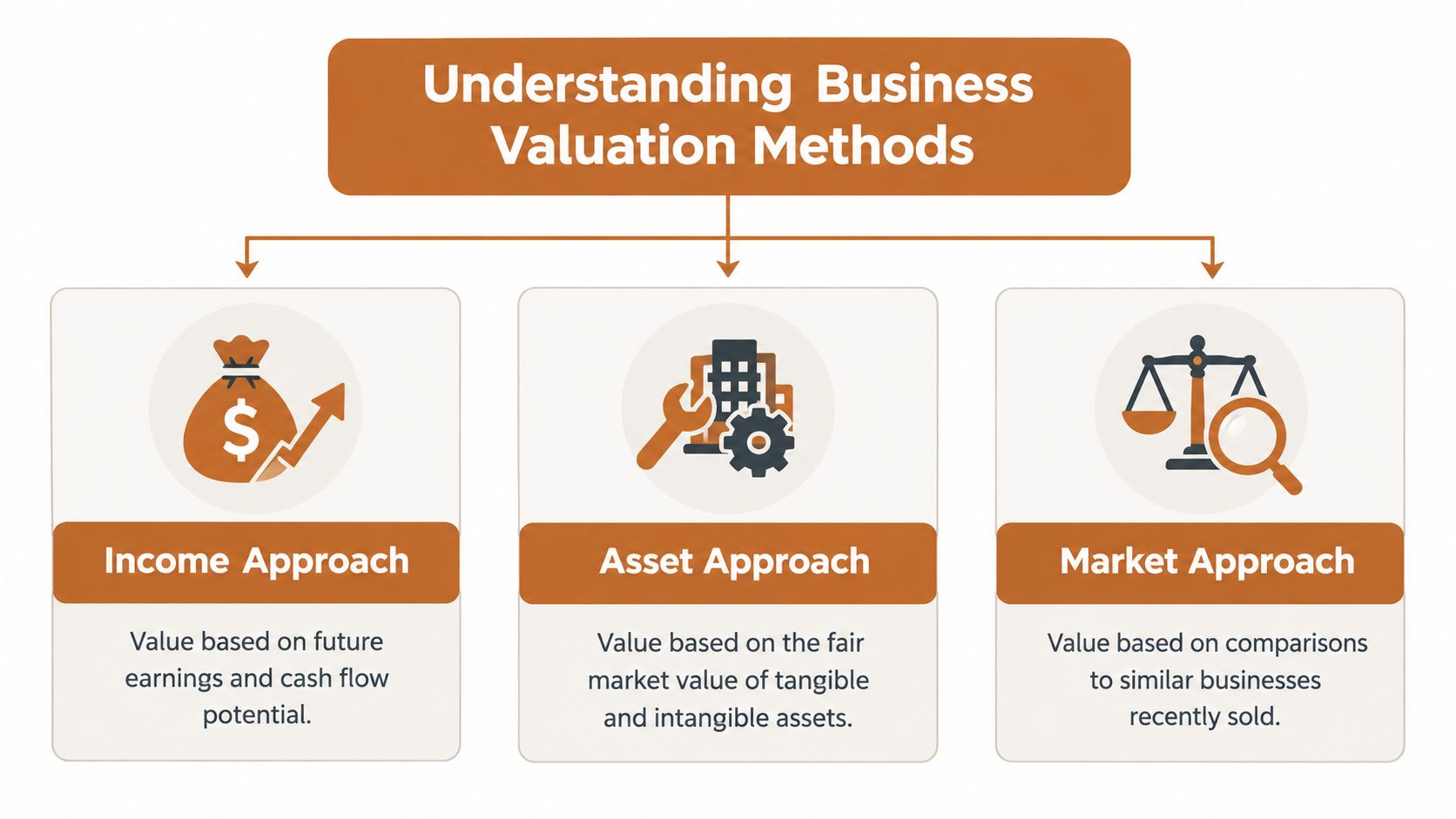
The market approach compares your company with similar businesses that have sold or been offered for sale. It provides a reality check because it reflects what buyers have paid in the same broad industry.
The comparison isn’t mechanical. A buyer still adjusts for service mix, local competition, owner involvement, earnings quality, equipment condition, and customer concentration. A listing with similar revenue isn’t automatically a true comparable if its cash flow and operating structure are different.
The asset approach estimates the fair market value of trucks, machinery, inventory, fixtures, and other tangible property. It can be useful for an equipment-heavy company, a business with weak or inconsistent earnings, or a situation where the assets provide meaningful collateral.
Assets usually establish a floor rather than a ceiling for a profitable plumbing business. A fleet of well-maintained trucks has value, but the customer relationships, brand, trained workforce, and cash flow often matter more to a buyer seeking an operating company.
The income approach focuses on future earning power. For smaller, owner-operated plumbing companies, the most useful measure is often Seller’s Discretionary Earnings, or SDE. SDE represents the economic benefit available to one owner-operator after normalizing the company’s financial statements.
A practical calculation starts with reported net income and then adds back legitimate owner-specific or nonrecurring expenses. The adjusted earnings figure is multiplied by a market-supported SDE multiple:
Normalized SDE × appropriate multiple = indicated business value
SDE works well for a small company because the owner may perform several roles that a larger company would assign to separate employees. A new owner may replace some of that labor personally, so the valuation needs to show the total benefit available to that owner. Larger, management-run companies are more often valued on EBITDA because the owner isn’t expected to perform the core operating work.
BizBuySell-based plumbing transaction data covering 2021 through 2025 reports a median SDE multiple of 2.24x and an average of 2.49x, while the median sold revenue multiple was 0.59x, according to recent plumbing transaction benchmarks. The contrast reinforces a central point: buyers generally pay for durable cash flow, not only the amount of work billed.
A valuation professional may use all three approaches, but the earnings approach usually carries the most weight when a plumbing business has consistent, transferable profitability.
Your tax return and profit-and-loss statement show accounting results. They don’t always show the earnings a buyer will use for valuation. The normalization process reviews each expense and asks whether a new owner would continue paying it at the same level.
An add-back is an expense removed from reported profit when it is personal, discretionary, nonrecurring, or greater than the amount required to run the business. Every add-back needs support. A buyer won’t accept a vague explanation that an expense was “for the owner.” They’ll want invoices, tax records, payroll details, and a clear reason the cost won’t continue.
Start with compensation. If your salary is above the market cost of replacing the work you perform, the excess may be considered an add-back. If you work full-time as the qualifying plumber, estimator, and manager, however, the buyer may need to replace that contribution, so the full amount won’t necessarily be added back.
Other areas deserve the same careful review:
Create a schedule that lists the expense, amount, date, explanation, and supporting document. Give your CPA or valuation advisor enough context to distinguish an actual add-back from a cost that will follow the company to its next owner.
Recent market commentary connects higher multiples with recurring maintenance, technician depth, and commercial or service-heavy revenue. It also describes a wide spread, from roughly 1.7x to 3.5x SDE for owner-operated plumbing shops to 6x or more EBITDA for management-run businesses, as reported in plumbing valuation market commentary. Those figures aren’t a shortcut for selecting your multiple. They illustrate why clean, defensible earnings and a transferable operating model matter together.
The strongest add-back is one a buyer can verify without an argument.
Don’t use aggressive adjustments to make the company appear more profitable than it is. Inflated SDE can produce a high asking price, but it often collapses during diligence and damages trust when the buyer recalculates the earnings base.
A buyer pays more when the business produces dependable earnings with less personal risk. The operational levers below all work toward that same outcome. They make revenue more predictable, reduce disruption if one person leaves, or help the next owner understand how to run the company.
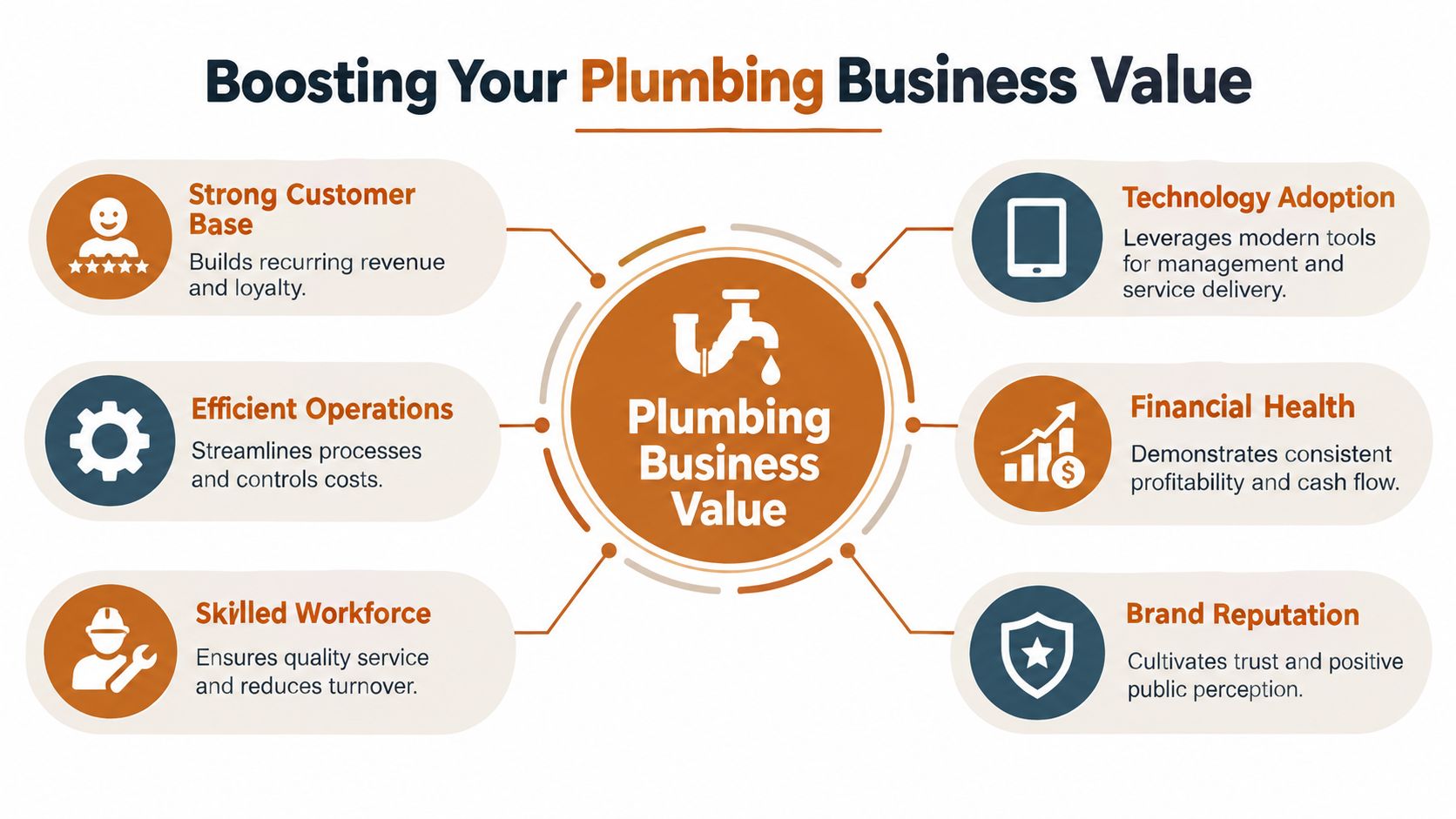
A maintenance agreement gives the buyer a clearer view of future demand than a calendar filled only with one-time emergency calls or construction projects. The value comes from the quality of the agreements, not merely their existence. Buyers examine renewal behavior, pricing, service obligations, customer concentration, and whether several technicians can fulfill the work.
Independent industry sources report that service-agreement-heavy operators can receive a recurring-revenue premium of roughly 0.5x to 1.0x to the base EBITDA multiple because recurring work can reduce volatility and improve forecasting, according to industry analysis of plumbing EBITDA multiples. Treat that as a valuation consideration, not a guaranteed uplift. A contract that loses money, depends on one technician, or can be canceled easily won’t carry the same weight as a profitable, well-documented maintenance base.
The most valuable staffing change is often the one that removes you from the critical path. If every difficult diagnosis, permit decision, estimate, and customer escalation comes back to you, the buyer is purchasing your personal labor and accepting key-person risk.
Build capability below the owner. Assign clear responsibilities to a service manager, dispatcher, lead technician, or office administrator. Keep licensing records current, create training materials, and use field-service software such as ServiceTitan, Housecall Pro, or Jobber to make scheduling, estimates, job notes, and invoices visible to the team.
Residential service can create strong local relationships and fast payment. Commercial accounts can provide repeat work and useful route density. Construction work may contribute volume, but it can expose the company to builder concentration, project timing, and margin pressure.
The right mix depends on your market. The buyer’s concern is concentration and durability. Maintain a customer list that shows account history, service type, gross margin, payment behavior, and the relationship owner inside your company.
A buyer shouldn’t have to learn your business through informal conversations over several months. Document how calls are answered, how emergencies are prioritized, how technicians receive work orders, how pricing is approved, how parts are tracked, and how callbacks are reviewed.
Good documentation also improves performance before a sale. It makes training more consistent and exposes bottlenecks that were previously hidden in the owner’s memory.
Reviews, referrals, branded vehicles, community relationships, and a recognizable phone number can create a durable lead source. Reputation becomes more valuable when the business can show how it turns that goodwill into booked work and repeat customers.
Avoid treating online ratings as a substitute for financial evidence. A strong reputation supports the story, but buyers still test whether the brand produces profitable, transferable revenue.
Consistent job costing, clear separation of personal expenses, current receivables, and reliable monthly reporting make earnings easier to trust. A buyer will pay closer attention to a company that can explain margin changes, technician productivity, callback costs, and slow-paying accounts.
The practical goal isn’t to make the business look perfect. It’s to make the financial story understandable, reconcilable, and repeatable.
A multiple is a shorthand for risk and opportunity. The same earnings figure can support a different valuation depending on whether the company depends on the owner, has recurring service work, maintains a capable technician bench, and produces clean records.
BizBuySell’s benchmark includes 226 reported plumbing listings. The dataset shows a median sale price of $638,730, a median asking price of $650,000, and median days on market of 202, along with an average revenue multiple of 0.67x and an average earnings multiple of 2.49x, as reported in BizBuySell’s plumbing valuation benchmarks. The market evidence provides an anchor, not an automatic price for your company.
| Metric | Average Multiple | Median Multiple | Notes |
|---|---|---|---|
| Seller’s Discretionary Earnings | 2.49x | 2.24x | More closely reflects cash flow available to an owner-operator |
| Sold revenue | 0.67x | 0.59x | Useful as a market check, but weaker when margins differ |
| Listed plumbing businesses | Not provided | Not provided | The benchmark includes reported listings and market observations |
A low-multiple business often has one or more structural weaknesses. The owner may be the only person who can perform licensed work, close larger estimates, or maintain key accounts. Revenue may be dominated by unpredictable projects, while the books combine personal spending with operating costs. The buyer must replace the owner and rebuild confidence at the same time.
A stronger business presents a different risk profile. Customers return through service agreements, several technicians can complete the work, supervisors own daily decisions, and the financial records support the earnings calculation. The buyer isn’t just acquiring equipment and a customer list. They’re acquiring an operating system that already produces cash flow.
Current commentary on 2026 plumbing valuations indicates that companies with 30% or more recurring service agreements can trade higher, service-led operators can reach 5.5x to 7x EBITDA, and businesses with low recurring revenue may struggle to exceed 4x EBITDA, according to a 2026 plumbing valuation analysis. These ranges apply to the source’s market discussion and shouldn’t be applied to an SDE calculation without professional judgment.
Use the benchmark to ask better questions. If your company sits near the lower end, identify the specific risk holding it there. If it appears stronger, document the evidence that supports a premium rather than assuming the buyer will recognize it automatically.
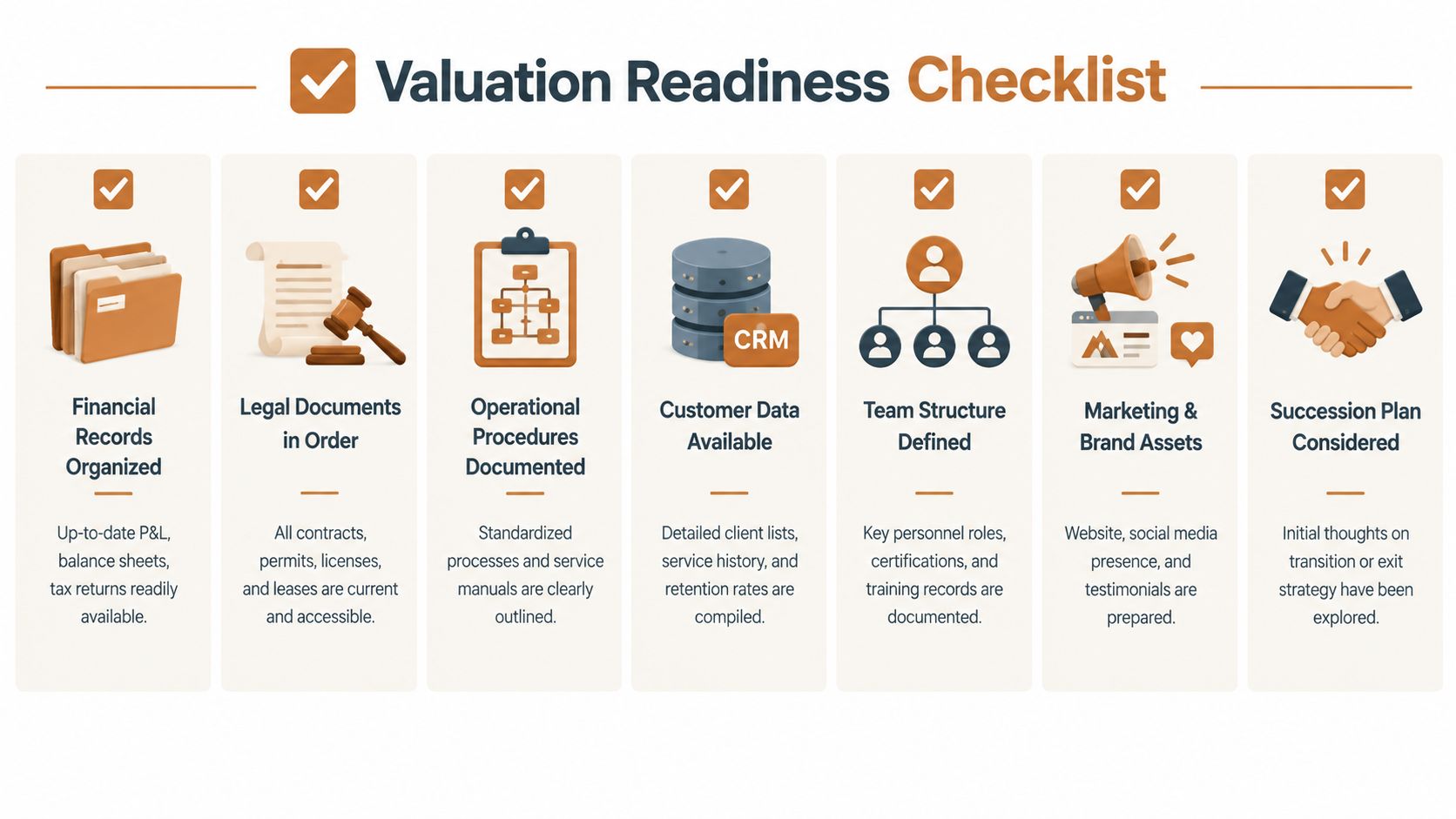
A valuation becomes more useful when the underlying records are ready for inspection. You don’t need a flawless company, but you do need an honest picture of its earnings, obligations, customers, people, and operating procedures.
A business appraiser can prepare a formal valuation for estate planning, shareholder matters, financing, or a defensible opinion of value. An M&A advisor focuses more heavily on positioning, buyer outreach, negotiation, deal structure, and managing a sale process. Your CPA helps normalize earnings and model tax consequences, while a transaction attorney reviews purchase agreements and protects your legal position.
You may not need every advisor immediately. You do need the right conversation before making an irreversible decision. A preliminary valuation can show whether your current business supports your plans, while an operational review can identify improvements that may take time to implement.
The best time to start isn’t the week you want to announce the sale. Start when you can still change the customer mix, strengthen the team, clean the books, and prove that the business performs without constant owner intervention.
The Owner’s Shortlist is a free service that helps owners find a business broker or other specialist. You talk to a real person, who introduces you to one specialist whose past work fits your business. If you’re getting your plumbing business valued, tell us about your business. Owners pay nothing.
Tell us your situation. We'll connect you with a specialist who works with owners like you. One conversation, no sales pressure.
Found this useful?
Add The Owner's Shortlist as a preferred source and get our articles highlighted in Google Search results.
Add to Preferred SourcesReady to sell my plumbing business? Follow a step-by-step roadmap for valuing, marketing, and closing the sale with confidence and clarity.
October 15, 2026
Learn how to sell your service business with a practical, step-by-step roadmap. From readiness and valuation to deal structure and closing, get actionable
October 14, 2026
Learn how business valuation EBITDA works for service companies. Discover adjustments, multiples, and owner-dependency tests before you sell.
October 12, 2026
Thinking 'I want to sell my landscaping business'? Learn how to value your company, prepare financials, handle labor risks, and find the right buyer quietly.
October 11, 2026