What Is a Quality of Earnings Report and Why It Matters
What is a quality of earnings report? Learn what a QoE covers, who prepares it, key adjustments, red flags, and how it shapes valuation and deal terms.
September 9, 2026
By Remi Taffin · September 13, 2026

You’re deciding whether to push harder, hold steady, or prepare the business for sale. One competitor is opening new territories and adding trucks, but every new job seems to produce less cash. Another is tightening pricing, renewing maintenance agreements, and growing at a pace the team can absorb. The second owner may be building the more valuable company, even if the first one reports faster revenue growth.
That’s the practical meaning of a sustainable growth model for an owner-operated business. It isn’t a corporate ESG slogan or a macroeconomic theory about steady-state expansion. It’s a decision framework for answering three questions: Is the revenue base defensible? Does growth become retained cash? Can the next operator run the business without you?
The framework below uses four levers, growth rate, margin, retention, and recurring revenue, to connect everyday operating choices with valuation and exit readiness. The purpose isn’t to make your company look complex on paper. It’s to stop you from confusing a busier business with a stronger one.
Two service companies can generate the same sales and carry completely different levels of risk. The first may rely on constant lead generation, one-off projects, and the owner’s personal relationships. The second may have predictable service agreements, documented pricing, stable technicians, and customers who renew because the service is embedded in their routines.
Both may appear to be growing. Only one may be building an asset that another person can own.
Start with the revenue base. Ask whether customers return because the business has earned durable trust, or because the owner personally rescues every account. A defensible revenue base has repeatable delivery, clear customer records, sensible contracts, and enough account diversity that one lost relationship doesn’t destabilize the company.
Next, follow revenue into cash. Growth that requires heavier discounting, longer payment terms, extra inventory, or premature hiring can leave the owner with more activity and less liquidity. The sustainable growth model treats retained cash as a test of quality, not an afterthought.
Finally, remove the owner from the operating picture. If the owner approves every quote, handles every difficult complaint, and remains the only person who understands margins, the company may be profitable but still difficult to transfer. A buyer wants evidence that performance survives an ownership change.
Practical rule: If growth requires the owner to work more hours indefinitely, it’s a workload increase, not a sustainable growth strategy.
This is also why the distinction between operating a trade and merely earning income from it matters. Owners who want a clearer explanation of that distinction can review this guide to trading as a business UK, particularly when separating personal effort from transferable enterprise value.
The four levers work together:
A good model doesn’t maximize every lever at any cost. It identifies the combination that produces reliable cash flow, manageable risk, and a business someone else could confidently operate.
Take a fictional HVAC and plumbing contractor. It installs replacement systems, handles emergency repairs, and sells maintenance agreements. The owner says revenue is rising, but that statement is incomplete. To understand whether the company is becoming stronger, measure the four numbers in sequence.
Calculate the change in revenue over a consistent period, then split it by service line, customer type, and source. A larger top line can hide a shift toward low-margin installations, a single large account, or work acquired through deep discounts.
The owner should ask, “What kind of revenue grew?” A repair customer who joins a maintenance plan contributes differently from a one-time installation customer acquired through a price concession.
Gross margin on service calls may differ materially from gross margin on installation work. Track revenue, direct labor, parts, subcontractors, warranty callbacks, and other direct costs by category. Then normalize operating expenses and owner compensation to see whether the reported operating margin reflects a business that could pay a replacement manager.
A contractor with impressive installation sales but weak job costing may be less attractive than a slower company that prices service work consistently and protects contribution.
For the HVAC and plumbing company, retention starts with maintenance agreement renewals. Track which customers renew, cancel, or lapse, then connect those outcomes to customer lifetime value, technician follow-up, service quality, and pricing.
Retention also applies to employees. A company that loses trained technicians repeatedly may struggle to deliver its customer promise, regardless of its marketing pipeline.
Recurring revenue includes maintenance agreements, membership plans, and scheduled replacement programs. Calculate it as a share of total revenue, but also inspect the contract terms, renewal process, cancellation behavior, and gross margin.
A contract that renews only because it’s underpriced isn’t durable recurring revenue. It’s a future margin problem.
| Metric | What It Measures | How to Calculate | Healthy Range (Trades) | Owner Warning Sign |
|---|---|---|---|---|
| Growth rate | Revenue expansion and its composition | Change in revenue over a consistent period, segmented by service line | Depends on capacity and economics | Sales rise while cash and margin fall |
| Margin | Profitability of work delivered | Revenue minus direct costs, then operating profit after normalized owner compensation | Depends on trade mix and market | Estimates and actual job costs diverge |
| Retention | Customer and employee durability | Renewing customers divided by customers eligible to renew | Depends on agreement type and service model | Cancellations remain unexplained |
| Recurring revenue | Predictability of future activity | Contracted or scheduled revenue divided by total revenue | Depends on the business model | Agreements are informal, underpriced, or owner-dependent |
There is no universal healthy range that applies to every trade. Run the four metrics together and inspect the weakest link. Strong growth with weak retention is fragile. Strong retention with poor margin is loyal but underpaid work. The useful diagnostic is whether each additional customer produces cash, stays long enough to justify acquisition cost, and can be served through a repeatable process.
Buyers don’t pay for revenue in isolation. They pay for the confidence that revenue will continue producing cash after the owner leaves.
Consider two HVAC and plumbing businesses with similar sales. Business A gets 40% of revenue from recurring agreements and retains 85% of eligible customers. Business B gets 5% from recurring sources and retains 60%. Those figures come from the worked comparison in the brief, not from an industry benchmark. The point is the structure of the earnings stream, not a promised valuation formula.
Business A gives a buyer more visibility into future work. Its agreements may support scheduling, technician planning, and customer follow-up. Business B must repeatedly replace lost customers and depend more heavily on fresh demand. A buyer will investigate both, but the second company carries more uncertainty even if its current revenue matches the first.
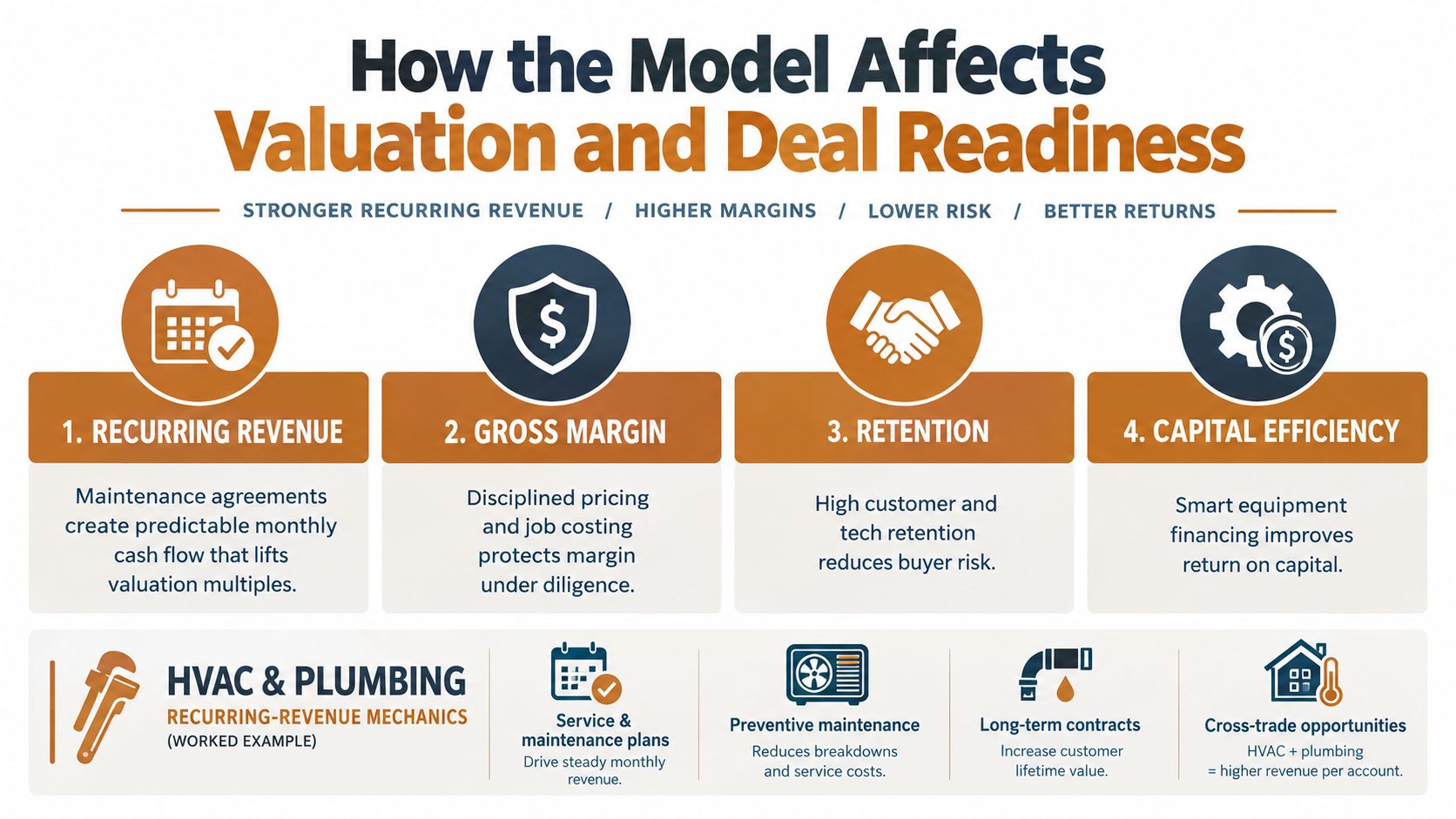
Growth rate matters when it reflects repeatable demand and adequate capacity. Growth that depends on the owner, unusual project timing, or underpriced work can weaken rather than strengthen the story.
Margin stability matters more than a single peak period. A buyer wants to know whether pricing, dispatch, job costing, and labor management hold up through normal operating pressure.
Retention reduces uncertainty. Customer retention supports revenue continuity, while technician retention protects delivery capacity and customer experience. High concentration in a few accounts can still create risk, even when overall renewal activity looks strong.
Recurring revenue creates a clearer forward view. Maintenance agreements don’t eliminate cancellations or service costs, but well-documented contracts make future activity easier to assess.
Owners comparing key business valuation methods should also understand how earnings quality, customer risk, and transferability affect the analysis. A valuation discussion becomes more useful when it starts with clean operating evidence rather than a preferred number.
Deal readiness is the ability to pass diligence without the owner acting as the company’s filing system, sales department, and technical expert. That means contracts are accessible, customer records reconcile with accounting, margins are supported by job-level data, and managers can explain the operating rhythm.
Seller’s discretionary earnings can help owners understand how buyers may normalize owner-related expenses. Review this explanation of seller discretionary earnings before presenting adjusted earnings as if every add-back were automatically acceptable.
Growth becomes destructive when the owner treats every increase in activity as progress. The common pattern is predictable. Sales rise, complexity rises faster, and the owner discovers too late that the business has traded cash quality for motion.
| Pitfall | What it damages | Disciplined model |
|---|---|---|
| Discounting to win volume | Gross margin and price credibility | Price around contribution and service value |
| Overhiring | Cash flow and utilization | Hire against backlog, capacity, and margin |
| Ignoring cancellations | Retention and customer lifetime value | Review non-renewals and intervene early |
| Untracked growth | Management control | Use a small dashboard tied to cash and value |
Hiring ahead of revenue is one of the fastest ways to create pressure. An owner sees a promising pipeline, adds technicians, and then spends months carrying payroll before demand becomes dependable. Hire when the backlog, utilization needs, and margin target support the decision, not when optimism does.
Low-margin new service lines create a similar trap. A new offering can increase revenue while consuming dispatch time, inventory, warranty capacity, and management attention. Price the line against contribution margin and operational complexity, not against the excitement of a larger top line.
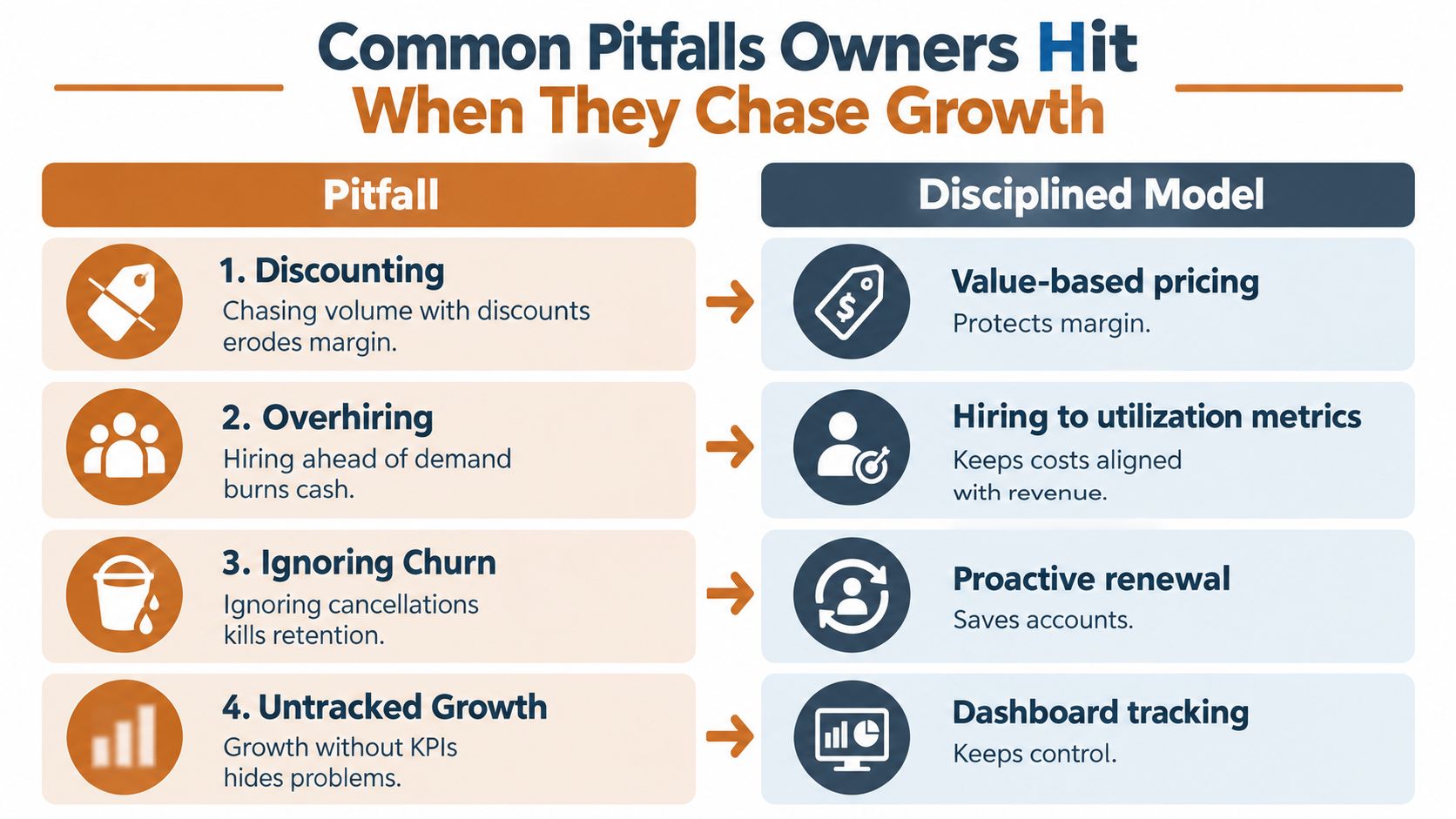
Discounting maintenance agreements may fill the schedule, but it can train customers to reject proper pricing later. Protect the service promise and price it so the company can fund competent delivery.
Technician productivity per truck deserves weekly attention. Before adding headcount, inspect billable time, travel, callbacks, unbilled work, parts availability, and scheduling gaps. If existing trucks aren’t producing efficiently, more trucks multiply the weakness.
Accounts receivable creates a quieter failure. Scaling sales while allowing payment terms and collections to drift can force the owner to finance customers. Tighten billing rules and collection ownership before increasing sales pressure.
Owners who want to sharpen conversion discipline can use this practical guide to how to win every lead competition. The useful lesson is not “chase every lead.” It’s to qualify demand, respond consistently, and avoid buying unprofitable work.
Revenue growth is only valuable when the company keeps enough of the resulting cash and can explain how it earned it.
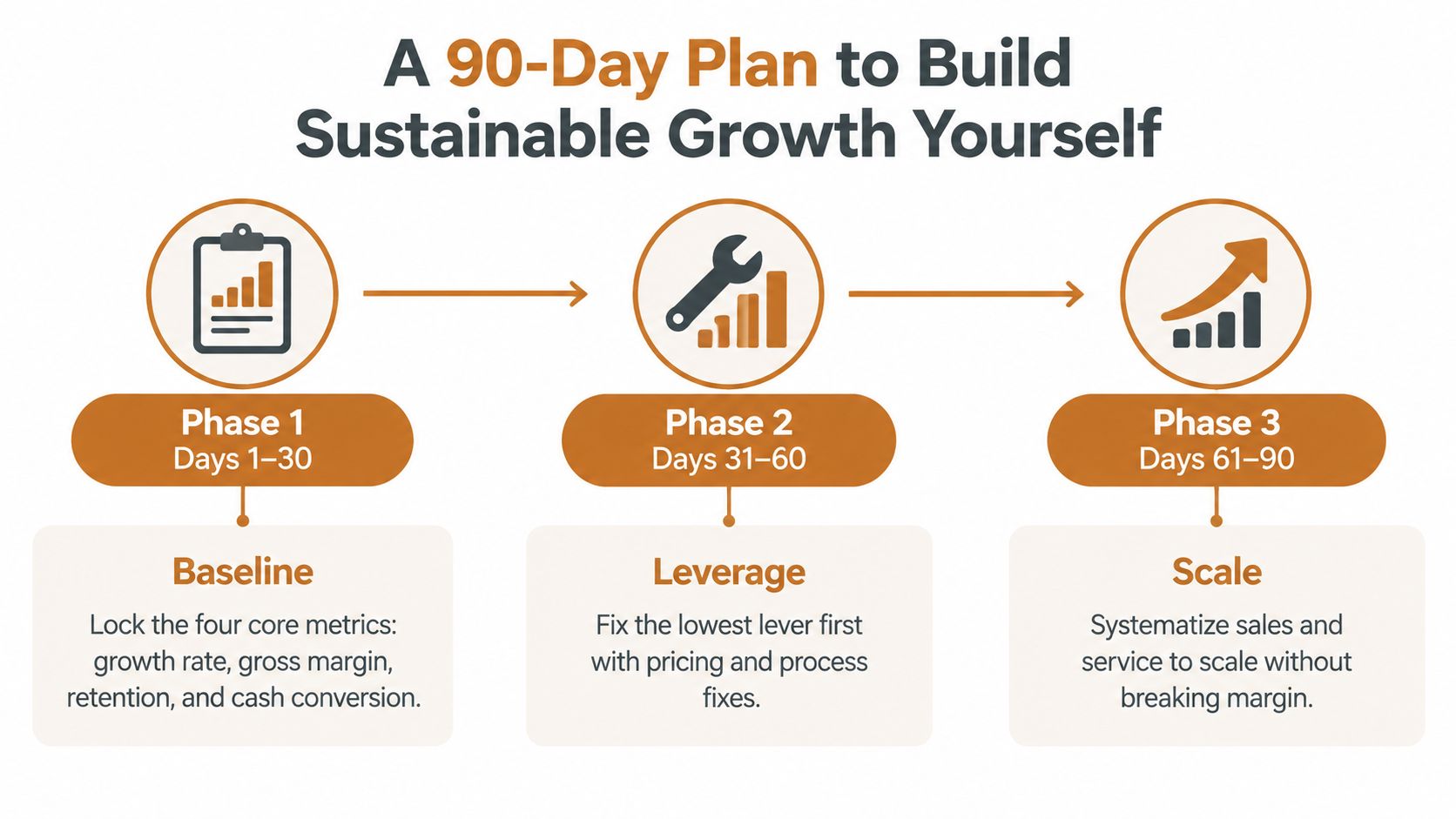
An owner deciding whether to grow, hold, or prepare for a sale needs a 90-day operating test, not a new logo, a larger ad budget, or another vehicle. Start with accurate measurement, then fix one constraint at a time. The goal is a business that produces dependable cash and can operate without the owner carrying every decision.
Pull actual figures from accounting, job costing, customer records, and contract files. Record growth rate, gross margin, customer retention, and recurring revenue percentage, using one consistent definition for each. These measures connect daily operations to valuation and exit readiness.
Segment the results. Separate service calls from installations, agreement customers from non-agreement customers, and owner-generated sales from team-generated sales. Review which work produces repeatable cash and which work depends on the owner’s direct involvement. The purpose is to identify the weak lever, not to build a decorative dashboard.
Ask this checkpoint question before moving on:
Which single metric is limiting cash generation or transferability right now?
If you cannot answer, improve the data first. Guesswork is not a baseline.
Choose one intervention. Five simultaneous initiatives make results impossible to attribute and give weak execution somewhere to hide.
The checkpoint is direct: did the selected move improve the weak metric without damaging another? A pricing change that raises margin but causes avoidable cancellations needs adjustment.
Create a weekly scorecard covering the four core metrics, cash collected, open receivables, agreement renewals, and operational exceptions. Assign every number to a named person. Shared ownership usually means no ownership.
Write an approval rule for qualified growth. A new hire, truck, territory, or service line must show how it supports margin, retention, recurring revenue, or dependable cash generation. Document the operating rhythm and the owner’s replacement responsibilities. Guidance on business systems and processes can help organize that transferability work before a sale process begins.
The final checkpoint matters most: can the team maintain the weekly rhythm when the owner is unavailable? If not, build system depth before pursuing more volume.
Watch the following short video alongside your scorecard review:
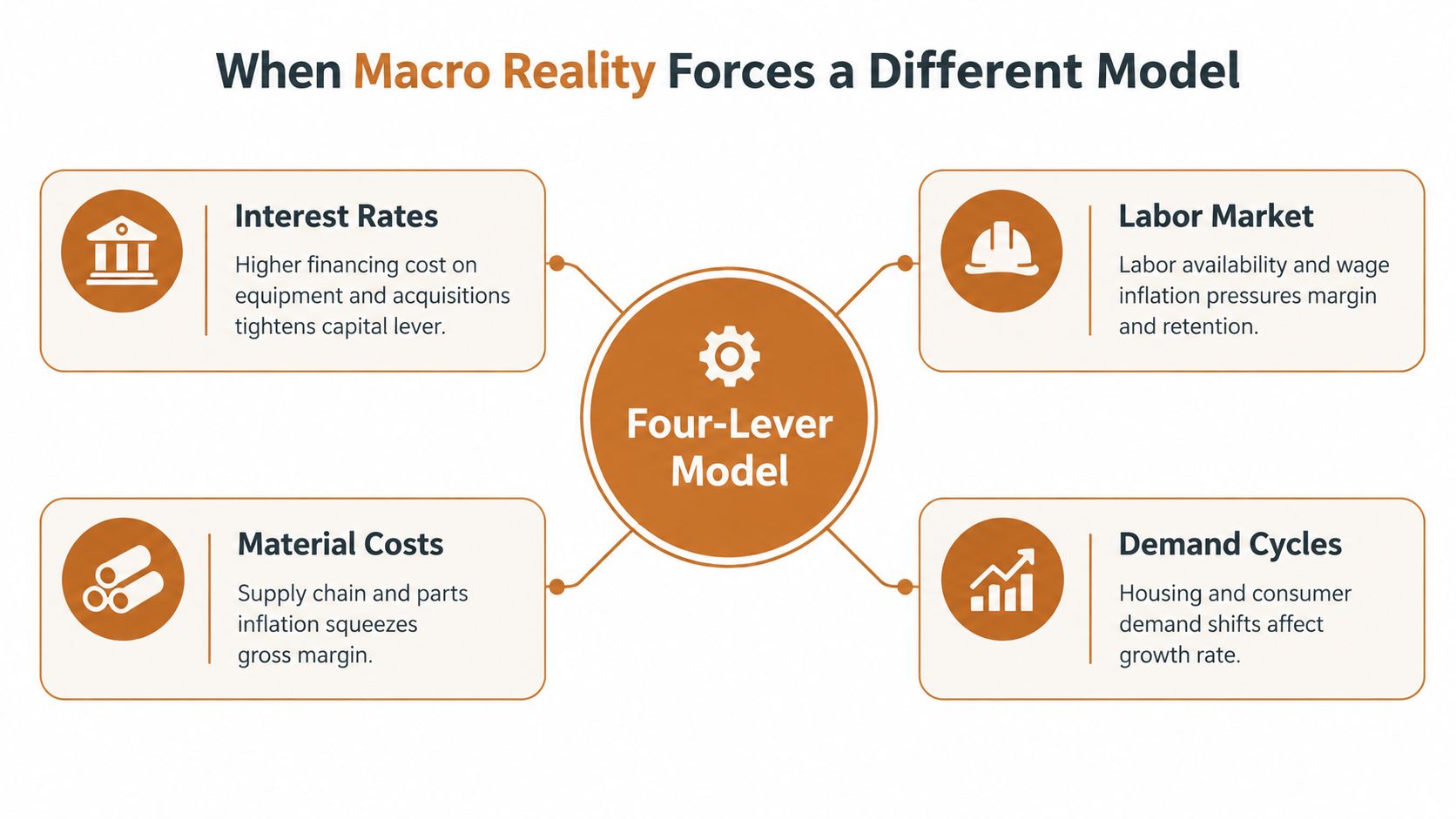
The sustainable growth model doesn’t operate in a vacuum. Financing costs affect equipment purchases and acquisitions. Labor availability affects service capacity and wage decisions. Insurance, fuel, materials, and parts can pressure margins. HVAC and plumbing demand can also move with replacement cycles, construction activity, weather, and household spending.
That doesn’t make the model useless. It makes the target more specific.
A debt-funded contractor may need to accept slower expansion than an equity-funded competitor because every new truck or acquisition adds repayment pressure. A business in a strong replacement cycle may have room to grow, while a new-construction-focused company may need to protect cash until demand improves. The right growth rate changes with the capital structure and demand environment.
Owners can improve pricing, dispatch, job costing, agreement design, collections, customer concentration, and management depth. They can’t personally set labor supply, financing markets, fuel costs, or broad demand.
The warning sign appears when the target growth rate requires staffing at wage economics the business can’t support, or when recurring revenue depends on prices that won’t survive a financing-cost reset. At that point, forcing the target can damage margin and cash.
The broader environment reinforces the need for discipline. The 2026 Sustainable Development Goals Report says only 15% of targets are on track, while 32% show stagnation and 15% are regressing, and global extreme poverty remains at 10%. These figures are reported in the UN 2026 SDG report. For owners, the lesson is practical. External progress is uneven, so resilience cannot depend on a smooth operating environment.
The IMF projects G20 growth at 3.2% in 2025 and 3.0% in 2026, with 2025 world GDP growth at 3.1%, as reported in the same verified brief. That outlook doesn’t determine an individual contractor’s result, but it supports a conservative operating posture when demand and financing conditions remain volatile.
The modern sustainability framework itself developed through milestones from the 1987 Brundtland Report, the 1992 Earth Summit, the 2000 Millennium Summit, and the 2015 adoption of the 2030 Agenda by 193 countries, as summarized by Sustainable Futures for All. An owner-level version must translate those broad concerns into pricing, capital allocation, labor resilience, and cash durability.
Bring in a specialist when the bottleneck is clear and the decision has meaningful financial consequences. Don’t bring one in to avoid doing the basic operating work.
A Growth and Financing specialist makes sense when the four metrics are honest, the business has a credible operating rhythm, and the next move requires capital the owner can’t evaluate quickly. That might involve equipment financing, an acquisition, a new location, or a capital structure decision where debt could either accelerate value or trap cash.
A Business Value specialist becomes useful when transition planning is approaching, recurring revenue needs valuation-grade documentation, or the owner wants a defensible value rather than another top-line target. Historical research illustrates why aggressive growth targets deserve scrutiny. One study found that a 7% annual GDP growth rate appeared in only about 10% of available country-year observations, according to the historical growth analysis. That macro finding isn’t a valuation rule for a private company, but it’s a useful warning against treating rapid growth as normal or automatically sustainable.
| Owner Situation | Right Specialist | Trigger to Engage |
|---|---|---|
| Core metrics are stable, but expansion needs funding | Growth and Financing specialist | The owner needs modeled debt, equity, or acquisition options |
| Equipment or acquisition financing could change risk materially | Growth and Financing specialist | Repayment capacity and capital structure need independent analysis |
| Transition is approaching and value needs support | Business Value specialist | The owner needs documented earnings quality and transferability |
| Recurring contracts exist but records are inconsistent | Business Value specialist | Agreements, renewals, customer data, and margins need diligence preparation |
| Metrics are unknown or unreliable | Neither yet | Fix measurement and operating discipline first |
A fractional CFO can be appropriate when the business needs financial cadence without a full-time executive. This guide to what is a fractional CFO can help you distinguish ongoing financial management from a one-time valuation or financing engagement.
The timing rule is simple. Specialists accelerate a working system. They don’t install honest pricing, clean customer records, reliable retention tracking, or owner-independent operations by magic. If recurring revenue is still an idea rather than a contract, or if margin is leaking from poor estimates, an advisor may spend months documenting a problem you could have corrected first.
Use the four levers as the filter. Get the numbers on paper, identify the constraint, and then hire the specialist whose expertise matches that constraint.
If you’re preparing to grow, refinance, or sell, visit The Owner’s Shortlist to compare vetted specialists and plain-language guides for valuation, financing, succession, and related owner decisions. Start with the bottleneck your four metrics reveal, then contact the specialist equipped to solve that specific problem.
Tell us your situation. We'll connect you with a specialist who works with owners like you. One conversation, no sales pressure.
Found this useful?
Add The Owner's Shortlist as a preferred source and get our articles highlighted in Google Search results.
Add to Preferred SourcesWhat is a quality of earnings report? Learn what a QoE covers, who prepares it, key adjustments, red flags, and how it shapes valuation and deal terms.
September 9, 2026
Learn the key methods for a plumbing business valuation. This guide covers SDE, multiples, value drivers, and how to prepare for a defensible assessment.
September 7, 2026
Learn how to do business valuation with a clear owner-focused method covering income, market, and asset approaches, multiples, and common pitfalls.
September 4, 2026
Recurring vs reoccurring revenue explained for business owners. Learn the valuation difference, real trade examples, and how to strengthen your revenue mix
August 27, 2026