How to Sell My Plumbing Business: A Practical Roadmap
Ready to sell my plumbing business? Follow a step-by-step roadmap for valuing, marketing, and closing the sale with confidence and clarity.
October 15, 2026
By Remi Taffin · July 26, 2026

You’re staring at a profit-and-loss statement that looks respectable, but it still doesn’t answer the question that matters most: what is the business worth to a buyer who’ll step into your shoes? That’s where Seller’s Discretionary Earnings, or SDE, comes in. It’s the figure that tries to show the annual financial benefit a single owner-operator can take from the business, not just the accounting profit on paper.
For many small business owners, SDE is the first valuation number that finally feels close to reality. It adds back things that distorted your reported profit, like your compensation, some benefits, certain discretionary spending, and one-time costs, so buyers can judge the business as if they were running it themselves. The tricky part is that the best SDE is not the biggest one, it’s the one a skeptical buyer can verify.
You open the P&L, see a profit number, and think, “That’s not the whole story.” Maybe you pay yourself through payroll, run your phone bill through the business, covered a one-time legal bill, or bought equipment that won’t be needed again. A buyer looking at your company won’t care how the bookkeeping was organized, they care about the financial benefit they’d receive.
Seller’s Discretionary Earnings is the standard way many small, owner-operated businesses answer that question. The International Business Brokers Association definition frames SDE as earnings before income taxes, depreciation, amortization, interest, non-operating items, nonrecurring items, and one owner’s entire compensation, which is why it’s treated as the shared language for pricing and diligence in smaller business deals (Midstreet explanation). In plain English, SDE tries to show the full annual benefit available to one full-time owner-operator.
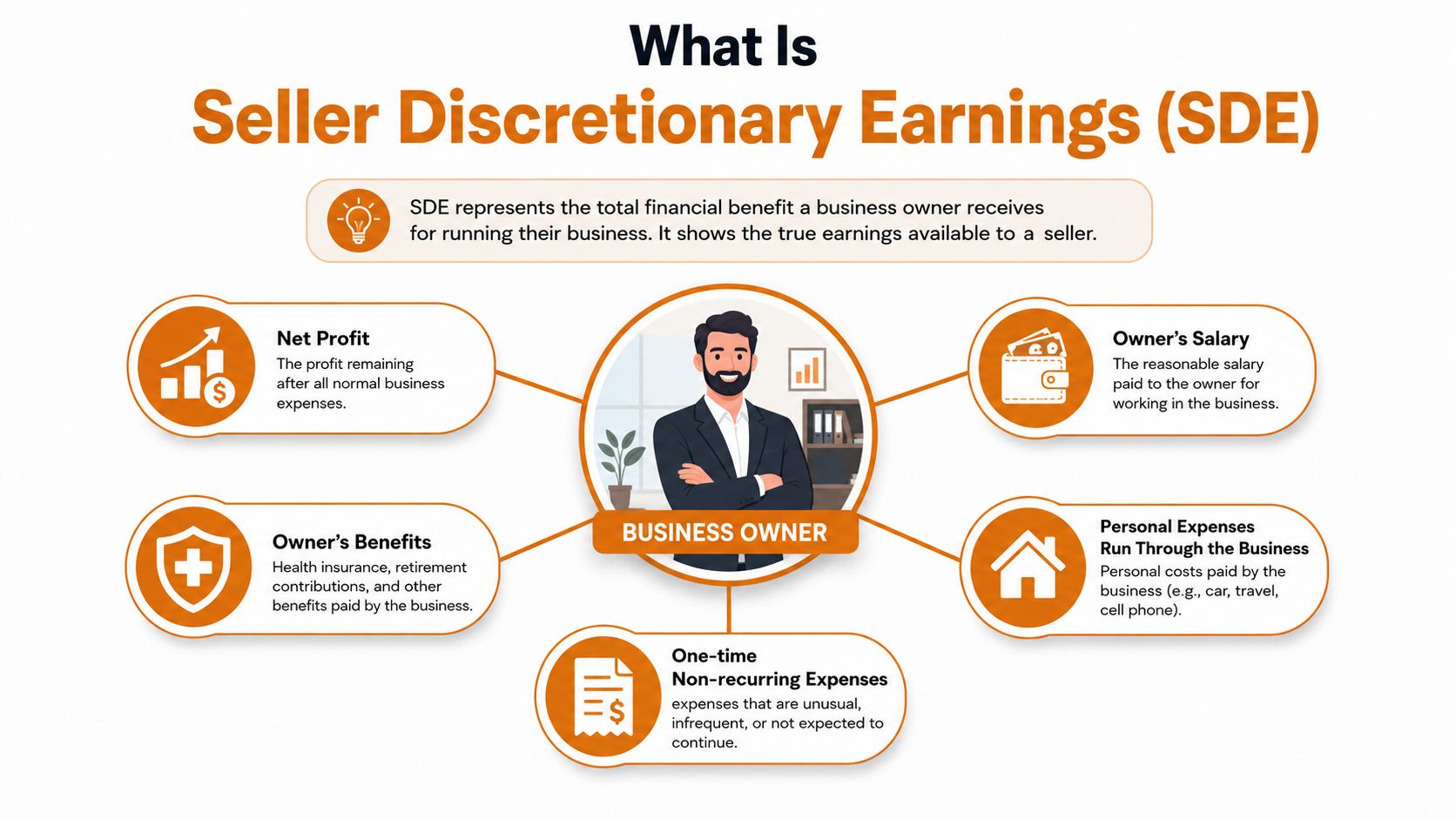
SDE matters because it bridges reported profit and market value in owner-run businesses. Buyers usually begin with pre-tax income and then normalize it by adding back owner pay, interest, depreciation, amortization, discretionary spending, and non-recurring items before applying a multiple (Wall Street Prep on SDE). That matters because a business can look modest on a tax return and still have stronger earning power after the add-backs are counted.
For a seller, SDE is the number that helps a buyer separate the business’s earnings power from the way the current owner chose to pay themselves. For a buyer, it’s a shortcut to understand whether the company can support one working owner and still leave room for debt service or living income. That’s why SDE is usually the better lens for smaller owner-operated companies than a raw net profit figure.
Practical rule: if your business only works because you’re deeply involved in day-to-day operations, SDE usually tells the story buyers want to hear.
A useful way to think about it is this, net profit is the business’s headline, while SDE is the business’s adjusted take-home capacity for a replacement owner. The distinction is especially important when you’ve mixed personal convenience and business operations for years, because buyers won’t accept that mix at face value. They’ll want the economics cleaned up first, then documented.
A clean SDE calculation starts with a simple habit, separate what the business needs from what only the current owner needed. That’s the whole logic behind the add-backs. If an expense wouldn’t follow the business to a new owner, it may belong in the SDE adjustment, but only if you can defend it.
Here’s the formula in plain terms, starting with pre-tax income and then adding back owner compensation, interest, depreciation, amortization, discretionary expenses, and non-recurring expenses (CFI overview). The point is not to make earnings look better, it’s to normalize them so a buyer can compare one business to another on consistent terms.
Imagine an HVAC service company. The owner pays themselves a salary, puts some vehicle costs through the company, and had a one-time equipment purchase that won’t repeat next year. Those items can change the earnings picture, but only if the records make clear that they were owner-specific or non-recurring.
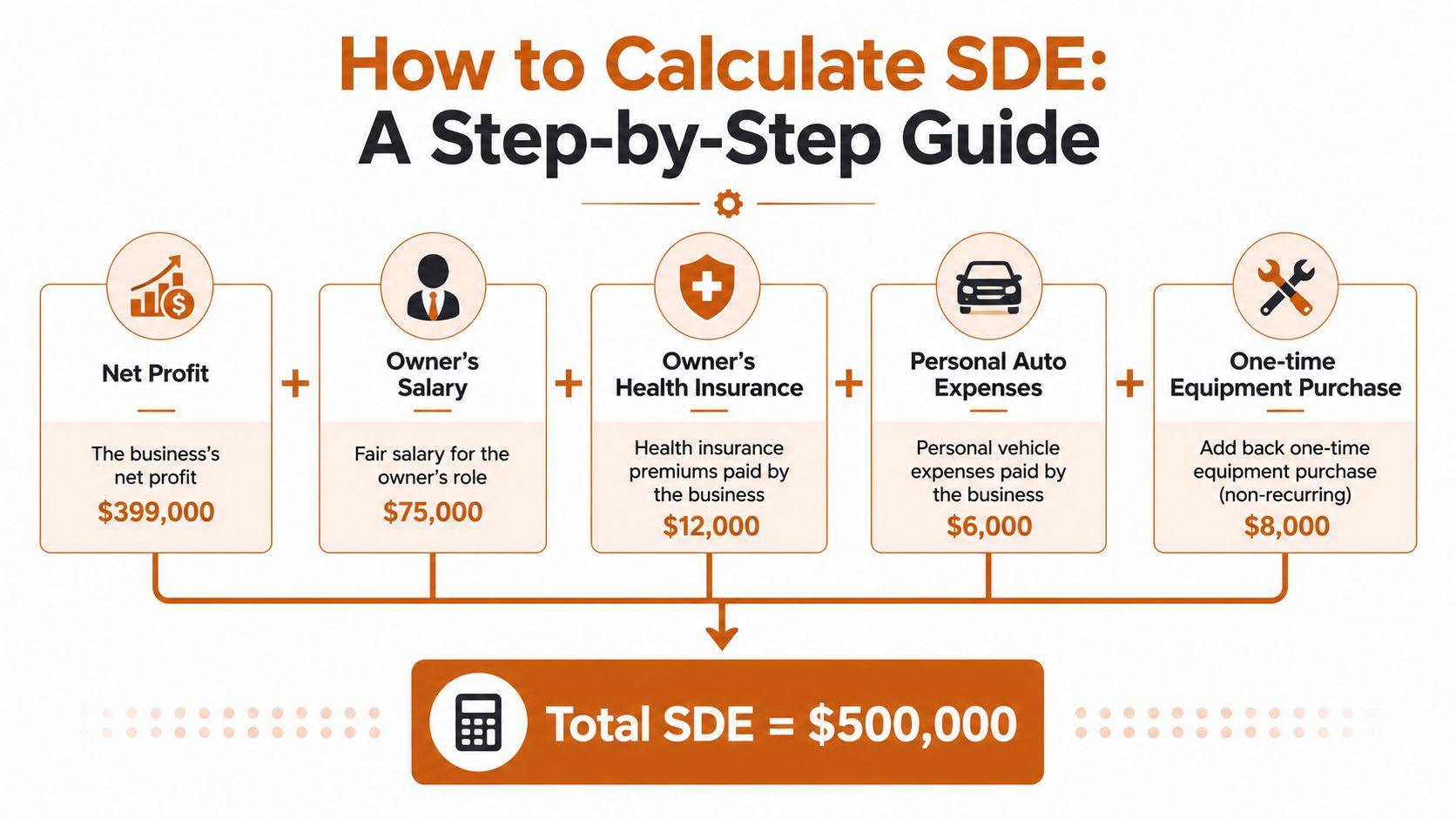
The common adjustments are straightforward, but each one needs a business reason.
A simple way to think about it is this, SDE asks, “What would this business earn for the next person if the books were cleaned up for ownership transfer?” That’s why this valuation guide matters once you’ve got the earnings figure. The number itself isn’t the deal value, it’s the starting point for it.
A buyer will usually care less about the label on an expense and more about the proof behind it.
If your records are tidy, SDE can be a very useful shorthand. If your books are messy, the same formula can become a source of argument. The difference comes down to classification, consistency, and documentation.
That’s why a strong calculation is not just mathematical. It’s also narrative. You’re telling a buyer why certain expenses belong in the business and why others were tied to the current owner’s way of running it. If that story is clear, SDE becomes a credible bridge between accounting and valuation.
A buyer examining a small, owner-run business usually starts with SDE because the owner’s role is part of the earnings picture. A buyer looking at a larger company often starts with EBITDA because management, not the seller, is expected to carry the day-to-day load. The difference is less about accounting jargon and more about who is doing the work after the sale.
A family-run restaurant makes the distinction easy to see. The owner may cook, place orders, approve bills, and cover staffing gaps. In a regional chain, those responsibilities are usually spread across a general manager and a leadership team, so the owner’s pay is not treated the same way in valuation.
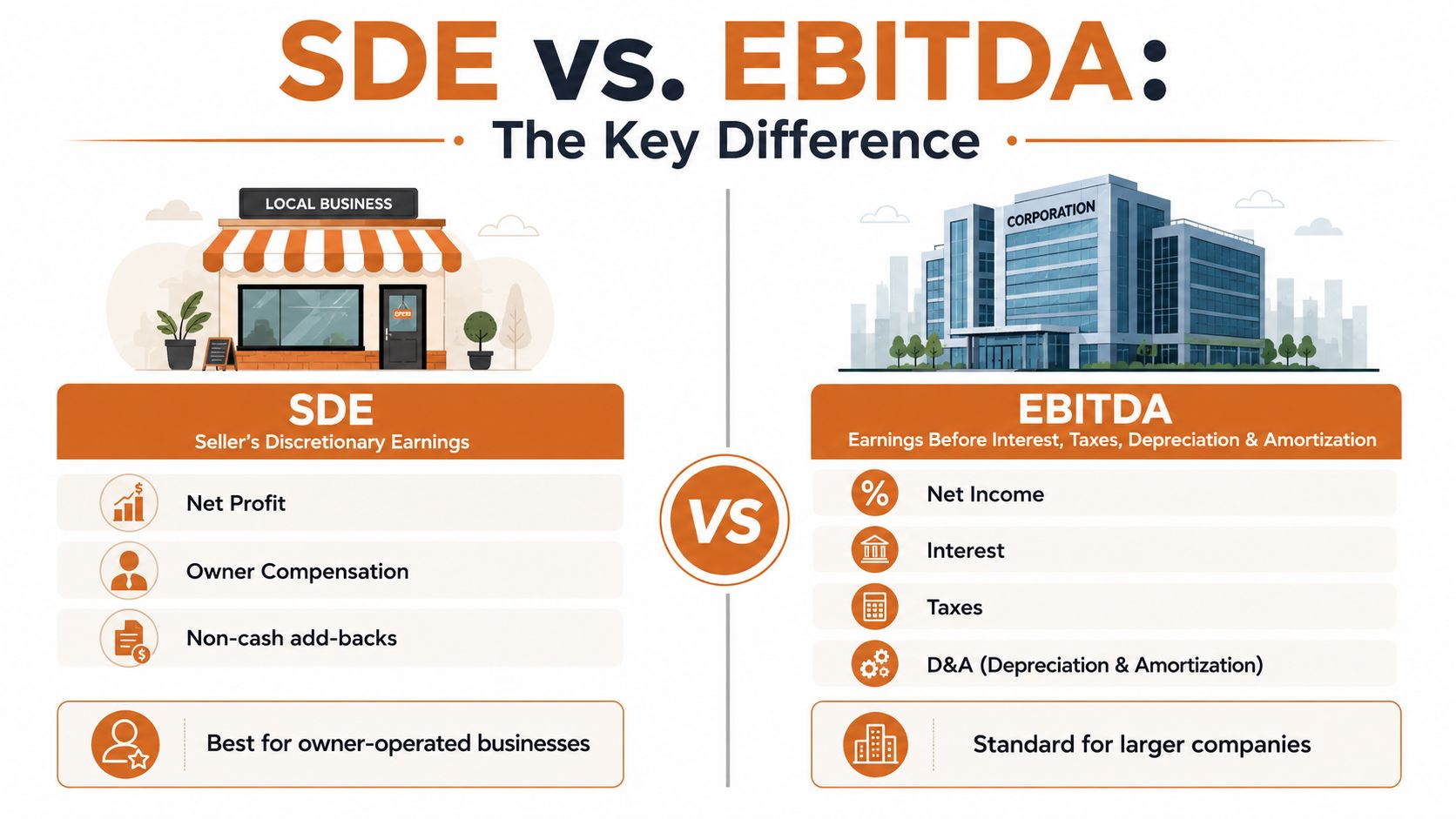
SDE includes the economics of the owner’s role because the buyer is often stepping into that role. For a small service company, that means the sale is not just about the profit on paper, it is also about the operating job the owner currently performs. If that job disappears after closing, the earnings number has to reflect the replacement cost somehow.
EBITDA handles the business differently. It removes interest, taxes, depreciation, and amortization, but it does not try to capture one owner’s full compensation in the same way SDE does. That makes EBITDA a better fit for companies that already have a management layer in place, where the business can keep running without the seller’s daily involvement. For owner-operated businesses, using EBITDA alone can make the company look smaller than the cash flow a buyer may receive.
This EBITDA guide helps clarify why the two metrics lead to different valuation conversations. A good analyst is not just asking which acronym sounds better. The core question is which earnings lens matches how the business works in practice.
SDE fits best when the business still depends heavily on you as the operator. EBITDA fits best when a management team already handles the daily work and the owner is not central to operations. That division is common in small-business M&A because it helps buyers price the workload they are taking on.
Good valuation language starts with the right metric. If you use EBITDA for a business that still depends on you, you can understate the company’s true economic benefit or confuse buyers who expect an SDE-based presentation.
For most owner-operated companies, SDE is the clearer lens because it captures both profit and the owner’s job. That is why buyers, brokers, and valuation professionals rely on it so often in smaller transactions, and why the number has to be defensible. A lower SDE that is cleanly documented usually travels farther in due diligence than a bigger figure that collapses under scrutiny.
Once a buyer has a defensible SDE, valuation becomes much more concrete. The earnings number gets multiplied by an industry and risk-based multiple to estimate price. That’s why SDE is not just a bookkeeping exercise, it’s the foundation under the offer.
The valuation logic is straightforward. Buyers start with adjusted earnings, then compare that figure to similar deals, business risk, customer concentration, and operational dependence on the owner. In practice, the seller’s job is to make the earnings base credible enough that the multiple can be discussed seriously. If the base looks shaky, the conversation about price gets shaky too.
Lenders look at SDE because they want to know whether the acquired business can support debt payments after the sale. They aren’t just asking whether the company looks profitable, they’re asking whether the cash flow is believable once the owner changes. Unsupported add-backs can shrink financing options because banks and buyers may reject them.
That’s why documentation matters so much. A strong SDE number can widen the pool of serious buyers. A weakly supported one can do the opposite, even if the headline figure looks attractive on paper.
A buyer can disagree with your multiple, but they’ll almost always attack the earnings base first. That’s where due diligence starts. If your SDE is clear, the rest of the pricing discussion becomes more productive because both sides are speaking from the same normalized number.
The most useful mindset here is to treat SDE as the deal’s common denominator. It’s the number both buyer and lender need before they can decide anything else. Without that shared base, valuation turns into opinion instead of analysis.
If the SDE can’t survive lender review, it won’t support the price you hoped for.
That’s why serious owners focus on making the calculation easy to audit, not just easy to inflate. Buyers don’t pay for optimism. They pay for earnings they believe will continue after closing.
The biggest mistake owners make is treating SDE like a place to push every possible expense into the “add-back” bucket. That rarely survives scrutiny. Recent guidance emphasizes that buyers want a defensible calculation, not just a larger number, and unsupported adjustments can get discounted in diligence (Baton on discretionary earnings).
A larger SDE can look impressive in a teaser or initial conversation, but it can backfire if the buyer starts asking for proof and the file goes thin. Recurring costs disguised as one-time items are a common problem. So are personal expenses that were never clearly separated from business spending in the first place.
The issue isn’t only honesty, it’s credibility. If a buyer thinks the calculation was stretched, they’ll question everything else too, from customer concentration to working capital needs. That skepticism can reduce trust faster than a lower, cleaner number ever would.
A practical filter is whether the cost would disappear under new ownership. If the answer is no, the add-back is probably weak. If the answer is yes, you still need backup, because even legitimate items can be challenged if the paper trail is thin.
A lower SDE that’s easy to prove is often more valuable than an inflated figure that triggers debate. That’s not a theoretical preference. It’s how deals stay alive when lenders and buyers start checking the details.
Practical rule: if you can’t explain an add-back in one sentence and document it in one folder, it’s probably not ready for diligence.
The smartest owners stop asking, “How high can I push the number?” and start asking, “Which number will still stand after the buyer’s accountant reviews it?” That shift usually leads to better negotiations, not worse ones.
An SDE calculation without backup is just a claim. Buyers want to see the trail behind every adjustment, especially when personal and business spending have been mixed for years. The cleaner your documentation, the less room there is for a buyer to argue that your earnings were overstated.
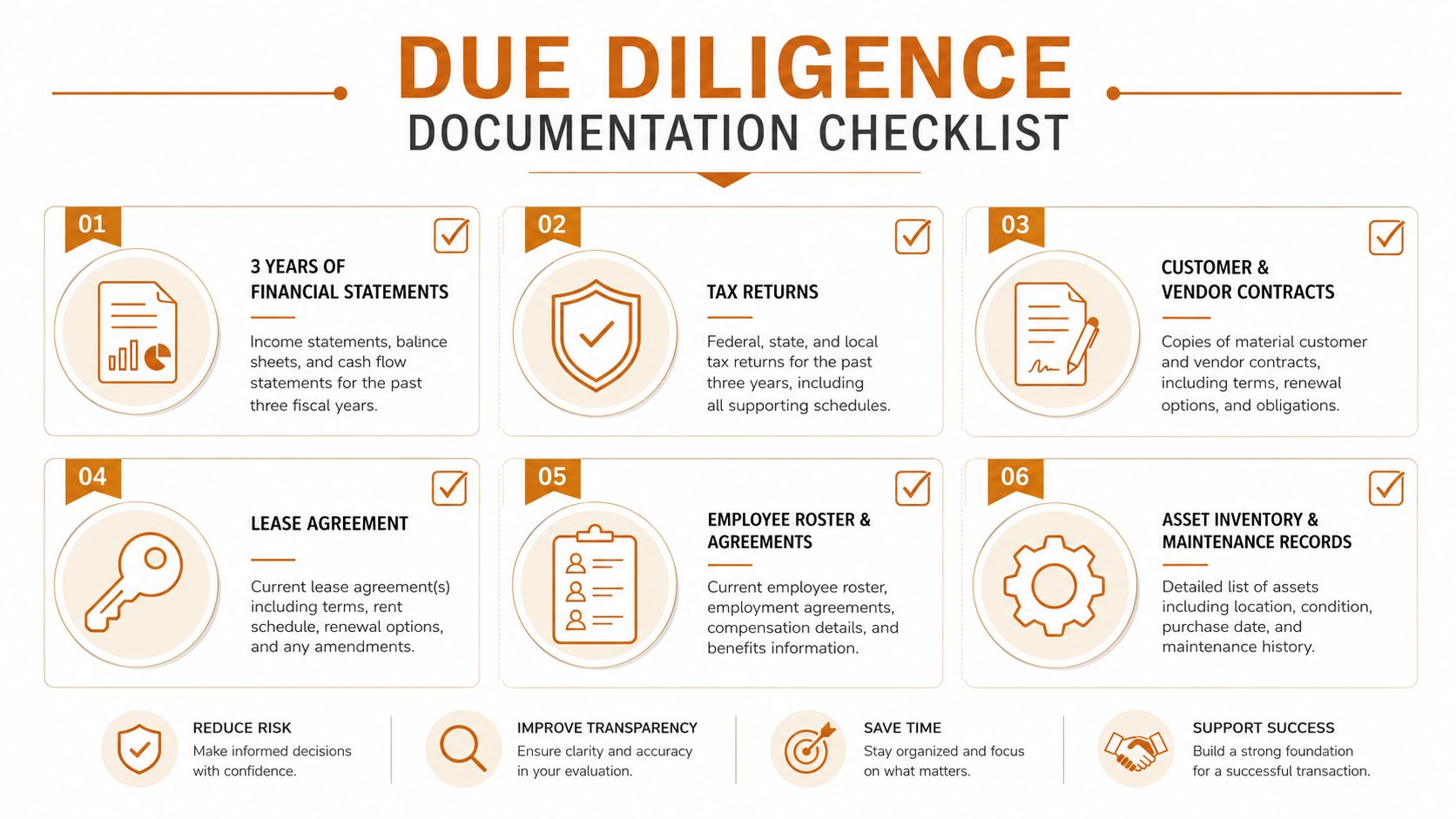
Start with the financial core. Gather three years of financial statements and tax returns, detailed profit and loss reports, payroll records that isolate the owner’s compensation, and any statements that show discretionary charges. Then collect invoices, receipts, or contracts for anything you want treated as non-recurring.
The easiest way to think about this file is simple, can another person trace every add-back without chasing you for explanations? If the answer is yes, you’re in good shape. If the answer is no, the number will feel fragile no matter how attractive it looks on the page.
Here’s a useful checklist:
This due diligence guide is a good companion if you want to understand how buyers look at the file once it’s assembled. The main idea is simple, organized support keeps the conversation focused on value instead of missing paperwork.
A buyer doesn’t need perfection. They need confidence. When your documentation is orderly, they can move faster through diligence and spend more time on the business they’re buying instead of the bookkeeping they’re questioning.
That’s especially important when the business has owner-specific spending woven into the records. The more clearly you separate those items now, the less negotiation pressure you’ll face later. Good files don’t just prove SDE, they reduce friction in the deal.
You can learn the SDE concept on your own. You probably should. But once you’re normalizing financials for the first time, responding to a formal offer, or preparing for buyer diligence, the stakes rise quickly and small mistakes get expensive.
A valuation specialist helps you frame the earnings number the way buyers will test it. An M&A-focused CPA helps clean up the accounting so add-backs are defensible. A transaction attorney helps make sure the deal terms match the economics you think you negotiated. Those roles overlap, but they solve different problems.
The trigger point is simple, if the business value matters to your exit plan, don’t guess at the number. A well-supported SDE can strengthen your negotiating position, while a poorly supported one can weaken it even when the headline looks bigger.
Practical rule: engage help before the buyer starts asking hard questions, not after the first round of pushback.
If you’re preparing to sell, The Owner’s Shortlist gives you a practical way to find the right valuation, tax, legal, and transaction specialists without wasting time on guesswork. Visit The Owner’s Shortlist to get clearer on your next move and build a sale process that can stand up in diligence.
Tell us your situation. We'll connect you with a specialist who works with owners like you. One conversation, no sales pressure.
Found this useful?
Add The Owner's Shortlist as a preferred source and get our articles highlighted in Google Search results.
Add to Preferred SourcesReady to sell my plumbing business? Follow a step-by-step roadmap for valuing, marketing, and closing the sale with confidence and clarity.
October 15, 2026
Learn how to sell your service business with a practical, step-by-step roadmap. From readiness and valuation to deal structure and closing, get actionable
October 14, 2026
Learn how business valuation EBITDA works for service companies. Discover adjustments, multiples, and owner-dependency tests before you sell.
October 12, 2026
Thinking 'I want to sell my landscaping business'? Learn how to value your company, prepare financials, handle labor risks, and find the right buyer quietly.
October 11, 2026