Confidential Information Memorandum Example: 5 Guides
Explore 5 confidential information memorandum examples for owner-operated businesses, with required sections, practical guidance, and common pitfalls.
October 22, 2026
By Remi Taffin · September 1, 2026 · Updated October 12, 2026
You can tell a business is owner-dependent by what happens when the owner leaves the room. A dispatcher waits for approval, a technician calls the owner for customer history, and an invoice sits unsent because only one person knows whether the work is billable. The company may look busy and profitable, but its operating knowledge is trapped in conversations, inboxes, spreadsheets, and memory.
That creates a problem far beyond daily frustration. A buyer, successor, lender, or new manager needs to understand how work gets sold, delivered, billed, reviewed, and corrected without relying on the owner’s constant intervention. Business systems and processes are therefore an exit-readiness issue, not just an efficiency project. The practical objective isn’t to build corporate bureaucracy. It’s to reduce avoidable fires and create a company you can leave for two weeks without incident.
Most owners don’t deliberately choose an undocumented business. They respond to pressure. A customer has a complicated history, so the owner handles the call. A salesperson wants to make an exception, so the owner approves the discount. A staff member can’t find the right answer, so the owner explains it again.
Those decisions feel efficient because they happen quickly. The owner already knows the customer, the pricing context, and the likely solution. But every fast answer creates another dependency. Employees learn to escalate instead of deciding, and the owner becomes the unofficial database for customer relationships, pricing judgment, vendor knowledge, and operational exceptions.
The first warning sign is often a simple question: “What happens if you’re unavailable?” If the answer includes “call me anyway,” the company hasn’t transferred responsibility. It has only created a larger group of people waiting for the owner.
That dependency affects staffing, scalability, and saleability. A new employee can’t reliably follow a process that exists only in someone’s head. A successor can’t assume responsibility for work they can’t see. A buyer may hesitate when performance depends on personal relationships or undocumented judgment.
Practical rule: If two competent employees would handle the same recurring situation differently, the business has a process problem, even if the customer hasn’t complained yet.
You don’t need a six-month transformation program to make progress. Start with the recurring work that affects customers, cash collection, delivery quality, or compliance. Capture the current method before trying to improve it.
That sequence matters. Process-improvement literature identifies incomplete execution as a common failure pattern, with independent BPM literature reporting that 60% to 70% of business process improvement projects fail or aren’t completed (process-improvement literature). McKinsey’s transformation research also found that 31% of transformations succeeded overall, compared with 59% when all 24 recommended actions were implemented, and 78% for completed transformations that fully executed those actions (McKinsey’s transformation benchmark). The lesson is direct: a modest system that people use is more valuable than an ambitious manual nobody finishes.
Use plain definitions. A system is the repeatable combination of people, tools, and steps that produces a result. A process is the documented path those steps follow. The system is the whole operating chain, while the process describes how one part of that chain is performed.
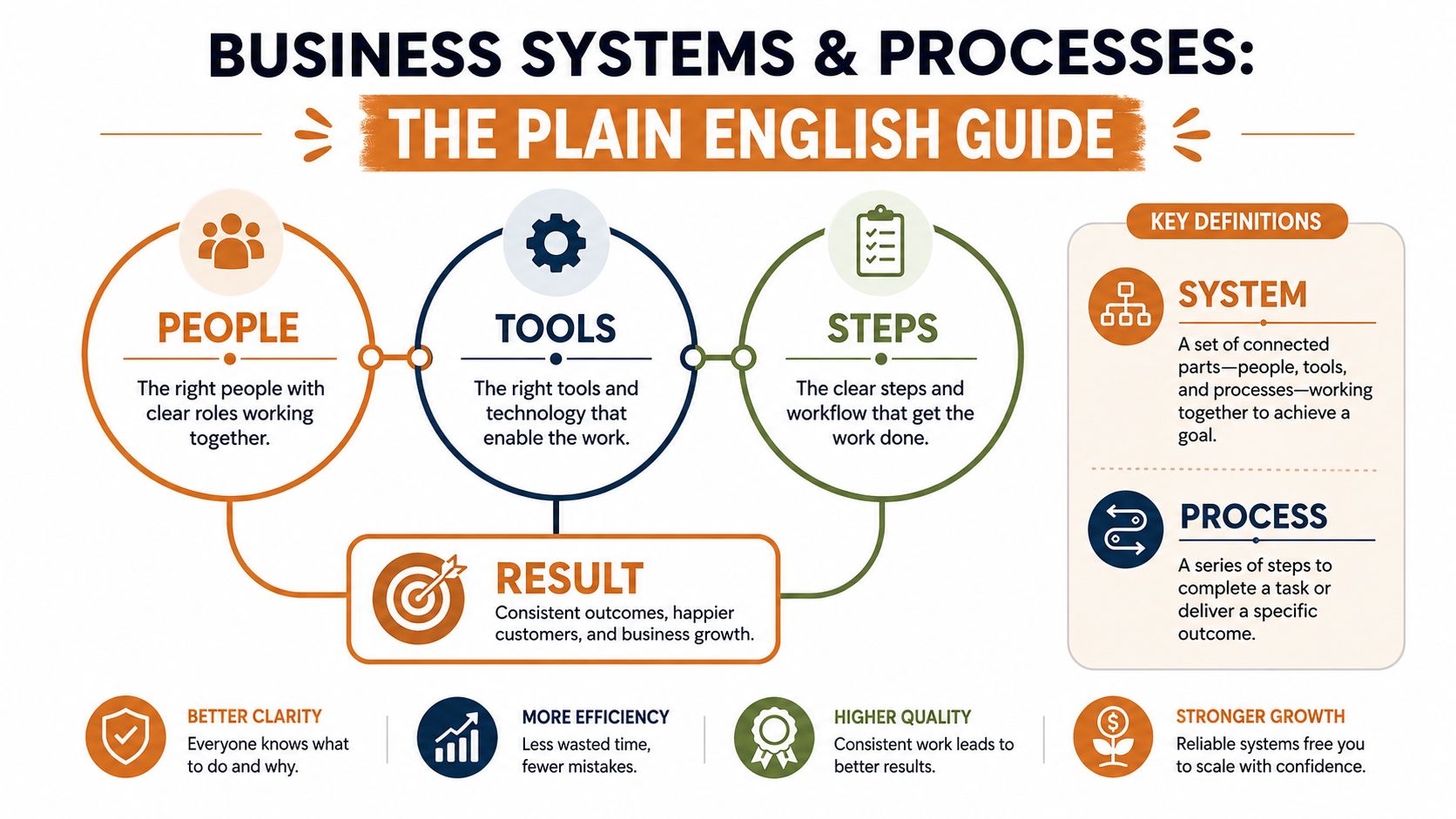
Consider an HVAC service call. A customer phones the company. The dispatcher records the request, confirms the address and urgency, and assigns a technician. The technician uses a diagnostic checklist, records the work completed, and identifies parts or follow-up work. The office sends the invoice, collects payment, and contacts the customer afterward.
Each handoff has a process. The entire path from incoming call to completed payment is the system.
The weak points are rarely the obvious tasks. A technician can usually diagnose a unit, and an office administrator can usually send an invoice. Trouble starts between roles:
Tools matter, but software won’t repair unclear ownership. A CRM, field-service platform, accounting package, or shared drive can store information, but someone still needs to define the required input, the next action, and the person accountable for completion.
A process becomes transferable when a capable person can follow it, recognize an exception, and know who owns the next decision.
For an owner preparing for a sale or succession, that distinction changes the priority. Don’t ask whether the company has software. Ask whether work moves consistently through people and tools without the owner acting as the connecting piece.
Start with an inventory of how the business operates, not a generic checklist copied from an industry guide. Set aside an hour, choose one department, and record the repeatable work someone performs during a normal week.
Write each task in simple language. Then attach the role that owns it, how often it runs, and whether the owner currently serves as the backup. Add the current failure mode. This last field is important because it captures the gap between the official version of the business and the version employees experience.
Use this sequence:
A rough first draft is useful precisely because it’s incomplete. Employees will mention steps nobody discusses in management meetings, such as checking a customer’s payment history before dispatching, confirming warranty coverage, or updating a shared calendar after a phone call.
| Process | Owner Role | Frequency | Current Owner Involvement | Failure Mode |
|---|---|---|---|---|
| Job dispatch to invoice | Dispatcher, technician, office administrator | Weekly | Owner approves difficult scheduling decisions and reviews disputed invoices | Missed job details, delayed invoicing, and unclear responsibility for callbacks |
Keep the inventory in a location the team already uses, such as Notion, Microsoft SharePoint, Google Drive, or the documentation area inside your field-service software. Give it one named administrator and review it when a process changes.
The inventory isn’t a presentation for an advisor. It’s a working control document. If a new employee can’t find it, or existing staff don’t update it after a change, it hasn’t become part of the operating system.
Owners often choose the process that caused the loudest complaint last week. That’s understandable, but it’s a poor way to allocate limited attention. A noisy process may be rare and low-value, while a quiet recurring process may determine whether the company bills accurately, delivers work profitably, or retains customers.
Rank each inventory item on two axes: frequency and revenue or risk impact. Frequency asks how often the work runs. Impact asks how much the process affects cash, customer experience, billable labor, rework, compliance, or owner dependency.
Plot the processes on a page. High-frequency, high-impact work belongs in the top-right corner and should receive attention first. Low-frequency, low-impact work can wait or receive a short note rather than a full SOP.
| Frequency | High Revenue Impact | Low Revenue Impact |
|---|---|---|
| High | Document first. Review dispatch, quoting, scheduling, fulfillment, invoicing, and payment processes. | Simplify or automate after the high-impact work is stable. |
| Low | Add clear controls and an owner role. Cover renewals, major estimates, compliance reviews, and unusual customer decisions. | Defer, delegate, or capture in a concise reference note. |
For an HVAC company, dispatch-to-technician routing usually deserves earlier documentation than annual truck permit renewals. It runs repeatedly, touches customer commitments, affects technician utilization, and can delay billing when information is missing.
Automation belongs after the process is clear enough to repeat. A workflow tool can send a reminder, move a task, or require a field before the next step, but it can’t decide whether the underlying handoff makes sense.
The market’s growth reflects strong demand for formalized workflows. One estimate valued the business process management market at USD 20.38 billion in 2024 and forecasts USD 61.17 billion by 2030, with a 20.3% compound annual growth rate from 2025 to 2030 (Grand View Research’s BPM market estimate). Another industry summary valued workflow automation at USD 4.8 billion in 2022 and projects a 26.5% CAGR from 2023 to 2030 (workflow automation market summary). Those figures describe a broad market, not a reason to buy software immediately.
The better order is inspect, define, test, then automate the stable portion. Recent process-intelligence commentary also highlights the growing role of process mining and digital twins while expecting at least 95% of automations deployed in 2025 to be deterministic, meaning rule-based rather than flexible (process-intelligence trends commentary). For most owner-led companies, clarity still comes before cleverness.
A transferable SOP doesn’t need to impress anyone. It needs to help the next competent person complete the work without asking the owner what to do.
Use five blocks:
Keep the steps short. Use numbered actions, one action per line, and aim for no more than 12 steps. If the process needs more, split it into connected procedures. A long document often hides several separate decisions rather than describing one usable process.
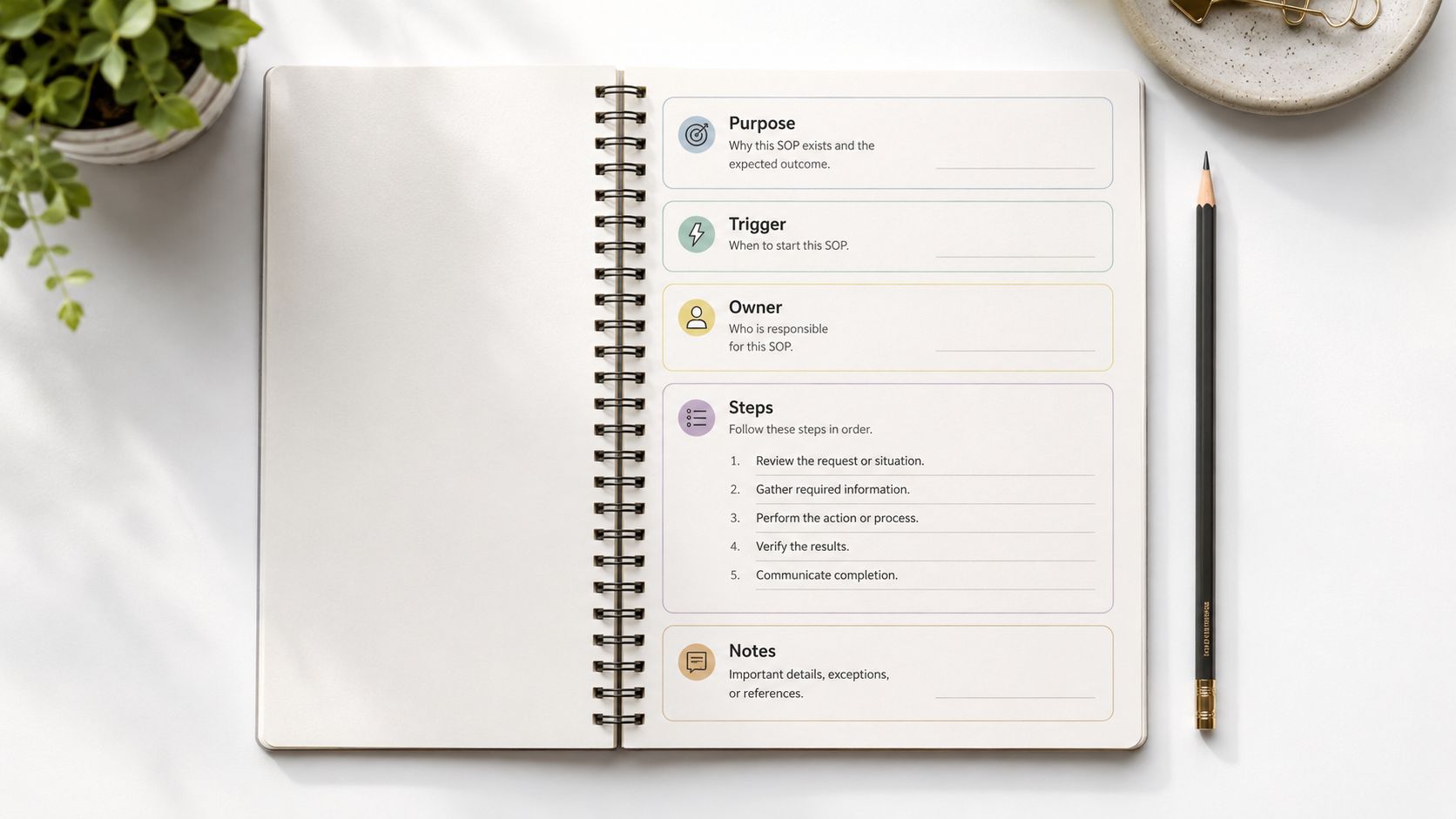
Purpose: Restore customer contact and assign the next action after a missed appointment.
Trigger: The scheduling system flags a missed appointment.
Owner: Service coordinator.
Steps:
Exceptions:
That’s enough operational detail to transfer the task. Don’t add company history, leadership philosophy, or information the next person can find through ordinary product documentation. Those additions make the file longer without making the decision path clearer.
A short screen recording made with Loom, paired with a one-page cheat sheet, often works better than a polished PDF buried in a shared drive. The video can show the actual scheduling screen, while the sheet gives the employee the trigger, steps, and exception rules at a glance.
Before you call an SOP complete, ask someone who didn’t write it to perform the process. Watch where they hesitate. Those pauses reveal missing instructions more reliably than an owner’s review.
The process should also show its revision date, responsible role, and location of related forms. A buyer or successor needs to know not only what to do, but which version governs the work today.
A dashboard should help the owner make a decision this week. If it exists mainly to look organized during a future sale, it will become stale.
A successor or buyer will want clear answers to three practical questions: Where does revenue come from? What does it cost to deliver? What’s breaking right now? Build measurement around those questions rather than collecting every available field from your accounting, CRM, or job-management system.
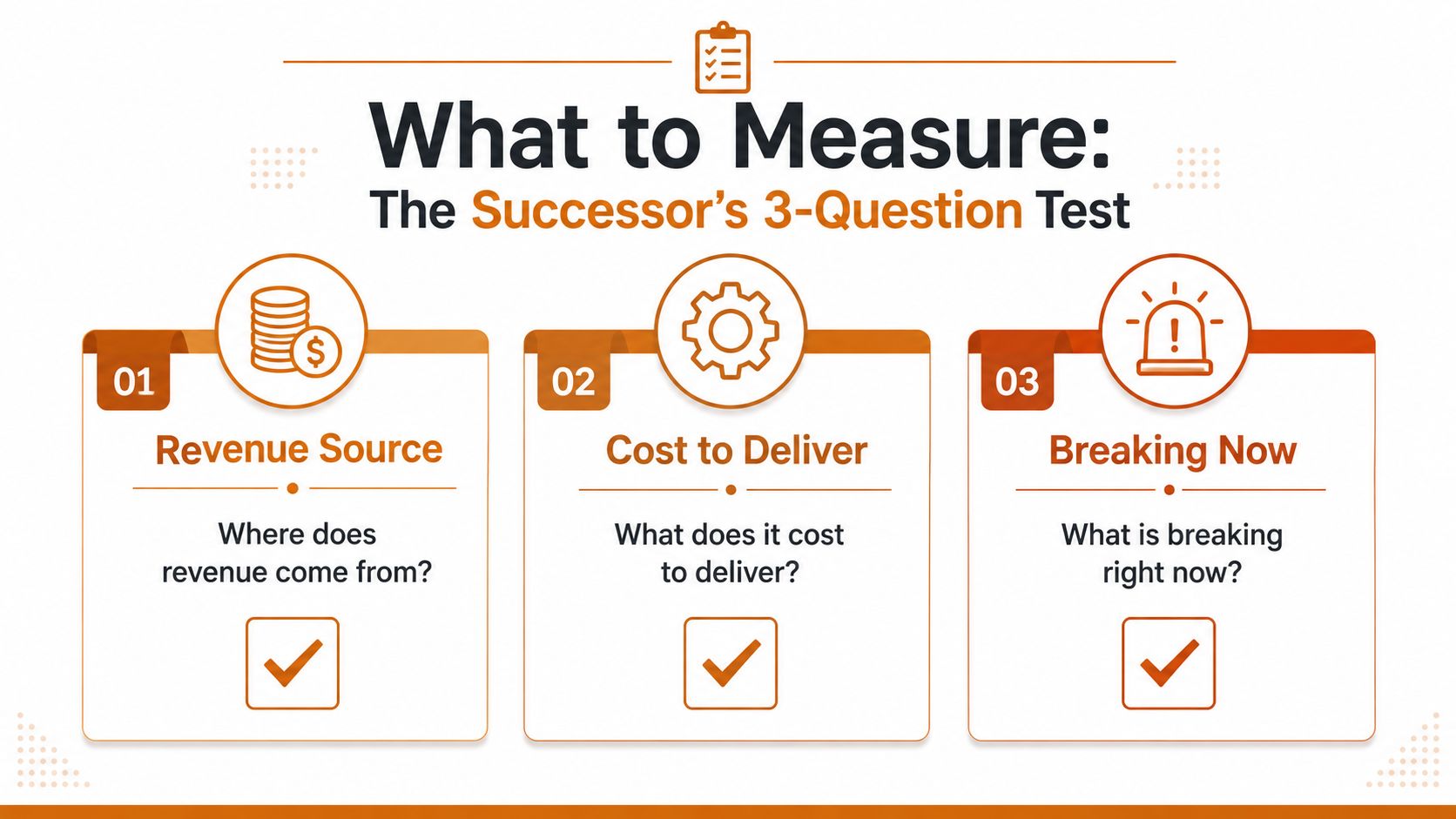
For a service business, start with revenue per job, labor utilization, and first-time fix rate. Define each formula beside the metric. For example, “revenue per job” needs a clear decision about whether cancelled work, taxes, or credits are included. “First-time fix rate” needs a consistent definition of what counts as a return visit.
A product or e-commerce business may need sell-through, gross margin, and customer acquisition payback instead. The right set depends on how the business earns and spends money, not on which dashboard template looks attractive.
Review the three measures weekly on one page. Assign each a current value, a target or acceptable range, an owner, and the action required when it moves in the wrong direction. Keep the meeting focused on decisions, not commentary.
Measurement should expose a problem while the owner can still fix it. It shouldn’t become a report card prepared for a buyer years from now.
Cut any metric you haven’t used to make a decision in the last 60 days. That rule keeps the scorecard practical and forces the team to distinguish useful operating information from decorative reporting.
The broader automation market supports better visibility when teams connect workflows, approvals, and records. But more data won’t compensate for inconsistent definitions. A clean weekly scorecard built from reliable inputs is more useful than a large dashboard nobody trusts.
Operational cleanup affects value because buyers aren’t purchasing your effort. They’re evaluating the earnings, relationships, controls, and operating capability that can continue after the transaction.
Three valuation questions deserve attention.
First, how dependent is the business on the owner? If the owner answers every important call, approves every unusual price, and carries customer history personally, a buyer may see a key-person risk.
Second, how dependable are the earnings? Buyers examine whether revenue comes from repeatable customer behavior, contracted work, disciplined pricing, and reliable delivery, or from one-off jobs that depend on the owner’s personal intervention.
Third, can the operation support a transfer? Clear roles, process records, job-cost information, and financial controls make due diligence easier to understand. They don’t guarantee a higher price, but they improve the quality of the business story a buyer can underwrite.
Consider a two-truck plumbing company where the owner answers every call, sets prices from memory, and resolves customer complaints personally. Compare that with the same type of company after it assigns dispatch responsibility, documents emergency callbacks and quoting, and maintains consistent job-cost records. The second business still faces normal trade risks, but its performance is easier to inspect and its responsibilities are easier to transfer.
| Dimension | Before Systems Work | After Systems Work |
|---|---|---|
| Owner dependency | The owner handles customer history, exceptions, and pricing decisions. | Roles contain routine decisions, with documented escalation points. |
| Earnings quality | Margin changes are difficult to explain because pricing and job inputs vary. | Job-cost records help connect work performed, labor, parts, and margin. |
| Customer relationships | Important accounts may depend on the owner’s personal contact. | Relationship history and follow-up responsibilities are recorded in the operating system. |
| Due diligence | The buyer must reconstruct how work moves through the company. | Process records, controls, and scorecards make the operating model easier to assess. |
Quiet deal killers include customer concentration tied to the owner’s relationships, margin volatility caused by ad hoc pricing, and missing financial controls. Process documentation won’t solve all three by itself. It can, however, expose where the company needs pricing rules, customer coverage, approval limits, and better records.
Use the in-house playbook when the business has a manageable number of core workflows, employees can describe the work, and the owner can review changes directly. Bring in a fractional COO or process specialist when teams disagree about the current workflow, departments resist ownership, or improvements cross several systems.
An M&A advisor can help when you’re preparing a sale process, assessing buyer fit, or deciding how to present transferability. A transaction attorney and tax specialist should be involved before legal structure, deal terms, or tax consequences become urgent. The practical sequence is simple: inventory the work, fix the high-impact dependencies, measure the operating result, then get specialist advice where the decision carries legal, tax, or transaction risk.
The Owner’s Shortlist is a free service that helps owners find a business broker or other specialist. You talk to a real person, who introduces you to one specialist whose past work fits your business. If you’re cleaning up your systems ahead of a sale, tell us about your business. Owners pay nothing.
Tell us your situation. We'll connect you with a specialist who works with owners like you. One conversation, no sales pressure.
Found this useful?
Add The Owner's Shortlist as a preferred source and get our articles highlighted in Google Search results.
Add to Preferred SourcesExplore 5 confidential information memorandum examples for owner-operated businesses, with required sections, practical guidance, and common pitfalls.
October 22, 2026
Partners who disagree on selling usually settle it one of four ways: a buyout, a partial sale, a sale together, or what the agreement forces.
October 20, 2026
What is deal structuring, explained for service business owners. Learn asset vs stock sales, earnouts, seller financing, holdbacks, and the questions
October 19, 2026
Learn how to identify well qualified buyers for your service business. Covers vetting criteria, red flags, sample questions, and next steps
October 17, 2026