Financial Due Diligence Checklist: 10 Areas to Review
A financial due diligence checklist for buyers and sellers of owner-operated trades businesses, covering earnings, debt, taxes, payroll, and equipment.
October 13, 2026
By Remi Taffin · August 29, 2026 · Updated October 13, 2026

You’ve run the business for two decades. The company is profitable, customers know your name, and the management team can keep the operation moving, but there’s no obvious successor. You’re tired enough to consider a sale, yet the private equity language makes the decision feel designed for fund managers rather than owners.
The useful questions are simpler: What does the lower middle market mean for my company? Who might buy it? How much could I receive? Which terms could change that amount? What should I fix before I speak with an advisor? This guide answers those questions in that order, using the way an owner experiences a transaction rather than the way a fund reports its investments.
Take a manufacturing company producing $4 million of adjusted EBITDA, with an owner who has run it for 22 years and no family member ready to take over. That company may be a natural private equity lower middle market candidate. It isn’t a distressed asset, a tiny lifestyle business, or a large-cap acquisition. It sits in the part of the market where investors often buy established, owner-operated companies and try to build them into larger businesses.
EBITDA means earnings before interest, taxes, depreciation, and amortization. Buyers use it as a rough measure of operating profit before financing and certain accounting effects. Adjusted EBITDA starts with that figure and removes expenses the buyer believes aren’t part of normal ongoing operations, such as unusual legal costs or personal expenses, although every adjustment must survive scrutiny.
Enterprise value is the value of the operating business before accounting for how it’s financed. It generally reflects the value of the company’s operations, while equity value is what remains for owners after debt, debt-like items, and other agreed adjustments are considered. That difference matters because a headline purchase price may not equal the cash deposited in your account.
Industry definitions vary. One summary describes the lower middle market as companies with approximately $1 million to $25 million of EBITDA and deal values of roughly $10 million to $250 million, while also noting that some practitioners use enterprise value of up to $100 million as a broader boundary. See the industry overview of lower middle market private equity definitions for those differing frames.
The important point isn’t finding one perfect cutoff. It’s locating your company relative to the buyer universe. Large-cap buyouts involve much bigger businesses and funds, while lower middle market funds often focus on companies where the owner still influences sales, hiring, pricing, or key supplier relationships.
A platform investment is the first company a fund buys in a particular industry or market. The fund may later acquire smaller related companies, called add-ons, and combine them with that platform. Fund size affects the transactions an investor can pursue, but the owner should focus less on the fund’s label and more on its intended role for the business.
Owner’s translation: You’re not selling into an abstract category. You’re deciding whether your company fits a buyer’s plan, financing capacity, and expectations for your involvement after closing.
A valuation multiple tells you how many dollars a buyer will pay for each dollar of EBITDA. Recent data illustrates a substantial gap: platform buyouts involving $10 million to $25 million of EBITDA averaged 5.9x EBITDA through the first nine months of 2025, compared with 10.0x EBITDA for platforms with $100 million to $250 million of EBITDA, according to an industry analysis citing GF Data. The comparison appears in this lower middle market private equity statistics analysis.
That gap doesn’t mean a smaller company is poorly run. It reflects the work and uncertainty attached to smaller transactions.
| Driver | Lower middle market | Large-cap buyouts |
|---|---|---|
| Debt capacity | Lenders may have less information and fewer financing options for a smaller business | Larger, more predictable businesses can support broader institutional financing |
| Buyer competition | Fewer buyers may have the mandate and resources to pursue the company | Large assets can attract many major funds |
| Return building | Investors may need operational improvement and acquisitions to create value | Scale can support returns with less reliance on a single operating change |
| Diligence risk | One customer, manager, or process can materially affect the business | Larger operations may spread those risks across divisions and markets |
Large businesses can be scarce. A fund that needs to invest substantial capital may have many smaller companies available but far fewer companies with the scale, management depth, and financing profile it requires. That scarcity can push prices upward.
A smaller company also often needs more hands-on work. The buyer may need to hire managers, formalize reporting, improve pricing, replace informal processes, or complete acquisitions. Each task can create upside, but it also creates execution risk. The fund’s model has to leave room for that risk.
Financing matters too. A large company with predictable cash flow may support more debt from a wider range of lenders. A smaller company can face tighter underwriting, particularly when revenue depends on a few relationships or when the owner remains central to sales.
Lower multiples don’t automatically mean low proceeds. If you own the entire company, selling at a lower multiple of a larger operating profit can still produce meaningful value. The right question is not whether your multiple matches a publicized large-cap deal. It’s whether the price, structure, taxes, debt payoff, and post-closing obligations produce an acceptable result for you.
The logo on the other side of the table matters less than the buyer’s intended use for your company. A fund buying your business as a platform will ask different questions from a fund buying it as an add-on. A family office may accept a longer path, while a search fund may expect a closer personal partnership.
| Buyer profile | What they want | Underwriting focus | Owner experience |
|---|---|---|---|
| Platform fund | A company that can anchor a broader investment plan | Management depth, durable cash flow, and room to grow | More formal reporting, possible new executives, and an active growth agenda |
| Add-on fund | A company that fits an existing portfolio business | Customer overlap, geography, capabilities, and integration practicality | Faster integration and more immediate changes to systems or processes |
| Family office | A durable investment with flexibility around timing and structure | Long-term economics, leadership, and downside protection | Potentially more patient ownership and a less standardized process |
| Search fund | A specific company that a first-time operator wants to lead | Transferability of the business, financing, and the buyer’s ability to operate it | A highly involved new owner, often with direct operating decisions |
A platform buyer usually wants more than current earnings. It wants a company that can support professional management and possibly absorb related acquisitions. That makes your second layer of leadership important. If every major decision still comes through you, the buyer may see transition risk even when the company performs well.
An add-on buyer may care less about whether your company can grow independently. It may value a complementary service, a new territory, a customer relationship, or a capability the existing portfolio company lacks. The buyer will spend more time testing operational fit, overlapping functions, and the practical difficulty of combining the businesses.
Family offices often have flexibility in how they approach ownership, but flexibility shouldn’t be confused with informality. They still need a defensible investment case and financing plan. A search fund is typically built around a particular acquisition and an individual operator. You may spend more time evaluating the person who will run the company than evaluating an institutional ownership committee.
To identify the buyer type, ask three direct questions: Is my company the first investment in a strategy or an addition to an existing company? Who will run it after closing? What decisions require investor approval? The answers will reveal more than the buyer’s marketing materials.
The headline value is only the starting point. First separate enterprise value from equity value. Enterprise value describes the operating business. Equity value is the amount attributable to the sellers after the agreed debt, cash, working capital, and other adjustments are applied. Ask for a bridge between the two in plain dollars, not just a multiple.
A buyer may assemble the transaction with several sources of money:
A seller can understand the structure by asking questions that sound almost too basic:
Recent reporting says all-cash deals fell to 51% in 2025 from 58% in 2024, while earnouts and tighter covenants became more common in the segment, as described in this lower middle market M&A outlook. A covenant is a promise the borrower makes to the lender, such as maintaining certain financial performance or limiting additional debt.
The same source describes broader market conditions in which deal volume fell 34% in the first half of 2026, while average deal size rose nearly fourfold. Those figures point to a financing environment in which lenders and investors are concentrating capital on fewer companies they can underwrite with confidence.
| Component | Share of total consideration | What it means for the seller |
|---|---|---|
| Cash at close | Negotiated in the purchase agreement | Immediate liquidity, subject to debt payoff and closing adjustments |
| Rollover equity | Negotiated percentage | Continued exposure to future upside and future risk |
| Earnout | Performance-dependent | Potential additional value, but no certainty of payment |
| Seller note | Negotiated repayment amount | A contractual claim that depends on the buyer and company’s future ability to pay |
| Escrow or holdback | Negotiated amount | Money retained to cover specified claims or adjustments |
The table contains no standard percentages because there isn’t one universal structure. Your economic result depends on the contract, financing documents, tax treatment, and the buyer’s definition of performance.
A sale usually begins before buyers hear about the company. The preparation phase involves cleaning financial statements, identifying adjustments, preparing a confidential information memorandum, organizing the data room, and deciding which buyers should receive information. If the business is not ready, the process can expose weaknesses before the owner has time to correct them.
The following sequence gives an operating owner a more realistic planning framework than a compressed process:
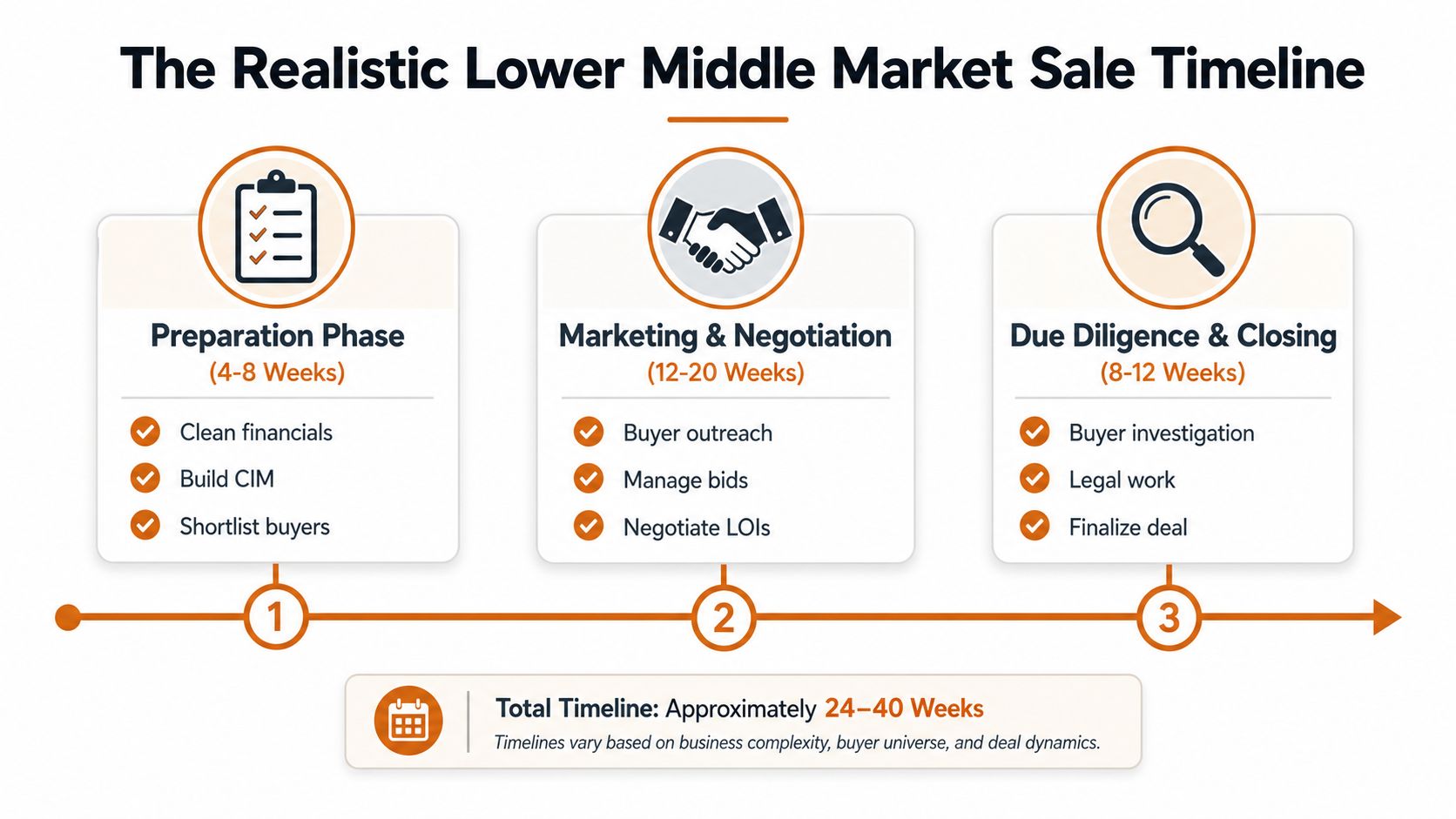
A customer concentration issue discovered late can change the buyer’s forecast or financing case. Owner dependency can create doubts about whether revenue survives your departure. Working capital disputes can alter the final payment, especially when the seller and buyer disagree about the amount of cash needed to operate normally.
Financing can also fail near the finish line. A lender may revise its view after reviewing detailed financial information, customer contracts, or current trading results. For that reason, an owner should plan around a total window of 7 to 14 months, not an optimistic four-to-six-month promise.
A signed letter of intent is progress, not certainty. The transaction becomes real only when diligence, financing, legal documents, and closing conditions all hold together.
Private equity can fit well when the owner wants liquidity but still sees an opportunity for the company to grow. A recurring-revenue business, a credible add-on opportunity, and a management team that can operate without the founder are attractive characteristics. An owner who’s willing to remain involved for a transition period and keep some equity may participate in a later value event, but that outcome depends on the new company’s performance and the eventual exit.
PE isn’t automatically the highest-price or lowest-risk path. A strategic acquirer may pay more because it expects cost savings, customer access, geographic expansion, or other synergies. Those same synergies can mean duplicated roles disappear, systems change quickly, and the company’s culture shifts soon after closing.
| Buyer type | Typical multiple | Owner role post-close | Best fit |
|---|---|---|---|
| Private equity | Depends on size, quality, structure, and financing | Often a transition role, with possible continued ownership | Growth, partial liquidity, and a second opportunity to benefit from expansion |
| Strategic acquirer | May pay more when synergies are valuable | Often reduced or eliminated after integration | Maximum price where the owner accepts operational change |
| Employee ownership or ESOP | Depends on company performance and transaction structure | Often advisory or transitional, with continued governance needs | Preserving culture and giving employees an ownership path |
| Family succession | Usually shaped by family financing and tax planning rather than an outside market bid | Often extended involvement during handoff | Legacy preservation and continuity |
An employee sale or ESOP can protect culture and give employees a meaningful ownership route, but it requires governance after the transaction and a patient approach to the transition. Family succession can keep the company within the family, but heirs may lack operating experience, capital, or the appetite to carry business risk.
Start with your objective. Maximum price, legacy, lifestyle, and risk reduction can point to different buyers. If you want a clean break, a structure requiring rollover equity and continued management may frustrate you. If you want to preserve jobs and remain connected to the company, a strategic sale may be a poor fit even if its offer is higher.
A buyer does not expect a company with no problems. The buyer needs to understand which problems are temporary, which are recurring, and what the business will look like after closing. Clear records and explainable results usually create more confidence than polished claims.
Collect financial statements, tax returns, bank records, debt schedules, and customer-level revenue. Organize at least three years of reliable information, with audited or reviewed statements where appropriate for the buyers you may approach. Ask a CPA to test every proposed EBITDA add-back. A personal expense or unusual charge supports valuation only if the buyer agrees it will not continue.
Prepare a working capital schedule based on normal operations. Reconcile accounts receivable, inventory, accounts payable, seasonal changes, and required cash to the business being sold. If the statements do not match the working capital the buyer expects to receive, the difference can become a late price negotiation.
Document who controls each important relationship and process. If you approve major quotes, negotiate every key vendor arrangement, or personally retain the largest customers, the buyer will need a transition plan. That dependence can also affect financing, because lenders want confidence that revenue and operations will continue after the owner steps back.
Review the areas that can reduce buyer confidence:
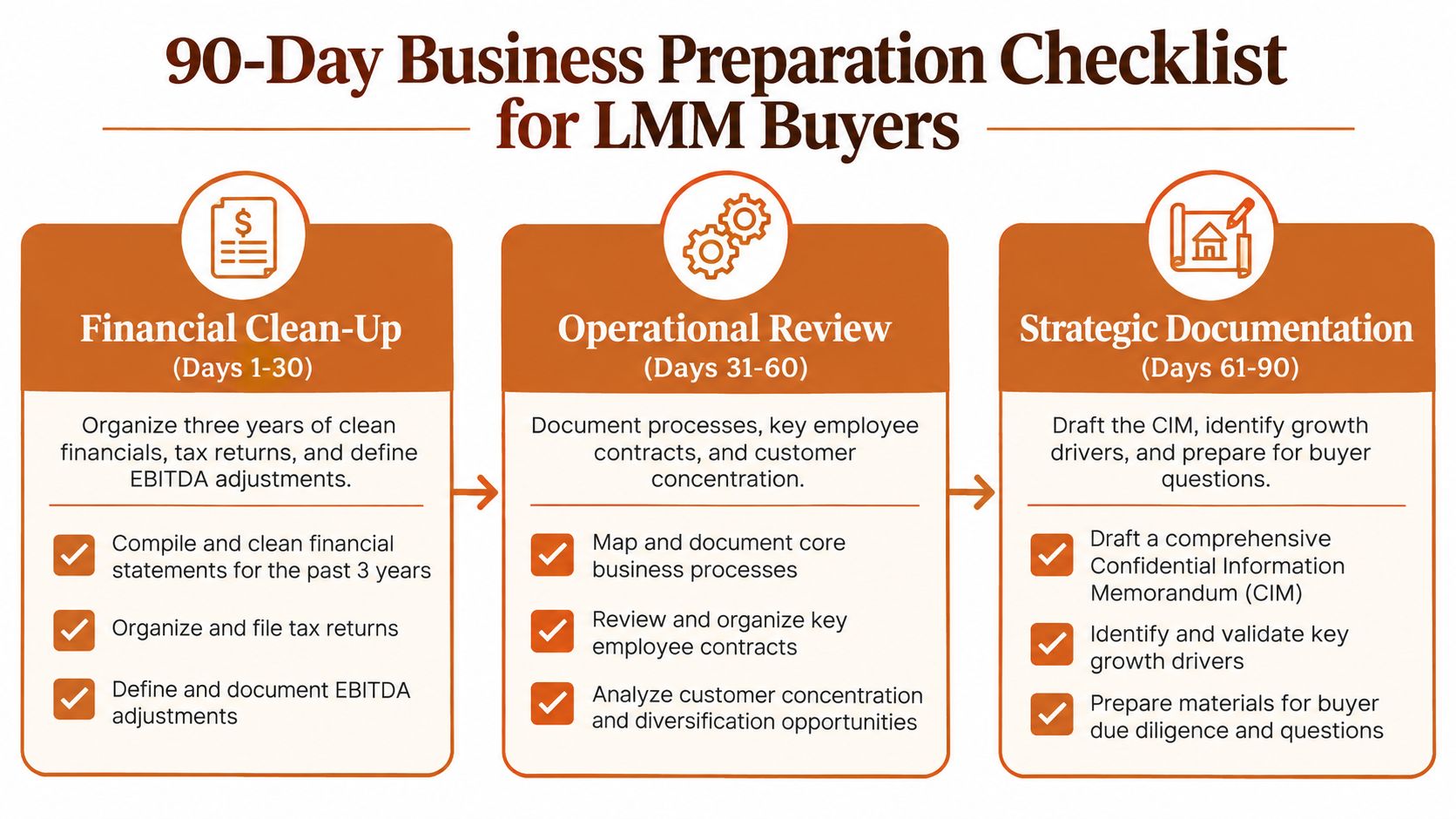
Describe the growth opportunity without turning it into a sales pitch. A private equity buyer may ask whether the company can expand geographically, raise prices, add services, improve margins, or acquire smaller competitors. If those plans are not realistic, explain why the company remains valuable as a standalone business.
Prepare a draft CIM, customer analysis, management presentation, forecast, and data-room index. Have an advisor challenge the assumptions before buyers do, especially assumptions that affect earnings, financing needs, or the cash you may receive at closing.
Practical rule: Do not begin a sale process before testing whether your financials, customer relationships, and management team can transfer to a new owner.
Bringing in a banker before fixing basic records can produce a lower price, weak buyer interest, or no credible process. A specialist can prioritize the work, but cannot replace missing information or make owner dependency disappear quickly. The preparation should show not only what the company earned, but also how the buyer will operate and finance it after the transaction.
Before an advisor can make the process useful, decide what a successful sale means for you. Are you ready to sell, or do you want to remain involved? Would you accept rollover equity, which leaves part of your value invested in the new company? How much financial risk can you tolerate after closing? Your tax exposure, family situation, desired lifestyle, and need for future income belong in the same discussion.
Outside analysis answers different questions. A specialist can establish a defensible valuation range, identify suitable buyers, compare cash with payments tied to future results, estimate how much debt the business can support, negotiate working capital terms, and review the purchase agreement. These responsibilities usually require several advisors rather than one person handling everything.
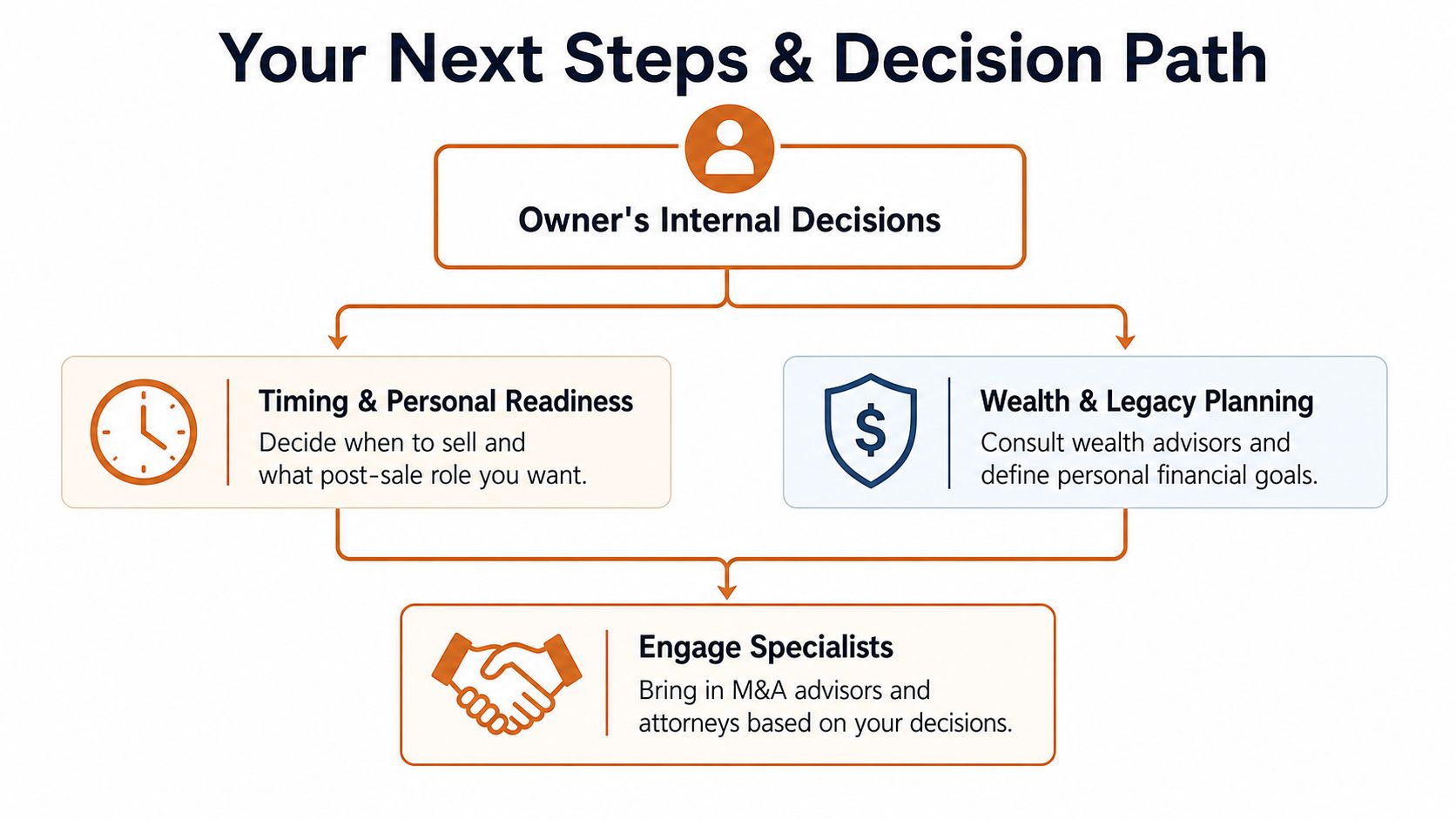
A generalist CPA can handle early financial cleanup and tax-return organization. A lower middle market investment banker becomes more useful when you need a competitive buyer process, a clear explanation of valuation, financing coordination, and help comparing offers. An M&A attorney should review the letter of intent and final agreement, including indemnities, escrow, earnouts, rollover terms, and post-closing obligations.
A wealth advisor can estimate what remains after taxes, debt repayment, reinvestment, and future liquidity needs. Enterprise value is the price assigned to the business. It is not the same as the money you can spend after the transaction.
Certain conditions support assembling a more specialized team:
A free matching service such as The Owner’s Shortlist can introduce an owner to a business broker or other specialist whose past work fits the business. Follow a deliberate sequence: decide what you want, determine what the business can support, prepare the records, then choose advisors for the remaining gaps.
Private equity in the lower middle market is a setting for weighing several connected decisions. Price, financing, management continuity, tax results, and your role after closing should be reviewed together.
If you are weighing a sale, recapitalization, family transition, or first buyer conversation, begin with the decision that needs an answer. Then contact the specialist whose expertise matches that next step.
Tell us your situation. We'll connect you with a specialist who works with owners like you. One conversation, no sales pressure.
Found this useful?
Add The Owner's Shortlist as a preferred source and get our articles highlighted in Google Search results.
Add to Preferred SourcesA financial due diligence checklist for buyers and sellers of owner-operated trades businesses, covering earnings, debt, taxes, payroll, and equipment.
October 13, 2026
Talk to a good broker 2 to 3 years before you want to sell. They'll show you what buyers will pick apart and who you need on your side to fix it.
October 8, 2026
Compare 10 business transfer lawyer options for sales, succession, family transfers, and smaller deals, with questions, fee models, and red flags.
October 5, 2026
Interest rates, inflation, the headlines. None of it matters as much as owners think. Here's what actually determines whether now is the right time to sell.
October 5, 2026