When should I first talk to a business broker about selling?
Talk to a good broker 2 to 3 years before you want to sell. They'll show you what buyers will pick apart and who you need on your side to fix it.
October 8, 2026
By Remi Taffin · August 24, 2026

Purchase price allocation is the process of breaking a deal price into specific assets, liabilities, and goodwill so the buyer can book them at fair value and the seller can understand how the proceeds will be taxed. In a taxable asset acquisition, the IRS residual method assigns consideration through asset classes, with the remainder allocated to goodwill and going-concern value.
You may have spent years building an HVAC company, plumbing business, manufacturing shop, or professional practice. During a sale, the number that matters most at first is usually the headline price. Then the purchase agreement turns that single figure into equipment, vehicles, inventory, customer relationships, trademarks, non-compete agreements, assumed liabilities, and goodwill.
That breakdown can change the seller’s after-tax proceeds and the buyer’s future depreciation, amortization, impairment testing, and reported earnings. The allocation isn’t a clerical footnote added after the negotiation. It can become one of the most consequential economic terms in the transaction.
The owner of a $12 million HVAC services company walked into closing expecting the practical outcome to be simple: the buyer would send one payment, the seller would transfer the business, and everyone would move on. Instead, the purchase agreement contained fifteen separate allocation lines.
The list included service vehicles, shop equipment, customer contracts, inventory, non-compete obligations, consulting commitments, and other assets and rights. Near the bottom sat a large residual labeled goodwill. The owner recognized the vehicles and equipment, but the customer relationships and restrictive covenants felt less tangible. The headline price had dissolved into buckets, and every bucket carried different consequences.
Practical rule: The purchase price is negotiated as one number, but the tax and accounting consequences are negotiated through the allocation.
The owner’s tax adviser focused on how much of the price could produce capital-gain treatment and how much could become ordinary income. The buyer’s team considered which acquired assets would create future depreciation or amortization deductions and how the allocation would affect the combined company’s earnings. A seller’s preference may not match a buyer’s preference, even when both parties agree on the total consideration.
The signed letter of intent also wasn’t the final economic event. The allocation determines how that consideration is characterized after closing. In an asset sale, the allocation question sits alongside the broader asset sale versus stock sale analysis, because transaction structure affects which tax rules apply and whether a basis step-up is available.
For an owner, the right question isn’t merely, “What price did I get?” It’s, “How much of that price is assigned to each bucket, what tax treatment follows, and what financial statements will the buyer report afterward?” Those answers begin with the basic meaning of PPA.
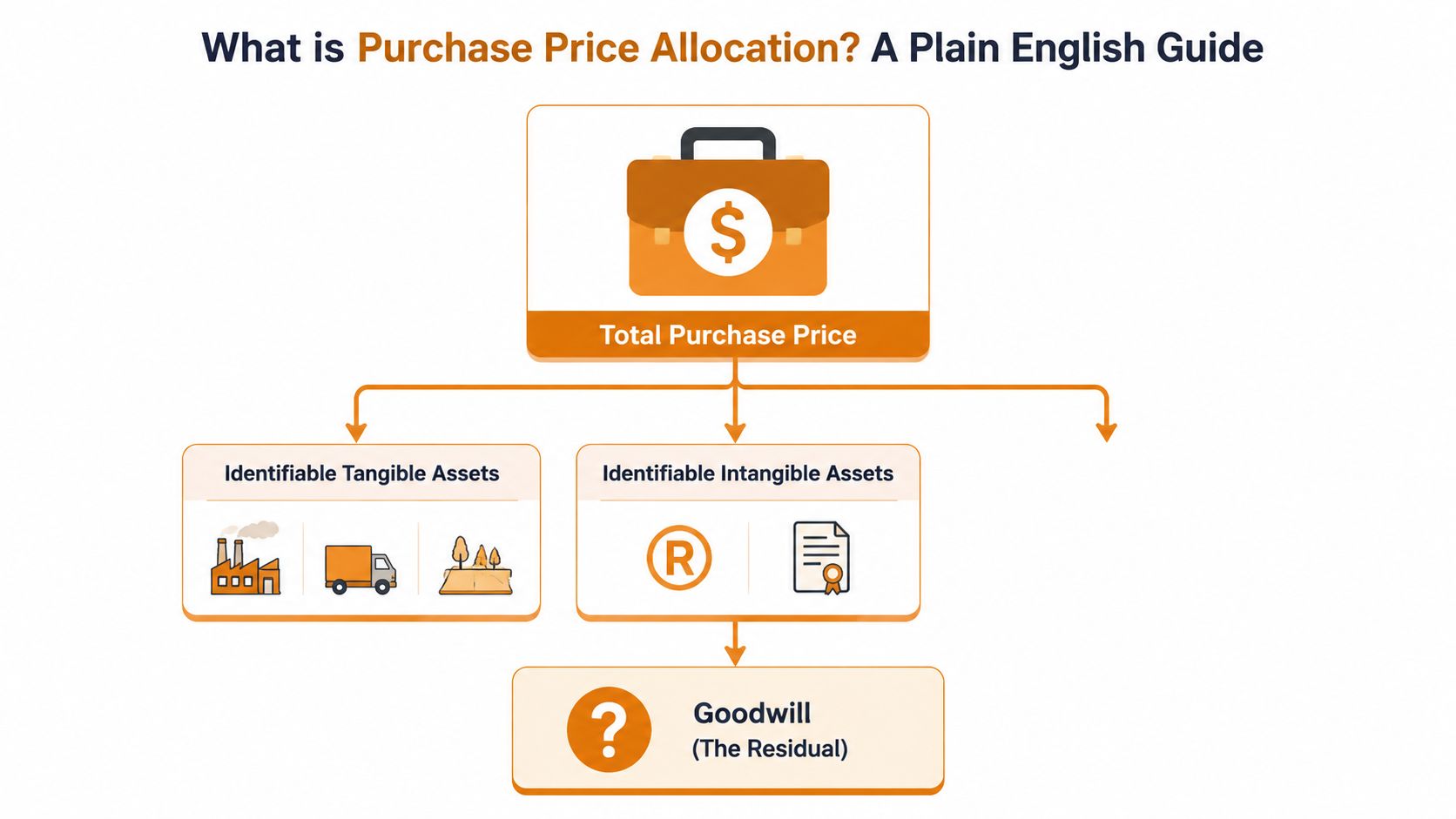
Purchase price allocation, or PPA, is the process of assigning the total consideration in an acquisition to the identifiable assets acquired and liabilities assumed. The assigned amounts are generally measured at fair value for financial reporting purposes. After the identifiable net assets are recognized, the remaining amount becomes goodwill, or a bargain-purchase gain if the measured net assets exceed the consideration.
The residual method provides a useful teaching scaffold:
For the HVAC owner, tangible assets might include trucks, tools, warehouse equipment, inventory, accounts receivable, and real estate. Intangible assets could include customer contracts, recurring service relationships, a trade name, developed software, permits, and a non-compete agreement. The buyer may also assume obligations connected with warranties, leases, debt, or other liabilities.
The key distinction is identifiable. An asset generally receives separate recognition when it arises from contractual or legal rights or when it can be separated from the business. Customer relationships supported by contracts can qualify. A registered trademark can qualify. Goodwill is different because it represents the value that can’t be attached to a separately recognized asset, including elements such as expected synergies, reputation, market position, and the assembled workforce.
For U.S. financial reporting, the buyer applies the business-combination framework in ASC 805. Internationally, IFRS 3’s acquisition method requires the acquirer to identify the acquisition date, recognize and measure identifiable net assets, and record goodwill or a bargain-purchase gain.
Tax law uses a related but distinct process. In a U.S. taxable asset acquisition, IRC Section 1060 and Form 8594 use the residual method, assigning consideration through asset classes before placing the remainder in the goodwill and going-concern category. The same deal therefore serves two masters, the buyer’s financial statements and the parties’ tax filings.
Suppose an HVAC owner agrees to sell the company for one price. The allocation determines how that price is divided on paper, which can change the owner’s after-tax proceeds and the buyer’s future deductions and reported earnings. Book PPA and tax PPA start with the same deal, but they serve different purposes.
| Dimension | Book PPA (ASC 805) | Tax PPA (IRC §1060) |
|---|---|---|
| Primary purpose | Record acquired assets and assumed liabilities for financial reporting | Assign consideration to tax asset classes and establish tax basis |
| Starting point | Consideration transferred in the business combination | Consideration in a taxable asset acquisition |
| Asset measurement | Identifiable assets and liabilities are measured at fair value | Consideration is assigned by the IRS residual method based on fair market value and class order |
| Intangible assets | Customer relationships, technology, trademarks, and contractual rights may be recognized separately | Section 197 intangibles follow tax rules that can differ from book useful-life judgments |
| Goodwill | Residual amount after identifiable net assets, generally tested annually for impairment rather than amortized under U.S. GAAP | Residual goodwill and going-concern value are generally amortized over 15 years under Section 197 in taxable deals |
| Seller’s result | Usually affects the buyer’s future financial statements more directly | Influences the seller’s character of income and the buyer’s future tax deductions |
| Stock transaction | A stock acquisition can still require purchase accounting when control of a business is acquired | A taxable stock acquisition generally doesn’t create a basis step-up unless a Section 338 election applies |
Book accounting asks how the buyer should report the acquired business at fair value. Tax allocation asks how the purchase consideration should be assigned for basis, income recognition, depreciation, and amortization. The same customer list, equipment, or goodwill can therefore produce different book and tax consequences.
For financial reporting, the buyer records identifiable assets and liabilities at fair value. Goodwill is the remaining amount after those items are recognized, and under U.S. GAAP it is generally tested for impairment rather than amortized. Tax rules use their own classes and recovery periods. Residual goodwill and going-concern value in a taxable deal are generally amortized over 15 years under Section 197.
That difference affects both sides of the closing table. A buyer may prefer more consideration assigned to assets that create depreciation or amortization deductions. The seller may prefer an allocation that produces a more favorable tax character than ordinary-income treatment for certain assets.
The allocation is similar to dividing one sale check into labeled envelopes. The labels do not change the headline price, but they can change how much the owner keeps after taxes and how the buyer’s earnings and deductions appear after closing. The result depends on the transaction structure, asset mix, and owner’s tax position.
A defensible PPA follows three steps: identify, measure, residual. The arithmetic can fit on a whiteboard. The harder work is making the asset list complete and supporting each value, because those choices can change the owner’s after-tax proceeds and the buyer’s reported earnings.
The process begins with the acquired business’s tangible items, including equipment, vehicles, land, buildings, inventory, receivables, and other operating assets. The team also identifies assumed liabilities, which reduce the value of the net assets acquired.
Historical book values provide context, but they do not automatically equal fair value on the acquisition date. A fully depreciated service truck may still be useful and valuable. Inventory may require a different analysis from machinery, while real estate may need a separate appraisal.
The review then moves beyond the balance sheet. Customer contracts, customer relationships, trade names, trademarks, patents, developed technology, licenses, and non-compete agreements may carry value even when the seller never recorded them internally. For an owner, this is the point where one headline sale price begins separating into categories with different tax and accounting effects.
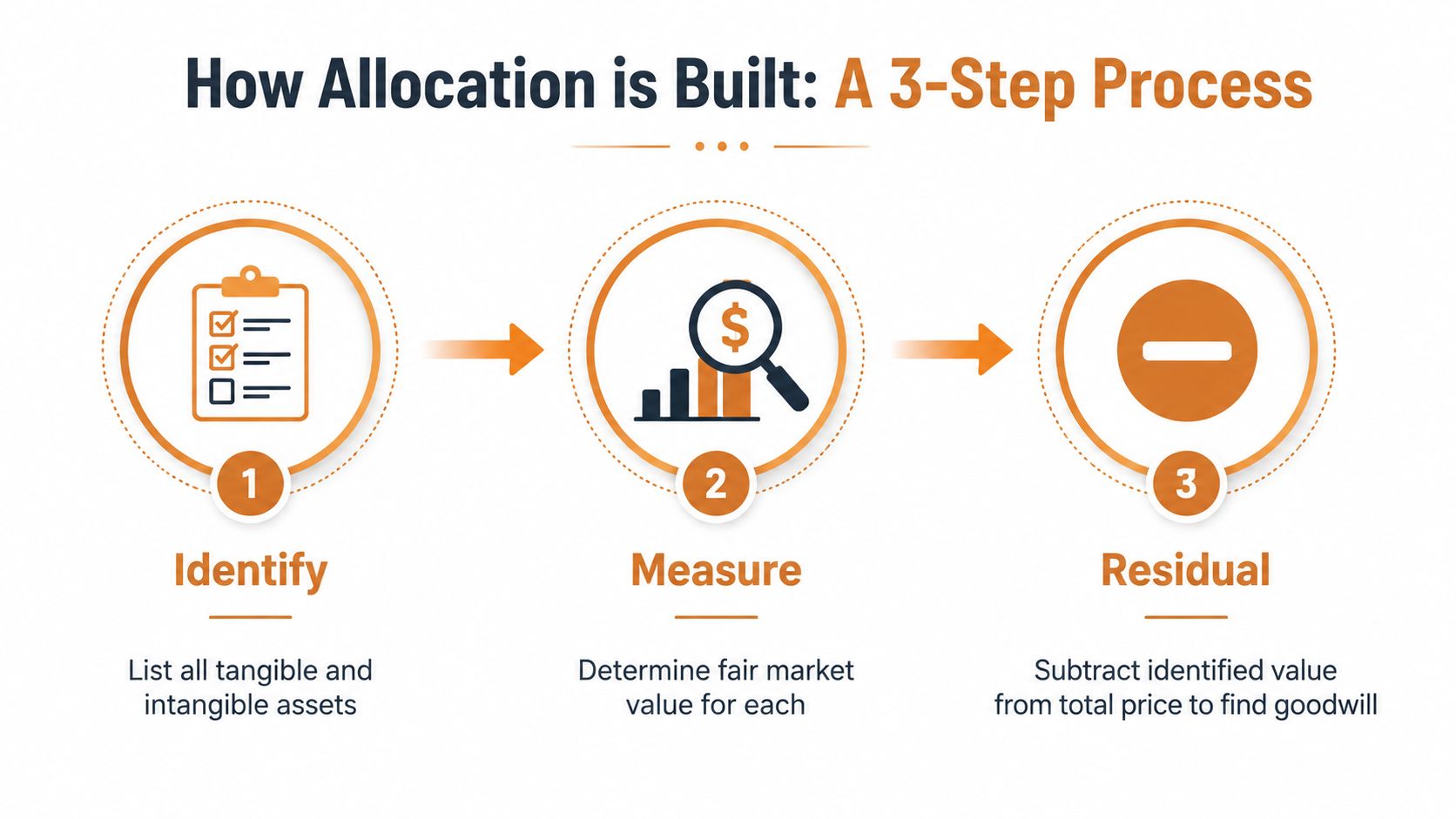
The valuation method should fit the asset. Equipment may be analyzed through replacement cost or market evidence. A trademark may use a relief-from-royalty approach, while customer relationships may use a multi-period excess earnings method. A broader business valuation may use discounted cash flow, a market approach, or another method supported by the facts.
The analysis depends on assumptions such as expected customer retention, pricing, margins, useful life, royalty rates, and discount rates. Those assumptions should connect to contracts, operating records, market evidence, and the buyer’s plan for using the assets.
A qualified business appraisal service can separate the valuation question from deal negotiation. It does not remove judgment, but it gives the parties a documented basis for reviewing, challenging, or defending the allocation.
Suppose a $5 million acquisition assigns $4.2 million to identifiable assets net of assumed liabilities. The remaining $800,000 becomes goodwill under the residual approach. That amount does not represent an asset with its own invoice. It is the value left after the identifiable items have been measured.
Goodwill can reflect expected synergies, brand strength, customer loyalty not separately recognized, market position, and the value of an operating workforce. If the valuation team assigns more value to customer relationships or technology, residual goodwill becomes smaller. If it assigns less, goodwill becomes larger. That shift can affect the owner’s tax outcome and the buyer’s future earnings presentation, even though the negotiated purchase price stays the same.
The allocation still matters after the purchase price is paid. For an owner, the practical question is simple: will the deal produce the expected after-tax proceeds, and how will the acquired business affect reported earnings? The answer depends partly on which assets receive value.
Book accounting assigns value to identifiable intangible assets, such as customer relationships, developed technology, and certain contractual rights. If those assets have finite useful lives, the buyer records amortization expense over those periods. That expense can lower reported GAAP earnings even though no new cash payment occurs after closing.
An owner reviewing the combined company should separate profit measures from cash movement. EBITDA generally excludes depreciation and amortization, so higher book amortization may reduce GAAP net income without reducing EBITDA by the same amount.
Under U.S. GAAP, goodwill is not amortized. Instead, it is tested for impairment annually. If the carrying value later cannot be supported, an impairment charge can reduce earnings without creating a matching current-period cash outflow.
Tax accounting follows a separate path. In a taxable deal, the allocation can give the buyer a stepped-up basis in acquired assets. The buyer’s tax basis is reset to the allocated purchase price rather than staying at the seller’s historical basis. Residual goodwill is generally amortized over 15 years under Section 197. A taxable stock acquisition normally does not receive that step-up unless a Section 338 election treats the transaction as a hypothetical asset purchase.
The same negotiated price can therefore produce different results depending on the allocation.
| Allocation Bucket | Book Treatment | Tax Treatment | Impact on Seller |
|---|---|---|---|
| Equipment and vehicles | Recorded at fair value and depreciated under applicable accounting rules | Added to the buyer’s tax basis under the applicable asset class | May create ordinary-income consequences where tax rules treat the gain as recapture |
| Inventory | Recognized at fair value for acquisition accounting | Assigned under the IRS class sequence and recovered as inventory is sold | Can produce ordinary-income treatment rather than the result associated with goodwill |
| Customer relationships | Separately recognized when identifiable and amortized over the assigned book life | May qualify as a Section 197 intangible with tax amortization under the applicable rules | Allocation can affect the seller’s income character and total tax |
| Non-compete agreement | Recognized as an identifiable contractual intangible when supported | Generally treated as a Section 197 intangible | Can produce a different seller result from goodwill |
| Goodwill | Residual amount, generally subject to annual impairment testing rather than amortization under U.S. GAAP | Residual goodwill is generally amortized over 15 years in a taxable deal | Often receives more favorable treatment than certain ordinary-income buckets, depending on the seller’s facts |
The seller’s entity and transaction structure also affect the outcome. An asset sale can spread value across equipment, inventory, contracts, covenants, and goodwill, creating different tax consequences for each category. A stock sale may produce a different tax profile, while the buyer may resist it because the desired basis step-up is not automatic. The allocation is therefore part of the seller’s proceeds analysis, not merely an accounting schedule prepared after closing.
The residual calculation looks mechanical only after the difficult judgments have already been made. The disagreement usually concerns the value assigned before the residual is calculated.
A customer relationship isn’t valued by counting names on a spreadsheet alone. The valuation team may consider expected attrition, customer spending, margins, renewal patterns, and the costs required to replace the revenue. A small change in the assumptions can shift value between customer relationships and goodwill.
A trademark raises a different question. The relief-from-royalty method requires an opinion about the royalty rate a market participant might pay for the right to use a comparable brand. Developed technology may require an assessment of obsolescence, replacement cost, competitive pressure, and the remaining period of economic usefulness.
The residual is only as reliable as the identifiable assets measured before it.
Discounted cash flow work introduces further judgment. Forecast revenue, expenses, reinvestment, discount rates, and the way cash flows are attributed to individual assets all require support. Houlihan Capital’s discussion of modern PPA highlights the role of market-participant assumptions, highest-and-best-use judgments, and methods such as discounted cash flow, relief from royalty, and multi-period excess earnings.
The incentives also differ. A buyer may favor allocations to depreciable or amortizable assets because those allocations can generate future deductions or expense recognition. A seller may prefer goodwill where that treatment produces a more favorable tax character than inventory, equipment recapture, or restrictive covenants.
Auditors review the assumptions for financial reporting. The IRS can examine whether the tax allocation is consistent with the applicable residual method and fair market value. Earn-outs, contingent consideration, working capital adjustments, and later changes in consideration can require the allocation to be revisited. Under the IRS ordering rules, increases and decreases in consideration do not get assigned wherever the parties prefer. They follow the prescribed class sequence.
Treat the allocation as a deal term before the purchase agreement is final, not as an administrative task assigned after closing. The owner who waits may discover that the buyer’s tax and accounting preferences have already shaped the draft.
A qualified valuation specialist should review the business early enough to challenge the buyer’s assumptions. The specialist needs access to customer data, contracts, fixed-asset records, intellectual property details, leases, and management forecasts. An owner’s CPA and transaction attorney should understand the valuation logic before the parties sign.
Ask the deal team for a draft allocation table. Review every line, including items that don’t appear on the seller’s historical balance sheet. Customer relationships, trademarks, non-compete agreements, consulting arrangements, earn-outs, and contingent consideration can all affect the final analysis.
Don’t review only the gross price. Ask the tax adviser to model at least three qualitative allocation cases:
The actual outcome requires the owner’s entity structure, tax basis, state rules, deal consideration, and transaction documents. The model should also address working capital adjustments, because a change in consideration can shift the residual allocation.
The purchase agreement should state how the parties will prepare and approve the final IRC Section 1060 allocation and how they’ll coordinate their filings. The seller should seek a meaningful review opportunity rather than agreeing to “mutual determination” without a process, deadline, or dispute mechanism.
Review earn-out language closely. Later payments may change total consideration and require a corresponding allocation adjustment. The agreement should explain who prepares the revised schedule, how the parties exchange information, and how disagreements are resolved.
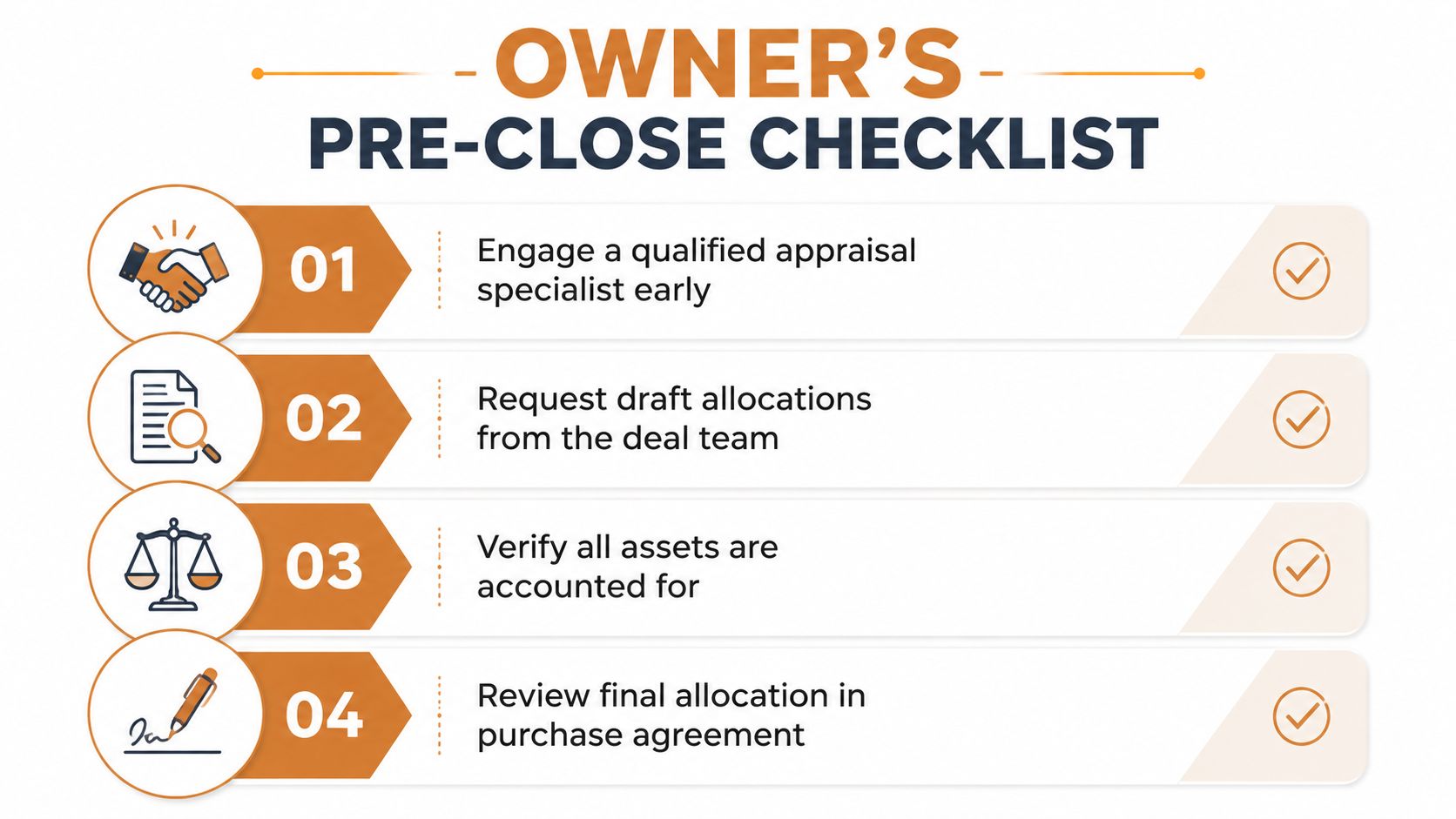
Owner’s decision: Don’t approve the headline price until you understand the buckets beneath it.
The first 90 days after signing can shape the allocation work, but the practical preparation should begin before closing. Those decisions can influence the buyer’s amortization deductions, future goodwill impairment charges, reported earnings, and the seller’s tax bill for years.
If you’re preparing to sell an owner-operated business, The Owner’s Shortlist offers plain-language guides and a curated directory of specialists for valuation, taxes, legal matters, and succession planning. Visit the site to compare relevant professionals and clarify the questions you should take to your CPA, attorney, and valuation adviser before you negotiate the final allocation.
Tell us your situation. We'll connect you with a specialist who works with owners like you. One conversation, no sales pressure.
Found this useful?
Add The Owner's Shortlist as a preferred source and get our articles highlighted in Google Search results.
Add to Preferred SourcesTalk to a good broker 2 to 3 years before you want to sell. They'll show you what buyers will pick apart and who you need on your side to fix it.
October 8, 2026
Compare 10 business transfer lawyer options for sales, succession, family transfers, and smaller deals, with questions, fee models, and red flags.
October 5, 2026
Interest rates, inflation, the headlines. None of it matters as much as owners think. Here's what actually determines whether now is the right time to sell.
October 5, 2026
What is a tuck-in acquisition? Learn how these deals impact owner-operated businesses, trades, valuation, and when to consult an M&A specialist.
September 29, 2026