Business Valuation Meaning for Owner Operated Firms
Explore business valuation meaning for owner-operated firms. Learn valuation methods, drivers, misconceptions, and steps to secure a defensible valuation.
September 28, 2026
By Remi Taffin · August 9, 2026

You’re about to sit down with a buyer, lender, broker, or valuation adviser, and the numbers look decent. Revenue’s up, the team’s busy, and the P&L doesn’t scream trouble. Then somebody asks for the customer breakdown, and one account jumps off the page. That’s when a business that felt broad suddenly looks fragile.
Customer concentration risk is the gap between what the income statement shows and what happens if a key buyer pulls back, delays payment, or walks. Owners usually think of it as a percentage problem. Buyers and lenders think of it as a survival problem, because one account can change cash flow, borrowing capacity, and negotiating power long before it changes the top line.
The first time most owners feel this risk is not during a formal analysis. It’s when they pull a customer ledger before a sale or refinance and realize that one relationship drives a big slice of the business. The company still looks healthy on paper, but now the owner is staring at a dependency that could reshape the deal.
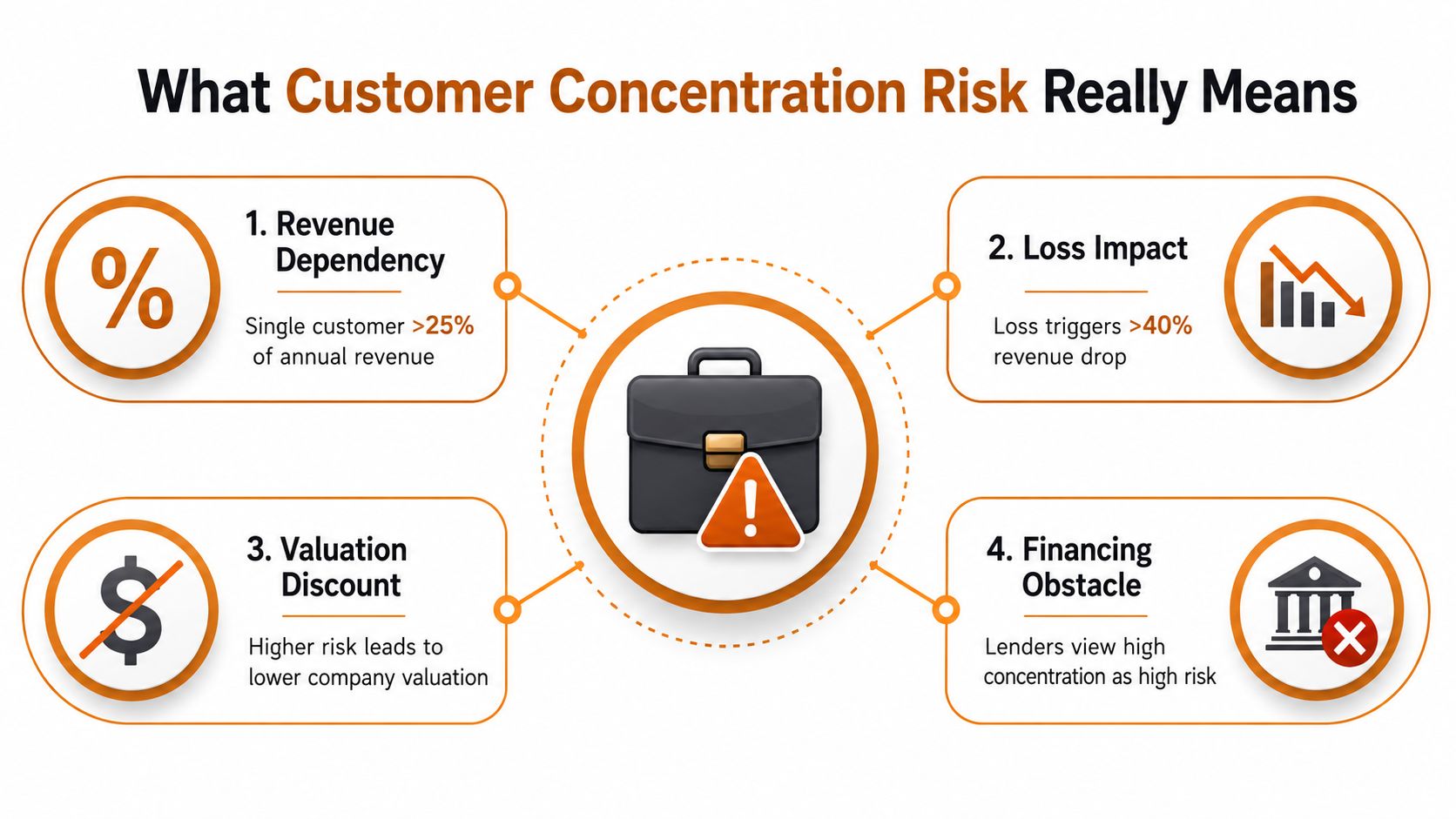
Customer concentration risk is the chance that losing, renegotiating, or getting squeezed by a small number of buyers does more damage than the headline revenue share suggests. That’s why this topic belongs in valuation, lending, and exit planning, not just in accounting review.
The research backs that up. In a 2021 study, a one-standard-deviation increase in customer concentration was linked to a 22.2% reduction in corporate risk-taking when risk was measured by the volatility of industry-adjusted profitability over three years. The same research framework defines concentration as sales to the top five customers divided by total sales (ScienceDirect study).
Practical rule: If a customer loss would force you to cut spending, delay hiring, or renegotiate debt, concentration risk is already affecting the business.
A recurring service business, a project contractor, and a subscription company can all carry customer concentration risk, but not in the same way. In one model, the issue is renewal power. In another, it’s the end of a project and the loss of follow-on work. In a third, it’s a customer that can reduce usage without formally leaving.
The point is simple. Two companies can have the same top-customer share and very different risk profiles. That’s why advisers ask more than, “What percentage of revenue comes from your biggest customer?” They want to know how quickly that revenue can disappear, and how hard it would be to replace.
The market also penalizes this exposure. Another finance study found that firms with at least one major customer earned monthly returns about 19.4 basis points lower than firms without any major customers, which tells you capital markets don’t treat concentrated revenue as a neutral accounting detail (ScienceDirect study).
Most owners overcomplicate this. You don’t need a consultant to start. You need three views of the same customer base, and you need to calculate them on the same period so the numbers mean something.
The first measure is single-customer share, which is just one customer’s revenue divided by total revenue. The second is top-five share, which shows how much the business depends on a small cluster of buyers. The third is the Herfindahl-Hirschman Index, or HHI, which squares each customer’s revenue share and adds them up, so one very large customer creates more concentration than several smaller ones.
A practical way to run the math is on trailing 12-month revenue, because that’s what buyers, lenders, and diligence teams usually want to see. If you run recurring revenue, backlog, or contracted minimums, you can layer those in separately, but start with the trailing numbers first.
| Measurement | What it shows | What it misses |
|---|---|---|
| Single-customer share | How big one account is relative to total revenue | Whether the account is sticky, replaceable, or near renewal |
| Top-five share | Whether revenue is spread across a small group or a wider base | How dependent the business is on one dominant account inside that group |
| HHI | How concentration changes when several medium customers replace one large one | Contract terms, tenure, and customer quality |
Suppose a business has $10 million in annual revenue. One customer brings in $2.5 million, three others bring in $1 million each, and the rest is spread across smaller accounts. The top customer share is 25%, the top-five share is already high, and the HHI will be more concentrated than a business with the same revenue split across ten equal customers.
If you replace that one big account with five customers at $500,000 each, the top-customer share falls, and HHI drops too. That’s the point of the index. It captures the difference between one oversized account and several medium-sized ones, even when the total revenue share looks similar.
Buyers don’t just ask whether you have concentration. They ask whether the concentration is getting better or worse, and whether the rest of the customer base can actually carry the business if one account slips.
For a plain-English valuation refresher, the Owner’s Shortlist guide to valuing a small business is a useful place to start before you send numbers to anyone outside the company.
A 25% customer on a hard-to-switch, multi-year contract is not the same as a 25% customer on a short-term deal. Anyone who has sat through diligence knows that. One looks like a manageable exposure, the other looks like a credit event waiting to happen.
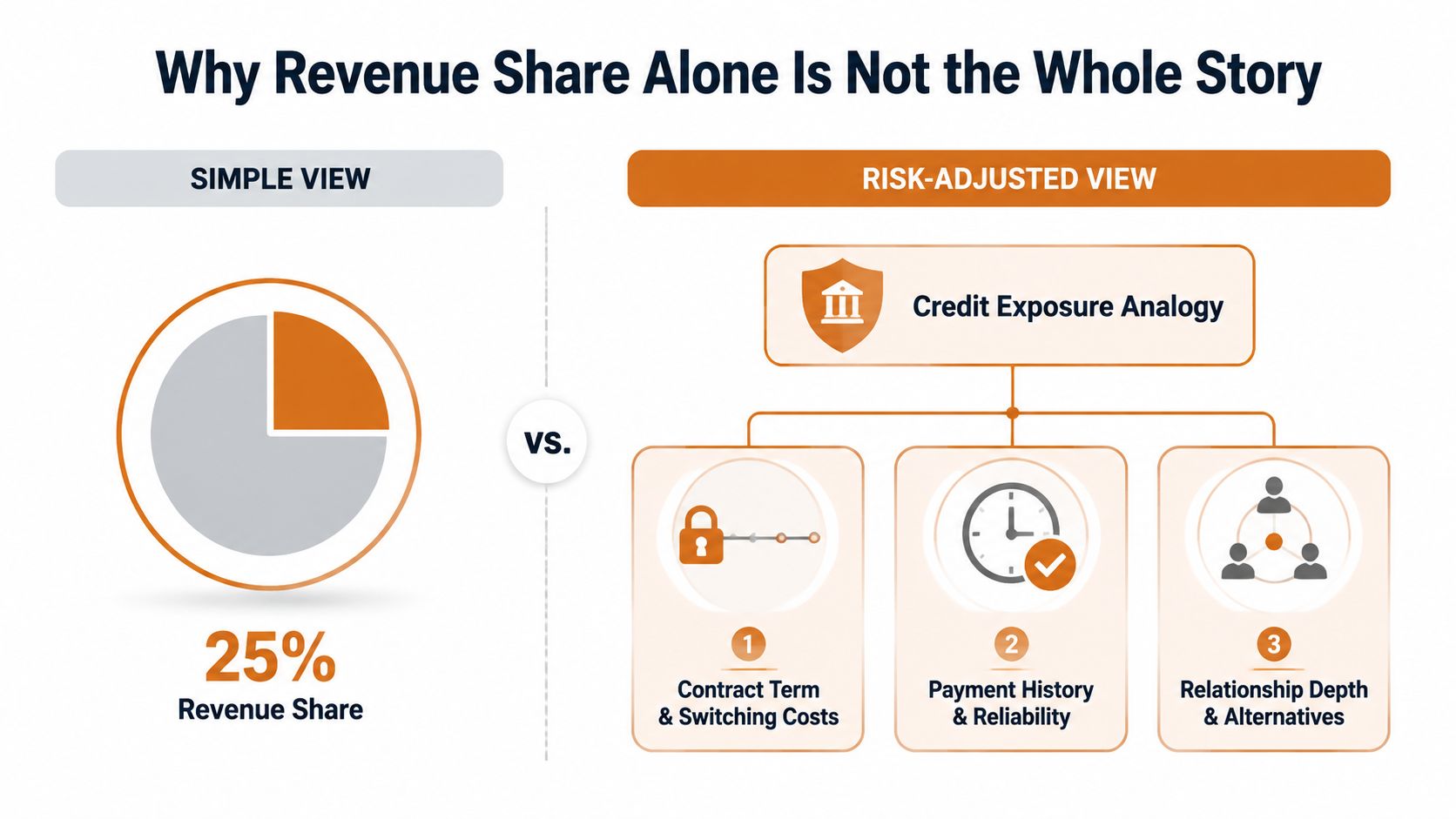
Practitioners who take this seriously look at contract term and enforceability, customer tenure, relationship depth, switching costs, and renewal timing. Revenue share matters, but it is only one part of the picture.
A customer with a long track record, embedded workflows, and real switching friction can be safer than a smaller account that can walk at the next renewal. The opposite is also true. A customer that has been around for years can still be dangerous if the contract is easy to exit or renegotiate.
That is why some advisers use a composite account-risk view, where revenue share is only part of the total score. One practitioner framework puts revenue share at 25% of the score and renewal timing at 10%, which reflects the basic reality that concentration risk is a loss-probability × loss-severity problem, not a simple percentage cutoff (Mario Peshev framework).
Buyers and lenders care about more than size. They want to know how likely the account is to leave, how much warning you would get, and how much cash would disappear if it did. Contract review is where that gets tested. It shows whether the customer is concentrated, or just visible on a spreadsheet.
They also look at the quality of earnings work because that is where concentration shows up in the details. A good Owner’s Shortlist article on financial due diligence is worth reading alongside a quality of earnings report overview, since both force the same question. If the largest customer slips, does the business still hold together?
If you cannot explain why the largest customer is sticky, you have already weakened your position in the conversation.
That is the point owners miss. A buyer is not just asking how much one account contributes today. They are asking what happens to diligence, valuation, financing, and exit options if that account changes its mind.
Concentration stops being a spreadsheet issue the moment a buyer or lender starts pricing the risk. Owners usually expect one problem. They get four. The deal can take a hit on valuation, diligence gets harder, financing tightens, and the exit path gets narrower.
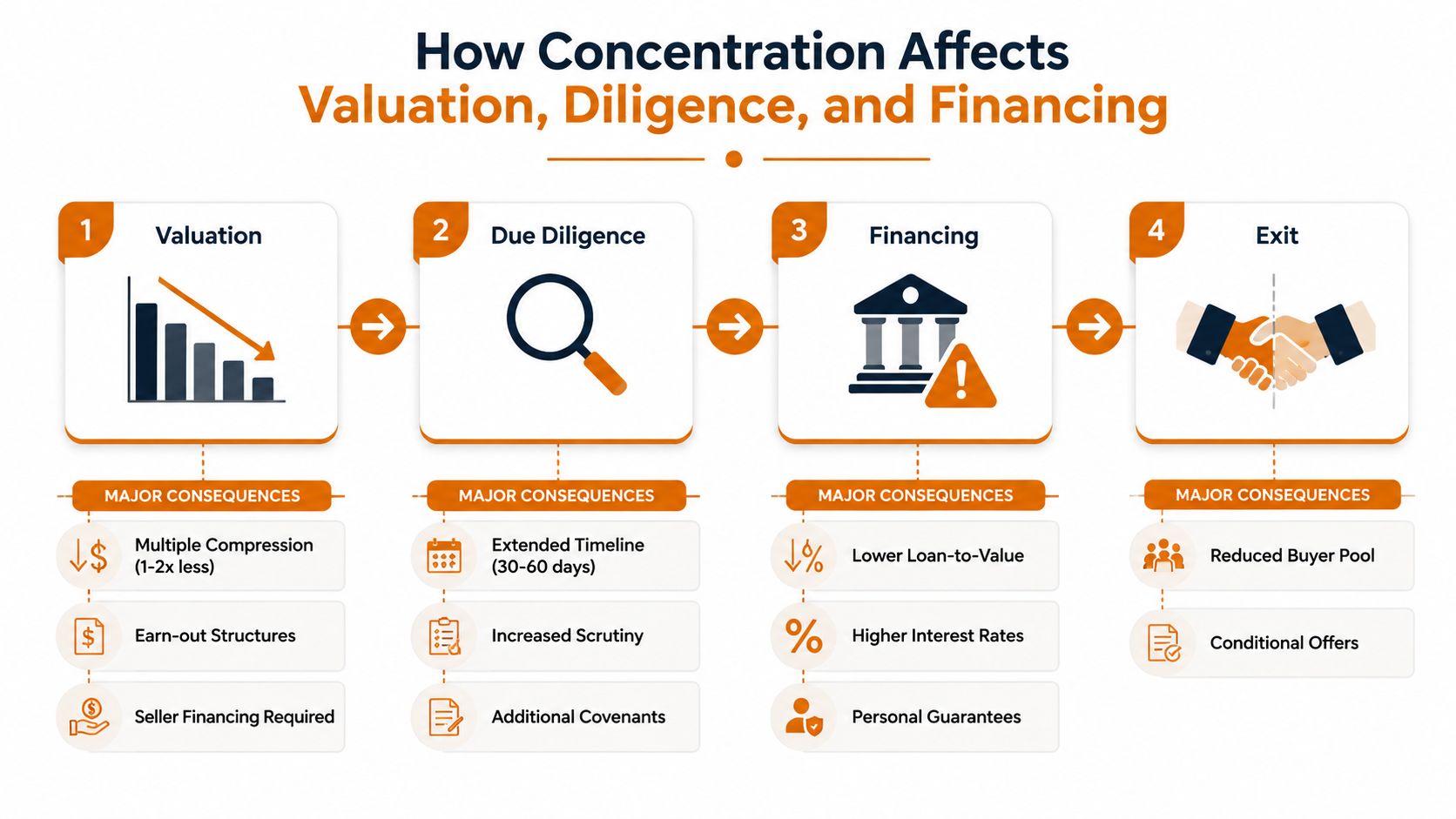
Buyers do not treat concentrated revenue as clean revenue. They price in the chance that a major account slips, slows, or leaves, and they pay less when that risk is front and center. Owners should expect that reality to show up in the deal price and in the terms around it (ScienceDirect study).
That is why the structure often changes before the headline number does. Buyers may push for earn-outs, seller notes, holdbacks, or other terms that leave more of the downside with the seller. They are not being difficult for the sake of it. They are trying to protect themselves if the largest customer changes course after closing.
Once concentration is on the table, the buyer’s questions get sharper. They want the contracts, renewal terms, payment history, customer references, and a plain explanation of what happens if that account walks. If one customer drives too much of the business, diligence turns into a close look at that relationship.
They also care about what the customer says, not just what the owner says. A concentrated account can make a solid business look fragile if the buyer hears about price pressure, scope creep, slow renewals, or an owner who is the only real relationship holder. The diligence team is trying to figure out whether the revenue is durable or just familiar.
That is why buyers often ask for the same sort of proof covered in an Owner’s Shortlist article on financial due diligence. They want to see whether the revenue base can stand up if the biggest account changes its behavior.
Lenders underwrite cash flow stability, not just reported revenue. If one customer drives too much of the top line, they build their downside case around that customer first. The result can be tighter covenants, lower borrowing capacity, more collateral pressure, or personal guarantees that owners hoped to avoid.
Concentration can start to affect day-to-day financing with the lender. A business can still be profitable and still get less friendly financing if the cash flow depends too heavily on one account. The lender is not rewarding growth. It is asking how much pain the company can absorb before the numbers break.
Concentration narrows the buyer pool. Some strategic buyers can live with it if the customer is a fit for their platform, but many buyers will not touch it unless there is a clear reason the account is sticky. The more dependent the business looks, the more conditional the offers become and the slower the process gets.
A practical benchmark from market guidance is that single-customer dependence above 20% to 30% of revenue is often treated as high risk, while many practitioners flag top-five customer shares above 40% as materially concentrated (Allianz Trade guidance). In recurring-revenue businesses, some guidance also flags top three to five customers at roughly 30% to 40% of ARR as a concentration risk (Wall Street Prep).
For owners, the takeaway is simple. Concentration is not just a backward-looking percentage. It changes what buyers ask, what lenders tolerate, what the business is worth, and how many exits are still open.
A 25% customer share can mean two completely different things. That’s why buyers don’t stop at the number. They want the story behind it, and they want proof that the story holds up.
Take a residential HVAC company with a stable base of service agreements and one large property-management client. That customer may represent roughly a quarter of revenue, but the work is recurring, the relationship is established, and the switching costs are real. A buyer still worries, but the account can look sticky enough to support the valuation.
Now take a project-based contractor with one general contractor client on a multi-year build. The same 25% looks much worse. When the job ends, so does the revenue stream unless the next bid lands. That’s not stability. That’s temporary dependence with a finish line.
A lender, buyer, or valuation specialist will react very differently to those two businesses because the exposure behaves differently. One has time, contract friction, and replacement potential. The other has a built-in end date and little control over what comes next.
That’s why concentration gets confused with stability in recurring-revenue service businesses, equipment maintenance accounts, and exclusive supplier arrangements. Owners see a large account and assume it proves strength. Buyers see whether that account can be replaced without wrecking the year.
The number matters, but the exit path matters more.
The most dangerous concentration is the kind that isn’t obvious yet. Trailing revenue can look fine right up until a renewal slips, a customer starts shrinking seats, or the procurement team opens a new bidding process.
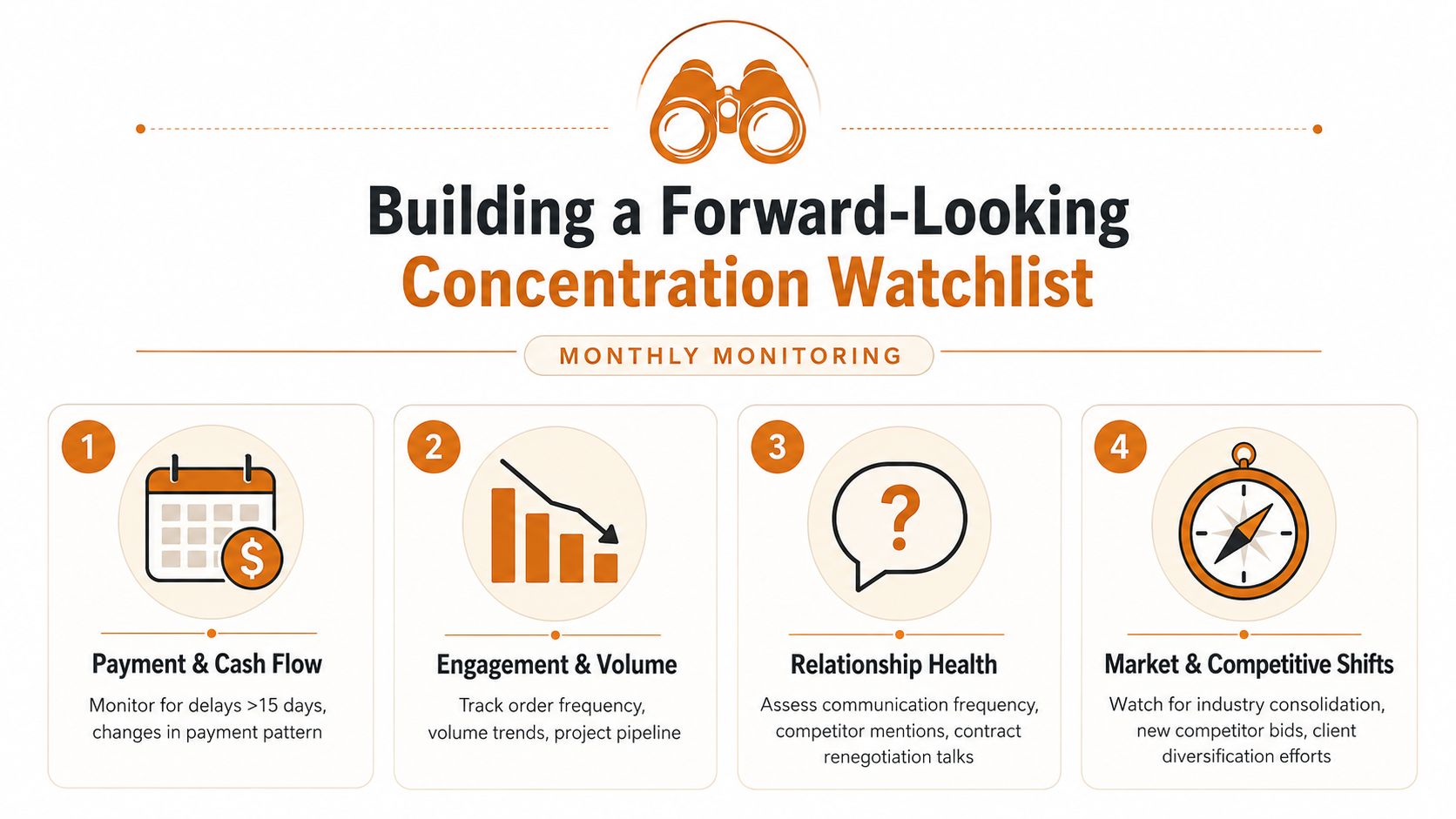
Track payment delays, scope cuts, seat reductions, declining usage, and pipeline gaps for replacement work. Those are the early warnings. If the customer is still paying, the owner can fool themselves into thinking nothing has changed, but the pattern often shows stress before the revenue line does.
The practical move is to review the largest accounts monthly, not once a year. Pair that review with simple cash stress tests. Ask what happens if the biggest customer pays late, cuts volume, or disappears at the next renewal. That’s not paranoia. That’s planning.
This matters most when you’re facing a sale, a refinance, or a succession event. A buyer wants to know whether the future revenue runway is stable. A lender wants to know whether cash will cover debt. The next generation wants to know what kind of business they’re inheriting.
The Kaezn guide on client concentration risk makes a good point here, because it highlights the gap between trailing revenue and forward-looking exposure. A business can look diversified on paper and still be vulnerable if one or two accounts control the next chunk of revenue.
You don’t fix concentration with one heroic move. You chip away at it with contract changes, customer growth, and better deal structure. Some fixes are fast. Some take years. Be honest about which is which.
Some moves change the optics fast, but the underlying exposure takes longer to heal. A contract extension can help in diligence. A broader sales pipeline takes longer to show up in real numbers. Both matter.
If you need benchmarking and deal-readiness work, bring in a valuation specialist. If the issue is structure, timing, or after-tax proceeds, use a tax adviser. If the concern is contract language, renewal rights, or succession documents, get an attorney involved. If the problem is how a lender will underwrite the concentration, talk to a financing specialist.
The Owner’s Shortlist is one place owners use to find vetted specialists in valuation, taxes, legal matters, financing, and succession, along with plain-language articles that explain the issues before anyone gets hired. That’s useful if you want to understand the problem before you spend money trying to solve it.
If you’re staring at a customer list and wondering whether the business is really as diversified as it looks, don’t guess. Use The Owner’s Shortlist to review plain-language guidance on valuation, tax, legal, financing, and succession topics, then connect with a specialist who can pressure-test the exposure before you talk to a buyer or lender.
Tell us your situation. We'll connect you with a specialist who works with owners like you. One conversation, no sales pressure.
Found this useful?
Add The Owner's Shortlist as a preferred source and get our articles highlighted in Google Search results.
Add to Preferred SourcesExplore business valuation meaning for owner-operated firms. Learn valuation methods, drivers, misconceptions, and steps to secure a defensible valuation.
September 28, 2026
What Is Recurring Revenue. Learn what recurring revenue is, how ARR and MRR work, real trade examples, and why this revenue model shapes business value and exit
September 23, 2026
Learn how much to sell a business for with SDE and EBITDA multiples, adjustments, and deal tips to set a defensible price and maximize proceeds.
September 21, 2026
Understand business valuation cost, fee structures, price ranges and what drives fees so you can budget wisely and get accurate quotes.
September 19, 2026