Family Inheritance Law for Business Owners
Navigate family inheritance law for your business. Learn how to structure succession, avoid family disputes, and protect your company's future value.
September 25, 2026
By Remi Taffin · July 16, 2026

If you own a business, your estate plan isn’t just about who gets what when you’re gone. It’s also about who can sign payroll on Monday, approve a vendor payment on Tuesday, and calm your employees and customers before rumors do the damage for you.
That distinction matters more than most owners realize. Many smart, disciplined operators have solid revenue, loyal customers, and a strong balance sheet, yet almost no legal structure for what happens if they die or become unable to run the company. In owner-operated businesses, especially in trades and family companies, the business often depends on one person holding together operations, relationships, pricing authority, and decision-making.
Estate planning for business owners should be treated like continuity planning. It protects your family, but it also protects your contracts, your employees, your value, and your options.
An HVAC owner builds a company over decades. He knows the major customers by name. He approves large bids himself. He handles bank relationships, makes key hiring calls, and signs off on anything important. Then he dies unexpectedly.
His family may own the value of the business in a broad sense, but that doesn’t mean they can immediately run it. Employees don’t know who’s in charge. Customers hesitate. Bills still come due. If no one has legal authority to act quickly, the business can stall at the exact moment it most needs direction.
That’s not an edge case. Approximately 70% of small business owners fail to create a formal estate or succession plan, and even when a plan exists, only 30% of heirs understand it, according to ElderLawAnswers on estate planning for entrepreneurs and business owners.
Most owners don’t delay because they don’t care. They delay because the problem feels abstract. Death feels remote. Legal documents feel technical. The business is busy now, so planning gets pushed behind hiring, sales, taxes, and operations.
Then there’s a second problem. Owners often believe they’ve already communicated their wishes because they’ve mentioned them at dinner, on a jobsite, or in a hallway conversation with a child or partner. That’s not a plan. That’s a memory, and memories don’t hold up well under stress.
Practical rule: If your successor would need to ask, “What did Dad want?” your plan isn’t finished.
The first breakdown usually isn’t emotional. It’s operational.
Estate planning for business owners works best when it answers two separate questions. First, who gets the value? Second, who gets the authority? Owners who answer only the first question leave the company exposed at the worst possible time.
A will is important. Every owner should have one. But a will doesn’t function as an operating manual for a business.
Think of it this way. A will is a set of delivery instructions. It says where assets should go. A business succession plan is a flight manual. It tells the right people how control shifts, how decisions keep getting made, and how ownership moves without grounding the company.
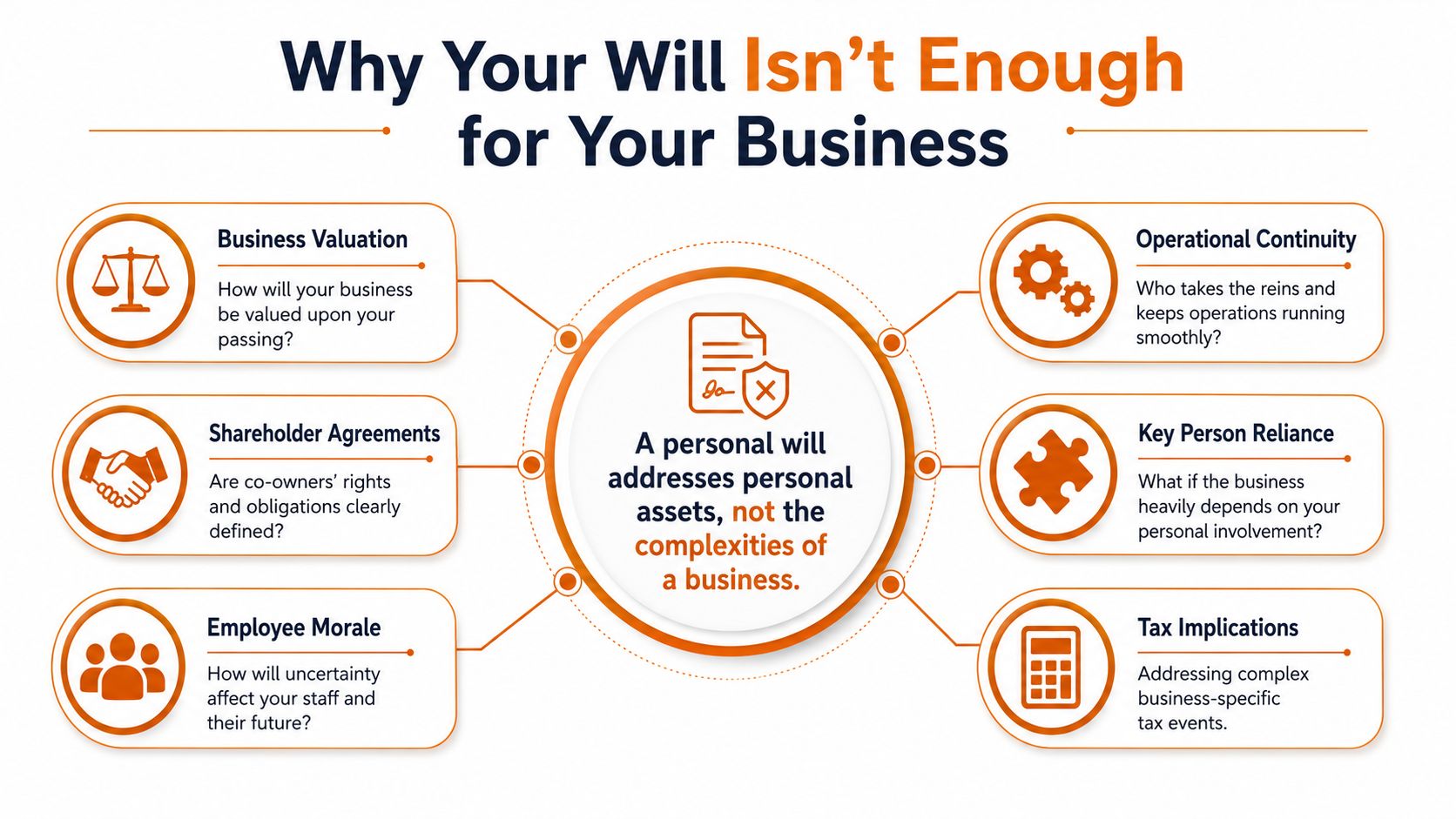
A will can name beneficiaries, nominate fiduciaries, and state your wishes. That’s useful. But if your business interest passes through your will alone, the transfer often depends on legal and administrative steps that don’t help your staff open the doors tomorrow morning.
A business needs more than inheritance instructions. It needs coordinated control mechanisms. Those often include trust planning, business agreement provisions, titling decisions, and clear authority for someone to step in without delay.
A personal estate plan that ignores the business entity is like leaving your family the keys to a building without telling them which locks those keys open.
Probate exists to validate a will and supervise asset transfer. For a house or a brokerage account, delay is frustrating. For an operating company, delay can be destructive.
During that gap, practical questions pile up fast:
If those answers depend on a court process or unclear paperwork, the company can lose momentum before ownership is formally sorted out.
Owners usually need a structure that works outside the will for business continuity purposes. The exact documents vary, but the core idea is consistent. You want the business interest and decision-making authority aligned in a way that lets a designated person act without confusion.
That often means focusing on a short list:
Estate planning for business owners fails when the personal documents say one thing and the business records say another. Courts, banks, buyers, and co-owners don’t resolve that mismatch quickly. You have to prevent it in advance.
If you own a company with a partner, or if you want a predictable transfer when you exit, the buy-sell agreement is one of the most important documents in your file. I often describe it as a prenuptial agreement for business owners. Everyone hopes the hard provisions never need to be tested, but when they are, they prevent panic and ugly bargaining.
A good buy-sell agreement does three jobs. It sets a price or valuation method. It creates a buyer. It provides the cash.
The first fight after an owner’s death or departure is often about value. One side says the company is worth a premium because of relationships and future earnings. The other says the business depends too much on the founder and should be discounted.
A buy-sell agreement reduces that argument by establishing a valuation method in advance. The method might rely on appraisal, a formula, or a fixed value that gets updated. The exact mechanism matters less than the discipline of agreeing before anyone is under pressure.
This isn’t just about preventing conflict. It’s also about preserving defensible value. A properly structured buy-sell agreement, funded by life insurance, can establish enterprise goodwill and ensure ownership transfers directly to designated successors, preserving liquidity and avoiding probate delays, as explained in Snug’s guide for business owners.
The second problem is more basic. Even if everyone agrees on value, who is required to buy the departing owner’s interest?
Without a binding obligation, the family may inherit an illiquid minority interest. They own something on paper, but they can’t easily turn it into cash. Meanwhile, the remaining owners may want control without wanting to pay promptly or fairly.
A buy-sell agreement solves that by answering the question in advance. Depending on structure, the buyer might be:
The family shouldn’t have to negotiate from a position of grief, and the business shouldn’t have to improvise its cap table in the middle of a crisis.
A purchase obligation without funding is a promise on paper. That’s why life insurance often sits at the center of a serious buy-sell structure. When properly matched to the agreement, insurance can create immediate liquidity for the purchase and help the business avoid fire-drill financing.
That funding piece matters for practical reasons. The surviving spouse may need cash, not a passive ownership stake in a company they don’t manage. The remaining owners may want continuity, not a rushed bank negotiation. The employees need confidence that the transition is stable.
Many agreements exist, but don’t work. They sit unsigned. They reference outdated values. They conflict with the LLC operating agreement or corporate bylaws. Insurance was purchased years ago and never reviewed after the company grew.
Review these points carefully:
A buy-sell agreement isn’t a generic form. It’s the central wiring for a business transition. If it isn’t current, funded, and coordinated, it won’t do its job when your family and co-owners need it most.
Most owners eventually face one strategic question that no legal document can answer for them. Who should take over the business?
The usual pathways are family transfer, sale to management or employees, and sale to an outside buyer. None is automatically best. Each one solves a different problem, and each one creates different trade-offs involving cash, control, timing, and legacy.
| Pathway | Potential Liquidity | Control & Legacy | Timeline & Complexity |
|---|---|---|---|
| Family transfer | Often lower immediate liquidity because value may stay inside the family structure | Usually strongest for preserving name, culture, and long-term legacy | Can take years of grooming, communication, and fairness planning among family members |
| Management or employee sale | Often moderate liquidity, depending on financing and internal buyer capacity | Can preserve culture and customer continuity if the team already runs daily operations | Usually requires careful structuring, training, and seller patience |
| Outside third-party sale | Often highest liquidity potential if the market is strong and the business is well prepared | Usually lowest owner control after closing, and culture may change | Can move faster or slower depending on buyer quality, diligence, and deal readiness |
Passing the business to children or relatives appeals to owners who highly value continuity of identity. The trucks still carry the family name. Employees see familiar leadership. Customers feel less disruption.
But family transfer is often the hardest path emotionally. Ownership and management aren’t the same thing. One child may work in the business while another doesn’t. One may be qualified to lead, another may merely expect equal treatment. Those aren’t legal drafting issues first. They’re judgment issues first. For a thoughtful framework on those trade-offs, see succession decisions that protect value, family, and optionality.
This pathway works well when the next generation isn’t interested or ready, but the internal team is strong. In many owner-operated businesses, the operations manager, service manager, or senior field leader already carries much of the day-to-day load.
The appeal is continuity. The people who know the customers, systems, and culture stay in place. The challenge is usually financing. Internal buyers may be capable operators but limited buyers, which often means a staged transfer, earnout structure, or seller financing approach.
Selling to an outside party often appeals to owners who want maximum liquidity and a cleaner separation. If your goals are retirement funding, risk reduction, or monetizing the business at a strong value, this route may fit.
The trade-off is control. The buyer may keep your team and brand, or may not. Your business can continue, but not necessarily on your terms. Owners who choose this path usually do best when they decide in advance which matters more: highest price, employee continuity, family harmony, or ongoing involvement after closing.
A succession plan works when it matches your real objective, not the objective you think you’re supposed to have.
A smooth transfer is only half the job. The other half is reducing the tax drag that can force a sale, dilute the family outcome, or strip cash out of the company at exactly the wrong moment.
Timing matters. Historical volatility in federal estate tax exemptions has created planning windows before, including the elimination of the estate tax for individuals dying in 2010 under EGTRRA, followed by reversion to pre-2001 standards in 2011 with a $1 million exemption. The same source notes that the 2026 inflation-adjusted exemption is approximately $13.61 million per individual, but prudent planning assumes exposure if exemptions are not extended. It also warns that transfer taxes can consume 40% to 50% of a business’s net value if owners don’t plan ahead with trusts and valuation strategies, according to William & Mary’s analysis of estate tax changes and planning.
Many owners built plans during a period when exemption amounts were far more forgiving. That creates a false sense of safety. A plan that looked fine under a higher exemption can be badly outdated if the law moves back toward a much lower baseline.
If most of your wealth sits inside the company, the tax problem is also a liquidity problem. Your estate may owe tax based on value, but that doesn’t mean there’s cash available to pay it. That’s how families get pushed into distressed decisions.
A helpful primer on the broader tax side of exit preparation is this guide to small business tax planning.
Two tools come up often because they can shift business value more efficiently than simple gifting.
A Grantor Retained Annuity Trust, or GRAT, is a way to transfer future appreciation. You place business interests into the trust, keep the right to receive an annuity for a set term, and if the business grows faster than the IRS assumed rate, that excess growth passes to beneficiaries with minimal gift tax cost. In practical terms, it’s like skimming future upside into a separate bucket while locking today’s value for transfer-tax purposes. Spencer Fane’s discussion of estate planning considerations for business owners explains this advantage in low-interest-rate settings and why appreciation above the Section 7520 rate is the key to the strategy.
An Intentionally Defective Grantor Trust, or IDGT, works differently. It can be used to move appreciation out of the taxable estate through a sale or transfer structure designed for transfer-tax efficiency while preserving certain income tax features. The mechanics are technical, but the business point is simple. You don’t want all future growth trapped in the taxable estate if careful structuring can move that growth more efficiently.
These aren’t do-it-yourself tools. They require legal drafting, valuation support, tax modeling, and coordination with the rest of the plan.
Good tax planning doesn’t replace succession planning. It preserves more of what succession planning is trying to save.
Most owners think estate planning starts at death. In practice, the more immediate business threat is often incapacity.
A stroke, accident, cognitive decline, or serious illness doesn’t just create a family crisis. It creates an authority crisis inside the company. Work keeps coming in. Payroll still has to run. Someone has to sign contracts, approve purchases, deal with lenders, and manage employees. If the owner is alive but unable to act, the business can freeze in a uniquely painful middle ground.
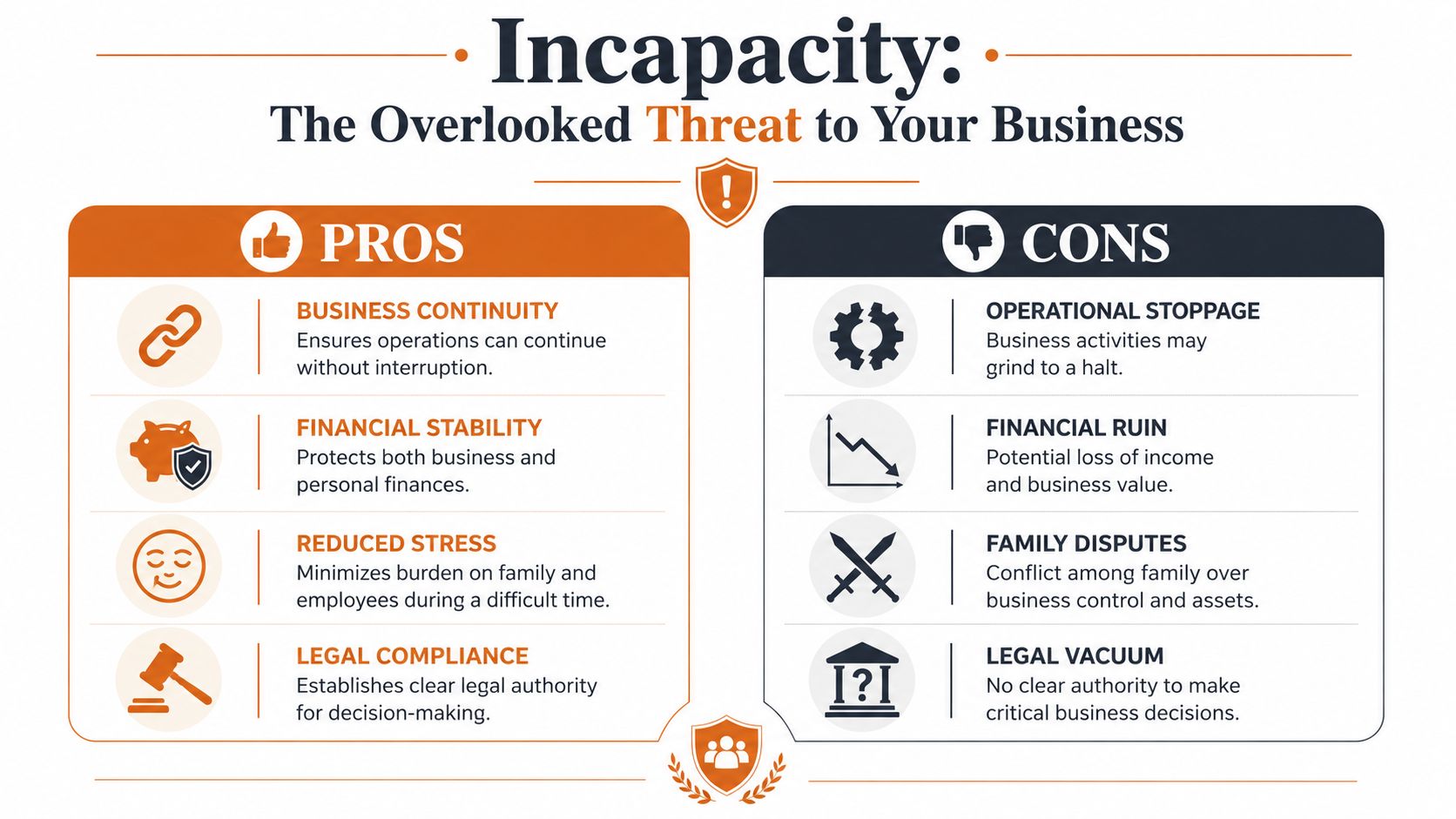
Many owners have a durable power of attorney and assume that’s the answer. Sometimes it helps. Often it doesn’t solve the entity-level problem.
The overlooked provision is failing to explicitly authorize a successor in the business’s operating agreement to take control during the owner’s incapacity, a gap that can cause revenue to collapse before probate even begins, according to Beancount’s guide for small business owners.
That distinction matters in owner-operated companies. A spouse or child may inherit the economic value of the business but still lack immediate authority to run it. They may not be able to sign a contract, direct staff, or deal with a bank because the governing documents never gave them that power.
Here’s a helpful discussion of the issue in video form.
For a small plumbing or HVAC company, incapacity planning should be concrete. Not theoretical.
If no one can act until a court, bank, or vendor gets comfortable, the plan arrived too late.
Estate planning for business owners is incomplete without incapacity planning. Death transfers wealth. Disability can interrupt control while the owner is still the legal owner. That operational gap is where many businesses lose value fastest.
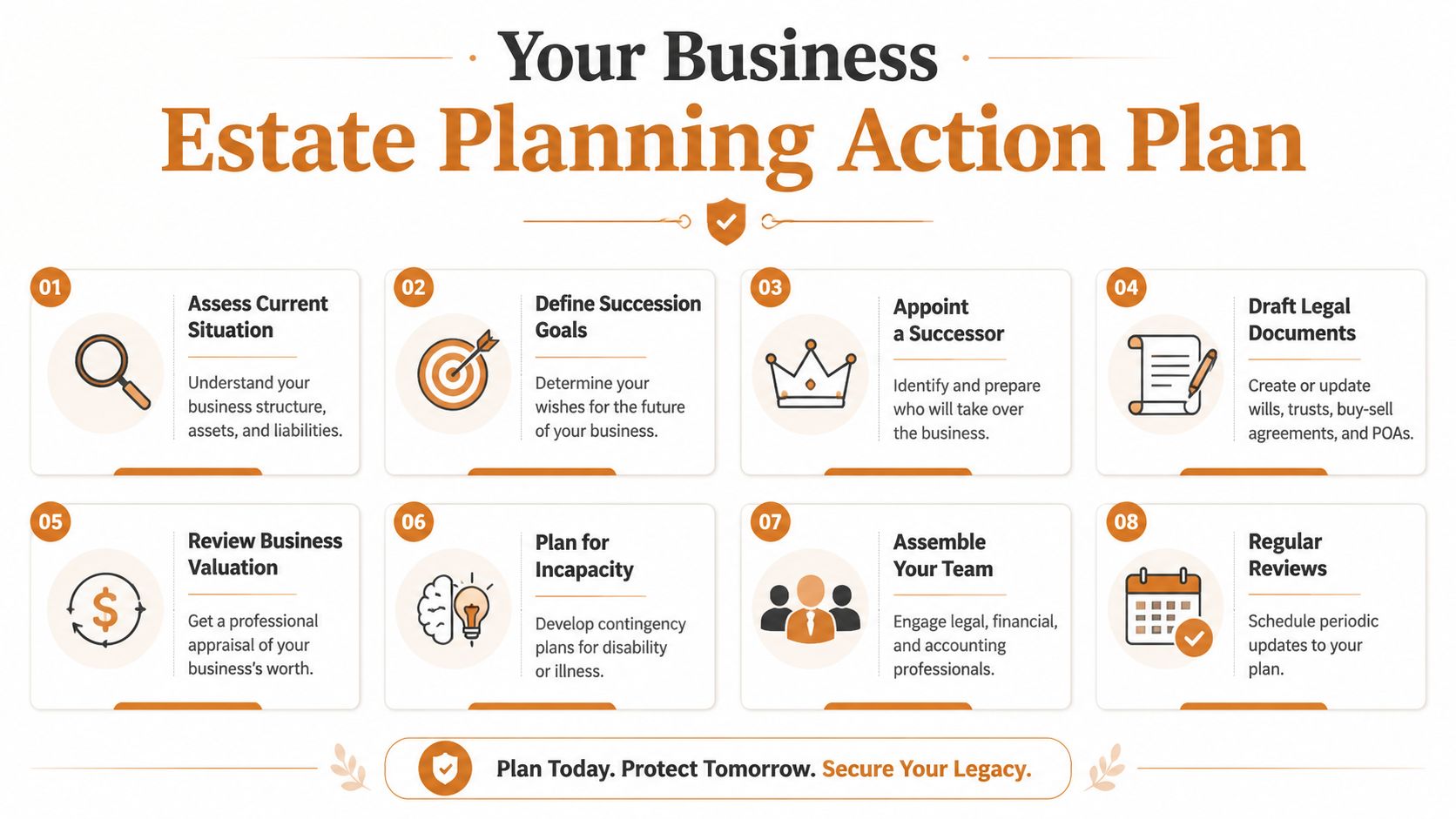
At this point, the work is less about theory and more about sequence. Most owners don’t need to solve everything at once. They need to stop leaving the plan half-built.
A practical action plan starts with clarity. What do you want to happen to the business if you die, retire, or become unable to run it? If the answer changes depending on the event, your documents need to reflect that difference.
For owners who need help finding the right legal specialist, this resource on choosing an estate planning law firm can help you understand what to look for.
No single advisor handles this alone.
The best plans aren’t just signed. They’re coordinated. Your family documents, business agreements, tax strategy, and continuity procedures should all point in the same direction.
If you’re sorting through estate planning, succession, taxes, valuation, or the right legal structure, The Owner’s Shortlist is a practical place to start. It offers plain-English guidance for owner-operated businesses and connects owners with vetted specialists in legal and estate matters, taxes, valuation, succession, and related decisions so you can move from uncertainty to an informed first conversation.
Tell us your situation. We'll connect you with a specialist who works with owners like you. One conversation, no sales pressure.
Found this useful?
Add The Owner's Shortlist as a preferred source and get our articles highlighted in Google Search results.
Add to Preferred SourcesNavigate family inheritance law for your business. Learn how to structure succession, avoid family disputes, and protect your company's future value.
September 25, 2026
Learn how succession of business works, from choosing a pathway to timing the handoff. A clear guide for owners planning their next chapter.
September 20, 2026
Plain-language estate planning wills and trusts guide for business owners covering definitions, tax implications, and questions to ask attorneys.
September 18, 2026
Learn company ownership transfer options, valuation, taxes and timing. Compare sale, gift, succession and ESOP paths with checklists.
September 17, 2026