Succession of Business: A Practical Owner's Guide
Learn how succession of business works, from choosing a pathway to timing the handoff. A clear guide for owners planning their next chapter.
September 20, 2026
By Remi Taffin · September 25, 2026
You’ve spent years building a company that supports your family. Your will leaves the shares equally to your children, so the arrangement feels fair. One child runs the company every day, another lives in another state, and a third has never worked in the business. Everyone inherits the same percentage. Nobody inherits a clear answer to the only question that matters on Monday morning: who has authority to run the company?
That gap is where family inheritance law becomes an operating risk. A business interest isn’t like a house or an investment account. Ownership carries voting rights, access to information, influence over hiring, borrowing, distributions, and the power to block decisions. Your estate plan must divide economic value without accidentally dividing operational control.
A business owner often treats the company as one line on an asset list. The will says who receives the shares, the beneficiaries appear to be treated equally, and the owner assumes the hard work is finished.
That approach misses the difference between wealth transfer and control transfer. If three heirs receive equal voting shares, they may need to agree on budgets, compensation, borrowing, acquisitions, and leadership. If one heir works in the company and the others don’t, the operating child may carry responsibility without holding enough authority to act.
Consider a manufacturing business owned by its founder. The founder’s oldest child manages production, the middle child works elsewhere, and the youngest child has limited involvement but expects an equal inheritance. A standard will transfers the shares equally. The result may be a three-person voting structure where the person responsible for customers and employees can’t make major decisions without family approval.
The conflict isn’t necessarily greed. The non-operating heirs may want liquidity, regular distributions, or a sale. The operating heir may need to reinvest profits, retain cash, and make decisions quickly. Equal shares give each person an economic stake, but they don’t give them compatible objectives.
Practical rule: Equal value doesn’t require equal voting power.
Corporate documents can make this worse if they don’t match the estate plan. Shareholder agreements, operating agreements, buy-sell provisions, transfer restrictions, and voting arrangements may control what happens to an ownership interest after death. A will that promises shares to someone who can’t legally receive them under the company’s governing documents creates confusion instead of certainty.
The Library of Congress describes a major historical shift in U.S. inheritance law. By 1935, 60% of states had replaced widow’s and widower’s lifetime dower and curtesy rights with fee-simple ownership, and by 1982 all states had done so (Library of Congress overview of U.S. inheritance law). The broader lesson for owners is clear: surviving spouses and other protected heirs may receive stronger ownership rights than a founder casually expects.
A useful starting point is this Coto & Waddington estate planning guide, which puts business ownership into the wider estate-planning context. But a general estate plan still needs to be coordinated with corporate governance, valuation, funding, and the people who will run the company.
A will is an instruction document. It tells the estate process who should receive property, but it generally becomes effective through probate. Probate gives the court a role in validating the will, appointing the personal representative, resolving creditor issues, and authorizing transfers.
For a business owner, that timing matters. The company may need someone with authority to sign contracts, approve payroll, access financial accounts, preserve customer relationships, and make urgent decisions. If the deceased owner’s shares remain tied up while the estate process begins, the company can face a damaging leadership gap.
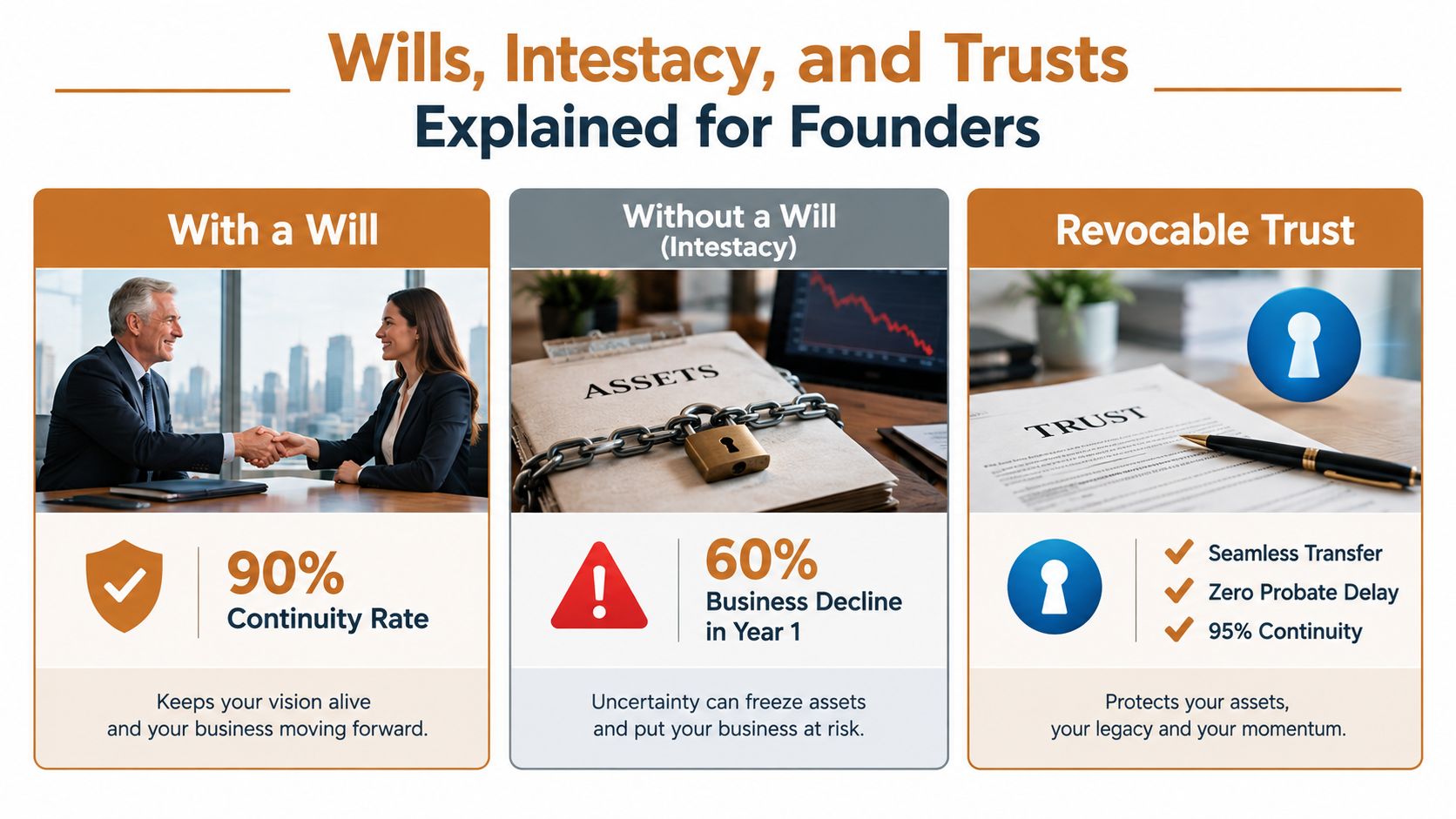
With a will, the owner names beneficiaries and usually nominates an executor. The executor handles the estate under court supervision, then distributes the ownership interest according to the document and applicable law. A will is far better than leaving the result to default law, but it may not provide immediate operating authority.
Without a will, the owner dies intestate. State law determines who inherits, often using a fixed formula based on spouses, children, parents, or other relatives. That formula doesn’t understand which child has the skills to run the business, which co-owner is acceptable, or which shareholder arrangement protects the company.
With a revocable trust, the owner transfers assets to a trust during life and names a successor trustee. If the business interest is properly titled in the trust, the successor trustee can manage it under the trust terms without waiting for the same probate transfer. The trust is a management vehicle, not a substitute for every corporate document. The trustee still needs clear authority, competent instructions, and coordination with shareholder or operating agreements.
Founders should also distinguish ownership succession from management succession. A trustee may hold or administer the interest, while a president, chief executive, manager, or designated successor runs daily operations. Those roles can be assigned to different people, and separating them often protects the company from an immediate family power struggle.
Reviewing estate planning, wills, and trusts for business owners can help you identify where personal documents and company documents need to agree. The practical test is simple: if you died tonight, who could legally access the ownership records, authorize essential payments, communicate with lenders, and make decisions for the company tomorrow?
You can’t assume that a will gives you unlimited freedom to choose who receives the business. Family inheritance law may protect a spouse, children, or other close relatives regardless of your preferred succession plan.
The United States has moved toward broader ownership rights for surviving spouses, but protection varies by jurisdiction. State law may provide an elective share, community-property rights, homestead protections, or other claims that limit what a spouse can be excluded from receiving. Those rights can reach the value of a closely held business, even when the owner intended the shares to pass to a child or business partner.
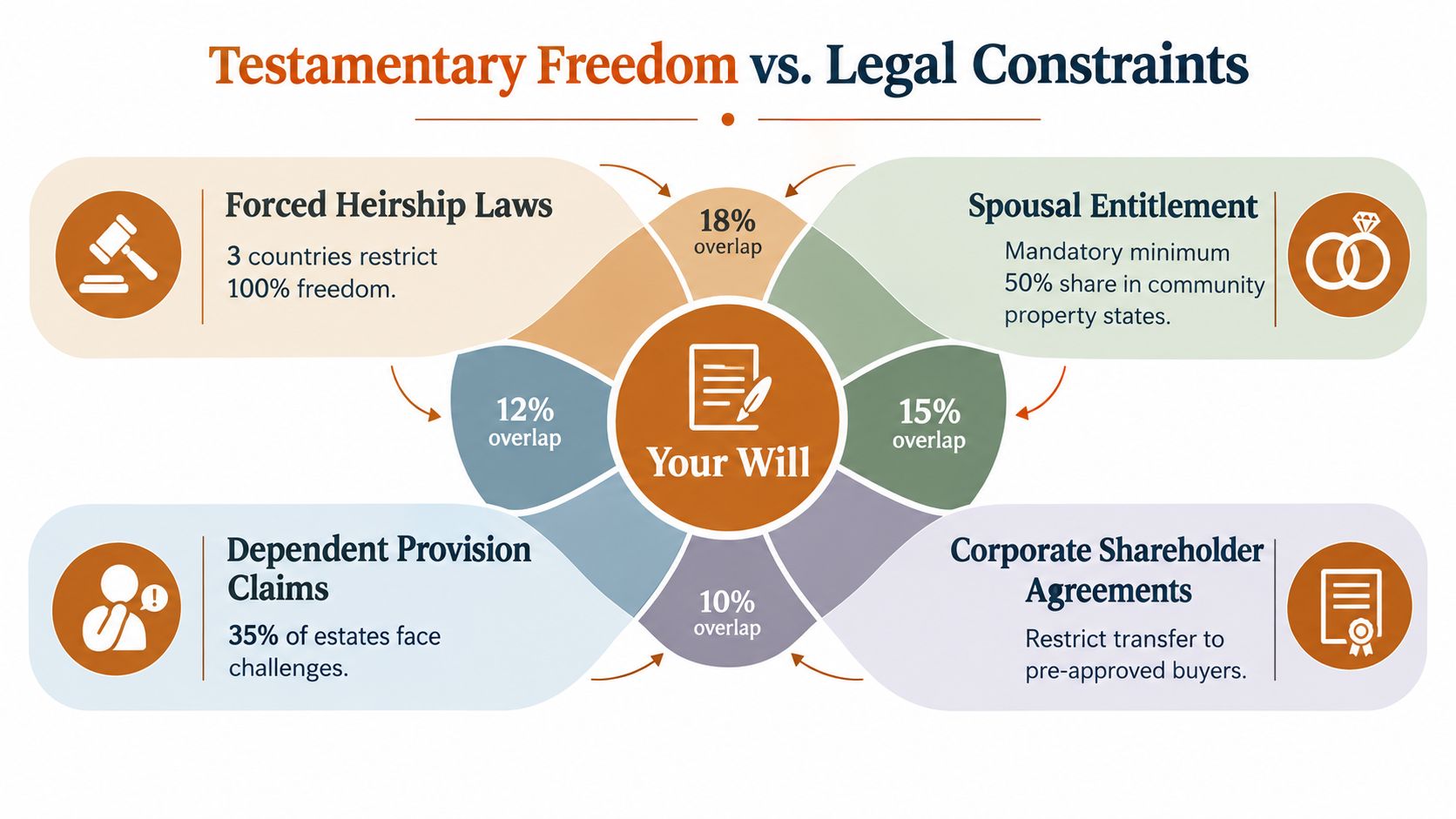
In a forced-heirship system, close relatives such as children, and sometimes a spouse, receive a legally protected portion of the estate. A will can’t defeat that reserved share. The ACTEC Foundation explanation of testamentary freedom and forced heirship describes the operational consequence: the free portion is the part the owner can allocate without triggering a compulsory-share claim.
That means the planning sequence matters. First calculate the protected portion. Then determine what remains available for discretionary gifts, business transfers, or equalization. If you reverse that order, you may promise more of the company than the law permits.
Cross-border owners face an even sharper contrast. A cross-national study found that in common-law countries, the average maximum share that could be left to a single child was 97.2% where there were two or three siblings and a surviving spouse. In civil-law countries, the comparable average was 57.8% with two siblings and 50.6% with three siblings (cross-national study of inheritance rules). Those figures don’t tell you what your local law will do, but they show why a succession plan that works in one jurisdiction can fail badly in another.
Suppose the law protects a spouse or child who won’t operate the company. The estate may need cash to satisfy that claim. If most of the estate consists of illiquid company shares, the executor may face pressure to sell shares, borrow against the business, or liquidate assets.
Your plan should therefore answer four separate questions:
A cross-border review should examine governing law, marital-property rules, local forced-heirship provisions, corporate transfer restrictions, and the location of each asset. A single will rarely resolves all of those issues.
Equal division sounds fair because it treats children alike. For an operating company, equal division can be financially reckless.
A restrictive inheritance regime can reduce the controlling heir’s wealth available for reinvestment and growth. Empirical work on family firms links stronger inheritance constraints to lower investment capacity, creating a direct connection between estate design and post-succession business performance (family-firm inheritance and investment analysis).
The mechanism is straightforward. The child who runs the company inherits an ownership interest, but siblings or other protected heirs also require value. If the business has little cash, the successor may borrow heavily, sell productive assets, reduce hiring, defer equipment purchases, or distribute profits that should have funded expansion.
Owners often say, “I want each child to receive the same.” That goal may be sensible for personal wealth, but it shouldn’t automatically dictate the ownership structure.
A company is a functioning system. It needs retained capital, clear authority, reliable banking relationships, and a leader who can act without asking every beneficiary for permission. Dividing voting shares equally can create deadlock. Dividing the business itself can duplicate overhead, split customers, and weaken negotiating power.
The better question is: what does each heir need to receive, and what must remain intact for the company to survive?
Consider using different asset classes to equalize outcomes. The operating child might receive voting shares and a defined salary. Other children might receive non-voting shares, investment assets, real estate, or insurance proceeds. A staged buyout can also convert a sibling’s ownership into a contractual payment without placing that sibling in day-to-day governance.
A family business isn’t a family bank account with employees attached. It needs an ownership design that respects both family value and commercial reality.
A buy-sell agreement can establish a purchase right or obligation when an owner dies. But the document won’t fund itself. The company and owners need to examine valuation methodology, payment terms, insurance availability, debt capacity, and the effect of the purchase on working capital.
Don’t assume a high valuation solves the problem. A higher value can increase the amount owed to non-operating heirs and intensify liquidity pressure. The plan must be tested against realistic cash flow, not just a balance-sheet estimate.
The recommendation is direct: protect the company’s reinvestment capacity before promising equal ownership. Economic fairness should be designed around what the business can fund.
Traditional estate plans were built around houses, bank accounts, paper records, and a family structure that lawyers could describe with simple labels. Your business may now depend on encrypted wallets, cloud platforms, proprietary software, customer databases, domain accounts, and authentication devices.
A 2026 global succession practice guide identifies digital assets and the legal recognition of non-traditional families as central planning issues, while a U.S. state-law review describes jurisdictions adding rules for digital wallets, virtual currency, and electronic wills (2026 global succession and estate-planning guide). The practical issue isn’t only who inherits an asset. It’s who can legally access, authenticate, administer, and transfer it.

A successor may inherit a company’s software subscription but lack the administrator credentials. A trustee may have authority over a digital wallet but not possess the recovery phrase. An executor may know that critical files exist but lack permission under the platform’s terms to retrieve them.
Create a controlled digital-asset register that identifies:
The register must be secured and updated. A list that contains only passwords is inadequate. Your attorney should coordinate access instructions with the trust, power of attorney, corporate resolutions, and employment or technology policies.
Blended families, unmarried partners, adopted children, stepchildren, dependents, and chosen family relationships can fall outside older beneficiary language. A phrase such as “my children” may not produce the result you expect in every jurisdiction or under every document.
Use names, legally accurate definitions, and alternate beneficiaries. Review retirement accounts, insurance policies, transfer-on-death registrations, and trust schedules together. A beneficiary form that conflicts with the trust or will can send value somewhere you didn’t intend.
Digital wealth and modern family arrangements turn succession into a cross-border access and compliance problem. Updating the will matters, but it isn’t enough. The operating plan must identify the person who can prove authority and keep the digital core of the company functioning.
Inheritance disputes in family businesses usually involve more than the stated argument about money. The deeper trigger may be control, recognition, unequal work, caregiving, or a sudden change in the owner’s intentions.
Recent commentary describes inheritance disputes as a direct threat to family-enterprise continuity, while reporting on Australia has connected contested-will activity and succession or probate filings with a growing court burden (recent inheritance-claim developments). The lesson for owners is uncomfortable: a large estate doesn’t prevent conflict. Ambiguity often creates it.
One dispute asks, “Was the distribution fair?” The other asks, “Who controls the company?” Those questions don’t need the same answer.
A child who worked in the business for years may deserve recognition for contribution. A child who provided caregiving may have a legitimate expectation of support. A spouse may need financial security. None of those facts automatically means every person should have equal voting authority over the company.
Use the ownership structure to separate benefits from decisions. The table below shows the trade-offs.
| Strategy | Impact on Business Control | Liquidity Requirement |
|---|---|---|
| Voting shares for operating successor | Concentrates decision-making with the person responsible for operations | Funding may be needed to equalize other heirs |
| Non-voting shares for other heirs | Preserves economic participation without routine voting power | Requires clear distribution and redemption terms |
| Buy-sell agreement | Creates a defined path for a partner, company, or approved buyer to acquire the interest | Requires valuation rules and a payment source |
| Life insurance for equalization | Provides cash outside the operating company for designated beneficiaries | Requires an appropriate policy, ownership structure, and review |
| Staged redemption | Converts an heir’s ownership into scheduled payments | Requires sustainable cash flow and default protections |
A governance plan should also define board appointments, dispute procedures, information rights, transfer restrictions, valuation dates, and what happens if an heir challenges the arrangement. Silence invites negotiation under pressure.
For owners dealing with a contested trust or unclear family expectations, this guide on clearing up Hawaii trust issues offers useful context on why documentation and administration can become litigation issues. The governing law will differ, but the operational principle travels well: unclear instructions create opportunity for whoever is willing to contest them.
A detailed succession planning guide for family-owned businesses can help you frame the conversation before a crisis. Hold the family meeting while you still control the process. Explain who will operate the company, how non-operating heirs will receive value, and why those choices protect both the family and the employees who depend on the business.
You don’t need to solve every estate issue in one meeting. You do need to identify the gaps that could interrupt control, access, or funding.
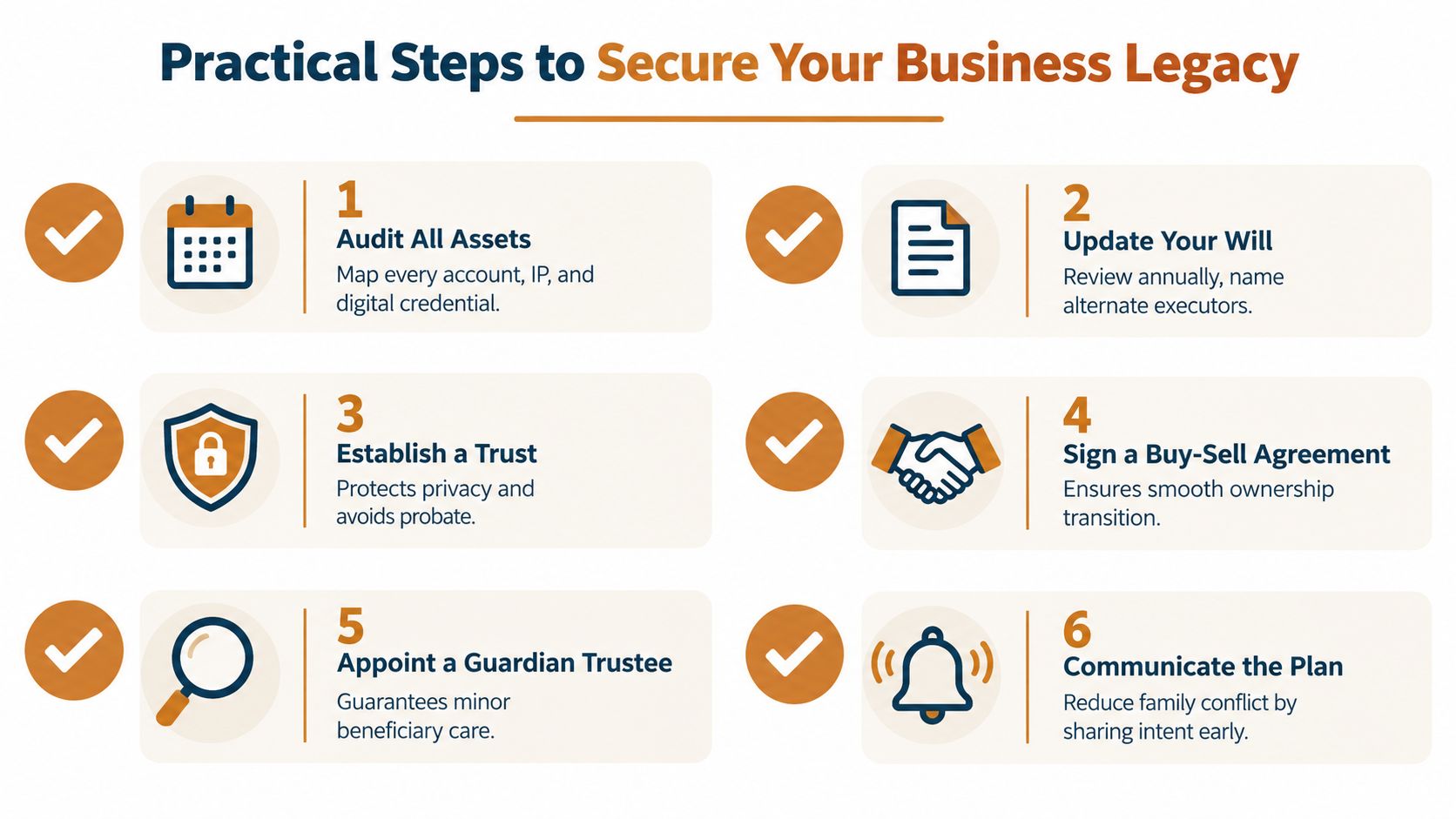
Map every asset and right. List shares, membership interests, intellectual property, bank accounts, insurance, real estate, loans, digital wallets, software accounts, and critical credentials. Identify the legal owner of each item.
Read the governing documents together. Compare your will, trust, beneficiary forms, shareholder agreement, operating agreement, bylaws, employment contracts, and loan documents. Look for conflicting transfer instructions or restrictions.
Name the operating successor. Choose the person who can lead the company, then document interim authority for incapacity and death. Ownership succession and management succession should be separate decisions.
Create the liquidity design. Work with your valuation and tax advisers to estimate the company’s value, determine what heirs need, and choose a funding method. Consider insurance, staged payments, redemption, or assets outside the company.
Document digital authority. Maintain a secure register of systems, access methods, recovery procedures, and legal permissions. Give the successor trustee or authorized executive a practical route to authenticate access.
Communicate and test the plan. Explain the structure to the people affected by it. Ask your attorney to run a death, incapacity, family challenge, and co-owner scenario against the documents.
A specialist team should include an estate attorney, corporate attorney, valuation professional, tax adviser, and insurance or financing adviser where appropriate. You need people who understand not only probate, but also voting control, working capital, business valuation, and the consequences of forced ownership transfers.
Use this business succession planning checklist as a working document, then take the completed inventory to qualified advisers. Don’t wait for a valuation dispute or family emergency to discover that your documents describe a distribution but not a functioning company.
This video provides another practical format for reviewing succession planning decisions:
Your objective is not to eliminate every difficult emotion. It is to remove avoidable uncertainty. A strong plan tells the family who receives value, who holds control, who manages the company, how protected claims are funded, and how the business keeps operating while the estate is administered.
The Owner’s Shortlist connects business owners with vetted specialists across legal and estate planning, valuation, taxes, financing, and succession, and it publishes practical guides to clarify decisions before an engagement. Visit The Owner’s Shortlist to review the succession resources and find an adviser suited to your company’s ownership and family circumstances.
Tell us your situation. We'll connect you with a specialist who works with owners like you. One conversation, no sales pressure.
Found this useful?
Add The Owner's Shortlist as a preferred source and get our articles highlighted in Google Search results.
Add to Preferred SourcesLearn how succession of business works, from choosing a pathway to timing the handoff. A clear guide for owners planning their next chapter.
September 20, 2026
Plain-language estate planning wills and trusts guide for business owners covering definitions, tax implications, and questions to ask attorneys.
September 18, 2026
Learn company ownership transfer options, valuation, taxes and timing. Compare sale, gift, succession and ESOP paths with checklists.
September 17, 2026
A practical roadmap for succession planning for small business owners — readiness, exit options, valuation, legal prep, and a working timeline.
September 15, 2026