Family Inheritance Law for Business Owners
Navigate family inheritance law for your business. Learn how to structure succession, avoid family disputes, and protect your company's future value.
September 25, 2026
By Remi Taffin · August 21, 2026
A succession plan can exist on paper and still leave a family business exposed. Deloitte’s 2026 global report found that 82% of family businesses have some form of succession plan, but only 46% describe it as broad and well-developed (Deloitte Private’s family-business succession report). The uncomfortable question isn’t which child should take over. It’s whether any family member should lead at all.
That decision deserves a disciplined process. Family continuity may be right, but so might a professional CEO, a partial sale, or a complete exit. The owner’s objectives, the next generation’s capability and interest, the company’s trajectory, and its capital needs should decide the path, not birth order or family pressure.
Family-business succession fails less often because owners lack affection for their companies than because they confuse intention with preparation. Independent family-business literature commonly cites survival of roughly 30% to the second generation, 12% to the third, and 3% to the fourth (family-business succession research summary). Another summary places successful transition at 33% to the second generation and 13% to the third (IIDM Global summary of family-business succession findings). The exact benchmark varies by study and definition, but the direction is clear. Each handover tests the business more severely than the last.
Owners should plan against a five- to ten-year runway, not a retirement date that arrives suddenly. That period gives the company time to assess successors, document operating knowledge, develop governance, resolve ownership questions, and test whether the proposed leader can perform without the founder’s constant intervention.
| Generation | Survival Rate | Typical Planning Horizon |
|---|---|---|
| Second generation | Roughly 30% to 33% | Five to ten years before transfer |
| Third generation | Roughly 12% to 13% | Five to ten years before transfer |
| Fourth generation | Roughly 3% | Five to ten years before transfer |
The cost of waiting appears in several forms:
A 2026 Deloitte Private report says 40% of family businesses are already undergoing or expect leadership succession within the next 10 years, so this isn’t a distant concern for a small group of owners (Deloitte Private succession findings).
Practical rule: A succession plan should protect four things at once: family wealth, key employees, family relationships, and the founder’s next chapter.
A properly designed plan defines how the owner will fund life after the handover, how the company will retain critical people, how relatives will make decisions, and what the founder will do once operational authority changes. Start with those outcomes before discussing names.
Naming a successor too early creates a trap. Once one child is announced, every later assessment can look like an attempt to justify or undermine that choice. Begin with the owner’s destination, then judge every transition option against it.
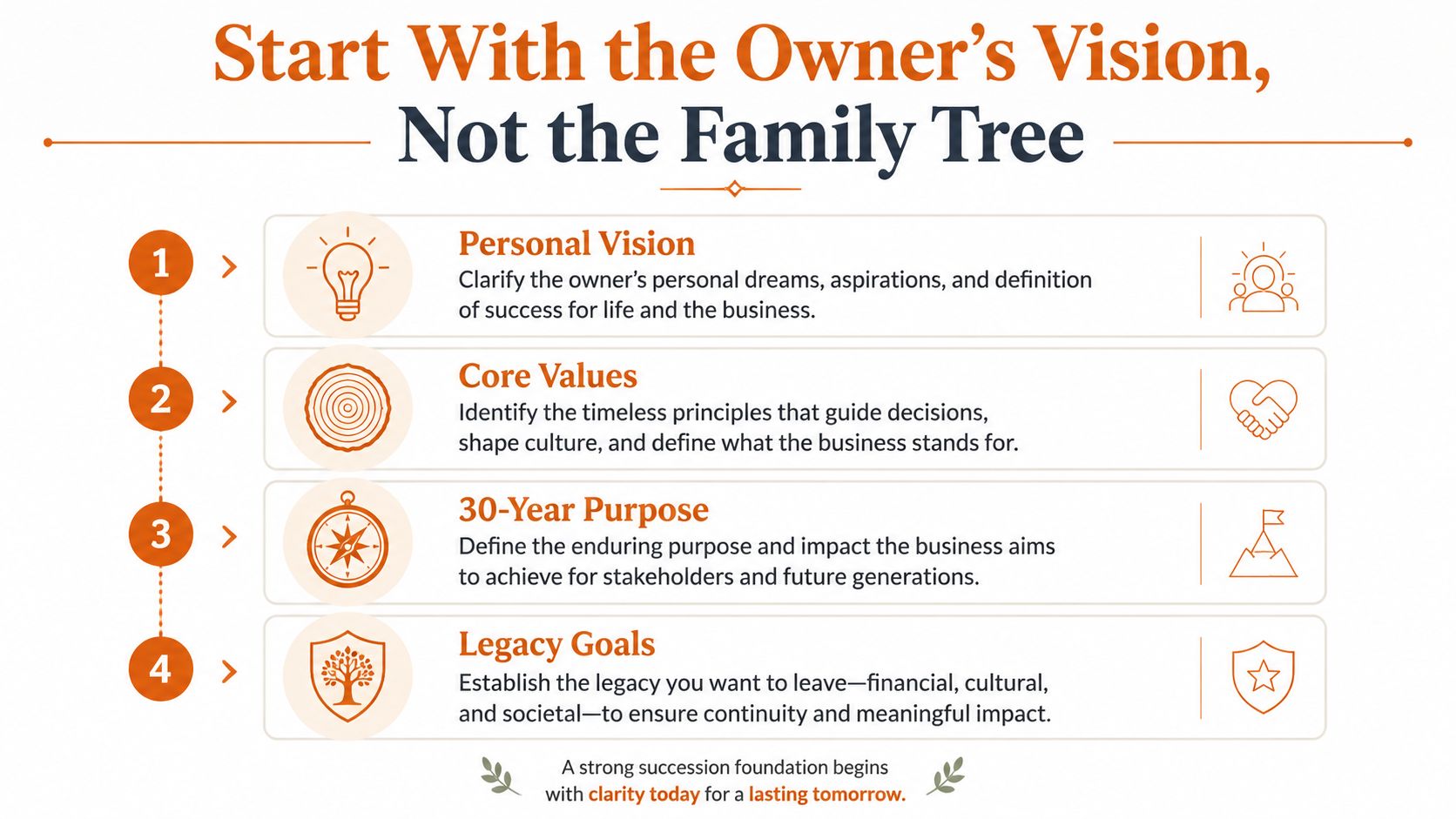
Write down what you want your involvement to look like in five, ten, and twenty years. Don’t use vague phrases such as “I’ll stay available.” Specify whether you want a board role, a consulting arrangement, a fixed income, occasional customer contact, or no operating involvement.
Your personal vision should address three separate issues:
That last question exposes weak plans quickly. A founder who wants retirement but retains veto power over hiring, pricing, and investment hasn’t completed a handover.
Set out the company’s desired direction without attaching it to a relative. Consider its markets, operating scale, workforce, risk tolerance, and capital requirements. Decide whether independence matters more than expansion, whether consolidation could strengthen the company, and whether an eventual sale should remain open.
Then record the values that are essential. These may include treatment of customers, loyalty to employees, quality standards, community involvement, or a craft tradition. Separate values from habits. “We’ve always done it this way” isn’t automatically a principle worth preserving.
Most owners want several outcomes that can’t all be maximized simultaneously. A family may want equal treatment among children, continued family control, strong dividends, reinvestment, charitable giving, and the highest possible sale value. Those objectives need an order of priority.
Create a simple matrix and rank each objective as essential, important, or negotiable. Include income continuity, legacy preservation, charitable intent, fairness among heirs, and maximum value. The matrix won’t remove difficult choices, but it will make the trade-offs visible.
Finish with a one-page founder vision document. Sign and date it, share it with the appropriate advisers and family members, and revisit it annually. This document should guide the successor conversation, not serve as a ceremonial statement after the decision has already been made.
A child can be loyal, capable, and committed to the family yet still be the wrong operating leader. Deloitte’s survey of family-owned enterprises identifies lack of next-generation interest, unclear selection criteria, and leadership skill gaps as leading succession hurdles. Treat those findings as decision inputs. Do not pressure a relative into inheriting a role that does not fit.
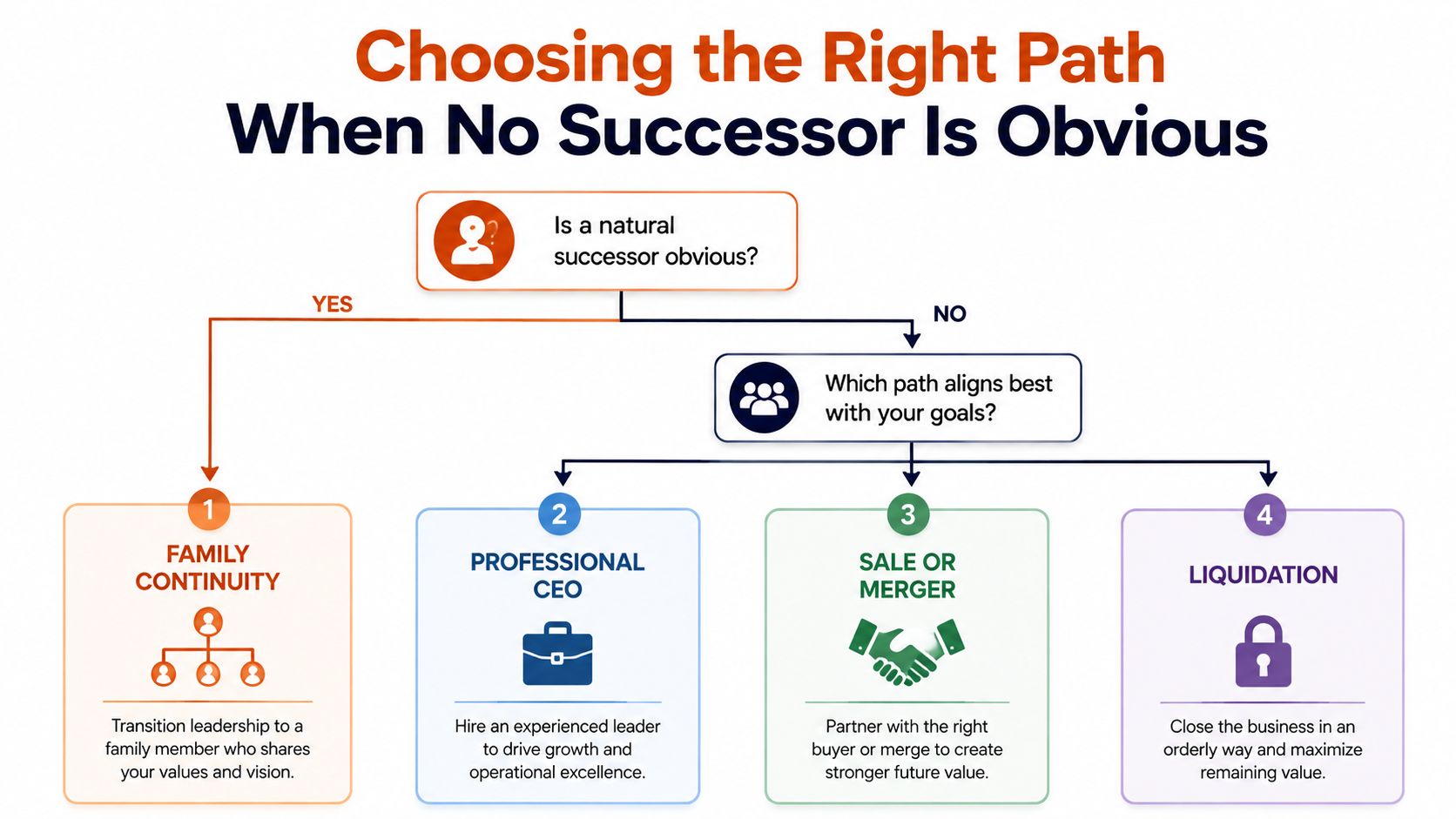
Choose family continuity only when at least one relative has both the capability and the desire to lead. Capability includes judgment, employee credibility, financial discipline, and the willingness to make unpopular decisions, not just technical knowledge or family loyalty.
The structure may involve one successor, sibling co-leadership, or a cousin consortium. Shared leadership requires written decision rights, individual accountability, and a process for resolving deadlocks. Do not create co-leadership to protect feelings.
A non-family CEO fits when relatives want ownership and distributions but do not want operating responsibility. Set this up only if the board has genuine authority, family employment rules are written, and the CEO can assess relatives without informal interference.
KPMG’s 2026 global family-business report recommends formal family employment policies, outside work experience before senior family roles, and mentoring structures. Deloitte’s survey records formal education, on-the-job training, and mentorship among common preparation methods. Use those practices to test readiness, not to manufacture it.
A minority recapitalization, employee ownership arrangement, or strategic partnership can provide liquidity while preserving some family influence. Owners considering an employee transition can review selling a business to employees before appointing specialist advisers.
This route suits an owner who wants to reduce concentration risk without leaving immediately. Define control rights, future funding obligations, minority protections, and the incoming partner’s responsibilities before signing. A partial sale can preserve continuity, but it also limits the family’s freedom to make future decisions alone.
A strategic sale or private-equity transaction may be the cleanest choice when no family member is ready, the owner needs liquidity, or the company requires capital and capabilities the family cannot provide. Review valuation methods, earn-out conditions, debt, warranties, and the founder’s post-sale role. A high headline valuation can produce a poor result when the earn-out depends on authority the founder no longer controls.
Score every route against owner objectives, family readiness, business performance trajectory, and capital needs. If none works, repair the business before asking anyone to inherit its risks. Address customer concentration, weak management, poor documentation, or fragile relationships first. The right successor may be a relative, a professional executive, an employee group, or a buyer. Family ownership is an option, not an obligation.
Governance is what prevents family emotion from becoming operating policy. It gives relatives a place to discuss values and ownership without turning every disagreement into a management crisis.
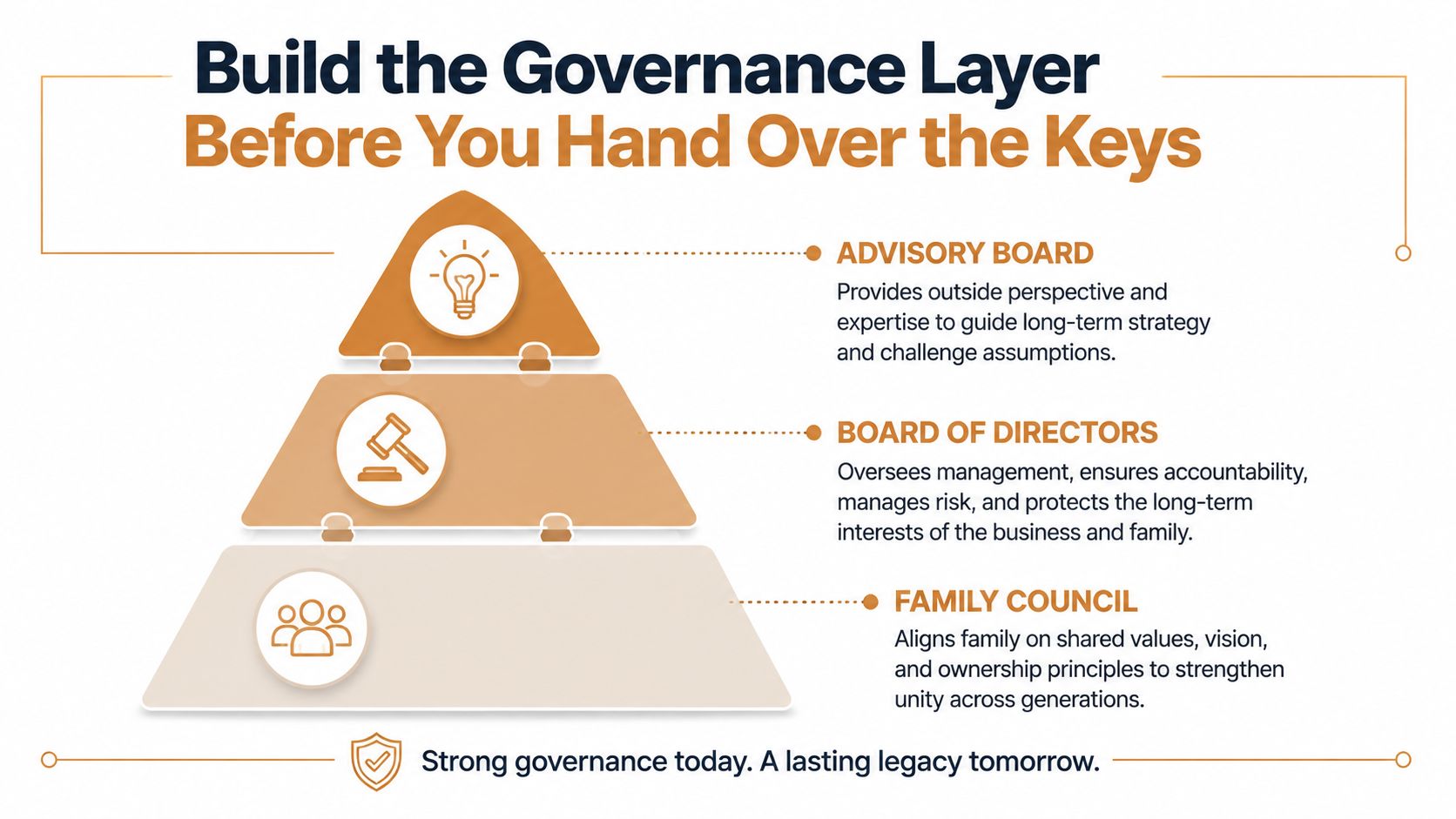
A family council should handle family-level questions, including shared values, ownership education, next-generation development, and communication. Meet regularly, ideally on a predictable quarterly schedule, and keep operational decisions out of the room unless they affect family policy.
A board of directors should oversee strategy, risk, the CEO, and capital allocation. Include independent members who have no family loyalty to protect. Independence matters most when the board must challenge the founder, remove an underperforming family executive, or reject a distribution that threatens the business.
An advisory board can add specialist knowledge before the company is ready for a formal board. Its value depends on candid discussion and access to accurate financial and operational information. An advisory board that merely confirms the owner’s preferences is decoration.
The shareholders’ agreement should address voting rights, transfer restrictions, dispute resolution, and the circumstances under which an owner can exit. It should also deal with tag-along and drag-along rights where appropriate, so a minority holder isn’t trapped or a sale isn’t blocked by one shareholder acting alone.
The agreement must match the will, trust documents, articles, and financing arrangements. A provision that works in isolation can fail when it conflicts with inheritance instructions or lender requirements.
Relatives shouldn’t receive jobs because they own shares, and shareholders shouldn’t receive management salaries merely because they’re family. Create written qualifications, probation requirements, performance reviews conducted by non-family managers, and clear reporting lines.
Compensation should distinguish salary for work from dividends for ownership. The family member who runs operations gets paid for that role. A passive shareholder receives distributions according to the ownership structure. Mixing those payments creates resentment on both sides and makes performance impossible to judge.
Governance lets the owner step back without forcing the business to drift.
Tax and legal planning should start while the owner can still change the structure. Begin with an independent appraisal that establishes a defensible value. The valuation date affects the transfer, funding needs, ownership discussions, and the evidence advisers rely on to support the transaction.
Coordinate the appraisal with the owner’s tax and legal advisers before the intended transfer. Owners can compare specialist options through a business appraisal service while assembling financial records, contracts, customer data, and operational information for the appraiser.
An estate freeze separates the company’s established value from its future growth. In a common structure, the owner exchanges existing common equity for preferred shares with defined rights. New growth-oriented shares then allocate future appreciation to the next generation.
This structure can limit the value transferred later, but it requires specific advice. The owner may surrender some growth participation, voting control, or flexibility. Tax authorities may also scrutinize valuations and transactions that lack genuine economic terms.
A buy-sell agreement works only when the buyer can meet the obligation. Life insurance can provide liquidity after a death, while term coverage may fit a defined period. A sinking fund or reserve offers another option, though disciplined cash allocation can compete with reinvestment.
Test the funding against a sudden death, disability, business downturn, and delayed payment. Confirm whether surviving owners can meet the obligation without cutting necessary investment or destabilizing payroll.
Do not approve the agreement until the funding plan works under pressure.
Review beneficiary designations, executor appointments, trusts, operating agreements, shareholder agreements, and buy-sell provisions together. The executor must understand the business well enough to follow the governing documents, preserve continuity, and distinguish company assets from personal estate property.
| Tool | Primary Purpose | Best Used When | Owner Trade-off |
|---|---|---|---|
| Independent valuation | Establish defensible business value | Before a transfer, recapitalization, or sale | Costs money and may challenge expectations |
| Estate freeze | Separate current value from future appreciation | When ownership and growth will shift | May reduce control or future upside |
| Buy-sell agreement | Define exit and transfer mechanics | Before death, disability, or shareholder conflict | Can restrict flexibility |
| Life insurance or reserves | Fund a purchase obligation | When heirs or co-owners need liquidity | Premiums or reserved cash reduce available resources |
| Updated will and beneficiary designations | Coordinate estate distribution | Whenever ownership or family circumstances change | Requires continuing review |
Use this sequence: valuation, estate-freeze analysis, shareholders’ agreement amendments, then funding instruments. A lawyer and tax adviser should test the full arrangement against the owner’s objectives and the company’s actual legal structure. That review should also clarify whether family continuity remains workable, whether professional management is needed, or whether an outside sale is the cleaner outcome. The right answer depends on value, control, funding, and the successor’s actual readiness, not family expectations.
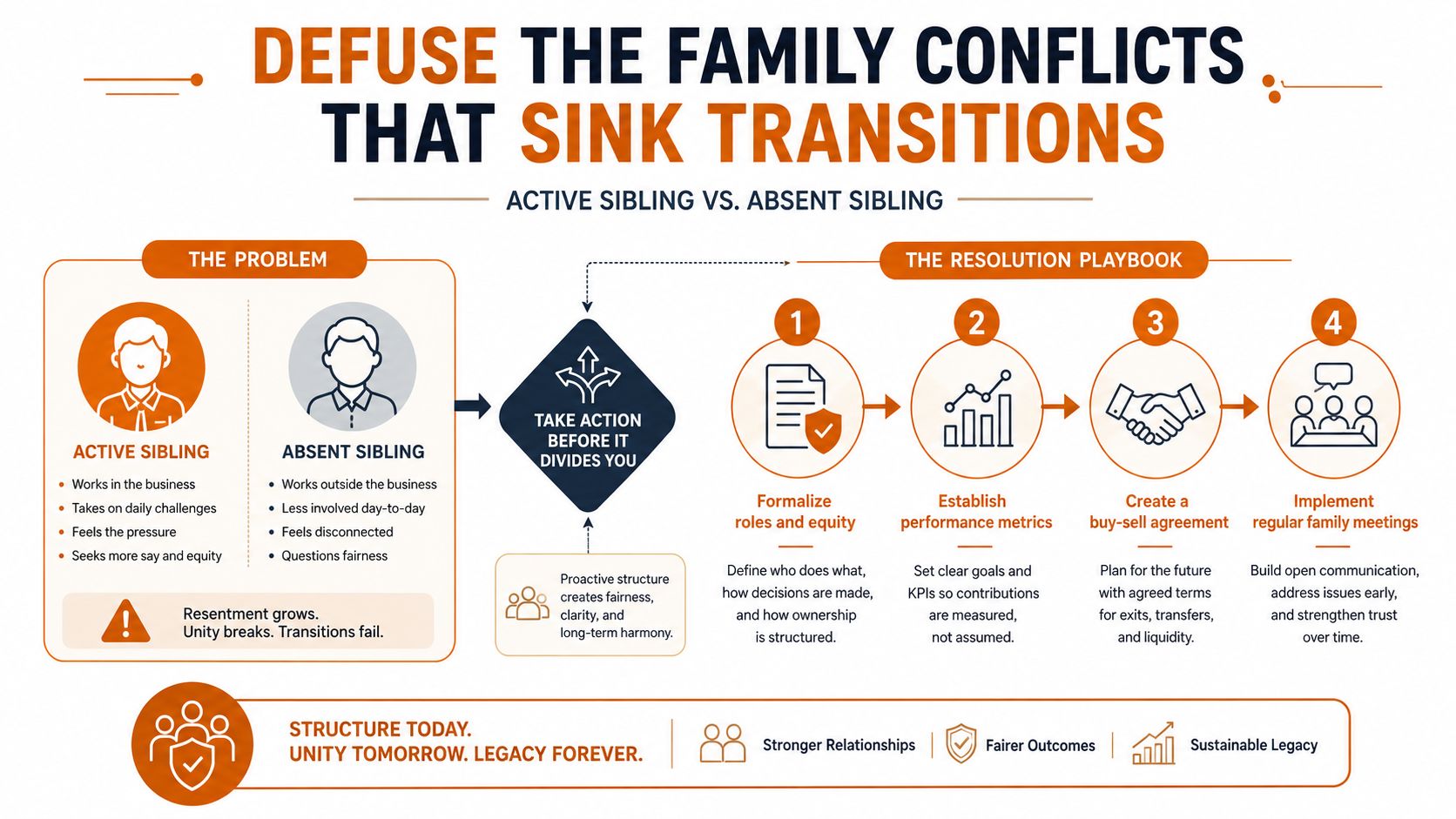
The most dangerous family-business conflict often begins with an apparently fair rule: everyone receives the same. Equal ownership can be appropriate. Equal authority, equal pay, and equal influence are different questions.
The classic example is the active sibling versus the absent sibling. One sibling works long hours, carries operational risk, and builds the company, while another expects equal returns without taking the same role. Solve this with written job descriptions, role grading, market-based compensation, and equity arrangements that reflect contribution where the family has agreed that contribution should matter.
Founders often announce a handover but retain informal authority. The successor carries the title while employees still seek the founder’s approval. That arrangement undermines the new leader and keeps the company dependent on one person.
Use a defined transition period, with a written end date for operational authority. During the handover, the founder can mentor, introduce relationships, and transfer institutional knowledge. Afterward, the founder should operate within the agreed board or advisory role, not issue private instructions to staff.
Shares should follow ownership arrangements and documented contributions, not marriage. In-laws may be capable and valuable employees, but their employment should meet the same standards applied to other relatives. Voting influence should come from legally defined ownership, not informal family alliances.
A written employment policy should address hiring, reporting relationships, promotion, termination, conflicts of interest, and access to confidential information. It should apply before a dispute occurs, not be drafted as a weapon against one particular relative.
A monthly family-business update can give relatives consistent information about performance, strategy, and major decisions. An annual off-site meeting with a paid facilitator can create room for harder topics, including ownership fairness, founder retirement, and the future of inactive shareholders.
Keep a neutral mediator on retainer before the family needs one. Mediation works better when the participants still have room to trust one another. Formal decision rights should identify what the next leader can decide alone, what requires board approval, what belongs to the family council, and what requires a shareholder vote.
Conflict protocol: Put the decision process in writing while relatives still agree that the family relationship matters more than winning the argument.
Owners should also align these rules with their estate documents. A specialist guide to estate planning for business owners can help identify where wills, ownership, and operating documents may pull in different directions.
A first-year plan should produce evidence, decisions, and accountability. It should also test a harder premise: whether the family wants, can lead, or should own the business. Family continuity is one option, alongside professional management, a partial sale, or a full exit.
Months one and two: Write the founder vision document. Set out personal income needs, desired involvement, business direction, values, and ranked objectives. State the conditions under which you would retain ownership, transfer control, or sell.
Months three and four: Assess potential successors against capability, interest, experience, judgment, and credibility. Speak with each candidate directly, then choose the route that fits the evidence. Do not treat inheritance as a leadership qualification.
Months five and six: Design the operating structure for the transition. Confirm the board or advisory group, family council, employment policy, compensation rules, reporting lines, and decision rights. Record who can decide alone and who needs approval.
Months seven through nine: Engage valuation, tax, legal, and insurance professionals. Review the ownership structure, will, beneficiary designations, buy-sell terms, and funding capacity as one plan. A document that works in isolation can still fail when these pieces interact.
Months ten and eleven: Present the proposed plan to affected family members and key executives. Explain the decision criteria, selected route, responsibilities, and unresolved issues. Set meeting routines and escalation procedures, and confirm how disputes will be handled.
Month twelve: Finalize the documents, obtain adviser sign-off, assign an owner to every action, and set the next formal review date. Put the contingency plan in the same file, not in someone’s memory.
How do I start with resistant relatives? Begin with business continuity and each person’s legitimate interests. Ask relatives to review the decision criteria before you announce a preferred path.
What if the chosen successor quits? Define interim management authority and keep a current list of internal and external candidates. A successor plan without a replacement process leaves the company exposed.
How often should we revisit the plan? Review it annually and after major changes in ownership, health, family relationships, financing, or business direction.
When does life insurance make sense? Consider it when a death would create a defined purchase obligation or liquidity need that the company and surviving owners cannot comfortably fund from cash flow.
Is a phased transfer better than a lump-sum handover? It can test leadership and preserve knowledge. Use it only when each transfer of authority has a documented date and scope.
How should we handle in-laws? Apply the same employment, performance, ownership, and voting rules to every participant. Marriage should not create an undocumented governance role.
The Owner’s Shortlist connects business owners with specialists in valuation, tax, legal and estate matters, financing, succession, and family ownership decisions. Visit The Owner’s Shortlist to clarify your options before engaging advisers to put the plan into effect.
Tell us your situation. We'll connect you with a specialist who works with owners like you. One conversation, no sales pressure.
Found this useful?
Add The Owner's Shortlist as a preferred source and get our articles highlighted in Google Search results.
Add to Preferred SourcesNavigate family inheritance law for your business. Learn how to structure succession, avoid family disputes, and protect your company's future value.
September 25, 2026
Learn how succession of business works, from choosing a pathway to timing the handoff. A clear guide for owners planning their next chapter.
September 20, 2026
Plain-language estate planning wills and trusts guide for business owners covering definitions, tax implications, and questions to ask attorneys.
September 18, 2026
Learn company ownership transfer options, valuation, taxes and timing. Compare sale, gift, succession and ESOP paths with checklists.
September 17, 2026